

ICSE Solutions Selina Concise Class 7 History Civics Chapter 5 Government Society and Culture Under The Delhi Sultanate have been provided below and is also available in Pdf for free download. The Selina Concise ICSE solutions for Class 7 History Civics have been prepared as per the latest syllabus and ICSE books and examination pattern suggested in Class 7. Questions given in ICSE Selina Concise book for Class 7 History Civics are an important part of exams for Class 7 History Civics and if answered properly can help you to get higher marks. Refer to more Chapter-wise answers for ICSE Class 7 History Civics and also download more latest study material for all subjects. Chapter 5 Government Society and Culture Under The Delhi Sultanate is an important topic in Class 7, please refer to answers provided below to help you score better in exams
Selina Concise Chapter 5 Government Society and Culture Under The Delhi Sultanate Class 7 History Civics ICSE Solutions
Class 7 History Civics students should refer to the following ICSE questions with answers for Chapter 5 Government Society and Culture Under The Delhi Sultanate in Class 7. These ICSE Solutions with answers for Class 7 History Civics will come in exams and help you to score good marks
Chapter 5 Government Society and Culture Under The Delhi Sultanate Selina Concise ICSE Solutions Class 7 History Civics
Government, Society and Culture Under The Delhi Sultanate
Important Words
- Qazis were judges who decided cases involving Muslims according to Islamic laws.
- Amir Khusrau was a well-known Persian poet who created the Indian sitar.
- Qawwali is a Persian style of group singing that was made popular by Sufi saints.
- Kathak is a dance style that began in the Sultanate era. It blends Hindu stories with Persian outfits.
Time To Learn
I. Fill in the blanks:
Question 1. The village administration was managed by __________.
Answer: Muqaddam
In simple words: The leader who looked after the village affairs was called the Muqaddam.
Exam Tip: Remember the spelling of "Muqaddam" as it is a key administrative term.
Question 2. Firoz Shah Tughlaq made the _________ system hereditary.
Answer: Iqtdary
In simple words: Firoz Shah Tughlaq made sure that when an Iqta holder died, his son would get the land.
Exam Tip: Iqtdary system is also spelled as 'Iqtadari' in some textbooks, but follow your book's spelling.
Question 3. _________ received Iqtas.
Answer: Iqtdar
In simple words: The officer who got a piece of land from the king was called an Iqtdar.
Exam Tip: An Iqtdar was the governor or military commander who got land grants called Iqtas.
Question 4. _________ arranged irrigation facilities for the farmers.
Answer: Firoz Shah Tughlaq
In simple words: This ruler built canals and wells to bring water to the fields for farming.
Exam Tip: Firoz Shah Tughlaq is well-known for his public welfare works, especially building canals for watering fields.
Question 5. The mixture of Persian and Hindu style in architecture is called _________ style.
Answer: Indo-Islamic
In simple words: When builders mixed Persian designs with Indian styles, they made a new look called Indo-Islamic.
Exam Tip: Indo-Islamic style is a major feature of building design during the Sultanate era.
Question. Match Column A with Column B:
| Column A | Column B |
|---|---|
| 1. Qazi | (a) Historian |
| 2. Tughlaqabad Fort | (b) Qutub-ud-din Aibak |
| 3. Qutab Minar | (c) Delhi |
| 4. Urdu | (d) Great poet of Persian and Hindi |
| 5. Minhaj-us-Siraj | (e) Chief Justice |
| 6. Amir Khusrau | (f) Camp |
Answer:
| Column A | Column B |
|---|---|
| 1. Qazi | (e) Chief Justice |
| 2. Tughlaqabad Fort | (c) Delhi |
| 3. Qutab Minar | (b) Qutub-ud-din Aibak |
| 4. Urdu | (f) Camp |
| 5. Minhaj-us-Siraj | (a) Historian |
| 6. Amir Khusrau | (d) Great poet of Persian and Hindi |
In simple words: This table links important names, places, and terms from the Delhi Sultanate with their correct meanings or founders.
Exam Tip: Be sure to pair the historical figures correctly with their roles, such as Qazi with justice and Amir Khusrau with poetry.
III. State whether the following statements are True or False:
Question 1. Urdu, a new language, developed in the Sultanate period.
Answer: True
In simple words: Yes, Urdu was a new language that grew during this time.
Exam Tip: Urdu was born in military camps as a mix of Persian, Hindi, and other languages.
Question 2. The Sufi saints believed in one God.
Answer: False
In simple words: The book marks this statement as false.
Exam Tip: Follow the specific true/false answers from your school textbook to secure maximum marks.
Question 3. The Sultanate was a military rule.
Answer: True
In simple words: The Sultan ruled with the help of a strong army.
Exam Tip: The power of the Sultan was based on his army, which is why it was a military rule.
Question 4. The village administration was managed by the Bakshi.
Answer: False (The village administration was managed by the Muqaddam.)
In simple words: The Muqaddam, not the Bakshi, was in charge of running the village.
Exam Tip: Make sure you know the roles of different officials, like Muqaddam for villages.
Question 5. The culture of the sultanate period saw healthy blending of Hindu and Muslim traditions.
Answer: True
In simple words: During this time, Hindu and Muslim ideas mixed well in music, buildings, and food.
Exam Tip: This mixture of styles is often called the 'Indo-Islamic' culture.
IV. Answer the following questions briefly:
Question 1. How did the government function during the Sultanate Period?
Answer: The Sultanate government worked through different departments. A minister or a senior officer looked after each division. The most important departments were:
1. Diwan-i-wazarat: This was the tax and money department. It was led by the chief minister, who was known as the Wazir.
2. Diwan-i-Arz: This was the army department. It was led by the Ariz-i-Mumalik. This office had the job of hiring, training, and paying the soldiers.
3. Diwan-i-Risalat: This department handled religious work and gave money to teachers and holy sites. It was run by the Chief Sadr, who was also the Chief Qazi. This official was the head of the law and justice division.
4. Diwan-i-Insha: This department sent and received all letters inside and outside the country. At the local level, the Muqaddam ran the village affairs. The Munsif checked the money books, and the Patwari wrote down all village details.
In simple words: The Sultanate was run by different departments for money, the army, religion, and letters. Each had its own chief officer.
Exam Tip: Be sure to write down the names of all four major departments and their respective heads to get full marks.
Question 2. What do you understand by Iqta system? How was this system organised?
Answer: Instead of paying officers in cash, the Sultan gave them land or villages to collect taxes from. This was the Iqta system. The officer, called an iqtadar, collected taxes from his area (the iqta). From this money, he kept his own salary. He used another portion to keep soldiers ready for the Sultan. The iqtadar also sent a set amount of money to the Sultan every year. He had to write down every coin he got and spent.
In simple words: In the Iqta system, officers were paid with land instead of cash. They collected taxes from their land, paid themselves and their soldiers, and sent some money to the king.
Exam Tip: Define the terms 'Iqta' and 'Iqtadar' clearly and list the duties of the officer, such as maintaining soldiers and keeping accounts.
Question 3. How was society divided during the Sultanate period?
Answer: Society was divided into four main groups during this period. The first group was the aristocracy, which held the most power. This included nobles and big officers who were very wealthy and lived in luxury. The second group had Muslim Ulemas and Hindu priests. They guided the ruler on running the state according to religious laws. The third group was the town people, which had lower officers, traders, and craft workers who were quite comfortable. The last group was the poor farmers and common people, who made up most of the population and struggled to meet their daily needs.
In simple words: People were split into four groups: rich nobles, religious leaders, comfortable town traders, and very poor farmers.
Exam Tip: List the four classes in order from top to bottom - nobles, priests, townspeople, and farmers - and briefly state their living conditions.
Question 4. Describe the important developments which took place in the following fields during the Sultanate period (a) Language (b) Music and (c) Dance.
Answer:
(a) Language: Persian was used for government work and by the nobles. Arabic was used by merchants from West Asia. Sanskrit stayed as the language of study for Hindus. Combining Persian and Hindi led to the birth of Urdu. The name Urdu means camp. Soldiers from different places used this language to talk to one another in their camps.
(b) Music: Mixing Persian-Arabic styles with Indian classical music created Hindustani music. New instruments like the sitar, tabla, and sarangi were made during this period. The Persian style of group singing, called qawwali, also became very popular.
(c) Dance: A dance form called Kathak started during the Sultanate years. This dance style puts Hindu stories together with Persian-style dresses.
In simple words: During this time, Urdu was born in military camps. Hindustani music grew using new instruments like the sitar, and Kathak dance combined Hindu and Persian ideas.
Exam Tip: Address each section (a, b, and c) separately using clear headings, and highlight key terms like Urdu, Hindustani music, and Kathak.
Question 5. With examples explain how the Turks and the Arabs influenced the architecture of the Sultanate period.
Answer: Sultanate buildings are known for using bricks, arches, domes, beams, and balconies. While Turkish structures were quite simple, they used many flower shapes and geometric designs. Red sandstone made these buildings look colorful. Builders also carved holy words from the Quran onto the walls. Examples of key buildings from this era are the Qutub Minar, the Alai Darwaza, the tomb of Ghiyasuddin Tughlaq, Firoz Shah Kotla, Tughlaqabad Fort, and the Lodi tombs.
In simple words: Builders during this era used arches, domes, and red sandstone. They decorated buildings with flower patterns and lines instead of human figures.
Exam Tip: Mention structural elements like arches and domes, and list at least two famous monuments as examples to score full marks.
Question. Picture study: This is a picture of a popular form of devotional music.
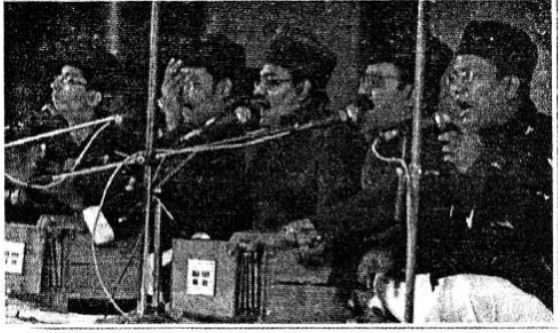
(i) What is the name of this form of music?
(ii) Name the famous personality who created this.
(iii) What is the theme of the music?
Answer:
(i) This style of music is called Qawwali.
(ii) The famous poet Amir Khusrau is credited with creating it.
(iii) Its main theme is the Ghazal, which merges beautiful poetry with sweet melodies.
In simple words: This picture shows Qawwali, a type of religious singing made by Amir Khusrau that combines poetry and tunes.
Exam Tip: Qawwali was sung by Sufi saints at their gatherings to express love for God.
A. Fill in the blanks:
Question 1. The rule of the Delhi Sultans lasted for over _________ centuries.
Answer: three
In simple words: The Delhi Sultans ruled India for more than three hundred years.
Exam Tip: "Three centuries" is equal to 300 years, running from 1206 to 1526 CE.
Question 2. Society during the Sultanate period was divided into _________ major groups.
Answer: four
In simple words: People in the community were grouped into four main classes.
Exam Tip: Recall the four groups: nobles, priests, townspeople, and common peasants.
Question 3. The Turks introduced _________ and _________ architectural styles.
Answer: Arabic, Persian
In simple words: The Turkish rulers brought building styles from Arabia and Persia to India.
Exam Tip: The combination of Turkish and Indian building styles created the Indo-Islamic style.
Question 4. New musical instruments such as the _________, _________ and _________ were developed during the Sultanate period.
Answer: tabla, sitar, sarangi
In simple words: Musicians during this era invented the sitar, tabla, and sarangi.
Exam Tip: Ensure you remember all three instruments as they are frequently asked in short-answer questions.
Question 5. The establishment of the Turkish rule in India led to the replacement of _________ by _________ as the official language in many regions.
Answer: Sanskrit, Persian
In simple words: Under Turkish rule, Persian became the main language for court work, replacing Sanskrit.
Exam Tip: Sanskrit was the traditional language of high learning, which was replaced by Persian in royal administration.
Question. Match the following:
| Column A | Column B |
|---|---|
| 1. The ulemas | (a) Qutb Minar |
| 2. Alai Darwaza | (b) chorus singing |
| 3. Qawwali | (c) combines Hindu themes with Persian costumes |
| 4. Kathak | (d) a system of medicine which was a legacy of Turkish rule |
| 5. Yunani | (e) Muslim religious leaders |
Answer:
| Column A | Column B |
|---|---|
| 1. The ulemas | (e) Muslim religious leaders |
| 2. Alai Darwaza | (a) Qutb Minar |
| 3. Qawwali | (b) chorus singing |
| 4. Kathak | (c) combines Hindu themes with Persian costumes |
| 5. Yunani | (d) a system of medicine which was a legacy of Turkish rule |
In simple words: This match links different religious, architectural, musical, and medical terms with their meanings.Exam Tip: Remember that the Alai Darwaza is the entrance gateway to the Qutb Minar complex.
C. Choose the correct answer:
Question 1. Under the Delhi Sultanate, the _________ were the most powerful class in society.
(a) aristocrats
(b) priests
(c) peasants
Answer: (a) aristocrats
In simple words: The rich and powerful nobles held the highest position in society.
Exam Tip: Aristocrats had most of the money and control during this time.
Question 2. The _________ were the chief advisors to the sultans.
(a) brahmanas
(b) ulema
(c) merchants
Answer: (b) ulema
In simple words: The ulema were Islamic holy scholars who gave advice to the kings on laws.
Exam Tip: The ulema had great influence over the policies of the Sultan.
Question 3. The life of the _________ was one of drudgery and poverty.
(a) peasants
(b) nobles
(c) priests
Answer: (a) peasants
In simple words: The poor farmers had to work very hard and lived with very little money.
Exam Tip: 'Drudgery' means hard, dull work, which describes the daily struggle of the peasants.
Question 4. The caste system was _________ by Hindus.
(a) followed strictly
(b) sometimes followed
(c) ignored
Answer: (a) followed strictly
In simple words: Hindu families carefully followed their traditional caste rules during this period.
Exam Tip: Despite the arrival of new cultures, traditional Hindu social rules remained very rigid.
Question 5. Amir Khusrau is believed to have invented the _________.
(a) harmonium
(b) sitar
(c) veena
Answer: (b) sitar
In simple words: The poet Amir Khusrau is thought to have created the sitar.
Exam Tip: Amir Khusrau is said to have combined the South Indian veena with the Persian tanpura to create the sitar.
D. State whether the following are true or false:
Question 1. The ruling class in the Delhi Sultanate enjoyed a lavish lifestyle.
Answer: True
In simple words: The rich rulers lived very comfortable and fancy lives.
Exam Tip: Nobles spent heavily on expensive clothes, palaces, and food.
Question 2. The Delhi sultans always allowed the ulema to influence their policies.
Answer: False (Sultans did not always let the ulema control their rules.)
In simple words: Some strong kings ignored the religious leaders' advice to make their own choices.
Exam Tip: Rulers like Alauddin Khalji kept religion separate from state administration.
Question 3. The purdah system was strictly observed by Muslim women.
Answer: True
In simple words: Muslim women wore veils and stayed in separate spaces away from public view.
Exam Tip: The purdah system became a common social practice for women in towns.
Question 4. The Rajput style of miniature painting continued in the Sultanate period.
Answer: True
In simple words: Hindu painters kept making small Rajput-style art during this time.
Exam Tip: Traditional Indian painting styles survived alongside new Persian influences.
Question 5. New types of food, such as bread and wine, became a part of Indian cuisine during the Sultanate period.
Answer: True
In simple words: New items like bread and wine were added to Indian food during this era.
Exam Tip: Foods like biryani also became popular due to the mixing of culinary habits.
E. Answer the following questions in one or two words/ sentences:
Question 1. Why was the aristocracy the most powerful social group during the Sultanate period?
Answer: They held the most power because they had a lot of wealth and high positions.
In simple words: This group was very powerful because they were rich and in charge of the government.
Exam Tip: Mention both factors - wealth and power - to justify why the nobles were on top.
Question 2. What was the chief source of revenue for the government?
Answer: The main source of money for the rulers was the tax collected from farmers.
In simple words: The government got most of its money from the taxes that poor farmers paid.
Exam Tip: Land revenue or tax paid by peasants was the backbone of the state economy.
Question 3. During whose reign did the life and conditions of the peasants improve?
Answer: Farmers had a better life and got many helps during the rule of Firoz Shah Tughlaq.
In simple words: Rulers like Firoz Shah Tughlaq helped farmers by giving them water and better conditions.
Exam Tip: Firoz Shah Tughlaq built canals and reduced taxes to help the farming community.
Question 4. Why did some Hindus convert to Islam?
Answer: Many lower-caste Hindus converted because they wanted to escape the special tax on non-Muslims.
In simple words: Some poor people converted to avoid paying the tax that only non-Muslims had to pay.
Exam Tip: Escaping the non-Muslim tax (Jizya) and seeking social equality were the main reasons for conversion.
Question 5. How do we know that women during the Sultanate period were oppressed?
Answer: We know this because practices like child marriage, Sati, and the purdah system became very common.
In simple words: Women were treated badly, and they had to follow strict rules like marrying early and covering their faces.
Exam Tip: Mention the social evils like child marriage and Sati to show how women's freedom was limited.
Question 6. What is the characteristic feature of Sultanate architecture?
Answer: The main look of this style comes from using a lot of bricks, arches, domes, and balconies.
In simple words: Buildings of this time are known for their rounded domes and curved arches.
Exam Tip: Arches, domes, and the use of red sandstone are the most prominent features of this style.
Question 7. Which two styles of music influenced the development of Hindustani music?
Answer: It grew from combining Persian-Arabic styles with classical Indian music.
In simple words: Hindustani music was made by mixing Indian music with styles from Persia and Arabia.
Exam Tip: Be sure to write both terms: 'Perso-Arabic' and 'Indian Classical' music.
Question 8. By whom were qawwalis popularized?
Answer: This type of group singing was made famous by Sufi saints.
In simple words: Sufi saints sang these religious songs together, making them popular.
Exam Tip: Sufi saints used Qawwali as a medium to spread their message of love and devotion.
Question 9. Which style of painting was patronized by the Lodi sultans?
Answer: The later Lodi kings supported Persian-style small paintings to decorate books.
In simple words: The Lodi rulers loved small Persian paintings and used them to show pictures in books.
Exam Tip: Persian miniature paintings were mainly used to illustrate manuscripts and books under the Lodis.
Question 10. How did the Turkish rulers gradually become Indianized?
Answer: By marrying Indian Muslims, they adopted local habits and slowly became part of Indian culture.
In simple words: Over time, the Turkish kings married locally and picked up Indian ways of living.
Exam Tip: Intermarriage was the chief factor that helped the Turks blend into Indian society.
F. Answer the following questions briefly:
Question 1. What effect did several centuries of interaction between traditional Indian culture and Islamic culture have on the Indian society?
Answer: Years of contact between old Indian traditions and Islamic ways had a huge effect. This blending created a brand new style called Indo-Islamic culture.
In simple words: When Indian and Islamic ways met, they mixed together to make a new lifestyle and art.
Exam Tip: The key term to mention here is the 'Indo-Islamic culture' which represents this cultural mixture.
Question 2. Describe the main features of society during the Sultanate period with reference to (a) the aristocracy and (b) the peasants.
Answer:
(a) Aristocracy: This was the top ruling group. It included the Sultan, nobles, landlords, and Hindu princes. They held all the power and riches, allowing them to lead very comfortable lives.
(b) Peasants: Farmers in this period were very poor and faced many difficulties. They did all kinds of tough chores and had to give a large share of their crop as taxes to the state.
In simple words: The nobles were rich and powerful, while the farmers were very poor and worked hard to pay high taxes.
Exam Tip: Contrast the high-living style of the aristocracy with the poverty and struggles of the peasants.
Question 3. Discuss the distinctive features of Sultanate architecture.
Answer: Sultanate buildings are marked by their heavy use of domes, arches, balconies, and bricks. Unlike more elaborate styles, Turkish buildings were simple but decorated with shapes of flowers and lines. Rulers used red sandstone to make their monuments colorful, and carved holy lines from the Quran on the walls. Well-known examples include the Qutub Minar, Alai Darwaza, and Tughlaqabad Fort.
In simple words: Rulers built using domes and arches made of red stone, decorated with patterns of flowers instead of human figures.
Exam Tip: Key points to remember are: use of arches and domes, floral/geometric designs, red sandstone, and Quranic inscriptions.
Question 4. Music and dance during the Sultanate period was the outcome of the fusion of Indo-Islamic culture. Explain.
Answer: Hindustani music was created by mixing Indian classical music with Persian-Arabic styles. During this time, new instruments like the sitar, tabla, and sarangi were developed. Amir Khusrau is said to have made the sitar by blending a veena from South India with a Persian tanpura. Similarly, the tabla was developed by modifying an Indian drum. Sufi saints made the Persian choral singing style called qawwali very popular. In dance, Kathak started during this era by combining Hindu stories with Persian-style outfits.
In simple words: Music and dance mixed Indian and Persian styles, giving us new instruments like the sitar and dance forms like Kathak.
Exam Tip: Be sure to write about both music (sitar, tabla, qawwali) and dance (Kathak) to fully address the question.
Question 5. Explain how new customs and practices changed the traditional lifestyle of the Indians.
Answer: The arrival of new habits altered how Indians lived. Both Hindus and Muslims started wearing clothing like pyjama-kurtas, kaftans, and salwar-kameez, which are still worn today. New dishes like biryani, bread, and wine also became a common part of Indian meals.
In simple words: People started eating new foods like biryani and wearing dresses like pyjama-kurtas that are still popular today.
Exam Tip: Give examples of both clothing (pyjama-kurtas) and food (biryani) when describing lifestyle changes.
Question. Picture study: This is a picture of a musical instrument used in Hindustani classical music. The name is derived from the Persian words - 'seh' (meaning 'three') and 'tar' (meaning 'strings').
(i) Identify the musical instrument.
(ii) During which period in medieval Indian history was this instrument invented?
(iii) By whom and how was it invented?
(iv) Name two other musical instruments that were developed during this period.
Answer:
(i) The instrument shown is the sitar.
(ii) It was created during the Delhi Sultanate period.
(iii) It was made by Amir Khusrau, who combined the South Indian veena with the Persian tanpura.
(iv) Two other instruments from this era are the tabla and the sarangi.
In simple words: This instrument is the sitar, made during the Delhi Sultanate by Amir Khusrau by mixing Indian and Persian instruments.
Exam Tip: Remember that 'sitar' literally means 'three strings' based on its Persian roots.
Free study material for History Civics
ICSE Selina Concise Solutions Class 7 History Civics Chapter 5 Government Society and Culture Under The Delhi Sultanate
Students can now access the detailed Selina Concise Solutions for Chapter 5 Government Society and Culture Under The Delhi Sultanate on our portal. These solutions have been carefully prepared as per latest ICSE Class 7 syllabus. Each solution given above has been updated based on the current year pattern to ensure Class 7 students have the most updated History Civics content.
Master Selina Concise Textbook Questions
Our subject experts have provided detailed explanations for all the questions found in the Selina Concise textbook for Class 7 History Civics. We have focussed on making the concepts easy for you in Chapter 5 Government Society and Culture Under The Delhi Sultanate so that students can understand the concepts behind every answer. For all numerical problems and theoretical concepts these solutions will help in strengthening your analytical skill required for the ICSE examinations.
Complete History Civics Exam Preparation
By using these Selina Concise Class 7 solutions, you can enhance your learning and identify areas that need more attention. We recommend solving the History Civics Questions from the textbook first and then use our teacher-verified answers. For a proper revision of Chapter 5 Government Society and Culture Under The Delhi Sultanate, students should also also check our Revision Notes and Sample Papers available on studiestoday.com.
FAQs
You can download the verified Selina Concise solutions for Chapter 5 Government Society and Culture Under The Delhi Sultanate on StudiesToday.com. Our teachers have prepared answers for Class 7 History Civics as per 2026-27 ICSE academic session.
Yes, our solutions for Chapter 5 Government Society and Culture Under The Delhi Sultanate are designed as per new 2026 ICSE standards. 40% competency-based questions required for Class 7, are included to help students understand application-based logic behind every History Civics answer.
Yes, every exercise in Chapter 5 Government Society and Culture Under The Delhi Sultanate from the Selina Concise textbook has been solved step-by-step. Class 7 students will learn History Civics conceots before their ICSE exams.
Yes, follow structured format of these Selina Concise solutions for Chapter 5 Government Society and Culture Under The Delhi Sultanate to get full 20% internal assessment marks and use Class 7 History Civics projects and viva preparation as per ICSE 2026 guidelines.