

ICSE Solutions Selina Concise Class 7 History Civics Chapter 6 The Vijayanagar and Bahmani Kingdoms have been provided below and is also available in Pdf for free download. The Selina Concise ICSE solutions for Class 7 History Civics have been prepared as per the latest syllabus and ICSE books and examination pattern suggested in Class 7. Questions given in ICSE Selina Concise book for Class 7 History Civics are an important part of exams for Class 7 History Civics and if answered properly can help you to get higher marks. Refer to more Chapter-wise answers for ICSE Class 7 History Civics and also download more latest study material for all subjects. Chapter 6 The Vijayanagar and Bahmani Kingdoms is an important topic in Class 7, please refer to answers provided below to help you score better in exams
Selina Concise Chapter 6 The Vijayanagar and Bahmani Kingdoms Class 7 History Civics ICSE Solutions
Class 7 History Civics students should refer to the following ICSE questions with answers for Chapter 6 The Vijayanagar and Bahmani Kingdoms in Class 7. These ICSE Solutions with answers for Class 7 History Civics will come in exams and help you to score good marks
Chapter 6 The Vijayanagar and Bahmani Kingdoms Selina Concise ICSE Solutions Class 7 History Civics
The Vijayanagar and Bahmani Kingdoms
Important Words
- Harihara I and Bukka Raya I: These two brothers founded the powerful Vijayanagar empire.
- Raichur Doab: This was a highly fertile tract of land located between the Krishna and Tungabhadra rivers.
- Domingo Paes: A traveler from Portugal who visited the Vijayanagar kingdom during the sixteenth century.
- Abdur Razzaq: A Persian traveler who journeyed to the Vijayanagar empire in the fifteenth century.
- Deccanis: These were local noblemen within the Bahmani kingdom.
- Pardesis: These were foreign nobles who served in the Bahmani court.
Time To Learn
I. Fill in the blanks:
Question 1. After the death of ________ the Bahamani kingdom declined.
Answer: Mahmud Gawan
In simple words: The Bahamani kingdom started to lose its power after their key minister, Mahmud Gawan, passed away.
Exam Tip: Always spell historical names correctly to secure full marks in fill-in-the-blank questions.
Question 2. The Vijayanagara rulers built the ________ temple.
Answer: Vithalswami
In simple words: The kings of Vijayanagara built a famous place of worship called the Vithalswami temple.
Exam Tip: Vithalswami and Hazara Rama are the two main temples built by these rulers - keep their names in mind.
Question 3. The Battle of Talikota was fought in ________.
Answer: 1565
In simple words: A big battle called the Battle of Talikota took place in the year 1565.
Exam Tip: This date is highly important because it marks the end of the Vijayanagara empire.
Question 4. The Vijayanagara empire was founded by ________ and ________.
Answer: Harihara, Bukka Raya
In simple words: Two brothers named Harihara and Bukka Raya started this great kingdom together.
Exam Tip: Remember both founders were brothers who established the kingdom in the 14th century.
Question 5. Occupation of ________, ________ was the main reason behind the Bahamani-Vijayanagara conflict.
Answer: Golconda, Konkan coast
In simple words: The two kingdoms fought mainly because they both wanted to control Golconda and the Konkan coast.
Exam Tip: These regions were very important for trade and resources like diamonds.
II. Match Column A with Column B
| Column A | Column B |
|---|---|
| 1. After the fall of the Bahamani Empire | (a) was founded by Hasan Gangu. |
| 2. Gulbarga | (b) was the most popular king of the Vijayanagara empire. |
| 3. Muhammad Shah II's reign | (c) was the capital of the Bahamani kingdom. |
| 4. The Vijayanagara empire | (d) was peaceful. |
| 5. The Bahamani kingdom | (e) was founded by Harihara and Bukka Raya. |
| 6. Krishnadev Raya | (f) there arose five independent states. |
Answer:
1. After the fall of the Bahamani Empire - (f) there arose five independent states.
2. Gulbarga - (c) was the capital of the Bahamani kingdom.
3. Muhammad Shah II's reign - (d) was peaceful.
4. The Vijayanagara empire - (e) was founded by Harihara and Bukka Raya.
5. The Bahamani kingdom - (a) was founded by Hasan Gangu.
6. Krishnadev Raya - (b) was the most popular king of the Vijayanagara empire.
In simple words: This list connects key historical facts, matching the empires, their rulers, capitals, and what happened after they fell.
Exam Tip: Drawing lines can look messy; always write down the matched pairs clearly side-by-side during exams.
III. State whether the following statements are True or False:
Question 1. The battle of Talikota was fought in
Answer: False. The battle actually took place in the year 1565.
In simple words: This statement is false because the battle did not happen in the year described by the text.
Exam Tip: Be ready to provide the correct year when marking a historical statement as false.
Question 2. Before coming to the Bahamani kingdom, Mahmud Gawan was a Persian merchant.
Answer: True. Before arriving in India, he worked as a trader from Persia.
In simple words: This is true because Gawan came from Persia where he used to sell goods.
Exam Tip: Remembering a key person's origin helps you answer multiple-choice and true-false questions easily.
Question 3. The Bahamani rulers fought with the Vijayanagara rulers over the occupation of the Gangetic Doab.
Answer: False. The two kingdoms actually fought over the control of the Raichur Doab, not the Gangetic Doab.
In simple words: This is false because their battle was for the fertile land near the Krishna and Tungabhadra rivers.
Exam Tip: Doabs are named after the rivers that form them; remember Raichur is in the south, while Gangetic is in the north.
Question 4. Nicoli Conti and Abdul Razzak visited the Vijayanagara kingdom as foreign travellers.
Answer: True. Both of these men were travelers from other countries who visited the empire.
In simple words: This is true because both travelers came to explore the famous southern kingdom.
Exam Tip: Note the names of foreign visitors, as they are crucial primary sources for medieval Indian history.
IV. Answer the following questions briefly:
Question 1. Describe briefly the administration of Vijayanagara rulers.
Answer: The rulers of Vijayanagar cared a lot about the well-being of their citizens. They spent most of the collected land taxes and other revenues on helping the public. Additionally, the king held the ultimate judicial power. Lawbreakers faced very harsh punishments.
In simple words: The kings used tax money to help their people. They also made sure that laws were strictly followed and criminals were punished.
Exam Tip: Mentioning public welfare projects and the king's role as the chief judge will get you full marks.
Question 2. Why did the Bahamani kingdom break up and what was the result?
Answer: Several factors caused the Bahamani kingdom to fall apart. These included a lack of religious acceptance, endless fighting with nearby states, rulers who loved luxury too much, and constant fights between local Deccani and foreign Irani noble groups. On top of that, the final rulers were not strong or capable. Once Gawan passed away, the empire collapsed because there were no skilled ministers left to manage it. Consequently, the territory split into five separate kingdoms: Bijapur, Golconda, Ahmednagar, Berar, and Bidar. Eventually, these states were taken over by the Mughal empire.
In simple words: The Bahamani kingdom split because of weak kings, constant fights among nobles, and wars. It broke into five smaller regions that the Mughals later captured.
Exam Tip: Be sure to list the names of all five independent states that emerged after the split.
Question 3. What was the contribution of the Vijayanagara rulers in the development of art and architecture?
Answer: The kings of Vijayanagara deeply supported education, art, and building designs. They filled their capital with stunning temples. Two of the most famous ones are the Hazara Rama and the Vithalaswami temples, which Krishnadeva Raya constructed at Hampi. These structures are incredibly beautiful, featuring highly detailed carvings on their pillared halls, tall gateways, and towers. The rulers also constructed a massive shelter known as the Elephants' Stable in their capital.
In simple words: The rulers built beautiful temples like Hazara Rama and Vithalaswami in Hampi. They also built a special stable for royal elephants.
Exam Tip: Use terms like "gopurams", "mandapas", and name specific temples like Vithalaswami to make your answer strong.
Question 4. Discuss the reasons for the conflict between the Bahamani and Vijayanagara empires.
Answer: The constant fighting between the two kingdoms happened because of three main reasons:
1. They both wanted the Raichur Doab, which was a very rich and fertile patch of land between the Krishna and Tungabhadra rivers.
2. Both empires wished to take over Golconda to control its famous diamond mines.
3. Each kingdom had big ambitions to rule over the entire southern peninsula, which kept them in a state of constant warfare.
In simple words: The two kingdoms fought over fertile farming land, rich diamond mines, and the power to rule all of South India.
Exam Tip: Point-wise answers are much easier for examiners to read and grade quickly.
Question 5. Discuss the achievements of Krishnadev Raya.
Answer: 1. He supported trade with other countries, especially the Portuguese who had set up ports along the Malabar Coast.
2. He collected a lot of money for his kingdom by putting taxes and custom duties on trade items.
3. He helped farmers by building canals and dams to supply water to their fields.
4. He was a great supporter of creative arts and writing.
5. He hosted a grand court where he welcomed and rewarded poets and wise scholars.
In simple words: Krishnadeva Raya helped his kingdom grow rich through trade and farming. He also supported art, literature, and smart scholars.
Exam Tip: Highlighting his support for both trade (Portuguese) and culture (poets) shows a complete understanding of his rule.
V. Tell Me Why!
Question 1. The Gol Gumbaz is called an architectural wonder.
Answer: Located in Bijapur, the Gol Gumbaz serves as the final resting place of Muhammad Adil Shah. Its massive dome is considered one of the biggest on Earth. It is famous for its incredible sound design. If someone makes even a quiet noise in its whispering gallery, the sound echoes many times and bounces back to them clearly.
In simple words: The Gol Gumbaz has one of the world's largest domes. It is a wonder because a small sound made inside echoes many times.
Exam Tip: Mention the "whispering gallery" and "multiple echoes" as key scientific and architectural highlights of this structure.
Question 2. Vijayanagara needed to keep a large army.
Answer: This was necessary because the empire faced constant threat and ongoing wars with the neighboring Bahamani kingdom.
In simple words: They needed many soldiers to protect themselves from their rivals, the Bahamani kingdom.
Exam Tip: Connect this directly to their rivalry over borders and the Raichur Doab.
Question 3. The Krishna-Tungabhadra doab was a much sought-after area.
Answer: This region was highly prized because of its extreme fertility and rich crop yields. Furthermore, the stories passed down by the locals, along with old buildings, stone writings, and ancient ruins found in this area, played a key role in helping historians piece together the history of the Vijayanagara Empire.
In simple words: This land was highly wanted because it was excellent for farming. The ruins and stories found there also helped historians learn about the past.
Exam Tip: Emphasize both its agricultural wealth (economic value) and its historical significance (monuments and inscriptions).
VI. Picture Study
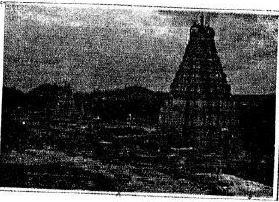
Question 1. This is a picture of a temple at a capital city:
(i) Name the temple.
(ii) Name the empire and the capital city where it was built.
(iii) Who was the greatest ruler of the empire? Mention the name of the book written by him.
Answer:
(i) The temple shown is the Virupaksha Temple.
(ii) It was built in the city of Hampi, which served as the capital of the Vijayanagara Empire.
(iii) The most prominent ruler of this empire was Krishnadeva Raya. He authored books like Veera-Saivanruta and Bhava-Chinta-Ratna.
In simple words: The picture shows the Virupaksha Temple in Hampi. The greatest king of this empire was Krishnadeva Raya, who also wrote books.
Exam Tip: For picture-based questions, double-check spelling of names like "Virupaksha" and "Krishnadeva Raya" as these carry direct marks.
Additional Questions (The Vijayanagara and Bahamani Kingdoms)
A. Fill in the blanks:
Question 1. Vijayanagar was established by two brothers, ________ and ________.
Answer: Harihara, Bukka Rai
In simple words: The kingdom was started by two brothers named Harihara and Bukka Rai.
Exam Tip: Be careful with spellings like "Bukka Rai" or "Bukka Raya" as both are accepted but should match your textbook.
Question 2. The Vijayanagar kingdom which was ruled by ________ kings, was very powerful for ________ years and became the centre of ________ civilization and culture.
Answer: sixteen, 230, Hindu
In simple words: The empire was ruled by 16 kings over 230 years, and it became a hub for Hindu life and traditions.
Exam Tip: Multiple blanks in one sentence require you to remember key numbers and cultural facts together.
Question 3. The ________ became a battleground for the prolonged struggle between the Vijayanagar and Bahmani kingdoms.
Answer: Raichur Doab
In simple words: The fertile land called the Raichur Doab was where the two kingdoms fought most of their wars.
Exam Tip: The word "Doab" means land between two rivers; in this case, Krishna and Tungabhadra.
Question 4. Each province in the Vijayanagar kingdom was placed under a ________ who was responsible for the administration of that province.
Answer: Governor
In simple words: A Governor was in charge of running each large area of the kingdom.
Exam Tip: Think of governors as the regional heads of administration appointed directly by the king.
Question 5. The two main sources of revenue for the Vijayanagar kingdom were taxes on ________ and ________.
Answer: land, trade
In simple words: The kingdom made most of its money from taxes on farming land and marketplace trade.
Exam Tip: Land tax (agricultural produce) and custom duties (trade) were the financial pillars of medieval Indian states.
Question 6. The Bahmani kingdom was established by ________. It lasted for about ________ years and was ruled by ________ kings.
Answer: Alauddin Hassan, 200, eighteen
In simple words: Alauddin Hassan started the Bahmani kingdom, which went on for around 200 years under 18 different kings.
Exam Tip: Hassan Gangu is another name for Alauddin Hassan; knowing both can help in exams.
B. Match the following:
| Column A | Column B |
|---|---|
| 1. Krishnadeva Raya | (a) Portugal |
| 2. Vithalaswami temple | (b) spartan lifestyle |
| 3. Domingo Paes | (c) a brilliant general |
| 4. Mahmud Gawan | (d) Bijapur |
| 5. Gol Gumbaz | (e) Vijayanagar kingdom |
Answer:
1. Krishnadeva Raya - (c) a brilliant general
2. Vithalaswami temple - (e) Vijayanagar kingdom
3. Domingo Paes - (a) Portugal
4. Mahmud Gawan - (b) spartan lifestyle
5. Gol Gumbaz - (d) Bijapur
In simple words: This list connects key historical figures, monuments, and places to their respective traits or kingdoms.
Exam Tip: Be prepared for match-the-following columns to cover multiple aspects like rulers, structures, and origins.
C. Choose the correct answer:
Question 1. The greatest ruler of the Vijayanagar kingdom was
(a) Harihara I
(b) Bukka Raya I
(c) Krishnadeva Raya
(d) Harihara II
Answer: (c) Krishnadeva Raya
In simple words: Out of all the kings, Krishnadeva Raya was the most powerful and popular.
Exam Tip: Krishnadeva Raya's reign represents the golden era of Vijayanagar; remember his name well.
Question 2. The Vijayanagar kingdom was divided into
(a) six provinces
(b) nine provinces
(c) eight provinces
(d) seven provinces
Answer: (a) six provinces
In simple words: The entire kingdom was split into six big administrative regions.
Exam Tip: Knowing the administrative divisions of kingdoms is highly useful for multiple-choice questions.
Question 3. The bottom rung of the administrative ladder in the Vijayanagar kingdom was the
(a) province
(b) village
(c) district
(d) town
Answer: (b) village
In simple words: The smallest unit of government in the kingdom was the village.
Exam Tip: In ancient and medieval India, the village has almost always been the lowest unit of administration.
Question 4. The Bahmani kingdom reached the height of its glory under the leadership of
(a) Mahmud Gawan
(b) Alauddin Bahman Shah
(c) Adil Shah
(d) Muhammad Shah II
Answer: (a) Mahmud Gawan
In simple words: The Bahmani kingdom did its best and grew strongest when Mahmud Gawan was leading it.
Exam Tip: Mahmud Gawan was actually a prime minister (wazir), but his leadership took the empire to its peak.
Question 5. The Bahmani rulers patronized
(a) Hinduism
(b) Buddhism
(c) Islam
(d) Jainism
Answer: (c) Islam
In simple words: The rulers of the Bahmani kingdom supported and followed Islam.
Exam Tip: They built many mosques and colleges (madarasas) to promote Islamic learning and studies.
D. State whether the following are true or false:
Question 1. The founders of the Vijayanagar kingdom brought the whole of South India, from the Tungabhadra to Cape Comorin, under their control.
Answer: True. The creators of the empire successfully united almost the entire southern region of India under their rule.
In simple words: This is true because the founders successfully expanded their kingdom to cover most of South India.
Exam Tip: Cape Comorin is the southernmost tip of India, now known as Kanyakumari.
Question 2. The Vijayanagar kingdom had established trade relations with the Dutch.
Answer: False. They actually built strong trading connections with the Portuguese rather than the Dutch.
In simple words: This is false because their primary European trade partners were the Portuguese on the west coast.
Exam Tip: Remember that the Portuguese were the first Europeans to establish a strong presence on the Malabar Coast.
Question 3. Vijayanagar was one of the wealthiest kingdoms in the Deccan in the 15th and 16th centuries CE.
Answer: True. During the 1400s and 1500s, this empire was known as one of the richest in the region.
In simple words: This is true because the empire grew extremely rich through extensive farming and foreign trade.
Exam Tip: The accounts of foreign visitors like Paes and Razzaq strongly highlight the incredible wealth of Vijayanagar.
Question 4. Mahmud Gawan slept on a mat and ate in earthen vessels.
Answer: True. Even though he was very powerful, Mahmud Gawan led a highly simple life, using clay pots for eating and resting on a basic mat.
In simple words: This is true because despite his high rank, he chose to live very simply.
Exam Tip: This detail demonstrates Gawan's personal integrity and modest lifestyle despite his immense political power.
Question 5. The Bahmani rulers used Persian and Arabic as court languages.
Answer: True. In their royal court, these leaders spoke and wrote in Persian and Arabic.
In simple words: This is true because the language of administration and culture in the court was Persian and Arabic.
Exam Tip: The use of Persian and Arabic was common among many medieval Islamic dynasties across India.
E. Answer the following questions in one or two words or sentences:
Question 1. How did the collapse of the Sultanate impact North India?
Answer: This breakdown left the northern region in a state of deep political confusion and disorder.
In simple words: When the central power fell, North India became unstable with lots of fighting for power.
Exam Tip: Focus on words like "political turmoil" or "instability" to explain the immediate result of a collapsing empire.
Question 2. What was Krishnadeva Raya’s contribution to literature and art?
Answer: He gave immense support to writers and artists. He was highly educated himself, writing poetry in Telugu and studying Sanskrit. In his grand court, he welcomed and rewarded many creative thinkers and scholars.
In simple words: The king loved art and writing. He wrote poems himself and supported many artists and wise people.
Exam Tip: Mention his dual role as both a patron (supporter) and a creator (poet in Telugu and Sanskrit scholar) to get full marks.
Question 3. What is the significance of the Battle of Talikota?
Answer: This historic battle brought together five rival kingdoms - Bijapur, Ahmednagar, Berar, Golconda, and Bidar - who united to defeat Vijayanagara. This severe defeat marked the end of the major Hindu empire in southern India.
In simple words: Five smaller kingdoms joined forces to defeat the big Vijayanagar empire, which completely ended its power in the south.
Exam Tip: Remember that the Battle of Talikota was fought in 1565 and effectively destroyed the Vijayanagara Empire.
Question 4. What major change was introduced in the village administration of the Vijayanagar kingdom?
Answer: While villages remained at the lowest level of local government, the rulers brought back the traditional feudal system. This meant that local officers held positions that passed down through their families.
In simple words: The government brought back an old system where village officer roles stayed within the same families.
Exam Tip: Mention the "revival of the feudal system" and the role of "hereditary officers" as the key administration shifts.
Question 5. What measures did the Vijayanagar rulers take to develop agriculture?
Answer: To boost farming, they cleared away forest areas to create new fields. They also constructed a network of canals, storage tanks, and dams to provide plenty of water for crops.
In simple words: They cut down forests to make more farm fields and built dams and canals to supply water.
Exam Tip: Always split your points into land development (clearing forests) and water systems (dams, canals, tanks).
Question 6. Why were there no major social or cultural changes in the Vijayanagar kingdom?
Answer: The kingdom held tightly to ancient Vedic traditions, keeping their lifestyle very traditional. Society was heavily guided by strict religious rules and a rigid caste system. Because of the high influence of the priestly class, very few social or cultural shifts were allowed to happen.
In simple words: People followed very old religious customs and a strict caste system, which stopped society from changing.
Exam Tip: Explain this by connecting "Vedic customs", the "rigid caste system", and the "influence of Brahmanas" together.
Question 7. Give one example to show that the Vijayanagar kings were tolerant and liberal.
Answer: Even though they were devoted Hindus, these rulers welcomed other faiths. For instance, they hired Muslim soldiers and officials to work in their military and government without any unfair treatment.
In simple words: The Hindu kings treated everyone fairly and even hired Muslim soldiers to fight in their army.
Exam Tip: Mentioning the employment of Muslims in the army is the most famous proof of their religious tolerance.
Question 8. Name any one foreign traveller whose observations are an important literary source of information about the Vijayanagar kingdom.
Answer: Historians learn about this empire from the detailed writings of travelers such as Domingo Paes of Portugal or Abdur Razzaq of Persia.
In simple words: Visitors like Domingo Paes wrote detailed logs that tell us what the empire was like.
Exam Tip: Keep names like Domingo Paes (Portugal) or Abdur Razzaq (Persia) ready for easy-to-score short answers.
Question 9. What was the extent of the Bahmani kingdom?
Answer: This empire spread across the northern Deccan area, reaching all the way from the Arabian Sea to the Bay of Bengal, with its southern border marked by the Krishna River.
In simple words: The kingdom reached from the sea on the west to the sea on the east, ending at the Krishna River in the south.
Exam Tip: State the geographic boundaries (seas on west/east, river in the south) clearly to define the kingdom's size.
Question 10. Give one example to show that Mahmud Gawan was a patron of learning.
Answer: He showed his love for education by constructing a grand college in Bidar. He also gave his personal library of three thousand books to it and provided financial help to poor students.
In simple words: He built a big school, shared his own library of 3,000 books, and gave money to poor students.
Exam Tip: Mentioning the building of the madarasa in Bidar is crucial for showing Gawan's focus on education.
F. Answer the following questions briefly:
Question 1. What did Krishnadeva Raya do to make the make the Vijayanagar kingdom powerful and prosperous?
Answer: To build a strong and wealthy empire, Krishnadeva Raya took several key actions:
1. He promoted active trade with Portuguese merchants.
2. He raised significant funds by setting up taxes and custom duties on trade goods.
3. He supported farming by clearing forests for more crop fields.
4. He built many canals and dams to supply water to farm fields.
In simple words: The king encouraged trade with foreigners and built systems to help farming grow. This brought lots of money into the empire.
Exam Tip: Organize your answer into trade/revenue achievements and agricultural/irrigation achievements.
Question 2. Mention two important features of each of the following in the Vijayanagar kingdom: (a) central government (b) provincial government.
Answer: (a) Central government:
1. The king held supreme power over the state, and his decisions acted as final laws.
2. A hand-picked group of ministers helped the king run the empire smoothly.
(b) Provincial government:
1. The empire was split into six distinct regions, each managed by a governor.
2. These regions were further broken down into smaller districts containing multiple villages.
In simple words: In the center, the king ruled with a team of ministers. In the regions, governors ran the six provinces, which were divided into districts and villages.
Exam Tip: Make sure to address both parts (a) and (b) with separate bullet points to keep your answer structured.
Question 3. Vijayanagar was one of the wealthiest kingdoms in the 15th and 16th centuries Explain.
Answer: During the 1400s and 1500s, Vijayanagar stood out as one of the richest empires. Its wealth came primarily from successful farming and busy trade markets. The state raised money using land taxes and trade duties.
The tax on land was set between one-sixth and one-third of the crops grown, depending on how good the soil was. To grow more food, the rulers cleared forests and created new fields supported by dams, canals, and water tanks.
Active trade brought immense riches. The markets were packed with imported items like Chinese silk, Arabian horses, and elephants from Sri Lanka. At the same time, the kingdom exported goods like cotton textiles, sandalwood, sugar, rice, and spices.
In simple words: Farming and busy markets made the empire very rich. They grew plenty of food and traded items like silk and spices with other countries.
Exam Tip: Divide this answer into three parts: sources of revenue, agricultural growth, and foreign trade details.
Question 4. Describe (a) the importance of trade in Vijayanagar and (b) the position of women in society.
Answer: (a) Trade played a vital role in the empire's economy. Under Krishnadeva Raya, friendly ties were kept with Portuguese merchants on the Malabar Coast. The government gained huge profits by taxing these imports and exports. This money helped fund major farming projects like dams and canals.
(b) While women were treated with respect, they had very limited independence. Practices like early marriage and sati were widespread. However, some women from noble families achieved high ranks, engaging in cultural, literary, and political affairs.
In simple words: Trade with the Portuguese brought in lots of tax money. Women were respected but did not have much freedom, though rich women could take part in public life.
Exam Tip: Be objective and precise when writing about social structures and the status of women in historical eras.
Question 5. Briefly discuss the conflict between the Vijayanagar and Bahmani kingdoms over the Raichur Doab.
Answer: The Raichur Doab was an extremely fertile tract of land situated between the southern border of the Bahmani kingdom and the northern border of Vijayanagar. Because this land produced high tax revenues, both empires fought constantly to control it. Control of the area shifted back and forth between the two sides until Vijayanagar was defeated at the Battle of Talikota.
In simple words: The Raichur Doab was great farming land on the border. Both sides fought over it for years to get its tax money until the final battle in 1565.
Exam Tip: Clearly define what the "Raichur Doab" was and why its geographic location made it a perfect battleground.
Question 6. Give an account of the achievements of Mahmud Gawan.
Answer: Mahmud Gawan achieved great success as a general and an administrator. He expanded the borders of the Bahmani kingdom and successfully won back the key port of Goa from Vijayanagar. He also boosted the economy by helping farmers and improving agriculture.
Additionally, he was highly educated and built a grand college in Bidar. He donated three thousand books from his personal collection to this school and offered financial aid to students who needed it.
In simple words: Mahmud Gawan won back Goa, helped farming grow, built a big library and school, and supported poor students.
Exam Tip: Ensure you describe both his military feats (like taking Goa) and his educational contributions (Bidar madarasa) to show a well-rounded answer.
Question 7. What was the actual position of the Bahmani kings in the administrative set-up?
Answer: In theory, the Bahmani rulers held supreme power. However, in reality, their true power depended on the strength of their military. When weak kings came to power, they were easily manipulated by religious scholars and influential nobles.
In simple words: Even though the kings were supposed to have all the power, they actually depended on how strong their army was. Weak kings were controlled by nobles.
Exam Tip: Mention the contrast between "theoretical absolute power" and "practical military reliance" to secure maximum marks.
Question 8. What did the Bahmani rulers do to patronize Islam?
Answer: To support their faith, the rulers built magnificent mosques in Bidar and Gulbarga. They also established schools and libraries to teach Islamic history and values, while adopting Persian and Arabic for royal court business.
In simple words: They built beautiful mosques and religious schools in their capital cities and used Persian and Arabic in court.
Exam Tip: Listing specific actions like building mosques in capitals and setting up madarasas shows a detailed knowledge of their cultural impact.
Question 9. Why were the sultans of the Deccan easily overpowered by the Mughal emperor of the north?
Answer: These southern rulers spent much of their time and resources fighting among themselves due to old rivalries. This constant warfare depleted their wealth and military strength, making them easy targets for the Mughal empire.
In simple words: The southern kingdoms kept fighting each other, which made them weak and poor. This made it easy for the Mughals to conquer them.
Exam Tip: Focus on "mutual rivalry" and "drain of wealth" as the core reasons behind their vulnerability to Mughal invasion.
G. Picture Study
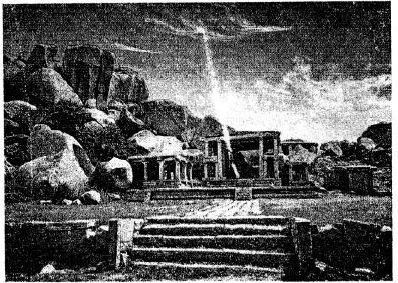
Question 1. This is a picture of the ruins of the capital city of a powerful kingdom in the Deccan which was founded by two brothers:
(i) Identify the city and name the kingdom.
(ii) Who was the greatest ruler of this kingdom?
(iii) Mention any five achievements of this ruler.
(iv) Describe briefly the capital city of this kingdom.
(v) What is the most outstanding feature of the Gol Gumbaz?
Answer:
(i) The city is Hampi, which was the capital of the Vijayanagar kingdom.
(ii) The greatest ruler of this kingdom was Krishnadeva Raya.
(iii) 1. He developed trade with Portuguese merchants located on the Malabar Coast.
2. He collected a lot of revenue through trade taxes and custom duties.
3. He helped farmers by expanding the farming fields.
4. He supported agriculture by constructing dams and canals.
5. He kept a grand court that welcomed and supported many talented artists, poets, and writers.
(iv) The capital city, Hampi, was a truly magnificent place. It was protected by seven strong walls and stretched for a total of ninety-six kilometers (or sixty miles). Its streets were paved and neatly organized. Inside the city, there were beautiful parks, clean lakes, large palaces, and temples. Flower sellers offered fresh, sweet-smelling blossoms everywhere. The citizens loved wearing fine jewelry, and precious stones like rubies, diamonds, emeralds, and pearls were sold openly in the busy markets.
(v) The most impressive feature of this structure is its huge whispering dome. Inside this area, even a soft whisper is reflected back clearly to the speaker nine times.
In simple words: This picture shows the ruins of Hampi. The greatest king was Krishnadeva Raya, who did many things to make the city wealthy. The city was surrounded by seven walls and had rich markets. Gol Gumbaz is known for its amazing whispering dome.
Exam Tip: Hampi's architecture is unique because of its massive fortification walls and detailed market layouts; mention these details to score well.
Free study material for History Civics
ICSE Selina Concise Solutions Class 7 History Civics Chapter 6 The Vijayanagar and Bahmani Kingdoms
Students can now access the detailed Selina Concise Solutions for Chapter 6 The Vijayanagar and Bahmani Kingdoms on our portal. These solutions have been carefully prepared as per latest ICSE Class 7 syllabus. Each solution given above has been updated based on the current year pattern to ensure Class 7 students have the most updated History Civics content.
Master Selina Concise Textbook Questions
Our subject experts have provided detailed explanations for all the questions found in the Selina Concise textbook for Class 7 History Civics. We have focussed on making the concepts easy for you in Chapter 6 The Vijayanagar and Bahmani Kingdoms so that students can understand the concepts behind every answer. For all numerical problems and theoretical concepts these solutions will help in strengthening your analytical skill required for the ICSE examinations.
Complete History Civics Exam Preparation
By using these Selina Concise Class 7 solutions, you can enhance your learning and identify areas that need more attention. We recommend solving the History Civics Questions from the textbook first and then use our teacher-verified answers. For a proper revision of Chapter 6 The Vijayanagar and Bahmani Kingdoms, students should also also check our Revision Notes and Sample Papers available on studiestoday.com.
FAQs
You can download the verified Selina Concise solutions for Chapter 6 The Vijayanagar and Bahmani Kingdoms on StudiesToday.com. Our teachers have prepared answers for Class 7 History Civics as per 2026-27 ICSE academic session.
Yes, our solutions for Chapter 6 The Vijayanagar and Bahmani Kingdoms are designed as per new 2026 ICSE standards. 40% competency-based questions required for Class 7, are included to help students understand application-based logic behind every History Civics answer.
Yes, every exercise in Chapter 6 The Vijayanagar and Bahmani Kingdoms from the Selina Concise textbook has been solved step-by-step. Class 7 students will learn History Civics conceots before their ICSE exams.
Yes, follow structured format of these Selina Concise solutions for Chapter 6 The Vijayanagar and Bahmani Kingdoms to get full 20% internal assessment marks and use Class 7 History Civics projects and viva preparation as per ICSE 2026 guidelines.