

Read and download the CBSE Class 12 Mathematics Continuity And Differentiability Assignment Set 06 for the 2026-27 academic session. We have provided comprehensive Class 12 Mathematics school assignments that have important solved questions and answers for Chapter 5 Continuity And Differentiability. These resources have been carefuly prepared by expert teachers as per the latest NCERT, CBSE, and KVS syllabus guidelines.
Solved Assignment for Class 12 Mathematics Chapter 5 Continuity And Differentiability
Practicing these Class 12 Mathematics problems daily is must to improve your conceptual understanding and score better marks in school examinations. These printable assignments are a perfect assessment tool for Chapter 5 Continuity And Differentiability, covering both basic and advanced level questions to help you get more marks in exams.
Chapter 5 Continuity And Differentiability Class 12 Solved Questions and Answers
Some Important Results/Concepts
* Continuity of a Function:
A function \( f \) is said to be continuous at \( x = a \) if:
Left hand limit = Right hand limit = Value of the function at \( x = a \)
\[ \lim_{x \to a^+} f(x) = \lim_{x \to a^-} f(x) = f(a) \]
\[ \lim_{h \to 0} f(a+h) = \lim_{h \to 0} f(a-h) = f(a) \]
* Differentiability of a Function:
A function \( f \) is said to be differentiable at \( x = a \) if the Left Hand Derivative is equal to the Right Hand Derivative, i.e., \( Lf'(a) = Rf'(a) \):
\[ \lim_{h \to 0} \frac{f(a-h) - f(a)}{-h} = \lim_{h \to 0} \frac{f(a+h) - f(a)}{h} \]
Standard Derivatives:
(i) \( \frac{d}{dx}(x^n) = n x^{n-1} \)
(ii) \( \frac{d}{dx}(x) = 1 \)
(iii) \( \frac{d}{dx}(c) = 0 \), for all \( c \in \mathbb{R} \)
(iv) \( \frac{d}{dx}(a^x) = a^x \log a \), \( a > 0 \), \( a \neq 1 \)
(v) \( \frac{d}{dx}(e^x) = e^x \)
(vi) \( \frac{d}{dx}(\log_a x) = \frac{1}{x \log a} \), \( a > 0 \), \( a \neq 1 \), \( x > 0 \)
(vii) \( \frac{d}{dx}(\log x) = \frac{1}{x} \), \( x > 0 \)
(xiii) \( \frac{d}{dx}(\cot x) = -\csc^2 x \), for all \( x \in \mathbb{R} \)
(xiv) \( \frac{d}{dx}(\sec x) = \sec x \tan x \), for all \( x \in \mathbb{R} \)
(xv) \( \frac{d}{dx}(\csc x) = -\csc x \cot x \), for all \( x \in \mathbb{R} \)
(xvi) \( \frac{d}{dx}(\sin^{-1} x) = \frac{1}{\sqrt{1-x^2}} \)
(xvii) \( \frac{d}{dx}(\cos^{-1} x) = -\frac{1}{\sqrt{1-x^2}} \)
(xviii) \( \frac{d}{dx}(\tan^{-1} x) = \frac{1}{1+x^2} \), for all \( x \in \mathbb{R} \)
(xix) \( \frac{d}{dx}(\cot^{-1} x) = -\frac{1}{1+x^2} \), for all \( x \in \mathbb{R} \)
(xx) \( \frac{d}{dx}(\sec^{-1} x) = \frac{1}{|x|\sqrt{x^2-1}} \)
(xxi) \( \frac{d}{dx}(\csc^{-1} x) = -\frac{1}{|x|\sqrt{x^2-1}} \)
(xxii) \( \frac{d}{dx}(|x|) = \frac{x}{|x|} \), \( x \neq 0 \)
(xxiii) \( \frac{d}{dx}(ku) = k \frac{du}{dx} \)
(xxiv) \( \frac{d}{dx}(u \pm v) = \frac{du}{dx} \pm \frac{dv}{dx} \)
Page 28
(viii) \( \frac{d}{dx}(\log_a |x|) = \frac{1}{x \log a} \), \( a > 0 \), \( a \neq 1 \), \( x \neq 0 \)
(ix) \( \frac{d}{dx}(\log |x|) = \frac{1}{x} \), \( x \neq 0 \)
(x) \( \frac{d}{dx}(\sin x) = \cos x \), for all \( x \in \mathbb{R} \)
(xi) \( \frac{d}{dx}(\cos x) = -\sin x \), for all \( x \in \mathbb{R} \)
(xii) \( \frac{d}{dx}(\tan x) = \sec^2 x \), for all \( x \in \mathbb{R} \)
(xxv) \( \frac{d}{dx}(u \cdot v) = u \frac{dv}{dx} + v \frac{du}{dx} \)
(xxvi) \( \frac{d}{dx}\left(\frac{u}{v}\right) = \frac{v \frac{du}{dx} - u \frac{dv}{dx}}{v^2} \)
2. Continuity
Level I
Question 1. Examine the continuity of the function f(x)=\(x^2\) + 5 at x=-1.
Answer: We evaluate the limit and functional value of \( f(x) = x^2 + 5 \) at \( x = -1 \):
First, find the functional value at \( x = -1 \):
\( f(-1) = (-1)^2 + 5 = 1 + 5 = 6 \).
Next, compute the limit of the function as \( x \to -1 \):
\( \lim_{x \to -1} f(x) = \lim_{x \to -1} (x^2 + 5) = (-1)^2 + 5 = 6 \).
Since \( \lim_{x \to -1} f(x) = f(-1) = 6 \), the function \( f(x) \) is continuous at \( x = -1 \).
In simple words: A function is continuous if the limit of the function equals its value at that point. Since both the limit and value are 6 at x = -1, the function is continuous.
Exam Tip: For simple polynomial functions, directly evaluating the limit and showing it equals the functional value is sufficient to prove continuity.
Question 2. Examine the continuity of the function f(x)=\( \frac{1}{x+3} \),x∈ R.
Answer: Let us analyze the points of continuity for \( f(x) = \frac{1}{x+3} \).
The function is defined for all real numbers except where the denominator becomes zero:
\( x + 3 = 0 \implies x = -3 \).
For any \( c \in \mathbb{R} \setminus \{-3\} \):
\( f(c) = \frac{1}{c+3} \), which is a well-defined real number.
The limit is:
\( \lim_{x \to c} f(x) = \lim_{x \to c} \frac{1}{x+3} = \frac{1}{c+3} = f(c) \).
Thus, the function is continuous for all \( x \in \mathbb{R} \setminus \{-3\} \). However, at \( x = -3 \), the function is not defined, which means it is discontinuous at \( x = -3 \).
In simple words: The function is continuous everywhere except at x = -3, because dividing by zero at that point makes the function undefined.
Exam Tip: Rational functions are continuous everywhere except at the points where their denominator vanishes.
Question 3. Show that f(x)=4x is a continuous for all x∈ R.
Answer: Let \( c \) be any arbitrary real number, i.e., \( c \in \mathbb{R} \).
The value of the function at \( x = c \) is:
\( f(c) = 4c \).
The limit of the function as \( x \to c \) is:
\( \lim_{x \to c} f(x) = \lim_{x \to c} (4x) = 4c \).
Since \( \lim_{x \to c} f(x) = f(c) = 4c \) for any real number \( c \), the function \( f(x) = 4x \) is continuous for all \( x \in \mathbb{R} \).
In simple words: The function is a straight line. Since we can draw it without lifting our pen for any real number, it is continuous everywhere.
Exam Tip: Every linear polynomial function of the form \( f(x) = kx \) is continuous on the entire set of real numbers.
Level II
Question 1. Give an example of a function which is continuous at x=1,but not differentiable at x=1.
Answer: Consider the absolute value function centered at \( x = 1 \):
\( f(x) = |x - 1| \).
Continuity Check:
At \( x = 1 \): \( f(1) = |1 - 1| = 0 \).
\( \lim_{x \to 1} |x - 1| = 0 \). Since the limit equals the functional value, \( f(x) \) is continuous at \( x = 1 \).
Differentiability Check:
Let us calculate the Left Hand Derivative (LHD) and Right Hand Derivative (RHD) at \( x = 1 \):
\( Lf'(1) = \lim_{h \to 0} \frac{f(1-h) - f(1)}{-h} = \lim_{h \to 0} \frac{|1-h-1| - 0}{-h} = \lim_{h \to 0} \frac{|-h|}{-h} = \lim_{h \to 0} \frac{h}{-h} = -1 \).
\( Rf'(1) = \lim_{h \to 0} \frac{f(1+h) - f(1)}{h} = \lim_{h \to 0} \frac{|1+h-1| - 0}{h} = \lim_{h \to 0} \frac{|h|}{h} = \lim_{h \to 0} \frac{h}{h} = 1 \).
Since \( Lf'(1) \neq Rf'(1) \), the function is not differentiable at \( x = 1 \).
In simple words: The function \( f(x) = |x-1| \) is continuous, but its graph has a sharp "V-shaped" corner at x = 1. Since the slope changes abruptly from -1 to 1, the function is not differentiable there.
Exam Tip: Modulus functions of the form \( |x - a| \) are classic examples of functions that are continuous but not differentiable at the corner point \( x = a \).
Question 2. For what value of k,the function \( f(x) = \begin{cases} kx^2, & \text{if } x \le 2 \\ 3, & \text{if } x > 2 \end{cases} \) is continuous at x=2.
Answer: For the function to be continuous at \( x = 2 \), the left-hand limit, right-hand limit, and functional value must be equal:
\( \lim_{x \to 2^-} f(x) = \lim_{x \to 2^+} f(x) = f(2) \).
Left-hand limit and functional value:
\( \lim_{x \to 2^-} kx^2 = k(2)^2 = 4k \).
\( f(2) = k(2)^2 = 4k \).
Right-hand limit:
\( \lim_{x \to 2^+} (3) = 3 \).
Equating these limits for continuity:
\( 4k = 3 \implies k = \frac{3}{4} \).
Thus, the function is continuous when \( k = \frac{3}{4} \).
In simple words: Find the limit from both sides of 2. Set them equal to each other and solve for k to make sure the two parts of the graph connect smoothly.
Exam Tip: For piecewise functions, calculate the left and right limits separately before setting them equal to solve for unknown variables.
Question 3. Find the relationship between "a" and "b" so that the function 'f' defined by: \( f(x) = \begin{cases} ax + 1, & \text{if } x \le 3 \\ bx + 3, & \text{if } x > 3 \end{cases} \) is continuous at x=3. [CBSE 2011]
Answer: For \( f(x) \) to be continuous at \( x = 3 \), we must have:
\( \lim_{x \to 3^-} f(x) = \lim_{x \to 3^+} f(x) = f(3) \).
Left-hand limit and functional value:
\( \lim_{x \to 3^-} (ax + 1) = a(3) + 1 = 3a + 1 \).
\( f(3) = 3a + 1 \).
Right-hand limit:
\( \lim_{x \to 3^+} (bx + 3) = b(3) + 3 = 3b + 3 \).
For continuity, equate these values:
\( 3a + 1 = 3b + 3 \)
\( \implies 3a - 3b = 2 \)
\( \implies a - b = \frac{2}{3} \text{ or } a = b + \frac{2}{3} \).
This is the required relationship between \( a \) and \( b \).
In simple words: Set the two pieces of the function equal to each other at the transition point x = 3 to find the linear relationship that ensures the graph is unbroken.
Exam Tip: When asked for a "relationship", express one variable in terms of the other (e.g., \( a = b + 2/3 \)) as your final answer.
Question 4. If f(x)=\( \begin{cases} \frac{\sin 3x}{x}, & \text{when } x \neq 0 \\ 1, & \text{when } x = 0 \end{cases} \). Find whether f(x) is continuous at x=0.
Answer: We evaluate the limit of \( f(x) \) as \( x \to 0 \):
\( \lim_{x \to 0} f(x) = \lim_{x \to 0} \frac{\sin 3x}{x} \).
Multiplying the numerator and denominator by 3:
\( \lim_{x \to 0} \frac{3\sin 3x}{3x} = 3 \lim_{3x \to 0} \frac{\sin 3x}{3x} \).
Using the standard limit \( \lim_{\theta \to 0} \frac{\sin \theta}{\theta} = 1 \):
\( \lim_{x \to 0} f(x) = 3(1) = 3 \).
Now, we check the functional value at \( x = 0 \):
\( f(0) = 1 \).
Since \( \lim_{x \to 0} f(x) = 3 \neq f(0) = 1 \), the function is not continuous at \( x = 0 \).
In simple words: The limit of the function as x approaches 0 is 3, but the actual value assigned to the function at 0 is 1. Because these two values do not match, there is a gap in the graph.
Exam Tip: Remember to scale the denominator when evaluating trigonometric limits like \( \sin(kx)/x \) to match the angle \( kx \).
Level III
Question 1. For what value of k, the function f(x)=\( \begin{cases} \frac{1 - \cos 4x}{8x^2}, & \text{if } x \neq 0 \\ k, & \text{if } x = 0 \end{cases} \) is continuous at x=0?
Answer: For continuity at \( x = 0 \), we require:
\( \lim_{x \to 0} f(x) = f(0) \implies \lim_{x \to 0} \frac{1 - \cos 4x}{8x^2} = k \).
Using the trigonometric identity \( 1 - \cos 2\theta = 2\sin^2 \theta \):
\( 1 - \cos 4x = 2\sin^2 2x \).
Substituting this back:
\( \lim_{x \to 0} \frac{2\sin^2 2x}{8x^2} = \lim_{x \to 0} \frac{\sin^2 2x}{4x^2} = \lim_{x \to 0} \left(\frac{\sin 2x}{2x}\right)^2 \).
Since \( \lim_{2x \to 0} \frac{\sin 2x}{2x} = 1 \):
\( \lim_{x \to 0} f(x) = 1^2 = 1 \).
Since \( \lim_{x \to 0} f(x) = f(0) \), we get:
\( k = 1 \).
In simple words: Use trig identities to convert the numerator into a sine-squared term. This simplifies the limit calculation at 0 to 1, meaning k must be 1 for continuity.
Exam Tip: Be precise when simplifying exponents: \( (2x)^2 = 4x^2 \), which perfectly matches the denominator in this problem.
Question 2. If function f(x)=\( \frac{2x+3\sin x}{3x+2\sin x} \), for x ≠ 0 is continuous at x=0, then Find f(0).
Answer: Since the function is continuous at \( x = 0 \), the functional value \( f(0) \) must equal the limit of \( f(x) \) as \( x \to 0 \):
\( f(0) = \lim_{x \to 0} \frac{2x + 3\sin x}{3x + 2\sin x} \).
Divide the numerator and denominator by \( x \):
\( f(0) = \lim_{x \to 0} \frac{2 + 3\left(\frac{\sin x}{x}\right)}{3 + 2\left(\frac{\sin x}{x}\right)} \).
Applying the standard limit \( \lim_{x \to 0} \frac{\sin x}{x} = 1 \):
\( f(0) = \frac{2 + 3(1)}{3 + 2(1)} = \frac{5}{5} = 1 \).
Thus, \( f(0) = 1 \).
In simple words: Dividing every term by x lets you apply the standard limit rule for sine, which simplifies the expression down to 5/5, or 1.
Exam Tip: Dividing both numerator and denominator by \( x \) is a very effective technique for solving limits that combine polynomial and trigonometric terms.
Page 29
Question 3. Let f(x) = \( \begin{cases} \frac{1 - \sin^3 x}{3\cos^2 x}, & \text{if } x < \frac{\pi}{2} \\ a, & \text{if } x = \frac{\pi}{2} \\ \frac{b(1 - \sin x)}{(\pi - 2x)^2}, & \text{if } x > \frac{\pi}{2} \end{cases} \). If f(x) be a continuous function at x=\( \frac{\pi}{2} \) , find a and b.
Answer: For \( f(x) \) to be continuous at \( x = \frac{\pi}{2} \), we must have:
\( \lim_{x \to (\pi/2)^-} f(x) = \lim_{x \to (\pi/2)^+} f(x) = f\left(\frac{\pi}{2}\right) = a \).
Left-Hand Limit (LHL):
\( \text{LHL} = \lim_{x \to (\pi/2)^-} \frac{1 - \sin^3 x}{3\cos^2 x} \).
Since \( \cos^2 x = 1 - \sin^2 x \):
\( \text{LHL} = \lim_{x \to (\pi/2)^-} \frac{(1 - \sin x)(1 + \sin x + \sin^2 x)}{3(1 - \sin x)(1 + \sin x)} = \lim_{x \to (\pi/2)^-} \frac{1 + \sin x + \sin^2 x}{3(1 + \sin x)} \).
Substituting \( x = \frac{\pi}{2} \):
\( \text{LHL} = \frac{1 + 1 + 1}{3(1 + 1)} = \frac{3}{6} = \frac{1}{2} \).
Thus, \( a = \frac{1}{2} \).
Right-Hand Limit (RHL):
\( \text{RHL} = \lim_{x \to (\pi/2)^+} \frac{b(1 - \sin x)}{(\pi - 2x)^2} \).
Let \( x = \frac{\pi}{2} + h \). As \( x \to \frac{\pi}{2}^+ \), \( h \to 0 \).
\( \text{RHL} = \lim_{h \to 0} \frac{b(1 - \sin(\pi/2 + h))}{(\pi - 2(\pi/2 + h))^2} = \lim_{h \to 0} \frac{b(1 - \cos h)}{(-2h)^2} = \lim_{h \to 0} \frac{b(2\sin^2(h/2))}{4h^2} \).
\( \text{RHL} = \frac{2b}{4} \lim_{h \to 0} \left( \frac{\sin(h/2)}{2(h/2)} \right)^2 = \frac{b}{2} \cdot \frac{1}{4} \lim_{h \to 0} \left(\frac{\sin(h/2)}{h/2}\right)^2 = \frac{b}{8} \).
Equating LHL and RHL to find \( b \):
\( \frac{b}{8} = \frac{1}{2} \implies b = 4 \).
Thus, \( a = \frac{1}{2} \) and \( b = 4 \).
In simple words: Factor the left-hand piece to cancel common terms and find 'a'. For the right-hand piece, use a substitution to simplify the limit and solve for 'b'.
Exam Tip: Using substitution \( x = a + h \) is the safest method to resolve complicated limits around non-zero boundary values.
Question 4. For what value of k,is the function f(x) = \( \begin{cases} \frac{\sin x + x\cos x}{x}, & \text{when } x \neq 0 \\ k, & \text{when } x = 0 \end{cases} \) continuous at x= 0?
Answer: For continuity at \( x = 0 \), the limit must equal the functional value:
\( \lim_{x \to 0} \frac{\sin x + x\cos x}{x} = k \).
Splitting the fraction:
\( \lim_{x \to 0} \left( \frac{\sin x}{x} + \frac{x\cos x}{x} \right) = \lim_{x \to 0} \left( \frac{\sin x}{x} + \cos x \right) \).
Applying standard limits as \( x \to 0 \):
\( \lim_{x \to 0} \frac{\sin x}{x} = 1 \) and \( \lim_{x \to 0} \cos x = 1 \).
Thus, the limit is:
\( 1 + 1 = 2 \).
Therefore, we get:
\( k = 2 \).
In simple words: Split the fraction into two separate terms. Since both terms approach 1 as x goes to 0, their sum is 2, which means k must be 2.
Exam Tip: Splitting terms in the numerator over a common denominator is a quick way to isolate standard limits.
3. Differentiation
Level I
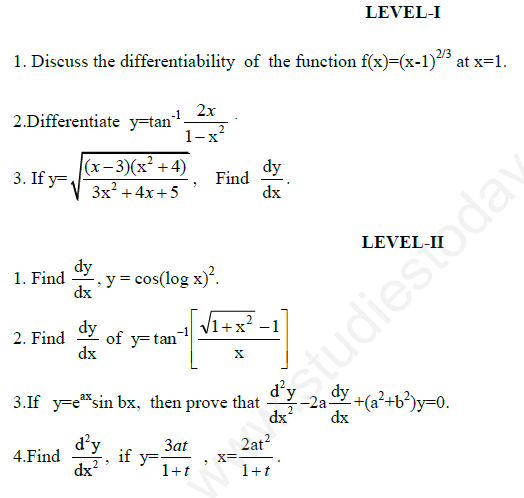
Question 1. Discuss the differentiability of the function f(x)=\((x-1)^{2/3}\) at x=1.
Answer: We check the differentiability of the function at \( x = 1 \) using the limit definition of the derivative:
\( f'(1) = \lim_{h \to 0} \frac{f(1+h) - f(1)}{h} \).
We calculate the terms:
\( f(1) = (1 - 1)^{2/3} = 0 \).
\( f(1+h) = (1+h-1)^{2/3} = h^{2/3} \).
Substituting these into the derivative limit:
\( f'(1) = \lim_{h \to 0} \frac{h^{2/3} - 0}{h} = \lim_{h \to 0} h^{2/3 - 1} = \lim_{h \to 0} \frac{1}{h^{1/3}} \).
As \( h \to 0 \), the term \( \frac{1}{h^{1/3}} \to \infty \) (or is undefined).
Since the limit does not exist as a finite real number, the function is not differentiable at \( x = 1 \).
In simple words: Calculating the derivative at x = 1 results in division by zero, which means the slope becomes infinitely steep. Thus, the function is not differentiable there.
Exam Tip: Functions with fractional exponents between 0 and 1 often have vertical tangent lines (infinite slopes) at their root points.
Question 2. Differentiate y=\(\tan^{-1} \frac{2x}{1-x^2}\).
Answer: Let \( x = \tan \theta \implies \theta = \tan^{-1} x \).
Substituting this into our equation:
\( y = \tan^{-1}\left(\frac{2\tan \theta}{1 - \tan^2 \theta}\right) \).
Using the double-angle identity \( \tan 2\theta = \frac{2\tan \theta}{1-\tan^2 \theta} \):
\( y = \tan^{-1}(\tan 2\theta) \)
\( \implies y = 2\theta \).
Replacing \( \theta \) back with \( \tan^{-1} x \):
\( y = 2\tan^{-1} x \).
Now, we differentiate with respect to \( x \):
\( \frac{dy}{dx} = \frac{d}{dx}(2\tan^{-1} x) = 2 \cdot \frac{1}{1+x^2} = \frac{2}{1+x^2} \).
In simple words: Substitute x with tangent of theta to simplify the inverse trig expression down to 2-theta. Differentiating this simplified term gives the final derivative.
Exam Tip: Always look for trigonometric substitutions to simplify inverse trigonometric expressions before differentiating.
Question 3. If y= \( \sqrt{\frac{(x-3)(x^2+4)}{3x^2+4x+5}} \) , Find \(\frac{dy}{dx}\).
Answer: Taking the natural logarithm on both sides of the equation:
\( \log y = \log\left( \frac{(x-3)(x^2+4)}{3x^2+4x+5} \right)^{1/2} \)
Using logarithm properties to expand the expression:
\( \log y = \frac{1}{2} \left[ \log(x-3) + \log(x^2+4) - \log(3x^2+4x+5) \right] \).
Differentiating both sides with respect to \( x \) using the chain rule:
\( \frac{1}{y} \frac{dy}{dx} = \frac{1}{2} \left[ \frac{1}{x-3} + \frac{2x}{x^2+4} - \frac{6x+4}{3x^2+4x+5} \right] \).
Multiplying by \( y \):
\( \frac{dy}{dx} = \frac{1}{2} \sqrt{\frac{(x-3)(x^2+4)}{3x^2+4x+5}} \left[ \frac{1}{x-3} + \frac{2x}{x^2+4} - \frac{2(3x+2)}{3x^2+4x+5} \right] \).
In simple words: Use logarithmic differentiation. Taking logs on both sides turns the complex fraction and square root into simple addition and subtraction terms that are easy to differentiate.
Exam Tip: Logarithmic differentiation is the best method to handle complex rational functions containing powers or square roots.
Level II
Question 1. Find \(\frac{dy}{dx}\) , y = cos(log x)\(^2\).
Answer: Let \( y = \cos(\log x)^2 \).
We differentiate using the chain rule step-by-step:
\( \frac{dy}{dx} = \frac{d}{dx} \left[ \cos(\log x)^2 \right] \)
\( \implies \frac{dy}{dx} = -\sin(\log x)^2 \cdot \frac{d}{dx} \left[ (\log x)^2 \right] \)
\( \implies \frac{dy}{dx} = -\sin(\log x)^2 \cdot \left[ 2\log x \cdot \frac{d}{dx}(\log x) \right] \)
\( \implies \frac{dy}{dx} = -\sin(\log x)^2 \cdot 2\log x \cdot \frac{1}{x} \)
\( \implies \frac{dy}{dx} = -\frac{2\log x \sin(\log x)^2}{x} \).
In simple words: Apply the chain rule. Differentiate the outer cosine function first, then the squared exponent, and finally the inner log function.
Exam Tip: Clearly write out each nested derivative stage in the chain rule to prevent missing any terms.
Question 2. Find \(\frac{dy}{dx}\) of y=\(\tan^{-1}\left[\frac{\sqrt{1+x^2}-1}{x}\right]\)
Answer: Let \( x = \tan \theta \implies \theta = \tan^{-1} x \).
We substitute this into the expression:
\( y = \tan^{-1}\left(\frac{\sqrt{1+\tan^2 \theta}-1}{\tan \theta}\right) = \tan^{-1}\left(\frac{\sec \theta - 1}{\tan \theta}\right) \).
Converting to sine and cosine:
\( y = \tan^{-1}\left(\frac{1-\cos \theta}{\sin \theta}\right) = \tan^{-1}\left(\frac{2\sin^2(\theta/2)}{2\sin(\theta/2)\cos(\theta/2)}\right) \)
\( \implies y = \tan^{-1}\left(\tan \frac{\theta}{2}\right) = \frac{\theta}{2} \).
Substituting back \( \theta = \tan^{-1} x \):
\( y = \frac{1}{2}\tan^{-1} x \).
Differentiating both sides with respect to \( x \):
\( \frac{dy}{dx} = \frac{1}{2(1+x^2)} \).
In simple words: This is the derivative of the simplified expression we solved on page 16. The final derivative is simply 1 divided by twice of (1 + x-squared).
Exam Tip: Simplifying the function first using trigonometry makes the differentiation step trivial.
Question 3. If \(y=e^{ax}\sin bx\), then prove that \(\frac{d^2y}{dx^2}-2a\frac{dy}{dx}+(a^2+b^2)y=0\).
Answer: Given \( y = e^{ax}\sin bx \).
We differentiate with respect to \( x \) using the product rule:
\( \frac{dy}{dx} = a e^{ax}\sin bx + b e^{ax}\cos bx \)
\( \implies \frac{dy}{dx} = a y + b e^{ax}\cos bx \) (using \( y = e^{ax}\sin bx \)).
Differentiating again to find the second derivative:
\( \frac{d^2y}{dx^2} = a \frac{dy}{dx} + b \left[ a e^{ax}\cos bx - b e^{ax}\sin bx \right] \)
\( \implies \frac{d^2y}{dx^2} = a \frac{dy}{dx} + a \left( b e^{ax}\cos bx \right) - b^2 y \).
From our first derivative, we know \( b e^{ax}\cos bx = \frac{dy}{dx} - ay \). Substituting this in:
\( \frac{d^2y}{dx^2} = a \frac{dy}{dx} + a \left( \frac{dy}{dx} - ay \right) - b^2 y \)
\( \implies \frac{d^2y}{dx^2} = 2a \frac{dy}{dx} - (a^2 + b^2)y \)
\( \implies \frac{d^2y}{dx^2} - 2a \frac{dy}{dx} + (a^2 + b^2)y = 0 \).
Hence, proved.
In simple words: Find the first and second derivatives. Use substitution to replace the trigonometric terms back with y and its first derivative, and simplify to get the target differential equation.
Exam Tip: Substituting earlier derivatives back into your expressions is a very effective way to cleanly prove differential equations.
Question 4. Find \(\frac{d^2y}{dx^2}\) , if y= \(\frac{3at}{1+t}\) , x=\(\frac{2at^2}{1+t}\).
Answer: We differentiate both parametric equations with respect to \( t \) using the quotient rule:
For \( y = \frac{3at}{1+t} \):
\( \frac{dy}{dt} = 3a \left[ \frac{(1+t)(1) - t(1)}{(1+t)^2} \right] = \frac{3a}{(1+t)^2} \).
For \( x = \frac{2at^2}{1+t} \):
\( \frac{dx}{dt} = 2a \left[ \frac{(1+t)(2t) - t^2(1)}{(1+t)^2} \right] = 2a \left[ \frac{2t + t^2}{(1+t)^2} \right] = \frac{2at(t+2)}{(1+t)^2} \).
Now, we find \( \frac{dy}{dx} \):
\( \frac{dy}{dx} = \frac{dy/dt}{dx/dt} = \frac{\frac{3a}{(1+t)^2}}{\frac{2at(t+2)}{(1+t)^2}} = \frac{3}{2t(t+2)} = \frac{3}{2(t^2 + 2t)} \).
To find the second derivative \( \frac{d^2y}{dx^2} \):
\( \frac{d^2y}{dx^2} = \frac{d}{dt}\left(\frac{dy}{dx}\right) \cdot \frac{dt}{dx} \).
\( \frac{d}{dt}\left[ \frac{3}{2}(t^2+2t)^{-1} \right] = -\frac{3}{2}(t^2+2t)^{-2} \cdot (2t+2) = -\frac{3(t+1)}{(t^2+2t)^2} \).
Thus:
\( \frac{d^2y}{dx^2} = -\frac{3(t+1)}{t^2(t+2)^2} \cdot \frac{(1+t)^2}{2at(t+2)} = -\frac{3(t+1)^3}{2at^3(t+2)^3} \).
In simple words: Find dy/dt and dx/dt, divide them to get dy/dx, and then differentiate dy/dx with respect to t and multiply by dt/dx to get the final second derivative.
Exam Tip: Do not forget the \( dt/dx \) multiplier term when finding second derivatives of parametric functions.
Level III
Question 1. Find \(\frac{dy}{dx}\) , if y = \(\tan^{-1}\left[\frac{\sqrt{1+x^2} - \sqrt{1-x^2}}{\sqrt{1+x^2} + \sqrt{1-x^2}}\right]\)
Answer: Let \( x^2 = \cos 2\theta \implies \theta = \frac{1}{2}\cos^{-1}(x^2) \).
We simplify the terms:
\( \sqrt{1+x^2} = \sqrt{1+\cos 2\theta} = \sqrt{2}\cos \theta \).
\( \sqrt{1-x^2} = \sqrt{1-\cos 2\theta} = \sqrt{2}\sin \theta \).
Substituting these into the function:
\( y = \tan^{-1}\left(\frac{\sqrt{2}\cos \theta - \sqrt{2}\sin \theta}{\sqrt{2}\cos \theta + \sqrt{2}\sin \theta}\right) = \tan^{-1}\left(\frac{1-\tan \theta}{1+\tan \theta}\right) \).
Using the identity \( \tan\left(\frac{\pi}{4} - \theta\right) = \frac{1-\tan \theta}{1+\tan \theta} \):
\( y = \tan^{-1}\left(\tan\left(\frac{\pi}{4} - \theta\right)\right) = \frac{\pi}{4} - \theta \).
Substituting back \( \theta = \frac{1}{2}\cos^{-1}(x^2) \):
\( y = \frac{\pi}{4} - \frac{1}{2}\cos^{-1}(x^2) \).
Now, we differentiate with respect to \( x \) using the chain rule:
\( \frac{dy}{dx} = 0 - \frac{1}{2} \left[ -\frac{1}{\sqrt{1-(x^2)^2}} \cdot \frac{d}{dx}(x^2) \right] \)
\( \implies \frac{dy}{dx} = \frac{1}{2\sqrt{1-x^4}} \cdot 2x = \frac{x}{\sqrt{1-x^4}} \).
In simple words: Substitute x-squared as cos(2-theta) to simplify the inverse tangent term down to 45 degrees minus theta. Differentiate this simplified term using the chain rule.
Exam Tip: Substituting \( x^2 = \cos 2\theta \) is the most effective way to solve calculus problems containing both \( 1+x^2 \) and \( 1-x^2 \) terms.
Question 2. Find \(\frac{dy}{dx}\) y = \(\cot^{-1}\left[\frac{\sqrt{1+\sin x} + \sqrt{1-\sin x}}{\sqrt{1+\sin x} - \sqrt{1-\sin x}}\right]\) , 0<x<\(\frac{\pi}{2}\).
Answer: Let \( y = \cot^{-1}\left[\frac{\sqrt{1+\sin x} + \sqrt{1-\sin x}}{\sqrt{1+\sin x} - \sqrt{1-\sin x}}\right] \).
This inner term is identical to the one simplified on Page 17 (Level III Q1), which reduces to \( \cot \frac{x}{2} \).
Thus, we can write:
\( y = \cot^{-1}\left(\cot \frac{x}{2}\right) \).
In the interval \( 0 < x < \frac{\pi}{2} \), we have \( 0 < \frac{x}{2} < \frac{\pi}{4} \), which lies within the principal value branch of \( \cot^{-1} \).
So, the function simplifies to:
\( y = \frac{x}{2} \).
Now, we differentiate with respect to \( x \):
\( \frac{dy}{dx} = \frac{d}{dx}\left(\frac{x}{2}\right) = \frac{1}{2} \).
In simple words: Use the trigonometric identities to simplify the entire expression inside the inverse cotangent to just x/2. The derivative of x/2 is 1/2.
Exam Tip: Always use the domain constraints to verify that your simplified angles lie in the principal value branch before taking the derivative.
Question 3. If y=\(\sin^{-1}\left(\frac{a + b\cos x}{b + a\cos x}\right)\), show that \(\frac{dy}{dx}\) = \(-\frac{\sqrt{b^2-a^2}}{b + a\cos x}\).
Answer: Differentiating both sides with respect to \( x \) using the chain rule:
\( \frac{dy}{dx} = \frac{1}{\sqrt{1 - \left(\frac{a+b\cos x}{b+a\cos x}\right)^2}} \cdot \frac{d}{dx}\left(\frac{a+b\cos x}{b+a\cos x}\right) \).
First, simplify the square root term:
\( \sqrt{1 - \left(\frac{a+b\cos x}{b+a\cos x}\right)^2} = \sqrt{\frac{(b+a\cos x)^2 - (a+b\cos x)^2}{(b+a\cos x)^2}} = \frac{\sqrt{(b^2-a^2)(1-\cos^2 x)}}{b+a\cos x} = \frac{\sqrt{b^2-a^2}\sin x}{b+a\cos x} \).
Next, find the derivative of the fraction using the quotient rule:
\( \frac{d}{dx}\left(\frac{a+b\cos x}{b+a\cos x}\right) = \frac{(b+a\cos x)(-b\sin x) - (a+b\cos x)(-a\sin x)}{(b+a\cos x)^2} = \frac{-(b^2-a^2)\sin x}{(b+a\cos x)^2} \).
Substituting both parts back into the chain rule product:
\( \frac{dy}{dx} = \frac{b+a\cos x}{\sqrt{b^2-a^2}\sin x} \cdot \frac{-(b^2-a^2)\sin x}{(b+a\cos x)^2} = -\frac{\sqrt{b^2-a^2}}{b+a\cos x} \).
Hence, proved.
In simple words: Apply the quotient and chain rules. The sine terms cancel out during simplification, leaving the final clean expression.
Exam Tip: Be methodical during the algebraic simplification step; factoring \( (b^2-a^2)(1-\cos^2 x) \) is key to canceling out the sine term.
Page 30
Question 4. Prove that \( \frac{d}{dx}\left[ \frac{1}{4\sqrt{2}}\log \left| \frac{x^2 + \sqrt{2}x + 1}{x^2 - \sqrt{2}x + 1} \right| + \frac{1}{2\sqrt{2}}\tan^{-1} \left( \frac{\sqrt{2}x}{1-x^2} \right) \right] = \frac{1}{1+x^4} \)
Answer: Let \( y = y_1 + y_2 \) where:
\( y_1 = \frac{1}{4\sqrt{2}} \left[ \log(x^2 + \sqrt{2}x + 1) - \log(x^2 - \sqrt{2}x + 1) \right] \).
Differentiating \( y_1 \) using the chain rule:
\( \frac{dy_1}{dx} = \frac{1}{4\sqrt{2}} \left[ \frac{2x+\sqrt{2}}{x^2+\sqrt{2}x+1} - \frac{2x-\sqrt{2}}{x^2-\sqrt{2}x+1} \right] \).
Combining these fractions over a common denominator \( (x^2+1)^2 - 2x^2 = x^4+1 \):
\( \frac{dy_1}{dx} = \frac{1}{4\sqrt{2}} \cdot \frac{\sqrt{2}(2 - 2x^2)}{x^4+1} = \frac{1-x^2}{2(1+x^4)} \).
Now, for \( y_2 = \frac{1}{2\sqrt{2}}\tan^{-1}\left(\frac{\sqrt{2}x}{1-x^2}\right) \):
Differentiating \( y_2 \) using the chain rule:
\( \frac{dy_2}{dx} = \frac{1}{2\sqrt{2}} \cdot \frac{1}{1 + \left(\frac{\sqrt{2}x}{1-x^2}\right)^2} \cdot \frac{(1-x^2)\sqrt{2} - \sqrt{2}x(-2x)}{(1-x^2)^2} \)
\( \implies \frac{dy_2}{dx} = \frac{1}{2\sqrt{2}} \cdot \frac{(1-x^2)^2}{(1-x^2)^2 + 2x^2} \cdot \frac{\sqrt{2}(1+x^2)}{(1-x^2)^2} = \frac{1+x^2}{2(1+x^4)} \).
Adding both derivative parts together:
\( \frac{dy}{dx} = \frac{1-x^2}{2(1+x^4)} + \frac{1+x^2}{2(1+x^4)} = \frac{2}{2(1+x^4)} = \frac{1}{1+x^4} \).
Hence, proved.
In simple words: Differentiate the log and inverse tangent parts separately. Combine their derivatives using algebra to cancel out the x-squared terms, leaving exactly 1/(1 + x to the power of 4).
Exam Tip: This is a lengthy calculus identity proof. Breaking the expression into separate \( y_1 \) and \( y_2 \) parts keeps the math clean and prevents errors.
4. Logarithmic Differentiation
Level I
Question 1. Differentiate y=\(log_7\)(log x).
Answer: We use the change of base formula for logarithms to convert to base \( e \):
\( y = \frac{\log(\log x)}{\log 7} \).
Now, we differentiate with respect to \( x \):
\( \frac{dy}{dx} = \frac{1}{\log 7} \cdot \frac{d}{dx}\left[ \log(\log x) \right] \).
Applying the chain rule:
\( \frac{dy}{dx} = \frac{1}{\log 7} \cdot \frac{1}{\log x} \cdot \frac{d}{dx}(\log x) \)
\( \implies \frac{dy}{dx} = \frac{1}{x \log x \log 7} \).
In simple words: Convert the base-7 logarithm to natural logarithm first. Then apply the chain rule to differentiate the log of a log.
Exam Tip: Always convert logarithms to base \( e \) using change-of-base rules before attempting to differentiate them.
Question 2. Differentiate , sin(log x),with respect to x.
Answer: Let \( y = \sin(\log x) \).
Differentiating both sides with respect to \( x \) using the chain rule:
\( \frac{dy}{dx} = \cos(\log x) \cdot \frac{d}{dx}(\log x) \)
\( \implies \frac{dy}{dx} = \frac{\cos(\log x)}{x} \).
In simple words: Differentiate the outer sine function to cosine, then multiply by the derivative of the inner log function, which is 1/x.
Exam Tip: The chain rule is the standard method for differentiating composite functions where one function is nested inside another.
Question 3. Differentiate y=\(tan^{-1}\)(logx)
Answer: We differentiate \( y = \tan^{-1}(\log x) \) using the chain rule:
\( \frac{dy}{dx} = \frac{1}{1 + (\log x)^2} \cdot \frac{d}{dx}(\log x) \)
\( \implies \frac{dy}{dx} = \frac{1}{x \left[ 1 + (\log x)^2 \right]} \).
In simple words: Apply the derivative formula for inverse tangent, and then multiply by the derivative of log(x), which is 1/x.
Exam Tip: Do not expand \( (\log x)^2 \) as \( 2\log x \); the exponent applies to the entire logarithm, not the argument \( x \).
Level II
Question 1. If y.\(\sqrt{x^2+1}\)=log[\(\sqrt{x^2+1}\)-x],show that (\(x^2\) +1)\(\frac{dy}{dx}\)+xy+1=0.
Answer: Let us differentiate both sides of the equation with respect to \( x \):
LHS derivative (using product rule):
\( \frac{d}{dx}\left[ y(x^2+1)^{1/2} \right] = \frac{dy}{dx}\sqrt{x^2+1} + y \cdot \frac{x}{\sqrt{x^2+1}} \).
RHS derivative (using chain rule):
\( \frac{d}{dx}\left[ \log(\sqrt{x^2+1}-x) \right] = \frac{1}{\sqrt{x^2+1}-x} \cdot \left[ \frac{x}{\sqrt{x^2+1}} - 1 \right] = \frac{1}{\sqrt{x^2+1}-x} \cdot \left[ \frac{x-\sqrt{x^2+1}}{\sqrt{x^2+1}} \right] = -\frac{1}{\sqrt{x^2+1}} \).
Equating both derivatives:
\( \frac{dy}{dx}\sqrt{x^2+1} + \frac{xy}{\sqrt{x^2+1}} = -\frac{1}{\sqrt{x^2+1}} \).
Multiplying the entire equation by \( \sqrt{x^2+1} \):
\( (x^2 + 1)\frac{dy}{dx} + xy = -1 \)
\( \implies (x^2 + 1)\frac{dy}{dx} + xy + 1 = 0 \).
Hence, proved.
In simple words: Differentiate both sides, simplify the resulting fractions by multiplying by the square root term, and rearrange the terms to match the target equation.
Exam Tip: Multiplying through by the denominator radical is a common technique to clear fractions in derivative proofs.
Question 2. Find \(\frac{dy}{dx}\) , y = cos(log x)\(^2\).
Answer: Let \( y = \cos(\log x)^2 \).
Differentiating both sides with respect to \( x \) using the chain rule:
\( \frac{dy}{dx} = -\sin(\log x)^2 \cdot \frac{d}{dx}\left[ (\log x)^2 \right] \)
\( \implies \frac{dy}{dx} = -\sin(\log x)^2 \cdot \left[ 2\log x \cdot \frac{1}{x} \right] \)
\( \implies \frac{dy}{dx} = -\frac{2\log x \sin(\log x)^2}{x} \).
In simple words: This is a duplicate of Level II Q1 from Page 29. Differentiate step-by-step from outside to inside.
Exam Tip: Be sure to write the argument \( (\log x)^2 \) clearly to avoid confusing it with \( \log(x^2) \).
Question 3. Find \(\frac{dy}{dx}\) if \((\cos x)^y = (\cos y)^x\)
Answer: Taking the natural logarithm on both sides of the equation:
\( \log\left( (\cos x)^y \right) = \log\left( (\cos y)^x \right) \)
\( \implies y \log(\cos x) = x \log(\cos y) \).
Differentiating both sides with respect to \( x \) using the product rule:
\( \frac{dy}{dx}\log(\cos x) + y \cdot \frac{-\sin x}{\cos x} = 1\cdot\log(\cos y) + x \cdot \frac{-\sin y \frac{dy}{dx}}{\cos y} \)
\( \implies \frac{dy}{dx}\log(\cos x) - y\tan x = \log(\cos y) - x\tan y \frac{dy}{dx} \).
Grouping \( \frac{dy}{dx} \) terms on one side:
\( \frac{dy}{dx} \left[ \log(\cos x) + x\tan y \right] = \log(\cos y) + y\tan x \)
\( \implies \frac{dy}{dx} = \frac{\log(\cos y) + y\tan x}{\log(\cos x) + x\tan y} \).
In simple words: Take logs on both sides to bring the exponents down, differentiate both sides using the product rule, and solve for the derivative.
Exam Tip: When taking derivatives of terms like \( \cos y \), always remember to include the \( dy/dx \) factor due to the chain rule.
Level III
Question 1. If \(x^p \cdot y^q = (x+y)^{p+q}\), prove that \(\frac{dy}{dx} = \frac{y}{x}\)
Answer: Taking the natural logarithm on both sides:
\( p \log x + q \log y = (p+q) \log(x+y) \).
Differentiating both sides with respect to \( x \):
\( \frac{p}{x} + \frac{q}{y} \frac{dy}{dx} = \frac{p+q}{x+y} \cdot \left( 1 + \frac{dy}{dx} \right) \)
\( \implies \frac{dy}{dx} \left[ \frac{q}{y} - \frac{p+q}{x+y} \right] = \frac{p+q}{x+y} - \frac{p}{x} \)
\( \implies \frac{dy}{dx} \left[ \frac{q(x+y) - y(p+q)}{y(x+y)} \right] = \frac{x(p+q) - p(x+y)}{x(x+y)} \)
\( \implies \frac{dy}{dx} \left[ \frac{qx - py}{y(x+y)} \right] = \frac{qx - py}{x(x+y)} \).
Since \( qx - py \neq 0 \) and \( x+y \neq 0 \), we can cancel these terms:
\( \frac{dy}{dx} \cdot \frac{1}{y} = \frac{1}{x} \implies \frac{dy}{dx} = \frac{y}{x} \).
Hence, proved.
In simple words: Taking logs on both sides simplifies the exponents. Differentiating and grouping terms leads to factors that cancel out, leaving just y/x.
Exam Tip: This is a standard result. If you encounter it in an MCQ or competitive exam, remember that \( x^p y^q = (x+y)^{p+q} \) always yields \( dy/dx = y/x \).
Question 2. \(y = (\log x)^{\cos x} + \frac{x^2+1}{x^2-1}\) , find \(\frac{dy}{dx}\)
Answer: Let \( y = u + v \) where:
\( u = (\log x)^{\cos x} \) and \( v = \frac{x^2+1}{x^2-1} \).
So, \( \frac{dy}{dx} = \frac{du}{dx} + \frac{dv}{dx} \).
For \( u \), take the natural log:
\( \log u = \cos x \log(\log x) \).
Differentiating with respect to \( x \):
\( \frac{1}{u}\frac{du}{dx} = -\sin x \log(\log x) + \cos x \cdot \frac{1}{\log x} \cdot \frac{1}{x} \)
\( \implies \frac{du}{dx} = (\log x)^{\cos x} \left[ \frac{\cos x}{x \log x} - \sin x \log(\log x) \right] \).
For \( v = \frac{x^2+1}{x^2-1} \), differentiate using the quotient rule:
\( \frac{dv}{dx} = \frac{(x^2-1)(2x) - (x^2+1)(2x)}{(x^2-1)^2} = \frac{2x^3 - 2x - 2x^3 - 2x}{(x^2-1)^2} = -\frac{4x}{(x^2-1)^2} \).
Adding both components:
\( \frac{dy}{dx} = (\log x)^{\cos x} \left[ \frac{\cos x}{x \log x} - \sin x \log(\log x) \right] - \frac{4x}{(x^2-1)^2} \).
In simple words: Split the function into two separate terms. Use log differentiation on the first term and the quotient rule on the second, then add their derivatives together.
Exam Tip: Never take the logarithm of a sum directly, as \( \log(A+B) \neq \log A + \log B \). Always split into \( u \) and \( v \) first.
Question 3. If \(x^y = e^{x-y}\) Show that \(\frac{dy}{dx}\) = \(\frac{\log x}{[\log(xe)]^2}\)
Answer: Taking the natural logarithm on both sides of the equation:
\( y \log x = (x-y) \log e \)
Since \( \log e = 1 \):
\( y \log x = x - y \)
\( \implies y(1 + \log x) = x \)
\( \implies y = \frac{x}{1 + \log x} \).
Now, differentiate with respect to \( x \) using the quotient rule:
\( \frac{dy}{dx} = \frac{(1+\log x)(1) - x(1/x)}{(1+\log x)^2} = \frac{1 + \log x - 1}{(1+\log x)^2} = \frac{\log x}{(1+\log x)^2} \).
Since \( 1 = \log e \), the denominator is:
\( 1 + \log x = \log e + \log x = \log(xe) \).
Substituting this back:
\( \frac{dy}{dx} = \frac{\log x}{[\log(xe)]^2} \).
Hence, proved.
In simple words: Take logs, express y explicitly in terms of x, differentiate using the quotient rule, and simplify the denominator using log addition rules.
Exam Tip: Expressing \( y \) explicitly in terms of \( x \) before differentiating avoids the need for implicit differentiation and makes the proof much cleaner.
Question 4. Find \(\frac{dy}{dx}\) when y = \(x^{xcotx} + \frac{2x^2-3}{x^2+x+2}\)
Answer: Let \( y = u + v \) where:
\( u = x^{x\cot x} \) and \( v = \frac{2x^2-3}{x^2+x+2} \).
For \( u \), take the natural log:
\( \log u = x\cot x \log x \).
Differentiating with respect to \( x \) using the product rule on three terms:
\( \frac{1}{u}\frac{du}{dx} = \cot x \log x + x(-\csc^2 x)\log x + x\cot x\left(\frac{1}{x}\right) \)
\( \implies \frac{du}{dx} = x^{x\cot x} \left[ \cot x \log x - x\csc^2 x \log x + \cot x \right] \).
For \( v = \frac{2x^2-3}{x^2+x+2} \), use the quotient rule:
\( \frac{dv}{dx} = \frac{(x^2+x+2)(4x) - (2x^2-3)(2x+1)}{(x^2+x+2)^2} = \frac{4x^3+4x^2+8x - (4x^3+2x^2-6x-3)}{(x^2+x+2)^2} = \frac{2x^2+14x+3}{(x^2+x+2)^2} \).
Thus, the total derivative is:
\( \frac{dy}{dx} = x^{x\cot x} \left[ \cot x (1+\log x) - x\csc^2 x \log x \right] + \frac{2x^2+14x+3}{(x^2+x+2)^2} \).
In simple words: Solve the two parts separately. The first uses log properties for the exponent, and the second uses the quotient rule. Add the results.
Exam Tip: When differentiating a product of three terms like \( f \cdot g \cdot h \), use the formula \( (fgh)' = f'gh + fg'h + fgh' \).
5 Parametric Differentiation
Level II
Question 1. If y = tanx, prove that \(\frac{d^2y}{dx^2} = 2y\frac{dy}{dx}\).
Answer: Given \( y = \tan x \).
Differentiating with respect to \( x \):
\( \frac{dy}{dx} = \sec^2 x \).
Differentiating again to find the second derivative:
\( \frac{d^2y}{dx^2} = 2\sec x \cdot (\sec x \tan x) = 2\sec^2 x \tan x \).
Using \( y = \tan x \) and \( \frac{dy}{dx} = \sec^2 x \), we substitute these into the equation:
\( \frac{d^2y}{dx^2} = 2\left(\frac{dy}{dx}\right)y = 2y\frac{dy}{dx} \).
Hence, proved.
In simple words: Find the first derivative as secant-squared. Differentiating again gives 2 times secant-squared times tangent. Substitute the original terms back to complete the proof.
Exam Tip: Do not forget the chain rule term \( \sec x \tan x \) when differentiating \( \sec^2 x \).
Question 2. If x = a\( \left(\cos \theta + \log \tan \frac{\theta}{2}\right) \) and y = a sin\(\theta\) find \(\frac{d^2y}{dx^2}\) at \(\theta\) = \(\frac{\pi}{4}\).
Answer: We first find \( \frac{dx}{d\theta} \) and \( \frac{dy}{d\theta} \):
\( \frac{dx}{d\theta} = a \left[ -\sin \theta + \frac{1}{\tan(\theta/2)} \cdot \sec^2(\theta/2) \cdot \frac{1}{2} \right] \)
\( \implies \frac{dx}{d\theta} = a \left[ -\sin \theta + \frac{1}{2\sin(\theta/2)\cos(\theta/2)} \right] = a \left[ -\sin \theta + \frac{1}{\sin \theta} \right] = a \left[ \frac{1-\sin^2 \theta}{\sin \theta} \right] = \frac{a\cos^2 \theta}{\sin \theta} \).
For \( y = a\sin \theta \):
\( \frac{dy}{d\theta} = a\cos \theta \).
Thus, the first derivative is:
\( \frac{dy}{dx} = \frac{dy/d\theta}{dx/d\theta} = \frac{a\cos \theta}{\frac{a\cos^2 \theta}{\sin \theta}} = \tan \theta \).
Now, we calculate the second derivative:
\( \frac{d^2y}{dx^2} = \frac{d}{d\theta}(\tan \theta) \cdot \frac{d\theta}{dx} = \sec^2 \theta \cdot \frac{\sin \theta}{a\cos^2 \theta} = \frac{\sin \theta}{a\cos^4 \theta} \).
Evaluating at \( \theta = \frac{\pi}{4} \):
\( \frac{d^2y}{dx^2} = \frac{1/\sqrt{2}}{a (1/\sqrt{2})^4} = \frac{1/\sqrt{2}}{a/4} = \frac{4}{\sqrt{2}a} = \frac{2\sqrt{2}}{a} \).
In simple words: Differentiate x and y with respect to theta, divide them to get dy/dx (which simplifies to tangent), differentiate again, and plug in the angle.
Exam Tip: Remember to multiply by \( d\theta/dx \) when calculating the second derivative in parametric form.
Question 3. If x = tan\( \left(\frac{1}{a} \log y\right) \), show that \( (1+x^2)\frac{d^2y}{dx^2} + (2x-a)\frac{dy}{dx} = 0 \)
Answer: Rearranging the equation:
\( \tan^{-1} x = \frac{1}{a} \log y \implies \log y = a\tan^{-1} x \).
Differentiating both sides with respect to \( x \):
\( \frac{1}{y} \frac{dy}{dx} = \frac{a}{1+x^2} \)
\( \implies (1+x^2)\frac{dy}{dx} = ay \).
Differentiating again with respect to \( x \) using the product rule on the left side:
\( (1+x^2)\frac{d^2y}{dx^2} + 2x \frac{dy}{dx} = a \frac{dy}{dx} \)
\( \implies (1+x^2)\frac{d^2y}{dx^2} + (2x-a)\frac{dy}{dx} = 0 \).
Hence, proved.
In simple words: Rewrite the equation to isolate log(y), differentiate to get a simpler expression, and differentiate once more to directly yield the target formula.
Exam Tip: Clearing denominators before taking the second derivative avoids messy quotient rule calculations.
Page 31
6. Second order derivatives
Level II
Question 1. If y = a cos (log x) + b sin(log x), prove that \(x^2 \frac{d^2y}{dx^2} + x\frac{dy}{dx} + y = 0\).
Answer: Differentiating \( y = a\cos(\log x) + b\sin(\log x) \) with respect to \( x \):
\( \frac{dy}{dx} = -a\sin(\log x) \cdot \frac{1}{x} + b\cos(\log x) \cdot \frac{1}{x} \)
\( \implies x \frac{dy}{dx} = -a\sin(\log x) + b\cos(\log x) \).
Differentiating both sides with respect to \( x \) using the product rule on the left:
\( x \frac{d^2y}{dx^2} + 1\cdot\frac{dy}{dx} = -a\cos(\log x) \cdot \frac{1}{x} - b\sin(\log x) \cdot \frac{1}{x} \)
\( \implies x^2 \frac{d^2y}{dx^2} + x \frac{dy}{dx} = -\left[ a\cos(\log x) + b\sin(\log x) \right] \)
Since the bracketed term is exactly \( y \):
\( x^2 \frac{d^2y}{dx^2} + x \frac{dy}{dx} = -y \)
\( \implies x^2 \frac{d^2y}{dx^2} + x \frac{dy}{dx} + y = 0 \).
Hence, proved.
In simple words: Differentiate once, multiply through by x to clear the fraction, differentiate again, and substitute y back in to complete the equation.
Exam Tip: Clearing the \( x \) term in the denominator before taking the second derivative is a highly effective way to directly obtain the target differential equation.
Question 2. If y=\((sin^{-1} x)^2\), prove that \((1-x^2)\frac{d^2y}{dx^2} - x\frac{dy}{dx} = 2\)
Answer: Differentiating \( y = (\sin^{-1} x)^2 \) with respect to \( x \):
\( \frac{dy}{dx} = 2\sin^{-1} x \cdot \frac{1}{\sqrt{1-x^2}} \)
\( \implies \sqrt{1-x^2}\frac{dy}{dx} = 2\sin^{-1} x \).
Squaring both sides of the equation:
\( (1-x^2)\left(\frac{dy}{dx}\right)^2 = 4(\sin^{-1} x)^2 \)
\( \implies (1-x^2)\left(\frac{dy}{dx}\right)^2 = 4y \).
Now, we differentiate both sides with respect to \( x \):
\( (1-x^2) \cdot 2\left(\frac{dy}{dx}\right)\frac{d^2y}{dx^2} + (-2x)\left(\frac{dy}{dx}\right)^2 = 4\frac{dy}{dx} \).
Dividing the entire equation by the common factor \( 2\frac{dy}{dx} \):
\( (1-x^2)\frac{d^2y}{dx^2} - x\frac{dy}{dx} = 2 \).
Hence, proved.
In simple words: Differentiate, square both sides to remove the radical, and differentiate once more to directly yield the target equation.
Exam Tip: Squaring both sides after the first derivative is a powerful shortcut to simplify radical terms before the second differentiation step.
Question 3. If \((x - a)^2+ (y - b)^2= c^2\) for some c>0.Prove that \( \frac{\left[1+\left(\frac{dy}{dx}\right)^2\right]^{3/2}}{\frac{d^2y}{dx^2}} \) is a constant, independent of a and b.
Answer: Given the circle equation: \( (x - a)^2 + (y - b)^2 = c^2 \).
Differentiating both sides with respect to \( x \):
\( 2(x-a) + 2(y-b)\frac{dy}{dx} = 0 \implies \frac{dy}{dx} = -\frac{x-a}{y-b} \).
Differentiating again to find the second derivative using the quotient rule:
\( \frac{d^2y}{dx^2} = -\left[ \frac{(y-b)(1) - (x-a)\frac{dy}{dx}}{(y-b)^2} \right] \)
Substituting \( \frac{dy}{dx} = -\frac{x-a}{y-b} \):
\( \frac{d^2y}{dx^2} = -\left[ \frac{(y-b) + \frac{(x-a)^2}{y-b}}{(y-b)^2} \right] = -\frac{(y-b)^2 + (x-a)^2}{(y-b)^3} \).
Using the circle equation, substitute \( (x-a)^2 + (y-b)^2 = c^2 \):
\( \frac{d^2y}{dx^2} = -\frac{c^2}{(y-b)^3} \).
Now, we calculate the numerator term:
\( 1 + \left(\frac{dy}{dx}\right)^2 = 1 + \frac{(x-a)^2}{(y-b)^2} = \frac{(y-b)^2 + (x-a)^2}{(y-b)^2} = \frac{c^2}{(y-b)^2} \).
Taking the power \( 3/2 \):
\( \left[1+\left(\frac{dy}{dx}\right)^2\right]^{3/2} = \left[ \frac{c^2}{(y-b)^2} \right]^{3/2} = \frac{c^3}{(y-b)^3} \).
Now, we calculate the entire ratio:
\( \text{Ratio} = \frac{\frac{c^3}{(y-b)^3}}{-\frac{c^2}{(y-b)^3}} = -c \).
Since \( c \) is a constant, the value is indeed a constant independent of \( a \) and \( b \).
In simple words: Find the first and second derivatives. Plug them into the formula and simplify using the circle equation. The final result is the negative radius of the circle, which is a constant.
Exam Tip: This ratio represents the radius of curvature of the circle, which is mathematically expected to be constant and equal to \( -c \) (or \( c \)).
7. Mean Value Theorem
Level II
Question 1. It is given that for the function f(x)=\(x^3 - 6x^2 + px + q\) on [1, 3], Rolle's theorem holds with c=2 + \(\frac{1}{\sqrt{3}}\). Find the values p and q.
Answer: According to Rolle's Theorem, if it holds on \( [1, 3] \), then:
1) \( f'(c) = 0 \)
2) \( f(1) = f(3) \)
First, find \( f'(x) \):
\( f'(x) = 3x^2 - 12x + p \).
Setting \( f'(c) = 0 \) at \( c = 2 + \frac{1}{\sqrt{3}} \):
\( 3\left(2 + \frac{1}{\sqrt{3}}\right)^2 - 12\left(2 + \frac{1}{\sqrt{3}}\right) + p = 0 \)
\( \implies 3\left(4 + \frac{4}{\sqrt{3}} + \frac{1}{3}\right) - 24 - \frac{12}{\sqrt{3}} + p = 0 \)
\( \implies 12 + \frac{12}{\sqrt{3}} + 1 - 24 - \frac{12}{\sqrt{3}} + p = 0 \)
\( \implies -11 + p = 0 \implies p = 11 \).
Now, we use the condition \( f(1) = f(3) \) to find \( q \):
\( f(1) = 1^3 - 6(1)^2 + 11(1) + q = 1 - 6 + 11 + q = 6 + q \).
\( f(3) = 3^3 - 6(3)^2 + 11(3) + q = 27 - 54 + 33 + q = 6 + q \).
Since \( f(1) = f(3) \) holds for any value of \( q \), \( q \) can be any real number.
Thus, the values are \( p = 11 \) and \( q \in \mathbb{R} \).
In simple words: Find the derivative, set it to zero at the given point c to solve for p, and show that q can be any real number because it cancels out when setting f(1) equal to f(3).
Exam Tip: Since \( q \) represents the vertical shift of the function, it does not affect the derivative or the horizontal alignment of the endpoints, which is why it can be any real number.
Question 2. Verify Rolle's theorem for the function f(x) = sinx, in [0, \(\pi\)]. Find c, if verified.
Answer: We check the three conditions for Rolle's Theorem on \( [0, \pi] \):
1) The sine function \( f(x) = \sin x \) is continuous on the closed interval \( [0, \pi] \).
2) It is differentiable on the open interval \( (0, \pi) \) with \( f'(x) = \cos x \).
3) Endpoints: \( f(0) = \sin 0 = 0 \), and \( f(\pi) = \sin \pi = 0 \). Thus, \( f(0) = f(\pi) \).
Since all conditions are satisfied, Rolle's Theorem is verified. There must exist at least one \( c \in (0, \pi) \) such that:
\( f'(c) = 0 \implies \cos c = 0 \).
In the interval \( (0, \pi) \), the only solution is:
\( c = \frac{\pi}{2} \).
Thus, Rolle's Theorem is verified with \( c = \frac{\pi}{2} \).
In simple words: Since the sine function is continuous and differentiable, and has equal values at the endpoints, Rolle's theorem is verified. The point where the slope is zero is 90 degrees (\(\pi/2\)).
Exam Tip: Explicitly state that the function is continuous and differentiable as the first step of any Rolle's theorem verification.
Question 3. Verify Lagrange's mean Value Theorem f(x) = \(\sqrt{x^2 - 4}\) in the interval [2,4]
Answer: We verify the conditions of Lagrange's Mean Value Theorem (LMVT) on \( [2, 4] \):
1) \( f(x) = \sqrt{x^2-4} \) is continuous on \( [2, 4] \) since \( x^2-4 \ge 0 \) for all \( x \ge 2 \).
2) It is differentiable on \( (2, 4) \) with \( f'(x) = \frac{x}{\sqrt{x^2-4}} \).
According to LMVT, there exists some \( c \in (2, 4) \) such that:
\( f'(c) = \frac{f(4) - f(2)}{4 - 2} \).
We calculate the endpoint values:
\( f(2) = \sqrt{2^2-4} = 0 \).
\( f(4) = \sqrt{4^2-4} = \sqrt{12} = 2\sqrt{3} \).
The slope of the secant line is:
\( \frac{2\sqrt{3} - 0}{2} = \sqrt{3} \).
Setting \( f'(c) = \sqrt{3} \):
\( \frac{c}{\sqrt{c^2-4}} = \sqrt{3} \)
Squaring both sides:
\( \frac{c^2}{c^2-4} = 3 \implies c^2 = 3c^2 - 12 \implies 2c^2 = 12 \implies c^2 = 6 \implies c = \sqrt{6} \) (taking the positive root since \( c \in (2, 4) \)).
Since \( \sqrt{6} \approx 2.45 \in (2, 4) \), LMVT is verified with \( c = \sqrt{6} \).
In simple words: Since the function is continuous and differentiable on the interval, LMVT holds. Setting the derivative equal to the slope of the secant line yields the point \( c = \sqrt{6} \).
Exam Tip: Be sure to verify that your calculated value of \( c \) actually lies within the open interval \( (a, b) \) to complete the proof.
Questions for self evaluation
Question 1. For what value of k is the following function continuous at x = 2 ? \( f(x) = \begin{cases} 2x+1, & x < 2 \\ k, & x = 2 \\ 3x-1, & x > 2 \end{cases} \)
Answer: For \( f(x) \) to be continuous at \( x = 2 \), the left-hand limit, right-hand limit, and functional value must be equal:
\( \lim_{x \to 2^-} f(x) = \lim_{x \to 2^+} f(x) = f(2) \).
Left-hand limit:
\( \lim_{x \to 2^-} (2x+1) = 2(2) + 1 = 5 \).
Right-hand limit:
\( \lim_{x \to 2^+} (3x-1) = 3(2) - 1 = 5 \).
Functional value:
\( f(2) = k \).
Equating these values:
\( k = 5 \).
Thus, the function is continuous when \( k = 5 \).
In simple words: The limits from both the left and right sides of 2 are equal to 5. To make sure the graph has no holes, the value of k at x = 2 must also be 5.
Exam Tip: Both one-sided limits must yield the same value for the overall limit to exist and equal the functional value.
Question 2. If f(x) = \( \begin{cases} 3ax + b, & \text{if } x > 1 \\ 11, & \text{if } x = 1 \\ 5ax - 2b, & \text{if } x < 1 \end{cases} \), continuous at x = 1, find the values of a and b. [CBSE 2012 Comptt.]
Answer: Since the function is continuous at \( x = 1 \), we have:
\( \lim_{x \to 1^-} f(x) = \lim_{x \to 1^+} f(x) = f(1) \).
This gives two equations:
1) Left-hand limit: \( \lim_{x \to 1^-} (5ax - 2b) = 5a - 2b = 11 \).
2) Right-hand limit: \( \lim_{x \to 1^+} (3ax + b) = 3a + b = 11 \).
We solve this system of linear equations. Multiplying the second equation by 2:
\( 6a + 2b = 22 \).
Adding this to the first equation:
\( (5a - 2b) + (6a + 2b) = 11 + 22 \)
\( \implies 11a = 33 \implies a = 3 \).
Substituting \( a = 3 \) into the second equation:
\( 3(3) + b = 11 \implies 9 + b = 11 \implies b = 2 \).
Thus, the values are \( a = 3 \) and \( b = 2 \).
In simple words: Set up a system of two equations by making the left and right limits equal to the value of 11. Solve for the variables a and b.
Exam Tip: Using the elimination method is a fast and reliable way to solve systems of linear equations on exams.
Question 3. Discuss the continuity of f(x) = |x - 1| + |x - 2| at x = 1 & x = 2.
Answer: We analyze the continuity of the function \( f(x) = |x-1| + |x-2| \):
Since \( f(x) \) is the sum of two modulus functions, both of which are continuous everywhere on the set of real numbers \( \mathbb{R} \), their sum must also be continuous everywhere.
Let's verify this explicitly at \( x = 1 \) and \( x = 2 \):
At \( x = 1 \):
\( f(1) = |1-1| + |1-2| = 0 + 1 = 1 \).
\( \lim_{x \to 1} f(x) = \lim_{x \to 1} (|x-1| + |x-2|) = |1-1| + |1-2| = 1 \).
Since the limit equals the value, \( f(x) \) is continuous at \( x = 1 \).
At \( x = 2 \):
\( f(2) = |2-1| + |2-2| = 1 + 0 = 1 \).
\( \lim_{x \to 2} f(x) = \lim_{x \to 2} (|x-1| + |x-2|) = |2-1| + |2-2| = 1 \).
Since the limit equals the value, \( f(x) \) is continuous at \( x = 2 \).
Thus, the function is continuous at both \( x = 1 \) and \( x = 2 \).
In simple words: The sum of any continuous functions is always continuous. Since both absolute value functions are continuous on their own, their sum has no breaks.
Exam Tip: Modulus functions are continuous everywhere, but they are not differentiable at their corner points.
Question 4. If f(x), defined by the following is continuous at x = 0, find the values of a, b, c : \( f(x) = \begin{cases} \frac{\sin(a + 1)x + \sin x}{x}, & x < 0 \\ c, & x = 0 \\ \frac{\sqrt{x + bx^2} - \sqrt{x}}{bx^{3/2}}, & x > 0 \end{cases} \)
Answer: For continuity at \( x = 0 \), we require:
\( \text{LHL} = \text{RHL} = f(0) = c \).
Left-Hand Limit (LHL):
\( \text{LHL} = \lim_{x \to 0^-} \frac{\sin(a+1)x + \sin x}{x} = \lim_{x \to 0^-} \left[ \frac{\sin(a+1)x}{x} + \frac{\sin x}{x} \right] \).
Multiply the first term's denominator by \( (a+1) \):
\( \text{LHL} = (a+1) \lim_{x \to 0^-} \frac{\sin(a+1)x}{(a+1)x} + \lim_{x \to 0^-} \frac{\sin x}{x} = (a+1)(1) + 1 = a + 2 \).
Thus:
\( c = a + 2 \).
Right-Hand Limit (RHL):
\( \text{RHL} = \lim_{x \to 0^+} \frac{\sqrt{x+bx^2} - \sqrt{x}}{bx^{3/2}} = \lim_{x \to 0^+} \frac{\sqrt{x}\sqrt{1+bx} - \sqrt{x}}{bx\sqrt{x}} \).
Factoring out \( \sqrt{x} \):
\( \text{RHL} = \lim_{x \to 0^+} \frac{\sqrt{1+bx} - 1}{bx} \).
Rationalizing the numerator:
\( \text{RHL} = \lim_{x \to 0^+} \frac{(1+bx) - 1}{bx(\sqrt{1+bx} + 1)} = \lim_{x \to 0^+} \frac{bx}{bx(\sqrt{1+bx} + 1)} = \lim_{x \to 0^+} \frac{1}{\sqrt{1+bx} + 1} \).
Substituting \( x = 0 \):
\( \text{RHL} = \frac{1}{1 + 1} = \frac{1}{2} \).
Now, we equate the limits:
\( c = \frac{1}{2} \).
Using \( c = a + 2 \):
\( \frac{1}{2} = a + 2 \implies a = -\frac{3}{2} \).
Since the limit is independent of \( b \), \( b \) can be any non-zero real number (to keep the denominator defined).
Thus, \( a = -\frac{3}{2} \), \( b \in \mathbb{R} \setminus \{0\} \), and \( c = \frac{1}{2} \).
In simple words: Solve the left and right limits at 0 separately. Setting them equal to c gives the values of a and c, while b can be any non-zero number.
Exam Tip: Rationalizing the numerator is the standard way to clear the radical indeterminate form \( 0/0 \) on the right-hand limit.
Question 5. If x = a\( \left(\cos \theta + \log \tan \frac{\theta}{2}\right) \) and y = a sin\(\theta\) find \(\frac{dy}{dx}\) at \(\theta\) = \(\frac{\pi}{4}\).
Answer: We differentiate both parametric equations with respect to \( \theta \):
For \( x = a\left(\cos \theta + \log \tan \frac{\theta}{2}\right) \):
\( \frac{dx}{d\theta} = a \left[ -\sin \theta + \frac{1}{\sin \theta} \right] = a \left[ \frac{1-\sin^2 \theta}{\sin \theta} \right] = \frac{a\cos^2 \theta}{\sin \theta} \) (as worked out on Page 30).
For \( y = a\sin \theta \):
\( \frac{dy}{d\theta} = a\cos \theta \).
We find \( \frac{dy}{dx} \):
\( \frac{dy}{dx} = \frac{dy/d\theta}{dx/d\theta} = \frac{a\cos \theta}{\frac{a\cos^2 \theta}{\sin \theta}} = \tan \theta \).
Evaluating at \( \theta = \frac{\pi}{4} \):
\( \frac{dy}{dx} = \tan\left(\frac{\pi}{4}\right) = 1 \).
Thus, the derivative value is 1.
In simple words: Find dy/d-theta and dx/d-theta, divide them to get tangent of theta, and evaluate at 45 degrees to get 1.
Exam Tip: Simplifying the parametric ratio to \( \tan \theta \) makes calculating the derivative value extremely clean.
Question 6. If y = \((\log x)^{\cos x} + \frac{x^2+1}{x^2-1}\) , find \(\frac{dy}{dx}\).
Answer: This is a duplicate of Level III Q2 from Page 30. Let us write down the solution:
Let \( y = u + v \) where \( u = (\log x)^{\cos x} \) and \( v = \frac{x^2+1}{x^2-1} \).
Using log differentiation for \( u \):
\( \frac{du}{dx} = (\log x)^{\cos x} \left[ \frac{\cos x}{x \log x} - \sin x \log(\log x) \right] \).
Using the quotient rule for \( v \):
\( \frac{dv}{dx} = -\frac{4x}{(x^2-1)^2} \).
Thus:
\( \frac{dy}{dx} = (\log x)^{\cos x} \left[ \frac{\cos x}{x \log x} - \sin x \log(\log x) \right] - \frac{4x}{(x^2-1)^2} \).
In simple words: Differentiate the two terms separately using log properties and the quotient rule, and sum the results.
Exam Tip: Make sure you state your substitution steps clearly when splitting the main function into two parts.
Page 32
Question 7. If \(xy + y^2 = \tan x + y\), find \(\frac{dy}{dx}\).
Answer: We differentiate both sides of the equation with respect to \( x \):
\( \frac{d}{dx}(xy + y^2) = \frac{d}{dx}(\tan x + y) \).
Applying the product rule on \( xy \) and the chain rule on the other terms:
\( \left( y + x \frac{dy}{dx} \right) + 2y \frac{dy}{dx} = \sec^2 x + \frac{dy}{dx} \).
Grouping all \( \frac{dy}{dx} \) terms on the left side:
\( x \frac{dy}{dx} + 2y \frac{dy}{dx} - \frac{dy}{dx} = \sec^2 x - y \)
\( \implies \frac{dy}{dx} [x + 2y - 1] = \sec^2 x - y \)
\( \implies \frac{dy}{dx} = \frac{\sec^2 x - y}{x + 2y - 1} \).
In simple words: Differentiate both sides implicitly using the product and chain rules, group all derivative terms on one side, and factor them out to solve.
Exam Tip: Be careful to apply the product rule correctly on the term \( xy \); it is a common mistake to write its derivative as simply \( y \).
Question 8. If y = \( \sqrt{x^2+1} - \log \left( \frac{1}{x} + \sqrt{1 + \frac{1}{x^2}} \right) \) , find \(\frac{dy}{dx}\).
Answer: We first simplify the logarithmic term:
\( \frac{1}{x} + \sqrt{1 + \frac{1}{x^2}} = \frac{1}{x} + \frac{\sqrt{x^2+1}}{x} = \frac{\sqrt{x^2+1}+1}{x} \).
So, the function is:
\( y = \sqrt{x^2+1} - \log\left(\sqrt{x^2+1}+1\right) + \log x \).
Now, we differentiate with respect to \( x \) using the chain rule:
\( \frac{dy}{dx} = \frac{x}{\sqrt{x^2+1}} - \frac{1}{\sqrt{x^2+1}+1} \cdot \frac{x}{\sqrt{x^2+1}} + \frac{1}{x} \)
\( \implies \frac{dy}{dx} = \frac{x}{\sqrt{x^2+1}} \left[ 1 - \frac{1}{\sqrt{x^2+1}+1} \right] + \frac{1}{x} \)
\( \implies \frac{dy}{dx} = \frac{x}{\sqrt{x^2+1}} \left[ \frac{\sqrt{x^2+1}}{\sqrt{x^2+1}+1} \right] + \frac{1}{x} \)
\( \implies \frac{dy}{dx} = \frac{x}{\sqrt{x^2+1}+1} + \frac{1}{x} = \frac{x^2 + \sqrt{x^2+1} + 1}{x(\sqrt{x^2+1}+1)} \).
Since \( x^2+1 = (\sqrt{x^2+1})^2 \):
\( \frac{dy}{dx} = \frac{\sqrt{x^2+1}(\sqrt{x^2+1}+1)}{x(\sqrt{x^2+1}+1)} = \frac{\sqrt{x^2+1}}{x} \).
In simple words: Simplify the logarithmic expression first, differentiate using the chain rule, and combine the terms to get the simplified derivative.
Exam Tip: Expanding the log fraction using \( \log(A/B) = \log A - \log B \) makes the differentiation much easier.
Question 9. If \(\sqrt{1-x^2} + \sqrt{1-y^2} = a(x-y)\) , prove that \(\frac{dy}{dx}\) = \(\sqrt{\frac{1-y^2}{1-x^2}}\).
Answer: Let \( x = \sin \theta \) and \( y = \sin \phi \).
Substituting these into the equation:
\( \cos \theta + \cos \phi = a(\sin \theta - \sin \phi) \).
Using sum-to-product identities:
\( 2\cos\left(\frac{\theta+\phi}{2}\right)\cos\left(\frac{\theta-\phi}{2}\right) = a \left[ 2\cos\left(\frac{\theta+\phi}{2}\right)\sin\left(\frac{\theta-\phi}{2}\right) \right] \).
Assuming \( \cos\left(\frac{\theta+\phi}{2}\right) \neq 0 \), we cancel common terms:
\( \cos\left(\frac{\theta-\phi}{2}\right) = a\sin\left(\frac{\theta-\phi}{2}\right) \implies \cot\left(\frac{\theta-\phi}{2}\right) = a \)
\( \implies \theta - \phi = 2\cot^{-1} a \).
Substituting back \( \theta = \sin^{-1} x \) and \( \phi = \sin^{-1} y \):
\( \sin^{-1} x - \sin^{-1} y = 2\cot^{-1} a \).
Differentiating both sides with respect to \( x \):
\( \frac{1}{\sqrt{1-x^2}} - \frac{1}{\sqrt{1-y^2}} \frac{dy}{dx} = 0 \)
\( \implies \frac{1}{\sqrt{1-y^2}} \frac{dy}{dx} = \frac{1}{\sqrt{1-x^2}} \)
\( \implies \frac{dy}{dx} = \frac{\sqrt{1-y^2}}{\sqrt{1-x^2}} = \sqrt{\frac{1-y^2}{1-x^2}} \).
Hence, proved.
In simple words: Substitute sine functions for x and y to simplify the algebraic equation to an angle identity, which is then easy to differentiate.
Exam Tip: Trigonometric substitutions are extremely powerful for solving implicit differential proofs that contain radical terms like \( \sqrt{1-x^2} \).
Question 10. Find \(\frac{dy}{dx}\) if (cosx)\(^y\) = (cosy)\(^x\)
Answer: Taking the natural logarithm on both sides of the equation:
\( y \log(\cos x) = x \log(\cos y) \).
This is a duplicate of Level II Q3 from Page 30. Let us write down the solution:
Differentiating both sides using the product rule:
\( \frac{dy}{dx}\log(\cos x) - y\tan x = \log(\cos y) - x\tan y \frac{dy}{dx} \).
Solving for \( \frac{dy}{dx} \):
\( \frac{dy}{dx} = \frac{\log(\cos y) + y\tan x}{\log(\cos x) + x\tan y} \).
In simple words: Take logs, differentiate using the product rule, and group the derivative terms to solve.
Exam Tip: Be sure to write out each step of your product rule expansion clearly to maximize your marks.
Question 11. If y = a cos (log x) + b sin(log x), prove that \(x^2 \frac{d^2y}{dx^2} + x\frac{dy}{dx} + y = 0\).
Answer: This is a duplicate of Level II Q1 from Page 31. Let us write down the proof:
Differentiating \( y = a\cos(\log x) + b\sin(\log x) \):
\( \frac{dy}{dx} = -a\sin(\log x) \cdot \frac{1}{x} + b\cos(\log x) \cdot \frac{1}{x} \implies x \frac{dy}{dx} = -a\sin(\log x) + b\cos(\log x) \).
Differentiating again:
\( x \frac{d^2y}{dx^2} + \frac{dy}{dx} = -a\cos(\log x) \cdot \frac{1}{x} - b\sin(\log x) \cdot \frac{1}{x} \)
\( \implies x^2 \frac{d^2y}{dx^2} + x \frac{dy}{dx} = -y \)
\( \implies x^2 \frac{d^2y}{dx^2} + x \frac{dy}{dx} + y = 0 \).
Hence, proved.
In simple words: This is a duplicate of Level II Q1 from Page 31. Differentiate, multiply through by x, and differentiate once more to directly yield the target equation.
Exam Tip: Write down your substitutions clearly so the examiner can follow your logic easily.
Question 12. If \(x^p \cdot y^q = (x+y)^{p+q}\), prove that \(\frac{dy}{dx} = \frac{y}{x}\).
Answer: Taking the natural logarithm on both sides:
\( p \log x + q \log y = (p+q) \log(x+y) \).
This is a duplicate of Level III Q1 from Page 30. Let us write down the proof:
Differentiating with respect to \( x \):
\( \frac{p}{x} + \frac{q}{y}\frac{dy}{dx} = \frac{p+q}{x+y}\left(1 + \frac{dy}{dx}\right) \).
Grouping \( \frac{dy}{dx} \) terms:
\( \frac{dy}{dx} \left[ \frac{q}{y} - \frac{p+q}{x+y} \right] = \frac{p+q}{x+y} - \frac{p}{x} \)
\( \implies \frac{dy}{dx} \left[ \frac{qx - py}{y(x+y)} \right] = \frac{qx - py}{x(x+y)} \)
\( \implies \frac{dy}{dx} = \frac{y}{x} \).
Hence, proved.
In simple words: This is a duplicate of Level III Q1 from Page 30. Taking logs on both sides simplifies the exponents, leading directly to the target derivative.
Exam Tip: Always make sure to write down your algebraic simplification steps explicitly to secure full credit.
Free study material for Mathematics
CBSE Class 12 Mathematics Chapter 5 Continuity And Differentiability Assignment
Access the latest Chapter 5 Continuity And Differentiability assignments designed as per the current CBSE syllabus for Class 12. We have included all question types, including MCQs, short answer questions, and long-form problems relating to Chapter 5 Continuity And Differentiability. You can easily download these assignments in PDF format for free. Our expert teachers have carefully looked at previous year exam patterns and have made sure that these questions help you prepare properly for your upcoming school tests.
Benefits of solving Assignments for Chapter 5 Continuity And Differentiability
Practicing these Class 12 Mathematics assignments has many advantages for you:
- Better Exam Scores: Regular practice will help you to understand Chapter 5 Continuity And Differentiability properly and you will be able to answer exam questions correctly.
- Latest Exam Pattern: All questions are aligned as per the latest CBSE sample papers and marking schemes.
- Huge Variety of Questions: These Chapter 5 Continuity And Differentiability sets include Case Studies, objective questions, and various descriptive problems with answers.
- Time Management: Solving these Chapter 5 Continuity And Differentiability test papers daily will improve your speed and accuracy.
How to solve Mathematics Chapter 5 Continuity And Differentiability Assignments effectively?
- Read the Chapter First: Start with the NCERT book for Class 12 Mathematics before attempting the assignment.
- Self-Assessment: Try solving the Chapter 5 Continuity And Differentiability questions by yourself and then check the solutions provided by us.
- Use Supporting Material: Refer to our Revision Notes and Class 12 worksheets if you get stuck on any topic.
- Track Mistakes: Maintain a notebook for tricky concepts and revise them using our online MCQ tests.
Best Practices for Class 12 Mathematics Preparation
For the best results, solve one assignment for Chapter 5 Continuity And Differentiability on daily basis. Using a timer while practicing will further improve your problem-solving skills and prepare you for the actual CBSE exam.
FAQs
You can download free PDF assignments for Class 12 Mathematics Chapter 5 Continuity And Differentiability from StudiesToday.com. These practice sheets have been updated for the 2026-27 session covering all concepts from latest NCERT textbook.
Yes, our teachers have given solutions for all questions in the Class 12 Mathematics Chapter 5 Continuity And Differentiability assignments. This will help you to understand step-by-step methodology to get full marks in school tests and exams.
Yes. These assignments are designed as per the latest CBSE syllabus for 2026. We have included huge variety of question formats such as MCQs, Case-study based questions and important diagram-based problems found in Chapter 5 Continuity And Differentiability.
Practicing topicw wise assignments will help Class 12 students understand every sub-topic of Chapter 5 Continuity And Differentiability. Daily practice will improve speed, accuracy and answering competency-based questions.
Yes, all printable assignments for Class 12 Mathematics Chapter 5 Continuity And Differentiability are available for free download in mobile-friendly PDF format.