

ICSE Solutions Frank Brothers Class 9 Biology Chapter 8 Pollination And Fertilization have been provided below and is also available in Pdf for free download. The Frank Brothers ICSE solutions for Class 9 Biology have been prepared as per the latest syllabus and ICSE books and examination pattern suggested in Class 9. Questions given in ICSE Frank Brothers book for Class 9 Biology are an important part of exams for Class 9 Biology and if answered properly can help you to get higher marks. Refer to more Chapter-wise answers for ICSE Class 9 Biology and also download more latest study material for all subjects. Chapter 8 Pollination And Fertilization is an important topic in Class 9, please refer to answers provided below to help you score better in exams
Frank Brothers Chapter 8 Pollination And Fertilization Class 9 Biology ICSE Solutions
Class 9 Biology students should refer to the following ICSE questions with answers for Chapter 8 Pollination And Fertilization in Class 9. These ICSE Solutions with answers for Class 9 Biology will come in exams and help you to score good marks
Chapter 8 Pollination And Fertilization Frank Brothers ICSE Solutions Class 9 Biology
Question 1. What is pollination? Explain where the male and female gametes are produced in a flower and how they fuse to form a zygote. Also, mention the two types of pollination.
Answer: The process of transferring pollen grains from an anther to a receptive stigma, whether on the same or a different blossom, is known as pollination. Inside the pollen sacs of the androecium's anthers, the male gametes are formed. On the other hand, female gametes develop inside the gynoecium's ovary, specifically within the ovules. In order to produce a zygote, male gametes have to reach the gynoecium so that fusion with female gametes can occur. Pollination serves as the mechanism for this transfer, which can be assisted by wind, insects, or other external carriers. This process is divided into two categories: self-pollination and cross-pollination.
In simple words: Pollination is how pollen moves from the male part of a flower to the female part. This helps the plant fertilize and make seeds, and it can happen within the same flower or between different ones.
Exam Tip: Clearly distinguish between androecium and gynoecium when explaining where gametes are produced, as these are key technical terms examiners look for.
Question 2. Name and explain the two modes of pollination, providing examples for each.
Answer: The two distinct methods of pollination are:
(i) Self-pollination: This refers to the movement of pollen grains from the anther to either the stigma of that very same flower, or to another flower on the same individual plant. Because the flowers have identical genetic traits, successful pollination is highly guaranteed. This type of pollination typically takes place in monoecious or bisexual blooms. Notable examples of plants using this method include Mirabilis and Arachis.
(ii) Cross-pollination: This entails transporting pollen from the anthers of a blossom on a particular plant to the stigma of a flower on a different plant of the same kind. It is commonly observed in dioecious or unisexual flowers, with examples including rose, jasmine, maize, and papaya.
In simple words: Self-pollination happens when pollen stays on the same plant, either in the same flower or another one on that plant. Cross-pollination happens when pollen travels to a flower on a completely different plant.
Exam Tip: When defining self-pollination, remember to state that it can occur either in the same flower or a different flower on the same plant, as this is a common point where students lose marks.
Question 3. Distinguish between self-pollination and cross-pollination, and state their respective advantages and disadvantages.
Answer:
The key differences between self-pollination and cross-pollination are summarized in the table below:
| Self-pollination | Cross-pollination |
|---|---|
| Takes place between the anther and stigma of a single plant. | Takes place between the anther and stigma of distinct plants. |
| No external pollinator or agent is needed. | Requires an external pollinating agent. |
| Both carpel and anther mature simultaneously. | Male and female organs mature at different times. |
| Keeps the parental traits fully intact. | Does not guarantee preservation of parental traits. |
| Pollen grains are created in smaller numbers. | Pollen grains are created in massive numbers. |
Advantages of self-pollination:
(i) It preserves the purity of the genetic line.
(ii) There is minimal loss or wastage of pollen grains.
(iii) The likelihood of pollination failing is very low.
(iv) The plant does not need to produce bright colours, scent, or nectar to attract pollinators.
Disadvantages of self-pollination:
(i) Repeated self-pollination over generations can result in weaker offspring.
(ii) The seeds produced are often of inferior quality.
(iii) It is difficult to get rid of defective or undesirable traits.
Advantages of cross-pollination:
(i) It leads to healthier and more robust offspring.
(ii) A large number of healthy, germinable seeds are formed.
(iii) It helps in creating new plant varieties with beneficial traits.
(iv) This method is highly useful in commercial crop farming.
Disadvantages of cross-pollination:
(i) It is quite wasteful because the plant must generate immense amounts of pollen to make up for losses.
(ii) Since it depends on external pollinators, successful pollination is never fully guaranteed.
(iii) Plants expend a lot of energy developing specialized structures to attract pollinators.
In simple words: Self-pollination is reliable and keeps the plant's traits the same, but can make the species weaker over time. Cross-pollination creates stronger plants and new varieties, but it wastes a lot of pollen and depends on helpers like wind or insects.
Exam Tip: In comparison questions, presenting your answer in a clear tabular format is highly favored by examiners as it makes the differences easy to read and evaluate.
Question 4. Explain the various adaptations or devices that favor self-pollination and cross-pollination in plants.
Answer:
Adaptations that support self-pollination:
- Bisexuality: This process is restricted to flowers containing both male and female reproductive parts.
- Homogamy: The male anther and female stigma of the flower must reach maturity at the exact same time.
- Cleistogamy: Some bisexual flowers remain permanently closed. These blooms are typically tiny, lack colour, scent, and nectar. Pollen is shed directly onto the stigma within the closed bud. An example of this is Arachis.
Adaptations that support cross-pollination:
- Unisexuality: The male stamens and female carpels develop on different flowers. These unisexual flowers can be located on the same plant or on separate plants.
- Dichogamy: In flowers that are bisexual, the male and female organs mature at different periods. It consists of two types:
1. Protandry: The stamens mature earlier than the carpels (e.g., jasmine).
2. Protogyny: The carpels reach maturity before the stamens (e.g., rose).
- Heterostyly: The flower styles develop to distinct lengths (either too long or too short), which physically prevents pollen from reaching the stigma of the same flower.
- Herkogamy: Even though reproductive parts mature together, a physical barrier stops self-pollination. For instance, in caryophyllaceous flowers, the stigma is positioned far beyond the stamens so that pollen cannot easily fall on it.
- Self-sterility: Pollen grains are genetically incapable of fertilizing the ovules of the very same flower.
In simple words: Plants have special tricks to help them self-pollinate or cross-pollinate. For self-pollination, they make sure both parts are in the same flower and ready at the same time. For cross-pollination, they mature at different times or have physical barriers so they must get pollen from a different plant.
Exam Tip: Be sure to memorize the specific terms like "Protandry" (male matures first) and "Protogyny" (female matures first), as these are frequently asked in short-answer questions and carry precise definitions.
Question 5. Describe the mechanism of pollination in:
(i) Salvia
(ii) Maize
Answer:
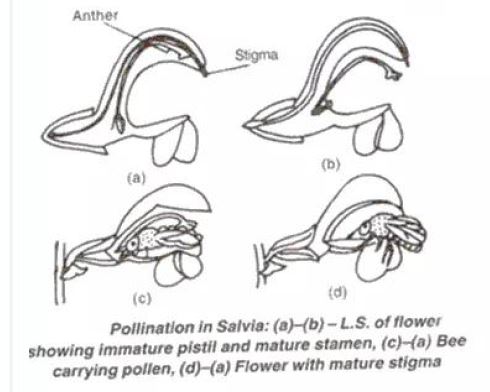
(i) Pollination in Salvia: In Salvia, pollination is facilitated by insects. The flower features a two-lipped corolla with a tubular base where a pair of stamens are fixed. The upper lip forms a protective hood, while the broader lower lip acts as a landing area for visiting insects. Only one of the stamens is fertile, and it is positioned safely beneath the upper hood of the corolla. As an insect lands on the lower lip and inserts its mouthparts into the tube to search for nectar, it triggers a lever-like mechanism. This causes the fertile anther to swing down and coat the insect's back with pollen. When the same insect travels to an older flower with a mature female organ, the downward-curved style brushes against its pollen-covered back, successfully transferring the pollen.
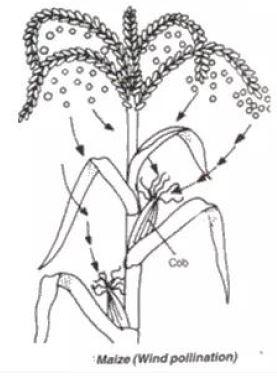
(ii) Pollination in Maize: Wind is the main agent responsible for pollination in maize plants, which are monoecious. The male flowers grow in clusters known as tassels at the very top of the plant, while the female parts, called cobs, develop lower down on the sides of the stem. From these female flowers, long, silky, thread-like styles hang outward. The male flowers release a large number of heavy pollen grains that are carried by light breezes. As these grains drop downward, they land on the sticky, exposed stigmas below, resulting in pollination.
In simple words: In Salvia, bees trigger a lever that dusts their backs with pollen. In maize, wind shakes pollen from the male tassels at the top of the plant, letting it fall onto the long, silky threads of the female cobs below.
Exam Tip: Use terms like "lever mechanism" for Salvia and "anemophily" or "wind pollination" for Maize. Explicitly mentioning that maize is "monoecious" (having male and female flowers on the same plant) is highly valued by examiners.
Question 6. Define the term fertilisation.
Answer: Fertilisation is the biological process where the male gamete merges with the female gamete to form a zygote.
In simple words: Fertilisation is when the male and female reproductive cells join together to start a new life.
Exam Tip: Make sure to mention the result of this fusion, which is the formation of a diploid zygote, to ensure a complete definition.
Question 7. Describe the steps involved in the germination of a pollen grain on the stigma until the release of male gametes.
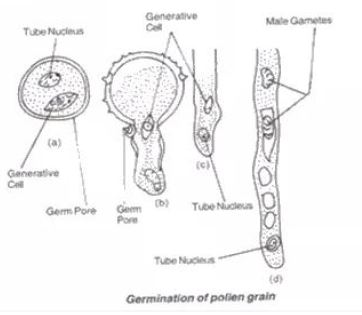
Answer: Once pollen grains settle on the receptive stigma, they soak up moisture and expand, causing the tough outer layer (exine) to burst. The thin inner layer (intine) then elongates outward, forming a structure called the pollen tube. This tube pushes its way downward through the style by releasing enzymes that break down and digest nutrients within the styling tissues. As it advances, the vegetative nucleus remains at the front tip of the growing tube. It is followed by the generative nucleus, which splits to produce two distinct male gametes. Finally, the pollen tube reaches the ovule, entering through a small pore called the micropyle, where it releases both male gametes directly into the embryo sac.
In simple words: After landing on the stigma, a pollen grain grows a long tube down the style to reach the egg. Inside this tube, a cell divides into two male gametes which are released into the ovary.
Exam Tip: Remember that the pollen tube enters through the "micropyle" of the ovule, and the generative nucleus divides into "two male gametes." Labeling these structures in diagrams is highly crucial for full marks.
Question 8. What is double fertilisation? Explain the processes of syngamy and triple fusion, and state the significance of double fertilisation.
Answer: In flowering plants (angiosperms), fertilisation occurs in two distinct events. First, one of the male gametes merges with the female egg cell to produce a diploid zygote, a step known as syngamy. Simultaneously, the second male gamete unites with the two polar nuclei located in the center of the embryo sac. This fusion produces a triploid nucleus referred to as the primary endosperm nucleus, and the process is called triple fusion. Because fertilisation happens twice within the same embryo sac, it is termed double fertilisation.
Significance: Double fertilisation is vital because the resulting triploid nucleus grows into the endosperm, a specialized tissue that provides essential nourishment to the growing plant embryo.
In simple words: Flowering plants have a two-step fertilization process. One male cell joins the egg to make the baby plant, while the other joins two helper cells to create a food supply that feeds the growing embryo.
Exam Tip: Clearly state the ploidy levels: the zygote is diploid (2n) and the primary endosperm nucleus is triploid (3n), as these details are frequently tested.
Question 9. Define a fruit.
Answer: A fruit is biologically described as a mature, fully ripened ovary of a flower that encloses one or multiple seeds.
In simple words: A fruit is simply the sweet or fleshy part of a plant that develops from a flower's ovary after it has been fertilized, holding the seeds inside.
Exam Tip: Make sure to write that a fruit develops specifically from the "ripened ovary" to get the scientific definition correct.
Question 10. State two major changes that occur in an ovary after fertilisation.
Answer: Following the process of fertilisation, the ovary experiences two key transformations:
- The internal ovules grow and mature into seeds.
- The outer walls of the ovary become thicker, ripening to form the pericarp, which is the fruit wall.
In simple words: Once fertilised, the tiny ovules inside the flower turn into seeds, and the outer wall of the ovary grows thick to become the skin or shell of the fruit.
Exam Tip: Remember that the "ovary" becomes the "fruit" and the "ovule" becomes the "seed." Getting these two terms mixed up is the most common mistake students make.
Question 11. Are fruits important for plants? Explain your answer.
Answer: Yes, fruits serve a crucial role for the plant because they offer a protective enclosure where the seeds can develop and mature. Additionally, fruits are often brightly coloured and delicious, which attracts various animals to eat them. As animals consume the fruits, they carry the seeds away and excrete them in different locations, ensuring the widespread dispersal and survival of the plant species.
In simple words: Fruits are important because they protect seeds while they grow. Since they are tasty and colorful, animals eat them and drop the seeds far away, helping new plants grow in different places.
Exam Tip: When discussing the importance of fruits, always mention two main points: protection of developing seeds, and assisting in seed dispersal.
Question 12(i). Pollination by insects is called
(a) anemophily
(b) hydrophily
(c) entomophily
(d) ornithophily
Answer: (c) entomophily
In simple words: When insects like bees or butterflies carry pollen between flowers, the process is called entomophily.
Exam Tip: Associating the prefix "entomo-" with insects can help you recall this term quickly in multiple-choice questions.
Question 12(ii). Chiropterophily is pollination brought about by
(a) bats
(b) insects
(c) birds
(d) snails
Answer: (a) bats
In simple words: Chiropterophily is the scientific name for pollination that is carried out by bats.
Exam Tip: Remember that bat-pollinated flowers usually open at night and have a very strong scent to attract these nocturnal creatures.
Question 12(iii). Pollination by birds is called
(a) ornithophily
(b) entomophily
(c) anemophily
(d) hydrophily
Answer: (a) ornithophily
In simple words: Ornithophily is the term used when birds are the agents that help transfer pollen.
Exam Tip: The term "ornithology" means the study of birds, which makes it easy to remember that "ornithophily" refers to bird pollination.
Question 12(iv). One male gamete fuses with the egg and forms a diploid zygote. This process is called
(a) syngamy
(b) triple fusion
(c) double fertilization
(d) parthenogenesis
Answer: (a) syngamy
In simple words: Syngamy is the process where a male sperm cell merges with a female egg cell to form a new cell that will grow into a seed.
Exam Tip: Always differentiate syngamy (fusion of egg and sperm) from triple fusion (fusion of sperm and polar nuclei) as they are the two parts of double fertilization.
Question 12(v). The study of fruits and fruit culture is known as
(a) olericulture
(b) floriculture
(c) pomology
(d) morphology
Answer: (c) pomology
In simple words: Pomology is the branch of science that deals with studying fruits and how to grow them.
Exam Tip: Keep in mind that pomology focuses solely on the cultivation of fruit crops, distinguishing it from other areas of plant science.
Question 12(vi). Fruits which develop only from the ovary of a flower are called
(a) false fruits
(b) true fruits
(c) parthenocarpic fruits
(d) aggregate fruits
Answer: (b) true fruits
In simple words: A true fruit is one that develops entirely from the ovary of a flower without any other flower parts being involved.
Exam Tip: Contrast true fruits (like mango or tomato) with false fruits (like apple or pear, which develop from the thalamus) to get full marks on comparison questions.
Free study material for Biology
ICSE Frank Brothers Solutions Class 9 Biology Chapter 8 Pollination And Fertilization
Students can now access the detailed Frank Brothers Solutions for Chapter 8 Pollination And Fertilization on our portal. These solutions have been carefully prepared as per latest ICSE Class 9 syllabus. Each solution given above has been updated based on the current year pattern to ensure Class 9 students have the most updated Biology content.
Master Frank Brothers Textbook Questions
Our subject experts have provided detailed explanations for all the questions found in the Frank Brothers textbook for Class 9 Biology. We have focussed on making the concepts easy for you in Chapter 8 Pollination And Fertilization so that students can understand the concepts behind every answer. For all numerical problems and theoretical concepts these solutions will help in strengthening your analytical skill required for the ICSE examinations.
Complete Biology Exam Preparation
By using these Frank Brothers Class 9 solutions, you can enhance your learning and identify areas that need more attention. We recommend solving the Biology Questions from the textbook first and then use our teacher-verified answers. For a proper revision of Chapter 8 Pollination And Fertilization, students should also also check our Revision Notes and Sample Papers available on studiestoday.com.
FAQs
You can download the verified Frank Brothers solutions for Chapter 8 Pollination And Fertilization on StudiesToday.com. Our teachers have prepared answers for Class 9 Biology as per 2026-27 ICSE academic session.
Yes, our solutions for Chapter 8 Pollination And Fertilization are designed as per new 2026 ICSE standards. 40% competency-based questions required for Class 9, are included to help students understand application-based logic behind every Biology answer.
Yes, every exercise in Chapter 8 Pollination And Fertilization from the Frank Brothers textbook has been solved step-by-step. Class 9 students will learn Biology conceots before their ICSE exams.
Yes, follow structured format of these Frank Brothers solutions for Chapter 8 Pollination And Fertilization to get full 20% internal assessment marks and use Class 9 Biology projects and viva preparation as per ICSE 2026 guidelines.