

ICSE Solutions Frank Brothers Class 9 Biology Chapter 9 Seeds Structure And Germination have been provided below and is also available in Pdf for free download. The Frank Brothers ICSE solutions for Class 9 Biology have been prepared as per the latest syllabus and ICSE books and examination pattern suggested in Class 9. Questions given in ICSE Frank Brothers book for Class 9 Biology are an important part of exams for Class 9 Biology and if answered properly can help you to get higher marks. Refer to more Chapter-wise answers for ICSE Class 9 Biology and also download more latest study material for all subjects. Chapter 9 Seeds Structure And Germination is an important topic in Class 9, please refer to answers provided below to help you score better in exams
Frank Brothers Chapter 9 Seeds Structure And Germination Class 9 Biology ICSE Solutions
Class 9 Biology students should refer to the following ICSE questions with answers for Chapter 9 Seeds Structure And Germination in Class 9. These ICSE Solutions with answers for Class 9 Biology will come in exams and help you to score good marks
Chapter 9 Seeds Structure And Germination Frank Brothers ICSE Solutions Class 9 Biology
Question 1. Define the following:
(a) Seed
(b) Germination
Answer:
(a) A seed represents a fully developed, fertilized ovule that contains an inactive embryo along with stored nutrients intended to support its subsequent growth.
(b) Germination refers to the sequence wherein a resting embryo inside the seed reactivates its growth to eventually produce a young seedling.
In simple words: A seed is a sleeping baby plant packaged with its own food. Germination is when this resting plant wakes up and starts growing into a seedling.
Exam Tip: Be sure to include the terms "fertilized mature ovule" and "inactive/dormant embryo" when defining a seed to secure full marks.
Question 2. Explain the following terms:
(a) Albuminous seed
(b) Dormancy
(c) Hypogeal germination
(d) Epigeal germination
Answer:
(a) Albuminous seed - These are monocot or dicot seeds where the primary food supply is retained within the endosperm tissue. Examples include grasses, cereals, and castor seeds.
(b) Dormancy - This is a state in which a viable seed is unable to sprout, even when supplied with ideal external conditions. Throughout this phase of temporary inactivity, growth remains suspended until a specific duration has passed.
(c) Hypogeal germination - During this process, the epicotyl grows more rapidly than the hypocotyl, keeping the cotyledons buried beneath the ground. This occurs in crops like wheat, peas, rice, and mangoes.
(d) Epigeal germination - This category of sprouting features the rapid stretching of the hypocotyl, which thrusts the cotyledons upward into open air and sunlight. Examples include beans, cotton, onions, and papayas.
In simple words: Albuminous seeds store their food in a special tissue called the endosperm. Dormancy is a sleeping stage where the seed refuses to sprout even in perfect conditions. In hypogeal germination, the seed stays underground, while in epigeal germination, the seed leaves are pushed above the dirt.
Exam Tip: Differentiate hypogeal and epigeal germination clearly by identifying which part elongates faster: epicotyl for hypogeal, and hypocotyl for epigeal.
Question 3. A seed is provided with all the conditions necessary for germination, yet it fails to germinate. Explain.
Answer: This happens when the seed is undergoing a phase of dormancy. During this period, the embryo stays completely inactive and will not sprout despite having all necessary environmental factors, until its set rest period is complete.
In simple words: Even with perfect water, air, and warmth, some seeds will not grow because they are in a deep sleep called dormancy that must finish first.
Exam Tip: Remember to highlight "dormancy" as the primary reason why a viable seed fails to germinate under favorable conditions.
Question 4. Give the functions of the following:
(a) Seed coat
(b) Micropyle
(c) Endosperm
(d) Cotyledons
Answer:
(a) Seed coat - Serving as the protective external layer, it shields the sensitive internal parts of the seed.
(b) Micropyle - This tiny opening permits moisture to pass inside to the developing embryo.
(c) Endosperm - It serves as a reservoir of nutrients, primarily stored in the form of starch.
(d) Cotyledons - These embryonic leaves store the essential nourishment needed by the growing plant.
In simple words: The seed coat protects the inside, the micropyle is a tiny hole for water to get in, and both the endosperm and cotyledons act as food pantries for the baby plant.
Exam Tip: Learn the distinction between endosperm and cotyledon functions: both store food, but their occurrence and structure vary between monocots and dicots.
Question 5. Name the following:
(a) The part of the seed which gives out the shoot.
(b) The protective sheath covering the radicle in the maize grain.
(c) The part of castor seed that stores food.
(d) The small opening through which water enters the seeds.
(e) What is formed from radicle and plumule?
(f) In which part of the maize seed food is stored?
(g) The type of germination in which the cotyledons come above ground.
(h) The type of germination in which the cotyledons stay below the ground.
(i) Lightest seed.
(j) Largest seed.
Answer:
(a) Plumule
(b) Coleorhiza
(c) Endosperm
(d) Micropyle
(e) Root and shoot respectively
(f) Endosperm
(g) Epigeal germination
(h) Hypogeal germination
(i) Orchis seed
(j) Seed of Lodoicea moldivica
In simple words: These are the scientific names for different seed parts, types of sprouting, and record-holding seeds in nature.
Exam Tip: Be precise with scientific terms like "Plumule" and "Coleorhiza", ensuring correct spelling to avoid losing marks.
Question 6. Differentiate between:
(a) Coleorhiza and Coleoptile
(b) Albuminous seed and Exalbuminous seed
(c) Epigeal germination and Hypogeal germination
Answer:
(a) Coleorhiza vs Coleoptile:
| Coleorhiza | Coleoptile |
|---|---|
| A protective outer sheath that envelopes the radicle in some seeds. | A protective outer sheath that envelopes the embryonic plumule in some seeds. |
(b) Albuminous seed vs Exalbuminous seed:
| Albuminous Seed | Exalbuminous Seed |
|---|---|
| They retain endosperm tissue at maturity. | They do not contain any endosperm when mature. |
| Nutrients are primarily stored within this endosperm. | Nutrients are stored solely inside the cotyledons. |
| Examples: Castor, cereals, and grasses. | Examples: Pea, gram, and lentil. |
(c) Epigeal germination vs Hypogeal germination:
| Epigeal Germination | Hypogeal Germination |
|---|---|
| The cotyledons are elevated above ground level. | The cotyledons stay buried underground. |
| The hypocotyl grows rapidly and stretches faster than the epicotyl. | The epicotyl grows rapidly and stretches faster than the hypocotyl. |
| Examples: Beans, castor, cotton, and papaya. | Examples: Pea, mango, wheat, and rice. |
In simple words: Coleorhiza guards the root while coleoptile protects the shoot. Albuminous seeds keep their endosperm for food, but exalbuminous ones do not. In epigeal growth, the stem pushes cotyledons up into the light, whereas in hypogeal growth, they stay deep in the dirt.
Exam Tip: Highlighting clear examples for each difference in comparison questions is a great way to ensure you receive full credit from the examiner.
Question 7. Give two examples each of:
(a) Dicotyledonous albuminous seeds.
(b) Monocotyledonous albuminous seeds.
(c) Dicotyledonous non-endospermic seeds showing hypogeal germination.
(d) Monocotyledonous endospermic seeds showing hypogeal germination.
Answer:
(a) Castor and papaya
(b) Grasses and wheat
(c) Pea and mango
(d) Wheat and rice
In simple words: These are examples of different seeds categorized by how many seed leaves they have, where they store food, and how they sprout.
Exam Tip: Memorize castor and wheat as classic examples of albuminous seeds, as they frequently appear in multiple-choice questions.
Question 8. Explain the factors that are necessary for seed germination.
Answer: The crucial factors required for successful seed germination are:
1. Water - Moisture is vital for sprouting because the protoplasm inside seed cells requires saturation to become active. It assists in chemical transformations and provides a liquid medium for essential enzymatic processes. Additionally, absorption of water softens and expands the seed coat, making it rupture so that the young embryo can emerge.
2. Temperature - Appropriate warmth is required to drive various metabolic activities inside the seed as it germinates. Sprouting is generally arrested below \( 0^\circ\text{C} \) or above \( 45^\circ\text{C} \), with the ideal range lying between \( 15^\circ\text{C} \) and \( 30^\circ\text{C} \).
3. Oxygen - As the developing embryo restarts active growth, it needs a continuous supply of energy. This energy is generated by breaking down stored nutrients in the endosperm or cotyledons through respiration, which relies heavily on oxygen.
In simple words: To sprout, seeds must have water to activate their cells and soften their shell, warmth (ideal temperature) to speed up growth processes, and oxygen to breathe and generate energy.
Exam Tip: Be sure to name all three factors (water, temperature, oxygen) and state the optimum temperature range of \( 15^\circ\text{C} - 30^\circ\text{C} \) explicitly.
Question 9. Describe the three-beans experiment to show that water, temperature, and oxygen are essential for germination.
Answer:
Procedure:
To perform this experiment, you need a beaker, a wooden strip, and three dry bean seeds. Tie the seeds to the wooden strip at three levels: one at the top end, one in the center, and one at the bottom end. Secure this arrangement inside the beaker and add water until the middle bean is half submerged. Place the beaker in a warm room for several days, occasionally adding water to keep the fluid level steady.
Observations:
After a few days, distinct differences can be seen:
- The seed in the middle sprouts successfully because it receives adequate water, warmth, and oxygen.
- The lowermost seed, which is completely submerged, gets plenty of water and heat but lacks oxygen; consequently, it might sprout a small radicle but will not grow further.
- The topmost seed has access to air and warmth but lacks moisture, preventing it from germinating.
Conclusion:
This setup proves that water, oxygen, and an appropriate temperature are all collectively necessary for seeds to germinate, and growth is blocked if any single factor is missing.
In simple words: Tie three seeds to a stick and place them in a glass so only the middle one is half in water. Only the middle seed grows because it has both water and air, while the top one has no water and the bottom one has no air.
Exam Tip: Be prepared to sketch the three-beans setup. Clearly label the three levels and specify which factors (water, oxygen, warmth) are available or unavailable for each seed.
Question 10. Explain why seeds sown too deep in the soil fail to germinate.
Answer: Planting seeds deep underground blocks their access to the oxygen needed for cellular respiration. Because of this lack of air, they are unable to produce energy and fail to sprout.
In simple words: If you bury seeds too deep, they cannot breathe. Without oxygen from the air, they run out of energy and cannot grow.
Exam Tip: The keyword here is "respiration" - mention that deep soil has inadequate oxygen, which halts the seedling's respiratory processes.
Question 11. Describe the structure of a typical seed with the help of a labeled diagram.
Answer:
A standard seed is composed of the following key anatomical components:
(i) Seed coat - This protective outer layer of the seed originates from the ovule's integuments. It comprises two main sheets: an exterior layer named the testa and an interior layer known as the tegmen, which together protect the delicate inner structures.
(ii) Micropyle - Located close to the hilum scar, this minute opening acts as a pathway for water to enter the inner embryo before sprouting.
(iii) Embryo - This is the tiny, undeveloped plant nested securely inside the seed coat, originating from the fertilized egg cell. The fully formed embryo is made of seed leaves (called cotyledons), a plumule, a hypocotyl, and a radicle. Dicotyledonous plants have two cotyledons attached via a tiny stem, while monocotyledonous plants possess just one. These cotyledons act as a food store for the early seedling.
(iv) Endosperm - Found in specific types of seeds, this tissue functions as a dedicated food storage reserve. Seeds containing this layer are referred to as endospermic.
Diagram of Seed Structure:
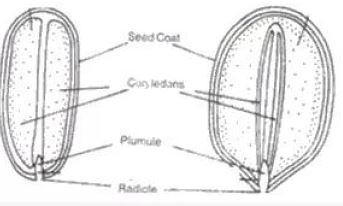
In simple words: A seed has a protective skin (seed coat) with a tiny water hole (micropyle). Inside, there is a baby plant (embryo) consisting of leaves (plumule), a root (radicle), and seed leaves (cotyledons) that feed it.
Exam Tip: Memorize the two layers of the seed coat: the outer tough "testa" and the inner thin "tegmen", as they are highly favored by examiners.
Question 12(i). Food is stored in the seeds of castor
(a) in radicle
(b) in plumule
(c) in cotyledons
(d) in endosperm
Answer: (d) in endosperm
In simple words: In a castor seed, the nutrients are packed inside the endosperm tissue rather than the cotyledons.
Exam Tip: Remember that castor is an albuminous (endospermic) dicot seed, which distinguishes it from most other dicots that store food in cotyledons.
Question 12(ii). Caruncle is present in
(a) wheat
(b) maize
(c) paddy
(d) castor bean
Answer: (d) castor bean
In simple words: Castor bean seeds have a special fleshy white structure near their tip, which is called a caruncle.
Exam Tip: The caruncle is a specialized outgrowth that assists the seed by absorbing water and facilitating entry of water into the micropyle.
Question 12(iii). Essential condition for germination is
(a) water
(b) oxygen
(c) temperature
(d) all of the options
Answer: (d) all of the options
In simple words: A seed needs water, oxygen, and the right temperature together to start growing. If any of these are missing, it cannot sprout.
Exam Tip: Pay attention to keywords like "essential". If the question lists water, air (oxygen), and warmth, the correct selection will include all of these factors.
Question 12(iv). Hypogeal germination is present in
(a) pea
(b) bean
(c) castor
(d) maize
Answer: (d) maize
In simple words: In maize grains, the cotyledon remains below the ground during the growth of the seedling, which is hypogeal germination.
Exam Tip: Maize is a classic example of a monocotyledonous seed showing hypogeal germination.
Question 12(v). Largest seed is
(a) double coconut
(b) coconut
(c) heartnut
(d) walnut
Answer: (a) double coconut
In simple words: The largest seed found in the entire plant kingdom is the double coconut seed.
Exam Tip: Memorize the scientific name of the double coconut (Lodoicea maldivica) as it is often tested alongside this fact.
Question 12(vi). The collective term for the stages that lead to the formation of seedling from a seed is
(a) dormancy
(b) germination
(c) viability
(d) none of the options
Answer: (b) germination
In simple words: Germination is the term used for all the steps a seed goes through to develop into a young plant.
Exam Tip: Ensure you understand the complete physiological transition from an inactive embryo to a fully self-sustaining green seedling.
Free study material for Biology
ICSE Frank Brothers Solutions Class 9 Biology Chapter 9 Seeds Structure And Germination
Students can now access the detailed Frank Brothers Solutions for Chapter 9 Seeds Structure And Germination on our portal. These solutions have been carefully prepared as per latest ICSE Class 9 syllabus. Each solution given above has been updated based on the current year pattern to ensure Class 9 students have the most updated Biology content.
Master Frank Brothers Textbook Questions
Our subject experts have provided detailed explanations for all the questions found in the Frank Brothers textbook for Class 9 Biology. We have focussed on making the concepts easy for you in Chapter 9 Seeds Structure And Germination so that students can understand the concepts behind every answer. For all numerical problems and theoretical concepts these solutions will help in strengthening your analytical skill required for the ICSE examinations.
Complete Biology Exam Preparation
By using these Frank Brothers Class 9 solutions, you can enhance your learning and identify areas that need more attention. We recommend solving the Biology Questions from the textbook first and then use our teacher-verified answers. For a proper revision of Chapter 9 Seeds Structure And Germination, students should also also check our Revision Notes and Sample Papers available on studiestoday.com.
FAQs
You can download the verified Frank Brothers solutions for Chapter 9 Seeds Structure And Germination on StudiesToday.com. Our teachers have prepared answers for Class 9 Biology as per 2026-27 ICSE academic session.
Yes, our solutions for Chapter 9 Seeds Structure And Germination are designed as per new 2026 ICSE standards. 40% competency-based questions required for Class 9, are included to help students understand application-based logic behind every Biology answer.
Yes, every exercise in Chapter 9 Seeds Structure And Germination from the Frank Brothers textbook has been solved step-by-step. Class 9 students will learn Biology conceots before their ICSE exams.
Yes, follow structured format of these Frank Brothers solutions for Chapter 9 Seeds Structure And Germination to get full 20% internal assessment marks and use Class 9 Biology projects and viva preparation as per ICSE 2026 guidelines.