

ICSE Solutions Goyal Brothers Class 9 History Civics Chapter 10 The Mughal Empire have been provided below and is also available in Pdf for free download. The Goyal Brothers ICSE solutions for Class 9 History Civics have been prepared as per the latest syllabus and ICSE books and examination pattern suggested in Class 9. Questions given in ICSE Goyal Brothers book for Class 9 History Civics are an important part of exams for Class 9 History Civics and if answered properly can help you to get higher marks. Refer to more Chapter-wise answers for ICSE Class 9 History Civics and also download more latest study material for all subjects. Chapter 10 The Mughal Empire is an important topic in Class 9, please refer to answers provided below to help you score better in exams
Goyal Brothers Chapter 10 The Mughal Empire Class 9 History Civics ICSE Solutions
Class 9 History Civics students should refer to the following ICSE questions with answers for Chapter 10 The Mughal Empire in Class 9. These ICSE Solutions with answers for Class 9 History Civics will come in exams and help you to score good marks
Chapter 10 The Mughal Empire Goyal Brothers ICSE Solutions Class 9 History Civics
Exercises
Question 1. Name any two sources to reconstruct the Age of the Mughals.
Answer: Two prominent literary records used to study the Mughal era are the Ain-i-Akbari and the Akbarnama.
In simple words: We can learn about the Mughal times from two famous books called Ain-i-Akbari and Akbarnama.
Exam Tip: Naming both the 'Ain-i-Akbari' and the 'Akbarnama' is the most direct way to secure full marks.
Question 2. Who wrote Ain-i-Akbari.
Answer: The historical text Ain-i-Akbari was composed by Abul Fazl.
In simple words: The book Ain-i-Akbari was written by Akbar's wise minister, Abul Fazl.
Exam Tip: Be sure to write 'Abul Fazl' clearly as the author of this famous text.
Question 3. What information does Abul Fazl provide about Akbar’s Admiralty Department ?
Answer: According to the writings of Abul Fazl, the Admiralty Department was tasked with several key responsibilities:
1. Overseeing the construction of various boats and river vessels.
2. Hiring and training experienced sailors and crew members.
In simple words: Abul Fazl wrote that Akbar's boat department was in charge of building boats and hiring good sailors.
Exam Tip: Specify both functions - constructing vessels and recruiting skilled mariners - for a complete answer.
Question 4. Name any two monuments that help to reconstruct the history of the Mughals.
Answer: Two significant architectural monuments that provide insights into Mughal history are the Agra Fort and Humayun's Tomb.
In simple words: Two famous buildings that teach us about the Mughals are the Agra Fort and Humayun's Tomb.
Exam Tip: Agra Fort and Humayun's Tomb are great physical sources of history to list.
Question 5. Name the two magnificent buildings within the Red Fort.
Answer: Two outstanding structures located inside the Red Fort complex are:
1. Diwan-i-Aam: A grand assembly hall designed for public audiences and state gatherings.
2. Diwan-i-Khas: A highly decorative, luxurious hall that housed the famous Peacock Throne, where the monarch met with royal princes, high-ranking nobles, and foreign diplomats.
In simple words: The two famous halls are the Diwan-i-Aam, where the king met regular citizens, and the Diwan-i-Khas, where he met important leaders on his Peacock Throne.
Exam Tip: Clearly distinguish between the public hall (Diwan-i-Aam) and the private, decorated hall (Diwan-i-Khas) to show deep understanding.
Question 6. Mention any two architectural features of the Jama Masjid at Delhi.
Answer: The Jama Masjid in Delhi features several prominent architectural details:
1. It is constructed on a raised platform, measuring roughly 9 meters high and spanning 1,170 square meters. The mosque features three grand entryways, reached by wide steps on the north, south, and east, with the grandest Eastern Gate reserved strictly for royal use. These gates lead into a spacious open courtyard.
2. The structure's outer corners are adorned with twelve-pillared pavilions topped with white marble domes, with the largest dome situated at the center.
3. The northern and southern wings are flanked by two tall, elegant minarets, each standing about 40 meters tall and split into three levels with viewing galleries.
4. The front facade of the main prayer hall contains eleven separate arches, with the dominant central arch rising significantly higher than the surrounding roofline.
In simple words: The Jama Masjid is built on a high platform with three grand entrances and has beautiful marble domes. It also features two very tall towers and an archway with eleven arches.
Exam Tip: Describe the high platform basement and the tall minarets as two defining architectural features of the mosque.
Question 7. In whose memory was the Taj Mahal built ?
Answer: The Taj Mahal was commissioned by Emperor Shah Jahan to honor the memory of his favorite empress, Mumtaz Mahal.
In simple words: The Taj Mahal was built by Shah Jahan because he loved his wife, Mumtaz Mahal, and wanted to remember her.
Exam Tip: Ensure you mention both Emperor Shah Jahan as the builder and Mumtaz Mahal as the queen in whose memory it was built.
Question 8. Whom did Babur defeat at the battlefield of Panipat? What was its consequence?
Answer: In April 1526, Babur successfully defeated Sultan Ibrahim Lodi at the historic Battle of Panipat. This critical triumph was achieved due to his tactical command and the use of advanced artillery and gunpowder weapons sourced from Turkey, establishing Babur as the ruler of northern India. The victory also paved the way for his next major clash against the powerful Rajput chief Rana Sanga of Mewar, who had assembled a grand coalition of Rajput rulers. Following Babur's subsequent victory at Khanua near Agra, he secured firm political authority over Central India.
In simple words: Babur defeated Sultan Ibrahim Lodi in April 1526. This victory helped him become the ruler of India and set up the Mughal Empire, after which he defeated the Rajputs at Khanua to secure central India.
Exam Tip: Identify Ibrahim Lodi as the defeated ruler, specify the date (April 1526), and state the main consequence: the establishment of Mughal rule in India.
Question 9. What was the result of Babur’s encounter with a huge confederacy of Rajputs at Khanua?
Answer: The Battle of Khanua ended in a decisive victory for Babur over the unified Rajput forces. This success granted the Mughal emperor undisputed sovereignty and administrative control over Central India.
In simple words: Babur won the Battle of Khanua against the combined Rajput army, giving him full control over Central India.
Exam Tip: Emphasize that this victory eliminated a major threat to Mughal rule and consolidated Babur's hold over Central India.
Question 10. What is the significance of the Second Battle of Panipat (1556)?
Answer: Fought in November 1556, the Second Battle of Panipat pitted the Mughal forces against Hemu, the general and nephew of Sher Shah Suri. The encounter resulted in the routing of the Afghan forces and the capture and execution of Hemu, effectively securing the Mughal dynasty's return to power in India.
In simple words: In November 1556, the Mughals defeated Hemu's Afghan army. Hemu was captured and killed, which helped the Mughals keep control of India.
Exam Tip: The primary significance is that it crushed the Afghan challenge and firmly re-established Akbar's claim to the Delhi throne.
Question 11. Name any two Deccan territories included in Akbar’s empire.
Answer: Among the southern regions integrated into the empire's sphere of influence during this era were Ahmadnagar, Bijapur, and Golconda.
In simple words: Two Deccan areas that became part of the Mughal empire's influence were Ahmadnagar and Bijapur.
Exam Tip: Listing Ahmadnagar and Bijapur is a safe choice to answer this question.
Question 12. What was Akbar’s Mansabdari System ?
Answer: The Mansabdari system was a highly distinctive administrative framework established by Akbar to organize the Mughal bureaucracy and military. Under this structure, officers held specific ranks, known as mansabs, which determined their status and salary. These officials held significant civil and military responsibilities, with ranks ranging from 10 to 5,000 for top-tier nobles. Ranks were classified into two components: 'zat', indicating personal status and pay, and 'sawar', reflecting the size of the cavalry troop they had to maintain. Additionally, mansabdars were required to keep two horses for every single cavalryman under their command.
In simple words: The Mansabdari system was a grading system for Mughal officers. Each officer had a rank (mansab) that decided their pay and how many soldiers they had to lead.
Exam Tip: Make sure to explain both the 'zat' (personal rank/salary) and 'sawar' (cavalry responsibility) components of this administrative system.
Question 13. Akbar’s Din-I-Ilahi was based on what principles or beliefs ?
Answer: This spiritual philosophy was founded on the concept of the unity of God, promoting moral virtues such as bravery, faithfulness, and social justice.
In simple words: It was based on the belief in one God and taught good qualities like bravery, loyalty, and being fair to everyone.
Exam Tip: In addition to 'oneness of God', list ethical virtues like 'loyalty' and 'justice' as core pillars of Din-i-Ilahi.
Question 14. Name any two Departments of Government during the Mughal Age.
Answer: Three major administrative departments under the Mughal administration were:
1. The Military Pay and Accounts Office, supervised by the Mir Bakshi.
2. The Imperial Household Department, managed by the Khan-i-Saman.
3. The Judicial System, led by the Chief Qazi.
In simple words: Two main departments were the military department (led by the Mir Bakshi) and the royal household department (led by the Khan-i-Saman).
Exam Tip: Label the departments alongside their respective heads (e.g., Mir Bakshi for military pay and Khan-i-Saman for the imperial household) for full credit.
Question 15. Who was at the head of the Finance Department under Mughal rule.
Answer: The official who directed the imperial finance department under Mughal administration was known as the Diwan.
In simple words: The finance minister under the Mughals was called the Diwan.
Exam Tip: Simply naming the 'Diwan' as the chief financial authority is sufficient for this direct question.
Question 16. Name the master architect who designed the Taj Mahal.
Answer: The master designer credited with planning the Taj Mahal was Ustad Isa.
In simple words: The architect who designed the beautiful Taj Mahal was Ustad Isa.
Exam Tip: Provide the name 'Ustad Isa' as the primary architect as per the textbook syllabus.
Question 17. Diwan-i-Khas in the Red Fort was used by the Emperor for what purpose ?
Answer: The Diwan-i-Khas was a highly decorated assembly hall that housed the magnificent Peacock Throne. The Mughal emperor used this exclusive space to conduct private meetings and grant audiences to royal family members, prominent court nobles, and visiting state guests.
In simple words: The Diwan-i-Khas was a fancy room where the king sat on his Peacock Throne to meet privately with princes, nobles, and important visitors.
Exam Tip: Contrast this with the Diwan-i-Aam by emphasizing that the Diwan-i-Khas was strictly for private royal audiences and housed the Peacock Throne.
Question 18. Mention any two factors responsible for Humayun’s failure against Sher Shah Suri.
Answer: Two primary reasons for Humayun's setbacks in his conflicts with Sher Shah Suri were:
1. He lacked the tactical military expertise and commanding skills possessed by his father, Babur.
2. He struggled to design and execute consistent, long-term political and military strategies.
In simple words: First, Humayun was not as strong of a general as his father Babur. Second, he was not able to stick to a solid, long-term plan.
Exam Tip: Focus on Humayun's personal shortcomings as a military general and his lack of a consistent administrative policy.
Question 19. Mention any two revenue reforms instituted by Sher Shah Suri.
Answer: Two major financial reforms introduced by Sher Shah Suri to organize land taxation include:
1. Implementing a standardized, orderly method for measuring agricultural land.
2. Accurately assessing tax rates based on land productivity and ensuring strict, systematic collection.
In simple words: First, Sher Shah Suri introduced a regular system to measure land. Second, he calculated land taxes fairly and collected them strictly.
Exam Tip: Clearly state that his system relied on 'land measurement' and 'strict assessment and collection' of taxes.
Question 20. What is the significance of Akbar’s Mansabdari system?
Answer: The primary significance of this system lay in its merit-based, centralized approach. The emperor directly selected and appointed competent officials as mansabdars, who performed dual roles as administrative governors and military commanders. This system streamlined the governance of the massive empire, making regional control highly efficient and organized.
In simple words: The system was important because Akbar chose qualified people directly to be both army leaders and governors, which made running his huge empire much easier.
Exam Tip: Highlight the dual military-civil administrative role of the mansabdars and the centralized control it gave the emperor.
Question 21. Mention the nature of Akbar’s Din-I-Ilahi.
Answer: Introduced in 1580, Din-i-Ilahi was a moral and spiritual philosophy rather than a rigid religion. It centered on the concept of monotheism and required followers to practice personal virtues such as courage, moral purity, and justice, while demanding absolute political loyalty to Akbar.
In simple words: Started in 1580, Din-i-Ilahi was a set of moral rules about believing in one God, being honest and brave, and showing deep loyalty to the emperor.
Exam Tip: Specify the introduction year (1580) and define it as an ethical philosophy based on monotheism and loyalty to the crown.
Question 22. How did Jahangir deal with the Sikh Guru, Guru Arjun Dev?
Answer: Emperor Jahangir ordered the imprisonment, severe torture, and ultimate execution of the fifth Sikh spiritual leader, Guru Arjan Dev.
In simple words: Jahangir tortured and put the fifth Sikh leader, Guru Arjan Dev, to death.
Exam Tip: Be direct: state that Guru Arjan Dev was tortured and executed under Jahangir's orders.
Question 23. Why was the title of ‘Shah Jahan’ conferred on Prince Khurram by Jahangir ?
Answer: Prince Khurram was married to Arjumand Banu Begum, the daughter of Asaf Khan, who held the influential office of Khan-i-Saman under Jahangir. Since Asaf Khan was the brother of the powerful empress Nur Jahan, this alliance deeply integrated Prince Khurram into the core ruling clique, leading Jahangir to bestow upon him the prestigious title of 'Shah Jahan'.
In simple words: Prince Khurram married Asaf Khan's daughter. Because Asaf Khan was the brother of Empress Nur Jahan, this strong family connection led Jahangir to give him the title 'Shah Jahan'.
Exam Tip: Stick to the textbook's explanation regarding the strategic marriage alliance with Asaf Khan's daughter and his connection to Nur Jahan.
Question 24. Who was Nur Jahan?
Answer: Nur Jahan was the widow of Sher Afghan, a prominent Persian noble. She later married Emperor Jahangir and became one of the most politically active and powerful empresses in Mughal history.
In simple words: Nur Jahan was a noblewoman whose husband, Sher Afghan, had died. She later married Emperor Jahangir and held great power in the empire.
Exam Tip: Mention her previous marriage to Sher Afghan and her subsequent marriage to Emperor Jahangir.
Question 25. Why did Shah Jahan revolt against his father?
Answer: Emperor Jahangir was heavily influenced by his ambitious wife, Nur Jahan, who sought to dominate the affairs of the state. Recognizing her political maneuvers to secure her own power, Prince Khurram (Shah Jahan) developed a deep rift with her. Sensing that his position as successor was being undermined, he ultimately launched a rebellion against his father.
In simple words: Shah Jahan rebelled because his father's wife, Nur Jahan, was very ambitious and wanted to control the throne. This created a rift, making Shah Jahan fight for his rights.
Exam Tip: Focus on the political rivalry between Shah Jahan and Empress Nur Jahan as the primary trigger for the rebellion.
Question 26. Metnion Shah Jahan’s conquests in the Deccan.
Answer: In the southern campaigns, Shah Jahan expanded Mughal territory by conquering Ahmadnagar and forcing the kingdoms of Bijapur and Golconda to accept Mughal suzerainty.
In simple words: In the south, Shah Jahan successfully conquered Ahmadnagar and took control of Bijapur and Golconda.
Exam Tip: Name the three major Deccan states: Ahmadnagar, Bijapur, and Golconda.
Question 27. Where is Humayun’s Tomb located? Mention any two features of the monument.
Answer: Situated in Delhi, Humayun's Tomb was built under the guidance of his widow, Hamida Banu Begum. Key architectural features of this historical site include:
1. It is built on a grand, elevated square platform with spacious archways on all sides, each leading to a separate chamber.
2. It features a prominent double dome made of white marble, which has a bulbous shape resting on a narrow cylindrical base.
In simple words: The tomb is in Delhi and was built by Humayun's wife. It sits on a high square base with arched doorways, and has a large, round marble dome on a narrow neck.
Exam Tip: Remember to state the location (Delhi), who commissioned it (Hamida Banu Begum), and highlight the double marble dome as a signature feature.
Structured Questions
Question 1. Akbar had both the time and inclination to look at the administrative problems of the Empire. In this context describe birefly.
(a) His Mansabdari System
(b) His Land Revenue System
Answer:
(a) Mansabdari System: To manage his military forces more efficiently, Akbar introduced the Mansabdari system. Nearly all administrative officers, with the exception of judicial and religious scholars (qazis and sadars), were given ranks (mansabs) and were expected to maintain a specific number of soldiers based on their rank. These officers were appointed directly by the emperor and paid in cash rather than through traditional land revenues. From their pay, mansabdars had to fund their personal expenses as well as maintain a required number of horses, transport animals, and equipment. They were expected to serve in any capacity or province as directed by the crown, fulfilling both military and civilian roles. By providing high salaries and elevated social standing, Akbar successfully attracted talented individuals to run the state. This system was not hereditary, allowing the emperor to promote, demote, or dismiss officials at his discretion.
(b) His Land Revenue System: The land administration system remained largely unchanged during the early years of Akbar's reign. However, when Raja Todar Mal took charge as the Diwan-i-Ashraf (head of the land revenue department), he designed a comprehensive new tax framework based on:
1. Conducting detailed land surveys and measurements.
2. Categorizing agricultural lands based on their yield and fertility.
3. Deciding fixed tax rates that farmers could pay in cash or in kind.
A key reform was the 'Dahsala' system, where tax collectors gathered data on the average crop yields and prices over the previous ten years. The government share was fixed at one-third of this ten-year average. This reform eliminated the need for tedious annual tax assessments, streamlining the revenue collection process. Ultimately, Todar Mal's policies successfully filled the imperial treasury while ensuring that farmers were not financially ruined. The state also offered loans to struggling cultivators, boosting agricultural productivity, trade, and regional industries.
In simple words: Akbar's Mansabdari system organized his officers into military ranks with cash salaries, making them loyal to him. His land revenue system, created by Todar Mal, surveyed and classified lands, fixing taxes at one-third of the ten-year average crop yield. This kept tax rates fair and boosted farming.
Exam Tip: In part (a), mention that the status was non-hereditary, and in part (b), focus on the three pillars of Todar Mal's system and the benefits of the Dahsala tax system.
Question 2. Akbar was the greatest of all medieval rulers of India. In this context describe: His policy of racial pacification and religious tolerance.
Answer: Akbar pursued a policy of social and religious integration to unite his diverse empire:
1. Abolition of Discriminatory Taxes: He abolished the Jizya (poll tax on non-Muslims) and the pilgrim tax, making all subjects feel equal under the law.
2. Opening of State Services: He welcomed non-Muslims, particularly Rajput princes, into high-ranking administrative and military roles, making them partners in governance.
3. Marital and Cultural Alliances: Akbar formed matrimonial alliances with prominent Rajput families and encouraged active patronage of Hindu literature, translation of classical texts, and fine arts.
4. Introduction of Din-i-Ilahi: In 1580, he established a moral code named Din-i-Ilahi, which focused on monotheism and demanded virtues like courage, purity, and justice. Though it required political loyalty to the emperor, it was never forced upon anyone and had limited followers.
In simple words: Akbar brought people of different religions together by stopping unfair taxes like Jizya, hiring Hindu Rajputs for high government jobs, and welcoming cultural exchanges. He also started a peaceful moral code called Din-i-Ilahi.
Exam Tip: Highlight key measures such as the abolition of Jizya, recruitment of Rajput nobles, and the creation of Din-i-Ilahi in 1580.
Question. Shah Jahan’s reign marks the climax of the Mughal dynasty and empire. In this context explain briefly:
(a) His Conquests.
(b) Magnificence of the Imperial Court and his Architectural. Achievements.
Answer:
(a) His Conquests: In 1632, Shah Jahan launched military operations against the Deccan state of Ahmadnagar, successfully annexing it. He then pressured the regional kingdoms of Bijapur and Golconda to accept Mughal supremacy. To enforce this, the emperor personally led his forces into the south. While Golconda accepted Mughal authority in 1636, military pressure had to be applied to force Bijapur to surrender. In the northwest, Shah Jahan sought to recover the strategic fort of Qandahar, capturing it in 1638. However, the victory was temporary, as the Shah of Iran reclaimed it in 1649. Three subsequent Mughal expeditions to recapture Qandahar failed, leading to its permanent loss. Domestically, the emperor also crushed the rebellion led by Jujhar Singh, the son of Bir Singh Bundela.
(b) Magnificence of the Imperial Court and his Architectural Achievements: Shah Jahan patterned his royal court after the majestic style of ancient Persian monarchs. Grand centerpieces like the diamond-encrusted Peacock Throne and the legendary Kohinoor diamond added immense prestige to his court. He was an active patron of literature, music, and painting, which advanced significantly during his reign. His architectural legacy remains outstanding, with masterpieces like the Taj Mahal in Agra and the Jama Masjid in Delhi serving as premier examples of Mughal design.
In simple words: Shah Jahan expanded his empire by conquering Ahmadnagar and forcing Bijapur and Golconda to submit, though he permanently lost control of Qandahar. His court was highly luxurious, featuring the Peacock Throne, and he built some of India's most famous monuments like the Taj Mahal.
Exam Tip: For part (a), focus on his Deccan campaign (1632-1636) and the loss of Qandahar. For part (b), highlight court luxuries like the Peacock Throne and his construction of the Taj Mahal.
Question 3. Aurangzeb died forlorn and destitute. In this context, explain briefly:
(a) His dealings with the Sikh
(b) His attempts to suppress rebellion in the Deccan.
Answer:
(a) His dealings with the Sikh Gurus: Aurangzeb pursued strict and conservative Sunni religious policies, enforcing the conversion of many non-Muslims. When Kashmiri Pandits sought the protection of Guru Tegh Bahadur, the ninth Sikh Guru, at Anandpur Sahib to escape state persecution, the emperor was angered. He ordered the capture of Guru Tegh Bahadur and brought him to Delhi, giving him the choice to convert to Islam or face execution. When the Guru stood firm in his faith, he was publicly executed at Chandni Chowk in Delhi, where the Gurudwara Sis Ganj stands today. Later, in 1704, Mughal forces attacked the Sikh stronghold of Anandpur. Guru Gobind Singh and his warriors defended the fort bravely, but his two young sons, Zorawar Singh and Fateh Singh, were captured and executed by being bricked alive for refusing to convert. The conflict culminated in the Battle of Muktsar, which resulted in massive casualties. This direct persecution created a deep, permanent divide between the Mughal empire and the Sikh community.
(b) His attempts to suppress rebellion in the Deccan: Following Shivaji's death, his eldest son, Sambhaji, assumed leadership of the Marathas. The situation grew critical when Aurangzeb's rebel son, Prince Akbar, sought asylum at the Maratha court. Fearing a unified coalition of Prince Akbar, the Marathas, and the Deccan sultanates of Bijapur and Golconda, Aurangzeb personally traveled south in 1681. While he successfully annexed Bijapur in 1686 and Golconda in 1687, and captured and executed Sambhaji in 1689, his campaigns failed to bring lasting peace. The Marathas refused to surrender, crowning Sambhaji's younger brother, Rajaram, and continuing their guerrilla warfare from Jinji. After Rajaram's death in 1700, his widow Tarabai assumed leadership, crowning her young son Shivaji II and leading a fierce resistance against the Mughals. Aurangzeb spent his final years, from 1700 to 1705, personally moving from one eastbound fortress to another. Ultimately, after a quarter-century of exhausting campaigns, Aurangzeb died in Aurangabad in 1707, leaving the state financially drained and militarily weakened.
In simple words: Aurangzeb executed Guru Tegh Bahadur for protecting Kashmiri Pandits and later executed Guru Gobind Singh's young sons, creating deep enmity with the Sikhs. In the south, he spent twenty-five years fighting the Marathas; though he executed Sambhaji, leaders like Tarabai continued a fierce resistance that drained the Mughal treasury.
Exam Tip: For part (a), describe the martyrdom of Guru Tegh Bahadur and the execution of Guru Gobind Singh's sons. For part (b), emphasize that the long Deccan campaign (1681-1707) became a financial and military 'ulcer' that ruined the empire.
Question 4. Describe the Mughal Administration under the following headlines:
(a) Position of the Monarch
(b) Main Departments of Government
Answer:
(a) Position of the Monarch: Mughal emperors like Humayun and Akbar viewed kingship as a divine office, describing royalty as a sacred light sent directly from God. Under this system of centralized autocracy, the ruler's power was absolute. The emperor served as the supreme executive head of state, the commander-in-chief of the military forces, and the final source of justice. Additionally, he held unlimited legislative authority, meaning his spoken decrees carried the force of law.
(b) Main Departments of Government: Directly beneath the Emperor, the highest status was held by the Vizier, though the imperial treasury and finance department were managed by the Diwan.
Other key state offices included:
1. The Military Pay and Accounts Office, supervised by the Mir Bakshi.
2. The Imperial Household Department, run by the Khan-i-Saman.
3. The Judicial Branch, led by the Chief Qazi.
Additionally, several specialized officers of lower rank assisted the administration, such as:
1. The Daroga-i-Topkhana, who commanded the royal artillery.
2. The Daroga of the Mint, who supervised currency production.
3. The Mir Arz, who managed petitions presented directly to the monarch.
In simple words: The Mughal Emperor had absolute power, acting as the military commander and final judge, believing his power came from God. The government was run by key ministers, including the Vizier, the Diwan (finance), the Mir Bakshi (military), and the Chief Qazi (justice).
Exam Tip: In part (a), explain the divine theory of kingship. In part (b), identify the roles of the Diwan, Mir Bakshi, and Khan-i-Saman to write a comprehensive answer.
Question 5. Describe the Mughal Administration with reference to the following:
(a) The Army and the Navy
(b) Administration of Law and Justice
Answer:
(a) The Army and the Navy: The Mughal military structure was made up of five main divisions:
1. Infantry
2. Cavalry
3. Artillery
4. Navy (Admiralty)
5. War Elephants
The artillery was divided into heavy siege guns, used to attack fortresses, and light artillery for mobile battlefields. The Admiralty Department managed naval duties, which included building transport boats, hiring professional sailors, and collecting tolls along waterways. While the navy was primarily used to fight river piracy and transport troops, the infantry became a powerful wing in the 17th century with the introduction of flintlock muskets. However, the army's overall efficiency was limited because soldiers were loyal to their individual commanders (mansabdars) rather than directly to the emperor. During long campaigns, the army resembled a slow-moving town, accompanied by family quarters (harem), administrative tents, cooks, musicians, and servants, which introduced luxury and indiscipline among the ranks.
(b) Administration of Law and Justice: The Chief Qazi served as the highest judicial authority below the Emperor, appointing regional Qazis for different provinces. Court hearings and legal decisions were managed by three main officers:
1. Qazis: Presided over trials and issued rulings.
2. Muftis: Interpreted traditional Islamic law and acted as legal advisers.
3. Mir-Adls: Drafted and announced the final judgments.
While provincial courts could issue fines or physical punishments (such as amputation) independently, any sentence of capital punishment (the death penalty) required direct royal approval from the Emperor, who remained the ultimate court of appeal.
In simple words: The military had five parts, including cavalry and artillery, but suffered from indiscipline as soldiers were more loyal to their direct officers than the king. The legal system was run by Qazis, Muftis, and Mir-Adls, but the Emperor held the final authority on all major cases, including death sentences.
Exam Tip: For part (a), discuss the five branches of the army and the reasons for its indiscipline. For part (b), identify the roles of Qazis, Muftis, and Mir-Adls.
Question. Give an account of the social developments during the Mughal Age under the following headlines:
(a) Social Structure
(b) Position of Women
Answer:
(a) Social Structure: Mughal society was broadly divided into three distinct economic classes:
1. Princes and Nobles: Lived in extreme luxury, wearing expensive silks and gems, dining in grand halls decorated with beautiful carpets, and occupying grand palaces. They enjoyed exotic foods and fine wines, and many kept domestic slaves.
2. The Middle Class: Included professionals, scholars, artists, and merchants. Most middle-class families maintained a comfortable but simple standard of living. However, wealthy traders on the western coast, who grew rich from international sea trade, lived in a much more luxurious style.
3. The Lower Class: Composed of laborers, small artisans, and landless peasants who struggled to survive. During the late reign of Shah Jahan, rural populations faced heavy exploitation from tax collectors. This class suffered the worst during natural disasters and famines. Local shopkeepers often hid their wealth to avoid exploitation by state tax collectors.
(b) Position of Women: The social standing of women during this era was generally difficult. Issues like child marriage remained widespread; although Akbar attempted to ban marriages before puberty, his efforts had limited success. Polygamy was common among the wealthy, and the practice of Sati (widows self-immolating on their husband's funeral pyre) persisted in Hindu communities despite repeated bans by Akbar, Jahangir, and Aurangzeb. However, despite these social limitations, several remarkable women played active political and social roles, including Rani Durgavati, Chand Sultana, Empress Nur Jahan, Jijabai, and Princess Jahanara.
In simple words: Mughal society was split into the extremely rich nobility, a working middle class, and a very poor lower class of laborers and peasants. Women faced harsh social practices like child marriage and Sati, though some royal women like Nur Jahan held immense political power.
Exam Tip: In part (a), contrast the extreme wealth of the nobility with the hardships faced by the lower classes. In part (b), identify major social issues like Sati alongside influential women figures like Nur Jahan.
Question. The Growing harmony between various religious communities was a marked feature of social life during the reigns of rulers from Akbar to Shah Jahan. In this context explain briefly:
(a) Growing harmony between Hindus and Muslims
(b) Growth of the Bhakti Movement and Sufism in the Mughal period.
Answer:
(a) Growing harmony between Hindus and Muslims: A defining aspect of social life from the reign of Akbar to Shah Jahan was the increasing cooperation and friendship between Hindus and Muslims. Akbar's open-minded and liberal approach helped bridge historical divides. By removing discriminatory taxes like Jizya and opening high administrative ranks to Hindu Rajputs, he created a shared ruling class. Akbar's marriages to Rajput princesses brought Hindu traditions directly into the royal palace, where festivals like Durga Puja were openly celebrated. This cultural exchange was mutual: Hindu landowners adopted Mughal dress styles, court etiquette, and culinary habits, while Muslim nobles regularly participated in Hindu festivals such as Holi and Diwali.
(b) Growth of the Bhakti Movement and Sufism in the Mughal period: During the 17th and 18th centuries, the Bhakti tradition expanded significantly with the rise of new spiritual paths. In Maharashtra, Saint Tukaram became a leading spiritual voice, while Bengal and Odisha remained centers of the devotional school inspired by Chaitanya Mahaprabhu. Sufism also maintained a strong influence, with Akbar himself studying Sufi mysticism alongside the teachings of Hindu saints. The Bhakti movement retained its mass appeal across Rajasthan, Gujarat, and South India, with influential leaders like Raja Man Singh of Amber actively sponsoring the Vaishnavite devotional tradition.
In simple words: Hindus and Muslims shared customs under Akbar and Shah Jahan, with court nobles participating in festivals like Holi and Diwali. At the same time, Sufi and Bhakti paths grew popular nationwide, supported by leaders like Raja Man Singh.
Exam Tip: Point out concrete signs of harmony, such as the abolition of Jizya, mutual participation in festivals, and royal patronage of Vaishnavism.
Question 6. Study the picture of the Red Ford and answer the following questions:
(a) Where is the Fort located ?
(b) Name the ruler who built it ?
(c) Mention two important buildings within its enclosure
(d) Mention three important features of the Fort
(e) Mention one occasion when the Fort is used by the Government of India
Answer: Based on the historical study of the Red Fort, the answers are as follows:
(a) The Red Fort is situated in the capital city of Delhi.
(b) It was built by the Mughal Emperor Shah Jahan between 1639 and 1648.
(c) Inside the fort complex are grand structures like the public audience hall (Diwan-i-Aam) and the private hall (Diwan-i-Khas).
(d) The fort features massive red sandstone defensive walls with two main gateways. The western Lahori Gate was used for formal royal ceremonies, while the Delhi Gate was for private use. Additionally, the interior houses the Diwan-i-Khas, which once held the famous Peacock Throne.
(e) Every year on August 15, the Prime Minister of India delivers an address to the nation from the fort's ramparts to mark Independence Day.
In simple words: The Red Fort is in Delhi, built by Shah Jahan. It has grand assembly rooms like the Diwan-i-Aam and Diwan-i-Khas, strong red walls, and is used every August 15 by the Prime Minister to celebrate Independence Day.
Exam Tip: Be precise with the construction dates (1639-1648) and identify the Lahori Gate as the primary ceremonial gateway.
Question 7. Identify the picture given below and answer the following question:
(a) Where is it located ?
(b) By whom was it built ?
(c) Name the architect who designed the monument
(d) Mention two architectural features of the monument.
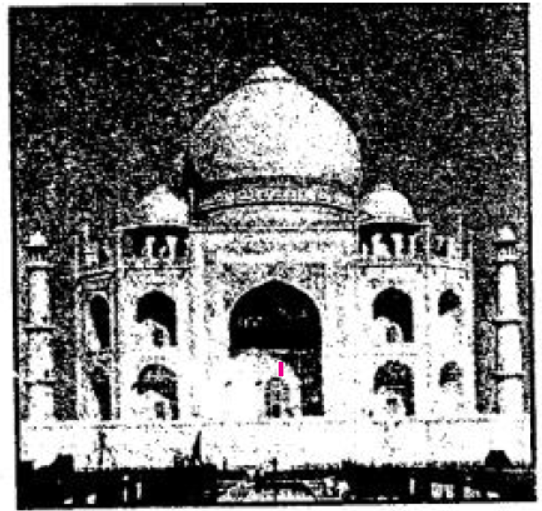
Answer: The monument pictured is the Taj Mahal, and the details are as follows:
(a) The Taj Mahal is located in the city of Agra.
(b) It was constructed by the Mughal Emperor Shah Jahan.
(c) The structural planning and design are credited to the architect Ustad Isa.
(d) Key architectural features of the monument include:
1. It is constructed entirely out of high-grade white marble.
2. The main tomb rests on a raised square platform, flanked by small decorative cupolas.
3. Four tall, elegant minarets are positioned at each corner of the main marble terrace.
In simple words: The picture is of the Taj Mahal in Agra, built by Shah Jahan and designed by Ustad Isa. It is made of pure white marble, sits on a high platform, and has four tall towers at its corners.
Exam Tip: List 'white marble construction' and the 'four corner minarets' as two clear, easily gradeable features of the Taj Mahal.
Question 8. The Mughal rulers of India were patrons of learning and scholars. In this context, describe briefly:
(a) The growth of Persian Literature in those times.
(b) The growth of Hindi Literature during the age of the Mughals.
Answer:
(a) The growth of Persian Literature: Persian literature advanced significantly under Mughal patronage. Akbar's court attracted many Persian scholars. His vizier, Abul Fazl, wrote the 'Ain-i-Akbari', which documents the administration and legal systems of the empire, and the 'Akbarnama', a detailed biography of Akbar. Other historians of the era include Nizam-ud-din Ahmad, author of 'Tabaqat-i-Akbari', and Badauni, who wrote 'Muntakhab-ut-Tawarikh'. Akbar also established a translation bureau to translate classical Sanskrit texts into Persian; the Mahabharata was translated as 'Razmnama', Badauni translated the Ramayana, Abul Fazl translated the Panchatantra, and Faizi translated several other classical Indian texts. This focus on translations continued under Jahangir.
(b) The growth of Hindi Literature: Hindi literature experienced a golden age during the Mughal era. Celebrated poet Tulsidas composed the 'Ramcharitmanas' and 'Ram Gitavali' in Awadhi. Surdas wrote the 'Sursagar', describing the early life of Lord Krishna. Akbar actively patronized Hindi poets, and close associates like Birbal, Raja Man Singh, and Raja Bhagwan Das composed poetic works. Akbar even gave Birbal the honorary title of 'Kavipriya'. Abdur Rahim Khan-i-Khanan became one of the most famous Hindi poets of the court, renowned for his moral couplets (dohas). Additionally, Malik Muhammad Jayasi composed the epic 'Padmavat', while the poet Sundar received the title 'Mahakavi Rai' from Emperor Shah Jahan for his work 'Sundar Sringar'.
In simple words: Persian literature grew through court histories like the Akbarnama and translations of Sanskrit epics like the Mahabharata. Hindi literature flourished with great epics like Tulsidas's Ramcharitmanas and Malik Muhammad Jayasi's Padmavat, supported by Akbar.
Exam Tip: Structure your answer around key works and authors: Abul Fazl (Ain-i-Akbari) for Persian, and Tulsidas (Ramcharitmanas) and Rahim (dohas) for Hindi.
Question 9. What role did the following factors play in decline and downfall of the Mughal Empire:
(a) Aurangzeb’s policies.
(b) Incompetence of the Later Mughals.
(c) Foreign Invasions.
Answer:
(a) Aurangzeb's Policies: Aurangzeb's conservative and orthodox religious views led him to abandon the tolerant policies of his predecessors. His simple lifestyle earned him the title of Zinda Pir from orthodox clergy. In 1669, he banned the construction of new temples and ordered the demolition of several prominent shrines, including those in Mathura and Varanasi. He also brought back the Jizya tax on Hindus. These measures alienated the Hindu population and lost him the loyalty of the Rajput kingdoms, which had long served as vital military allies of the empire.
(b) Incompetence of the Later Mughals: The emperors who succeeded Aurangzeb were weak and lacked the political or military capability to maintain centralized authority. Consequently, major provinces like Bengal, Awadh, and the Deccan broke away to form independent states. This internal weakness allowed regional powers like the Marathas, Jats, and Sikhs to expand their influence. The ultimate blow came in 1739, when the Persian ruler Nadir Shah invaded Delhi, looting immense wealth including the Peacock Throne and the Kohinoor diamond, leaving the central administration completely paralyzed. The dynasty ended symbolically after the 1857 Uprising, when the British exiled the last titular ruler, Bahadur Shah II, to Rangoon, where he passed away in 1862.
(c) Foreign Invasions: The structural collapse of the empire left India vulnerable to external raids. Following Nadir Shah's devastating invasion in 1739, the Afghan commander Ahmad Shah Abdali launched multiple campaigns, capturing Punjab by 1759. This set up a direct conflict with the expanding Maratha Empire, culminating in the Third Battle of Panipat in 1761. Abdali's victory crushed the Maratha bid for Delhi but also completed the destruction of Mughal authority, clearing the path for the rise of Sikh power in Punjab and the eventual expansion of British rule across the subcontinent.
In simple words: Aurangzeb's harsh taxes and temple bans turned his loyal Rajput allies against him. The later rulers were weak, allowing key provinces to break away, which left India open to devastating invasions by Nadir Shah and Ahmad Shah Abdali that ruined the country and paved the way for the British.
Exam Tip: For a complete answer, address all three factors: Aurangzeb's religious policies, the loss of provinces under incompetent successors, and the impact of the 1761 Battle of Panipat.
Question 10. Akbar was tbe greatest of all medieval rulers of India, In this context describe:
(a) His Concern about Law and Justice
Answer: Akbar prioritized the quick and fair delivery of justice as a core royal duty:
1. Judicial Hierarchy: The Chief Qazi served as the highest judicial official, appointing reliable local Qazis to manage provincial courts. These judges oversaw both civil and criminal trials.
2. Local Settlements: While larger cities and administrative hubs had designated courts, village communities resolved their disputes locally using the traditional Panchayat system.
3. Imperial Role: The Emperor acted as the supreme judicial authority, serving as the final court of appeal for all major disputes. Fortresses across the empire were utilized as secure prisons to hold convicted criminals.
In simple words: Akbar made sure justice was fast and fair, appointing provincial Qazis for town courts while allowing villages to use their local Panchayats. He held the final word as the supreme judge.
Exam Tip: Highlight the roles of the Chief Qazi for town courts, the Panchayats for villages, and the Emperor as the ultimate court of appeal.
Question 11. Describe Aurangzeb’s Administration under the following headlines:
A Setback to the Policy of Religious Toleration
Provincial Government
Answer:
(a) A Setback to the Policy of Religious Toleration: Upon taking the throne, Aurangzeb abandoned the tolerant and inclusive religious policies of his predecessors like Akbar, Jahangir, and Shah Jahan. He favored a highly orthodox and conservative interpretation of Sunni Islam and sought to base state laws on Sharia. However, the precise impact of his policies remains a subject of historical debate. For instance, his extensive legal compilation, the 'Fatwa-e-Alamgiri', may have been intended for personal reference or was never fully enforced nationwide. While some historians argue that these strict edicts faced structural challenges in implementation, others suggest they were mainly intended for the royal court's guidance. Additionally, the constant warfare, regional rebellions, and the financial drain from Shah Jahan's building projects left few resources for public cultural patronage.
(b) Provincial Government: Under Aurangzeb's rule, the number of provinces reached an all-time high of twenty-one. To maintain administrative stability, the provincial administration utilized a system of dual control. The Diwan, who served as the chief financial and revenue officer of the province, maintained a close check on the Subahdar to prevent any single official from accumulating absolute local power.
In simple words: Aurangzeb shifted away from the tolerant policies of earlier kings, aiming to run the state based on Sharia law, though historians still debate how strictly his laws were enforced. Administratively, his empire grew to twenty-one provinces, where governors and finance officers kept a strict check on each other's power.
Exam Tip: Explain how his orthodox approach to Sharia ended religious toleration, and mention that his provincial system managed twenty-one subahs using a system of checks and balances.
Additional Questions
Short Answer Questions
Question 1. Name two important sources which provide information about the Mughals.
Answer: Two valuable historical sources for studying the Mughal era are the literary work 'Ain-i-Akbari' and the monuments located at Fatehpur Sikri.
In simple words: We can learn about the Mughals from the book Ain-i-Akbari and the old buildings at Fatehpur Sikri.
Exam Tip: Listing the 'Ain-i-Akbari' as a written source and 'Fatehpur Sikri' as an architectural source makes a balanced answer.
Question 2. Name of the author of Ain-i-Akbari.
Answer: The author of the historical text Ain-i-Akbari is Abul Fazl.
In simple words: The book Ain-i-Akbari was written by Abul Fazl.
Exam Tip: Abul Fazl is the correct name to provide for this question.
Question 3. What was the title of the Mahabharata translated into Persian ?
Answer: The Persian translation of the Hindu epic Mahabharata was titled 'Razmnama'.
In simple words: The Persian translation of the Mahabharata is called the Razmnama.
Exam Tip: Write 'Razmnama' clearly to get full marks on this question.
Question 4. Who was the architect who designed Humayun’s tomb?
Answer: The Persian architect Mirak Mirza Ghiyas designed the monument, which was constructed by local Indian artisans and builders. The central tomb is built on an elevated platform measuring 8.5 meters high, featuring grand archways on all sides.
In simple words: Humayun's tomb was designed by a Persian architect named Mirak Mirza Ghiyas and built by Indian craftsmen on a high base.
Exam Tip: Ensure you name 'Mirak Mirza Ghiyas' as the primary architect.
Question 5. Who built the Agra Fort ?
Answer: The Agra Fort was constructed on the banks of the Yamuna River by Emperor Akbar between 1565 and 1573.
In simple words: The Agra Fort was built by Emperor Akbar next to the Yamuna River between 1565 and 1573.
Exam Tip: State both the builder (Akbar) and the location (along the Yamuna River in Agra) to write a complete answer.
Question 6. Name two buildings located in Fatehpur Sikri.
Answer: Two famous structures situated in Fatehpur Sikri are:
1. The Palace of Jodha Bai, built for Akbar's Rajput queen.
2. The massive ceremonial gateway known as the Buland Darwaza.
In simple words: Two famous buildings there are Jodha Bai's Palace and the massive gateway called Buland Darwaza.
Exam Tip: Listing 'Jodha Bai's Palace' and the 'Buland Darwaza' is the most reliable answer.
Question 7. Why did Akbar build Fatehpur Sikri ?
Answer: Akbar founded Fatehpur Sikri to serve as a grand symbol of his imperial power, to honor spiritual teachings, and to showcase the architectural brilliance of Islamic design.
In simple words: Akbar built Fatehpur Sikri to show the power of his empire and to honor his spiritual beliefs.
Exam Tip: Highlight how the city served as a visual symbol of Akbar's political power and his spiritual achievements.
Question 8. Between whom was the First Battle of Panipat fought ?
Answer: The First Battle of Panipat was fought between the Mughal invader Babur and the Lodi Dynasty ruler, Ibrahim Lodi.
In simple words: The first battle of Panipat was fought between Babur and Ibrahim Lodi.
Exam Tip: Simply naming Babur and Ibrahim Lodi as the opposing commanders is sufficient.
Question 9. Who invited Babur to India ? Why ?
Answer: Daulat Khan Lodi, who served as the governor of Punjab, invited Babur to invade India in order to overthrow the reigning Sultan, Ibrahim Lodi, from the Delhi throne.
In simple words: Daulat Khan Lodi, the governor of Punjab, invited Babur to India to help overthrow King Ibrahim Lodi.
Exam Tip: Identify the governor of Punjab (Daulat Khan Lodi) and state his goal of overthrowing Ibrahim Lodi.
Question 10. Who was defeated by Akbar at the Battle of Haldighati in 1576 ?
Answer: The Rajput ruler Maharana Pratap of Mewar was defeated by Akbar's forces at the Battle of Haldighati in 1576.
In simple words: Maharana Pratap was defeated by Akbar's army at the Battle of Haldighati in 1576.
Exam Tip: Identify 'Maharana Pratap' clearly as the opposing leader defeated in this battle.
Question 11. Mention any two steps taken by Akbar to promote better understanding between the Hindus and the Muslims.
Answer: Two major steps taken by Akbar to bridge religious divides and promote harmony were:
1. He abolished the Jizya collected from non-Muslim subjects, along with the pilgrim tax levied on those visiting holy sites like Prayag and Varanasi.
2. He integrated Hindu leaders into the ruling class by appointing Rajput chiefs to high ranks (mansabs) based on merit, while securing ties through royal marriages.
In simple words: First, Akbar stopped unfair taxes like the Jizya and the pilgrim tax. Second, he hired many Hindu Rajput leaders for top government and army positions.
Exam Tip: Focus on the abolition of Jizya/pilgrim taxes and the appointment of Rajput nobles to high military ranks (mansabs).
Question 12. Name the two taxes abolished by Akbar.
Answer: The two regional taxes abolished by Akbar were the Jizya and the pilgrim tax.
In simple words: The two taxes Akbar stopped were the Jizya and the pilgrim tax.
Exam Tip: List both 'Jizya' and 'pilgrim tax' for a complete answer.
Question 13. Name the Mughal ruler who forbade the evil practice of Sati.
Answer: According to historical records, Emperor Aurangzeb was the ruler who formally banned the practice of Sati across his territories.
In simple words: Emperor Aurangzeb was the ruler who officially banned the practice of Sati.
Exam Tip: State 'Aurangzeb' as the ruler who banned the practice as per the textbook syllabus.
Question 14. What principles did Akbar’s Din-i-Ilahi promote ?
Answer: Din-i-Ilahi advocated for monotheism while emphasizing core moral virtues such as bravery, personal loyalty, and justice.
In simple words: It promoted belief in one God and taught values like courage, loyalty, and being fair.
Exam Tip: Mention belief in one God and the promotion of ethical virtues like loyalty and justice.
Question 15. When and for what purpose did Akbar built the Ibadat Khana?
Answer: The Ibadat Khana was constructed in 1575 at Fatehpur Sikri. Akbar created this assembly hall to invite religious scholars, spiritual mystics, and philosophers of different faiths to discuss theological and spiritual topics.
In simple words: The House of Worship was built in 1575 in Fatehpur Sikri. Akbar used it as a meeting place to discuss religion and philosophy with scholars of different faiths.
Exam Tip: Provide the correct year (1575) and explain its purpose: to hold inter-faith discussions among different religious scholars.
Question 16. Name the Mughal ruler whose reign was famous for ‘Chain of Justice’.
Answer: Emperor Jahangir's reign was renowned for the installation of the famous 'Chain of Justice'.
In simple words: The reign of Emperor Jahangir was famous for the Chain of Justice.
Exam Tip: Simply write 'Jahangir' as the ruler associated with this judicial symbol.
Question 17. Name the two important centers of’trade during the Mughal Period.
Answer: Two major hubs of commercial trade during the Mughal era were Lahore and Delhi.
In simple words: Two busy trading cities during Mughal times were Lahore and Delhi.
Exam Tip: Naming 'Lahore' and 'Delhi' is the most accurate way to answer this question.
Question 18. Mention any two measures which indicate Nur Jahan’s important position during Jahangir’s reign.
Answer: Two clear indications of Nur Jahan's immense political influence during Jahangir's rule are:
1. She was officially elevated to the prestigious rank of 'Padshah Begum'.
2. Imperial coins were minted featuring her name, and her signature was officially attached to all royal decrees alongside the Emperor's.
In simple words: First, she was given the title of 'Padshah Begum'. Second, coins were printed with her name, and her signature was added to all official royal orders.
Exam Tip: Highlight the minting of coins in her name and her joint signature on royal decrees as strong evidence of her power.
Question 19. Name the two English, ambassadors who came to Jahangir’s court. Who sent them and for what ?
Answer: The two English representatives who visited Jahangir's court were Captain William Hawkins and Sir Thomas Roe. They were dispatched by King James I of England to secure trade permissions and commercial concessions for the East India Company.
In simple words: The two ambassadors were Captain Hawkins and Sir Thomas Roe. They were sent by King James I of England to get trade permissions for English merchants in India.
Exam Tip: Make sure to list both ambassadors' names, state that they were sent by King James I, and specify their goal: securing trade concessions.
Question 20. Between whom was the Third Battle of Panipat fought ? Who emerged victorious in the battle ?
Answer: The Third Battle of Panipat was fought in 1761 between the Maratha Empire and the invading Afghan ruler, Ahmad Shah Abdali. The battle ended in a decisive victory for Ahmad Shah Abdali's forces.
In simple words: The battle was fought in 1761 between the Marathas and Ahmad Shah Abdali. Ahmad Shah Abdali won the battle.
Exam Tip: Identify both sides, the year (1761), and state clearly that Abdali emerged victorious.
Question 21. Name the title given to the heads of the revenue department and the military department respectively in the Mughal Empire.
Answer: In the Mughal administrative system, the chief of the revenue department was the Wazir (also referred to as the Diwan or Diwan-i-Ala), while the head of the military department was designated as the Mir Bakshi.
In simple words: The head of the finance department was called the Diwan, and the head of the military department was called the Mir Bakshi.
Exam Tip: Provide both titles clearly: Diwan for revenue/finance and Mir Bakshi for the military.
Question 22. Who were mansabdars ? How were they paid ?
Answer: The term 'mansabdar' designated an officer who held a specific administrative or military rank within the Mughal state service, collectively making up the empire's ruling elite. Rather than receiving cash, these officials were compensated through revenue-yielding land assignments known as jagirs. Most mansabdars did not personally live on or manage these lands; instead, they had the right to collect the taxes due from their assigned areas, which was typically carried out by their personal agents.
In simple words: Mansabdars were royal officers who held a specific rank. They were paid with lands called jagirs, and instead of living there, they had agents collect the tax money from those lands as their salary.
Exam Tip: Define 'mansab' as rank, and explain that payment was made through land revenue assignments called 'jagirs' collected by agents.
Structured Questions
Question 1(a). With reference to the Mughal Empire, explain briefly the significance of the following: Ain-i-Akbari.
Answer: The Ain-i-Akbari was written by Abul Fazl, Akbar's influential vizier and one of the famous 'Nine Jewels' of the royal court. This work was part of a major historical project ordered by the emperor. Today, it serves as an invaluable primary source for studying the administrative, social, and cultural life during Akbar's reign.
The text is divided into five volumes:
- Volume 1: Details the operations and upkeep of the imperial household.
- Volume 2: Focuses on government employees, the civil services, and the military organization.
- Volume 3: Outlines the administrative regulations of the state, including guidelines for the judiciary, executive branches, and the division of the provinces.
- Volume 4: Documents traditional Indian sciences, Hindu philosophical systems, literature, and social customs.
- Volume 5: Preserves the personal sayings and philosophical insights of Emperor Akbar, alongside a detailed autobiography of Abul Fazl himself.
In simple words: The Ain-i-Akbari was written by Akbar's minister, Abul Fazl. It is split into five volumes that explain the royal palace, the army, the laws, Indian philosophy, and Akbar's own wise sayings.
Exam Tip: List what each of the five volumes of the Ain-i-Akbari covers to provide a comprehensive, high-scoring answer.
Question 1(b). Monuments at Fatehpur Sikri.
Answer: The grand city of Fatehpur Sikri was designed to celebrate the power of Akbar's growing empire, reflect spiritual teachings, and showcase Islamic architectural grandeur. Completed in 1578, the city served as the administrative capital of the Mughal court for several years, though it was eventually abandoned due to a severe water crisis.
The city is home to several monumental structures, including:
- The Panch Mahal and the colossal Buland Darwaza.
- The grand congregational mosque and the exquisite white marble tomb of the Sufi saint Sheikh Salim Chishti.
- The specialized assembly halls, namely the Diwan-i-Aam and the Diwan-i-Khas.
- Royal residential quarters, such as Jodha Bai's Palace and Raja Birbal's House.
In simple words: Fatehpur Sikri was Akbar's capital city built in 1578 but abandoned due to lack of water. It has beautiful monuments like the Buland Darwaza gateway, the tomb of Salim Chishti, and palaces for Jodha Bai and Birbal.
Exam Tip: Name at least three major structures inside Fatehpur Sikri, such as the Buland Darwaza, Panch Mahal, and Salim Chishti's tomb, to secure full marks.
Question 2(a). With reference to the Mughal rule, state briefly: Akbar’s policy towards the Rajputs.
Answer: Akbar's administrative strategy focused on building cooperative relationships with the Rajputs, transforming them into vital allies rather than enemies. He cemented these ties by marrying Harkha Bai, the daughter of Raja Bharmal of Amber. Akbar ensured his Hindu queens enjoyed complete religious freedom, constructing a dedicated temple/shrine for Jodha Bai inside the palace at Fatehpur Sikri. Rather than subduing them, he integrated the Rajput chiefs into the core administration, treating them as equal partners in the governance of the Mughal Empire.
In simple words: Akbar built friendly ties with the Rajputs by marrying Jodha Bai and giving her full religious freedom. He made Rajput leaders equal partners by hiring them for top government and military roles.
Exam Tip: Emphasize how Akbar's policy of religious freedom and administrative partnership transformed former rivals into loyal allies of the Mughal crown.
Question 2(b). Akbar’s policy of religious tolerance.
Answer: Akbar is highly regarded for his progressive and inclusive approach toward different faiths. He showed deep respect for all religious communities and treated his subjects equally. Key measures reflecting this policy include:
1. Abolishing the discriminatory Jizya tax on non-Muslims and banning the practice of forcing war prisoners to convert.
2. Building the Ibadat Khana in 1575, where he hosted discussions with scholars, priests, and philosophers of different religions to understand their spiritual viewpoints.
In simple words: Akbar respected all religions by stopping unfair taxes like the Jizya and ending forced conversions. In 1575, he built the Ibadat Khana to sit and talk peacefully with priests of various faiths.
Exam Tip: Mention specific reforms like the abolition of Jizya and the construction of the Ibadat Khana in 1575 as evidence of his tolerance.
Question 3(a). With reference to the administrative system in the Mughal Period, answer the following questions: What was the position of the monarch ?
Answer: Mughal historical records and court chronicles state that the authority of the monarch was divine in nature. The state promoted legends, such as that of the mythical Mongol queen Alanqua, who was said to have been blessed by a ray of sunlight while resting, passing this sacred 'Divine Light' down through generations of rulers. This theory positioned the King as God's representative on earth, making his authority absolute and unquestionable.
In simple words: Mughal kings believed their power was holy and came directly from God, passing down a divine light from generation to generation to justify their absolute rule.
Exam Tip: Explain the divine origin of power and use the legend of the Mongol queen Alanqua as a specific textbook detail.
Question 3(b). Who were the three important ministers ?
Answer: The three highly influential administrative offices below the Mughal Emperor were:
1. The Vakil: Popular during the reigns of Babur and Humayun, this officer wielded extensive control over civilian and military administration. A notable example was Bairam Khan during Akbar's early years.
2. The Wazir or Diwan: Supervised the imperial treasury and held complete responsibility for managing state revenues, income, and expenditures.
3. The Mir Bakshi: Managed military administration, pay accounts, and also directed the empire's intelligence and spy networks.
In simple words: The three main ministers were the Vakil (Prime Minister), the Diwan (Finance Minister), and the Mir Bakshi (who ran the military and intelligence departments).
Exam Tip: List the Vakil, Diwan, and Mir Bakshi, explaining the specific administrative duties of each minister.
Question 3(c). How was the provincial government organised ?
Answer: The Mughal empire utilized a structured hierarchy to administer its vast provinces:
1. Administrative Divisions: The entire empire was divided into twelve major provinces, known as subahs. These subahs were further divided into districts, which were split into sub-districts called parganas or mahals.
2. Subahdar: Each province was governed by a Subahdar (also called a sipah salar or nazim), typically a high-ranking mansabdar. His responsibilities included maintaining public peace, enforcing imperial decrees, and administering justice.
3. Provincial Diwan: Directed the financial administration of the province, operating independently of the governor to handle revenue collection and treasury audits.
4. Other Key Officials: The administration was supported by officers such as the faujdar, kotwal, bakhshi, sadr qazi and muhtasib.
In simple words: The empire was split into provinces (subahs), then districts (sarkars), and sub-districts (parganas). Each province was run by a Governor (Subahdar) for security and a Diwan for tax collection, supported by police chiefs (kotwals) and judges.
Exam Tip: Name the sub-divisions of the empire (subahs, sarkars, and parganas) and describe the balance of power between the Subahdar and the Diwan.
Question 4(a). With reference to Mansabdari system, answer the following questions: What was the Mansabdari system
Answer: The Mansabdari system was a unique administrative framework introduced by Akbar to structure the military and civil services of the Mughal state. Under this system, all state officials were assigned a specific grade or rank, known as a mansab, forming the ruling elite. These officers held extensive civil and military responsibilities. Ranks started at 10 and went up to 5,000 for top-tier nobles, and were divided into two categories: 'zat' (personal rank and salary) and 'sawar' (the exact size of the cavalry troop they had to maintain). Additionally, each officer was required to keep two horses for every single cavalryman under their command.
In simple words: It was a ranking system for Mughal government and army officers. A person's rank (mansab) decided their pay, their social status, and how many soldiers and horses they had to lead.
Exam Tip: Explain that 'mansab' means rank and describe how it organized the empire's military and administrative services.
Question 4(b). What was meant by zat and sawar rank ?
Answer: The mansabdar's rank was divided into two distinct components:
1. Zat: This numerical rank determined the officer's personal status, social prestige in the royal court, and their monthly salary. A higher zat rank indicated a more influential noble and a larger salary.
2. Sawar: This rank indicated the precise number of armed cavalrymen the officer was required to maintain and bring to battle. Additionally, mansabdars had to maintain twenty horses for every ten cavalrymen under their command.
In simple words: Zat decided the officer's personal salary and social rank at court, while Sawar decided the exact number of cavalry troops they had to maintain and bring for battles.
Exam Tip: Clearly contrast 'Zat' (personal rank/salary) with 'Sawar' (military/cavalry quota) for a high-scoring answer.
Question 5(a). With reference to the social development during the Mughal Age, answer the following question: Explain the division of society on the basis of wealth.
Answer: Mughal society was structured hierarchically based on wealth, resembling a traditional feudal pyramid:
1. The Ruling Elite: Situated at the top of the social pyramid, the nobles enjoyed extreme wealth, privileges, and influence. They occupied grand palaces, wore luxurious silks, and spent their leisure time playing indoor games and outdoor sports.
2. The Middle Class: Included professionals, scholars, artists, and merchants. Most middle-class families maintained a comfortable but simple standard of living. However, wealthy traders on the western coast, who grew rich from international sea trade, lived in a much more luxurious style.
3. The Lower Class: Composed of laborers, small artisans, and landless peasants who lived a highly vulnerable existence. They lacked proper clothing, with basic items like shoes and woolen winter garments being unaffordable. Although they could obtain simple food during good harvest years, they suffered severely during crop failures and famines. Local shopkeepers often hid their wealth to avoid exploitation by state tax collectors.
In simple words: Mughal society had a wealthy ruling class that lived in luxury, a comfortable middle class of merchants and scholars, and a very poor lower class of laborers who struggled to afford basic clothes and shoes, suffering terribly during famines.
Exam Tip: Contrast the lifestyle of the wealthy nobility with the hardships faced by the lower classes, and mention the simple lives of merchants who often hid their wealth.
Question 5(b). Explain briefly any two steps taken by Akbar towards integrating the Hindus and the Muslims.
Answer: Akbar implemented several progressive steps to foster peace and integration between the Hindu and Muslim communities:
1. Abolition of Discriminatory Taxes: He removed the Jizya and the pilgrim tax levied on those visiting holy sites like Prayag and Varanasi. Additionally, he banned the practice of forcing prisoners of war to convert to Islam.
2. Inclusion in Administration: He welcomed Hindu leaders, particularly Rajput rajas, into the imperial administration, granting them high military ranks (mansabs) based on their competence. He also strengthened these political partnerships through strategic marriage alliances.
In simple words: First, Akbar abolished unfair taxes like the Jizya and pilgrim taxes. Second, he hired Hindu Rajputs for high-level government and military ranks to make them partners in running the state.
Exam Tip: Discuss the abolition of Jizya and the integration of Rajput nobles into the administrative machinery as the two main integration efforts.
Question 5(c). What steps were taken by the Mughal rulers to promote education ?
Answer: The Mughal emperors supported learning and introduced several key reforms to promote education:
1. Curriculum Reforms: Akbar revised the educational syllabus to focus on practical and secular subjects, including mathematics, moral education, agriculture, geometry, astronomy, logic, and history.
2. Infrastructure Development: The imperial public works department (Shuhra-i-am) was tasked with building schools and colleges. Jahangir enacted a law directing that the property of wealthy citizens who died without heirs be used to fund and maintain educational institutes.
3. Financial Aid: Although Shah Jahan focused on monumental architecture, he provided state scholarships to support deserving students.
4. Education for Girls: Female education existed during this period. Girls from elite families received private tutoring at home, while middle-class girls often attended the same primary schools as boys.
In simple words: Akbar added practical subjects like math, geometry, and history to the school syllabus, while the government built schools and colleges. Shah Jahan offered student scholarships, and girls were educated either through home tutors or local schools.
Exam Tip: Cover all major aspects of their educational efforts: Akbar's curriculum reform, the construction of schools by the public works department, and the presence of female education.
Free study material for History Civics
ICSE Goyal Brothers Solutions Class 9 History Civics Chapter 10 The Mughal Empire
Students can now access the detailed Goyal Brothers Solutions for Chapter 10 The Mughal Empire on our portal. These solutions have been carefully prepared as per latest ICSE Class 9 syllabus. Each solution given above has been updated based on the current year pattern to ensure Class 9 students have the most updated History Civics content.
Master Goyal Brothers Textbook Questions
Our subject experts have provided detailed explanations for all the questions found in the Goyal Brothers textbook for Class 9 History Civics. We have focussed on making the concepts easy for you in Chapter 10 The Mughal Empire so that students can understand the concepts behind every answer. For all numerical problems and theoretical concepts these solutions will help in strengthening your analytical skill required for the ICSE examinations.
Complete History Civics Exam Preparation
By using these Goyal Brothers Class 9 solutions, you can enhance your learning and identify areas that need more attention. We recommend solving the History Civics Questions from the textbook first and then use our teacher-verified answers. For a proper revision of Chapter 10 The Mughal Empire, students should also also check our Revision Notes and Sample Papers available on studiestoday.com.
FAQs
You can download the verified Goyal Brothers solutions for Chapter 10 The Mughal Empire on StudiesToday.com. Our teachers have prepared answers for Class 9 History Civics as per 2026-27 ICSE academic session.
Yes, our solutions for Chapter 10 The Mughal Empire are designed as per new 2026 ICSE standards. 40% competency-based questions required for Class 9, are included to help students understand application-based logic behind every History Civics answer.
Yes, every exercise in Chapter 10 The Mughal Empire from the Goyal Brothers textbook has been solved step-by-step. Class 9 students will learn History Civics conceots before their ICSE exams.
Yes, follow structured format of these Goyal Brothers solutions for Chapter 10 The Mughal Empire to get full 20% internal assessment marks and use Class 9 History Civics projects and viva preparation as per ICSE 2026 guidelines.