

ICSE Solutions Goyal Brothers Class 9 History Civics Chapter 11 Bhakti Movement Sufism And Influence Of Christianity On Indian Society have been provided below and is also available in Pdf for free download. The Goyal Brothers ICSE solutions for Class 9 History Civics have been prepared as per the latest syllabus and ICSE books and examination pattern suggested in Class 9. Questions given in ICSE Goyal Brothers book for Class 9 History Civics are an important part of exams for Class 9 History Civics and if answered properly can help you to get higher marks. Refer to more Chapter-wise answers for ICSE Class 9 History Civics and also download more latest study material for all subjects. Chapter 11 Bhakti Movement Sufism And Influence Of Christianity On Indian Society is an important topic in Class 9, please refer to answers provided below to help you score better in exams
Goyal Brothers Chapter 11 Bhakti Movement Sufism And Influence Of Christianity On Indian Society Class 9 History Civics ICSE Solutions
Class 9 History Civics students should refer to the following ICSE questions with answers for Chapter 11 Bhakti Movement Sufism And Influence Of Christianity On Indian Society in Class 9. These ICSE Solutions with answers for Class 9 History Civics will come in exams and help you to score good marks
Chapter 11 Bhakti Movement Sufism And Influence Of Christianity On Indian Society Goyal Brothers ICSE Solutions Class 9 History Civics
Bhakti Movement, Sufism and Influence of Christianity on Indian Society
Exercises
Question 1. What is meant by Composite Culture?
Answer: This term describes a culture formed by combining various elements from different traditions, including classical Hindu heritage alongside Islamic and Christian philosophies and practices.
In simple words: It is a blended culture that brings together ideas and traditions from different religions, like Hinduism, Islam, and Christianity.
Exam Tip: To score full marks, clearly state that composite culture is a blend of multiple distinct religious and social traditions.
Question 2. Name any two factors responsible for the emergence of Composite Culture in India.
Answer: As Hindus and Muslims coexisted, a unique blend emerged that was not strictly one or the other, but a combination of both cultures. Complete isolation was impossible, leading to mutual influence in terms of faith and customs. Key drivers included a mutual spirit of tolerance, a shared desire to adopt each other's practices, and the broad perspective of saints who catalyzed movements like Sufism and the Bhakti cult.
In simple words: When Hindus and Muslims lived together, they naturally shared customs and ideas. This friendly exchange and the teachings of open-minded saints helped create a mixed culture.
Exam Tip: Ensure you mention the mutual coexistence of Hindus and Muslims and the role of tolerant saints or movements like Bhakti and Sufism.
Question 3. Mention any one impact of the emergence of Composite Culture in India.
Answer: The pursuit of mutual understanding facilitated cultural integration across various aspects of daily life, such as music, literature, art, architecture, and religious traditions. For instance, Hindu concepts of Yoga and Vedanta significantly influenced Islamic philosophy, while Sufism offered a shared space for both communities to connect. Additionally, fine arts like painting reflected a harmonious blend of Persian and indigenous Indian styles.
In simple words: The mixed culture brought people together, leading to a beautiful blend of Hindu and Muslim styles in art, music, and architecture.
Exam Tip: Focus on one clear area of impact, such as the fusion of Persian and Indian styles in music or architecture, to make your answer concrete.
Question 4. Name any two sources to reconstruct religious thoughts and ideas leading to the growth of Composite Culture.
Answer: The two primary sources for understanding the religious concepts that fostered a mixed culture are:
1. Bijak - This is a collection of Kabir's teachings. Kabir gathered ideas from diverse paths, including Islam, the Vedas, and yoga, to explain God. He adopted terms such as alakh (the unmanifested), nirakar (without form), Brahman, and Atman from Vedantic heritage.
2. Guru Granth Sahib - This unique holy text compiles the spiritual songs and teachings of numerous saints, poets, and sages. Compiled by Guru Arjan Dev to emphasize the essential oneness of all faiths and mystical paths, this grand anthology of spiritual poetry reflects the social, political, and economic life of India between the 12th and 17th centuries.
In simple words: The two main sources are the Bijak, which contains Kabir's poems, and the Guru Granth Sahib, which is the holy book of the Sikhs containing teachings from many different saints.
Exam Tip: When naming historical sources, always mention the primary author or compiler, such as Kabir for the Bijak and Guru Arjan Dev for the Guru Granth Sahib.
Question 5. What is Bijak ?
Answer: This book is a compilation of the poetic verses composed by Saint Kabir. It is divided into three primary parts, which are known as Sakhi, Ramaini, and Shabda.
In simple words: The Bijak is a collection of Kabir's poems, split into three main parts called Sakhi, Ramaini, and Shabda.
Exam Tip: Be sure to list all three sections - Sakhi, Ramaini, and Shabda - as they are crucial for getting full marks on this question.
Question 6. Name any two Sikh Gurus whose sermons and hymns are included in the Adi Granth.
Answer: The holy Adi Granth contains a rich collection of spiritual teachings and songs from five Gurus of the Sikh faith, including Guru Nanak, Guru Angad, Guru Amardas, Guru Ramdas, and Guru Arjun Dev Ji.
In simple words: The Adi Granth includes the holy writings of several Sikh leaders, such as Guru Nanak and Guru Arjun Dev.
Exam Tip: Though you only need to name two Gurus, remembering Guru Nanak and Guru Arjun Dev is the easiest way to secure full marks.
Question 7. Name any two saints other than the Sikh Gurus whose devotional hymns are included in the Adi Granth.
Answer: Devotional songs by non-Sikh saints such as Saint Kabir, Bhagat Namdev (Namedo), Saint Ravidas (Raidasa), and the Sufi mystic Baba Farid are featured in the holy scripture.
In simple words: The holy book also has songs written by other famous saints like Kabir and Baba Farid.
Exam Tip: Kabir and Baba Farid are excellent examples of non-Sikh contributors to write down for this answer.
Question 8. Who among the Sikh Gurus announced the end of personal Guruship and named Guru Granth Sahib as the Guru of the Sikhs ?
Answer: It was Guru Gobind Singh Ji, the tenth spiritual leader of the Sikhs, who declared the conclusion of human Guruship and established the Adi Granth as the eternal 'Guru Granth Sahib'.
In simple words: Guru Gobind Singh Ji, the tenth Guru, declared that there would be no more human Gurus, and the holy book would guide the Sikhs instead.
Exam Tip: State clearly that Guru Gobind Singh Ji was the tenth Guru who declared the holy scripture as the eternal guide.
Question 9. Who founded the Chisti Order (Silsila) ?
Answer: The Chisti order, or silsila, was established in India by the Sufi saint Hazrat Muin-ud-Din Chisti.
In simple words: The Chisti group of Sufis was started by a famous saint named Hazrat Muin-ud-Din.
Exam Tip: Clearly write the full name 'Hazrat Muin-ud-Din Chisti' to show a thorough understanding of Sufi history.
Question 10. Name the two stages in the Spiritual Path leading one to the Union with God ?
Answer: According to Hazrat Nizam-ud-din, reaching a state of oneness with the Divine involves two main phases: Talab, representing an intense longing for God, and Fana, which signifies the dissolution of one's ego.
In simple words: To connect with God, one needs a deep desire to meet Him (called Talab) and must completely let go of pride or ego (called Fana).
Exam Tip: Remember to list both non-English terms, 'Talab' and 'Fana', along with their English meanings.
Question 11. Who sought the Raja’s permission to build a fort at Kochi ?
Answer: Afonso de Albuquerque, who served as the Portuguese governor in India, requested and obtained permission from the ruler (Raya) of Cochin to construct a fortress at Kochi.
In simple words: A Portuguese leader named Afonso de Albuquerque asked the King of Cochin for permission to build a fort there.
Exam Tip: Properly spelling 'Afonso de Albuquerque' and identifying him as the Portuguese Governor will earn you top marks.
Question 12. Mention any one historic merit of the St. Francis Assisi Church at Kochi.
Answer: One significant historical feature of this church is its iconic clock, set up in 1923 to honor Hal Harrison Jones, who managed Aspinwall and Company. Additionally, the grounds house a war memorial dedicated to the local residents of Cochin who lost their lives in the First World War.
In simple words: The church has an old clock built in 1923 and a memorial monument for the brave people of Cochin who died in the First World War.
Exam Tip: You can mention either the famous 1923 clock or the World War I memorial as a key historical highlight.
Question 13. Mention the two main features (principles) of the Bhakti Cult.
Answer: Two central concepts of the Bhakti movement are:
1. Equality before the Divine, meaning God views all human beings as equal without distinctions of high or low birth.
2. Rejecting the worship of physical idols and criticizing rigid, outward religious ceremonies.
In simple words: The Bhakti movement teaches that everyone is equal in the eyes of God, and that we do not need complex rituals or idols to pray.
Exam Tip: Focus on 'equality of all humans' and 'rejection of empty rituals' as the core principles of Bhakti.
Question 14. Mention the contribution made by Sant Jnaneswar to Marathi literature.
Answer: Sant Dhyaneshwar made a lasting impact on Marathi literature by authoring the Dhyaneshwari, a celebrated commentary on the Bhagavad Gita. He translated several Sanskrit scriptures into Marathi, such as the Amritanubhava, Atmanubhava, and Bhavartha Dipika, and composed spiritual hymns known as Abhangas.
In simple words: Sant Dhyaneshwar translated sacred books into Marathi and wrote a famous commentary called Dhyaneshwari, along with holy poems called Abhangas.
Exam Tip: Be sure to name the 'Dhyaneshwari' and the spiritual poems called 'Abhangas' in your response.
Question 15. Mention the two main teachings of Kabir.
Answer: Two fundamental teachings of Saint Kabir include:
1. Opposing the adoration of idols, superficial rituals, and the practice of going on pilgrimages to holy sites.
2. Emphasizing that sincere, heartfelt devotion is the true path to attaining spiritual liberation.
In simple words: Kabir taught that we should avoid empty rituals and holy journeys, and instead focus on loving and devoting ourselves to God.
Exam Tip: Contrast his rejection of rituals with his emphasis on personal devotion to God for a complete answer.
Question 16. Mention the two important teachings of Guru Nanak
Answer: Guru Nanak championed the values of universal brotherhood and mutual respect among different faiths. He urged both Hindus and Muslims to overlook their theological divides, emphasizing that all paths lead to the same Divine truth.
In simple words: Guru Nanak taught that all people are brothers and sisters, and that every religion is equal and should be respected.
Exam Tip: Use key terms like 'universal brotherhood' and 'religious harmony' to secure maximum marks.
Question 17. Who was Mirabai ? What was her message to the people ?
Answer: Mirabai was a royal Rajput princess who wedded into the ruling dynasty of Mewar, Udaipur. Devoted to Lord Krishna from her early childhood, she spent her days in deep worship even after her marriage. In her spiritual compositions, she sang, “People say, Mira has gone mad. I have myself become the eternal maid-servant of my Narayana.” Her primary message was: “There is but one means to experience Lord’s Divine Presnce - that is Bhakti.”
In simple words: Mirabai was a princess who loved Lord Krishna. She taught everyone that loving God with a pure heart is the best way to reach Him.
Exam Tip: Mention her royal background in Mewar and her absolute devotion to Lord Krishna to give a complete answer.
Question 18. Name the two famous Sufi Saints of India.
Answer: Two highly renowned Sufi mystics of India are Hazrat Khwaja Muin-ud-Din Chisti and Hazrat Nizam-ud-din Auliya.
In simple words: Two of the most popular Sufi saints in India are Muin-ud-Din Chisti and Nizam-ud-din Auliya.
Exam Tip: Write down both names clearly, as they are the most prominent figures of the Chisti order in India.
Question 19. Mention the two main principles of Sufism.
Answer: The two core principles of the Sufi path are:
1. Attaining close union with God is achieved through deep love and devotion rather than the empty practice of religious rituals.
2. Believing in a single God who views all human beings as His children, which implies that loving God is best expressed by caring for humanity.
In simple words: Sufism teaches that we can find God through true love rather than outer rituals, and that loving God means loving all human beings.
Exam Tip: Focus on the ideas of 'devotional love over rituals' and 'brotherhood of humanity' to cover the main principles.
Question 20. When and by whom was Christianity believed to have been introduced in India ?
Answer: Christianity is believed to have been brought to India during the first century AD by Saint Thomas, who arrived in the southern part of the country.
In simple words: Christianity was introduced to India in the first century by St. Thomas when he visited South India.
Exam Tip: You must include both the time period (first century AD) and the person (St. Thomas) to get full credit.
Question 21. Who was St. Francis Xavier ?
Answer: St. Francis Xavier was a key co-founder of the religious order known as the Society of Jesus. He traveled extensively across Asia, focusing on territories then under Portuguese influence, such as Japan and the islands of Borneo and the Moluccas. Ultimately, his most impactful missionary achievements took place in India.
In simple words: St. Francis Xavier helped start the Society of Jesus. He traveled all over Asia to teach Christianity, finding his greatest success in India.
Exam Tip: Mention his association with the 'Society of Jesus' and his missionary work in India for a high-scoring answer.
Question 22. Which two principles did St. Francis Xavier include among the human values ?
Answer: The core values promoted by St. Francis Xavier included showing humility in the presence of God, practicing mercy, maintaining a pure heart, and expressing genuine love for both friends and foes alike.
In simple words: St. Francis Xavier taught people to be humble before God, to be merciful, to keep their hearts pure, and to love everyone, even their enemies.
Exam Tip: List at least two of his values, such as humility, mercy, or universal love, to get full marks.
Structured Questions
Question 1. Explain the sources of reconstruct religion thoughts and ideas leading to the growth of Composite Culture with reference to:
(a) Bijak’s contents
(b) Guru Granth Sahib and Guru Nanak Dev’s teachings
Answer:
(a) Bijak - This text is a collection of Kabir's teachings, consisting of three main parts: Sakhi, Ramaini, and Shabda, along with a fourth part that contains various traditional folk songs.
1. The Sakhi section is written using the doha, or couplet, poetic style.
2. The Ramaini section typically uses the chaupai meter and is generally set to a musical raga.
3. The Shabda section has the most flexible poetic structure. As a highly popular song style, its tunes and words changed across different regions and singers. Kabir took inspiration from diverse traditions, such as Islam, the Vedas, and yogic paths, to explain the Ultimate Truth. For instance, he used Vedantic concepts like alakh (the invisible), nirakar (without form), Brahman, and Atman.
(b) Guru Granth Sahib and Guru Nanak's Teachings - The Guru Granth Sahib stands as a unique holy scripture that brings together the devotional songs, hymns, and sayings of a wide range of saints, mystics, and poets. Compiled by Guru Arjan Dev, it highlights the essential harmony among all faiths and the shared essence of mystical insights. This grand anthology of sacred and philosophical poetry, composed between the 12th and 17th centuries, reflects the social, economic, and political realities of medieval India. Held by the Sikh community as their 'Living Guru', it serves as a spiritual compass for all of humanity, offering guidance on morality and faith. Its teachings focus on karma - action, deed, and consequence - emphasizing community bonding and the surrender of the ego. It portrays God as all-powerful and all-knowing. Furthermore, Guru Nanak Dev's core teachings focused on universal brotherhood and harmony among different religions. He urged Hindus and Muslims to set aside their divides and live in peace, believing that every religion holds equal value.
In simple words: The Bijak holds Kabir's poems in different styles like couplets and songs, combining Hindu and Islamic ideas. The Guru Granth Sahib is the sacred book of the Sikhs that blends teachings from many different saints, focusing on good deeds, equality, and loving everyone.
Exam Tip: For structured questions, make sure to address both parts (a) and (b) clearly with distinct sub-headings and bullet points where applicable.
Question 2. Explain the importance of each of the following:
(a) Ajmer Sharief Dargah
(b) Historic merit of the St. Francis Assisi Church, Kochi.
Answer:
(a) Ajmer Sharief Dargah - The shrine of Saint Khwajah Moinuddin Chishti is highly sacred in India, drawing respect from Muslims as well as followers of other religions who deeply respect the saint. Each year, thousands of pilgrims travel to Ajmer Sharief to show their devotion. A special six-day festival called Urs is celebrated annually to honor the memory of this beloved spiritual leader.
(b) Historic Merit of the St. Francis Assisi Church, Kochi - This historical church holds both cultural and architectural significance. It provided essential services such as baptisms and weddings, and these archives are preserved in the parish records dating from 1751 to 1804. For over four decades, these archives were hand-recorded by the church minister, Predikant Comelies. In the 1930s, specialists in London restored the fragile pages of this historical register. Today, visitors can view photocopies of these records, while the originals are safely preserved. The church is also known for its historic clock, installed in 1923 to remember Hal Harrison Jones, who was then managing Aspinwall and Company. Additionally, a war memorial monument stands on the grounds to honor the local residents of Cochin who perished in World War I.
In simple words: Ajmer Sharief is a highly respected holy shrine for both Hindus and Muslims, famous for its annual Urs festival. St. Francis Church in Kochi is famous for its historical parish records, an old clock from 1923, and a memorial for World War I soldiers.
Exam Tip: Mention specific details like the 'Urs' festival for the Dargah, and the '1751-1804 records' or '1923 clock' for the Church to show precise historical knowledge.
Question 3. Explain the significance (impact) of the Bhakti movement under the following heads:
(a) Ensuring Harmony between Hindus and Muslims.
(b) Preaching the fundamental Equality of all human beings.
(c) Promoting regional languages and Devotional Literature.
Answer: The impact of the Bhakti movement under the given heads is explained as under:
1. Ensuring Harmony between Hindus and Muslims: Spreading across the entire country, the Bhakti movement gained wide popularity. Reformers presented a simplified path of faith, free from elaborate ceremonies, focusing purely on deep devotion to God. By trying to reform Hinduism, they helped it adapt to the presence of Islam, while fostering peaceful relations between Hindus and Muslims through mutual tolerance. This peaceful message also positively influenced several Muslim kings, helped attract followers from both religious communities, and brought social stability.
2. Preaching the fundamental Equality of all human beings: The saints worked toward building a fairer social structure by advocating for equal rights and rejecting the rigid caste system. They showed that empty rituals were useless, freeing ordinary people from the absolute control of priestly classes. Consequently, the movement initiated both religious renewal and progressive social shifts.
3. Promoting regional languages and Devotional Literature: Bhakti saints chose to deliver their messages in local dialects, which gave a massive boost to regional tongues such as Hindi, Bengali, Marathi, Maithili, and Gujarati. The spiritual poetry and songs written during this era remain highly valued literary works globally.
In simple words: The Bhakti movement made religion simpler and brought Hindus and Muslims together in peace. It taught that all people are equal regardless of caste, and helped local Indian languages grow through beautiful spiritual songs.
Exam Tip: Structure your answer using the exact headings from the question to make it easy for examiners to award full marks.
Question 4. Explain the rise and significance of the Sufi Movement with reference to:
(a) Nizam-ud-Din Auliya’s main beliefs
(b) Impact of Sufism on Indian Society
Answer:
(a) Nizam-ud-Din Auliya's Main Beliefs - The saint taught that believers could achieve union with God during their earthly life through two stages: Talab, which is an intense yearning for God, and Fana, which represents the dissolution of the ego. He strongly opposed any bias based on a person's faith, caste, or gender. He said, “be generous to the needy, the poor, the exploited and the oppressed.”
(b) Impact of Sufism on Indian Society - Sufism played a crucial role in closing the divide between Hindu and Muslim communities, greatly fostering a spirit of mutual cooperation. It did so in the following ways:
1. It championed the ideals of religious harmony, universal brotherhood, and the oneness of the Divine, pointing out that despite different rituals, all religions share the same goal of reaching God.
2. It promoted the concept of absolute equality among all people, ignoring differences in caste, color, creed, or faith.
3. It supported the basic unity of all faiths, emphasizing that every spiritual path guides its followers toward seeking God's grace.
In simple words: Nizam-ud-Din Auliya taught that we can find God by letting go of our ego and helping the poor. Sufism helped unite Hindus and Muslims by teaching that all religions lead to the same God and that everyone is equal.
Exam Tip: Be sure to explain the concepts of 'Talab' and 'Fana' in part (a), and list at least two ways Sufism united society in part (b).
Question 5. Describe Francis Xavier’s missionary activities in India under the following headlines:
(a) His preachings among the pearl-fishers along the East Coast of Southern India.
(b) His love for children of born parents not legally married.
Answer:
(a) Preachings among the pearl-fishers - Arriving in Goa in 1542, Francis Xavier spent the subsequent three years sharing Christian teachings among the communities of pearl fishers along the southeastern coast of India and the northern regions of Cape Comorin. His teachings made him highly respected and popular among local groups, including the Paravas, Katesars, Kadaiyars, and Mukkuvars. He also earned deep respect among the Pattamkattiyars, who traditionally served as leaders on the Fisher Coast.
(b) Care for children of unmarried parents - During this period, several children were born to Portuguese sailors and Indian women who were not officially married. Francis Xavier taught these children about the Christian faith. To protect them from social stigma and the label of being 'illegitimate', he actively worked to encourage their parents to marry legally. Francis Xavier passed away in 1552, and his preserved remains eventually became a revered site for pilgrims.
In simple words: Francis Xavier preached to poor pearl-fishers in South India and became very popular among them. He also cared for children of unmarried couples, helping their parents get married to protect the kids from social shame.
Exam Tip: Identify the year 1542 for his arrival in Goa and mention his work with the Paravas and other fishing communities to score full marks.
Question 6. No survey of the Bhakti movement can omit the names of great woman figures who left the impression of their preaching upon future generations. In this context, explain briefly the preaching.
(a) Lallesvari. (b) Mirabai.
Answer:
(a) Lallesvari (1317-1372): As a revered Kashmiri saint, her life was associated with many legends and extraordinary deeds. She preached that realizing God requires giving up material wealth, feeling deep love for the Divine, and rising above divisions of caste or creed. She said, “I thought my mind to see the Lord in all my fellowmen. Do not discriminate between a Hindu and a Musalman. Let us give up fraud and untruth. ”
(b) Mirabai (1450-1512): She was a Rajput princess who married into the royal house of Mewar, Udaipur. A devoted follower of Lord Krishna from her childhood, she spent her life in worship, which angered her husband's family and eventually led to the end of her marriage. She then traveled widely, singing her devotional songs. One of her hymns goes: “People say Mira has gone mad. I have myself become the eternal maid-servant of my ” Upon reaching Dwarka, she wrote several spiritual songs in Gujarati. She is considered a leading figure in Gujarati devotional poetry, second only to Narsi Mehta. With Saint Ravidas (Raidas) as her spiritual guide, her core message was: “there is but one means to experience Lord’s Divine Presence- that is Bhakti. ”
In simple words: Lallesvari was a Kashmiri saint who taught that we must give up greed and see God in all people. Mirabai was a Rajput princess who left her royal life to sing beautiful songs for Lord Krishna and spread the message of love.
Exam Tip: In long answers about historical saints, including their active years (like 1317-1372 for Lallesvari and 1450-1512 for Mirabai) adds great academic value.
Question 7. Name the book, where Kabir’s teachings are recorded.
Answer: The teachings of Kabir are preserved in the scripture known as the Bijak (which translates to the seed-book).
In simple words: Kabir's teachings are written in a book called the Bijak.
Exam Tip: Simply write 'Bijak' as the main answer, and adding that it means 'seed-book' shows extra detail.
Question 8. Mention two important aspects of the teachings of Chaitanya Mahaprabhu.
Answer: Two key elements of Chaitanya Mahaprabhu's teachings are:
1. He worshiped a single Supreme God, whom he named Krishna or Hari, and encouraged others to place their complete faith in Him.
2. He advocated for a sense of universal brotherhood, rejected any discrimination based on caste or social class, and strongly spoke out against the control of the priestly elite.
In simple words: Chaitanya Mahaprabhu taught that everyone should have faith in one God (Krishna) and that all humans are equal, regardless of their caste.
Exam Tip: Name 'Krishna' or 'Hari' as the supreme deity in his teachings and mention his opposition to caste barriers.
Question 9. Who was Lallesvari? What are her teachings?
Answer: Lallesvari was a well-known Kashmiri saint whose life story is filled with traditional legends and spiritual wonders. She taught that the true path to God-realization involves letting go of material wealth, cultivating deep devotion for the Divine, and overcoming social divisions like caste and creed.
In simple words: Lallesvari was a holy woman from Kashmir. She taught that we should not care about money or caste, but focus on loving God.
Exam Tip: Highlight 'renunciation of material goods' and 'universal love' as her primary teachings.
Question 10. Explain the characteristics of Muslim architecture under these heads: Mosques and Tombs.
Answer: Islamic architectural features are generally categorized into religious and secular designs. The religious monuments consist mainly of mosques and tombs:
- Mosques: A typical mosque features a spacious, open central courtyard enclosed by a pillared corridor. The prayer hall features a recessed niche called the Mehrab built into the western wall. To the right of this Mehrab is a pulpit, while a tall minaret rises above the structure from where the Muazzin calls devotees to prayer. A prominent central dome sits directly above the main sanctuary.
- Tombs: Built as resting places for the departed, a tomb contains a main chamber that also features a Mehrab on its western wall. The entire building is crowned with an elegant dome, and the actual burial space containing the grave (Kabr) is located in an underground vault directly below the center of the structure.
In simple words: Mosques are places of prayer with a big courtyard, a tall tower for the call to prayer, and a dome. Tombs are buildings for the dead that have a main room with a dome and a grave underneath.
Exam Tip: Use specific architectural terms like 'Mehrab' (prayer niche), 'Minaret' (tower), and 'Kabr' (burial chamber) to write an expert-level answer.
Additional Questions
Short Answer Questions
Question 1. What is meant by the term composite culture ?
Answer: The blending of Turkish settlers with Indian communities, each bringing distinct religious systems, artistic traditions, architecture, and literature, gave rise to a mixed heritage called Indo-Islamic culture. This synthesis was not solely Persian or Muslim, nor was it exclusively Indian or Hindu; rather, it represented a harmonious integration of the finest aspects of both traditions.
In simple words: It is a combined culture that grew when Turkish and Indian peoples lived together, blending the best parts of Hindu and Muslim art, building styles, and beliefs.
Exam Tip: Clearly explain that Indo-Islamic culture is a combination of Hindu and Muslim elements, rather than being purely one or the other.
Question 2. Mention the two phases of the growth of Indo-Islamic culture.
Answer: The two primary areas reflecting the growth of Indo-Islamic culture are music and painting.
Music: Indian musical styles incorporated the rich traditions of Arab music. The scholar Amir Khusrau integrated several Perso-Arabic ragas with native Indian melodies, establishing the popular styles of qawwalis and khayals. Many medieval rulers supported musicians; for instance, the 14th-century work 'Gunyat-ut-Munya' became the earliest musical treatise written by a Muslim scholar in India. Emperor Akbar famously supported thirty musicians, including the legendary Tansen, who created numerous new ragas.
Paintings: While the ancient murals of Ajanta show early indigenous styles, painting experienced a major revival under Emperor Akbar. He employed seventeen master artists, thirteen of whom were Hindus. These painters were commissioned to illustrate Persian translations of the Mahabharata as well as the Akbarnama. A notable manuscript from this period, the 'Hamzanama', contains nearly 1,200 distinct paintings.
In simple words: The two main areas that showed this mixed culture were music and painting. Musicians like Tansen blended Persian and Indian styles, while artists under Emperor Akbar painted beautiful books.
Exam Tip: Make sure to list both 'Music' and 'Paintings' as the two developmental phases, and mention Akbar or Tansen as supporting historical examples.
Question 3. Mention any two factors which promoted composite culture during the Mughal Age.
Answer: Two primary elements drove the development of a shared, composite culture during the Mughal era:
1. The vast riches and absolute authority possessed by the Mughal rulers allowed them to steadily sponsor literature and fine arts. They utilized their resources and free time to commission grand palaces, strongholds, and memorial structures.
2. The Mughal rulers possessed a deep appreciation for artistic beauty. Most of them sought creative outlets to express their aesthetic tastes through various visual mediums.
In simple words: First, the Mughal kings had the money and power to support artists and build huge palaces. Second, the kings themselves loved art and wanted to create beautiful things.
Exam Tip: Focus on the emperors' immense wealth and their personal interest in art and architecture as the two main promoting factors.
Question 4. Name the first work on Indian music compiled by a Islamic scholar.
Answer: The earliest book on Indian music written by a Muslim scholar is titled 'Gunyat-ut-Munya'.
In simple words: The first book about Indian music written by an Islamic scholar is called 'Gunyat-ut-Munya'.
Exam Tip: Write the book title 'Gunyat-ut-Munya' clearly in quotation marks to secure full marks.
Question 5. Name the two Indian motifs used in Islamic architecture in India.
Answer: The swastika and the lotus are two traditional Indian designs frequently integrated into Islamic architectural projects across the country.
In simple words: Two Indian designs used in Muslim buildings are the swastika and the lotus flower.
Exam Tip: Name both the 'swastika' and the 'lotus' as the key traditional Indian motifs used in Islamic structures.
Question 6. Name a temple built on the arch and dome principle of Islamic architecture.
Answer: The Golden Temple located in Amritsar was constructed using the arch and dome design methods typical of Islamic architectural traditions.
In simple words: The Golden Temple in Amritsar was built using arches and domes, which are styles taken from Muslim buildings.
Exam Tip: Identify the 'Golden Temple at Amritsar' as the primary example of a non-Muslim shrine adopting Islamic structural styles.
Question 7. Mention any two features of Mughal Architecture.
Answer: Two key elements of Mughal architectural style include:
1. The presence of a highly visible, large dome crowning the building.
2. Gateway entries designed with a rectangular shape positioned beneath a curved arch.
In simple words: First, Mughal buildings have a big, round dome on top. Second, they have rectangular doorways set inside large arches.
Exam Tip: Mention 'prominent domes' and 'arched rectangular gateways' as two distinct and easy-to-remember features.
Question 8. Name any two poets who wrote in Urdu.
Answer: Two celebrated literary figures who composed poetry in Urdu are Mir Dard (Mir Dad) and Mirza Ghalib.
In simple words: Two very famous poets who wrote beautiful poems in the Urdu language are Mir Dard and Mirza Ghalib.
Exam Tip: Mirza Ghalib is highly recognized, and combining him with Mir Dard gives a historically solid answer.
Question 9. What is meant by Sufism ? Name two Sufi saints.
Answer: The term 'Sufi' originates from the Arabic word 'suf', meaning wool, referring to the spiritual mystics who dressed in simple, rough woolen robes. Other historians suggest the name comes from 'safa', which means purity. Sufi practitioners migrated to India alongside Turkish settlers. Sufism represents a mystical movement that emphasizes mutual tolerance, human brotherhood, and the absolute oneness of God.
Two prominent Sufi saints are:
1. Hazrat Khwaja Muin-ud-Din Chisti.
2. Hazrat Khwaja Nizam-ud-Din Auliya of Delhi.
In simple words: Sufism is a peaceful branch of Islam that teaches love, equality, and devotion to one God. Sufi saints originally wore simple woolen clothes, and famous examples include Muin-ud-Din Chisti and Nizam-ud-Din Auliya.
Exam Tip: Be sure to explain the two possible origins of the word ('wool' and 'purity') and list Muin-ud-Din Chisti and Nizam-ud-Din Auliya as the saints.
Question 10. Mention any two doctrines of Sufism.
Answer: Two core beliefs of Sufism are:
1. The basic harmony and essential unity shared by all world religions.
2. The belief in absolute equality and brotherhood among all people.
In simple words: Sufism teaches that all religions are fundamentally connected and that every person is equal and should be treated like family.
Exam Tip: Focus on 'unity of all religions' and 'equality of mankind' as the primary pillars of Sufi philosophy.
Question 11. What is known as Chishti Silsila ?
Answer: The term 'silsila' translates to a chain, representing an unbroken spiritual connection from the master to the student. Within this system, the spiritual guide was referred to as the pir, while the disciples were known as murids. A successor, or wali, was chosen by the pir to lead after them. Each division established a spiritual retreat, or khanqah, where mystics lived alongside their followers. The early Sufis who established themselves in India primarily aligned with the Chisti and Suhrawardi orders.
In simple words: The Chishti Silsila is a chain of spiritual teachers (Pirs) and students (Murids). They lived together in simple homes, teaching love and unity, and it became one of the most popular Sufi groups in India.
Exam Tip: Make sure to define the terms 'pir' (master), 'murid' (disciple), and 'silsila' (chain) to write an excellent answer.
Question 12. Mention any two doctrines of Bhakti cult.
Answer: Two fundamental principles of the Bhakti movement are:
1. The belief in a single Supreme God, who should be approached through deep, personal love and devotion.
2. The vital role of an enlightened guide, or Guru, who is essential for helping a devotee experience the Divine.
In simple words: First, there is only one God, and we should pray to Him with love. Second, we need a wise teacher, or Guru, to guide us to God.
Exam Tip: Focus on 'loving devotion to one God' and 'the importance of a Guru' as the two primary doctrines.
Question 13. Who was Kabir ? Mention any two of his teachings ?
Answer: Kabir was a prominent disciple of the celebrated Bhakti leader Ramananda. Born around AD 1398 to a Hindu Brahmin widow, he was raised in the home of a Muslim weaver family. He sought to reform medieval society by fostering harmony and peace between diverse religious groups.
His primary teachings include:
1. Belief in a single Divine creator, who can be worshiped using various names and forms.
2. Sincere love for God combined with righteous deeds are the sole pathway to spiritual liberation.
3. A person must completely abandon deceit, dishonesty, and pretense to connect with the Divine.
In simple words: Kabir was a famous saint raised by a Muslim weaver family who tried to unite Hindus and Muslims. He taught that God is one, that we must do good deeds, and that we must be honest in our prayers.
Exam Tip: State his connection to his teacher Ramananda, mention his mixed Hindu-Muslim upbringing, and list two of his moral teachings clearly.
Question 14. Mention any three teachings of Guru Nanak.
Answer: The core teachings of Guru Nanak include the following concepts:
1. He emphasized the oneness of God and the essential brotherhood of all human beings.
2. He promoted personal devotion to the Divine as a replacement for elaborate religious rituals.
3. He declared that there is but one God, whose name is Eternal Truth, and who is the creator of the universe.
4. He strongly opposed the practice of worshipping physical idols.
In simple words: Guru Nanak taught that there is only one God who created everything, that all humans are equal, and that we should focus on loving God instead of worshipping idols or doing complex rituals.
Exam Tip: State three distinct points, such as the unity of God, rejection of idol worship, and the brotherhood of humanity, to secure full marks.
Question 15. Who was St. Francis Xavier ? What did he do to spread Christianity among Indians ?
Answer: St. Francis Xavier was born in a Spanish castle on April 7, 1506. After receiving his Holy vows in 1537, he set out on a missionary expedition toward India in 1541, arriving in Goa in 1542. To introduce Christian teachings, he walked through local streets ringing a small handbell to gather children and teach them. Once a crowd assembled, he would guide them to a church to explain the principles of the Christian faith.
In simple words: St. Francis Xavier was a Spanish missionary who arrived in India in 1542. He spread Christianity by ringing a small bell in the streets to gather people and children, then teaching them about God in church.
Exam Tip: To get full marks, include his arrival year (1542) in Goa and describe his unique method of using a bell to gather crowds.
Question 16. Mention any two steps taken by the Christian missionaries to spread the belief of Christianity through language and literature.
Answer: To share Christian beliefs using language and literature, missionaries took several key actions:
1. To bridge the communication gap with local populations, they compiled comprehensive grammar guides and dictionaries for various Indian languages.
2. St. Francis Xavier studied the local language of the Malabar coast and created a basic grammar guide and vocabulary reference sheet, enabling other Jesuit priests to quickly learn the regional tongue.
In simple words: First, missionaries wrote down dictionaries and grammar books for Indian languages so they could talk to the people. Second, St. Francis Xavier learned the local Malabar language and wrote guides to help other priests learn it too.
Exam Tip: Focus on the creation of grammars and dictionaries, and name the Malabar language as a specific regional example.
Structured Questions
Question 1(a). Explain briefly the Indo-Islamic culture. How can you say that it was a composite culture ?
Answer: The rise of the Delhi Sultanate in the early 13th century initiated a transformative era in India's cultural evolution. As Turkish settlers interacted with Indian communities - who possessed deep-rooted faiths and sophisticated systems of literature, building, and art - a unique, integrated heritage emerged, known as Indo-Islamic culture. This culture did not belong exclusively to Persian or Islamic traditions, nor was it solely Hindu or Indian; it represented an elegant combination of the finest qualities of both paths.
Its evolution unfolded in two major periods: the Sultanate era and the Mughal era. The Sultanate period witnessed the initial blending of native Indian customs with Turkish lifestyles, while the Mughal period saw this shared culture become deeply rooted and consolidated. Today, many regional centers and major cities, including Delhi, Lucknow, and Hyderabad, stand as living testaments to this shared architecture, language, and social tradition.
In simple words: Indo-Islamic culture started in the 13th century when Turkish and Indian ideas mixed. It is a combined culture because it is a blend of Hindu and Muslim styles of building, speaking, and living, which you can still see in cities like Delhi and Lucknow.
Exam Tip: Differentiate between the 'Sultanate phase' (initial fusion) and the 'Mughal phase' (consolidation) to write a detailed, high-scoring answer.
Question 1(b). What were the factors that led to the emergence of composite culture during the Mughal Age ?
Answer: The growth of a shared, composite culture under the Mughals was fueled by several key factors:
1. The vast economic resources and supreme authority of the Mughal monarchs allowed them to continuously support literary scholars and artists. They channeled their wealth and personal time into constructing majestic palaces, defensive strongholds, and grand monuments.
2. The Mughal rulers possessed an innate passion for art and aesthetics, with each ruler eager to cultivate visual arts as a form of personal expression. This artistic focus, combined with the rich historical legacies of both the Mughal and native Indian traditions, created an ideal environment for producing exceptional literature and fine arts.
In simple words: The Mughals had great wealth and power to pay for beautiful buildings and books. Also, because the emperors loved art, they blended their own Persian traditions with Indian styles to create a unique culture.
Exam Tip: Highlight how the combination of imperial wealth and the personal artistic passion of the rulers drove the cultural synthesis.
Question 1(c). What were the salient features of Indo-Islamic architecture ?
Answer: Indo-Islamic architecture integrated several distinct elements into the Indian landscape:
1. It introduced a sense of grand scale, wide-open spacing, and structural majesty to traditional building methods.
2. Buildings featured intricate geometric patterns, floral carvings, and decorative panels inscribed with holy verses from the Quran.
3. Muslim builders also adopted indigenous Indian elements, such as placing the ornate lotus-shaped kalash design, originally found atop Hindu temples, on the domes of their own structures.
In simple words: Indo-Islamic buildings are known for being very large and spacious. They use beautiful geometric and flower patterns, writing from the Quran, and sometimes place Indian lotus shapes on their domes.
Exam Tip: Remember to mention specific blending features, such as geometric designs, Quranic inscriptions, and the adoption of the temple-style 'Kalash' dome-topper.
Question 2. With reference to the composite culture, state briefly the impact of this culture on the following:
(a) Literature.
(b) Architecture
(c) Paintings
Answer:
(a) Literature - The integration of Hindu and Islamic cultures left a strong mark on regional languages. Persian was adopted as the official administrative language of the Mughal court, opening up active cultural exchanges with Central Asia and Iran. Over time, Persian became popular among noble families and court officials. The most prominent linguistic blend occurred with the rise of Urdu, a language combining vocabulary from Persian, Arabic, Hindi, and other regional tongues. Initially termed 'Zaban-e-Hindvi' due to its close grammatical resemblance to Hindi, Urdu represents a true cultural bridge.
(b) Architecture - The fusion of these two cultures is highly visible in their building styles. Despite having very different historical methods and aesthetics, Hindu and Islamic systems combined to establish a distinct Indo-Islamic style.
Key features exchanged between the two styles include:
1. Islamic building designs brought massive scale, grand archways, wide courtyards, and structural majesty to Indian architecture.
2. In terms of decoration, Turkish builders avoided carving human or animal shapes, choosing instead intricate geometric grids, floral motifs, and panels of Arabic script featuring Quranic verses. They also adopted traditional Indian motifs, including the bell, the lotus, and the swastika.
3. The ornate 'Kalash' design, typically positioned at the peak of Hindu temple spires, was modified by Muslim builders and placed atop the domes of mosques and tombs.
4. Several historic temples in Vrindavan incorporated Mughal stylistic designs into their structures.
5. Mughal architectural concepts influenced regional palaces and forts. For example, the Golden Temple in Amritsar adopted the arch-and-dome framework of Islamic designs alongside various Mughal decorative styles.
(c) Paintings - Under Emperor Akbar, a unique school of painting emerged that fused Persian and indigenous Indian artistic methods. Art production was structured in specialized royal workshops, or karkhanas, where painters from different parts of India collaborated. Of the seventeen master painters in Akbar's court, thirteen were Hindus. These artists were tasked with creating vibrant illustrations for Persian translations of the Mahabharata and the Akbarnama. Their paintings showcased Indian themes and landscapes, utilizing traditional Indian pigments such as deep peacock blue and Indian red. The crowning artistic achievement of this era is the 'Hamzanama' (or Dastan-i-Amir Hamza) manuscript, which boasts nearly 1,200 detailed paintings.
In simple words: In literature, Persian blended with local tongues to create the Urdu language. In architecture, Muslim builders added grand arches and domes to Indian structures, while adopting Indian designs like the lotus. In painting, royal workshops mixed Persian and Indian styles to make beautiful illustrated books using local colors like peacock blue.
Exam Tip: For long-answer questions, divide your response into three clear sections (Literature, Architecture, Paintings) and use specific historical terms like 'Urdu', 'Kalash', and 'karkhanas' to earn full marks.
Question 3. Sufism was a liberal reform movement within Islam With reference to Sufism write short notes on the following:
(a) Devotion to God
(b) Caste distinctions
(c) Unity of all religions
Answer: Sufism developed as a progressive reform movement within Islam, emphasizing several key spiritual ideas:
(a) Devotion to God: Sufi saints championed the values of religious tolerance, mutual brotherhood, and the oneness of the Divine. They believed that despite the different outer rituals of various world religions, the core objective remains to connect with God, making sincere, loving devotion the most vital part of faith.
(b) Caste distinctions: Sufism strongly rejected social hierarchies, advocating for the absolute equality of all human beings regardless of their caste, skin color, background, or creed.
(c) Unity of all religions: Sufi teachings centered on the fundamental unity of all faiths, arguing that every spiritual path ultimately leads its followers to the same Divine creator to receive His blessings.
In simple words: Sufism is a friendly movement that teaches: first, we must love and dedicate ourselves to God; second, all humans are equal regardless of their caste; and third, all religions ultimately worship the same God.
Exam Tip: Write short, structured notes for each of the three sub-headings, focusing on 'loving devotion', 'rejection of caste', and 'universal unity of religions'.
Question 4. Summarise the impact of Bhakti movement with regard to:
(a) Equality of all human beings.
(b) Fostering unity and harmony between different communities.
(c) Promoting regional languages and devotional literature.
Answer: The impact of the Bhakti movement under the given heads is explained as under:
(a) Equality of all human beings - The Bhakti movement taught that everyone is equal in the eyes of the Divine. It emphasized that a person's worth is decided by their actions and character rather than their birth, aiming to foster a spirit of universal brotherhood across society.
(b) Fostering unity and harmony between different communities - Sincere respect grew between different religious groups as both Hindus and Muslims honored the Sufi saints. People studied the spiritual poems of Kabir and Rahim, while celebrating the writings of Tulsidas and Surdas. The devotional compositions of Mirabai were loved by members of both communities, and even Emperor Akbar famously visited to listen to her devotional singing.
(c) Promoting regional languages and devotional literature - Bhakti reformers chose to speak and write in the common languages of the masses, which led to a massive growth in regional dialects like Hindi, Bhojpuri, Maithili, and Odia. Great literature was written during this time, including Tulsidas's 'Ramcharitmanas', the Gurmukhi texts of the Sikh Gurus, and Bengal's Vaishnava songs. The reformist teachings of figures like Kabir, Guru Nanak, and Ravidas sought to establish a new social structure based on equality, actively criticizing caste hierarchies and empty ceremonies. By proving that complex, expensive rituals were unnecessary, they reduced the social dominance of the priestly class and brought about deep social change.
In simple words: The Bhakti movement taught that all people are equal in God's eyes. It brought Hindus and Muslims together by encouraging them to enjoy the same spiritual songs and saints. It also helped local languages like Hindi grow because the saints sang in the language of the common people, freeing them from the control of priests.
Exam Tip: Make sure to connect the decline of priestly dominance with the rise of regional literature (like the Ramcharitmanas) to provide a complete historical analysis.
Question 5(a). Explain the role played by St. Francis Xavier and Robert de Nobili in spreading Christianity in India.
Answer: Saint Francis Xavier arrived in India in 1542 as the pioneering Jesuit missionary, followed later by Robert de Nobili in 1605. Both individuals made major contributions to the expansion of Christianity in the country.
St. Francis Xavier was born in Spain on April 7, 1506. He was known for his dedication to public service, spending much of his time helping the sick in hospitals. He took his holy vows in 1537, began his journey to the East in 1541, and arrived in Goa in 1542. He spent his early months in India preaching and volunteering at hospitals. He adopted a unique teaching style, walking through public lanes while ringing a handbell to draw children. Once a crowd formed, he would bring them to local churches to explain Christian concepts.
Robert de Nobili was born in Tuscany in September 1577. He joined the Jesuit order in 1597 and sailed for India in October 1604, arriving in Goa in 1605. After a brief stay in Cochin, he moved to Madurai in November 1606. To connect deeply with the local population, de Nobili mastered Sanskrit, Tamil, and Telugu, while studying Indian philosophical systems and holy scriptures. He distanced himself from European habits, choosing instead to adopt the orange robes, vegetarian diet, and ascetic lifestyle of an Indian sanyasi. This custom-tailored approach helped him gain followers among the upper castes, though it drew criticism from other Western missionaries who accused him of diluting Christian doctrines. He successfully defended his methods before the Archbishop of Goa and eventually secured formal approval from the Pope to continue his lifestyle.
In simple words: St. Francis Xavier arrived in Goa in 1542, using a handbell in the streets to gather crowds and teach Christianity while helping the sick. Robert de Nobili arrived in 1605 and chose to live like an Indian saint, learning local languages like Tamil and Sanskrit to connect with the people.
Exam Tip: In this comparative answer, make sure to highlight St. Francis Xavier's public street-preaching methods and Robert de Nobili's adoption of the local Indian ascetic lifestyle (inculturation).
Question 5(b). Explain the role of Christian missionaries in promoting language, literature and art in India.
Answer: Christian missionaries played an important part in the development of Indian linguistics, literature, and visual arts:
1. To communicate effectively with local populations, early missionaries created the first formal dictionaries and grammar books for various regional Indian languages.
2. St. Francis Xavier learned the Malabar regional language, compiling a vocabulary list and a grammar handbook that became key learning resources for subsequent Jesuit missionaries.
3. The English priest Thomas Stephens wrote a celebrated epic poem in Konkani as well as a grammar guide. Similarly, the missionary Diogo Ribeiro authored grammar guides and translated Christian texts into local tongues.
4. Beyond literature, missionaries introduced new artistic expressions. They established Western music education in parish schools, introducing classes in dance, singing, and musical instruments. Many local churches set up music academies, ensuring that worship hymns were accompanied by organs and other instruments.
5. Missionaries actively patronized painting, wood carving, and sculpture, primarily using religious themes to decorate local churches. These artworks left a strong impression on Mughal artists, and contemporary historical records confirm that Emperors Akbar and Jahangir took a deep interest in European Christian art.
6. Through their extensive correspondence and letters sent back home, these missionaries served as primary cultural ambassadors, explaining Indian traditions and customs to the Western world.
In simple words: Christian missionaries wrote the first grammar books and dictionaries for local Indian languages, and composed books in languages like Konkani. They also introduced Western music and instruments in schools, and brought European religious paintings that even Mughal kings liked to look at.
Exam Tip: Mention specific names like Thomas Stephens (Konkani epic) and Diogo Ribeiro, and discuss how Western music and painting influenced Mughal courts to get top marks.
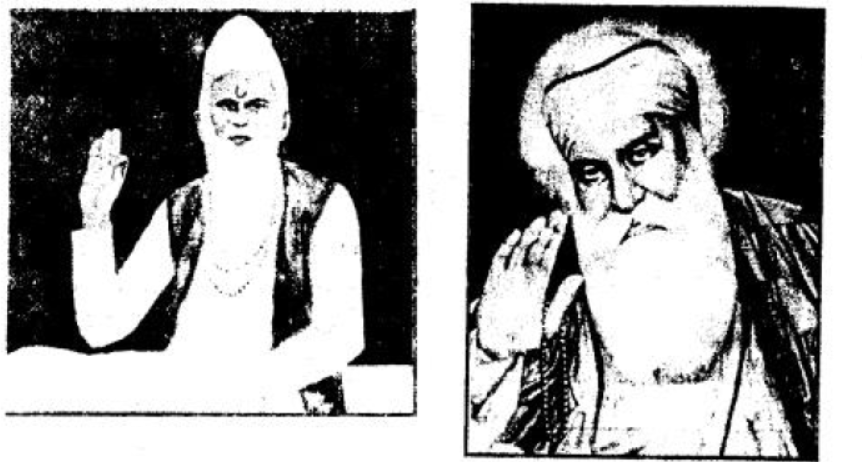
Question 6(a). Name the Bhakti Saints given in the pictures. Where were they born ?
Answer: The spiritual figures shown in the illustrations are Saint Kabir, who was born in Banaras, and Guru Nanak Dev Ji, who was born in the village of Talwandi, currently known as Nankana Sahib.
In simple words: The pictures show Kabir, who was born in Banaras, and Guru Nanak Dev Ji, who was born in Talwandi.
Exam Tip: Be precise with birthplaces: Banaras for Kabir and Talwandi (Nankana Sahib) for Guru Nanak.
Question 6(b). Mention any two teachings of each these two saints.
Answer: The core teachings of these two saints are highlighted below:
Teachings of Kabir:
1. There is but a single Supreme Creator, who can be approached and worshiped under different names.
2. Sincere devotion and moral integrity are the true paths to connect with God, rather than relying on the guidance of a priestly class.
Teachings of Guru Nanak Dev Ji:
1. He emphasized the oneness of the Divine and urged his followers to focus on true devotion rather than outward rituals.
2. He promoted a balanced 'middle path', showing that a person could lead a rich spiritual life while still carrying out their daily duties as a family householder.
In simple words: Kabir taught that God is one but has many names, and that all humans are equal. Guru Nanak taught that we should love God directly instead of doing empty rituals, and that we can be spiritual while living a normal family life.
Exam Tip: Make sure to list distinct teachings for both Kabir and Guru Nanak separately to keep your answer organized.
Question 6(c). How did the Sufi and the Bhakti movements foster the growth of Indo-Islamic culture.
Answer: The Sufi and Bhakti movements were crucial in shaping a shared, composite Indo-Islamic culture:
Role of Sufism:
1. It actively promoted mutual understanding and built a strong sense of harmony between Hindu and Muslim communities.
2. It inspired prominent writers of the era, such as Amir Khusrau and Malik Muhammad Jayasi, to write beautiful poetry in Persian and Hindi that celebrated Sufi ideals.
Role of the Bhakti Movement:
1. Bhakti reformers spread the message of universal brotherhood, insisting on the basic equality of all people.
2. By choosing to teach in local dialects rather than Sanskrit, they popularized regional languages such as Hindi, Bhojpuri, Maithili, and Odia. This shift led to the creation of masterworks like Tulsidas's 'Ramcharitmanas', early Gurmukhi texts from the Sikh Gurus, and the rich Vaishnava poetry of Bengal.
In simple words: Sufism helped bring Hindus and Muslims together and inspired poets like Kabir and Jayasi to write in local languages. The Bhakti movement taught that everyone is equal and helped local Indian languages grow through beautiful holy poetry.
Exam Tip: Discuss the literary contributions of both movements (such as Amir Khusrau for Sufism and Tulsidas for Bhakti) to show their deep cultural impact.
Free study material for History Civics
ICSE Goyal Brothers Solutions Class 9 History Civics Chapter 11 Bhakti Movement Sufism And Influence Of Christianity On Indian Society
Students can now access the detailed Goyal Brothers Solutions for Chapter 11 Bhakti Movement Sufism And Influence Of Christianity On Indian Society on our portal. These solutions have been carefully prepared as per latest ICSE Class 9 syllabus. Each solution given above has been updated based on the current year pattern to ensure Class 9 students have the most updated History Civics content.
Master Goyal Brothers Textbook Questions
Our subject experts have provided detailed explanations for all the questions found in the Goyal Brothers textbook for Class 9 History Civics. We have focussed on making the concepts easy for you in Chapter 11 Bhakti Movement Sufism And Influence Of Christianity On Indian Society so that students can understand the concepts behind every answer. For all numerical problems and theoretical concepts these solutions will help in strengthening your analytical skill required for the ICSE examinations.
Complete History Civics Exam Preparation
By using these Goyal Brothers Class 9 solutions, you can enhance your learning and identify areas that need more attention. We recommend solving the History Civics Questions from the textbook first and then use our teacher-verified answers. For a proper revision of Chapter 11 Bhakti Movement Sufism And Influence Of Christianity On Indian Society, students should also also check our Revision Notes and Sample Papers available on studiestoday.com.
FAQs
You can download the verified Goyal Brothers solutions for Chapter 11 Bhakti Movement Sufism And Influence Of Christianity On Indian Society on StudiesToday.com. Our teachers have prepared answers for Class 9 History Civics as per 2026-27 ICSE academic session.
Yes, our solutions for Chapter 11 Bhakti Movement Sufism And Influence Of Christianity On Indian Society are designed as per new 2026 ICSE standards. 40% competency-based questions required for Class 9, are included to help students understand application-based logic behind every History Civics answer.
Yes, every exercise in Chapter 11 Bhakti Movement Sufism And Influence Of Christianity On Indian Society from the Goyal Brothers textbook has been solved step-by-step. Class 9 students will learn History Civics conceots before their ICSE exams.
Yes, follow structured format of these Goyal Brothers solutions for Chapter 11 Bhakti Movement Sufism And Influence Of Christianity On Indian Society to get full 20% internal assessment marks and use Class 9 History Civics projects and viva preparation as per ICSE 2026 guidelines.