

ICSE Solutions Goyal Brothers Class 9 History Civics Chapter 12 The Renaissance have been provided below and is also available in Pdf for free download. The Goyal Brothers ICSE solutions for Class 9 History Civics have been prepared as per the latest syllabus and ICSE books and examination pattern suggested in Class 9. Questions given in ICSE Goyal Brothers book for Class 9 History Civics are an important part of exams for Class 9 History Civics and if answered properly can help you to get higher marks. Refer to more Chapter-wise answers for ICSE Class 9 History Civics and also download more latest study material for all subjects. Chapter 12 The Renaissance is an important topic in Class 9, please refer to answers provided below to help you score better in exams
Goyal Brothers Chapter 12 The Renaissance Class 9 History Civics ICSE Solutions
Class 9 History Civics students should refer to the following ICSE questions with answers for Chapter 12 The Renaissance in Class 9. These ICSE Solutions with answers for Class 9 History Civics will come in exams and help you to score good marks
Chapter 12 The Renaissance Goyal Brothers ICSE Solutions Class 9 History Civics
Question 1. What it meant by Renaissance ?
Answer: The word 'Renaissance' comes from the Latin term 'Renascence'. It refers to a rebirth, specifically representing the revival of classical Greco-Roman intellect and study, the restoration of artistic styles, and the development of humanist philosophies.
In simple words: The Renaissance was a time of "rebirth." It means people started caring again about ancient Greek and Roman ideas, art, and human-centered thinking.
Exam Tip: Focus on the Latin origin word "Renascence" and the three key aspects: rebirth of learning, revival of art, and growth of humanism.
Question 2. Why is Renaissance known as an Intellectual Movement?
Answer: This era is described as an Intellectual Movement because it triggered fresh advancements across multiple domains, including science, literature, politics, philosophy, art, and religion.
In simple words: It is called an intellectual movement because it completely changed how people thought about books, art, science, and the world around them.
Exam Tip: Remember to list the major areas of improvement - science, literature, art, and philosophy - to get full marks.
Question 3. Mention any two causes that led to the advent of Renaissance.
Answer: Two key factors that brought about the Renaissance include:
1. The fall and capture of Constantinople to Turkish forces.
2. The gradual decay of the feudal system.
In simple words: The two main reasons for the start of the Renaissance were the Turks taking over Constantinople and the old feudal system fading away.
Exam Tip: Keep your points concise. "Capture of Constantinople" and "Decline of Feudalism" are the absolute core keywords.
Question 4. Name the country where the scholars took refuge after the siege of Constantinople.
Answer: Following the fall of Constantinople, these learned individuals found safety in Italy.
In simple words: After Constantinople was attacked, the educated people ran away to Italy for safety.
Exam Tip: Italy is the central geographic location for the start of the Renaissance; ensure this country name is clearly highlighted in your answer.
Question 5. What caused the Greek scholars to come to Italy? Or Give an important reason why the Renaissance began in Italy.
Answer: The Ottoman Turks laid siege to the city of Constantinople in the year 1453, forcing Greek academics to flee and seek shelter in Italy.
In simple words: In 1453, Turkish forces attacked Constantinople, which made Greek thinkers run away to Italy to stay safe.
Exam Tip: Mentioning the specific year 1453 and the name of the invaders (Ottoman Turks) will help secure maximum marks.
Question 6. Who reached Kerala’s coastal town of Calicut in 1498?
Answer: A navigator from Portugal named Vasco da Gama arrived at Calicut, a coastal town in Kerala, during the year 1498.
In simple words: A Portuguese traveler named Vasco da Gama sailed to the coast of Calicut in Kerala in 1498.
Exam Tip: Spell the explorer's name carefully (Vasco da Gama) and include both the region (Kerala/Calicut) and the year (1498).
Question 7. How did the invention of printing press bring new awakening in Europe?
Answer: Due to the creation of the printing press, producing books in massive quantities became feasible. Consequently, copies of the Holy Bible, classical works, and various religious texts were widely distributed across the European continent.
In simple words: The printing press let people print thousands of books quickly. This allowed normal people all over Europe to read the Bible and other important books.
Exam Tip: Emphasize the shift to mass production of texts, which made knowledge accessible beyond just the wealthy and the clergy.
Question 8. Mention an outstanding impact of the Renaissance ii the field of literature.
Answer: Writers began utilizing local and vernacular languages for their literary creations.
In simple words: Writers started printing books in the everyday languages that normal people spoke, instead of just using Latin.
Exam Tip: Use the term "vernacular languages" or "native languages" to describe this major literary shift.
Question 9. Who wrote ‘The Prince’? What is its importance?
Answer: The book 'The Prince' was authored by Machiavelli. It held significant influence over contemporary governance by proposing that statecraft and politics ought to be kept distinct from religious affairs.
In simple words: Machiavelli wrote "The Prince." This book was important because it argued that politics and government should be kept separate from religion.
Exam Tip: The separation of politics from religion is the core thesis of Machiavelli's work; ensure this is clearly expressed.
Question 10. Who was the famous English poet and dramatist the 16th century?
Answer: During the sixteenth century, the most prominent English playwright and poet was William Shakespeare.
In simple words: William Shakespeare was the most well-known writer and playwright in England during the 1500s.
Exam Tip: Shakespeare is a crucial figure of the English Renaissance; remember to identify him as both a poet and a dramatist (playwright).
Question 11. Name any two literary works of Shakespeare.
Answer: Though Shakespeare produced 38 theatrical plays, over 150 sonnets, and numerous poetic works, some of his most famous writings include tragedies like Macbeth and Hamlet, alongside historical chronicles like Henry V.
In simple words: Shakespeare wrote many plays and poems. Two of his most famous plays are Hamlet and Macbeth.
Exam Tip: To answer this question quickly, just name two famous plays like Macbeth, Hamlet, Romeo and Juliet, or Julius Caesar.
Question 12. Who translated the Holy Bible into German Language
Answer: The translation of the Holy Bible into the German tongue was completed by Martin Luther.
In simple words: Martin Luther translated the Christian Bible into German so regular German people could read it.
Exam Tip: Be careful not to confuse Martin Luther (the Protestant reformer) with Martin Luther King Jr. (the American civil rights leader).
Question 13. Mention the names of two celebrated artists of the 16th century?
Answer: Two of the most highly acclaimed creators from the sixteenth century are Leonardo da Vinci and Michelangelo.
In simple words: Two very famous artists of this time were Leonardo da Vinci and Michelangelo.
Exam Tip: Keep the spellings correct: Leonardo da Vinci and Michelangelo (frequently spelled Michael Angelo in old texts).
Question 14. Mention the contributions of:
(a) Leonardo de Vinci.
(b) Mithaelangelo in the field of painting.
Answer:
(a) Working as both a sculptor and a painter, Leonardo da Vinci created legendary masterpieces such as the 'Mona Lisa' and 'The Last Supper'.
(b) Michelangelo excelled in painting and sculpting as well, with his finest work being the magnificent frescoes decorating the ceiling of the Vatican's Sistine Chapel.
In simple words:
(a) Leonardo da Vinci painted the "Mona Lisa" and "The Last Supper."
(b) Michelangelo painted the famous ceiling of the Sistine Chapel in the Vatican.
Exam Tip: Associate 'Mona Lisa' and 'The Last Supper' with Leonardo, and the 'Sistine Chapel ceiling' with Michelangelo.
Question 15. Name two famous sculptors of Italy.
Answer: Michelangelo and Lorenzo Ghiberti stand out as two prominent Italian sculptors of the Renaissance.
In simple words: Two famous Italian sculptors were Lorenzo Ghiberti and Michelangelo.
Exam Tip: Lorenzo Ghiberti is famous for his bronze doors, while Michelangelo is known for statues like David and Pietà.
Question 16. Mention the contributions of Lorenzo Ghiberti in the field of sculpture.
Answer: Lorenzo Ghiberti, a highly regarded Italian sculptor, spent two decades crafting two magnificent sets of bronze gates for the Florence Baptistery.
In simple words: Lorenzo Ghiberti spent 20 years making beautiful bronze doors for a church building in Florence, Italy.
Exam Tip: Remember the key details: bronze doors, Florence Baptistery, and the 20-year duration of his work.
Question 17. Name the finest example of the Renaissance architecture in Rome.
Answer: The premier representation of Renaissance-style building design in Rome is St. Peter's Basilica (also known as St. Peter's Church).
In simple words: The best example of Renaissance buildings in Rome is St. Peter's Church.
Exam Tip: St. Peter's Church (or Basilica) is the primary example of Roman Renaissance architecture to memorize.
Question 18. What was the famous theory introduced by Copernicus?
Answer: A Polish cleric named Nicolaus Copernicus proposed the heliocentric concept, stating that the Earth spins on its own axis and circles the Sun, rather than the celestial body and stars revolving around our planet.
In simple words: Copernicus was a Polish priest who figured out that the Earth spins and moves around the Sun, instead of the Sun going around the Earth.
Exam Tip: This is the heliocentric theory. Ensure you explain that the Earth rotates on its axis and revolves around the Sun.
Question 19. Who invented the Telescope?
Answer: The telescope was developed by Galileo Galilei, an astronomer from Italy.
In simple words: An Italian space scientist named Galileo invented the telescope.
Exam Tip: State Galileo's name and mention he was an Italian astronomer to present a complete answer.
Question 20. Who proved the theory of Law of Gravitation?
Answer: The scientific principles behind gravity were demonstrated and proven by Sir Isaac Newton, an English physicist.
In simple words: An English scientist named Sir Isaac Newton proved how gravity works.
Exam Tip: Isaac Newton is the key name associated with proving the Universal Law of Gravitation.
Question 21. Mention two important effects or consequences of the Renaissance.
Answer: Two major outcomes resulting from the Renaissance are:
1. It laid the groundwork for and triggered the religious Reformation.
2. It produced an extensive surge in literary works written in local languages.
In simple words: Two big results of the Renaissance were the religious Reformation movement and the massive increase in books written in local everyday languages.
Exam Tip: Use standard terms like "Reformation" and "Vernacular Literature" as these are the main grading markers.
Question 22. Who discovered the Eastern Coast of Canada? What did it lead to?
Answer: The eastern shoreline of Canada was explored by John Cabot, a navigator of Italian origin. This exploration allowed the British Crown to lay claim to vast regions of North America.
In simple words: John Cabot, an Italian explorer, found the east coast of Canada, which let the British take control of a lot of North America.
Exam Tip: Provide two distinct parts in your answer: who made the discovery (John Cabot) and the consequence (British territorial claims in North America).
Question 23. Name the rulers who patronised the works of literature and art in Europe.
Answer: Monarchs such as King Henry VIII and Queen Elizabeth I of England, King Francis I of France, Emperor Charles V of Spain, and King Christian II of Denmark actively supported and promoted this artistic and literary movement.
In simple words: European rulers like King Henry VIII and Queen Elizabeth I of England, King Francis I of France, and Charles V of Spain helped pay for and support artists and writers.
Exam Tip: Memorize at least two or three of these royal patrons, particularly Francis I of France and Elizabeth I of England, to write a complete answer.
Structured Questions
Question 1. The 15th and 16th centuries are by and large regarded as the ‘Renaissance Period’. In this context explain how each of the following led to the advent and growth of Renaissance:
(a) Capture of Constantinople by the Turks
(b) Decline of Feudalism
Answer:
(a) **Capture of Constantinople by the Turks:** In 1453, Ottoman Turkish forces took over Constantinople, which had served as the Christian capital of the Byzantine Empire for over ten centuries. The city's massive archives and libraries stored invaluable manuscripts by ancient Greek and Latin authors. When the siege commenced, academics and students escaped to other regions of Europe, bringing these precious documents with them. They received an exceptionally warm reception in Italy, a country that had already nurtured legendary literary figures like Dante, Petrarch, and Boccaccio. Wealthy merchants, aristocrats, and religious leaders soon gathered to learn from these displaced scholars.
(b) **Decline of Feudalism:** Under the old feudal structure, wealthy lords owned massive lands and heavily exploited agricultural laborers, severely hindering social progression and freedom. Basic human rights and individual equality were virtually nonexistent. However, during the thirteenth and fourteenth centuries, the feudal system began to break down. This disintegration fostered a culture of independent thought and open-minded inquiry, opening the door for the "New Learning." As a result, dramatic breakthroughs occurred in art, philosophy, literature, and scientific study.
In simple words:
(a) When the Turks took over Constantinople in 1453, Greek scholars ran away to Italy with old, valuable books. Italy was already a place that loved art and books, so these scholars were welcomed, and they taught people new ideas.
(b) In the past, rich lords controlled all the land and made life hard for poor farmers. When this system broke down in the 1300s and 1400s, people became free to think for themselves, which helped art, science, and learning grow.
Exam Tip: For part (a), mention 1453, the Byzantine Empire, and how fleeing scholars brought Greek and Roman manuscripts to Italy. For part (b), explain how the end of landlord control allowed common people to think freely and pursue education.
Question 2. The word ‘Renaissance’ signifies the freedom-loving thoughts of man. In this context explain the role of
(a) Original thinkers, and
(b) Men with advanced scientific ideas in bringing about a spirit of Inquiry among people of Europe.
Answer:
(a) Throughout the Middle Ages, the Christian Church actively opposed novel ideas, demanding that academics blindly accept church doctrines. Despite this pressure, independent intellectual development could not be held back indefinitely. Courageous philosophers began to challenge Church authority, urging the public to exercise their own intellectual judgment. Intellectuals such as Roger Bacon, Peter Abelard, and Thomas Aquinas fundamentally transformed how people thought by placing immense emphasis on logical reasoning.
(b) Roger Bacon, living in the thirteenth century, demonstrated remarkably advanced thinking for his era. He envisioned motorized ships that could sail rapidly under the control of a single pilot, land vehicles that could move on their own, and flying apparatuses where a pilot could use mechanical wings to glide through the skies. Early scientists and philosophers like Bacon paved the path and acted as precursors to the broader Renaissance movement.
In simple words:
(a) In the Middle Ages, the Church wanted everyone to believe whatever they were told without asking questions. But thinkers like Roger Bacon and Thomas Aquinas challenged this and told people to use logic and reasoning.
(b) Roger Bacon was a scientist from the 1200s who had amazing ideas ahead of his time, like boats that didn't need rowers, cars, and flying machines. He helped start the new way of scientific thinking.
Exam Tip: Note the names Roger Bacon, Peter Abelard, and Thomas Aquinas, and highlight how they shifted focus from blind faith to rational inquiry and logical proof.
Question 3. How did the following factors help in the advent and growth of Renaissance:
(a) New Trade routes between Europe and the East
(b) Invention of the Printing Press
Answer:
(a) **New Trade routes between Europe and the East:** Because the Turkish invasions made traditional eastern Mediterranean shipping lanes highly perilous, European powers felt a strong urgency to establish fresh sea lanes to India and Asian markets. Prince 'Henry the Navigator' of Portugal pioneered this era of global maritime exploration by setting up a navigation academy, training sailors to use the astrolabe and mariner's compass. His explorers navigated the West African coastline, reaching places like Sudan, Senegal, and the Azores. Bartholomew Diaz successfully rounded the southern tip of Africa, naming it the 'Cape of Good Hope'. By 1497, Vasco da Gama traveled across the Indian Ocean to reach Calicut, India. Shortly after, Pedro Álvares Cabral reached Brazil in 1500, and Ferdinand Magellan launched a historic global circumnavigation between 1520 and 1522. Italy grew into a bustling trading hub. Meanwhile, Christopher Columbus sailed across the Atlantic in 1492 with three ships - the Santa Maria, the Niña, and the Pinta - landing in the Bahamas (which he called San Salvador) and exploring Cuba and Haiti. Believing he had reached India, he had actually located a new continent, which was later named America after the Italian explorer Amerigo Vespucci. Magellan's voyage later navigated the southern tip of South America via the Straits of Magellan, eventually reaching the Philippines. Other explorers like Hernando Cortés conquered Mexico, John Cabot explored eastern Canada under the English flag, and Sir Francis Drake completed a global voyage between 1577 and 1580. These explorations expanded geographical knowledge and sparked global connections.
(b) **Invention of the Printing Press:** Around the mid-1400s, the emergence of the mechanical printing press revolutionized European society and religious understanding. It allowed for the rapid, high-volume production of reading materials. Sacred books like the Holy Bible and numerous philosophical, classical, and academic texts were printed in massive quantities, making them accessible to a broad public all across Europe.
In simple words:
(a) When old land routes became dangerous, explorers sailed the oceans to find new ways to reach India. Sailors like Columbus, Vasco da Gama, and Magellan discovered new lands, which brought different cultures together and made trade boom.
(b) Before the printing press, books had to be written by hand, which made them very rare. Once the press was invented, books became cheap and common, allowing millions of people to read and learn.
Exam Tip: Use a few key explorers as examples (such as Columbus, Vasco da Gama, and Magellan) to show how geography expanded, and emphasize how the printing press democratized knowledge by making books affordable.
Question 4. The Renaissance was a period of great intellectual activity. Given an account of the outstanding works of the following writers:
(a) Machivelli
(b) Shakespeare
Answer:
(a) **Machiavelli:** Hailing from Florence, Niccolò Machiavelli is widely regarded as the founder of modern political science and philosophy. In his celebrated book, 'The Prince', he analyzed the political environment and struggles within Italy during the late fifteenth and early sixteenth centuries. His pragmatic observations heavily shaped the strategies of contemporary European leaders and kings. Crucially, Machiavelli proposed that state politics should operate independently of religious control.
(b) **Shakespeare:** While early English writers like Geoffrey Chaucer pioneered classics like the 'Canterbury Tales', and later figures like John Milton produced epic poems like 'Paradise Lost', it was William Shakespeare who elevated English literature to global heights in the sixteenth century. Renowned as the most remarkable poet and dramatist of his nation, his wide-ranging theatrical plays and sonnets provided an immense boost to English dramatic art and literary style.
In simple words:
(a) Machiavelli was an Italian thinker who wrote "The Prince." His book argued that rulers should keep politics separate from religion, which changed how kings governed.
(b) William Shakespeare was a legendary English playwright who wrote famous plays and poems. His brilliant writing made English literature respected all over the world.
Exam Tip: For Machiavelli, focus on his book 'The Prince' and the theme of separating politics from religion. For Shakespeare, emphasize how his plays elevated the status of English literature globally.
Question 5. The Renaissance artists tried to put life in canvas and stone. Describe their achievements in the fields of: (a) Painting (b) Architecture
Answer:
(a) Painting: During the latter half of the fifteenth century, Florence in Italy became the birthplace of highly talented creators and painters. 1. Leonardo da Vinci: He excelled in many fields, working as a painter, sculptor, musical performer, and scientific thinker. His legendary creations, "The Last Supper" and "Mona Lisa", represent pinnacles of European artistic achievement. He introduced innovative methods to provide his artwork with an extraordinarily lifelike quality. 2. Michelangelo: Renowned as a premier painter and a brilliant sculptor, his supreme achievement remains the breathtaking ceiling frescoes within the Vatican's Sistine Chapel. He drew heavily from Biblical stories, and his monumental fresco "The Last Judgment" is widely regarded as one of the most celebrated artworks globally. 3. Raphael: An influential figure of the Florentine school, his most famous work is the "Sistine Madonna". He spent many years in Rome employed by the Pope, beautifying the Vatican and contributing designs for St. Peter's Church. In the initial phase of the Renaissance, painters typically drew inspiration from holy scriptures to adorn church and palace walls with Biblical narratives. However, as interest in classical Greek and Roman myths was revived, later painters began depicting Christian themes using Greco-Roman aesthetic conventions. (b) Architecture: Architects of this era moved away from Gothic traditions, choosing instead to embrace classical Greco-Roman designs. Prominent elements of this new style included majestic domes, rounded archways, and high columns. Located in Rome, St. Peter's Basilica, capable of hosting eighty thousand worshipers, serves as a premier illustration of Renaissance building design. Its spectacular dome, created by Michelangelo, towers over four hundred feet above ground level.
In simple words: Renaissance artists and builders brought realism to their work. Painters like Leonardo da Vinci and Michelangelo created lifelike paintings, while architects built grand structures with domes and columns inspired by ancient Rome and Greece.
Exam Tip: Make sure to mention Leonardo da Vinci, Michelangelo, and Raphael specifically when discussing Renaissance painting, and highlight St. Peter's Church for architecture.
Question 6. There was a splendid galaxy of scientific persons whose discoveries revolutionised our ideas of the universe. In this context mention the discoveries of the following men: (a) Copernicus (b) Galileo
Answer:
(a) Copernicus: Nicolaus Copernicus was a skilled mathematician and astronomer who developed a cosmic model placing the Sun, rather than the Earth, at the center of our solar system. The release of this theory in his famous treatise, De revolutionibus orbium coelestium (On the Revolutions of the Celestial Spheres), right before he died in 1543, represents a milestone in scientific history that sparked the Copernican Revolution. His heliocentric concept rested on these core ideas: 1. No single common center exists for every astronomical orbit or sphere. 2. The center of our Earth does not mark the center of the cosmos, but acts only as the source of gravity and the center of the Moon's orbit. 3. The Sun serves as the primary midpoint around which all heavenly bodies revolve, making it the cosmic center. 4. Our planet undergoes multiple types of movement, spinning on its own axis while also traveling along a circular path around the Sun. (b) Galileo: As an Italian astronomer, Galileo Galilei (1564-1642) utilized the telescope - the most critical scientific device of his era - to observe the motion of celestial objects, thereby gathering proof for Copernicus' model. Because his findings defied traditional doctrines, the Church prosecuted Galileo for questioning its supreme authority, resulting in the burning of his writings. Only three years after Galileo's trial, another thinker, Giordano Bruno, was executed at the stake in Rome by religious authorities for maintaining that the Earth revolves around the Sun.
In simple words: Copernicus showed that the Sun, not the Earth, is at the center of the solar system. Galileo used a telescope to prove this theory, though he faced harsh punishment from the Church for doing so.
Exam Tip: Clearly list Copernicus's four main points about the heliocentric theory to score full marks in descriptive answers.
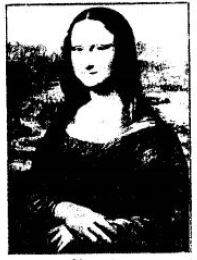
Question 7. Study this picture carefully and answer the questions that follow: (a) Give the name by which the portrait is known. (b) Name the artist who portrayed it? (c) Mention the main features of this painting?
Answer:
(a) The portrait is known as the 'Mona Lisa'. (b) It was painted by the master artist Leonardo da Vinci (1452-1519). (c) This artwork is celebrated for its exquisite representation of grace and balance. It is often described as surpassing natural beauty. A key characteristic is the gentle, mysterious smile on her face, combined with her partially veiled, expressive eyes that seem to communicate directly with the viewer, creating an incredibly captivating and desirable overall impression.
In simple words: This is the Mona Lisa, painted by Leonardo da Vinci. It is famous for its peaceful beauty and the subject's soft, mysterious smile.
Exam Tip: Remember that the main features of the Mona Lisa are its balance, harmony, and her unique, subtle smile.
Question 8. What were the effects of the Renaissance?
Answer: The main impacts of the Renaissance included: 1. Sparking the Protestant Reformation: A newfound desire to explore the unknown through critical questioning, systematic observation, and active testing weakened the absolute authority of the Church, paving the way for religious reform. 2. Rapid Growth of Native Languages and Literature: The movement greatly stimulated writing in local languages instead of Latin. In England, William Shakespeare produced his famous plays, while his Spanish contemporary Miguel de Cervantes penned "Don Quixote". In France, Molière established the national theater, "Comédie-Française". 3. Broadening Horizons through Sea Explorations: New global discoveries opened trade channels connecting Europe with Eastern nations. This commerce generated immense wealth for European kingdoms. Colonization followed as England and Spain extracted vast fortunes from the Americas, allowing European powers to dominate regions in Asia, Africa, and the Americas to bolster their global influence. 4. Focus on Human Potential and Individuality: Prior to this era, people generally surrendered their personal desires to the will of religious or social hierarchies. With the rise of humanism, people began to value themselves as distinct individuals. They recognized humanity's capability to find joy and liberty independent of religious control, which was reflected in contemporary art and literature depicting regular human lives. 5. Emergence of Sovereign Countries: Growing patriotic sentiment, coupled with the development of distinct regional literatures, fueled the rise and expansion of independent Nation-States.
In simple words: The Renaissance changed Europe by encouraging people to question the Church, write in their own languages, explore new lands, value human life as individuals, and form independent nations.
Exam Tip: Be prepared to list at least three distinct outcomes of the Renaissance, such as the rise of local literature, geographical discoveries, and the humanist movement.
Short Answer Questions
Question 1. What is meant by the term ‘Renaissance’ ?
Answer: The word "Renaissance" translates to rebirth or a period of revival. It represents a multifaceted transition in Europe that bridged the medieval and modern eras, starting during the fourteenth century in Italy and continuing until the seventeenth century.
In simple words: "Renaissance" means rebirth. It was a time of big changes in Europe from the 1300s to the 1600s, moving from the Middle Ages to modern times.
Exam Tip: Always define the term literally as "rebirth" or "revival" and specify its timeframe (14th to 17th century) and place of origin (Italy) to secure full points.
Question 2. Mention any two causes of the Renaissance.
Answer: Two primary factors were: 1. The weakening of the feudal system, which allowed for greater social movement among people. 2. The active backing and financial support of monarchs, aristocrats, and rich merchants - such as the influential Medici family in Florence - who funded and encouraged Renaissance artists.
In simple words: Two main causes were the end of the feudal system, which gave people more freedom, and rich families like the Medicis paying artists to create masterworks.
Exam Tip: Citing the Medici family of Florence as an example of patronage is a key detail that examiners look for when grading this question.
Question 3. What role did the victory of the Turks over Constantipole play in the rise of Renaissance.
Answer: In 1453, Constantinople was captured by Ottoman forces. This event forced numerous Greek and Roman intellectuals to flee to Rome and other European territories, carrying valuable classical manuscripts with them. Consequently, they introduced and popularized ancient classical learning across different parts of Europe.
In simple words: When Constantinople fell in 1453, smart Greek and Roman scholars fled to Europe. They brought old books with them, helping spread classical knowledge.
Exam Tip: Note the exact year (1453) of the fall of Constantinople, as historical accuracy on dates is highly valued in exam keys.
Question 4. How did the decline of feudalism contribute to the rise of Renaissance ?
Answer: The decay of feudal structures during the thirteenth and fourteenth centuries encouraged independent thought. The resulting stability and liberty nurtured an environment suitable for the expansion of modern scholarship. This shift sparked major advancements across painting, writing, philosophy, and scientific exploration, driving the momentum of the Renaissance.
In simple words: As the old feudal system ended, people gained more freedom and peace. This let them think freely and create new art, science, and literature.
Exam Tip: Explain how the decline of feudalism directly led to "free thinking" and "peace," which are the crucial links to the growth of learning.
Question 5. Why did the Renaissance began in Italy ? Give two reasons.
Answer: 1. Italy served as the historic core of the ancient Roman Empire, meaning the region was filled with classical ruins and monuments. These physical remnants drew researchers, intellectuals, and creators to the peninsula. 2. The vast wealth that Italian city-states amassed through trade connections with Eastern nations provided the financial resources needed to sponsor cultural projects.
In simple words: The Renaissance started in Italy because it was full of ancient Roman ruins that inspired artists, and Italian cities were rich from trade, allowing them to pay for art and learning.
Exam Tip: Clearly state both aspects - the cultural heritage of the Roman Empire and the wealth from trade - to provide a complete answer.
Question 6. How did the invention of the printing press bring in a new awakening in Europe ?
Answer: Johannes Gutenberg established the initial printing press in Germany around 1456, a technology William Caxton later brought to England. This mid-fifteenth-century breakthrough allowed for the mass production of written works. Consequently, copies of the Bible alongside various classical and religious texts were widely distributed throughout the continent.
In simple words: The printing press let people print books quickly and in large numbers. This made books like the Bible cheap and easy to find, helping ideas spread fast.
Exam Tip: Mention Johannes Gutenberg and the year 1456, along with the impact of mass-producing the Bible, to ensure a high-scoring answer.
Question 7. Explain briefly the term ‘Humanism’
Answer: The concept of humanism comes from the Latin phrase "Studia humanitatis", translating to the study of humanity. It represented a major transition from focusing purely on divine affairs to focusing on human life. This perspective celebrated human potential, emphasizing the inherent value of individuals. It rejected strict self-denial and supported the human right to find happiness and fulfill physical and emotional needs during earthly life.
In simple words: Humanism means focusing on the value, happiness, and dignity of human beings on Earth, rather than just focusing on religious or divine matters.
Exam Tip: Mention the origin "Studia humanitatis" and the shift from divine to human concern to explain this term fully.
Question 8. Who is known as the Father of Humanism ?
Answer: The distinguished writer and intellectual Francesco Petrarch is widely recognized as the "father of humanism". His poetic works, including lyrics and sonnets, gained immense fame across the European continent.
In simple words: Petrarch is called the Father of Humanism. He was a famous writer whose poems were loved all over Europe.
Exam Tip: Remember Petrarch's name and associate him with Italian sonnets and humanist philosophy.
Question 9. Mention any two factors that led to the growth of the spirit of enquiry among the people of Europe.
Answer: The growth of a questioning mindset among Europeans was driven by these main developments: (a) The Crusades: These holy military campaigns were fought to secure access to sacred sites around Jerusalem. By putting Europeans in direct contact with Asian societies, the Crusades introduced Eastern knowledge to the West. This interaction expanded people's perspectives, challenged rigid dogmas, and encouraged individuals to prioritize logical thinking over unquestioned belief. (b) Progress in Science: Though science stagnated during the era of absolute religious faith, some medieval academics adopted analytical viewpoints and prompted students to study the natural world directly. This practice led to various breakthroughs. The rise of scientific exploration fostered a skeptical, inquiry-based attitude. For instance, Roger Bacon envisioned motor vehicles and aircraft, Copernicus demonstrated the Earth's orbit around the Sun, and Galileo created the telescope. Such milestones widened intellectual horizons and dismantled outdated superstitions.
In simple words: The Crusades connected Europe with Eastern ideas, and early scientific discoveries showed people how to look at nature directly. Both helped people choose logic over blind belief.
Exam Tip: Highlight how both factors (Crusades and Science) encouraged "reason" over "blind faith" or "dogma."
Question 10. Mention the impact of the Renaissance in the field of English literature.
Answer: The most profound change brought by the Renaissance was the shift toward writing in regional vernaculars rather than Latin. This period saw England produce many distinguished authors, poets, and playwrights. Geoffrey Chaucer, known as the "Father of English Poetry", created his landmark work "The Canterbury Tales". Thomas More wrote "Utopia", describing a perfect society on an island. Other notable figures of the era include Francis Bacon, William Shakespeare, Ben Jonson, and Christopher Marlowe. Additionally, John Milton produced his epic masterpiece "Paradise Lost", while Edmund Spenser penned "The Faerie Queene".
In simple words: Instead of Latin, writers started using English. This led to famous works by writers like Shakespeare, Chaucer (The Canterbury Tales), Milton (Paradise Lost), and Thomas More (Utopia).
Exam Tip: List at least three writers and their respective works to present a thorough and complete answer.
Question 11. Mention the theory introduced by Copernicus.
Answer: Copernicus established the scientific claim that the Earth revolves around the Sun.
In simple words: Copernicus showed that the Earth travels around the Sun.
Exam Tip: This is a direct, short answer. State the heliocentric concept clearly in one sentence.
Question 12. How did Renaissance lead to the rise of monarchical form of governments in Europe.
Answer: The Renaissance accelerated the development of powerful centralized monarchies throughout Europe. As the influence of feudal lords and religious institutions weakened, citizens increasingly sought order, safety, and national stability. Consequently, the public backed their kings, thereby consolidating and expanding royal authority.
In simple words: Because the Church and feudal lords lost power, people wanted strong kings who could keep peace and safety. So, they supported monarchs, making them more powerful.
Exam Tip: Connect the decline of the Church/feudalism to the people's desire for stability and peace, which led to supporting a central king.
Question 13. Mention two outstanding features of the Renaissance Art.
Answer: 1. The creation of highly realistic bronze sculptures, such as Donatello's representation of David and Michelangelo's famous "Pieta". 2. Masterful bronze metalworking, exemplified by Lorenzo Ghiberti crafting two sets of detailed bronze doors for the Florence Baptistery.
In simple words: Renaissance art was famous for realistic bronze statues, like Michelangelo's Pieta, and beautiful bronze doors, like those made by Ghiberti in Florence.
Exam Tip: Name specific artists (like Donatello, Michelangelo, or Ghiberti) and their works to illustrate the features of Renaissance art.
Question 14. Mention any two consequences of the geographical explorations.
Answer: Sailors representing Spain and Portugal led major efforts in oceanic exploration. After the capture of Constantinople by Ottoman forces closed traditional overland routes, Europeans searched for alternative paths to the East, leading to several key achievements: 1. Prince Henry the Navigator of Portugal charted sea routes along the African coastline. 2. Bartolomeu Dias successfully sailed to the southern tip of Africa, reaching the Cape of Good Hope. 3. Vasco da Gama completed a sea voyage extending all the way to India in 1498. 4. Christopher Columbus reached the Americas in 1492.
In simple words: Because old trade routes were blocked, explorers sailed to find new paths. This led to discovering the sea route around Africa to India and finding the Americas.
Exam Tip: Be ready to name Vasco da Gama (India, 1498) and Columbus (America, 1492) as key figures of these maritime discoveries.
Question 15. Who wrote “The Canterbury Tales” ?
Answer: "The Canterbury Tales" was written by the celebrated English poet Geoffrey Chaucer.
In simple words: Geoffrey Chaucer wrote the famous book "The Canterbury Tales".
Exam Tip: Remember Chaucer's role as the "Father of English Poetry" in relation to this masterpiece.
Question 16. Mention two of the paintings of Michelangelo.
Answer: Two prominent paintings created by Michelangelo are "The Last Judgment" and "The Fall of Man".
In simple words: Two of Michelangelo's famous paintings are "The Last Judgment" and "The Fall of Man".
Exam Tip: Note that these works are famous frescoes located on the ceiling and altar wall of the Sistine Chapel.
Question 17. Mention any two statues sculpted by Michelangelo.
Answer: Michelangelo, who worked across painting, sculpture, building design, and poetry, carved several legendary sculptures, including "Pieta", "David", and "Moses".
In simple words: Michelangelo was a multitalented artist whose most famous sculptures are "David", "Pieta", and "Moses".
Exam Tip: Clearly distinguish between his paintings (frescoes like "The Last Judgment") and his marble sculptures ("David" and "Pieta") to avoid mixing them up in exam responses.
II. Structured Questions
Question 1. Many factors contributed to usher in the spirit of Renaissance, which had far-reaching consequences for the entire world. In this context, write short notes on: (a) Invention of the printing press (b) Decline of Feudalism. (c) Capture of Constantinople.
Answer:
(a) **Invention of the printing press:** Introducing moveable type printing across Europe during the mid-fifteenth century enabled the rapid reproduction of written materials. Instead of rare, hand-copied manuscripts, copies of the Bible along with essential religious and classical works became accessible to many. This access to books catalyzed a profound intellectual awakening across European society. (b) **Decline of Feudalism:** As the feudal structure deteriorated in the thirteenth and fourteenth centuries, it created space for independent, critical thinking. The relative safety and social liberty that followed this decline encouraged the spread of modern knowledge, leading to major creative and analytical leaps in painting, literature, philosophy, and early science. (c) **Capture of Constantinople:** Serving as the capital of the Byzantine (Eastern Roman) Empire, Constantinople was a critical repository of classical civilization and housed invaluable ancient texts. Following its fall to Ottoman forces in 1453, many resident academics fled to Rome and other European cities with their documents. These scholars brought with them logical approaches, open minds, and humanist ideals. As they resettled, they stimulated a deep interest in ancient Greek and Roman philosophy, science, and literature, laying the groundwork for the Renaissance.
In simple words: The printing press made books common, the end of feudalism gave people freedom to think, and the fall of Constantinople sent smart scholars to Europe. Together, these events sparked the Renaissance.
Exam Tip: Structured questions require detailed explanations for each sub-part. Ensure each note contains the key historical consequence (e.g., scholars fleeing to Rome for the fall of Constantinople).
2. Renaissance brought in a spirit of enquiry among the people of Europe. In this context, answer the following questions
Question 2(a). How did the development of science create the spirit of inquiry ?
Answer: The evolution of scientific thought nurtured a questioning mindset and analytical attitude. Roger Bacon theorized early concepts of self-propelled vehicles and flying devices. Later, Copernicus demonstrated that our planet revolves around the Sun, while Galileo designed the telescope to observe outer space. These advancements expanded human understanding, helping to dismantle superstitious ideas and outdated customs.
In simple words: Scientific progress showed people how to look for real evidence instead of just believing old stories. Inventions like the telescope changed how people saw the universe.
Exam Tip: When discussing "scientific temper," cite Roger Bacon, Copernicus, and Galileo as key examples of early scientific pioneers.
Question 2(b). Explain briefly the role of original thinkers in promoting the spirit of enquiry among the people of Europe.
Answer: Throughout the Middle Ages, religious authorities actively suppressed independent thought, insisting that scholars defer to established church dogmas. Nevertheless, independent inquiry could not be held back indefinitely. Courageous intellectuals openly challenged traditional doctrines and urged people to cultivate critical thinking. Thinkers such as Roger Bacon, Peter Abelard, and Thomas Aquinas transformed intellectual life by placing a high value on logical reasoning.
In simple words: During the Middle Ages, the Church wanted people to believe dogma without questioning it. Brave thinkers like Roger Bacon and Thomas Aquinas challenged this by teaching people to use logic and reasoning.
Exam Tip: Mention Peter Abelard and Thomas Aquinas to show a deep understanding of medieval philosophy and the transition to the Renaissance.
Question 2(c). What was the role of Crusades in ushering in the spirit of inquiry ?
Answer: The Crusades were a series of military campaigns aimed at securing Christian access to holy sites in Jerusalem. These movements brought Western Europeans into direct contact with Eastern cultures. This exchange of ideas expanded European horizons and weakened rigid, unquestioned assumptions, encouraging people to rely on intellectual reasoning instead of accepting doctrines without proof.
In simple words: The Crusades were holy wars that took Europeans to Asia. This trip exposed them to new ideas, helping them think more broadly and question old beliefs.
Exam Tip: Clearly state that contact with the East was the primary mechanism through which the Crusades stimulated a spirit of inquiry.
3. Renaissance of lists tried to depict life on canvas and stone. With reference to this statement, describe the following:
Question 3(a). Progress in the art of painting
Answer: During this period, the art of painting advanced dramatically, focusing on realistic depictions of human experiences that inspired viewers. To capture authentic poses and emotions, creators integrated mathematical proportions and precise human anatomy into their work. Renowned painters and their key works include: 1. Leonardo da Vinci (1452-1519): Known for masterpieces such as "Virgin of the Rocks", "The Last Supper", and "Mona Lisa". 2. Michelangelo (1475-1564): Celebrated for works like "The Last Judgment" and "The Fall of Man". 3. Raphael (1483-1520): Noted for the "Sistine Madonna" and his architectural work on St. Peter's Basilica.
In simple words: Painting became much more realistic because artists studied the human body and used geometry. Famous painters include Leonardo da Vinci, Michelangelo, and Raphael.
Exam Tip: Mention how the study of human anatomy and geometry helped Renaissance painters achieve realism.
Question 3(b). Progress in the art of sculpture.
Answer: A renewed fascination with classical antiquity deeply influenced the field of sculpture. While some artists modeled their work directly on classical Greek and Roman masterpieces, others sculpted original pieces that matched the quality of ancient creations. Significant sculptors of this era include: 1. Donatello (1386-1466): Famous for his bronze sculpture of David. 2. Lorenzo Ghiberti: Renowned for designing the bronze doors of the Florence Baptistery. 3. Michelangelo: Master sculptor of the "Pieta" (depicting the Virgin Mary and Jesus), alongside iconic statues of David and Moses. 4. Numerous Italian sculptors contributed to beautifying churches and palaces, closely linking the evolution of sculpture with architectural progress.
In simple words: Sculptors were inspired by ancient Greek and Roman art. They made lifelike statues out of marble and bronze, like Donatello's David and Michelangelo's Pieta.
Exam Tip: Be sure to mention Donatello and Michelangelo with their respective sculptures to show a clear understanding of the progress in sculpture.
Question 4. Renaissance was a period of intellectual activity. In the context, write briefly on the impact of Renaissance on Science under the following heads: (a) Progress in astronomy (b) Progress in medicine. (c) Progress in mathematics.
Answer:
(a) **Progress in astronomy:** Copernicus (1473-1543) argued that the Earth is spherical and, along with the Moon and other planets, revolves around the Sun in circular paths. Subsequently, the German scientist Johannes Kepler (1571-1630) demonstrated that the orbits of the Earth and other planets around the Sun are actually elliptical rather than perfectly circular. The Italian scientist Galileo Galilei (1564-1642) developed the telescope, and Sir Isaac Newton (1642-1727) formulated the law of universal gravitation. (b) **Progress in medicine:** Significant breakthroughs transformed medical knowledge during this period: 1. Andreas Vesalius (1514-1564) compiled an influential text on human anatomy. 2. William Harvey (1578-1657) mapped the circulatory system, explaining how blood moves from the heart throughout the body and back. 3. Paracelsus (1493-1541) established a strong link between chemical principles and medical practices. 4. Valerius Cordus (1515-1544) synthesized ether using alcohol and sulfuric acid. 5. Jan Baptista van Helmont (1577-1644) identified carbon dioxide. (c) **Progress in mathematics:** The introduction of algebraic concepts and Arabic numerals from Arab scholars enriched Western mathematics. Modern geometry was organized systematically by Girard Desargues (1593-1662), while Simon Stevin promoted the use of decimal systems for currencies, weights, and measurements.
In simple words: During the Renaissance, science flourished. Astronomers mapped the solar system, medical pioneers learned how the human body and blood circulation work, and mathematicians introduced algebra and decimals to Europe.
Exam Tip: Categorize your answer clearly under the three headings (Astronomy, Medicine, Mathematics) and try to mention at least two key figures with their contributions for each section.
Free study material for History Civics
ICSE Goyal Brothers Solutions Class 9 History Civics Chapter 12 The Renaissance
Students can now access the detailed Goyal Brothers Solutions for Chapter 12 The Renaissance on our portal. These solutions have been carefully prepared as per latest ICSE Class 9 syllabus. Each solution given above has been updated based on the current year pattern to ensure Class 9 students have the most updated History Civics content.
Master Goyal Brothers Textbook Questions
Our subject experts have provided detailed explanations for all the questions found in the Goyal Brothers textbook for Class 9 History Civics. We have focussed on making the concepts easy for you in Chapter 12 The Renaissance so that students can understand the concepts behind every answer. For all numerical problems and theoretical concepts these solutions will help in strengthening your analytical skill required for the ICSE examinations.
Complete History Civics Exam Preparation
By using these Goyal Brothers Class 9 solutions, you can enhance your learning and identify areas that need more attention. We recommend solving the History Civics Questions from the textbook first and then use our teacher-verified answers. For a proper revision of Chapter 12 The Renaissance, students should also also check our Revision Notes and Sample Papers available on studiestoday.com.
FAQs
You can download the verified Goyal Brothers solutions for Chapter 12 The Renaissance on StudiesToday.com. Our teachers have prepared answers for Class 9 History Civics as per 2026-27 ICSE academic session.
Yes, our solutions for Chapter 12 The Renaissance are designed as per new 2026 ICSE standards. 40% competency-based questions required for Class 9, are included to help students understand application-based logic behind every History Civics answer.
Yes, every exercise in Chapter 12 The Renaissance from the Goyal Brothers textbook has been solved step-by-step. Class 9 students will learn History Civics conceots before their ICSE exams.
Yes, follow structured format of these Goyal Brothers solutions for Chapter 12 The Renaissance to get full 20% internal assessment marks and use Class 9 History Civics projects and viva preparation as per ICSE 2026 guidelines.