

ICSE Solutions Goyal Brothers Class 9 History Civics Chapter 7 The Age Of The Guptas have been provided below and is also available in Pdf for free download. The Goyal Brothers ICSE solutions for Class 9 History Civics have been prepared as per the latest syllabus and ICSE books and examination pattern suggested in Class 9. Questions given in ICSE Goyal Brothers book for Class 9 History Civics are an important part of exams for Class 9 History Civics and if answered properly can help you to get higher marks. Refer to more Chapter-wise answers for ICSE Class 9 History Civics and also download more latest study material for all subjects. Chapter 7 The Age Of The Guptas is an important topic in Class 9, please refer to answers provided below to help you score better in exams
Goyal Brothers Chapter 7 The Age Of The Guptas Class 9 History Civics ICSE Solutions
Class 9 History Civics students should refer to the following ICSE questions with answers for Chapter 7 The Age Of The Guptas in Class 9. These ICSE Solutions with answers for Class 9 History Civics will come in exams and help you to score good marks
Chapter 7 The Age Of The Guptas Goyal Brothers ICSE Solutions Class 9 History Civics
Question 1. Name one literary and another archaeological source to reconstruct the Age of the Gupta’s.
Answer: We can reconstruct the Gupta era using different historical records. For a literary reference, we can look at the travel writings of the Chinese traveler Fa-hien. As for physical evidence, the historical inscriptions carved on the Allahabad Pillar serve as an archaeological key.
In simple words: We learn about the Guptas from two main sources. First is the travel diary of a Chinese traveler named Fa-hien. Second is the writing carved on a famous stone pillar in Allahabad.
Exam Tip: When naming sources, clearly label which one is written (literary) and which one is physical (archaeological) to score full marks.
Question 2. Name the famous Inscription that tells us about the character and military achievements of Samudragupta.
Answer: The military conquests and personality of Samudragupta are recorded in detail on the Allahabad Pillar Inscription.
In simple words: The writing on the Allahabad Pillar describes the victories and life of King Samudragupta.
Exam Tip: Remember that this inscription is also called the 'Prayag Prasasti', which is a great keyword to include in exams.
Question 3. Which great conquest enabled Chandragupta II to carry the title of Sakari ?
Answer: Chandragupta II earned this specific title after defeating the Saka rulers and taking over the territories of Gujarat along with the Kathiawar peninsula.
In simple words: Chandragupta II got the name 'Sakari' because he defeated the Saka people and took their lands in Gujarat.
Exam Tip: The term 'Sakari' literally translates to 'destroyer of the Sakas' - mentioning this translation can help gain extra marks.
Question 4. Who was Fa-hien ? What is the title of the book that he wrote about India ?
Answer: He was a Buddhist traveler from China who spent over thirteen years exploring different parts of India. He recorded his observations in a book called Fo-Kwo-Ki, which translates to 'The Travels of Fa-hien'.
In simple words: Fa-hien was a Chinese traveler who visited India for over 13 years. He wrote a book about his journey called Fo-Kwo-Ki.
Exam Tip: Do not forget to write both the original Chinese name of the book and its English translation.
Question 5. What did Fa-hien write about the City of Pataliputra ?
Answer: According to the Chinese pilgrim's records, Pataliputra was a highly prosperous city where residents lived comfortably. He highlighted the presence of two majestic Buddhist monasteries representing both the Hinayana and Mahayana sects. He also admired the magnificent palace built by Emperor Ashoka. The city featured a high-quality medical facility funded by wealthy residents, alongside numerous rest houses along major roads for travelers. People of different faiths coexisted peacefully, and the general public followed the law. The government operated with gentle laws, avoiding harsh restrictions on movement and completely eliminating the death penalty.
In simple words: Pataliputra was a rich and peaceful city. It had two big monasteries, Ashoka's beautiful palace, and a free hospital paid for by rich citizens. The laws were kind, and there was no death penalty.
Exam Tip: For long-answer questions about foreign accounts, list key points like administration, social life, religion, and public welfare structures.
Question. Which Gupta ruler defeated the Hunas ?
Answer: The credit for successfully repelling the invasions of the Hunas goes to the Gupta emperor Skandagupta.
In simple words: King Skandagupta was the ruler who fought and defeated the Hunas.
Exam Tip: Skandagupta is famously remembered for saving the empire from these nomadic invaders, which is crucial to mention.
Question 6. What does Fa-hien write about the life of the people during the Gupta age?
Answer: The Chinese traveler noted that the majority of citizens in the Gupta period lived on a vegetarian diet and practiced non-violence. However, the social structure was deeply divided by a rigid caste system where untouchability was common. The Chandalas were treated as outcasts, forced to live outside main residential areas and perform low-status work; they even had to strike wooden pieces when entering markets to warn others of their presence. While slavery was practiced, members of the Brahmin class were exempt from it. Women received education in household duties and artistic skills, though remarrying was discouraged for widows. Additionally, the temple maiden system, known as Devadasi, was active in various religious places.
In simple words: Most people did not eat meat and believed in non-violence. But society had strict divisions, and poor outcasts called Chandalas were treated very badly. Women learned arts but widows could not remarry easily.
Exam Tip: When discussing Gupta society, present both the positive aspects (like non-violence) and negative social issues (like untouchability and gender restrictions) for a balanced answer.
Question 7. Who was the greatest literary genius of the Gupta period?
Answer: Kalidasa is celebrated as the outstanding literary figure of the Gupta era.
In simple words: Kalidasa was the most famous and talented writer of the Gupta times.
Exam Tip: Mentioning that Kalidasa was one of the 'Nine Gems' (Navaratnas) in the royal court will add value to your answer.
Question 8. Name two dramas and two epics written by Kalidasa.
Answer: Two of the prominent plays composed by Kalidasa are Malavikagnimitra and Vikramorvasiya. His two highly acclaimed epic poems are Raghuvamsa and Kumarasambhava.
In simple words: Two plays by Kalidasa are Malavikagnimitra and Vikramorvasiya. His two epic poems are Raghuvamsa and Kumarasambhava.
Exam Tip: Memorize the spelling of these Sanskrit titles carefully to avoid losing marks in your history exams.
Question 9. Mention the contributions of Aryabhatta in the field of astronomy.
Answer: As a pioneering Indian scientist, Aryabhatta proposed that our planet is a sphere. He also demonstrated that the Earth spins on its axis while traveling around the Sun.
In simple words: Aryabhatta was the first Indian scientist to say the Earth is round and that it turns on its own axis while going around the Sun.
Exam Tip: Highlight that he discovered the Earth's rotation and revolutionary movements long before modern western astronomy.
Question 10. Name the famous astronomer of the Gupta period after whom an Indian Satellite was named.
Answer: The pioneering scientist Aryabhatta is the individual after whom India named its initial space satellite.
In simple words: India's very first space satellite was named after the great astronomer Aryabhatta.
Exam Tip: State clearly that 'Aryabhata' was India's first satellite, launched in 1975, to show extra historical context.
Question 11. Mention the important contributions of Varahamihira.
Answer: A prominent scholar of the Gupta period, Varahamihira authored the Brihat Samhita, an encyclopedic work covering diverse fields like botany, mathematics, astronomy, and geography. He also created a significant treatise on astrology and compiled the Pancha Siddhantika, which summarizes five distinct methods of astronomical study.
In simple words: Varahamihira wrote a famous book called Brihat Samhita about science, plants, and stars. He also wrote Pancha Siddhantika, which explains five different ways to study astronomy.
Exam Tip: Remembering the titles 'Brihat Samhita' and 'Pancha Siddhantika' is essential when writing about Gupta-era scientific achievements.
Question 12. Mention two famous temples of the Gupta period.
Answer: Two outstanding temple structures from this era are the Bhitargaon Temple situated close to Kanpur, and the Deogarh Vishnu Temple, frequently referred to as the Dasavatara Temple, located near Jhansi.
In simple words: Two well-known temples are the Dasavatara Temple in Deogarh and the Bhitargaon Temple near Kanpur.
Exam Tip: Note the locations (Deogarh and Kanpur) alongside the temple names as they are often tested in fill-in-the-blank questions.
Question 13. Metion two important architectural features of the Dasavatara (Vishnu) Temple at Deogarh.
Answer: This historic shrine is constructed on a broad raised platform featuring steps in the center of all four sides. Additionally, the structure was built with a tall tower or spire, and its ceiling was held up by columns.
In simple words: The temple is built on a wide, raised platform with steps on every side. It also had a tall tower on top and a roof held up by stone pillars.
Exam Tip: Use terms like 'high plinth' or 'raised platform' and 'shikhara' (spire) to match standard textbook descriptions of early temple architecture.
Question 14. The Provincial Governors during the reign of the Gupta were called by which names ?
Answer: These regional administrators, who were typically members of the royal family, held titles such as Pradeshikas or Uparika Maharaja.
In simple words: The governors of different areas were usually princes. They were called Uparika Maharaja or Pradeshikas.
Exam Tip: Point out that these positions were reserved for royal family members to show you understand the administrative structure.
Question 15. The Districts (Vishyas) were placed under whose charge during the rule of Guptas ?
Answer: Provinces known as Bhuktis were subdivided into districts called Vishyas, administered by officials known as Ayuktas or Vishayapatis, who were generally selected by the regional governor. This local government also included specialized officers like the Nagarshresthi, who served as the leading banker; the Pushtapal, responsible for maintaining official records; and the Prathamkayastha, who handled official correspondence and paperwork.
In simple words: Districts were called Vishyas and ruled by officers named Vishayapatis. Other helper officers included a record keeper, a chief letter-writer, and a chief banker.
Exam Tip: Learn the roles of Vishayapati, Pushtapal, and Nagarshresthi as individual definitions, as they frequently appear in short-answer sections.
Question 16. Mention an important cause for the revival of Brahmanical religion in the Gupta period.
Answer: A major factor behind the resurgence of Brahmanism was the active patronage of the Gupta rulers, who strongly promoted and helped rebuild their traditional faith.
In simple words: The Gupta kings loved and supported the Hindu religion, which helped make it popular and strong again.
Exam Tip: Focus on the term 'royal patronage' as the primary driver for religious changes in ancient Indian history.
Question 17. What is the importance of Panchatantra?
Answer: This work is a famous anthology of fables designed to convey ethical values and life lessons to young readers.
In simple words: The Panchatantra is a book of short animal stories that teach children good values and lessons about life.
Exam Tip: Mention that Vishnu Sharma is the traditional author of these moral stories to demonstrate complete knowledge.
Question 18. Name three important sciences which made great progress during the Gupta period.
Answer: The three scientific fields that saw remarkable advancement during this era were mathematics, medicine, and astronomy.
In simple words: Three sciences that grew a lot during this time were math, medical science, and the study of stars.
Exam Tip: Always list these three standard fields when summarizing the scientific achievements of the Golden Age.
Question 19. Mention the famous work on medicine written by Vriddha-Vagabhatta.
Answer: The celebrated medical text compiled by Vriddha-Vagabhatta is the Ashtang Sangrah.
In simple words: Vriddha-Vagabhatta wrote a famous medical book called Ashtang Sangrah.
Exam Tip: Be precise with the spelling of 'Ashtang Sangrah' to secure full marks.
Question 20. Which Gupta ruler defeated the Hunas?
Answer: It was the Gupta monarch Skandagupta who successfully defended the realm and overcame the invading Hunas.
In simple words: The Hunas were defeated by the brave Gupta king Skandagupta.
Exam Tip: Skandagupta's victory over the Hunas is widely regarded as one of his greatest military feats.
Question 21. Mention two pieces of evidence to show that the art of Sculpture excelled during the Gupta period.
Answer: Two classic examples showcasing the peak of artistic carving in this period are the standing statue of Buddha found in Mathura, and the impressive relief carving of the Great Boar at the Udayagiri cave entrance.
In simple words: Two great examples of Gupta carving are the standing Buddha statue found at Mathura, and the sculpture of the Great Boar at the Udayagiri cave.
Exam Tip: Make sure to associate the specific deity/figure with its correct location (Buddha at Mathura, Boar at Udayagiri).
Question 22. What is known as Frescoes ?
Answer: Wall paintings created by applying pigments onto plaster are referred to as frescoes.
In simple words: Frescoes are beautiful paintings made directly on the plaster of walls.
Exam Tip: In exams, define a fresco specifically as a painting done on wet or dry plaster walls to show clear understanding.
Question 23. Mention two places famous for the art of painting during the Gupta period.
Answer: Two locations highly celebrated for their murals from this era are the Bagh Caves situated near Gwalior in Madhya Pradesh, and the Ajanta Caves located in Maharashtra.
In simple words: Two famous places for paintings are the Ajanta Caves in Maharashtra and the Bagh Caves near Gwalior.
Exam Tip: Always specify the states (Maharashtra and Madhya Pradesh) alongside the cave names for completeness.
Question 24. Mention two important features of the paintings at Ajanta.
Answer: First, the artists prepared the rough rock surfaces by spreading a thick layer of clay combined with organic matter like straw and gypsum, followed by a fine coat of lime plaster to establish a smooth, shiny base. Second, the artists sketched the outlines of their subjects directly onto this prepared surface before coloring them in with water-based paints.
In simple words: First, the rough walls were covered with a mix of clay, straw, and plaster to make them smooth. Second, the artists drew the outlines first and then colored them using water colors.
Exam Tip: Remembering the step-by-step process of wall preparation (plastering, lining, and coloring) is highly valued by examiners.
Question 25. Name the Chinese pilgrim who studied at the Nalanda University.
Answer: The notable traveler from China who attended Nalanda University for his studies was Hiuen-Tsang.
In simple words: Hiuen-Tsang was the famous Chinese scholar who went to study at Nalanda University.
Exam Tip: Note the difference in timing - Fa-hien visited during the Guptas (Chandragupta II), while Hiuen-Tsang visited later during Harsha's reign.
Question 26. Mention the extent of King Harsha’s empire.
Answer: The territories under the direct administration of King Harshavardhana spanned across several regions, including Eastern Punjab, Kanauj in Uttar Pradesh, Magadha in Bihar, alongside Bengal and Orissa.
In simple words: King Harsha's empire was very big and included parts of Eastern Punjab, Kanauj, Bihar, Bengal, and Orissa.
Exam Tip: Listing these five territories clearly in a bulleted list will help you secure full marks in descriptive exams.
Question 27. How can we say that Harshavardhana w as a patron of learning ?
Answer: Harshavardhana demonstrated his dedication to education and the arts by supporting renowned writers such as his court poet Matang Diwakar, Mayur (who wrote Suryashataka), and Banabhatta (the author of Harshacharita). In addition to funding scholars, Harsha was an accomplished writer himself, composing three classic Sanskrit dramas: Ratnavali, Priyadarshika, and Nagananda. Furthermore, he provided significant financial support and protection to the prestigious Nalanda University.
In simple words: Harsha helped famous writers like Banabhatta and Mayur. He was also a writer himself who wrote three plays. He also gave a lot of money and help to Nalanda University.
Exam Tip: Mentioning both his support for other authors (like Banabhatta) and his own books (the three plays) shows a complete picture of his patronage.
Question 28. Who wrote Harshcharita ?
Answer: This historic biography was composed by the court scholar Banabhatta.
In simple words: Banabhatta was the writer who wrote the book Harshacharita.
Exam Tip: The 'Harshacharita' is an invaluable historical biography of King Harsha; make sure to learn the correct spelling of both the author and the book.
Question 29. Where was the Fifth Buddhist Assembly held ? Who presided over the Assembly’s deliberations ?
Answer: This grand religious gathering was hosted in Kanauj, and the Chinese scholar Hiuen-Tsang was chosen to lead its discussions.
In simple words: The Fifth Buddhist Assembly took place in Kanauj, and it was led by the Chinese traveler Hiuen-Tsang.
Exam Tip: Be sure to name both the city (Kanauj) and the president (Hiuen-Tsang) in separate, clear phrases.
Question 30. Mention the main conquests of Pulakesin II.
Answer: During his reign from 608 AD to 642 AD, Pulakesin II expanded his territory by bringing the northern Konkan region as well as Malwa and Gujarat under his control.
In simple words: Pulakesin II ruled from 608 to 642 AD. He conquered northern Konkan, Gujarat, and Malwa.
Exam Tip: Highlighting his defeat of King Harsha near the Narmada River is another major accomplishment often expected by examiners.
Question 31. Whose reign marks the climax of the Pallava power ?
Answer: The authority of the Pallava dynasty reached its absolute peak during the rule of Narasimhavarman.
In simple words: The Pallava empire became most powerful when King Narasimhavarman was ruling.
Exam Tip: He is also famous for building the rock-cut temples at Mahabalipuram, which is a great detail to add.
Question 32. Mention the main conquests of the Pallava ruler Narasimhavarman.
Answer: Narasimhavarman achieved a major victory by capturing and occupying Badami, the Chalukya capital. He also overcame the combined forces of the Cholas, Cheras, and Pandyas, and launched two successful naval missions to Sri Lanka to assist Prince Manavarman in securing his crown.
In simple words: Narasimhavarman captured the Chalukya capital named Badami. He also defeated the Cholas, Cheras, and Pandyas, and sent ships to help a prince in Sri Lanka.
Exam Tip: Remember that Narasimhavarman took the title 'Vatapikonda' (Conqueror of Vatapi/Badami) after this victory.
Question 33. Name the Inscription that refers to the achievements of King Kharvela of Kalinga.
Answer: The accomplishments of King Kharavela are detailed in the famous Hathigumpha Inscription, located on the Udayagiri hills close to Bhubaneswar in Odisha.
In simple words: King Kharavela's successes are written in the Hathigumpha Inscription, which is on the Udayagiri hills in Odisha.
Exam Tip: The term 'Hathigumpha' translates to 'Elephant Cave' - knowing this detail helps in general knowledge questions.
Question 34. Who converted Kanishka to Buddhism ?
Answer: The Kushana ruler Kanishka was guided into the Buddhist faith by the prominent monk Asvaghosa.
In simple words: A Buddhist monk named Asvaghosa was the one who helped Kanishka become a Buddhist.
Exam Tip: Asvaghosa was not only a monk but also a legendary poet who wrote the Buddhacharita.
Question 35. Name the two sects into which Buddhism got split during Kanishka’s reign.
Answer: Under Kanishka's patronage, the Buddhist religion divided into two primary schools: the Hinayana (often called the Lesser Vehicle) and the Mahayana (known as the Great Vehicle).
In simple words: During Kanishka's rule, Buddhism split into two groups: Hinayana and Mahayana.
Exam Tip: It was during the Fourth Buddhist Council organized by Kanishka that this major division became official.
Question 36. Give one evidence to suggest that the sculptural art flourished during the reign of Satvahanas of Deccan.
Answer: The exquisite carvings found at the Amaravati and Nagarjunakonda stupas provide strong proof of high-quality artistic skill under Satavahana rule.
In simple words: The beautiful stone carvings on the stupas at Amaravati and Nagarjunakonda prove that art was very popular.
Exam Tip: Be prepared to name either 'Amaravati' or 'Nagarjunakonda' individually if asked for a single site of Satavahana art.
Question 37. Name a fine specimen of rock-cut architecture during the reign of the Satvahanas.
Answer: The cave temple or Chaitya located at Karle stands as a superb representation of rock-cut construction from the Satavahana era.
In simple words: The big cave-hall called the Chaitya at Karle is a great example of their rock-cut architecture.
Exam Tip: A 'Chaitya' is a Buddhist prayer hall, which is characterized by its vaulted roof and rock-carved pillars.
Question 38. Name the two main crafts that flourished during the Gupta age.
Answer: The two major artisanal professions that reached great heights in the Gupta era were crafting fine jewelry and stone carving.
In simple words: Making beautiful jewelry and carving stone statues were the two main crafts that grew a lot.
Exam Tip: Metallurgy and terracotta work are also valid alternatives if you need to list other Gupta crafts.
Question 39. Mention an important cause for the revival of Brahmanical religion in the Gupta period.
Answer: The primary driver for the restoration of Brahmanical Hinduism was the unwavering dedication of the Gupta emperors, who actively funded and elevated their ancestral faith.
In simple words: The revival happened because the Gupta kings gave a lot of royal support and money to the Hindu religion.
Exam Tip: Royal performance of traditional rituals like the Ashvamedha (horse sacrifice) by Gupta kings also signaled this revival.
Question 40. Mention-any one cause that led to the decline of the mighty Gupta empire.
Answer: A critical factor that brought about the downfall of the Gupta empire was the continuous waves of hostile invasions by the Hunas.
In simple words: The main reason the Gupta empire collapsed was the continuous attacks by a tribe called the Hunas.
Exam Tip: Besides the Huna attacks, weak successors and independent provincial governors also weakened the central power.
Question 41. Mention the literary works of Dandin.
Answer: The well-known compositions authored by Dandin include Kavyadarsha and Dashakumaracharita.
In simple words: Dandin wrote two famous books named Dashakumaracharita and Kavyadarsha.
Exam Tip: Note the spelling 'Dashakumaracharita' (often spelled as Daskumarcharita in older sources) for correctness.
Question 42. Name the literary work of Perundevanar.
Answer: The celebrated literary piece produced by Perundevanar is titled Bharatam.
In simple words: Perundevanar wrote a famous book called Bharatam.
Exam Tip: 'Bharatam' is a classic translation of the Mahabharata epic into the Tamil language.
Question 43. How many Rathas are found at Mahabalipuram?
Answer: There are a total of eight monolithic rock temples, known as Rathas, located at Mahabalipuram.
In simple words: There are eight stone temples shaped like chariots at Mahabalipuram.
Exam Tip: Although they are named after characters from the Mahabharata, there are actually eight of these monolithic structures in total.
Question 44. Name the ‘Pancha Pandava’ Rathas.
Answer: The specific shrines that make up this group are the Dharmaraja Ratha, Bhima Ratha, Arjuna Ratha, Sahadeva Ratha, and Draupadi Ratha.
In simple words: The five temples are named Draupadi Ratha, Dharmaraja Ratha, Arjuna Ratha, Bhima Ratha, and Sahadeva Ratha.
Exam Tip: Learn these five names as they are the primary shrines in the Pallava architectural complex at Mahabalipuram.
Question 45. Name the largest and the smallest of the
Answer: Among these structures, the Dharmaraja Ratha is the most massive, whereas the Draupadi Ratha is the most compact.
In simple words: The biggest stone chariot temple is the Dharmaraja Ratha, and the smallest one is the Draupadi Ratha.
Exam Tip: These monolithic temples are carved out of single pieces of solid granite rock.
Structured Questions
Question 1. There are many literary sources to reconstruct the Age of the Guptas. In this context explain the literary accounts of Fa-hien.
Answer: In his travelogue Fo-Kwo-Ki, the Chinese pilgrim Fa-hien provides a rich description of social and religious environments during the early Gupta rule. He described the region of Magadha as highly prosperous, dotted with thriving urban centers and populated by well-to-do citizens. Pataliputra, the capital, stood out as an exceptionally wealthy city complete with multiple social welfare facilities, including a major hospital funded by philanthropic citizens. Fa-hien observed that despite their wealth, residents lived simple lives, with many adhering to peaceful Buddhist moral codes. Society was religiously diverse, with Vaishnavism, Shaivism, Buddhism, and Jainism all coexisting harmoniously without sectarian conflict. Images of Hindu deities were regularly featured on state coinage as well as in local arts. Furthermore, Fa-hien praised the gentle and humane administration of the empire, noting that the laws were lenient and criminal offenses were typically resolved with simple financial fines rather than physical punishment. These details suggest that the Gupta kingdom was peaceful, thriving, and run on highly moral and progressive ideals.
In simple words: Fa-hien wrote that Magadha was a rich and peaceful land. People lived simple lives and got along well, even if they followed different religions like Hinduism, Buddhism, or Jainism. The government was kind, and punishments were light, usually just small fines.
Exam Tip: Structure your answer into clear sub-headings like 'Social Life', 'Religious Harmony', and 'Administration' to present your points systematically and earn higher marks.
Question 2. Regarding archaeological sources to reconstruct the Age of the Gupta, explain what significance do the following have: (a) Allahabad Pillar Inscription (b) Nalanda University
Answer:
(a) The Allahabad Pillar Inscription: This inscription stands as one of the most vital pieces of written archaeological evidence for understanding the Gupta dynasty. It offers a detailed chronicle of the military victories, conquests, and general reign of Emperor Samudragupta. Historians highly value this record because it provides an extensive and reliable list of kingdoms, tribes, and rulers that were brought under Gupta control.
(b) Nalanda University: This was the premier center of higher learning in ancient India, established in the fifth century AD during Kumaragupta I's reign. The vast campus featured impressive structures, including eight separate colleges funded by various donors, such as King Balaputradeva of Sumatra, all enclosed by a protective brick wall. It housed over ten thousand scholars and instructors from across Asia, including China, Korea, and Tibet. Students utilized three immense libraries: Ratnasagar, Ratnodadhi, and Ratnaranjak. The rigorous curriculum covered the four Vedas, logic, grammar, medicine, yoga, and different schools of Buddhist philosophy. Admission was highly selective, with a challenging entrance exam that filtered out about eighty percent of applicants. The university remained a leading educational hub until its destruction in the twelfth century AD by Bakhtiyar Khilji.
In simple words: (a) The Allahabad Pillar is a very important stone writing that tells us about King Samudragupta's victories and the kingdoms he ruled. (b) Nalanda was a massive and famous ancient university in Bihar. It had three large libraries, thousands of students from different countries, and taught subjects like science, math, religion, and grammar. Only the smartest students could pass the hard entry test.
Exam Tip: For (a), emphasize that Harisena, the court poet, composed the inscription. For (b), mention key details like the library names (Ratnasagar, etc.) and its founder (Kumaragupta I).
Question 3. Samudragupta earned a reputation as one of the greatest kings and conquerors. In this context, explain:(a) His Conquests, (b) His Personal Attainments.
Answer:
(a) His Conquests: Samudragupta followed a calculated military policy across different regions. In northern India (Aryavarta), he completely defeated local rulers, such as the Nagas of Mathura, and incorporated their lands directly into his empire. In southern India (Dakshinapatha), he defeated twelve rulers spanning regions like Andhra and Tamil Nadu, but chose not to annex their territories; instead, he restored them as tributary kings who paid regular taxes. Additionally, rulers from boundary states like Nepal, Assam, Bengal, and parts of Rajasthan voluntarily accepted his supremacy and paid tribute.
(b) His Personal Attainments: Beyond his military success, Samudragupta was an accomplished intellectual, musician, and poet, earning the title 'Kaviraja'. Gold coins depicting him playing the veena show his love for music. Although he was a devout follower of Lord Vishnu, he maintained an open-minded approach, showing equal respect for other faiths and supporting various scholars and educational activities.
In simple words: (a) Samudragupta conquered northern rulers and took their lands. He also defeated twelve southern kings but let them keep their thrones as long as they paid taxes to him. (b) He was not just a warrior but also a talented poet, scholar, and musician who played the veena. He followed Hinduism but respected all other religions.
Exam Tip: Differentiate clearly between his aggressive 'annexation' policy in the north and his 'tributary' policy (digvijaya/grahan-moksha-anugraha) in the south.
Question 4. The reign of Chandragupta n marks the zenith of the Gupta glory. In this context briefly describe his conquests and the extent of his Empire.
Answer: Chandragupta II elevated the empire to its highest peak of influence through strategic alliances and military victories. To defeat the Saka rulers dominating western India, he formed marriage alliances by marrying the Naga princess Kuberanaga and wedding his daughter, Prabhavatigupta, to the Vakataka king Rudrasena II. This secured critical regional allies for his campaign. He then launched a successful attack on the Saka satraps of Gujarat and the Kathiawar peninsula, defeating them and earning the title 'Sakari'. This victory brought lucrative coastal trade routes into the empire and ended foreign rule in the region. He also crushed a combined rebellion in Vanga (Bengal) and led his army as far northwest as Bactria (Vahilkas) in northern Afghanistan.
In simple words: Chandragupta II defeated the Saka rulers of Gujarat by first making friends and marrying into other powerful royal families. This victory opened up rich trade routes. He also won battles in Bengal and led his soldiers all the way to Afghanistan.
Exam Tip: Explain how matrimonial alliances with the Nagas and Vakatakas played a crucial role in his victory over the Sakas.
Question 5. The Gupta era witnessed an unprecedented intellectual progress. In this context explain: (a) Enrichment of Sanskrit literature with reference to the works of Kalidasa and Visakhadutta. (b) Technical and Scientific works of Aryabhatta
Answer:
(a) Sanskrit Literature: Often termed the 'Golden Age' for Sanskrit writing, this era saw brilliant creations by legendary authors. Kalidasa produced world-renowned works, including his masterpiece drama Abhijnanashakuntalam, as well as highly regarded plays like Malavikagnimitra and Vikramorvasiya. His poetic genius is reflected in epics like Raghuvamsa and Kumarasambhava, alongside lyric poems like Ritusamhara. Another literary master, Vishakhadatta, authored the political drama Mudrarakshasa, which charts the downfall of the Nanda dynasty and the rise of the Mauryas. He also wrote Devichandraguptam, focusing on the early life of Chandragupta II.
(b) Scientific and Technical Works of Aryabhatta: Aryabhatta stood out as a brilliant mathematician and astronomer, writing the famous texts Aryabhatiya and Surya Siddhanta. In mathematics, his work covered key areas like algebra, geometry, arithmetic, and trigonometry. He calculated the value of pi accurately to 3.1416 and created a formula to determine the area of a triangle. In astronomy, his Surya Siddhanta explained the scientific reasons behind solar and lunar eclipses. He was also the first Indian scientist to prove that the Earth is a sphere that spins on its axis while moving around the Sun.
In simple words: (a) Kalidasa wrote famous plays like Shakuntala and epics like Raghuvamsa. Vishakhadatta wrote Mudrarakshasa, a play about history and politics. (b) Aryabhatta was a genius who calculated the value of Pi (3.1416), found out how to calculate triangle areas, explained how eclipses happen, and showed that the Earth is round and spins on its axis.
Exam Tip: Memorize the names of the books written by each scholar, as associating the correct book with the correct author is critical for securing full marks.
Question 6. With reference to Nalanda University answer the following questions:
(a) Under whose patronage did the University develop into a famous Center of Learning ?
(b) Give three of its special features ?
(c) Who destroyed this University ?
Answer:
(a) Nalanda was ancient India's most famous seat of education, situated at Rajagriha in Bihar. It was founded in the fifth century AD by Sakraditya during Kumaragupta-I's reign. The campus featured grand structures, boasting at least eight colleges established by various supporters, such as King Balaputradeva of Sumatra. According to the accounts of Hiuen Tsang, a high brick wall surrounded the entire university premises.
(b) The institution offered excellent resources to assist students with their learning. This included three massive libraries known as Ratnasagar, Ratnodadhi, and Ratnaranjak. Over ten thousand learners and educators resided there, hailing from international regions like China, Japan, Korea, Mongolia, Tibet, Ceylon, and different areas of India. Pupils studied diverse subjects like the four Vedas, grammar, logic, medicine, yoga, Samkhya, Nyaya, and different Buddhist doctrines. Since it functioned as a highly advanced academy, entering was extremely tough. Candidates had to clear a challenging entrance test where only about twenty percent qualified, ensuring that only the exceptionally gifted gained entry.
(c) The university served as a brilliant center of knowledge until the twelfth century AD, when Mohammad-bin-Bakhtiyar Khilji, a commander under Mohammad Ghori, demolished it. Only the ruins of this glorious institution survive today.
In simple words: Nalanda University was a world-famous ancient college in Bihar, started in the 5th century AD. It had huge libraries, thousands of international students, very tough entrance exams, and was finally destroyed in the 12th century.
Exam Tip: When writing about Nalanda, remember to name the three libraries (Ratnasagar, Ratnodadhi, and Ratnaranjak) and mention that its founder was Sakraditya during the reign of Kumaragupta-I.
Question 7. Study the picture given here and answer the following questions:
(a) Where is this Vishnu Temple located ?
(b) Which period does it belong to ?
(c) What are the three main structural features of the temple?
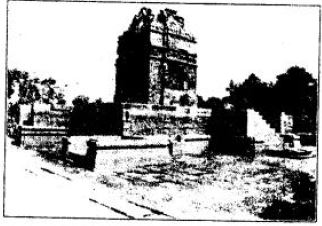
Answer:
(a) This structure is the Vishnu temple situated in Deogarh, which is frequently referred to as the Dashavatara Temple.
(b) It was built during the era of the Gupta Empire.
(c) Unlike the flat-roofed Sanchi temple from the same era, this temple has distinct architectural features. Its portico pillars are crowned with bell-shaped capitals. Additionally, during this period, numerous rock-cut shrines, assembly halls, and monasteries (Stupas, Chaityas, and Viharas) were carved directly from massive stone formations.
In simple words: The Dashavatara Temple is a famous Gupta-era Vishnu temple in Deogarh. It has distinct pillars with bell-like tops, showing the advanced stone-carving skills of that era.
Exam Tip: Note down that the Deogarh temple is dedicated to Lord Vishnu and is called the Dashavatara Temple, which is a key specimen of Gupta art.
Question 8. The Pallava period recorded brilliant achievements in the fields of literature, art and architecture. In this context explain: Architectural features of the Dharmaraja Rath.
Answer:
The primary characteristics of the Dharmaraja Ratha are outlined below:
1. The Dharmaraja Ratha stands as a single-stone monument, sculpted entirely from a solitary rock on the coast.
2. It shows similarities to Buddhist monasteries and prayer halls, featuring a square foundation topped by a pyramid-shaped spire.
3. The main tower rises in three distinct levels, ending with a miniature dome-like structure at its highest point.
4. Beautifully crafted stone carvings decorate the outer walls of this temple.
In simple words: The Dharmaraja Ratha is a coastal temple carved from one giant rock. It looks like a Buddhist hall, has a square base with a three-level pyramid tower, and is decorated with beautiful sculptures.
Exam Tip: Use terms like "monolithic" (meaning carved out of a single rock) and "pyramidal tower" to secure full marks for this question.
Question 9. Harshavardhana not only brought the greater part of northern India under his direct rule, he also consolidated his dominions by efficient administrative machinery. In this context explain:
(a) His Conquests and Extent of his Empire
(b) His Administration.
Answer:
(a) Conquests and Territorial Reach: Following the death of his older brother Rajyavardhana, Harshavardhana took over the throne of Thanesar. Once in power, his immediate priority was to save his sister and retaliate against Sasanka. Leading a massive military force, he decisively routed his opponent. Initially, Harsha governed Kanauj on his sister's behalf, but eventually merged Thanesar and Kanauj into a single powerful empire. According to the Chinese traveler Hiuen Tsang, Harsha brought five distinct territories under his sway, which were:
1. Eastern Punjab
2. Kanauj (Uttar Pradesh)
3. Magadha (Bihar)
4. Bengal
5. Orissa
Although he attempted to push his borders south of the Narmada River, his expansion was stopped by the Chalukya monarch, Pulakesin II. Harsha passed away in 648 AD without leaving behind any successor.
(b) Administrative System: Harsha transformed a modest principality into the dominant empire of northern India. Hiuen Tsang wrote that the emperor closely managed state matters himself, often feeling that the daytime was not long enough for his tasks. Both civil and defense administrators executed their duties very smoothly. Distant regions were administered by Governors, while provinces were divided further into districts known as Visayas. Laws were extremely strict, with life in prison being a standard sentence for treason or major violations. Acts against public morality carried severe physical mutilations, such as losing an ear, nose, hand, or foot, while smaller infractions were settled with monetary penalties.
In simple words: King Harsha built a large northern Indian empire by uniting Thanesar and Kanauj, though he was stopped from going south by King Pulakesin II. His rule was very hands-on, and he kept order using extremely strict laws and punishments.
Exam Tip: Remember that Harsha's southward expansion was blocked specifically at the Narmada River by the Chalukya king, Pulakesin II, and that the districts in his administration were called "Visayas".
Question 10. The Pallava period recorded brilliant achievements in the fields of literature, art and architecture. In this context explain:
(a) Their patronage to literature.
(b) Contributions in the field of architecture.
Answer:
(a) Literary Support: Pallava kings were great supporters of Sanskrit writers. King Mahendravarman, a learned ruler and musician himself, authored the satirical play Mattavilasa Prahasana. The court of Narasimhavarman II hosted Dandin, the writer of Kavyadarsha and Dashakumaracharita. Scholars like Dinnaga and Vatsyayana, who wrote Nyayabhasya, were connected to the capital city, Kanchipuram. While Sanskrit served as the language of administration and formal literature, Tamil was widely utilized for writing devotional hymns. Local authors also received royal support, such as Perundevanar who translated the Mahabharata as Bharatavenba, and the anonymous court poet of Nandivarman III who wrote Nandikkalambakam.
(b) Architectural Advancements: The Pallava dynasty built splendid temples, pioneering two main architectural styles in South India - rock-cut structures and free-standing structural shrines. Rock-hewn architecture was split into Mandapas (pillared open halls with small inner chambers, seen in places like Pallavaram, Trichinopoly, and Dalavanur) and Rathas (temples carved out of single large boulders). The finest monolithic Rathas are located at Mahabalipuram in Tamil Nadu.
In simple words: Pallava kings supported Sanskrit and Tamil writers, including famous scholars like Dandin. They also built amazing temples, creating both cave-like pillared halls (Mandapas) and temples carved from single rocks (Rathas) in Mahabalipuram.
Exam Tip: Clearly distinguish between the two types of rock-cut architecture under the Pallavas: Mandapas (cave temples/open pavilions) and Rathas (monolithic temples/chariots).
Question 11. Study the picture of Dharmaraja Ratha and answer the following questions:
(a) Name the place and the State where the Ratha is located ?
(b) Under which Dynasty and in whose reign was the Ratha built ?
(c) When was it built ?
(d) Mention three architectural features of the
Answer:
(a) It is located in Mahabalipuram, within the state of Tamil Nadu.
(b) It was constructed during the Pallava dynasty's reign, under the patronage of King Narasimhavarman I.
(c) The temple was built during the seventh century AD.
(d) The architectural details of this monolithic temple include:
1. It is sculpted from one massive piece of granite, featuring a square base and a pyramidal spire that looks like a Buddhist Vihara.
2. The upper tower rises in three distinct steps, crowned with a small dome-like stupa at the top.
In simple words: The Dharmaraja Ratha is a 7th-century monolithic granite temple in Mahabalipuram, Tamil Nadu, built by the Pallava king Narasimhavarman I with a square base and a three-tiered pyramid top.
Exam Tip: Remember that "monolithic" means carved from a single piece of stone, and associate the Dharmaraja Ratha with King Narasimhavarman I of the Pallava dynasty.
Question 12. With reference to the Gupta administration, mention briefly: The position of the King and his Ministers.
Answer:
The Roles of the Emperor and his Council: Gupta rulers moved away from the simple title of "Rajan", adopting grander designations such as Maharajadhiraja, Parambhattaraka, and Paramadaivata. They placed a strong emphasis on the divine nature of the throne, with titles like "Paramadaivata" elevating emperors to a divine status. A group of ministers supported the monarch in governing. The chief of civil affairs was known as the Mantri. Additionally, key administrative positions were held by the Senapati, who led the military forces, the head of royal security, and the Sandhivigrahika, who managed external relations.
In simple words: Gupta kings took high titles like "Maharajadhiraja" to show they had god-like authority. They were helped by ministers, including the civil chief (Mantri), military chief (Senapati), and foreign minister (Sandhivigrahika).
Exam Tip: Be prepared to list key administrative titles of the Gupta period, such as "Mantri" (civil head), "Senapati" (army general), and "Sandhivigrahika" (foreign minister).
Short Answer Questions:
Question 1. When did Fa-hien visit India? Who was the ruler at that time ?
Answer:
Fa-hien set out from China in 399 AD, arriving in India by 405 AD, where he remained until 411 AD. During this period, Chandragupta II was the ruling emperor.
In simple words: The Chinese pilgrim Fa-hien traveled to India and stayed from 405 to 411 AD, during the reign of Emperor Chandragupta II.
Exam Tip: Remember that Fa-hien's visit coincided with the reign of Chandragupta II (also known as Vikramaditya), a key detail often tested in exams.
Question 2. During whose reign Hiuen Tasang visited India ?
Answer:
The Chinese traveler Hiuen Tsang journeyed through India when Harshavardhana was in power.
In simple words: Hiuen Tsang came to India during the rule of King Harsha.
Exam Tip: Do not confuse the two famous Chinese pilgrims: Fa-hien visited during Chandragupta II's reign, while Hiuen Tsang came during Harsha's reign.
Question 3. Name the three dramas written by Kalidasa.
Answer:
The three theatrical plays composed by Kalidasa are Malavikagnimitram, Abhijnanasakuntalam, and Vikramorvashiyam.
In simple words: Kalidasa wrote three very famous plays: Malavikagnimitram, Abhijnanasakuntalam, and Vikramorvashiyam.
Exam Tip: Memorize the names of Kalidasa's three plays, as they are classic examples of Sanskrit drama.
Question 4. Why is the Gupta Period known as the Golden Age of Indian culture ?
Answer:
The Gupta era is celebrated for its immense advancements in governance, arts, economy, sciences, medicine, education, and literature. Great higher education centers flourished, including Nalanda in Bihar and Taxila near Rawalpindi. Masterpieces of temple architecture from this era include the brick temple at Bhitargaon near Kanpur, Bhitari temple in Ghazipur, and the Deogarh temple near Jhansi. Outstanding scholars like Aryabhata, Varahamihira, and Brahmagupta made pioneering discoveries in astronomy and mathematics, while Charaka and Sushruta made profound contributions to Ayurvedic medicine. The rust-resistant Delhi Iron Pillar highlights their highly advanced metalworking skills. This period also saw a literary revival with exceptional poets and writers like Kalidasa, Bhasa, Shudraka, Harishena, Dandin, Banabhatta, and Vishnusharma (who composed the Panchatantra). Religious texts like the Puranas and the Bhagavad Gita were also compiled during this time, making it truly the Golden Age of Indian civilization.
In simple words: The Gupta Period is called the Golden Age because of massive achievements in sciences, arts, literature, medicine, and architecture, producing legendary scholars like Aryabhata and Kalidasa.
Exam Tip: To explain the "Golden Age," organize your answer into clear fields like science (Aryabhata), literature (Kalidasa), medicine (Sushruta), and metallurgy (Delhi Iron Pillar).
Question 5. How was Samudragupta a bold and great conqueror ?
Answer:
Samudragupta was an exceptionally courageous military leader who defeated several contemporary kings. He built a vast empire that stretched from the Yamuna and Chambal rivers in the west all the way to the Brahmaputra River in the east. Because of his remarkable military conquests, historians often refer to him as the "Napoleon of India."
In simple words: Samudragupta was a fearless king who expanded his empire from the Yamuna River to the Brahmaputra River. His brilliant military victories earned him the nickname "Napoleon of India."
Exam Tip: Mention his vast empire's boundaries (Yamuna to Brahmaputra) and his famous title, the "Napoleon of India," which was coined by historian Vincent Smith.
Question 6. Who was Fa-hien ? What did he say about India ?
Answer:
Fa-hien was a Buddhist pilgrim from China who traveled to India during the reign of Emperor Chandragupta II. He wrote favorably about the peaceful and gentle governance influenced by Buddhist principles, the high financial prosperity of regions like Magadha and its capital Pataliputra, and the humble lifestyle of the citizens. His writings also document the peaceful coexistence of various faiths, including Vaishnavism, Shaivism, Shaktism, Buddhism, and Jainism.
In simple words: Fa-hien was a Chinese traveler who visited during Chandragupta II's reign. He described India as a wealthy and peaceful land where different religions lived together happily under gentle laws.
Exam Tip: State that Fa-hien observed a gentle administration with mild punishments, and emphasize the peaceful coexistence of diverse religious sects during the Gupta period.
Question 7. Name two renowned Sanskrit authors and their important works during the Gupta period.
Answer:
1. Kalidasa: A legendary poet in Emperor Vikramaditya's court, known for his masterly poems such as Ritusamhara and Raghuvamsa.
2. Shudraka: A playwright who composed the drama Mrichchhakatika (also translated as "The Little Clay Cart"), which humorously illustrates the everyday social and economic conditions of the people.
In simple words: Two great writers were Kalidasa, who wrote beautiful poems like Raghuvamsa, and Shudraka, who wrote a funny play about daily life called Mrichchhakatika.
Exam Tip: Be prepared to write down both the authors' names and their respective books with correct spellings to earn full marks.
Question 8. Name two famous universities tliat existed during the Gupta period ?
Answer:
The two prominent centers of higher learning of this era were Nalanda University located in Bihar and Taxila situated near modern-day Rawalpindi.
In simple words: The two most famous ancient universities during the Gupta period were Nalanda in Bihar and Taxila near Rawalpindi.
Exam Tip: Make sure to mention both Nalanda and Taxila, along with their general geographic locations.
Question 9. Name any two titles adopted by the Gupta rulers ?
Answer:
Two well-known titles associated with Gupta emperors are "Maharajadhiraja" (meaning King of Kings) and the historical moniker "Napoleon of India."
In simple words: Two major titles used to describe Gupta kings are "Maharajadhiraja" and "Napoleon of India."
Exam Tip: "Maharajadhiraja" was a title taken by the kings themselves to show supreme power, whereas "Napoleon of India" is a modern historical title given to Samudragupta.
Question 10. Name the officer who collected the toll tax during the Gupta period.
Answer:
During the Gupta era, the administrative official responsible for gathering toll duties was called the "Shaulkika."
In simple words: The tax collector who gathered tolls on goods in the Gupta Empire was called a Shaulkika.
Exam Tip: Memorize specific administrative terms like "Shaulkika" (toll collector) as they are frequently asked in short-answer questions.
Question 11. Name the officer who was in charge of a province or bhukti during the Gupta period.
Answer:
In the Gupta administration, the official appointed to govern a province, also known as a bhukti, was termed the Vishayapati.
In simple words: The governor of a province (called a bhukti) during the Gupta empire was known as a Vishayapati.
Exam Tip: Learn the administrative divisions of the Guptas: "bhukti" was a province and its administrator is recorded here as the "Vishayapati".
Question 12. What contribution did Aryabhatta and Varahamihira make in the field of science, astronomy and mathematics ?
Answer:
Aryabhata formulated the decimal place-value system with zero, calculated the precise value of pi as 3.1416, and created formulas to determine the area of triangles. In astronomy, he explained the relative motion of the Sun and the rotation of the Earth. Varahamihira demonstrated that the Moon revolves around the Earth and conducted detailed observations on planetary movements.
In simple words: Aryabhata discovered the zero decimal system, calculated the value of pi, and explained how the Earth rotates. Varahamihira proved that the Moon orbits the Earth and studied the planets.
Exam Tip: Make sure to credit Aryabhata with mathematics (decimal system, pi value, triangle area) and Varahamihira with astronomy (the Moon's orbit).
Question 13. What was the chief architectural feature of the brick temple at Bhitrigaon ?
Answer:
Constructed during the fifth century AD, this brick temple features a pyramid-style roof and exterior walls adorned with sculpted clay figures and deities. The inner sanctum (garbhagriha) houses a Shivalinga. Its most remarkable design feature is the semi-circular arch used to carry the weight of the roof structure.
In simple words: The 5th-century brick temple at Bhitargaon has a pyramid-shaped roof, beautiful outer wall sculptures, and a Shivalinga inside. Its most important feature is the use of arches to support the roof.
Exam Tip: The use of the true arch in construction is the standout architectural innovation of the Bhitargaon brick temple.
Question 14. Give two distinguishing features of Ajanta and Bagh paintings.
Answer:
1. The paintings portray highly expressive and life-like human faces and physical postures drawn with elegant fluid lines.
2. The artwork showcases detailed, vibrant depictions of nature, such as floral patterns and birds, capturing dynamic real-world scenes.
In simple words: The paintings at Ajanta and Bagh have very life-like human figures drawn with graceful movements, as well as beautiful paintings of birds and flowers.
Exam Tip: Emphasize the natural expressions on human faces and the graceful depictions of limbs and natural elements in these ancient frescoes.
II. Structured Questions.
Question 1. With reference to the sources of information about the Gupta Age, write short notes on the following:
(a) Accounts of Fa-hien
(b)The Allahabad Pillar Inscription
(c) Nalanda University
Answer:
(a) Travels of Fa-hien: In his travelogue titled Fo-Kwo-Ki, the Chinese monk Fa-hien recorded the social lifestyles and religious climates of early Gupta India. He observed that Magadha was a highly prosperous region with bustling towns populated by wealthy citizens. Pataliputra was described as a thriving urban center featuring many charity foundations, including a fully-funded hospital set up by wealthy local donors. Fa-hien noted that despite their wealth, citizens lived modestly and adhered to Buddhist ethics. He observed the peaceful practice of diverse traditions like Shaivism, Vaishnavism, Shaktism, Buddhism, and Jainism without any sectarian conflict. He also remarked that representations of Hindu deities were visible on contemporary coins, paintings, and sculptures. He praised the gentle nature of the Gupta government, noting that legal rules were mild and penalties usually involved only small financial fines. His writings present the Gupta state as an enlightened and wealthy empire.
(b) Allahabad Pillar Inscription: This inscription stands as one of the most valuable stone-engraved records of the Gupta dynasty. It details the deeds and victories of the Gupta rulers, specifically offering an extensive account of Samudragupta's military expeditions. Both modern and ancient researchers highly value this monument. It preserves an extensive catalog of the regional rulers, kingdoms, and tribal confederations that were brought under Samudragupta's dominion.
(c) Nalanda University: Situated at Rajagriha in Bihar, Nalanda was the premier institute of higher education in ancient India, founded during Kumaragupta-I's reign in the fifth century AD by Sakraditya. The sprawling campus consisted of impressive buildings, including eight specialized colleges built by various royal donors like King Balaputradeva of Sumatra. Chinese monk Hiuen Tsang wrote that a protective brick wall encircled the entire campus. The academy provided wonderful facilities, boasting three huge libraries known as Ratnasagar, Ratnodadhi, and Ratnaranjak. It accommodated over ten thousand residents, including pupils and diverse instructors from lands such as China, Japan, Korea, Mongolia, Tibet, and Ceylon. Studies covered the four Vedas, grammar, logic, medicine, yoga, Samkhya, Nyaya, and various Buddhist school philosophies. This elite institute accepted only advanced students, using a rigorous entrance process that eliminated nearly eighty percent of applicants, accepting only the brightest minds. It remained a leading light of knowledge until the twelfth century AD, when it was ruined by Mohammad-bin-Bakhtiyar Khilji, a general under Mohammad Ghori. Today, only archaeological ruins of this magnificent site remain.
In simple words: This answer describes three primary historical sources for the Gupta Age: Fa-hien's journal which praises India's wealth and peaceful life, the Allahabad Pillar detailing Samudragupta's victories, and Nalanda University, a legendary international college in Bihar.
Exam Tip: Structure structured notes with subheadings matching the parts (a), (b), and (c) to ensure your answers are organized and easy for the examiner to read.
2. With reference to the Age of the Guptas, answer the following questions.
Question 2(a). Explain the extent of samudragupta’s Empire based on the information given in the Allahabad Pillar Inscription.
Answer:
As recorded in the Allahabad Pillar Inscription, Samudragupta divided the contemporary regional rulers into four distinct categories, applying different strategic policies to each:
1. The nine kings of Aryavarta (Northern India) were completely overthrown, and their lands were directly incorporated into the Gupta Empire.
2. The twelve kings of Dakshinapatha (Southern India), who submitted after their defeat, were set free and permitted to govern their respective states as feudatories.
3. The rulers of the inner boundary states - including Assam, coastal Bengal, Nepal, and several north-western clan-republics (gana sanghas) - paid regular tribute, obeyed imperial commands, and attended the royal court.
4. The sovereigns of more distant frontier regions surrendered to his authority and established alliances, often by offering their daughters in marriage.
In simple words: The Allahabad Pillar shows that Samudragupta conquered northern kings directly, let defeated southern kings keep their thrones as vassals, made border states pay tribute, and formed marriage alliances with distant rulers.
Exam Tip: Memorize the four categories of kings mentioned on the Allahabad Pillar: Aryavarta (annexed), Dakshinapatha (reinstated), border states (tributary), and outer regions (allied).
Question 2(b). Explain how Chandragupta II expanded his empire.
Answer:
Possessing the tactical brilliance of his predecessor, Chandragupta II grew the Gupta territories through targeted military campaigns and strategic marital unions. He captured the Saka-held lands of Saurashtra, Malwa, and Gujarat, earning the title "Sakari" (defeater of the Sakas). As noted by historian Dr. Vincent Smith, acquiring Saurashtra and Malwa added fertile, wealthy provinces to the state and provided vital access to western ports, connecting the empire directly to European sea trade via Egypt. Additionally, he formed clever matrimonial alliances, marrying Princess Kuberanaga of the influential Naga dynasty. He also married his daughter, Prabhavati, to the Vakataka king Rudrasena II, securing strong political leverage and influence across the Deccan region.
In simple words: Chandragupta II expanded his empire by defeating the Sakas to gain control of wealthy western ports, and by making strategic marriages with the powerful Naga and Vakataka families.
Exam Tip: Highlight both military conquests (defeating the Sakas) and matrimonial alliances (Nagas and Vakatakas) as the dual strategies used by Chandragupta II.
3.With reference to the administrative system of the Guptas, answer the following questions:
Question 3(a). Explain the position and powers of the king during the Gupta Age.
Answer:
During the Gupta period, the monarch wielded absolute authority spanning legislative, administrative, military, and judicial domains. As supreme commanders of the armed forces, emperors like Samudragupta, Chandragupta II, and Skandagupta personally led their troops into battles. The sovereign held the power to appoint provincial governors as well as key military and civil officials, all of whom functioned under his direct supervision. The central administration operated under royal oversight. The monarch served as the sole authority for conferring titles and honors. All territorial land belonged to the crown, giving the king the right to build dams, offer asylum to foreign visitors, levy, collect, or excuse taxes, and deliver ultimate judicial verdicts. Any abandoned or unclaimed properties reverted directly to the state treasury.
In simple words: The Gupta king held absolute power over the military, courts, and land. He appointed all high officials, led armies into battle, collected taxes, and claimed any unclaimed property.
Exam Tip: Mention that the king was the ultimate source of authority in all four domains: administration, military (acting as Commander-in-Chief), judiciary, and land ownership.
Question 3(b). Describe briefly the administration of villages during the Gupta period.
Answer:
At the grassroots level, rural areas were managed by a village headman. Historical Gupta inscriptions highlight how local leaders and respected elders participated in managing these settlements or minor administrative circles called vithis. Their official permission was mandatory for any transfer of land, and they held considerable influence over other critical community matters.
In simple words: Villages and small towns (called vithis) were run by a headman and local elders. No land could be bought or sold without their official approval.
Exam Tip: Note the term "vithis" for small towns or village circles, and emphasize the role of local elders and headmen in approving land sales.
4. With reference to Golden Age of Indian Culture answer the following questions.
Question 4(a). Briefly describe growth of Sanskrit literature.
Answer:
Sanskrit established itself as the primary language of scholars and retained its elite status for nearly a millennium. The Gupta emperors declared Sanskrit as the official state language for administrative business, replacing Prakrit on their royal inscriptions and state documentation. This period witnessed a spectacular revival in classical Sanskrit literature, producing masterpiece epics, dramas, poetry, prose, and lyrical works.
In simple words: Under the Guptas, Sanskrit became the official state language used in government records instead of Prakrit, leading to a massive boom in beautiful classical plays and poems.
Exam Tip: Point out that the shift from Prakrit to Sanskrit as the official court and inscription language was a major driver for the literary boom in this period.
Question 4(b). Give an account of the contribution of Aryabhatta,Varahamihira and Brahmagupta.
Answer:
1. Aryabhata (471-500 AD): Author of the legendary works Aryabhatiya and Surya Siddhanta, he explained that the Earth revolves around the Sun. In mathematics, he devised the formula to find the area of a triangle and calculated the value of pi as 3.1416. He laid the foundation for trigonometry and utilized the decimal system, which includes digits from 1 to 9 and zero.
2. Varahamihira: He wrote the renowned treatises Pancha-Siddhantika and Brihat Samhita. He demonstrated that the Moon revolves around the Earth while the Earth orbits the Sun, alongside conducting detailed studies of planetary paths.
3. Brahmagupta: He penned the Brahma-Sphuta-Siddhanta, where he discussed the principles of gravity many centuries before Sir Isaac Newton. His mathematical concepts continue to influence modern science.
In simple words: Aryabhata calculated pi, used decimals, and explained Earth's rotation. Varahamihira studied planetary orbits and proved the Moon orbits Earth. Brahmagupta wrote about gravity centuries before Newton.
Exam Tip: Create a clear list for each scholar (Aryabhata, Varahamihira, Brahmagupta) and mention at least one key text and one scientific discovery for each.
Question 4(c). Describe the progress in medicine during this period.
Answer:
The foundation of Ayurvedic medicine was strengthened by pioneering scholars like Charaka and Sushruta (dating back to the 2nd century AD), whose ancient formulations continue to serve as the basis for modern herbal supplements like "Chyawanprash" and various digestive remedies.
In simple words: Ancient medical experts like Charaka and Sushruta developed Ayurvedic herbal medicines and remedies that are still widely used today, such as Chyawanprash.
Exam Tip: Name Charaka and Sushruta as the major figures of Ayurvedic medicine, noting that their ancient herbal formulas remain popular today.
Free study material for History Civics
ICSE Goyal Brothers Solutions Class 9 History Civics Chapter 7 The Age Of The Guptas
Students can now access the detailed Goyal Brothers Solutions for Chapter 7 The Age Of The Guptas on our portal. These solutions have been carefully prepared as per latest ICSE Class 9 syllabus. Each solution given above has been updated based on the current year pattern to ensure Class 9 students have the most updated History Civics content.
Master Goyal Brothers Textbook Questions
Our subject experts have provided detailed explanations for all the questions found in the Goyal Brothers textbook for Class 9 History Civics. We have focussed on making the concepts easy for you in Chapter 7 The Age Of The Guptas so that students can understand the concepts behind every answer. For all numerical problems and theoretical concepts these solutions will help in strengthening your analytical skill required for the ICSE examinations.
Complete History Civics Exam Preparation
By using these Goyal Brothers Class 9 solutions, you can enhance your learning and identify areas that need more attention. We recommend solving the History Civics Questions from the textbook first and then use our teacher-verified answers. For a proper revision of Chapter 7 The Age Of The Guptas, students should also also check our Revision Notes and Sample Papers available on studiestoday.com.
FAQs
You can download the verified Goyal Brothers solutions for Chapter 7 The Age Of The Guptas on StudiesToday.com. Our teachers have prepared answers for Class 9 History Civics as per 2026-27 ICSE academic session.
Yes, our solutions for Chapter 7 The Age Of The Guptas are designed as per new 2026 ICSE standards. 40% competency-based questions required for Class 9, are included to help students understand application-based logic behind every History Civics answer.
Yes, every exercise in Chapter 7 The Age Of The Guptas from the Goyal Brothers textbook has been solved step-by-step. Class 9 students will learn History Civics conceots before their ICSE exams.
Yes, follow structured format of these Goyal Brothers solutions for Chapter 7 The Age Of The Guptas to get full 20% internal assessment marks and use Class 9 History Civics projects and viva preparation as per ICSE 2026 guidelines.