

ICSE Solutions Goyal Brothers Class 9 History Civics Chapter 8 South India And The Cholas have been provided below and is also available in Pdf for free download. The Goyal Brothers ICSE solutions for Class 9 History Civics have been prepared as per the latest syllabus and ICSE books and examination pattern suggested in Class 9. Questions given in ICSE Goyal Brothers book for Class 9 History Civics are an important part of exams for Class 9 History Civics and if answered properly can help you to get higher marks. Refer to more Chapter-wise answers for ICSE Class 9 History Civics and also download more latest study material for all subjects. Chapter 8 South India And The Cholas is an important topic in Class 9, please refer to answers provided below to help you score better in exams
Goyal Brothers Chapter 8 South India And The Cholas Class 9 History Civics ICSE Solutions
Class 9 History Civics students should refer to the following ICSE questions with answers for Chapter 8 South India And The Cholas in Class 9. These ICSE Solutions with answers for Class 9 History Civics will come in exams and help you to score good marks
Chapter 8 South India And The Cholas Goyal Brothers ICSE Solutions Class 9 History Civics
Question 1. Mention two ways in which Inscriptions may be used for reconstructing the history of the Imperial Cholas.
Answer: We can learn several key details about the Chola dynasty through their inscriptions:
1. They offer detailed insights into Chola administrative systems.
2. They document donations and land grants made to priests and religious structures.
3. They provide information regarding temple building and the installation of sacred idols.
4. Wall carvings functioned like public registries by documenting land transactions, mortgages, and ownership transfers.
5. They maintain records of crucial community resolutions and pacts regarding public welfare.
In simple words: Inscriptions are written records on stone or copper plates. They help us understand how the Chola kings ruled, what gifts they gave, and how land was bought and sold.
Exam Tip: To secure full marks, mention how inscriptions acted as public registries on temple walls and described local administration like the Uttaramerur inscription.
Question 2. Name one of the masterpieces of the temples built, by the Chola king Rajaraja I. Mention one architectural feature of the temple.
Answer: The majestic Brihadeswara Temple, frequently referred to as the Rajarajeshwar Temple in Thanjavur, was built by him. An outstanding feature is its layout, which links a columned portico, an assembly hall, and a Nandi pavilion together.
In simple words: King Rajaraja I built the Brihadeswara Temple in Thanjavur. This large temple connects different halls, including a special section for the sacred bull, Nandi.
Exam Tip: Remember that the Brihadeswara Temple is also known as the Rajarajeshwar Temple. Always state its location, Thanjavur, to secure complete marks.
Question 3. Under whose rule, the Cholas rose to imperial greatness towards the end of the 10th century AD?
Answer: The dynasty attained imperial prominence in the late tenth century under Rajaraja I, who was the son of Sundara Chola.
In simple words: Rajaraja I, the son of Sundara Chola, led the empire to power and glory at the end of the 10th century.
Exam Tip: Clearly identify Rajaraja I as the son of Sundara Chola to show a deep understanding of Chola chronology.
Question 4. Mention any two victories won by Cholas under Rajaraja I.
Answer: The conquests of the Maldives and the takeover of Kalinga were two major military triumphs.
In simple words: Under Rajaraja I, the Cholas conquered the island group of Maldives and took control of Kalinga.
Exam Tip: Mentioning specific regions like Kalinga or the Maldives shows accurate historical knowledge.
Question 5. Who among the Chola kings adopted the title of ‘Gangaikonda’? Name the city commemorating the event.
Answer: The designation 'Gangaikonda' was taken by Rajendra I. He founded the city of Gangaikonda-Cholapuram, also called Gangakundrapuram, to mark this occasion.
In simple words: Rajendra I took the title 'Gangaikonda' and built a new capital city named Gangaikonda-Cholapuram to celebrate his victory.
Exam Tip: Always spell 'Gangaikonda-Cholapuram' correctly as it is a common high-yield question in ICSE exams.
Question 6. What names were given to the following territorial divisions of the Chola kingdom: (a) Province, and (b) the District?
Answer: During the Chola rule, the administrative divisions were designated as follows:
(a) Provinces were referred to as Mandalams.
(b) Districts were referred to as Nadus.
In simple words: The Cholas divided their kingdom into provinces called Mandalams and further into districts called Nadus.
Exam Tip: Ensure you clearly distinguish between 'Mandalam' for provinces and 'Nadu' for districts, as confusing the two is a very common student error.
Question 7. What was the method of electing members of the village assembly under the Cholas?
Answer: For elections to the local council, slips of paper containing candidates' names were placed inside an earthenware pot and thoroughly shaken. A young child then extracted these slips individually, and the local priest declared the chosen members.
In simple words: To choose committee members, names were written on slips and put in a pot. A young boy pulled out the slips one by one, and a priest read the names.
Exam Tip: This election system is famously known as the 'Kudavolai' system. Mentioning the use of palm-leaf slips ('Ola') and the pot ('Kuda') can earn extra marks.
Question 8. Mention any two duties assigned to a village assembly under the Cholas.
Answer: The local council was responsible for several administrative functions, including:
1. Managing and distributing water resources.
2. Arranging for the schooling and instruction of young students.
In simple words: The village assembly had to make sure farms got enough water and that children were taught in schools.
Exam Tip: Mention specific civic duties like maintaining tanks and managing local temples to write a well-rounded answer.
Question 9. Give one evidence to suggest that the Brihadeswara Temple is a repository of every branch of art.
Answer: The following points demonstrate that the temple serves as an exhibition of diverse artistic traditions:
1. It features a sequence of connected structures, including an assembly hall, a pillared portico, and a pavilion dedicated to Nandi.
2. The central grand hall was built with three levels, where the topmost tier opens to a terrace decorated with statues of Nandi bulls along the boundary.
3. Sculpted guardian figures, or dwarapalas, stand watch at all the external entrances, mirroring the main gateway.
4. Beautifully styled inscriptions in both Sanskrit and Tamil script cover its walls.
5. The complex includes the notable Amman shrine dedicated to Brihannayaki, consort of the main deity. Thus, the site stands as a grand center for multiple artistic forms - such as architecture, sculpting, mural painting, metallurgy, and performance.
In simple words: The temple has beautiful stone carvings, grand gateways, ancient writing in lovely handwriting, and shrines. It shows the best of Chola building, painting, and dancing styles.
Exam Tip: In long answers about the temple's artistic value, list multiple mediums of art such as sculpture, fine calligraphy, and architecture to show its comprehensive nature.
Structured Questions
Question 1. With the accession of Rajaraja I (985-1014 AD) began the most glorious epoch of the Cholas. In this context, explain briefly: (a) His Conquests. (b) His activities as a Great Builder and a Ruler.
Answer: (a) His Military Campaigns:
Rajaraja routed the Chera forces before capturing Madurai and taking the Pandyan ruler Amarbhujanga captive. He brought Kalinga under Chola control and launched major incursions into the Western Chalukya territories. Furthermore, he crossed the sea to invade Sri Lanka, establishing control over its northern territories, and took the Maldives in his later years. Through these campaigns, Rajaraja established his hegemony over nearly all of modern Tamil Nadu, parts of Karnataka, neighboring provinces, Sri Lanka, and nearby island territories.
(b) His Administration and Architecture:
Rajaraja I was an efficient administrator, a magnificent builder, and a generous supporter of literature and the arts. His administration was highly distinguished by the growth of local self-governing bodies in villages. In Thanjavur, he constructed the grand Brihadeswara Temple, or Rajarajeshwar Temple. He also constructed and funded shrines dedicated to Vishnu. Although he was an ardent devotee of Lord Shiva, he showed respect for other faiths, which is demonstrated by his land grant of a village to a Buddhist monastery (Vihara) located at Nagapattinam.
In simple words: Rajaraja I was a legendary warrior who conquered Sri Lanka, Maldives, and parts of South India. He was also a kind ruler who built beautiful temples like the Brihadeswara Temple and supported all religions.
Exam Tip: When writing about Rajaraja I, make sure to highlight his conquest of northern Sri Lanka and the establishment of local self-government (Gram Sabhas) as key achievements.
Question 2. King Rajendra I (1014-1044 AD) raised the Chola empire to the pinnacle of glory. In this context explain: (a) His main Conquests. (b) His attainments as a Great Builder.
Answer: (a) His Primary Military Conquests:
Around 1017 AD, Rajendra I brought the entirety of Sri Lanka under his rule. He restructured the lands of the Pandyas, Cheras, and Sri Lanka into administrative provinces of his kingdom. His military forces marched northwards all the way to the Ganges river basin, defeating rulers in Odisha and parts of Bengal. To celebrate this triumph, he took the name 'Gangaikonda' and established a new capital city named Gangaikonda-Cholapuram. Furthermore, in 1025 AD, he sent out an impressive naval force to defeat the Shailendra dynasty and assert authority over parts of Java and Sumatra.
(b) His Major Construction Works:
Near his newly established capital, Rajendra I built a massive man-made lake. This reservoir featured retaining walls extending over 25 kilometers in length and received water diverted from the Vellar and Kolerun rivers. He was also responsible for building an exceptional temple at Gangaikonda-Cholapuram, which features a spectacular monolithic granite Shiva Lingam.
In simple words: Rajendra I captured all of Sri Lanka and sent ships to Southeast Asia. He built a huge artificial lake for water storage and a grand temple at his new capital.
Exam Tip: In questions about Rajendra I, do not forget to mention his naval expedition against the Shailendra kingdom of Sumatra and Java, which demonstrates the naval power of the Cholas.
Question 3. Under Cholas, the ruler was the pivot on which turned the whole machinery of the state, but actual administration was not highly centralised. In this context, explain briefly. (a) The position of the Chola Monarch. (b) Functioning of the autonomous rural institutions (Gram Sabhas).
Answer: (a) The Status of the Chola King:
The emperor stood at the center of the administrative machinery. Elaborate celebrations and rituals accompanied his coronation. Royal authority and prestige were highlighted by the vast wealth of the state, grand palace complexes, and courtly majesty. Whenever the king issued oral commands, officers wrote them down carefully before passing them along to relevant departments.
(b) The Operation of Village Assemblies (Gram Sabhas):
The Gram Sabha held extensive authority over the administration of local matters. These rural assemblies resolved disputes within the village, leaving only major criminal offenses to the imperial courts. They managed water networks and supervised public establishments like schools and temples. They had the right to buy, sell, or donate land for charitable uses, and kept highly accurate financial records. Anyone caught stealing or misappropriating public funds faced harsh penalties. To run smoothly, the assembly operated through specialized committees that handled distinct sectors, including reservoir maintenance, gardens, judiciary, and general administration.
In simple words: The king was the supreme ruler, but villages governed themselves. Local village assemblies looked after daily needs like water, schools, temples, and justice using smaller committees.
Exam Tip: Highlight the contrast between the supreme power of the Chola king and the decentralised, self-governing nature of the village assemblies (Gram Sabhas).
Question 4. Study the picture of the Brihadeswara Temple and answer the following questions: (a) Name the place where the Temple is located. (b) When and by whom was the Temple built? (c) To which Deity was the temple dedicated? (d) Mention outstanding features of the Temple
Answer: (a) The temple is situated in Thanjavur.
(b) The structure was constructed around 1000 AD by the prominent Chola emperor, Rajaraja I (Rajaraja the Great).
(c) This religious site is dedicated to the worship of Lord Shiva.
(d) Key architectural aspects of the temple include its main layout, which links a Nandi pavilion, a pillared hallway, and an assembly area inside a wide walled courtyard. The monumental tower (vimana) rises 57 meters high in a pyramidal form. Composed of thirteen distinct levels, the peak of the tower is topped by a single block of granite that stands 8.6 meters tall and weighs nearly 80 metric tons. Additionally, the inner walls are decorated with exquisite murals and beautiful stone carvings.
In simple words: This temple is in Thanjavur, built around 1000 AD by Rajaraja I for Lord Shiva. It has a massive 57-meter pyramidal tower topped by a single huge stone weighing 80 tons.
Exam Tip: Always include the dimensions of the temple tower (57 meters) and the weight of the capstone (80 tons) to show precise knowledge.
Question 5. Discuss people’s social life under Imperial Cholas with reference to: (a) Caste System (b) Religion (c) Literature and Cultural Activities
Answer: (a) Social Hierarchy and Castes:
A rigid caste structure was highly prevalent in South India during this era. Alongside the wealthy priestly class (Brahmins), traders and merchants became influential due to their growing financial power. Conversely, individuals from lower castes endured harsh social discrimination; they were forbidden from collecting water from shared public wells and were denied entry into religious temples.
(b) Religious Life:
Chola monarchs were devoted followers of Lord Shiva. However, they maintained a respectful and tolerant policy toward other religious traditions and sects.
(c) Literary and Artistic Developments:
The Chola period is celebrated as the peak era of Tamil literature. In the ninth century, the famous poet Kamban adapted the Sanskrit epic 'Ramayana' into Tamil, producing the famous 'Kamban Ramayana'. While Kamban focused on the initial sections (Kandas), the concluding chapters (Uttarakhanda) were completed by Ottakuttan. During the twelfth century, the poet Pugalendi rose to fame for writing 'Nalavenba', which narrates the love saga of Nala and Damayanti. Furthermore, Jain and Buddhist academics made significant additions to Tamil writing. For instance, the Jain scholar Amrit Sagar authored a text on the principles of poetry, and the Buddhist academic Buddhamitra compiled the grammatical treatise 'Virasoliyam' (Rasolium).
In simple words: Chola society had a strict caste system where lower castes faced hardships. The kings worshipped Shiva but respected other faiths. Tamil literature flourished, with poets writing famous works like the Tamil Ramayana.
Exam Tip: In essay-type questions on Chola society, structure your answer clearly under the headings of caste system, religious tolerance, and key literary figures like Kamban.
Question 6. Write a brief note on the development of Tamil Literature under the Cholas.
Answer: The growth of literary works, art, and building styles elevated the cultural legacy of the Chola dynasty, which initiated major advancements in these domains. This period was a major turning point for Tamil literature, with kings offering extensive patronage and financial support to local writers and poets. While classical Sangam literature historically focused on personal and societal themes like romance, warfare, statecraft, and commerce, the resurgence of Chola authority in the mid-ninth century vastly expanded artistic horizons. A unified empire across South India brought stability and safety, enabling people to connect with diverse cultural influences. Tamil became the vibrant language of common expression. The most celebrated masterpiece from this period is the 'Kamban Ramayana', composed by the poet Kamban under King Kulottunga III. This work stands as a monumental epic in Tamil; although Kamban drew inspiration from Valmiki's original Sanskrit composition, his epic is highly original and goes far beyond a simple translation or rewrite.
In simple words: Tamil literature reached its peak under Chola patronage, which offered safety and wealth. The most famous book of this era is Kamban's Tamil Ramayana, which is a unique and masterful epic.
Exam Tip: Mention Kamban's Ramayana and the patronage of Chola kings like Kulottunga III to emphasize how literature flourished during this period.
Additional Questions
Short Answer Questions
Question 1. Mention the significance of inscriptions for providing information about the Cholas.
Answer: Inscriptions are highly valuable historical sources that shed light on various aspects of Chola history:
1. They describe the functioning of the central and local administrative machinery.
2. They document charitable contributions and land endowments made to priests and temples.
3. They record the construction dates of shrines and the consecration of new divine statues.
4. Carvings on temple structures acted as official land registries, retaining details of property sales, mortgages, and transfers of village land rights.
5. They preserve legal rulings and community agreements on subjects of public welfare.
In simple words: Inscriptions are stone and metal records. They help us learn about Chola government rules, donations to priests, new temples, land transactions, and village agreements.
Exam Tip: Explain that inscriptions serve as primary archaeological sources, making them highly reliable for reconstructing medieval political and social histories.
Question 2. Who established the rule of the Cholas ?
Answer: The Chola dynasty was founded by King Vijayalaya (AD 846-871) in the mid-ninth century. He established his rule over the Tamil region, making Thanjavur his capital city.
In simple words: Vijayalaya started the Chola rule in the middle of the 9th century and made Thanjavur his capital.
Exam Tip: Remember Vijayalaya as the founder of the medieval Chola Empire, and note Thanjavur as his capital to gain full marks.
Question 3. Why did Rajaraja undertake a naval expedition against Ceylon and Maldives ?
Answer: As an exceptional military leader, Rajaraja I (AD 985-1012) campaigned against the Cheras, Pandyas, and parts of Mysore. Since this region was heavily frequented by Arab merchants, he launched naval campaigns against Ceylon and the Maldives to secure his influence over the trade routes along the South Indian coast.
In simple words: Rajaraja I wanted to control the busy sea trade routes used by Arab merchants, so he sent his navy to attack Ceylon and the Maldives.
Exam Tip: Highlight the economic motive - controlling maritime trade and Arab merchant activities - when explaining Rajaraja's naval expeditions.
Question 4. Name any three great rulers of the Chola dynasty.
Answer: Three prominent emperors of the Chola line were:
1. Rajaraja I (AD 985-1012)
2. Rajendra Chola I (AD 1012-1044)
3. Rajadhiraja Chola (AD 1044-1052)
In simple words: Three of the most powerful Chola kings were Rajaraja I, Rajendra Chola, and Rajadhiraja Chola.
Exam Tip: Memorise these three rulers along with their reign periods as they represent the peak of Chola imperial power.
Question 5. Give any two achievements of Rajendra Chola.
Answer: Two major accomplishments of Rajendra Chola were:
1. He overcame the Bengali ruler Mahipala, subsequently taking the title 'Gangaikonda' to honor this feat.
2. He utilized his powerful naval fleet to overcome the Shrivijaya ruler, securing safe passage for Indian traders who faced harassment from Shrivijaya merchants.
In simple words: Rajendra Chola defeated the King of Bengal and took the title of 'Gangaikonda'. He also used his navy to defeat the Shrivijaya kingdom, protecting Indian merchants at sea.
Exam Tip: The defeat of the Shrivijaya Kingdom in Southeast Asia is a unique naval achievement of Rajendra Chola - ensure you mention this in exams.
Question 6. Name the new capital built by Rajendra Chola.
Answer: He established his new capital at Gangaikonda-Cholapuram.
In simple words: The new capital city built by Rajendra Chola was called Gangaikonda-Cholapuram.
Exam Tip: This capital was constructed to celebrate Rajendra Chola's successful military expedition to the River Ganga.
Question 7. Why did the Cholas build a strong naval fleet ?
Answer: They developed a powerful navy to maintain firm oversight and control over maritime commerce between Arab merchants and Indian traders in the southern coastal zone.
In simple words: The Cholas built a strong navy to control sea trade between Arab merchants and Indian businessmen along the coast.
Exam Tip: Connect the Chola navy to commercial dominance over the Indian Ocean to show a deep understanding of their foreign policy.
Question 8. What made the Chola administration strong and effective?
Answer: The efficiency of the Chola governance came from its structured hierarchy, with the emperor serving as the primary administrative authority. Power was shared across central departments, provincial bodies, and localized assemblies. These local units included the 'ur' - which was the council for common villages, the 'Sabha' - which served as the assembly for Brahmins, and the 'nagaram' - representing mercantile communities. This balanced and well-coordinated system ensured effective administration.
In simple words: The Chola system was strong because it had a central government, regional provinces, and three types of local village councils called the ur, Sabha, and nagaram.
Exam Tip: Be sure to list the three distinct local assemblies - Ur, Sabha, and Nagaram - as they are crucial to answering questions about Chola local self-governance.
Question 9. Name the two languages promoted by the Cholas.
Answer: The Chola rulers actively patronized Tamil and Sanskrit. Renowned writers and playwrights created numerous works in Tamil during this time. These Tamil literary creations were eventually compiled into an eleven-volume collection called the 'Tirumurais'.
In simple words: The Cholas supported the Tamil and Sanskrit languages. Famous Tamil plays and poems were collected into eleven holy volumes called Tirumurais.
Exam Tip: Name 'Tirumurais' as the compiled collection of Tamil literary works to secure full marks.
Question 10. Name any two features of temple built by the Cholas.
Answer: Two primary characteristics of Chola temple architecture are:
1. They feature very tall towers (called vimanas) and large, open courtyards.
2. They were predominantly designed and constructed following the Dravidian style of architecture.
In simple words: Chola temples have massive towers called vimanas, big open courtyards, and are built in the southern Dravidian style.
Exam Tip: Always use the term 'Dravidian style' when describing the architecture of Chola temples.
Question 11. Which is the best example of Chola temples ?
Answer: The finest illustration of Chola architecture is the Brihadeswara Temple, also called the Shiva Temple, situated in Thanjavur.
In simple words: The Brihadeswara Temple, dedicated to Lord Shiva in Thanjavur, is the best example of Chola temple art.
Exam Tip: The Brihadeswara Temple in Thanjavur is the most frequently asked example of Chola architecture. Memorise its name and deity (Shiva).
Question 12. What is known as the ‘gopuram’ ?
Answer: A 'gopuram' refers to the ornate, monumental gateway structure built at the entrance of a temple.
In simple words: A gopuram is the grand, beautifully carved gateway at the entrance of a South Indian temple.
Exam Tip: The gopuram is a signature feature of Dravidian architecture, acting as the main entry portal.
Question 13. To what use was the temple put during the Chola period?
Answer: Under the Cholas, temples served as central hubs of public and social life. Financial donations from the public were used for preserving and decorating these holy spaces. Certain temples even engaged in local and international commerce. Additionally, temples acted as major employers, providing livelihoods to many, while offering schooling, housing, food, and clothes to their staff. They also set up medical centers and hospitals to treat the sick.
In simple words: Chola temples were not just for worship; they were also schools, hospitals, social centers, and employers that helped care for the community.
Exam Tip: To write a comprehensive answer, explain that Chola temples had religious, social, educational, and economic roles.
Question 14. Name one important literary source that gives information about the Cholas. Name the author of this text and the ruler, whose exploits its describes.
Answer: A key literary source for Chola history is the 'Kalingattuparani'. This heroic war poem was composed by Jayankondar, who served as the court poet under Kulottunga I. The epic chronicles and celebrates the triumph of Emperor Kulottunga Chola I over the Kalinga ruler, Anantavarman Chodaganga, during the Chola-Kalinga conflict.
In simple words: The 'Kalingattuparani' is a famous war poem by Jayankondar. It describes how King Kulottunga Chola I won a war against the King of Kalinga.
Exam Tip: Remember that 'Kalingattuparani' is a primary literary source describing the military exploits of Kulottunga I.
Question 15. Name the last ruler of the Cholas.
Answer: Rajadhiraja Chola (AD 1044-1052) was the final great monarch of the Chola line.
In simple words: Rajadhiraja Chola was the last of the major, powerful kings of the Chola dynasty.
Exam Tip: In standard textbooks, Rajadhiraja Chola is recognized as the last of the great imperial Chola emperors.
Question 16. Who finally defeated the Cholas ?
Answer: The Chola forces suffered a major defeat at the hands of the Chalukyas during the historic Battle of Koppam in AD 1052.
In simple words: The Cholas were defeated by the Chalukyas in the year 1052 AD at the Battle of Koppam.
Exam Tip: Name both the 'Chalukyas' and the 'Battle of Koppam' to ensure you get full marks.
Question 17. Give an example of sculpture during the Chola period.
Answer: The artisans of this era were highly skilled in sculpting stone and bronze figures of deities. A prominent masterpiece is the bronze statue of Lord Shiva depicted as 'Nataraja' - the Lord of Dance.
In simple words: The most famous Chola sculpture is the beautiful bronze statue of Lord Shiva as Nataraja, the Lord of Dance.
Exam Tip: The bronze 'Nataraja' is world-famous as a supreme example of medieval Indian metallurgy and art.
Question 18. Who wrote the Tamil Ramayana ?
Answer: The Tamil version of the Ramayana was written by the poet Kamban.
In simple words: The Tamil Ramayana was written by the famous poet Kamban.
Exam Tip: This work is also known as 'Kambaramayanam' and is considered a masterpiece of Tamil literature.
Detailed Questions
Question 1. With reference to the sources of information about the Cholas, give the significance of the following: (a) Chola Inscriptions. (b) Brihadeshwara Temple.
Answer: (a) Significance of Chola Inscriptions:
These written records offer key historical evidence regarding Chola society:
1. They shed light on governance methods. For instance, the famous Uttaramerur inscription details how village councils operated, alongside tax and revenue systems.
2. They document donations and properties given to religious figures and shrines. Copper-plate records detail land grants and special privileges given to organizations or individuals. Key examples include the Leyden grant of Parantaka Chola (kept in Holland's Leyden Museum) and the records of Parakesari Uttama Chola.
3. They record when temples were constructed or when new divine idols were installed.
4. They act as archives for administrative decisions and community pacts. This includes imperial decrees on taxes, local council resolutions, and legal verdicts passed on criminal acts like theft or homicide.
5. Carvings on temple structures functioned as local land registries by preserving accounts of sales, land mortgages, and ownership transfers.
(b) Significance of the Brihadeshwara Temple:
This temple is a supreme architectural landmark of medieval South India and a masterpiece of Tamil design. UNESCO has designated it as a World Heritage Site, and it is a key example of Dravidian-style architecture. The monumental temple has a towering vimana crowned by a massive capstone made from a single block of granite. Elaborate sculptures and decorative motifs cover the entire structure from bottom to top. Deep within the inner sanctum, it houses a massive Shiva Lingam sculpted from a single monolithic rock.
In simple words: Inscriptions tell us how Chola villages ran, how land was traded, and what gifts were made. The Brihadeshwara Temple is a famous UNESCO heritage site that shows the brilliant Dravidian style of building.
Exam Tip: Be ready to cite specific inscriptions like the 'Uttaramerur inscription' and 'Leyden plates' when explaining how historians piece together Chola history.
Question 2. With reference to the Chola period explain the following” (a) Taxes imposed by the Cholas. (b) Administration of the Kingdom, (c) The three types of village assemblies.
Answer: (a) Taxation and State Revenue:
The state's income came from trade levies, land taxes, and shares of agricultural yields. While a portion of this wealth supported the king, the remaining funds were used to build and maintain public works.
(b) Administrative Structure:
Government operations were structured into distinct levels - including central authorities, provincial divisions, and village-level administrations - to ensure efficient governance throughout the empire.
(c) Types of Local Assemblies:
The local self-government operated through three distinct kinds of village councils:
1. 'ur' - the assembly representing common agricultural villages.
2. 'Sabha' - the assembly composed of Brahmin residents.
3. 'nagaram' - the assembly comprising traders and merchant groups.
In simple words: Cholas collected taxes from land and trade to build public works. The empire had central, regional, and local governments, with local councils called the ur, Sabha, and nagaram.
Exam Tip: List the Ur, Sabha, and Nagaram clearly, explaining the different social groups (commoners, priests, and merchants) each represented.
Question 3. With reference to the Chola Administration, write short notes on: (a) The King, the chief administrator (b) Local Self-Government
Answer: (a) Role of the Chola Monarch:
The king sat at the heart of the administration, assisted by a council of advisors and ministers. He regularly traveled throughout his territories on royal tours to directly observe the grievances of the public.
(b) Local Self-Governance:
The Cholas established an exceptional system of local autonomy. In numerous villages, local affairs were managed directly by the residents rather than imperial officers. These communities operated through three categories of local councils - the ur, the sabha, and the nagaram. Detailed descriptions of the organization and rules of these local bodies are found in extensive inscriptions on temple walls.
In simple words: The king ruled with his ministers and toured the land to help people. Villages had their own assemblies (ur, sabha, and nagaram) that ran local affairs without government interference.
Exam Tip: When writing about local self-government, emphasize that the daily administration was run by the villagers themselves, which was a very advanced concept for medieval times.
Question 4. Study the picture of the Brihadeshwara Temple and answer the following questions: (a) W’ho built this temple ? (b) To which deity is the temple dedicated ? (c) Mention two special features of this temple.
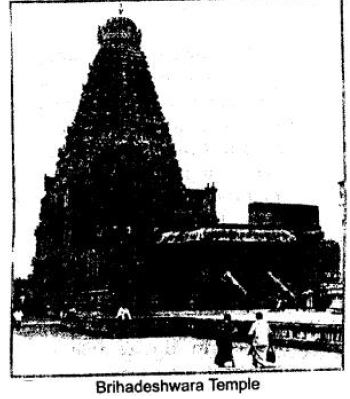
Answer: (a) The Brihadeswara Temple in Thanjavur was built by the legendary Chola monarch, Rajaraja I.
(b) The main deity worshipped in this temple is Lord Shiva.
(c) Two key architectural highlights of this monument are:
1. The temple features a massive central tower (vimana) with 13 successive tiers that reaches a height of 190 feet.
2. The peak of the tower is capped by a monolithic stone dome measuring 25 feet high and weighing nearly 80 tons.
In simple words: Rajaraja I built the Brihadeswara Temple for Lord Shiva. It features a grand 190-foot tower capped by a single 80-ton block of stone.
Exam Tip: Remember the specifications: a 13-storeyed vimana of 190 feet and an 80-ton monolithic stone on top.
Question 5. With reference to the South Indian temples answer the following questions: (a) The role of the temple as an employer. (b)The role of the temple as a landlord. (c) The role of the temple as centres of learning.
Answer: (a) The Temple as an Employer:
Temples created jobs for many people, offering diverse livelihoods. They looked after their employees' well-being by providing housing, clothes, food, education, and medical services through established healthcare centers.
(b) The Temple as a Landlord:
Because religious institutions held vast tracts of agricultural land, the temple administrations functioned as major landowners and managers.
(c) The Temple as a Center of Learning:
People from various backgrounds gathered within temple compounds to discuss community issues and exchange ideas. This encouraged the sharing of knowledge, fostered social awareness, and supported educational growth.
In simple words: Temples provided jobs, food, and housing. They owned large farms and acted as landowners. They were also meeting places where people gathered to learn and talk about local issues.
Exam Tip: Explain that Chola temples were social and economic engines, not just religious shrines, to write a high-scoring answer.
Question 6. With reference to Chola literature, write on the following: (a) Kalingattuparani (b) Religious and secular literature.
Answer: (a) Kalingattuparani:
This twelfth-century heroic war song was composed by Jayankondar, who was the court poet for Kulottunga I. It is widely considered an exceptional historical piece in Tamil, celebrating the triumph of Kulottunga Chola I over the Kalinga ruler, Anantavarman Chodaganga. The work offers highly detailed, dramatic descriptions of battlefield action and maps out the march of the imperial army. Its grand style and choice of words make it a literary masterpiece.
(b) Religious and Secular Works:
Religious writing during this period included the Tamil Ramayana along with various retellings of the epics Ramayana and Mahabharata. On the other hand, non-religious or secular literature consisted of scholarly works, such as grammatical treatises authored by Buddhamitra and Rawankashi.
In simple words: The 'Kalingattuparani' is a 12th-century war poem celebrating Kulottunga I's victory. Chola writers also produced holy books like the Tamil Ramayana and grammar textbooks.
Exam Tip: Differentiate clearly between religious works like the Tamil Ramayana and secular works like grammatical treatises to show a balanced understanding of Chola literature.
Free study material for History Civics
ICSE Goyal Brothers Solutions Class 9 History Civics Chapter 8 South India And The Cholas
Students can now access the detailed Goyal Brothers Solutions for Chapter 8 South India And The Cholas on our portal. These solutions have been carefully prepared as per latest ICSE Class 9 syllabus. Each solution given above has been updated based on the current year pattern to ensure Class 9 students have the most updated History Civics content.
Master Goyal Brothers Textbook Questions
Our subject experts have provided detailed explanations for all the questions found in the Goyal Brothers textbook for Class 9 History Civics. We have focussed on making the concepts easy for you in Chapter 8 South India And The Cholas so that students can understand the concepts behind every answer. For all numerical problems and theoretical concepts these solutions will help in strengthening your analytical skill required for the ICSE examinations.
Complete History Civics Exam Preparation
By using these Goyal Brothers Class 9 solutions, you can enhance your learning and identify areas that need more attention. We recommend solving the History Civics Questions from the textbook first and then use our teacher-verified answers. For a proper revision of Chapter 8 South India And The Cholas, students should also also check our Revision Notes and Sample Papers available on studiestoday.com.
FAQs
You can download the verified Goyal Brothers solutions for Chapter 8 South India And The Cholas on StudiesToday.com. Our teachers have prepared answers for Class 9 History Civics as per 2026-27 ICSE academic session.
Yes, our solutions for Chapter 8 South India And The Cholas are designed as per new 2026 ICSE standards. 40% competency-based questions required for Class 9, are included to help students understand application-based logic behind every History Civics answer.
Yes, every exercise in Chapter 8 South India And The Cholas from the Goyal Brothers textbook has been solved step-by-step. Class 9 students will learn History Civics conceots before their ICSE exams.
Yes, follow structured format of these Goyal Brothers solutions for Chapter 8 South India And The Cholas to get full 20% internal assessment marks and use Class 9 History Civics projects and viva preparation as per ICSE 2026 guidelines.