

ICSE Solutions Goyal Brothers Class 10 Physics Chapter 9 Electric Energy Power Household Circuits have been provided below and is also available in Pdf for free download. The Goyal Brothers ICSE solutions for Class 10 Physics have been prepared as per the latest syllabus and ICSE books and examination pattern suggested in Class 10. Questions given in ICSE Goyal Brothers book for Class 10 Physics are an important part of exams for Class 10 Physics and if answered properly can help you to get higher marks. Refer to more Chapter-wise answers for ICSE Class 10 Physics and also download more latest study material for all subjects. Chapter 9 Electric Energy Power Household Circuits is an important topic in Class 10, please refer to answers provided below to help you score better in exams
Goyal Brothers Chapter 9 Electric Energy Power Household Circuits Class 10 Physics ICSE Solutions
Class 10 Physics students should refer to the following ICSE questions with answers for Chapter 9 Electric Energy Power Household Circuits in Class 10. These ICSE Solutions with answers for Class 10 Physics will come in exams and help you to score good marks
Chapter 9 Electric Energy Power Household Circuits Goyal Brothers ICSE Solutions Class 10 Physics
Exercise 1
Question 1. (a) What do you understand by the term electric work ?
Answer: Electric work is defined as the work performed when an electrical charge is made to pass through a conducting medium across a specific electric potential difference.
We know that:
\( V = \frac{W}{Q} \)
Therefore:
\( W = VQ \)
In simple words: Electric work is the electrical energy spent to push a charge through a wire.
Exam Tip: Always state the formula \( W = VQ \) and write the units clearly to secure full marks.
Question 1. (b) State and define SI unit of electric work.
Answer: The standard SI unit used to measure electric work is the Joule (J). Mathematically, it is represented as:
\( 1 \text{ J} = 1 \text{ volt} \times 1 \text{ coulomb} \)
One Joule is the measure of electrical work done when a charge of one coulomb passes through a conductor that has a potential difference of one volt across its ends.
In simple words: The unit of electric work is the Joule, which is the work done when a 1-coulomb charge moves across a 1-volt potential difference.
Exam Tip: Be sure to write the relation \( 1 \text{ J} = 1 \text{ V} \times 1 \text{ C} \) to get full credit for the definition.
Question 1. (c) Name two bigger units of electric work. How are they related to SI unit ?
Answer: Two larger units of electrical work are:
1. Kilo-joule (kJ), where \( 1 \text{ kJ} = 10^3 \text{ J} \)
2. Mega-joule (MJ), where \( 1 \text{ MJ} = 10^6 \text{ J} \)
In simple words: Kilo-joule and Mega-joule are bigger units of electric work, representing thousands and millions of Joules respectively.
Exam Tip: Write the powers of 10 clearly when showing the relationship with the Joule.
Question 2. Derive an expression for electric work connecting :
(a) Current, resistance and time
(b) Current, potential difference and time.
(c) Potential difference, resistance and time.
Answer: We start with the basic definition of potential difference, which is:
\( V = \frac{W}{Q} \)
\( \implies W = VQ \)
Since charge \( Q = It \):
\( W = VIt \) ...(i)
(a) By applying Ohm's Law (\( V = IR \)), we can substitute the value of potential difference into equation (i):
\( W = (IR)It = I^2Rt \) ...(ii)
This is the expression connecting current, resistance, and time.
(b) From equation (i), we already have the expression connecting potential difference, current, and time:
\( W = VIt \)
(c) From Ohm's Law, we also have \( I = \frac{V}{R} \). Substituting this value of current into equation (i):
\( W = V \left(\frac{V}{R}\right)t = \frac{V^2t}{R} \) ...(iii)
This is the expression connecting potential difference, resistance, and time.
In simple words: You can calculate electric work using different formulas (\( VIt \), \( I^2Rt \), or \( \frac{V^2t}{R} \)) depending on whether you know current, voltage, resistance, or time.
Exam Tip: Clearly list the substitutions from Ohm's Law step-by-step to make your derivation easy for the examiner to follow.
Question 3. State three factors which determine the quantity of heat produced in a conductor.
Answer: The electrical energy converted into heat within a conducting wire depends on three primary variables as determined by Joule's Law of Heating (\( H = I^2Rt \)):
1. The strength of the electric current (\( I \)) passing through the medium (heat is directly proportional to the square of the current).
2. The electrical resistance (\( R \)) offered by the material (heat is directly proportional to the resistance).
3. The duration of time (\( t \)) for which the current continues to flow (heat is directly proportional to the duration of current flow).
In simple words: The heat produced in a wire increases if you pass more current, use a wire with higher resistance, or let the current flow for a longer time.
Exam Tip: Write down the formula \( H = I^2Rt \) before explaining each factor to ground your answer in core theory.
Question 4. (a) What do you understand by the term electric power ?
Answer: Electric power refers to the rate at which electrical energy is delivered by an electrical source or consumed by a connected appliance.
\( P = \frac{\text{Work Done}}{\text{Time Taken}} = \frac{W}{t} \)
Since \( W = VIt \):
\( P = \frac{VIt}{t} = VI \)
In simple words: Electric power is how fast an appliance uses electricity.
Exam Tip: Providing both definitions (supply rate by source and consumption rate by appliance) shows a comprehensive understanding.
Question 4. (b) State SI unit of electric power and define it
Answer: The standard SI unit for measuring electric power is the Watt (W), which equals one Joule per second (\( \text{J s}^{-1} \)). One Watt is defined as the power consumed when an electrical current of one Ampere passes through a circuit under a potential difference of one Volt.
In simple words: Power is measured in Watts. One Watt is the power used when a 1-Ampere current flows at 1-Volt potential difference.
Exam Tip: Do not forget to state both equivalent units: Watt (W) and Joules per second (\( \text{J s}^{-1} \)).
Question 4. (c) Name two bigger units of electric power and their relation with SI unit.
Answer: Two larger units used for electric power are:
1. Kilowatt (kW), where \( 1 \text{ kW} = 1000 \text{ W} = 10^3 \text{ W} \)
2. Megawatt (MW), where \( 1 \text{ MW} = 10^6 \text{ W} \)
In simple words: Kilowatt and Megawatt are larger units used to measure high power, representing thousands and millions of Watts respectively.
Exam Tip: Show the relationships clearly using scientific notation (powers of 10).
Question 5. Derive an expression for electric power connecting :
(a) Current and resistance.
(b) Current and potential difference.
(c) Potential difference and resistance.
Answer: Since power is defined as the rate of doing work:
\( P = \frac{W}{t} \)
(a) We know that the work done in terms of current, resistance, and time is \( W = I^2Rt \). Substituting this:
\( P = \frac{I^2Rt}{t} = I^2R \) ...(i)
This is the expression connecting current and resistance.
(b) Since work done in terms of potential difference, current, and time is \( W = VIt \):
\( P = \frac{VIt}{t} = VI \) ...(ii)
This is the expression connecting current and potential difference.
(c) From Ohm's Law, we have \( I = \frac{V}{R} \). Substituting this value of current into equation (ii):
\( P = V \left(\frac{V}{R}\right) = \frac{V^2}{R} \) ...(iii)
This is the expression connecting potential difference and resistance.
In simple words: Electric power can be calculated in three different ways using current, voltage, and resistance depending on what values are given.
Exam Tip: Memorize all three formulas for power (\( VI \), \( I^2R \), and \( \frac{V^2}{R} \)) as they are extremely useful for solving numerical problems on series and parallel circuits.
Question 6. (a) What do you understand by term electric energy ?
Answer: Electric energy represents the total work done by an electric current in maintaining a flow of charge through a circuit. It is calculated as the product of power and the time duration for which the electrical appliance is operated:
\( E = P \times t = VIt \)
In simple words: Electric energy is the total electricity used by an appliance over a period of time.
Exam Tip: State the relation \( E = P \times t \) clearly to define electrical energy mathematically.
Question 6. (b) Name and define the smallest commercial unit of electric energy.
Answer: The fundamental unit of electrical energy is the Joule (J). One Joule is defined as the quantity of energy consumed when a charge of one coulomb flows through a conducting wire across a potential difference of one volt.
In simple words: The Joule is the base unit of energy, equivalent to moving a 1-coulomb charge under a 1-volt potential difference.
Exam Tip: Be careful to define the unit of energy (Joule) in terms of electrical quantities (Coulomb and Volt) for electrical chapters.
Question 6. (c) Name and define the standard commercial unit of electric energy.
Answer: The standard commercial unit for measuring electric energy is the Kilowatt-hour (kWh). One Kilowatt-hour is defined as the amount of electrical energy consumed by a device rated at one kilowatt when it operates continuously for one hour.
In simple words: The commercial unit is the Kilowatt-hour, which is the energy used by a 1000-Watt appliance running for one hour.
Exam Tip: Remember that 1 kWh is commonly referred to as "one unit" on commercial electricity bills.
Question 7. With respect to electricity, define :
1. watt hour
2. watt
3. kilowatt
4. kilowatt hour. Amongst the above units, which are the units of : (i) electric energy (ii) electric power.
Answer: Let's define the given terms:
1. Watt-hour (Wh): The electrical energy consumed when an appliance with a power rating of one Watt is operated for a duration of one hour.
2. Watt (W): The power of an appliance that does electrical work at the rate of one Joule per second.
3. Kilowatt (kW): A higher unit of power representing a work-doing rate of 1,000 Joules per second.
4. Kilowatt-hour (kWh): The commercial unit of energy consumed when a device rated at one kilowatt is used for one hour.
Grouping of units:
(i) Units of electric energy: Watt-hour (Wh) and Kilowatt-hour (kWh).
(ii) Units of electric power: Watt (W) and Kilowatt (kW).
In simple words: Units with "hour" (Wh and kWh) measure total energy, while plain "watt" or "kilowatt" measure the rate of power consumption.
Exam Tip: Be extremely careful not to confuse "kilowatt" (power) with "kilowatt-hour" (energy), as this is a very common trap.
Question 8. How many joules of energy is equal to one kilowatt hour?
Answer: To find the equivalent of one Kilowatt-hour in Joules, we perform the following conversion:
\( 1 \text{ kWh} = 1 \text{ kW} \times 1 \text{ hour} \)
\( 1 \text{ kWh} = 1000 \text{ W} \times 3600 \text{ seconds} \)
Since \( 1 \text{ W} = 1 \text{ J s}^{-1} \):
\( 1 \text{ kWh} = 1000 \text{ J s}^{-1} \times 3600 \text{ s} = 3.6 \times 10^6 \text{ Joules} \)
In simple words: One kilowatt-hour is a very large amount of energy, equal to exactly 3.6 million Joules.
Exam Tip: Always show the full step-by-step conversion from hours to seconds and kilowatts to watts to ensure maximum points in descriptive exams.
Question 9. Distinguish between kilo-watt and kilowatt hour.
Answer: The differences between Kilowatt and Kilowatt-hour are:
- Kilowatt (kW): This is a unit used to measure electric power (rate of energy consumption). It is equivalent to 1,000 Joules per second (\( 1000 \text{ J s}^{-1} \)).
- Kilowatt-hour (kWh): This is a commercial unit used to measure total electrical energy. It is the energy consumed when an appliance rated at 1 kW runs for one hour, which is equal to \( 3.6 \times 10^6 \) Joules.
In simple words: Kilowatt is the speed of electricity consumption, whereas Kilowatt-hour is the actual amount of electricity used.
Exam Tip: Presenting this distinction in a comparative table showing physical quantity, definitions, and mathematical values is highly recommended.
Question 10. How many kilowatt is equal to one hour power ?
Answer: One horse power (HP) is equivalent to 746 Watts (often approximated to 750 Watts in general terms).
To convert this value to kilowatts:
\( 1 \text{ HP} = \frac{746}{1000} \text{ kW} = 0.746 \text{ kW} \)
Using the approximated value of 750 W:
\( 1 \text{ HP} \approx \frac{750}{1000} \text{ kW} \approx 0.750 \text{ kW} \)
In simple words: One horse power is equal to approximately 0.746 Kilowatts.
Exam Tip: Remember the exact conversion \( 1 \text{ HP} = 746 \text{ W} \) as it is the standard value used in numerical problems.
Multiple Choice Questions
Tick (✓) the most appropriate option.
Question 1. A bulb has a resistance of 20 Ω and the p.d across its terminals is V. If the bulb is usedfor t seconds then energy consumed by the bulb is :
(a) \( \frac{V}{20} \times t \)
(b) \( \frac{V^2}{20} \times t \)
(c) \( V \times t = 20 \)
(d) \( \frac{V \times t^2}{20} \)
Answer: (b) \( \frac{V^2}{20} \times t \)
In simple words: The electrical energy is given by \( \frac{V^2}{R} \times t \). Since the resistance is 20 ohms, the formula becomes \( \frac{V^2}{20} \times t \).
Exam Tip: Use the standard relationship \( E = \frac{V^2}{R} t \) when voltage and resistance are provided, and substitute \( R = 20\ \Omega \).
Question 2. A current Iflows through a resistance R for the time ‘t’, the electric energy consumed by the resistance is :
(a) \( I \times R \times t \)
(b) \( I \times R^2 \times t \)
(c) \( I^2 \times R \times t \)
(d) \( \frac{I^2 \times R}{t} \)
Answer: (c) \( I^2 \times R \times t \)
In simple words: The electrical energy used when a current flows is calculated by squaring the current, multiplying by resistance, and multiplying by time.
Exam Tip: Memorize the three forms of energy equations: \( V I t \), \( I^2 R t \), and \( \frac{V^2}{R} t \).
Question 3. The unit for electric work in SI system :
(a) Joule
(b) watt
(c) watt second
(d) watt hour
Answer: (a) Joule
In simple words: In the international system of units, any form of work or energy is measured in Joules.
Exam Tip: Don't get confused by power units like watt; work is always measured in Joules in the SI system.
Question 4. An electric appliance has a rating of 1000 W – 200 V. The resistance of the element of electric appliance is :
(a) 200 Ω
(b) 400 Ω
(c) 40 Ω
(d) 4000 Ω
Answer: (c) 40 Ω
In simple words: We find the resistance using the formula \( R = \frac{V^2}{P} \), which gives \( \frac{200 \times 200}{1000} = 40\ \Omega \).
Exam Tip: Power rating formulas like \( R = \frac{V^2}{P} \) are highly tested; always check your unit arithmetic carefully.
Question 5. Kilowatt hour is commercial unit of :
(a) power
(b) electric energy
(c) heat energy
(d) mechanical energy
Answer: (b) electric energy
In simple words: The kilowatt-hour is the standard commercial unit used by utility companies to measure the electricity consumed.
Exam Tip: Remember that "commercial unit of electrical energy" is the formal term for "unit" on electricity bills.
Question 6. Kilowatt hour and kilowatt are :
(a) SI units of power and electric energy
(b) commercial units of power and electric energy
(c) SI units of-electric energy and power
(d) commercial units of electric energy and power
Answer: (d) commercial units of electric energy and power
In simple words: Kilowatt-hour is the commercial unit for energy, and kilowatt is the commercial unit for electrical power.
Exam Tip: Keep in mind that SI units are Watt and Joule, whereas commercial units scale up to kilowatt and kilowatt-hour.
Numerical Problems on Electric Energy
Practice Problems 1
Question 1. Calculate the energy released by a heater, which draws a current of 5A at 220 V for 1 min.
Answer: Given data:
Current, \( I = 5\text{ A} \)
Potential difference, \( V = 220\text{ V} \)
Time, \( t = 1\text{ min} = 60\text{ s} \)
The formula for energy produced is:
\( W = V \cdot I \cdot t \)
Substituting the values:
\( W = 220\text{ V} \times 5\text{ A} \times 60\text{ s} \)
\( W = 66000\text{ J} \)
In simple words: Multiply voltage, current, and time (in seconds) to find the energy released, which is 66,000 Joules.
Exam Tip: Always convert time from minutes to seconds before multiplying to keep units in the standard SI format.
Question 2. An electric device consumes 8640 J of energy in 30 min. while operating at 24 V. Calculate the current drawn by the device.
Answer: Given data:
Energy, \( W = 8640\text{ J} \)
Time, \( t = 30\text{ min} = 30 \times 60 = 1800\text{ s} \)
Voltage, \( V = 24\text{ V} \)
We use the energy relation:
\( V \cdot I \cdot t = W \)
Substituting the known values:
\( 24\text{ V} \times I \times 1800\text{ s} = 8640\text{ J} \)
\( 43200 \cdot I = 8640 \)
\( I = \frac{8640}{43200} = 0.2\text{ A} \)
In simple words: We find the current by dividing the total energy by the product of voltage and time (in seconds). This gives 0.2 Amperes.
Exam Tip: Be careful when simplifying fractions during division to avoid simple calculation errors.
Practice Problems 2
Question 1. An ekctric kettle draws a current of4A for 2.5 min. if the resistance of its element is 100 Ω , calculate the electric energy drawn by kettle in kilojoules.
Answer: Given data:
Current, \( I = 4\text{ A} \)
Time, \( t = 2.5\text{ min} = 2.5 \times 60 = 150\text{ s} \)
Resistance, \( R = 100\ \Omega \)
Using Joule's formula for energy:
\( W = I^2 \cdot R \cdot t \)
Substituting the values:
\( W = 4^2 \times 100 \times 150 \)
\( W = 16 \times 15000 = 240000\text{ J} \)
Converting to kilojoules:
\( W = \frac{240000}{1000} = 240\text{ kJ} \)
In simple words: Use the formula \( I^2 R t \) with time in seconds, and then divide the final Joules by 1000 to get the answer in kilojoules.
Exam Tip: Pay attention to the unit requested in the question (kilojoules instead of Joules) to secure full marks.
Question 2. A soldering iron draws an energy of 43200 J in 4 min, when the current flowing through its element is 6 A, calculate the resistance of its heating element.
Answer: Given data:
Energy, \( E = 43200\text{ J} \)
Time, \( t = 4\text{ min} = 4 \times 60 = 240\text{ s} \)
Current, \( I = 6\text{ A} \)
The formula relating energy, current, resistance, and time is:
\( E = I^2 \cdot R \cdot t \)
Rearranging to find resistance:
\( R = \frac{E}{I^2 \cdot t} \)
Substituting the values:
\( R = \frac{43200}{6^2 \times 240} \)
\( R = \frac{43200}{36 \times 240} \)
\( R = \frac{43200}{8640} = 5\ \Omega \)
In simple words: Divide the total energy by the square of the current multiplied by the time in seconds to find the resistance of 5 ohms.
Exam Tip: Remember to square the current \( I^2 \) in the denominator, a common step students occasionally overlook.
Practice Problems 3
Question 1. Calculate the heat energy given out by the filament of an electric bulb in 20 s, when its resistance is 4 Ω and p.d. across its ends in 12 V.
Answer: Given data:
Time, \( t = 20\text{ s} \)
Resistance, \( R = 4\ \Omega \)
Potential difference, \( V = 12\text{ V} \)
The expression for heat energy is:
\( E = \frac{V^2 \cdot t}{R} \)
Substituting the variables:
\( E = \frac{12^2 \times 20}{4} \)
\( E = \frac{144 \times 20}{4} \)
\( E = 36 \times 20 = 720\text{ J} \)
In simple words: The heat energy can be computed using \( \frac{V^2 t}{R} \), yielding 720 Joules.
Exam Tip: Since time is already given in seconds, you can substitute the numbers directly into the formula.
Question 2. An electric device gives out 5760 J of heat energy in 1 min, when current flows through it at a p.d. of 24 V. Find the resistance of the device.
Answer: Given data:
Heat energy, \( E = 5760\text{ J} \)
Time, \( t = 1\text{ min} = 60\text{ s} \)
Potential difference, \( V = 24\text{ V} \)
The heat energy formula is:
\( E = \frac{V^2 \cdot t}{R} \)
Rearranging the equation to solve for resistance:
\( R = \frac{V^2 \cdot t}{E} \)
Substituting the values:
\( R = \frac{24^2 \times 60}{5760} \)
\( R = \frac{576 \times 60}{5760} \)
\( R = \frac{34560}{5760} = 6\ \Omega \)
In simple words: We find the resistance by dividing \( V^2 \times t \) by the total heat energy, which results in 6 ohms.
Exam Tip: Simplify the calculation by noting that \( 576 \) in the numerator divides easily into \( 5760 \).
Practice Problems 4
Question 1. An electric heater draws a current of 3.5 A at a p.d. of 250 V. Calculate the power of 4 such heaters.
Answer: Given data:
Current drawn by one heater, \( I = 3.5\text{ A} \)
Potential difference, \( V = 250\text{ V} \)
The power rating of a single heater is:
\( P = V \cdot I \)
For 4 heaters, the total power is:
\( P_{\text{total}} = 4 \times V \cdot I \)
Substituting the values:
\( P_{\text{total}} = 4 \times 250\text{ V} \times 3.5\text{ A} \)
\( P_{\text{total}} = 1000 \times 3.5 = 3500\text{ W} \)
In simple words: Calculate the power of one heater by multiplying voltage and current, then multiply by 4 to get the total power of 3500 Watts.
Exam Tip: Multiplying \( 4 \times 250 = 1000 \) first simplifies the decimal multiplication with \( 3.5 \).
Question 2. An electric bulb is rated 500 W – 200 V. Calculate the magnitude of current.
Answer: Given data:
Power, \( P = 500\text{ W} \)
Voltage, \( V = 200\text{ V} \)
Using the power relation:
\( P = V \cdot I \)
Solving for current:
\( I = \frac{P}{V} \)
Substituting the values:
\( I = \frac{500}{200} = 2.5\text{ A} \)
In simple words: Divide power by voltage to get the current flowing through the bulb, which equals 2.5 Amperes.
Exam Tip: Power rating questions usually require isolating \( I \) from \( P = VI \); memorize this fundamental relation.
Question 3. An electric heater of power 1000 W, draws a current of 5.0 A. Calculate the line voltage.
Answer: Given data:
Power, \( P = 1000\text{ W} \)
Current, \( I = 5.0\text{ A} \)
The formula for voltage is:
\( V = \frac{P}{I} \)
Substituting the values:
\( V = \frac{1000}{5.0} = 200\text{ V} \)
In simple words: Divide the power by the current to find that the voltage is 200 Volts.
Exam Tip: Be sure to write the correct SI unit, Volts (V), for line voltage calculations.
Practice Problems 5
Question 1. An electric heater has a resistance of 40 Ω and draws a current of 4 A. Calculate :
1. its power
2. p.d. at its ends
Answer: Given data:
Resistance, \( R = 40\ \Omega \)
Current, \( I = 4\text{ A} \)
1. To find the power:
\( P = I^2 \cdot R \)
\( P = 4^2 \times 40 \)
\( P = 16 \times 40 = 640\text{ W} \)
2. To find the potential difference across the ends:
\( V = I \cdot R \)
\( V = 4\text{ A} \times 40\ \Omega = 160\text{ V} \)
In simple words: 1. Power is found using \( I^2 R \), which equals 640 Watts. 2. Voltage is found using Ohm's Law (\( I \times R \")), which gives 160 Volts.
Exam Tip: Clearly label your sub-parts in the answer, as examiners grade each section independently.
Question 2. An electric heater of power 900 W, has a resistance of 36 Ω Calculate the magnitude of current and the p.d. at its ends.
Answer: Given data:
Power, \( P = 900\text{ W} \)
Resistance, \( R = 36\ \Omega \)
(i) To determine the current:
\( P = I^2 \cdot R \)
\( I^2 = \frac{P}{R} \)
\( I^2 = \frac{900}{36} = 25 \)
\( I = \sqrt{25} = 5\text{ A} \)
(ii) To determine the potential difference:
\( V = I \cdot R \)
\( V = 5\text{ A} \times 36\ \Omega = 180\text{ V} \)
In simple words: First, find the current by taking the square root of power divided by resistance (5 Amperes). Then, multiply current by resistance to find the voltage (180 Volts).
Exam Tip: Remember to perform the square root step to find \( I \) from \( I^2 \); do not leave the answer at 25.
Practice Problems 6
Question 1. An electric motor of power 1000 W, operates at 250 V. Calculate the inductive resistance of motor and current flowing through it.
Answer: Given data:
Power, \( P = 1000\text{ W} \)
Voltage, \( V = 250\text{ V} \)
(i) To determine the resistance:
\( P = \frac{V^2}{R} \)
\( R = \frac{V^2}{P} \)
\( R = \frac{250 \times 250}{1000} \)
\( R = \frac{62500}{1000} = 62.5\ \Omega \)
(ii) To determine the current flowing through it:
\( I = \frac{P}{V} \)
\( I = \frac{1000}{250} = 4\text{ A} \)
In simple words: Divide the square of the voltage by the power to find the resistance of 62.5 ohms, and divide the power by the voltage to find the current of 4 Amperes.
Exam Tip: Check your calculations twice when squaring voltages like \( 250^2 = 62500 \) to ensure accuracy.
Question 2. An electric device operates at 24 V and has a resistance of 8 Ω Calculate the power of the device and current flowing through it
Answer: Given data:
Voltage, \( V = 24\text{ V} \)
Resistance, \( R = 8\ \Omega \)
(i) To determine the power:
\( P = \frac{V^2}{R} \)
\( P = \frac{24 \times 24}{8} \)
\( P = 3 \times 24 = 72\text{ W} \)
(ii) To determine the current:
\( I = \frac{V}{R} \)
\( I = \frac{24}{8} = 3\text{ A} \)
In simple words: Find the power by calculating \( \frac{V^2}{R} \) (72 Watts) and the current by using Ohm's Law \( \frac{V}{R} \) (3 Amperes).
Exam Tip: Dividing \( 24/8 = 3 \) first is a handy mental shortcut when calculating \( \frac{24 \times 24}{8} \).
Practice Problems 7
Question 1. An electric bulb is rated 200 W – 200 V. It is immersed in 200 g of oil (SHC 0.8 Jg-10 C-1) at 10°C. The bulb is switched on for 2 minutes. If all the electric energy is absorbed in the form of heat energy by the oil, calculate :
(a) Resistance of the filament of the bulb.
(b) Current flowing through the bulb.
(c) Final temperature of the oil.
Answer: Given data:
Bulb power, \( P = 200\text{ W} \)
Voltage, \( V = 200\text{ V} \)
Mass of oil, \( m = 200\text{ g} \)
Specific heat capacity of oil, \( c = 0.8\text{ J g}^{-1}\text{ }^\circ\text{C}^{-1} \)
Initial temperature, \( T_1 = 10^\circ\text{C} \)
Time, \( t = 2\text{ min} = 120\text{ s} \)
(a) Filament resistance:
\( R = \frac{V^2}{P} \)
\( R = \frac{200 \times 200}{200} = 200\ \Omega \)
(b) Current drawn:
\( I = \frac{P}{V} \)
\( I = \frac{200}{200} = 1\text{ A} \)
(c) Heat absorbed equals electric energy:
\( Q = m \cdot c \cdot (T_2 - T_1) \)
\( P \cdot t = m \cdot c \cdot (T_2 - 10) \)
\( 200 \times 120 = 200 \times 0.8 \times (T_2 - 10) \)
\( 24000 = 160 \times (T_2 - 10) \)
\( T_2 - 10 = \frac{24000}{160} = 150 \)
\( T_2 = 150 + 10 = 160^\circ\text{C} \)
In simple words: (a) The resistance is 200 ohms. (b) The current is 1 Ampere. (c) Equating electrical energy to heat energy shows that the oil's temperature increases to 160°C.
Exam Tip: Be mindful of energy conservation equations where electrical energy consumed (\( P \cdot t \)) equals the heat absorbed (\( m c \Delta T \)).
Question 2. An electric kettle is rated 1000 W – 250 V. It is used to bring water at 20°C to its boiling point. If the kettle is used for 11 minutes and 12 seconds, calculate :
(a) Resistance of the element of the kettle.
(b) Current flowing through the element.
(c) Mass of water in the kettle [SHC of water = 4.2 Jg-10 C-1]
Answer: Given data:
Power, \( P = 1000\text{ W} \)
Voltage, \( V = 250\text{ V} \)
Initial temperature, \( T_1 = 20^\circ\text{C} \)
Boiling point of water, \( T_2 = 100^\circ\text{C} \)
Time, \( t = 11\text{ min } 12\text{ s} = (11 \times 60) + 12 = 672\text{ s} \)
Specific heat capacity of water, \( c = 4.2\text{ J g}^{-1}\text{ }^\circ\text{C}^{-1} \)
(a) Element resistance:
\( R = \frac{V^2}{P} \)
\( R = \frac{250 \times 250}{1000} = 62.5\ \Omega \)
(b) Current drawn:
\( I = \frac{P}{V} \)
\( I = \frac{1000}{250} = 4\text{ A} \)
(c) Mass of water:
Electric energy consumed \( Q = P \cdot t = 1000 \times 672 = 672000\text{ J} \)
Heat energy absorbed \( Q = m \cdot c \cdot (T_2 - T_1) \)
\( 672000 = m \times 4.2 \times (100 - 20) \)
\( 672000 = m \times 4.2 \times 80 \)
\( 672000 = m \times 336 \)
\( m = \frac{672000}{336} = 2000\text{ g} = 2\text{ kg} \)
In simple words: (a) The resistance is 62.5 ohms. (b) The current is 4 Amperes. (c) Equating heat energy and electrical energy yields 2000 grams (or 2 kilograms) of water.
Exam Tip: Remember that the boiling point of water is implicitly \( 100^\circ\text{C} \) even if not explicitly stated in the problem statement.
Practice Problems 8
Question 1. Calculate the resistance of nichrome wire, which will bring 200 g of water at 20° C to its boiling points in 7 minutes, when current flowing through wire is 4A.
Answer: Given data:
Mass of water, \( m = 200\text{ g} \)
Initial temperature, \( T_1 = 20^\circ\text{C} \)
Final temperature (boiling point), \( T_2 = 100^\circ\text{C} \)
Time, \( t = 7\text{ min} = 7 \times 60 = 420\text{ s} \)
Current, \( I = 4\text{ A} \)
Specific heat capacity of water, \( c = 4.2\text{ J g}^{-1}\text{ }^\circ\text{C}^{-1} \)
Heat energy needed to boil water:
\( Q = m \cdot c \cdot (T_2 - T_1) \)
\( Q = 200 \times 4.2 \times (100 - 20) \)
\( Q = 200 \times 4.2 \times 80 = 67200\text{ J} \)
Since the heat energy is supplied electrically:
\( I^2 \cdot R \cdot t = Q \)
\( 4^2 \times R \times 420 = 67200 \)
\( 16 \times 420 \times R = 67200 \)
\( 6720 \cdot R = 67200 \)
\( R = \frac{67200}{6720} = 10\ \Omega \)
In simple words: First, calculate the heat energy needed to boil the water (67,200 Joules). Then, divide this by \( I^2 \times t \) to find that the wire's resistance is 10 ohms.
Exam Tip: Keep units consistent by using grams for mass if the specific heat capacity is in \( \text{J g}^{-1}\text{ }^\circ\text{C}^{-1} \).
Question 2. Calculate p.d. at the ends of a power source which, supplies current to a 4 ohm resistance wire for 20 minutes and raises temperature of 400 g of water through 20 .
Answer: Given data:
Resistance, \( R = 4\ \Omega \)
Time, \( t = 20\text{ min} = 20 \times 60 = 1200\text{ s} \)
Mass of water, \( m = 400\text{ g} \)
Temperature rise, \( \Delta T = 20^\circ\text{C} \)
Specific heat capacity of water, \( c = 4.2\text{ J g}^{-1}\text{ }^\circ\text{C}^{-1} \)
Heat energy produced to raise the temperature:
\( Q = m \cdot c \cdot \Delta T \)
\( Q = 400 \times 4.2 \times 20 = 33600\text{ J} \)
This heat is generated by the electrical source:
\( E = \frac{V^2 \cdot t}{R} \)
\( 33600 = \frac{V^2 \times 1200}{4} \)
\( 33600 = V^2 \times 300 \)
\( V^2 = \frac{33600}{300} = 112 \)
\( V = \sqrt{112} = \sqrt{16 \times 7} = 4\sqrt{7}\text{ V} \approx 10.58\text{ V} \)
In simple words: Calculate the heat energy required as 33,600 Joules. Use the formula \( \frac{V^2 t}{R} = 33600 \) to solve for the voltage, which is approximately 10.58 Volts (or \( 4\sqrt{7} \) Volts).
Exam Tip: When \( \Delta T \) is directly stated as "raises temperature through 20", use \( \Delta T = 20 \) without subtracting from any initial temperature.
Question 3. Calculate the current flowing through an electric drill, connected to 200 V supply, if it drills a hole in a metal plate of mass 500 g, such that its temperature rises from 10 to 60 in 5 minutes, assuming all the work done is converted into heat energy. [S.H.C. of metal 0.6 Jg-1 c-1]
Answer: Given data:
Voltage, \( V = 200\text{ V} \)
Mass of metal plate, \( m = 500\text{ g} \)
Initial temperature, \( T_1 = 10^\circ\text{C} \)
Final temperature, \( T_2 = 60^\circ\text{C} \)
Time, \( t = 5\text{ min} = 5 \times 60 = 300\text{ s} \)
Specific heat capacity of metal, \( c = 0.6\text{ J g}^{-1}\text{ }^\circ\text{C}^{-1} \)
Heat energy produced:
\( Q = m \cdot c \cdot (T_2 - T_1) \)
\( Q = 500 \times 0.6 \times (60 - 10) \)
\( Q = 300 \times 50 = 15000\text{ J} \)
Electrical energy converted to heat:
\( V \cdot I \cdot t = Q \)
\( 200 \times I \times 300 = 15000 \)
\( 60000 \cdot I = 15000 \)
\( I = \frac{15000}{60000} = 0.25\text{ A} \)
In simple words: Calculate the heat energy generated (15,000 Joules). Dividing this by the product of voltage and time gives a current of 0.25 Amperes.
Exam Tip: Be sure to calculate the temperature difference \( \Delta T = 60 - 10 = 50^\circ\text{C} \) correctly before finding the heat energy.
Practice Problems 9
Question 1. Circuit diagram shows four dry cells of e.m.f. 1.5 V and internal resistance 0.25 Ω connected to an external circuit A 3 Ω wire is immersed in 20 g of water at 20°C. The current switched on for 6 minutes and 36 seconds. Calculate :
(a) Reading shown by the ammeter
(b) Current in 1.5 Ω wire
(c) Final temperature of water
Answer:
Given data:
Number of cells = 4, each of EMF \( = 1.5\text{ V} \)
Total EMF of the combination, \( E = 4 \times 1.5 = 6\text{ V} \)
Equivalent parallel resistance of \( 1.5\ \Omega \) and \( 3\ \Omega \), \( R_p \):
\( R_p = \frac{1}{\frac{1}{1.5} + \frac{1}{3}} = 1\ \Omega \)
Total external resistance of the circuit:
\( R = R_p + 3\ \Omega = 1 + 3 = 4\ \Omega \)
(a) Reading shown by the ammeter:
Using the current relation (neglecting internal resistance per the textbook template):
\( I = \frac{E}{R} = \frac{6}{4} = 1.5\text{ A} \)
(b) Current in \( 1.5\ \Omega \) wire:
Voltage drop across parallel group:
\( V = I \cdot R_p = 1.5\text{ A} \times 1\ \Omega = 1.5\text{ V} \)
Current through the \( 1.5\ \Omega \) resistor:
\( I_1 = \frac{V}{1.5} = \frac{1.5}{1.5} = 1\text{ A} \)
(c) Final temperature of water:
Time, \( t = 6\text{ min } 36\text{ s} = 396\text{ s} \)
Mass of water, \( m = 20\text{ g} \)
Specific heat capacity, \( c = 4.2\text{ J g}^{-1}\text{ }^\circ\text{C}^{-1} \)
Initial temperature, \( T_1 = 20^\circ\text{C} \)
Energy converted to heat in water:
\( Q = I^2 \cdot R_{\text{water}} \cdot t = m \cdot c \cdot (T_2 - 20) \)
\( (1.5)^2 \times 3 \times 396 = 20 \times 4.2 \times (T_2 - 20) \)
\( 6.75 \times 396 = 84 \times (T_2 - 20) \)
\( 2673 = 84 \times (T_2 - 20) \)
\( T_2 - 20 = \frac{2673}{84} \approx 31.8 \)
\( T_2 = 31.8 + 20 = 51.8^\circ\text{C} \)
In simple words: (a) The ammeter reads 1.5 Amperes. (b) The current dividing into the parallel branch is 1 Ampere. (c) The heat produced by the series resistor warms the water to a final temperature of 51.8°C.
Exam Tip: Be sure to calculate the parallel equivalent resistance first before finding the total resistance of the circuit.
Question 2. A battery of 12 V and negligible internal resistance is connected to an external circuit consisting of three resistors of 6 Ω, 3 Ω and 2 Ω in parallel, which further connected to a resistance of 3 Ω in series to the battery. The 3 Ω resistance is immersed in 50 g oil of sp. heat capacity 0.8 Jg-10 C-1, when the temperature of the oil rises by 54 0C.
(a) Draw the labelled circuit diagram.
(b) Calculate the value of current in the tnain circuit.
(c) Calculate the current following in 2 Ω resistance in parallel.
(d) Calculate the time for which current is switched on.
Answer:
(a) Labelled circuit diagram is represented above.
(b) Calculate the value of current in the main circuit:
First, find the equivalent resistance of the parallel branch, \( R_p \):
\( \frac{1}{R_p} = \frac{1}{6} + \frac{1}{3} + \frac{1}{2} \)
\( \frac{1}{R_p} = \frac{1 + 2 + 3}{6} = \frac{6}{6} = 1\ \Omega \)
\( R_p = 1\ \Omega \)
Total resistance of the circuit with the series resistor:
\( R = R_p + 3\ \Omega = 1 + 3 = 4\ \Omega \)
Current in the main circuit:
\( I = \frac{V}{R} = \frac{12}{4} = 3\text{ A} \)
(c) Calculate the current flowing in the \( 2\ \Omega \) resistance in parallel:
Voltage drop across parallel group AB:
\( V_{AB} = I \cdot R_p = 3\text{ A} \times 1\ \Omega = 3\text{ V} \)
Current through the \( 2\ \Omega \) resistor:
\( I_1 = \frac{V_{AB}}{2} = \frac{3}{2} = 1.5\text{ A} \)
(d) Calculate the time for which current is switched on:
Specific heat capacity of oil, \( c = 0.8\text{ J g}^{-1}\text{ }^\circ\text{C}^{-1} \)
Mass of oil, \( m = 50\text{ g} \)
Rise in temperature, \( \Delta T = 54^\circ\text{C} \)
Heat energy absorbed by the oil:
\( Q = m \cdot c \cdot \Delta T \)
\( Q = 50 \times 0.8 \times 54 = 2160\text{ J} \)
Since the heat energy is supplied by the \( 3\ \Omega \) series resistor:
\( I^2 \cdot R_{\text{series}} \cdot t = Q \)
\( 3^2 \times 3 \times t = 2160 \)
\( 27 \cdot t = 2160 \)
\( t = \frac{2160}{27} = 80\text{ s} \)
Converting to minutes and seconds:
\( t = 1\text{ min } 20\text{ s} \)
In simple words: (a) The circuit diagram shows three parallel resistors connected in series with a 3-ohm resistor. (b) The main current is 3 Amperes. (c) The current through the 2-ohm resistor is 1.5 Amperes. (d) The current was switched on for 1 minute and 20 seconds.
Exam Tip: Be sure to compute the parallel branch equivalent first to determine both the total resistance and the branch voltage.
Practice Problems 10
Question 1. An electric kettle rated 250 V can bring a certain amount of water to its boiling point in 8 min. If it is connected to 200 V mains, calculate the time in which water comes to its boiling point.
Answer: Let the resistance of the kettle element be \( R \). The heat energy required to boil the given quantity of water remains constant.
First case (at 250 V):
\( E = \frac{V_1^2 \cdot t_1}{R} = \frac{250 \times 250 \times 8}{R} \) &dots;(i)
Second case (at 200 V):
\( E = \frac{V_2^2 \cdot t_2}{R} = \frac{200 \times 200 \times t_2}{R} \) &dots;(ii)
Using the principle of conservation of energy, we equate both expressions:
\( \frac{200 \times 200 \times t_2}{R} = \frac{250 \times 250 \times 8}{R} \)
\( 200 \times 200 \times t_2 = 250 \times 250 \times 8 \)
\( t_2 = \frac{250 \times 250 \times 8}{200 \times 200} \)
\( t_2 = \frac{500000}{40000} = 12.5\text{ min} \)
In simple words: Since the lower voltage heats the water more slowly, it takes longer (12.5 minutes instead of 8 minutes) to reach the boiling point.
Exam Tip: Remember that when the same appliance is used under different voltages, its resistance remains unchanged. Always set up an equation equating the energy expressions to solve for the unknown time.
Question 2. An immersion heating rod is rated 220 V and can bring certain amount of water to its boiling point in 15 min. When this immersion rod is actually connected to an electric circuit, it brings the water to boil in 18.15 min. Calculate the line voltage.
Answer: Let \( R \) be the resistance of the heating rod. The heat energy required to boil the water is the same in both scenarios.
At rated voltage (220 V):
\( E = \frac{V_1^2 \cdot t_1}{R} = \frac{220 \times 220 \times 15}{R} \) &dots;(i)
At actual line voltage (\( V_2 \)):
\( E = \frac{V_2^2 \cdot t_2}{R} = \frac{V_2^2 \times 18.15}{R} \) &dots;(ii)
Equating both expressions due to equal energy consumption:
\( \frac{V_2^2 \times 18.15}{R} = \frac{220 \times 220 \times 15}{R} \)
\( V_2^2 \times 18.15 = 220^2 \times 15 \)
\( V_2^2 = 220^2 \times \frac{15}{18.15} \)
\( V_2^2 = 220^2 \times \frac{1500}{1815} \)
\( V_2^2 = 220^2 \times \frac{100}{121} \)
\( V_2^2 = 48400 \times \frac{100}{121} = 400 \times 100 = 40000 \)
\( V_2 = \sqrt{40000} = 200\text{ V} \)
In simple words: Since the water took longer to boil, the actual supply voltage was lower than the rated voltage, measuring exactly 200 Volts.
Exam Tip: Simplify the fraction \( \frac{15}{18.15} \) to \( \frac{100}{121} \) first; recognizing that 121 is the square of 11 makes the calculation much easier.
Practice Problems 11
Question 1. An electric oven is marked 1000 W - 200 V. Calculate :
(a) Resistance of its element
(b) Energy consumed by the oven in 1/2 hour in joules.
(c) Time, in which ii will consume 15 kWh of energy.
Answer: Given values: Power \( P = 1000\text{ W} \), Voltage \( V = 200\text{ V} \)
(a) The resistance of the heating element is:
\( R = \frac{V^2}{P} = \frac{200 \times 200}{1000} = 40\ \Omega \)
(b) Time \( t = 0.5\text{ hour} = 1800\text{ s} \). The electrical energy consumed is:
\( E = P \cdot t = 1000\text{ W} \times 1800\text{ s} = 1.8 \times 10^6\text{ J} \)
(c) Consumed energy \( = 15\text{ kWh} \). Since the power of the oven is \( 1000\text{ W} = 1\text{ kW} \):
\( \text{Time } t = \frac{\text{Energy}}{\text{Power}} = \frac{15\text{ kWh}}{1\text{ kW}} = 15\text{ hours} \)
In simple words: (a) The resistance of the oven's coil is 40 ohms. (b) It uses 1,800,000 Joules of energy in half an hour. (c) It will take 15 hours of operation to use up 15 units of electricity.
Exam Tip: When working out energy in Joules, always convert hours to seconds. For energy in kWh, keep the power in kW and time in hours.
Question 2. An electric motor is rated 2 HP - 250 V. Calculate :
(a) Current flowing through it
(b) Energy consumed by it in one second
(c) Time in which it will consume 90 kWh of energy. [1 HP = 750 W]
Answer: Given values: Power \( P = 2\text{ HP} = 2 \times 750 = 1500\text{ W} \), Voltage \( V = 250\text{ V} \)
(a) The current traversing the motor is:
\( I = \frac{P}{V} = \frac{1500}{250} = 6\text{ A} \)
(b) Energy consumed in one second is:
\( E = P \cdot t = 1500\text{ W} \times 1\text{ s} = 1500\text{ J} \)
(c) Total energy consumed \( = 90\text{ kWh} \). Since power is \( 1500\text{ W} = 1.5\text{ kW} \):
\( \text{Time } t = \frac{\text{Energy}}{\text{Power}} = \frac{90\text{ kWh}}{1.5\text{ kW}} = 60\text{ hours} \)
In simple words: (a) A current of 6 Amperes flows through the motor. (b) The motor consumes 1500 Joules of energy every second. (c) It must run for 60 hours to consume 90 kWh of energy.
Exam Tip: Use the conversion factor \( 1\text{ HP} = 750\text{ W} \) as specified in the question, rather than the standard \( 746\text{ W} \), to ensure your calculations align with the grading key.
Practice Problems 12
Question 1. A geyser is rated 2000 W and operates 2 hours a day on 200 V mains. Calculate the monthly bill for running the geyser when energy costs Rs. 1.90 per kWh.
Answer: Power of the geyser \( P = 2000\text{ W} = 2\text{ kW} \)
Daily operation time \( t = 2\text{ hours} \)
Energy consumed in a single day is:
\( E_{\text{daily}} = 2\text{ kW} \times 2\text{ h} = 4\text{ kWh} \)
Total energy used in a 30-day month:
\( E_{\text{monthly}} = 4\text{ kWh/day} \times 30\text{ days} = 120\text{ kWh} \)
Cost of electrical energy per unit \( = \text{Rs. } 1.90 \)
Total monthly bill:
\( \text{Monthly Bill} = 120 \times 1.90 = \text{Rs. } 228 \)
In simple words: The geyser uses 4 units of electricity each day, leading to a total of 120 units for the month. This results in a monthly electricity bill of Rs. 228.
Exam Tip: Be sure to express the power in kilowatts (kW) first to calculate the energy directly in kilowatt-hours (kWh) or units.
Question 2. An electric oven of resistance 20 Ω draws a current of 10 A. It works 3 hours daily. Calculate the weekly bill when enregy costs Rs. 1.50 per kWh.
Answer: Given values: Resistance \( R = 20\ \Omega \point \), Current \( I = 10\text{ A} \), Daily run time \( t = 3\text{ hours} \)
First, find the power consumption of the oven:
\( P = I^2 \cdot R = 10^2 \times 20 = 100 \times 20 = 2000\text{ W} = 2\text{ kW} \)
Energy used by the oven each day:
\( E_{\text{daily}} = 2\text{ kW} \times 3\text{ h} = 6\text{ kWh} \)
Total energy consumed over one week (7 days):
\( E_{\text{weekly}} = 6\text{ kWh/day} \times 7\text{ days} = 42\text{ kWh} \)
Cost per unit of electricity \( = \text{Rs. } 1.50 \)
Weekly bill amount:
\( \text{Weekly Bill} = 42 \times 1.50 = \text{Rs. } 63 \)
In simple words: The oven consumes 2 kilowatts of power, using 6 units of electricity daily. Over a week, this totals 42 units, costing Rs. 63.
Exam Tip: If power is not directly given, use \( P = I^2 R \) to determine the wattage before calculating the energy units.
Question 3. An electric bulb draws a current of 0.8 A and works on 250 V on an average 8 hrs a day. If energy costs Rs. 1.50 per board of trade unit, calculate the monthly bill
Answer: Given values: Current \( I = 0.8\text{ A} \), Voltage \( V = 250\text{ V} \), Daily usage \( t = 8\text{ hours} \)
The electrical power of the bulb is:
\( P = V \cdot I = 250\text{ V} \times 0.8\text{ A} = 200\text{ W} = 0.2\text{ kW} \)
Energy consumed in a single day:
\( E_{\text{daily}} = 0.2\text{ kW} \times 8\text{ h} = 1.6\text{ kWh} \)
Total energy consumed in a month (30 days):
\( E_{\text{monthly}} = 1.6\text{ kWh/day} \times 30\text{ days} = 48\text{ kWh} \)
Given cost per unit (Board of Trade unit or kWh) \( = \text{Rs. } 1.50 \)
Total monthly bill:
\( \text{Monthly Bill} = 48 \times 1.50 = \text{Rs. } 72 \)
In simple words: The bulb consumes 1.6 units of electricity daily, which adds up to 48 units in a month. At Rs. 1.50 per unit, the monthly expense is Rs. 72.
Exam Tip: Remember that "Board of Trade (B.O.T.) unit" is simply another term for kilowatt-hour (kWh).
Practice Problems 13
Question 1. 4 tube lights of 40 W each and 2 fans of 100 W each are connected to 200 V mains and operate on an average 8 hours a day. If energy costs Rs. 1.50 kWh, calculate
(a) monthly bill
(b) minimum fuse rating.
Answer: Given parameters: Voltage \( V = 200\text{ V} \), Daily duration \( t = 8\text{ hours} \), Unit cost \( = \text{Rs. } 1.50 \)
Calculate the total power of all appliances:
Power of 4 tube lights \( = 4 \times 40\text{ W} = 160\text{ W} \)
Power of 2 fans \( = 2 \times 100\text{ W} = 200\text{ W} \)
Total Power, \( P_{\text{total}} = 160\text{ W} + 200\text{ W} = 360\text{ W} = 0.36\text{ kW} \)
(a) Total energy consumed in a 30-day month:
\( E_{\text{monthly}} = 0.36\text{ kW} \times 8\text{ h/day} \times 30\text{ days} = 86.4\text{ kWh} \)
Monthly Bill calculation:
\( \text{Monthly Bill} = 86.4\text{ kWh} \times \text{Rs. } 1.50 = \text{Rs. } 129.60 \)
(b) Minimum rating for the fuse:
\( \text{Current Drawn} = \frac{P_{\text{total}}}{V} = \frac{360\text{ W}}{200\text{ V}} = 1.8\text{ A} \)
Thus, the minimum fuse rating should be at least 1.8 Amperes.
In simple words: (a) The combined power of the lights and fans is 360 Watts, using 86.4 units over a month, which costs Rs. 129.60. (b) The total current drawn is 1.8 Amperes, so the fuse must be rated for at least this value.
Exam Tip: Combine the power of all active appliances first before performing any energy or current calculations.
Question 2. An electric motor of 2 H.P. and two coolers of 500 W each operate on 250 V mains for 4 hours a day. If the energy costs Rs. 1.80 per kWh, calculate
(a) weekly bill
(b) minimum fuse rating. [Take 1 HP = 750 W]
Answer: Given parameters: Voltage \( V = 250\text{ V} \), Operating time \( t = 4\text{ hours/day} \), Unit cost \( = \text{Rs. } 1.80 \)
Total power calculation:
Power of the motor \( = 2\text{ HP} = 2 \times 750\text{ W} = 1500\text{ W} \)
Power of 2 coolers \( = 2 \times 500\text{ W} = 1000\text{ W} \)
Total Power, \( P_{\text{total}} = 1500 + 1000 = 2500\text{ W} = 2.5\text{ kW} \)
(a) Total weekly energy consumption (7 days):
\( E_{\text{weekly}} = 2.5\text{ kW} \times 4\text{ h/day} \times 7\text{ days} = 70\text{ kWh} \)
Weekly bill calculation:
\( \text{Weekly Bill} = 70\text{ kWh} \times \text{Rs. } 1.80 = \text{Rs. } 126 \)
(b) Minimum fuse rating based on total current:
\( \text{Current Drawn} = \frac{P_{\text{total}}}{V} = \frac{2500\text{ W}}{250\text{ V}} = 10\text{ A} \)
The minimum fuse rating required is 10 Amperes.
In simple words: (a) Together, the motor and coolers use 2500 Watts. Operating them for 4 hours daily for a week consumes 70 units of energy, costing Rs. 126. (b) Since the system draws a current of 10 Amperes, a 10 A fuse is required.
Exam Tip: Always pay attention to whether a "weekly" (7 days) or "monthly" (30 days) bill is requested in the problem statement.
Practice Problems 14
Question 1. A boys hostel has following appliances when energy is supplied at 200 V and costs Rs. 5.25 per kWh.
(a) 40 bulbs of 100 W each, working 8 hours a day.
(b) 20 fans each drawing a current 0.8 A and working 15 hours a day.
(c) Two T.V. sets, each offering a resistance of 200 Ω and working 4 hours a day.
(d) Two electric motors of 1.5 H.P. each and working 4 hours a day
1. Calculate the monthly bill
2. Amongst the fuse of 48 A and 50 A which one you will use and why ?
Answer: Given: Mains Voltage \( V = 200\text{ V} \), Energy cost \( = \text{Rs. } 5.25\text{ per kWh} \)
Calculate the daily energy consumed by each category of appliance:
(a) 40 bulbs (100 W each, 8 h):
\( E_a = 40 \times 100\text{ W} \times 8\text{ h} = 32000\text{ Wh} \)
(b) 20 fans (each drawing 0.8 A at 200 V, 15 h):
\( E_b = 20 \times (200\text{ V} \times 0.8\text{ A}) \times 15\text{ h} = 20 \times 160\text{ W} \times 15\text{ h} = 48000\text{ Wh} \)
(c) 2 TV sets (200 \( \Omega \) resistance each, 4 h):
Power of 1 TV \( = \frac{V^2}{R} = \frac{200 \times 200}{200} = 200\text{ W} \)
\( E_c = 2 \times 200\text{ W} \times 4\text{ h} = 1600\text{ Wh} \)
(d) 2 motors (1.5 HP each, 4 h, taking 1 HP = 750 W):
Power \( = 2 \times 1.5 \times 750 = 2250\text{ W} \)
\( E_d = 2250\text{ W} \times 4\text{ h} = 9000\text{ Wh} \)
Total energy consumed per day:
\( E_{\text{daily}} = 32000 + 48000 + 1600 + 9000 = 90600\text{ Wh} = 90.6\text{ kWh} \)
1. Monthly energy consumption (30 days):
\( E_{\text{monthly}} = 90.6\text{ kWh} \times 30 = 2718\text{ kWh} \)
\( \text{Monthly Bill} = 2718 \times \text{Rs. } 5.25 = \text{Rs. } 14269.50 \)
2. Calculate total power of all appliances to determine the current load:
\( P_{\text{bulbs}} = 40 \times 100 = 4000\text{ W} \)
\( P_{\text{fans}} = 20 \times 160 = 3200\text{ W} \)
\( P_{\text{TVs}} = 2 \times 200 = 400\text{ W} \)
\( P_{\text{motors}} = 2250\text{ W} \)
\( P_{\text{total}} = 4000 + 3200 + 400 + 2250 = 9850\text{ W} \)
Maximum current drawn by the circuit:
\( I_{\text{max}} = \frac{P_{\text{total}}}{V} = \frac{9850\text{ W}}{200\text{ V}} = 49.75\text{ A} \)
Since the maximum current is 49.75 A, we must select the **50 A** fuse. A 48 A fuse would melt under peak normal operation as the current exceeds 48 A.
In simple words: 1. The total energy used in 30 days is 2718 units, amounting to Rs. 14,269.50. 2. The maximum current drawn is 49.75 Amperes, so a 50 A fuse is chosen because a 48 A fuse would burn out during regular full use.
Exam Tip: For fuse selection questions, always pick the standard fuse rating that is slightly *greater* than the maximum calculated current.
Question 2. An establishment receives electric energy at a rate of Rs. 4.50 per kWh at a p.d. of 240 V. It uses following appliances.
(a) 20 tube lights of 40 W each working 10 h a day.
(b) Two stero systems, each drawing a current of 2A and working 4h a day.
(c) Four ovens, each of resistance 24 Ω working 6 h a day.
(d) Two cooling machines of 4 H.P. each working 15 hours a day.
1. calculate monthly bill
2. minimum fuse rating of circuit
Answer: Given: Line Voltage \( V = 240\text{ V} \), Energy cost \( = \text{Rs. } 4.50\text{ per kWh} \)
Daily energy calculations:
(a) 20 tube lights (40 W each, 10 h):
\( E_a = 20 \times 40\text{ W} \times 10\text{ h} = 8000\text{ Wh} \)
(b) 2 stereo systems (each drawing 2 A at 240 V, 4 h):
\( E_b = 2 \times (240\text{ V} \times 2\text{ A}) \times 4\text{ h} = 2 \times 480\text{ W} \times 4\text{ h} = 3840\text{ Wh} \)
(c) 4 ovens (24 \( \Omega \) resistance each, 6 h):
Power of 1 oven \( = \frac{V^2}{R} = \frac{240 \times 240}{24} = 2400\text{ W} \)
\( E_c = 4 \times 2400\text{ W} \times 6\text{ h} = 57600\text{ Wh} \)
(d) 2 cooling machines (4 HP each, 15 h, using 1 HP = 750 W):
Power \( = 2 \times 4 \times 750 = 6000\text{ W} \)
\( E_d = 6000\text{ W} \times 15\text{ h} = 90000\text{ Wh} \)
Total daily energy usage:
\( E_{\text{daily}} = 8000 + 3840 + 57600 + 90000 = 159440\text{ Wh} = 159.44\text{ kWh} \)
1. Monthly energy consumption (30 days):
\( E_{\text{monthly}} = 159.44\text{ kWh} \times 30 = 4783.20\text{ kWh} \)
Monthly Bill amount:
\( \text{Monthly Bill} = 4783.20 \times \text{Rs. } 4.50 = \text{Rs. } 21524.40 \)
2. Total power of all devices:
\( P_{\text{lights}} = 20 \times 40 = 800\text{ W} \)
\( P_{\text{stereos}} = 2 \times 480 = 960\text{ W} \)
\( P_{\text{ovens}} = 4 \times 2400 = 9600\text{ W} \)
\( P_{\text{coolers}} = 6000\text{ W} \)
\( P_{\text{total}} = 800 + 960 + 9600 + 6000 = 17360\text{ W} \)
Minimum current rating for circuit fuse:
\( I_{\text{fuse}} = \frac{P_{\text{total}}}{V} = \frac{17360\text{ W}}{240\text{ V}} \approx 72.33\text{ A} \)
Thus, the circuit requires a fuse rated at approximately 73 Amperes (or standard 73 A).
In simple words: 1. The establishment uses 4783.2 units of electricity monthly, totaling Rs. 21,524.40. 2. The peak total current is 72.33 Amperes, requiring a minimum fuse rating of about 73 A.
Exam Tip: Be meticulous with power ratings based on resistance (\( P = \frac{V^2}{R} \)) and current (\( P = VI \)) when summing up total power.
Exercise - 2
Question 1. (a) What do you understand by the term electric fuse ?
Answer: An electric fuse is a critical safety component integrated into an electrical circuit to restrict the maximum current. It contains a wire with a low melting point that melts and interrupts the path of the current if it exceeds a safe limit, thereby safeguarding appliances and wiring from thermal damage.
In simple words: A fuse is a safety wire that melts and cuts off electricity if too much current flows through, saving your appliances from burning out.
Exam Tip: Highlight the phrase "safety device" and explain its primary function (limiting excess current by melting) to secure complete marks.
Question 1. (b) Name a material from which an electric fuse is made.
Answer: Fuse wires are typically manufactured from an alloy consisting of lead and tin, chosen because it possesses a relatively low melting temperature and a high specific electrical resistance.
In simple words: Fuse wire is made from a special mix of tin and lead that melts easily when heated.
Exam Tip: Always specify "an alloy of lead and tin" rather than just writing simple metals like copper or iron.
Question 1. (c) State two properties of a material which makes it suitable for an electric fuse.
Answer: The properties that make a substance appropriate for a fuse are:
1. A very low melting temperature.
2. A high specific electrical resistance.
In simple words: The fuse material must have a low melting point so it melts quickly when hot, and high resistance to heat up rapidly under heavy current.
Exam Tip: Do not confuse "high resistance" with "high resistivity." High resistance ensures sufficient heating (\( I^2 R \)) to melt the low melting point alloy.
Question 1. (d) Draw a diagram of a fuse wire, connected in a fuse socket.
Answer: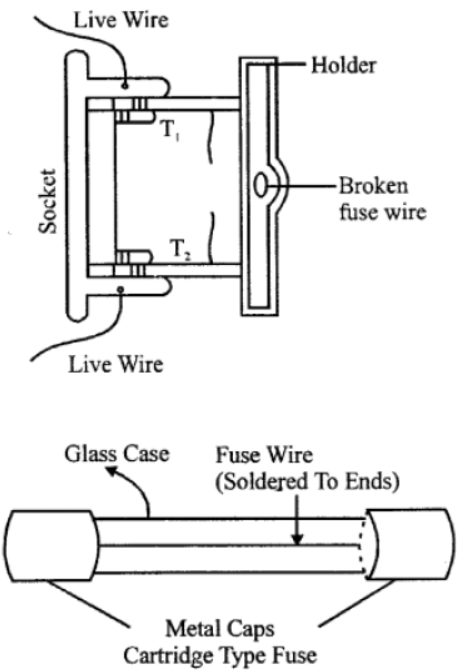
Exam Tip: When drawing electrical fuses, clearly label key features such as the live wire terminals, holder, glass case, and metallic contact caps.
Question 2. (a) Why is a fuse wire always placed in a live wire ?
Answer: Placing the fuse wire in the live conductor guarantees that if an overload or short-circuit occurs, the fuse will melt and immediately cut off the high voltage supply before it reaches the appliance. This ensures the device is completely isolated from the live potential, eliminating the threat of a fatal shock upon contact.
In simple words: The fuse is put in the live wire so that if it breaks, the dangerous high voltage is cut off immediately before it can travel into the appliance.
Exam Tip: Clearly state that interrupting the live wire isolates the appliance from high electric potential, ensuring user safety even if the appliance is touched.
Question 2. (b) How does fuse wire protect an electric circuit ?
Answer: When the current flowing through a circuit rises above the safe threshold, the excessive current generates substantial thermal energy (\( I^2 R \)) in the fuse wire. Due to its low melting threshold, the wire melts rapidly, creating a gap that halts the current flow, thereby saving the household wiring and connected devices from fire and ruin.
In simple words: High currents heat the fuse wire until it melts. This action cuts the wire in two, immediately stopping the dangerous electrical flow.
Exam Tip: Be sure to explain the step-by-step process: excessive current leads to heat, which melts the wire, breaking the circuit loop.
Question 2. (c) Two fuse wires of the same length are rated 15A and 5A. Which of the two is thicker and why ?
Answer: The 15A rated fuse wire must be significantly thicker than the 5A rated wire. Resistance is inversely proportional to the cross-sectional area of a conductor (\( R \propto \frac{1}{A} \)). A thicker wire has less resistance, which allows it to carry a larger electrical current (up to 15A) without overheating and melting under normal operating conditions.
In simple words: The 15A fuse wire is thicker because a thicker wire has less electrical resistance, allowing more current to flow safely without melting it.
Exam Tip: Use the formula \( R \propto \frac{1}{A} \) to substantiate why a higher current rating demands a thicker wire with reduced resistance.
Question 2. (d) Why is it dangerous to replace a fuse wire with a copper wire?
Answer: Replacing a fuse wire with copper is highly hazardous because copper possesses low electrical resistance and an exceptionally high melting temperature. Consequently, if a dangerous current overload occurs, the copper wire will not melt, allowing heavy current to persist and potentially causing a devastating electrical fire.
In simple words: Copper does not melt easily. If you use it as a fuse, it will let dangerous currents flow until your house wiring gets hot enough to start a fire.
Exam Tip: Contrast the high melting point of copper with the low melting point of lead-tin alloy to explain the safety hazard.
Question 3. (a) What do you understand by the term earthing ?
Answer: Earthing, also known as grounding, refers to the safety practice of connecting the metallic outer frame of an electrical appliance to the earth through a thick conductor. This maintains the metallic body at zero electric potential, mitigating shock hazards.
In simple words: Earthing means connecting the metal body of an appliance to the ground with a safety wire, keeping its voltage at a safe level of zero.
Exam Tip: Use terms like "zero potential" and "metal casing" to demonstrate a precise physics-based understanding of grounding.
Question 3. (b) How does earthing protect a user from receiving an electric shock?
Answer: Connecting the earth wire to the metal body of an appliance via a three-pin plug ensures the outer casing remains at zero volts. If a live wire touches the metal casing inside, the current flows directly into the ground rather than passing through a user who touches the appliance, preventing severe electric shocks.
In simple words: If a live wire touches the metal case, the electricity flows safely down the earth wire into the ground instead of shocking you.
Exam Tip: Explain that the earth wire offers a path of much lower resistance than the human body, directing current away from the user.
Question 3. (c) How is a household circuit earthed ?
Answer: At the local power station, the neutral and earth wires are connected together to maintain them at zero potential. Inside the house, the live and neutral wires connect to the kWh meter input terminal, while the earth terminal connects directly to the metal casing of the meter. This earth connection is then distributed as a common safety ground line to all three-pin sockets throughout the home.
In simple words: The safety earth wire from every socket is connected together and wired to a metal plate buried deep in the ground outside the house.
Exam Tip: Describe how the grounding line connects back to the main service board and is routed alongside the live and neutral circuits.
Question 3. (d) Explain how the fuse melts when a short circuit appliance gets earthed.
Answer: When an earthed appliance experiences a short circuit, the current flows directly from the live terminal to the metal body and straight into the earth. Because the earth path has near-zero electrical resistance, the overall resistance drops drastically, causing the current magnitude to spike. This immense surge overloads the fuse wire, heating it up instantly until it melts and breaks the circuit.
In simple words: A short circuit to the grounded metal body causes a massive surge of current to rush into the earth. This huge surge instantly melts the fuse, cutting off power.
Exam Tip: Highlight that the low resistance of the earth path causes a rapid increase in current, which triggers the fuse to melt quickly.
Question 4. (a) What is the function of a switch in an electric circuit?
Answer: The primary function of an electrical switch is to safely make or break an electric circuit, allowing a user to easily turn an electrical appliance on or off as needed.
In simple words: A switch is used to start or stop the flow of electricity to an appliance by closing or opening the circuit path.
Exam Tip: Define the switch's role as "connecting or disconnecting the appliance" in the electric circuit loop.
Question 4. (b) Why is switched placed in a live wire ?
Answer: If a switch were placed in the neutral wire instead of the live wire, the appliance would remain connected to the live potential even when turned off. Anyone touching the heating element or internal wiring would complete the circuit to the ground and receive a severe, potentially fatal electric shock. Placing the switch in the live wire ensures the device is safely de-energized when switched off.
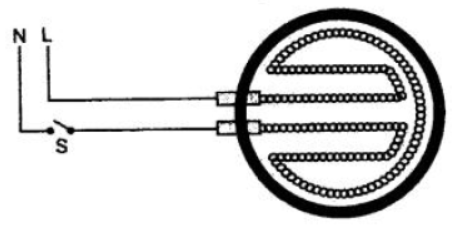
In simple words: Putting the switch in the live wire cuts off the high voltage supply before it reaches the appliance. If you put it in the neutral wire, high voltage stays inside the device even when it is turned off.
Exam Tip: Use a simple wiring sketch showing the open switch "S" in the live wire line to visually support your explanation.
Question 4. (c) what consequences will follow, if a switch is placed in the neutral wire ?
Answer: When the switch is connected to the neutral line, turning the switch off will open the circuit but will leave the entire appliance at the high potential of the live wire. If a person accidentally touches the internal parts of the appliance, current will flow through their body to the ground, causing a dangerous electric shock.
In simple words: If the switch is in the neutral wire, the device is still connected to live electricity even when turned off, making it dangerous to touch.
Exam Tip: Emphasize that the appliance remains at "live potential" even though it is not actively running.
Question 5. (a) Why is household wiring done in parallel ? Give at least two reasons ?
Answer: Household appliances are wired in parallel for the following key reasons:
1. Every connected appliance receives the same rated operating voltage (usually 220 V) as the main power line, allowing them to function at full capacity.
2. Each appliance operates on an independent circuit branch. If one device fails or is switched off, it does not interrupt the current to any other appliances, which continue to run normally.
In simple words: 1. Parallel wiring ensures every appliance gets the full 220V power. 2. It allows you to turn off one appliance without turning off everything else in the house.
Exam Tip: State both reasons clearly as separate, numbered points to help the examiner grade your response easily.
Question 5. (b) What are the disadvantages of wiring in series in a house?
Answer: The primary drawbacks of using a series circuit for household wiring are:
1. The total resistance of the circuit increases significantly with each added appliance, which drastically reduces the total operating current from the source.
2. Since there is only a single path for current, if any one appliance fails or is turned off, the entire circuit is broken, causing all other connected devices to immediately stop working.
In simple words: In a series circuit, if one bulb burns out, all the other lights in the house will go out too. Also, appliances will not get enough power to run properly.
Exam Tip: Mention the "single-path constraint" of series wiring, which is the underlying cause of both disadvantages.
Question 6. Draw a circuit diagram for distribution of power from pole to the main switch and label it
Answer:
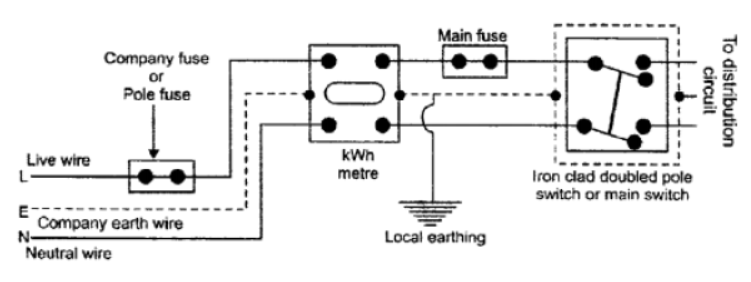
Exam Tip: Be sure to correctly sequence and label the Company Fuse, kWh Meter, Main Switch, and local earth connection in order from left to right.
Question 7. Name two systems of distribution of power in a house.Give the advantages and disadvantages of each system.
Answer: The two distinct household power distribution frameworks are:
(i) Tree System
Advantages:
1. All electrical appliances are connected in parallel, allowing them to be operated independently using individual switches.
2. The neutral and ground conductors are kept common across all individual circuits.
3. Branch circuits can be easily routed to different rooms directly from the main distribution panel.
Disadvantages:
1. Installation is relatively expensive and takes a long time to complete.
2. It requires different sizes of plugs and sockets to accommodate appliances based on their power ratings.
3. If a fuse melts in one major line branch, it shuts down all appliances connected along that entire circuit.
(ii) Ring System
Advantages:
1. Every individual appliance has its own fuse, meaning a fault can be addressed without interrupting any other devices in the circuit.
2. The total length of copper wiring required is significantly less, reducing costs.
3. It is easier to install, expand, and maintain over time.
In simple words: The Tree System runs separate branches to different rooms like the branches of a tree, which is expensive. The Ring System runs a continuous loop wire around the house, which uses less wire and lets every appliance have its own safety fuse.
Exam Tip: Structure your response clearly by presenting the advantages and disadvantages of both the Tree and Ring systems using bulleted lists.
Question 8. (a) State the colour of (i) live wire, (ii) neutral wire, (iii) earth wire according to international convention
Answer: As per modern international standard insulation color conventions, the wires are coded as follows:
(i) Live conductor: **Brown**
(ii) Neutral conductor: **Light Blue**
(iii) Earth safety conductor: **Green or Yellow**
In simple words: Under new international rules, the live wire is brown, the neutral wire is light blue, and the safety earth wire is green or yellow.
Exam Tip: Always specify the *new* international colors (Brown, Light Blue, Green/Yellow) rather than the old Indian convention (Red, Black, Green) unless asked otherwise.
Question 8. (b) State the position of (i) earth pin, (ii) live pin and (iii) neutral pin in an electric plug.
Answer: Looking at the front face of a standard three-pin plug:
(i) The earth terminal is positioned at the top center.
(ii) The live terminal (labeled L) is located on the bottom right side.
(iii) The neutral terminal (labeled N) is situated on the bottom left side.
In simple words: When looking at a plug, the top, thick pin is the earth. The bottom-right pin is live, and the bottom-left pin is neutral.
Exam Tip: Remember the "L on the Right, N on the Left" rule to easily recall plug pin layouts.
Question 8. (c) Why is the earth terminal of a plug made (i) thicker, (ii) longer
Answer: The design features of the safety earth pin serve critical purposes:
(i) **Thicker:** The earth pin is made physically thicker so that it is physically impossible to accidentally force it into the live or neutral holes of a socket, preventing high-voltage hazards.
(ii) **Longer:** The earth pin is made longer so that when you insert the plug, the earth pin makes contact with the ground circuit first before the live and neutral pins connect. Similarly, when removing the plug, the earth pin is the last to break contact, ensuring continuous ground safety.
In simple words: (i) The earth pin is thicker so it cannot fit into the wrong socket holes. (ii) It is longer so that the appliance is safely grounded first, before the live electricity is connected.
Exam Tip: Be sure to explicitly state that the longer pin ensures "first-to-connect, last-to-disconnect" grounding behavior for optimal user protection.
Multiple Choice Questions
Tick (✓) the most appropriate option.
Question 1. A fuse wire is connected in before the switch.
(a) neutral wire
(b) earth wire
(c) live wire
(d) either (a) or (c)
Answer: (c) live wire
In simple words: The fuse is always installed in the live wire before the switch so that it can cut off the high voltage immediately if an overload occurs.
Exam Tip: Always place safety devices like switches and fuses in the live wire to prevent the appliance from remaining at high potential when off.
Question 2. A switch in a circuit is always connected in the :
(a) live wire
(b) earth wire
(c) neutral wire
(d) either (a) or (b)
Answer: (a) live wire
In simple words: A switch is connected to the live wire to ensure that turning it off completely cuts off the supply of electricity to the appliance.
Exam Tip: Remember that placing a switch in the neutral wire is a severe safety hazard since high voltage would still reach the device.
Question 3. According to old convention, the colour of neutral wire is :
(a) red
(b) green
(c) black
(d) none of these
Answer: (c) black
In simple words: In older electrical systems, black insulation was used to denote the neutral wire.
Exam Tip: Be sure to distinguish between old conventions (Red-Live, Black-Neutral, Green-Earth) and new international standards.
Question 4. According to new convention, the colour of live wire is :
(a) light blue
(b) yellow
(c) green
(d) brown
Answer: (d) brown
In simple words: Under modern safety rules, brown is the color code designating the live wire.
Exam Tip: Modern color-coding standards use Brown for Live, Light Blue for Neutral, and Green/Yellow for Earth.
Question 5. Which is not the characteristic of a fuse wire ?
(a) It has high resistance
(b) It has low melting point
(c) It has low resistance
(d) It is an alloy of lead and tin
Answer: (c) It has low resistance
In simple words: A fuse wire must have a high resistance so that it heats up rapidly when too much current passes through it, allowing it to melt.
Exam Tip: A proper fuse wire must have a low melting point and a relatively high resistance to function effectively as a safety mechanism.
Question 6. In a three pin plug the live pin in :
(a) thinner and is toward left
(b) thicker and is towards left
(c) thinner and is towards right
(d) thicker and is towards right
Answer: (c) thinner and is towards right
In simple words: The live pin on a standard three-pin plug is thinner than the earth pin and is located on the right-hand side.
Exam Tip: The live pin is always situated on the right side of the plug when looking at its front face.
Question 7. In a household electric circuit all appliances are connected in :
(a) parallel circuit
(b) series circuit
(c) mixed circuit
(d) any of these
Answer: (a) parallel circuit
In simple words: Household circuits are always wired in parallel so that every appliance can get the same voltage and work independently.
Exam Tip: A parallel configuration is the standard choice for home wiring because it keeps devices working even if one is turned off.
Question 8. An average lighting circuit of a cpoor family has a fuse rating of
(a) 10 A
(b) 15 A
(c) 5 A
(d) 2 A
Answer: (c) 5 A
In simple words: Standard household lighting circuits that power low-wattage bulbs and fans normally use a 5 Ampere fuse.
Exam Tip: Heavy heating appliances utilize a 15 A fuse, whereas basic lighting circuits operate safely on a 5 A fuse rating.
Questions From ICSE Examination Papers
2001
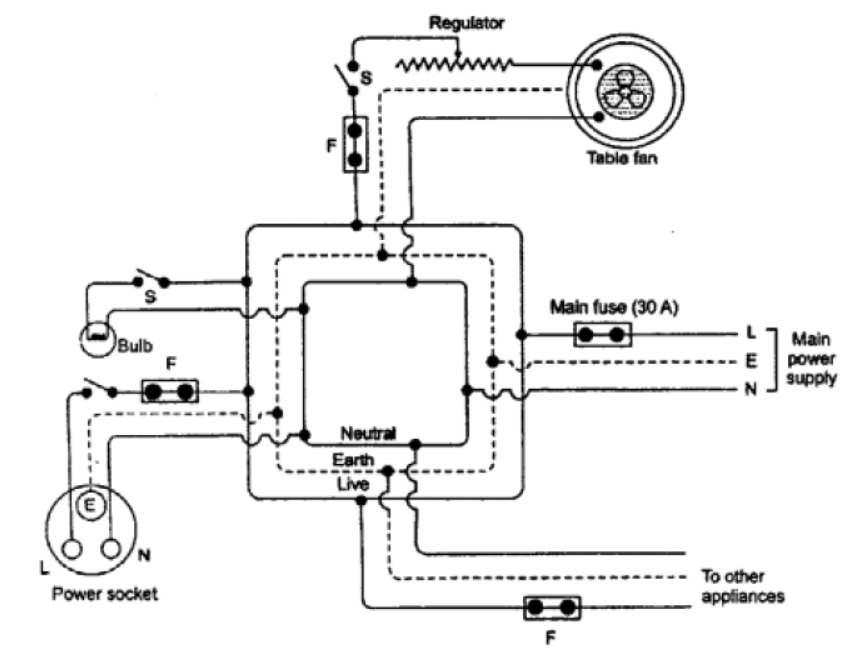
Question 1. (a) Draw a diagram of ring main circuit for domestic distribution of electric power.
(b) Name the physical quantity which is measured in
1. Kilowatt hour
2. Kilowatt
Answer:
(a) The ring main circuit diagram is shown below:
(b) The physical quantities corresponding to the units are:
1. Kilowatt-hour is used to measure **electrical energy consumption**.
2. Kilowatt is used to measure **electrical power**.
In simple words: (a) The ring main circuit is a loop system where power is distributed across parallel lines throughout a house. (b) A kilowatt-hour counts the total energy used, while a kilowatt measures the power rating of an appliance.
Exam Tip: Be sure to draw the earth connection as a dashed line and place fuses correctly in the live wire branches of the ring circuit.
Question 2. A bulb is marked 100 W - 220 V and an electric heater is marked 1000 W - 220 V Answer the following questions :
(a) What is the ratio of resistance of the filament of the bulb to the element of the heater ?
(b) How does power-voltage rating of an electric appliance help us to decide the type of connecting wires (leads) to be used for it ?
(c) In the above mentioned devices in 2(a) which of the two devices needs a thicker wire.
Answer: Given data: Bulb rating \( = 100\text{ W} - 220\text{ V} \), Heater rating \( = 1000\text{ W} - 220\text{ V} \)
(a) The resistance of an appliance is given by \( R = \frac{V^2}{P} \). Since both operate at the same voltage (220 V):
\( R_{\text{bulb}} = \frac{220^2}{100} \)
\( R_{\text{heater}} = \frac{220^2}{1000} \)
Taking the ratio:
\( \frac{R_{\text{bulb}}}{R_{\text{heater}}} = \frac{\frac{220^2}{100}}{\frac{220^2}{1000}} = \frac{1000}{100} = \frac{10}{1} \)
Thus, the resistance ratio is **10 : 1**.
(b) An appliance's current draw is calculated as \( I = \frac{P}{V} \). High-power appliances draw a higher current. Connecting wires must be selected with an appropriate thickness to carry this current safely without overheating (\( I^2 R \)), preventing damage to the insulation and the risk of electrical fire.
(c) The **heater** needs a thicker connecting wire because its higher power rating of 1000 W means it draws ten times more current than the bulb, requiring lower resistance wires to avoid excessive heating.
In simple words: (a) The bulb's filament resistance is 10 times higher than that of the heater. (b) The power rating tells us the current drawn, which helps us pick wires of the correct safety thickness. (c) The heater requires thicker wires to safely carry its high current without melting.
Exam Tip: For ratio problems, cancel out common terms (like \( V^2 \)) early to make the mathematical steps quick and error-free.
Question 3. (a) Calculate the daily household electric bill for a family which uses the following appliances for 8 hours a day, when electrical energy costs Rs. 2 per unit
1. one 100 W bulb
2. one 100 W fan
3. one 1000 W heater.
(b) How does earthing protect a user from electric shocks ?
Answer: Given data: Daily usage \( = 8\text{ hours} \), Rate per unit \( = \text{Rs. } 2 \)
(a) Energy consumed by each appliance in one day:
1. Bulb: \( E_{\text{bulb}} = \frac{100\text{ W} \times 8\text{ h}}{1000} = 0.8\text{ kWh} \)
2. Fan: \( E_{\text{fan}} = \frac{100\text{ W} \times 8\text{ h}}{1000} = 0.8\text{ kWh} \)
3. Heater: \( E_{\text{heater}} = \frac{1000\text{ W} \times 8\text{ h}}{1000} = 8\text{ kWh} \)
Total electrical energy consumed per day:
\( E_{\text{total}} = 0.8 + 0.8 + 8 = 9.6\text{ kWh} = 9.6\text{ units} \)
Daily cost calculation:
\( \text{Daily Bill} = 9.6\text{ units} \times \text{Rs. } 2 = \text{Rs. } 19.20 \)
(b) When the metallic frame of an appliance is earthed via a three-pin plug, it remains locked at zero potential. If a live wire accidentally contacts the metal frame, the current finds a low-resistance path through the earth wire and flows straight to the ground. This triggers the fuse to blow immediately, isolating the appliance and protecting any user from a severe electric shock.
In simple words: (a) The appliances consume 9.6 units of electricity daily, costing Rs. 19.20. (b) Earthing creates a safe highway for stray current to escape into the ground, blowing the fuse instead of shocking anyone who touches the device.
Exam Tip: Keep the daily calculations in decimal forms of kWh to avoid fractional arithmetic errors during addition.
2002
Question 4. A geyser has a label 2 kW, 240 V. What is the cost of using it for 30 minutes, if the cost of electricity is Rs. 3.00 per commercial unit ?
Answer: Given data: Power \( P = 2\text{ kW} \), Time \( t = 30\text{ minutes} = 0.5\text{ hour} \), Unit cost \( = \text{Rs. } 3.00 \)
The energy consumed by the geyser is:
\( E = P \cdot t = 2\text{ kW} \times 0.5\text{ h} = 1\text{ kWh} = 1\text{ unit} \)
Calculating the total cost:
\( \text{Cost} = 1\text{ unit} \times \text{Rs. } 3.00 = \text{Rs. } 3.00 \)
In simple words: Running the 2 kW geyser for half an hour uses exactly one unit of electricity, which costs Rs. 3.00.
Exam Tip: Remember that a commercial unit of electricity is precisely equal to 1 kilowatt-hour (kWh).
Question 5. Explain briefly the function of the following in the household wiring :
(a) a three-pin plug
(b) main switch.
Answer:
(a) **Three-pin plug:** It acts as a safety connector that links a portable appliance to the electrical socket. Its top pin grounds the appliance first, while the other two pins safely deliver the live and neutral currents.
(b) **Main switch:** It acts as the master electrical circuit breaker for the home, enabling users to completely turn off the electricity supply across both the live and neutral wires during maintenance or emergencies.
In simple words: (a) A three-pin plug connects your appliance to power while grounding it safely. (b) The main switch turns off all the electricity in your home with one single lever.
Exam Tip: Be sure to describe both the connection and safety aspects of the three-pin plug to earn maximum marks.
Question 6. Make a table with the names of 3 electrical appliances used in home in one column, their power, voltage rating and approximate time for which each one is used in one day in the other columns.
Answer: The required table listing household appliances is provided below:
| Appliance | Power | Voltage Rating | Approximate Daily Use Time |
|---|---|---|---|
| Geyser | 2000 W | 220 V | 1 hour |
| Electric Fan | 60 W | 220 V | 10 hours |
| Tubelight | 40 W | 220 V | 8 hours |
In simple words: This table lists common home appliances along with their standard power usage, operating voltages, and typical daily running times.
Exam Tip: Choose standard appliances with realistic wattage ratings (like 2000 W for a heater and 60 W for a fan) to present a technically sound table.
2003
Question 7. An electric kettle is rated 2.5 kW, 250 V. Find the cost of running the kettle for two hours at 60 paise per unit.
Answer: Given data: Power \( P = 2.5\text{ kW} \point \), Time \( t = 2\text{ hours} \), Rate \( = 60\text{ paise per unit} \)
The energy used by the kettle is:
\( E = P \cdot t = 2.5\text{ kW} \times 2\text{ h} = 5\text{ kWh} = 5\text{ units} \)
Calculating the total cost:
\( \text{Cost} = 5\text{ units} \times 60\text{ paise} = 300\text{ paise} = \text{Rs. } 3.00 \)
In simple words: The kettle consumes 5 units of energy over two hours, which costs 300 paise or Rs. 3.00 at the given rate.
Exam Tip: Convert your final cost from paise to Rupees so your answer is written in the standard monetary format.
Question 8. Two fuse wires of the same length are rated 5 A and 20 A. Which of the fuse wires is thicker and why ?
Answer: The **20 A** fuse wire must be thicker. Since resistance is inversely proportional to the area of cross-section (\( R \propto \frac{1}{\pi r^2} \)), a thicker wire possesses lower resistance and can safely carry a larger current of 20 Amperes without overheating and melting.
Using the standard proportional relation between current limit and radius:
\( I \propto r^{3/2} \)
Therefore, a higher current rating requires a larger wire radius, making the 20 A fuse wire thicker.
In simple words: The 20 A fuse wire is thicker because a thicker wire has less electrical resistance, allowing a much larger current to flow through it safely.
Exam Tip: Clearly state that resistance decreases as thickness increases, which is key to letting higher currents pass through safely.
Question 9. With reference to the given diagram, calculate
(a) Equivalent resistance between P and Q.
(b) The reading of the ammeter.
(c) The electrical power between P and Q.
Answer:
(a) Equivalent resistance \( R_p \) between terminals P and Q:
\( \frac{1}{R_p} = \frac{1}{4} + \frac{1}{6} \)
\( \frac{1}{R_p} = \frac{3 + 2}{12} = \frac{5}{12} \)
\( R_p = \frac{12}{5} = 2.4\ \Omega \)
(b) Ammeter reading:
If key K is open, the current is zero.
If key K is closed:
Total potential difference, \( V = 2 \text{ cells} \times 2\text{ V} = 4\text{ V} \)
\( I = \frac{V}{R_p} = \frac{4\text{ V}}{2.4\ \Omega} = \frac{40}{24} = 1.67\text{ A} \)
(c) Electrical power dissipated between P and Q:
\( P = I^2 \cdot R_p \)
\( P = \left(\frac{5}{3}\right)^2 \times 2.4 = \frac{25}{9} \times 2.4 = 6.67\text{ W} \)
In simple words: (a) The combined resistance between P and Q is 2.4 ohms. (b) With the switch closed, the ammeter reads 1.67 Amperes. (c) The power used across the parallel branch is 6.67 Watts.
Exam Tip: Be sure to write "zero" as the current reading if the question does not specify that the key is closed, or calculate for both states to be thorough.
Question 10. Electrical power P is given by the expression : P = (Q × V) / time.
(a) What do the symbols Q and V represent ?
(b) Express ‘Power’ in terms of current and resistance explaining the symbols used there in.
Answer:
(a) The symbols are defined as follows:
\( Q \) represents the **electric charge**.
\( V \) represents the **potential difference**.
(b) Deriving the power expression:
We know that power is:
\( P = \frac{Q \cdot V}{t} \)
Since current is the rate of flow of charge, \( I = \frac{Q}{t} \):
\( P = I \cdot V \)
According to Ohm's Law, \( V = I \cdot R \). Substituting this:
\( P = I \cdot (I \cdot R) = I^2 \cdot R \)
Here:
\( P = \text{electrical power} \)
\( I = \text{electric current} \)
\( R = \text{electrical resistance} \)
In simple words: (a) Q stands for charge and V stands for voltage. (b) Power can be rewritten as current squared multiplied by resistance (\( I^2 R \)).
Exam Tip: Clearly define each derived term (P, I, and R) at the end of your derivation to ensure full credit.
2004
Question 11. State the purpose of a fuse in an electric circuit. Name thematerial required for making a fuse wire.
Answer: The primary purposes of an electrical fuse are:
1. It functions as a safety valve, limiting the maximum current to a safe level.
2. It melts and disconnects the circuit when an overload or short circuit happens, protecting expensive household electronics and preventing potential house fires.
The material used to make fuse wire is an **alloy of lead and tin**.
In simple words: A fuse acts as a safety shield that melts and breaks the circuit during a power surge, protecting your appliances. It is made from a lead-tin alloy.
Exam Tip: When describing the purpose of a fuse, mention both current limitation and fire prevention as the key protective benefits.
Question 12. An electric bulb is rated 240V – 60 W and is working at 100% efficiency.
(a) Calculate the resistance of the bulb.
(b) If an identical bulb is connected in series with this bulb then:
1. Draw the circuit diagram.
2. What is the rate of conversion of energy in each bulb ?
3. Total power used by the bulbs.
Answer: Given data: Rated Voltage \( V = 240\text{ V} \), Rated Power \( P = 60\text{ W} \)
(a) The resistance of the bulb filament is:
\( R = \frac{V^2}{P} = \frac{240 \times 240}{60} = 960\ \Omega \)
(b) 1. The series circuit diagram is shown below:
2. Rate of energy conversion (power) in each bulb when connected in series:
The total resistance of two identical bulbs in series is:
\( R_{\text{total}} = R_1 + R_2 = 960 + 960 = 1920\ \Omega \)
The current in the circuit is:
\( I = \frac{V}{R_{\text{total}}} = \frac{240\text{ V}}{1920\ \Omega} = 0.125\text{ A} \)
Power conversion rate of each bulb:
\( P_{\text{each}} = I^2 \cdot R = (0.125)^2 \times 960 = 15\text{ W} = 15\text{ J s}^{-1} \)
3. Total power consumed by both bulbs:
\( P_{\text{total}} = \frac{V^2}{R_{\text{total}}} = \frac{240 \times 240}{1920} = 30\text{ W} \)
In simple words: (a) The resistance of each bulb is 960 ohms. (b) 1. The diagram shows the two bulbs connected in series. 2. When in series, the rate of energy conversion in each bulb drops to 15 Joules per second. 3. The total power used by both bulbs is 30 Watts.
Exam Tip: Remember that connecting identical appliances in series splits the available voltage equally, lowering their operational power.
2005
Question 13. (a) In a three-pin plug, why is the earth pin made longer and thicker than the other two pins ?
Answer: The earth pin is designed with these unique features for safety reasons:
1. **Longer:** The added length ensures the earth pin establishes connection with the ground circuit first before the live and neutral lines receive power. When unplugging, it is the last to disconnect, maintaining grounding protection throughout.
2. **Thicker:** Its larger diameter prevents it from being mistakenly pushed into the live or neutral holes of a socket, and provides a low-resistance path so any stray leakages flow safely to the ground.
In simple words: The earth pin is longer so it grounds the appliance first, and thicker so you cannot plug it into the wrong, dangerous socket holes.
Exam Tip: Be sure to write down both distinct safety benefits: "first-to-connect" (for length) and "wrong-insertion prevention" (for thickness).
Question 13. (b) An electrical appliance is rated 1500 W – 250 V. This appliance is connected to 250 V mains. Calculate :
1. the current drawn,
2. the electrical energy consumed in 60 hours,
3. the cost of electrical energy coi sumed at Rs. 2.50 per KWH.
Answer: Given data: Power \( P = 1500\text{ W} = 1.5\text{ kW} \), Voltage \( V = 250\text{ V} \), Operating time \( t = 60\text{ hours} \)
1. Current drawn:
\( I = \frac{P}{V} = \frac{1500\text{ W}}{250\text{ V}} = 6\text{ A} \)
2. Electrical energy consumed:
\( E = P \cdot t = 1.5\text{ kW} \times 60\text{ h} = 90\text{ kWh} \)
3. Cost of energy consumed:
\( \text{Cost} = 90\text{ kWh} \times \text{Rs. } 2.50 = \text{Rs. } 225 \)
In simple words: 1. The appliance draws a current of 6 Amperes. 2. It consumes 90 units of electricity over 60 hours. 3. At Rs. 2.50 per unit, the total operating cost is Rs. 225.
Exam Tip: Keep power in kilowatts (kW) when multiplying by hours to find energy directly in kWh, simplifying the cost calculation.
2006
Question 14. Draw a labelled diagram of a three-pin socket.
Answer: The labelled diagrams of a three-pin socket and its corresponding three-pin plug are shown below:
In simple words: The diagram illustrates the layout of a standard domestic three-pin socket on the left, with the corresponding pin connections of a matching plug on the right.
Exam Tip: Always place Earth at the top center, Neutral on the left, and Live on the right when sketching a socket from the front view.
Question 15. Find the cost of operating an electric toaster for 2 hours, if it draws a current of 8A on a 110 V circuit. The cost of electrical energy is Rs. 2.50 per kWh.
Answer: Given data:
Time duration, \( t = 2\text{ hours} \)
Current drawn, \( I = 8\text{ A} \point \)
Voltage rating, \( V = 110\text{ V} \)
Rate per kWh \( = \text{Rs. } 2.50 \)
First, find the power consumption of the toaster:
\( P = V \cdot I = 110\text{ V} \times 8\text{ A} = 880\text{ W} \)
Convert the power to kilowatts (kW):
\( P = \frac{880}{1000} = 0.88\text{ kW} \)
Calculate the electrical energy consumed over 2 hours:
\( E = P \cdot t = 0.88\text{ kW} \times 2\text{ h} = 1.76\text{ kWh} \)
Compute the operating cost:
\( \text{Cost} = 1.76\text{ kWh} \times \text{Rs. } 2.50 = \text{Rs. } 4.40 \)
In simple words: The toaster uses 880 Watts of power, consuming 1.76 units of electricity in 2 hours. At the rate of Rs. 2.50 per unit, it costs Rs. 4.40 to operate.
Exam Tip: Always double check that you convert the wattage into kilowatts before multiplying by time to avoid calculating cost directly from Watts.
2007
Question 16. Of the three connecting wires in a household circuit :
(a) Which two of the three wires are at the same potential ?
(b) In which of the three wires should the switch be connected ?
Answer:
(a) Out of the three wires, the earth wire and the neutral wire are maintained at the same electrical potential of zero volts.
(b) The switch must always be connected into the live wire branch.
In simple words: (a) The neutral and earth wires both have zero potential. (b) The switch must be installed in the live wire to keep things safe.
Exam Tip: Be clear that earth and neutral are at zero potential, whereas the live wire is at high voltage (usually 220 V).
Question 17. What is meant by earthing of an electrical appliance ? Why is it essential ?
Answer: Earthing means connecting the outer metallic body of an appliance to a thick copper conductor that is buried deep in the ground, terminating at a copper plate surrounded by charcoal and common salt. This safety practice is essential because if a live wire inside accidentally contacts the metal body, the current flows safely into the ground rather than passing through a user, preventing a dangerous electrical shock.
In simple words: Earthing is connecting the metal frame of a device to the ground using a wire. It prevents you from getting a shock if a loose live wire touches the metal casing.
Exam Tip: Mention the path of "low resistance" provided by the ground connection to explain why current bypasses the human body.
2008
Question 18. (a) Draw a labelled diagram of the staircase wiring for a dual control switch showing a bulb in the circuit.
Answer: The circuit diagram for a dual control switch (staircase wiring) is shown below:
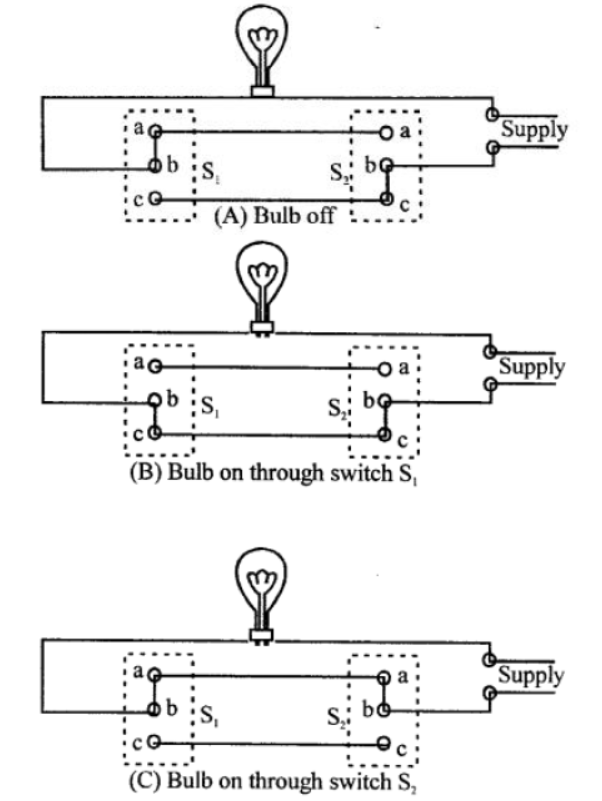
In simple words: This diagram shows two 2-way switches connected in a staircase loop. Flipping either switch will change the connection, turning the bulb on or off from either location.
Exam Tip: Be sure to label terminal points a, b, and c on both switches to demonstrate how the dual-control toggle system operates.
Question 18. (b) The electrical gadgets used in a house such as bulbs, fans, heater, etc., are always connected in parallel, NOT in series. Give two reasons for connecting them in parallel.
Answer: Household appliances are always wired in a parallel arrangement because:
1. Each appliance receives the identical, rated potential difference from the power mains, enabling them to operate at peak design performance.
2. Appliances can be turned on or off independently using their respective switches, meaning the failure or shutdown of one branch does not affect the rest of the circuit.
In simple words: Parallel wiring ensures every appliance gets full voltage to run properly, and turning off one device does not turn off everything else.
Exam Tip: Present these key benefits as distinct, numbered statements to ensure examiners can easily spot the main points.
Question 18. (c) An electrical heater is rated 4 kW, 220 V. Find the cost of using this heater for 12 hours if one kWh of electrical energy costs Rs. 3.25.
Answer: Given data:
Power rating of heater, \( P = 4\text{ kW} \)
Time duration, \( t = 12\text{ hours} \)
Rate per kWh \( = \text{Rs. } 3.25 \)
Calculate the electrical energy consumed:
\( E = P \cdot t = 4\text{ kW} \times 12\text{ h} = 48\text{ kWh} \)
Compute the total operating cost:
\( \text{Total Cost} = 48\text{ units} \times \text{Rs. } 3.25 = \text{Rs. } 156 \)
In simple words: The heater consumes 48 units of electricity over 12 hours, which costs Rs. 156 at the given rate.
Exam Tip: Since power is already given in kW, you can simply multiply it by the hours directly to find the energy units.
Question 19. How does the heat produced in a wire or a conductor depend upon the :
(a) current passing through the conductor.
(b) resistance of the conductor ?
Answer: According to Joule's Law of heating (\( H = I^2 \cdot R \cdot t \)), the generated thermal energy depends on the factors as follows:
(a) It is directly proportional to the square of the electrical current flowing through the wire (\( H \propto I^2 \)).
(b) It is directly proportional to the electrical resistance of the wire (\( H \propto R \)).
In simple words: (a) Double the current increases the heat by four times. (b) Heat increases proportionally with the electrical resistance of the wire.
Exam Tip: Always state the proportional relationship explicitly and support your explanation with the formula \( H = I^2 R t \).
2009
Question 20. (a) An electric heater is rated 1000 W - 200 V. Calculate :
1. the resistance of the heating element.
2. the current flowing through it.
(b) (i) Give two characteristic properties of copper wire which make it unsuitable for use as fuse wire.
(ii) Name the material which is used as a fuse wire ?
Answer: Given data: Power \( P = 1000\text{ W} \point \), Voltage \( V = 200\text{ V} \)
(a) 1. The resistance of the heater is calculated as:
\( R = \frac{V^2}{P} = \frac{200 \times 200}{1000} = 40\ \Omega \)
2. The current flowing through the element is:
\( I = \frac{V}{R} = \frac{200\text{ V}}{40\ \Omega} = 5\text{ A} \)
(b) (i) Copper wire is inappropriate for a fuse wire because:
a. It has a high melting point, so it does not melt during a current overload.
b. It has low specific resistance, preventing sufficient heat generation to break the circuit in time.
(ii) An alloy of lead and tin is used to make fuse wires.
In simple words: (a) 1. The heating element has 40 ohms of resistance. 2. The current is 5 Amperes. (b) (i) Copper is bad for fuses because it doesn't melt easily and has low resistance. (ii) A lead-tin alloy is used instead.
Exam Tip: Use the basic Ohm's Law relation \( I = \frac{V}{R} \) or the power equation \( I = \frac{P}{V} \) to quickly cross-check your current calculations.
Question 21. (a) The diagrams (i) and (ii) given alongside are of a plug and a socket with arrows marked a as 1, 2,3 and 4, 5, 6 respectively on them. Identify and write Live (L), Neutral (N) and Earth (E) against the correct number.
(b) Calculate the electrical energy consumed when a bulb of 40 W is used for 12.5 hours everyday for 30 days.
Answer:
(a) Identifying the pins and socket holes based on the standard configuration:
**For the Plug:**
1. Pin 1 (top, thick pin) corresponds to the **Earth (E)** line.
2. Pin 2 (left pin) corresponds to the **Neutral (N)** line.
3. Pin 3 (right pin) corresponds to the **Live (L)** line.
**For the Socket:**
4. Hole 4 (top, wide hole) corresponds to the **Earth (E)** line.
5. Hole 5 (left hole) corresponds to the **Neutral (N)** line.
6. Hole 6 (right hole) corresponds to the **Live (L)** line.
(b) Given data: Power \( P = 40\text{ W} = 0.04\text{ kW} \), Daily run time \( = 12.5\text{ hours} \), Days \( = 30 \)
Calculate the total operating hours:
\( t = 12.5\text{ hours/day} \times 30\text{ days} = 375\text{ hours} \)
Energy consumed calculation:
\( E = P \cdot t = 0.04\text{ kW} \times 375\text{ h} = 15\text{ kWh} \)
In simple words: (a) Pins 1 and 4 connect to Earth, 2 and 5 to Neutral, and 3 and 6 to Live. (b) The bulb uses exactly 15 units (kWh) of electricity over the 30-day period.
Exam Tip: For socket wiring, remember that when looking from the front, Neutral is always wired on the left and Live is always on the right.
2010
Question 22. (a) Which part of an electrical appliance is earthed ?
(b) State a relation between electrical power, resistance and potential difference in an electrical circuit.
Answer:
(a) The outer metallic housing or frame of an electrical appliance is earthed.
(b) The mathematical relation between power (\( P \)), potential difference (\( V \)), and resistance (\( R \)) is:
\( P = \frac{V^2}{R} \)
In simple words: (a) The metal frame of a device is earthed. (b) Power equals the voltage squared divided by the resistance.
Exam Tip: Be sure to write the full equation \( P = \frac{V^2}{R} \) and briefly state what each symbol represents.
Question 23. (a) In what unit does the domestic electric meter measure the electrical energy consumed? State the value of this unit in S.I. Unit.
(b) Why should switches always be connected to the live wire?
(c) Give one precaution that should be taken while handling switches.
Answer:
(a) The domestic meter registers electrical energy in **kilowatt-hour (kWh)**. Its SI value is:
\( 1\text{ kWh} = 3.6 \times 10^6\text{ J} \)
(b) Connecting the switch to the live wire ensures that turning it off cuts off the high mains potential from reaching the appliance. This keeps the appliance frame safe to touch during maintenance.
(c) Never operate or handle switches with wet hands, as water drastically lowers skin resistance, creating a shock hazard.
In simple words: (a) Energy is measured in kilowatt-hours, equal to 3.6 million Joules. (b) The switch must be in the live wire to completely cut off the high voltage when turned off. (c) Keep your hands dry when operating switches.
Exam Tip: Mention the term "zero potential" when explaining the safety benefit of placing a switch in the live wire.
Question 24. Calculate the quantity of heat that will be produced in a coil of resistance 75 Ω if a current of 2 A is passed through it for 2 minutes.
Answer: Given data:
Resistance, \( R = 75\ \Omega \)
Current, \( I = 2\text{ A} \)
Time duration, \( t = 2\text{ minutes} = 2 \times 60 = 120\text{ s} \)
The thermal energy produced is:
\( H = I^2 \cdot R \cdot t \)
\( H = 2^2 \times 75 \times 120 \)
\( H = 4 \times 75 \times 120 \)
\( H = 300 \times 120 = 36000\text{ J} \)
In simple words: The coil generates 36,000 Joules of heat energy in 2 minutes.
Exam Tip: Convert time into seconds before multiplying to get your final thermal energy answer in Joules.
2011
Question 25. (a) Two bulbs are marked 100 W, 220 V and 60 W, 110 V. Calculate the ratio of their resistances.
(b) (i) What is the colour code for insulation of earth wire?
(ii) Write an expression for calculating electric power in terms of current and resistance.
(c) (i) Name two safety devices which are connected to the live wire of a household electrical circuit.
(ii) Give one important function of each of these devices.
(d) (i) An electric bulb is marked 100 W, 250 V. What information does this convey ?
(ii) How much current will the bulb draw if connected to 250 V supply ?
Answer:
(a) Calculating the resistance of each bulb:
For the first bulb (\( 100\text{ W} - 220\text{ V} \)):
\( R_1 = \frac{V_1^2}{P_1} = \frac{220 \times 220}{100} = 484\ \Omega \)
For the second bulb (\( 60\text{ W} - 110\text{ V} \)):
\( R_2 = \frac{V_2^2}{P_2} = \frac{110 \times 110}{60} = \frac{12100}{60} \approx 201.67\ \Omega \)
Taking the ratio of their resistances:
\( \frac{R_1}{R_2} = \frac{484}{\frac{1210}{6}} = \frac{484 \times 6}{1210} = \frac{2904}{1210} = 2.4 : 1 \)
(b) (i) Under international standards, the color code for earth wire insulation is **Yellow (or Green-Yellow)**.
(ii) Electric power expressed in current and resistance:
\( P = I^2 \cdot R \)
(c) (i) Two common safety systems connected in the live line are the **Fuse** and the **Switch**.
(ii) **Fuse:** It limits the current flow, melting to break the circuit if the load gets too high.
**Earth wire:** It redirects ground leakages directly to the earth, preventing user shocks.
(d) (i) This label indicates that the bulb consumes 100 Joules of energy per second when operated on a 250 V supply.
(ii) Calculating the current drawn:
\( I = \frac{P}{V} = \frac{100\text{ W}}{250\text{ V}} = 0.4\text{ A} \)
In simple words: (a) The resistance ratio of the two bulbs is 2.4 : 1. (b) (i) The earth wire is green or yellow. (ii) Power equals current squared times resistance. (c) Fuses break the circuit under overload, while grounding prevents shocks. (d) The bulb uses 100 Watts at 250 Volts, drawing a current of 0.4 Amperes.
Exam Tip: For rating explanation questions under part (d), always define what "100 W" means in terms of energy per second (Joules per second).
2012
Question 26. (a) An electrical appliance is rated at 1000 kVA, 220V. If the appliance is operated for 2 hours, calculate the energy consumed by the appliance in :
(i) kWh (ii) joule
(b) (i) What is the purpose of using a fuse in an electrical circuit?
(ii) What are the characteristic properties of a fuse wire ?
(c) (i) Write an expression for the electrical energy spent in the flow of current through an electrical appliance in terms of I, R and t.
(ii) At what voltage is the alternating current supplied to our houses ?
(iii) How should the electric lamps in a building be connected?
Answer: Given data: Power rating \( = 1000\text{ kVA} \approx 1000\text{ kW} \), Voltage \( = 220\text{ V} \), Time \( t = 2\text{ hours} \)
(a) (i) Energy in kWh:
\( E = 1000\text{ kW} \times 2\text{ h} = 2000\text{ kWh} \)
(ii) Energy in Joules:
\( E = 2000 \times 3.6 \times 10^6\text{ J} = 7.2 \times 10^9\text{ J} \)
(b) (i) The fuse acts as a sacrificial barrier, melting to break the circuit in the event of a dangerous short circuit or current overload.
(ii) Fuse wire must possess: 1. A low melting temperature, and 2. High electrical resistance.
(c) (i) The electrical energy spent is given by:
\( E = I^2 \cdot R \cdot t \)
(ii) Domestic AC power is standardly supplied at **220 V**.
(iii) Lamps inside buildings are always connected in **parallel**.
In simple words: (a) The device consumes 2000 units of energy, which equals 7.2 billion Joules. (b) A fuse wire melts to stop high currents and must have a low melting point. (c) Energy is \( I^2 R t \), main power is 220 V, and household lights must be wired in parallel.
Exam Tip: Be sure to write the final energy in Joules using standard scientific scientific notation (\( 7.2 \times 10^9\text{ J} \)) for neatness.
2013
Question 27. (a) (i) Name the device used to protect the electric circuits from overloading and short circuits.
(ii) On what effect of electricity does the above device work?
(b)(i) An electrical gadget can give an electric shock to its user under certain circumstances. Mention any two of these circumstances.
(ii) What preventive measure provided in a gadget can protect a person from an electric shock ?
Answer:
(a) (i) The protective device is the **electric fuse**.
(ii) It operates based on the **heating effect of electric current**.
(b) (i) A shock can happen if: 1. The insulation fails, allowing the live wire to make direct contact with the outer metal body. 2. The user has wet hands, creating a low-resistance path to the ground upon contact.
(ii) Grounding the metallic casing with an earth wire provides an escape path, safely blowing the fuse instead of shocking the user.
In simple words: (a) A fuse protects circuits by melting when it gets hot from too much current. (b) Shocks can happen due to damaged wires or wet hands, but earthing protects you by sending stray currents into the ground.
Exam Tip: Always state "heating effect of electric current" explicitly when describing how a fuse or circuit breaker operates.
2014
Question 28. (i) Two sets A and B, of the three bulbs each, are glowing in two separate rooms. When one of the bulbs in set A is fused, the other two bulbs, cease to glow. But in set B, when one bulb fuses, the other two bulbs continue to glow. Explain why this phenomenon occurs.
(ii) Why do we prefer arrangement of Set B for house hold circuiting?
Answer:
(i) The bulbs in set A are connected in **series**. This creates a single continuous path, so if one bulb fails, the loop opens and cuts current to all other bulbs. In contrast, set B is wired in **parallel**, meaning each bulb has its own independent branch, so a failure in one does not affect the others.
(ii) The parallel layout of Set B is preferred for homes because it ensures that turning off one appliance does not shut down other devices, and guarantees that every appliance receives the full supply voltage.
In simple words: (i) Set A is in series, so one broken bulb turns off all of them. Set B is in parallel, so they work independently. (ii) Parallel wiring is better for homes so you can switch lights on and off separately.
Exam Tip: Clearly link the "cease to glow" behavior to the series layout, and the "continue to glow" behavior to the parallel layout.
2015
Question 29. (a) Fill in the blanks space.
For a fuse, higher the current rating _____ is the fuse wire.
(b) (i) Name the device used to increase the voltage at a generating station.
(ii) At what frequency is AC supplied to residential houses?
(iii) Name the wire in a household electrical circuit to which the switch is connected.
Answer:
(a) For a fuse, higher the current rating, **thicker** is the fuse wire.
(b) (i) The device used to step up the voltage is a **step-up transformer**.
(ii) Domestic AC is supplied at a standard frequency of **50 Hz**.
(iii) The switch is connected directly in the **live (or phase) wire** line.
In simple words: (a) A higher current rating means the fuse wire must be thicker. (b) (i) A step-up transformer increases voltage, (ii) power is supplied at 50 Hz, and (iii) the switch goes in the live wire.
Exam Tip: Be sure to write "thicker" as the correct term for higher current capacity fuse wire.
2016
Question 30. (a) Calculate the quantity of heat produced in a 20 Ω resistor carrying 2.5 A current in 5 minutes.
(b) State the characteristics required in a material to be used as an effective fuse wire.
(c) (i) Which particles are responsible for current in conductors?
(ii) To which wire of a cable in power circuit should the metal case of a geyser be connected ?
(iii) To which wire should the fuse be connected ?
Answer: Given data: Resistance \( R = 20\ \Omega \point \), Current \( I = 2.5\text{ A} \), Time \( t = 5\text{ minutes} = 300\text{ s} \)
(a) Calculating the generated thermal energy:
\( H = I^2 \cdot R \cdot t \)
\( H = (2.5)^2 \times 20 \times 300 \)
\( H = 6.25 \times 6000 = 37500\text{ J} \)
(b) An effective fuse wire material must have:
1. High specific resistance (resistivity).
2. A low melting point temperature.
(c) (i) **Free electrons** are the charge carriers responsible for current in conductors.
(ii) The metallic body of a geyser must be connected to the **earth wire**.
(iii) The fuse must be connected directly into the **live wire**.
In simple words: (a) The resistor produces 37,500 Joules of heat. (b) Fuse wire needs high resistivity and a low melting point. (c) Electrons carry current, the geyser frame connects to earth, and the fuse connects to the live wire.
Exam Tip: For part (a), show the step-by-step conversion of time into seconds to receive full credit on numerical marking schemes.
Free study material for Physics
ICSE Goyal Brothers Solutions Class 10 Physics Chapter 9 Electric Energy Power Household Circuits
Students can now access the detailed Goyal Brothers Solutions for Chapter 9 Electric Energy Power Household Circuits on our portal. These solutions have been carefully prepared as per latest ICSE Class 10 syllabus. Each solution given above has been updated based on the current year pattern to ensure Class 10 students have the most updated Physics content.
Master Goyal Brothers Textbook Questions
Our subject experts have provided detailed explanations for all the questions found in the Goyal Brothers textbook for Class 10 Physics. We have focussed on making the concepts easy for you in Chapter 9 Electric Energy Power Household Circuits so that students can understand the concepts behind every answer. For all numerical problems and theoretical concepts these solutions will help in strengthening your analytical skill required for the ICSE examinations.
Complete Physics Exam Preparation
By using these Goyal Brothers Class 10 solutions, you can enhance your learning and identify areas that need more attention. We recommend solving the Physics Questions from the textbook first and then use our teacher-verified answers. For a proper revision of Chapter 9 Electric Energy Power Household Circuits, students should also also check our Revision Notes and Sample Papers available on studiestoday.com.
FAQs
You can download the verified Goyal Brothers solutions for Chapter 9 Electric Energy Power Household Circuits on StudiesToday.com. Our teachers have prepared answers for Class 10 Physics as per 2026-27 ICSE academic session.
Yes, our solutions for Chapter 9 Electric Energy Power Household Circuits are designed as per new 2026 ICSE standards. 40% competency-based questions required for Class 10, are included to help students understand application-based logic behind every Physics answer.
Yes, every exercise in Chapter 9 Electric Energy Power Household Circuits from the Goyal Brothers textbook has been solved step-by-step. Class 10 students will learn Physics conceots before their ICSE exams.
Yes, follow structured format of these Goyal Brothers solutions for Chapter 9 Electric Energy Power Household Circuits to get full 20% internal assessment marks and use Class 10 Physics projects and viva preparation as per ICSE 2026 guidelines.