

ICSE Solutions Voyage Class 9 Geography Chapter 3 Rotation And Revolution have been provided below and is also available in Pdf for free download. The Voyage ICSE solutions for Class 9 Geography have been prepared as per the latest syllabus and ICSE books and examination pattern suggested in Class 9. Questions given in ICSE Voyage book for Class 9 Geography are an important part of exams for Class 9 Geography and if answered properly can help you to get higher marks. Refer to more Chapter-wise answers for ICSE Class 9 Geography and also download more latest study material for all subjects. Chapter 3 Rotation And Revolution is an important topic in Class 9, please refer to answers provided below to help you score better in exams
Voyage Chapter 3 Rotation And Revolution Class 9 Geography ICSE Solutions
Class 9 Geography students should refer to the following ICSE questions with answers for Chapter 3 Rotation And Revolution in Class 9. These ICSE Solutions with answers for Class 9 Geography will come in exams and help you to score good marks
Chapter 3 Rotation And Revolution Voyage ICSE Solutions Class 9 Geography
I. Short Answer Questions
Question 1. What is meant by the earth’s axis ?
Answer: The Earth spins around an unseen line called its axis. This line connects the North Pole to the South Pole.
In simple words: The axis is an imaginary line that goes through the center of the Earth from top to bottom, which the Earth spins around.
Exam Tip: Remember that the axis is imaginary - it is not a real line you can touch.
Question 2. Name the two chief motions of the earth.
Answer: The two main ways the Earth moves are rotation and revolution.
In simple words: The Earth moves in two ways: it spins around like a top, and it travels in a big circle around the Sun.
Exam Tip: Be clear on the difference between the two motions - spinning is rotation, while traveling around the sun is revolution.
Question 3. Describe two characteristics of rotation.
Answer: One key feature of rotation is that the Earth turns from west to east, taking 24 hours to finish one full spin. Another feature is that the Earth spins on a tilted axis that always points toward the North Star.
In simple words: The Earth spins from west to east once every day, and its tilt always points in the exact same direction in space.
Exam Tip: Don't forget to mention that the Earth rotates from west to east - this is why the sun appears to rise in the east.
Question 4. Mention two effects of the rotation of the earth.
Answer: First, the spinning of the Earth causes day and night. Second, this turning motion creates an outward force that makes the Earth wider at its equator and flatter at its north and south poles.
In simple words: Because the Earth spins, we get daylight and darkness. The spinning also squashes the Earth slightly, making the middle bulge out.
Exam Tip: Always use the term 'centrifugal force' when explaining why the Earth is bulging at the equator and flat at the poles.
Question 5. Mention any two possible consequences if the axis of the earth was vertical instead of inclined.
Answer: 1. Every single place on Earth would have equal periods of daylight and darkness, meaning exactly 12 hours of day and 12 hours of night.
2. The planet would not experience different seasons throughout the year.
In simple words: If the Earth did not tilt, every day would be half light and half dark, and the weather would stay the same all year long.
Exam Tip: If asked about a vertical axis, write down 'no seasons' and 'equal days and nights of 12 hours' as your two main points.
Question 6. State one reason why we do not feel the motions of the earth.
Answer: The pull of gravity holds all objects and the atmosphere firmly onto the Earth. Because of this, everything moves along with the planet at the same steady speed, and nothing changes its position unless acted upon by an outside force.
In simple words: Gravity holds us and everything around us tight to the Earth, so we all move together at the exact same speed without feeling it.
Exam Tip: Explain that because gravity binds us and the atmosphere to the Earth, we are moving with it, which is why we don't feel the motion.
Question 7. Define ‘revolution’.
Answer: Revolution refers to the journey of the Earth as it travels along its path around the Sun, which takes about 365 days and 6 hours.
In simple words: Revolution is the Earth's long trip all the way around the Sun once a year.
Exam Tip: Always include the exact time - 365 days and 6 hours (or 365 and a quarter days) - when defining revolution.
Question 8. State two chief characteristics of the revolution of the earth.
Answer: First, the Earth travels through space at a mean speed of about 100,000 kilometers per hour. Second, it moves along an oval-shaped path where its distance from the Sun changes, reaching its closest point of 147.3 million kilometers in January and its farthest point of 152 million kilometers in July.
In simple words: The Earth moves around the Sun at a super fast speed of 100,000 kilometers per hour in an oval path, being closest to the Sun in January and furthest in July.
Exam Tip: Mention the terms 'elliptical orbit', 'perihelion' (closest), and 'aphelion' (farthest) along with their respective months to score full marks.
Question 9. Mention two effects of revolution.
Answer: The two primary results of this motion are the cycle of seasons over the year and the formation of different temperature or heat zones on the planet.
In simple words: Because the Earth moves around the Sun, we have different seasons and different hot and cold regions across the world.
Exam Tip: The two key points to memorize are the change of seasons and the creation of heat zones.
Question 10. What is meant by Summer Solstice ? When do we have Summer Solstice in the Northern Hemisphere ?
Answer: The Summer Solstice happens on June 21 in the top half of the world. At this time, the Sun shines directly over the Tropic of Cancer, and the North Pole leans toward the Sun, bringing summer to the Northern Hemisphere.
In simple words: On June 21, the top half of the Earth leans closest to the Sun, making the sun shine straight down on the Tropic of Cancer and bringing the longest day of summer.
Exam Tip: Always link the Summer Solstice to June 21, the Tropic of Cancer, and the tilt of the North Pole toward the Sun.
Question 11. What is meant by Equinox ? Give the dates of the two Equinoxes.
Answer: An equinox is a time when every place on Earth gets an equal amount of day and night. This happens on two specific dates: March 21 (known as the Spring or Vernal Equinox) and September 23 (known as the Autumn Equinox).
In simple words: An equinox is when day and night are exactly the same length everywhere on Earth, happening on March 21 and September 23.
Exam Tip: Remember the exact dates: March 21 is for Spring/Vernal, and September 23 is for Autumnal.
Question 12. What will be the duration of daylight in the Northern Hemisphere on March 21st at 23°30′ latitude ?
Answer: The period of daytime will last for exactly 12 hours.
In simple words: On March 21, which is an equinox, the sun will shine for exactly 12 hours.
Exam Tip: During an equinox, day and night are 12 hours each at all latitudes, so you do not need to do any complex math based on the degrees.
Question 13. What is the relationship of seasons between the Northern and Southern Hemispheres ?
Answer: The seasons in the two halves of the Earth are completely opposite to each other. When the top half has summer, the bottom half is in winter, and when the top half has spring, the bottom half experiences autumn.
In simple words: The two halves of the Earth always have opposite seasons. When it is summer in the north, it is winter in the south.
Exam Tip: Use the word 'opposite' or 'reciprocal' to describe this relationship, and give an example like summer and winter to illustrate.
Question 14. How has the phenomenon of the ‘Midnight Sun’ come about ?
Answer: Areas located north of the Arctic Circle get 24 hours of daylight during the summer because the North Pole tilts constantly toward the Sun. This effect is known as the 'Midnight Sun,' and Norway is famously called the country of the Midnight Sun.
In simple words: Since the top of the Earth tilts toward the Sun in summer, places near the North Pole like Norway get sunshine all day and night without it setting.
Exam Tip: Be sure to mention the Arctic Circle, 24-hour daylight, and Norway when describing the Midnight Sun.
Question 15. What are the seasons in the Northern and the Southern Hemispheres on 23rd September ?
Answer: On September 23, the Northern Hemisphere has autumn, while the Southern Hemisphere has spring.
In simple words: On September 23, the top half of the world is starting autumn, and the bottom half is starting spring.
Exam Tip: Use the word 'respectively' or write out the seasons clearly for each hemisphere to show which is which.
Question 16. Mention one effect of seasons in low and high latitudes.
Answer: The impact of the seasons varies greatly between low and high latitude regions. Near the equator (low latitudes), it is generally warm all year with plenty of rain, whereas near the poles (high latitudes), the climate is cold with very little precipitation. The polar areas remain covered in ice and snow throughout the year because temperatures stay below freezing.
In simple words: Places near the equator stay warm and wet all year, while places near the poles stay cold and dry, with snow that never melts.
Exam Tip: Highlight the contrast in temperature and rainfall: low latitudes are warm and rainy, while high latitudes are cold and dry.
II. Give reasons for each of the following
Question 1. We always see the sun rising in the East.
Answer: Because the Earth rotates from west to east, the eastern parts of the globe move into the sunlight first, making the Sun appear to rise in the east.
In simple words: Since the Earth spins from west to east, the eastern side gets daylight first, making the sun look like it is rising in the east.
Exam Tip: The key to this answer is the direction of rotation: West to East.
Question 2. Norway is called the Land of the Midnight Sun.
Answer: The northern region of Norway lies past the Arctic Circle, where the Sun stays above the horizon continuously for six months from March to September. Since daylight is visible even at night during this period, it is named the Land of the Midnight Sun.
In simple words: In northern Norway, the sun does not set at all from March to September, so people can see sunlight even at midnight.
Exam Tip: Connect the location (above the Arctic Circle) with the duration (six months of continuous light) to explain the name.
Question 3. The speed of the rotation of the earth is greater at the Equator than at the Arctic Circle.
Answer: Every part of the planet completes one full turn in 24 hours. Because the equator is the largest circle of latitude, any point on it must travel the longest distance in that same time, reaching a speed of 1660 kilometers per hour. This speed decreases as you move toward the poles, where it becomes zero.
In simple words: Since the Earth is widest at the middle, the equator has a longer distance to turn in 24 hours than the areas near the poles, so it has to spin much faster.
Exam Tip: State the rotation speed at the equator (1660 km/h) and explain that the equator is the largest latitude circle to earn full marks.
Question 4. 25 th of December in New Zealand may be one of the hottest days of the year.
Answer: Since New Zealand is located in the Southern Hemisphere, it experiences summer during December because the Sun shines directly over the Tropic of Capricorn at this time of year.
In simple words: New Zealand is in the bottom half of the world, where December is the middle of summer and the sun is directly overhead.
Exam Tip: Always mention that New Zealand is in the Southern Hemisphere, where seasons are opposite to those in the Northern Hemisphere.
Question 5. The length of day and night is not equal at all places on the earth.
Answer: The tilt of the Earth's axis, combined with how the Sun appears to move back and forth between the Tropic of Cancer and the Tropic of Capricorn, causes day and night lengths to vary across different regions.
In simple words: Because the Earth is tilted as it travels around the Sun, different parts of the world get different amounts of daylight throughout the year.
Exam Tip: The two main reasons for varying day lengths are the tilted axis of the Earth and its revolution around the Sun.
Question 6. The period of twilight and dawn increases polewards.
Answer: Near the equator, the Sun rises and sets along a nearly vertical path, making dawn and twilight short. However, as you move toward the poles, the Sun travels along a very slanted path, which extends dawn and twilight to about an hour near the equator and up to fifty days at the poles.
In simple words: At the equator, the sun goes straight down, so it gets dark quickly. Near the poles, the sun goes down at a slant, keeping the sky in a dim glow for a much longer time.
Exam Tip: Contrast the vertical path of the sun at the equator with its slanted (oblique) path at higher latitudes.
Question 7. Noon is hotter than morning.
Answer: At midday, the Sun's rays strike the ground directly from above, concentrating their heat over a smaller area. In contrast, morning sunlight hits the Earth at a slant, spreading the same energy over a much wider surface.
In simple words: At noon, the sun is directly above us and its rays are concentrated, while in the morning, the rays are tilted and spread out, making it cooler.
Exam Tip: Use the terms 'vertical rays' for noon and 'slanting rays' for morning to show how the sun's energy is concentrated or spread out.
Question 8. Days and nights are equal at all places on earth on March 21.
Answer: On March 21, known as the Vernal Equinox, the Sun shines directly over the equator. This allows sunlight to be distributed evenly across both hemispheres, making day and night of equal length from the North Pole to the South Pole.
In simple words: On March 21, the sun is right above the equator, so both the top and bottom halves of the Earth get the exact same amount of light and darkness.
Exam Tip: Clearly state that the sun's rays fall vertically on the equator on this day, which creates equal daylight and darkness globally.
Question 9. Vertical rays are hotter than slanting rays.
Answer: Direct, upright rays from the Sun travel a shorter distance through the atmosphere and concentrate their energy on a smaller area of the ground. Because of this, the tropical regions receive much more heat than the temperate and polar zones.
In simple words: Straight sun rays travel a shorter way through the air and hit a smaller, focused spot, making them feel much hotter than tilted rays.
Exam Tip: Explain two points: vertical rays travel a shorter distance through the atmosphere and cover a smaller surface area.
Question 10. Though the earth is nearest to sun in winter yet the winter is cool.
Answer: Even though the Earth is closest to the Sun in January, the Northern Hemisphere is tilted away from the Sun during this time. Since the Southern Pole leans toward the Sun, the northern half gets less direct light and experiences cold winter temperatures.
In simple words: Even though we are physically closer to the sun in winter, our half of the Earth is tilted away from the sun, so we get less heat.
Exam Tip: State that seasonal temperatures are determined by the tilt of the Earth's axis, not its distance from the Sun.
III. Long Answer Questions
Question 1. What is meant by rotation of the earth ? Discuss the effect of the rotation of the earth.
Answer: (a) Rotation is the spinning of the Earth on its own axis, which takes about 24 hours to complete one full turn.
(b) This spinning creates the cycle of day and night. The side of the Earth turned toward the Sun gets light (day), while the side facing away remains in darkness (night). A full cycle of one day and one night makes up a single solar day.
In simple words: Rotation is the Earth spinning like a top once every 24 hours. This creates day on the side facing the sun and night on the side facing away.
Exam Tip: When defining rotation, always mention the 24-hour duration and the primary effect of causing day and night.
Question 2. Describe the two interesting phenomena made by the circle of illumination viz., Solstice and Equinox.
Answer: The circle of illumination is the boundary line that separates the lit half of the Earth from the dark half.
1. Solstice: On June 21, the Northern Hemisphere has its longest day because the Sun is directly above the Tropic of Cancer, which is the Summer Solstice. Conversely, on December 22, the Sun is directly above the Tropic of Capricorn, giving the Southern Hemisphere its longest day, known as the Winter Solstice.
2. Equinox: On March 21 and September 23, the Sun shines directly over the equator. This makes day and night of equal length everywhere on Earth, bringing spring and autumn to the opposite hemispheres.
In simple words: The circle of illumination is the line between day and night. At a solstice, one half of the Earth has its longest day, while at an equinox, day and night are equal everywhere.
Exam Tip: Define the circle of illumination first, and then clearly distinguish between Solstices (unequal days) and Equinoxes (equal days).
Question 3. What is the effect of the inclined axis of the earth on day and night ?
Answer: The tilt of the Earth's axis causes the length of day and night to vary across the world. Because of this tilt, the North Pole experiences continuous daylight for six months from April to September during its summer, while the South Pole has continuous daylight for six months from October to March during its summer.
In simple words: The Earth's tilt makes some days longer and some shorter. Near the poles, it causes six full months of light followed by six months of darkness.
Exam Tip: Explain that without the tilted axis, day and night would be equal everywhere. Use the 6-month day at the poles as an example.
Question 4.
1. On which two days are the days and nights equal all over the world and why ? What name do you give to these days ?
2. Which is the largest and which is the shortest day in the Northern Hemisphere and why ?
3. On which dates does the sun shine vertically overhead at
(a) Equator,
(b) Tropic of Cancer.
(c) Tropic of Capricorn ?
Answer: 1. On March 21 and September 23, day and night are equal in length globally because the Sun's rays shine directly over the equator. These dates are called Equinoxes.
2. In the Northern Hemisphere, the longest day occurs on June 21 when the North Pole tilts closest to the Sun, and the shortest day occurs on December 22 when it tilts furthest away.
3. The Sun is directly overhead on these specific dates:
(a) Equator: March 21 and September 23.
(b) Tropic of Cancer: June 21.
(c) Tropic of Capricorn: December 22.
In simple words: Day and night are equal on March 21 and September 23 (Equinoxes). The longest day is June 21 and the shortest is December 22 in the northern half of the world, depending on where the sun shines directly.
Exam Tip: Be sure to answer all three parts of this question systematically, using bullet points or numbered lists to make it easy for the examiner to read.
Question 5. Describe how the duration of sunlight changes from the Equator to the Poles with respect to the angle of incidence.
Answer: The angle at which sunlight hits the Earth varies from 0 degrees at the poles to 90 degrees at the equator, which directly influences how long daylight lasts. At the equator, daylight is consistently 12 hours long. In contrast, during its summer, the North Pole gets 24 hours of continuous light, while the South Pole receives 24 hours of light during its own summer. Therefore, daylight duration increases from the equator toward the North Pole in summer and decreases in winter, with the opposite pattern occurring in the Southern Hemisphere.
In simple words: At the equator, days are always 12 hours long. As you go closer to the poles in summer, the days get longer and longer until the sun never sets at all.
Exam Tip: State the daylight values (12 hours at the equator and 24 hours at the poles during summer/winter) to support your explanation of the changing angles of incidence.
Question 6. With the help of a diagram describe the heat zones.
Answer: The Earth is divided into three main heat zones based on the amount of heat received from the Sun:
1. Torrid Zone: This is the hottest zone, located between the Tropic of Cancer and the Tropic of Capricorn. The Sun's rays fall vertically here, making it very warm.
2. Temperate Zone: This zone lies between the Tropic of Cancer and the Arctic Circle in the Northern Hemisphere, and between the Tropic of Capricorn and the Antarctic Circle in the Southern Hemisphere. It experiences a moderate climate with slanting sun rays.
3. Frigid Zone: This is the coldest region, situated between the Arctic Circle and the North Pole, and between the Antarctic Circle and the South Pole. The Sun's rays are extremely slanted here, keeping temperatures very low.
In simple words: The Earth has three main areas: the hot torrid zone in the middle, the cool temperate zones, and the freezing frigid zones at the top and bottom.
Exam Tip: When drawing the heat zones, make sure to label the five major latitude lines accurately, as they act as boundaries for each zone.
Question 7. Explain with the help of diagram how the tilt of the earth’s axis and the revolution cause
1. seasons.
2. variation in the length of day and night; and
3. changes in the altitude of the midday sun at different times of the year.
Answer: 1. Seasons: As the Earth moves along its elliptical path around the Sun, its orientation changes, leading to the creation of different seasons. On June 21, the Sun shines vertically over the Tropic of Cancer, and on December 22, it shines over the Tropic of Capricorn. On March 21 and September 23, the Sun is directly overhead at the equator. Consequently, the regions near the poles experience continuous daylight for six months at a time. The Northern Hemisphere goes through winter from December to March, spring from March to June, summer from June to September, and autumn from September to December, while the Southern Hemisphere experiences the exact opposite seasons.
2. Length of day and night: Day length generally decreases as you travel from the equator toward the poles in winter, while the polar zones experience continuous daylight for six months and continuous darkness for the other six months.
3. Midday Sun altitude: The Sun only shines vertically overhead within the tropical belt, between the Tropic of Cancer and the Tropic of Capricorn. Outside of this belt, the midday Sun is never directly above, and its rays always strike the ground at a slant, following shorter, curved paths across the sky.
In simple words: Because the Earth's tilt stays pointed in the same direction while orbiting the Sun, different parts of the planet take turns getting the most direct sunlight, creating seasons and changing day lengths.
Exam Tip: In seasonal diagrams, make sure the Earth's axis points in the exact same direction at all four positions to correctly show the tilt.
Question 8. Describe how seasons are made and reversed between the Northern and Southern Hemispheres.
Answer: The tilt of the Earth's axis causes the Northern Hemisphere to receive direct sunlight from March to September, while the Southern Hemisphere gets more direct light from September to March. This difference reverses the seasons between the two halves of the globe; for example, when the Northern Hemisphere is experiencing summer, the Southern Hemisphere is in winter, and when one has spring, the other has autumn.
In simple words: Since the Earth is tilted, when one half leans toward the Sun and has summer, the other half leans away and has winter.
Exam Tip: State the specific months when each hemisphere receives maximum sunlight to clearly explain why the seasons are reversed.
Question 9. Distinguish between :
1. Rotation and Revolution
2. Vertical and Slanting Rays.
3. Equinox and Solstice.
4. Twilight and Dawn.
Answer:
**(i) Rotation and Revolution:**
* **Rotation:**
(a) This refers to the spinning of the Earth on its imaginary axis.
(b) It takes approximately 24 hours to complete.
(c) It is responsible for the occurrence of day and night.
* **Revolution:**
(a) This refers to the Earth's movement along its elliptical orbit around the Sun.
(b) It takes about 365 days and 6 hours to complete.
(c) It results in the changing of the seasons.
**(ii) Vertical and Slanting Rays:**
* **Vertical Rays:**
(a) These rays shine directly from straight overhead and cover a focused area.
(b) They fall exclusively within the tropical region between the Tropic of Cancer and the Tropic of Capricorn.
* **Slanting Rays:**
(a) These rays hit the Earth's surface at an angle, spreading their heat over a wider area.
(b) They fall in the temperate and polar zones, ranging from \( 23\frac{1}{2}^{\circ}\text{ N} \) to \( 90^{\circ}\text{ N} \) and \( 23\frac{1}{2}^{\circ}\text{ S} \) to \( 90^{\circ}\text{ S} \).
**(iii) Equinox and Solstice:**
* **Equinox:**
(a) It represents the time of year when day and night are of equal length worldwide.
(b) This occurs on March 21 and September 23.
(c) The midday Sun is directly overhead at the equator.
* **Solstice:**
(a) It represents the time of year when the Sun reaches its highest or lowest point in the sky at noon.
(b) It occurs on June 21 and December 22.
(c) The midday Sun is directly overhead at the Tropic of Cancer or the Tropic of Capricorn.
**(iv) Twilight and Dawn:**
* **Twilight:**
(a) This is the soft, diffused light visible in the sky just after the Sun sets.
(b) It typically displays a yellowish or orange glow.
* **Dawn:**
(a) This is the faint light that appears in the sky just before the Sun rises.
(b) It often displays a reddish or pinkish color.
In simple words: Rotation is spinning in place for 24 hours, while revolution is orbiting the Sun for a year. Vertical rays are straight and hot, whereas slanting rays are tilted and cooler.
Exam Tip: Use bullet points or side-by-side comparison formats when answering 'distinguish between' questions to score high marks.
Practice Questions (Solved)
Question 1. Name the two movements of the Earth.
Answer: The Earth has two movements: rotation and revolution.
In simple words: The Earth moves in two ways, which are rotation and revolution.
Exam Tip: Always list both rotation and revolution when asked about Earth's movements.
Question 2. How much time does the Earth take for one revolution?
Answer: One full revolution takes about 365 days, 5 hours, 48 minutes, and 46 seconds.
In simple words: It takes the Earth about 365 and a quarter days to complete its orbit around the Sun.
Exam Tip: Providing the exact duration (365 days, 5 hours, 48 minutes, 46 seconds) shows precise subject knowledge.
Question 3. State the direction of rotation of Earth.
Answer: The Earth rotates from west to east.
In simple words: The Earth spins from the west toward the east.
Exam Tip: The west-to-east spin is why we see celestial bodies rise in the east and set in the west.
Question 4. Name the longest day in the Northern Hemisphere.
Answer: June 21 is the longest day in the Northern Hemisphere.
In simple words: The longest day in the top half of the Earth is June 21.
Exam Tip: Specify June 21 as the Summer Solstice in the Northern Hemisphere.
Question 5. Name the shortest day in the Northern Hemisphere.
Answer: December 22 is the shortest day in the Northern Hemisphere.
In simple words: The shortest day of the year in the northern half of the Earth is December 22.
Exam Tip: December 22 corresponds to the Winter Solstice in the Northern Hemisphere.
Question 6. Name the longest day in the Southern Hemisphere.
Answer: The longest day in the Southern Hemisphere is December 22.
In simple words: The bottom half of the Earth has its longest day on December 22.
Exam Tip: Remember that the longest day in the Southern Hemisphere is the same date as the shortest day in the Northern Hemisphere.
Question 7. Name the shortest day in the Southern Hemisphere.
Answer: The shortest day in the Southern Hemisphere occurs on June 21.
In simple words: The shortest day in the bottom half of the Earth is June 21.
Exam Tip: Always notice how dates for the longest and shortest days are reversed between the two hemispheres.
Question 8. On what dates are the days and nights equal throughout the world ?
Answer: Day and night are equal in length globally on March 21 and September 23.
In simple words: Day and night are equal all over the world on March 21 and September 23.
Exam Tip: These dates are the equinoxes, when the Sun is directly over the equator.
Question 9. At which latitude, is the Sun overhead on 21st June ?
Answer: The Sun is directly overhead at the latitude of \( 23\frac{1}{2}^{\circ}\text{ N} \) (Tropic of Cancer).
In simple words: On June 21, the sun shines straight down on the Tropic of Cancer.
Exam Tip: Identifying \( 23\frac{1}{2}^{\circ}\text{ N} \) as the Tropic of Cancer adds value to your answer.
Question 10. At which latitude is the Sun overhead on 22nd – December?
Answer: On December 22, the Sun is directly overhead at \( 23\frac{1}{2}^{\circ}\text{ S} \), which is the Tropic of Capricorn.
In simple words: On December 22, the sun shines straight down on the Tropic of Capricorn.
Exam Tip: Remember that the Tropic of Capricorn is at \( 23\frac{1}{2}^{\circ}\text{ S} \).
Question 11. Name the two ends of the Axis of the Earth.
Answer: The two ends of the Earth's axis are the North Pole and the South Pole.
In simple words: The very top and very bottom tips of the Earth's axis are the North Pole and South Pole.
Exam Tip: Label these as the northernmost and southernmost points of the planet.
Question 12. What is the speed of rotation at the equator ?
Answer: The rotational speed at the equator is about 1600 kilometers per hour.
In simple words: The Earth spins at about 1600 kilometers per hour at its widest point.
Exam Tip: The speed of rotation is highest at the equator and decreases to zero at the poles.
Question 13. Which country is known as the land of the ‘midnight Sun’?
Answer: Norway is famously called the land of the midnight Sun.
In simple words: Norway is the country known as the land of the midnight Sun.
Exam Tip: Be ready to explain why this country has this nickname (due to its location north of the Arctic Circle).
Question 14. Which country is known as the land of the rising Sun?
Answer: Japan is recognized as the land of the rising Sun.
In simple words: Japan is the nation known as the land of the rising Sun.
Exam Tip: Japan is called this because it lies on the far eastern edge of Asia, where the sun appears to rise first.
Question 15. What does the word equinox mean ?
Answer: The word 'equinox' literally translates to 'equal nights'.
In simple words: Equinox means a time of equal day and night length.
Exam Tip: The term comes from Latin words meaning 'equal' and 'night'.
Question 16. We always see the Sun rising in the East. Why ?
Answer: This happens because the Earth spins on its axis from west to east.
In simple words: We see the sun rise in the east because the Earth rotates from west to east.
Exam Tip: Always link the apparent motion of the Sun to the actual rotation direction of the Earth.
Question 17. What the word ‘Solstice mean’?
Answer: The term 'solstice' translates to 'the Sun standing still'.
In simple words: Solstice means the sun seems to stop moving in the sky.
Exam Tip: This term describes the point where the Sun's path appears to stop before reversing direction.
Question 18. When does the summer solstice occur ?
Answer: The summer solstice takes place on June 21.
In simple words: The summer solstice happens on June 21.
Exam Tip: June 21 is the summer solstice for the Northern Hemisphere.
Question 19. When does the winter solstice occur ?
Answer: The winter solstice happens on December 22.
In simple words: The winter solstice occurs on December 22.
Exam Tip: This date marks the winter solstice in the Northern Hemisphere.
Question 20. When is the spring equinox ?
Answer: The spring equinox falls on March 21.
In simple words: The spring equinox happens on March 21.
Exam Tip: This is also referred to as the Vernal Equinox.
Question 21.
(a) What do you mean by “Rotation of Earth” ?
(b) What are its effects ?
Answer: The two primary motions of the Earth are:
1. Rotation (or daily motion)
2. Revolution (or annual motion)
**(a) Rotation of the Earth:**
Rotation refers to the spinning of the Earth on its axis from west to east, completing one full turn every 24 hours. Because the Earth spins while the Sun remains stationary, it creates the illusion of the Sun rising and setting.
**(b) Effects of Rotation:**
1. Creation of day and night: This is the most crucial outcome of the Earth's rotation.
2. Apparent movement of celestial bodies: The Sun, Moon, and stars appear to travel across the sky from east to west.
3. Deflection of winds and ocean currents: Their paths change direction because of the spin.
4. Variations in local time: Different regions around the globe experience different times of day.
5. Regular occurrence of tides: Ocean tides happen twice daily in a predictable cycle.
In simple words: Rotation is the Earth spinning like a top once a day. This causes day and night, makes the sun look like it moves, and shapes winds and ocean tides.
Exam Tip: Be sure to list at least three distinct effects of rotation, such as day/night, local times, and wind deflection.
Revolution of the Earth
Revolution is the movement of the Earth along its path around the Sun, which takes about \( 365\frac{1}{4} \) days to complete. The Earth travels along its fixed path, called an orbit, at a speed of roughly 29.8 kilometers per second (about 107,200 kilometers per hour). This orbit spans a total distance of approximately 965 million kilometers.
Effects of Revolution:
1. It is a primary cause of the different seasons on Earth.
2. It causes the lengths of day and night to vary at any given location throughout the year.
3. It alters the height of the midday Sun in the sky over the course of the year.
Question 22.
Give reasons for the following statements :
(a) The Sun does not rise at the same time everywhere in the world.
(b) The speed of rotation at Leningrad (60°N), Genoa (45°N) and Singapore (0°N) along the Earth’s axis is not the same.
(c) We do not feel the great speeds of Earth’s rotation in day-to-day life.
Answer: (a) Since the Earth is a round sphere and not a flat surface, the Sun cannot rise at the exact same moment across the entire world.
(b) Due to the round shape of the Earth, latitudes have different circumferences, meaning places like Singapore, Genoa, and Leningrad spin at different speeds.
(c) We do not perceive the fast spinning of the Earth because the ground, water, and atmosphere all move together at the same constant speed.
In simple words: The sun rises at different times because the Earth is round, not flat. We don't feel the Earth spinning because we and the air around us are moving with it.
Exam Tip: For part (c), emphasize that everything, including the atmosphere, is moving together with the Earth, which prevents us from feeling the motion.
Question 23.
Give reasons for the following statements :
(a) The areas, lying on the Equator, have their duration of day-light almost constant throughout the year.
(b) The duration of day and night is equal everywhere on 21st March and 23rd September.
(c) Daylight decreases as we go polewards from March 21st to June 21st in the Southern Hemisphere.
(d) Beyond the tropics, the Sun is never overhead.
(e) On the 22nd of December, the altitude of the midday Sun at Colombo is different from that of Delhi.
(f) The regions, near North Pole and South Pole, have six months of continuous day light and darkness.
Answer: (a) Day and night stay equal at 12 hours each throughout the year at the equator. This is because, during the Earth's orbit, the boundary line of light (circle of illumination) always divides the equator into two equal halves, ensuring one half is illuminated and the other half is dark.
(b) On March 21 and September 23, the Earth is at special orbital positions called equinoxes. On these dates, the midday Sun is directly over the equator, exposing both hemispheres equally to the Sun's rays and making day and night equal worldwide.
(c) After March 21, the Sun appears to shift northward. Consequently, the circle of illumination divides Southern Hemisphere latitudes unequally, leaving larger parts in darkness. This results in shorter days as you move south, with the Antarctic Circle entering total darkness by June 21.
(d) Because the Earth's axis is tilted, the Sun's vertical rays only migrate between the Tropic of Cancer and the Tropic of Capricorn. Thus, the Sun can never be directly overhead in regions beyond these tropics.
(e) On December 22, the Sun is directly over the Tropic of Capricorn. Because Colombo is much closer to the equator than Delhi, the midday Sun appears at a much higher angle in Colombo than it does in Delhi.
(f) Due to the tilt of the Earth's axis, the North Pole tilts toward the Sun from March 21 to September 23, receiving continuous daylight, while the South Pole tilts away in darkness. From September 23 to March 21, this situation reverses, giving the South Pole six months of day and the North Pole six months of night.
In simple words: At the equator, days are always 12 hours because the light line always cuts it in half. Near the poles, the tilt causes six months of constant day or night.
Exam Tip: For multiple part reason-giving questions, answer each part clearly with a matching sub-heading to show structure.
Question 24.
Give reasons for the following :
(a) Twilight is of longer duration in higher latitudes than at Equator.
(b) Altitude of the Sun varies at a place according to seasons.
(c) Seasons are reversed between Northern and Southern Hemisphere.
(d) The duration of day and night is equal everywhere in the world on 21st March.
(e) Tropical latitudes are the hottest part of the’Earth.
(f) The period of Twilight and Dawn increases polewards.
(g) 25th of December (Christmas) in New Zealand may be one of the hottest days of the year.
(h) Noon is hotter than morning.
(i) Vertical rays are hotter than slanting rays.
(j) There is no Twilight and Dawn on the Equator.
(k) Sun rises on the east.
(l) Norway is called the land of the Midnight Sun.
(m) The speed of the rotation of the earth is greater at the Equator than at the Arctic Circle.
(n) Winds are deflected to the right in Northern Hemisphere and to the left in Southern Hemisphere.
(o) The variation in the lengths of day and night goes on increasing polewards.
Answer: (a) The length of twilight is determined by the path the Sun takes across the sky. Near the equator, where the path is nearly vertical, the Sun sinks quickly, making twilight very short. At higher latitudes, the Sun sets at a sharp angle, keeping twilight going for a much longer time.
(b) The height of the midday Sun depends on latitude. As seasons change throughout the year, the Sun's position shifts, causing its altitude in the sky to change.
(c) The Earth's axis is tilted at about 23.5 degrees relative to its orbit, causing each hemisphere to take turns leaning toward the Sun, which reverses their seasons.
(d) On March 21, the Sun shines straight down on the equator, and because of the Earth's tilt, the circle of illumination passes directly through both poles, creating equal day and night lengths globally.
(e) The tropics are the warmest regions because the Sun's direct rays shift back and forth between the Tropic of Cancer and the Tropic of Capricorn, delivering maximum heat to this belt.
(f) As latitude increases toward the poles, dawn and twilight last much longer because the Sun remains just below the horizon (up to 18 degrees) for an extended period, especially past 50 degrees latitude.
(g) Since New Zealand lies in the Southern Hemisphere at around 40 degrees latitude, December is their mid-summer when the Sun is directly over the Tropic of Capricorn, making Christmas Day very hot.
(h) Midday is warmer because the vertical sun rays travel a shorter path through the air compared to the slanted rays of the morning.
(i) Direct vertical rays focus their heat over a very tight area, while tilted slanting rays spread the same amount of solar energy over a much larger surface.
(j) At the equator, the Sun's path is almost perfectly vertical, meaning it rises and sets so rapidly that twilight and dawn are nearly instantaneous.
(k) The Earth rotates on its axis from west to east, which makes the stationary Sun appear to rise in the eastern sky.
(l) A large portion of Norway lies north of the Arctic Circle, where summer days range from 24 hours of light to six months of continuous daylight as you go closer to the pole.
(m) Because the Earth is a sphere, the circumference at the equator is much larger than at the Arctic Circle, requiring equatorial points to travel faster to complete a rotation in 24 hours.
(n) The rotation of the Earth from west to east causes a deflection of moving winds and currents, known as the Coriolis Effect.
(o) The variation in day length increases toward the poles because the circle of illumination is widest at the equator and narrows as it approaches the poles.
In simple words: Twilight lasts longer at the poles because the sun sets slowly at a slant, while at the equator it drops straight down. The tropics stay hot because the sun is always overhead.
Exam Tip: For multiple-choice reasoning questions, practice writing a concise sentence for each letter to keep your answers organized and complete.
Question 25. What is Midnight Sun ? Where does it shine ?
Answer: The 'Midnight Sun' is a natural phenomenon where the Sun remains visible for a full 24 hours without setting. This occurs north of the Arctic Circle around June 21 and includes parts of Alaska, Northern Europe, and Norway, with a famous viewing spot in Hammerfest. Similarly, in the Southern Hemisphere, the Midnight Sun shines around the South Pole in Antarctica during late December.
In simple words: The Midnight Sun is when the sun does not set at all for 24 hours or more, happening during summer in places very close to the North or South Pole.
Exam Tip: Be sure to mention specific locations like Norway (Hammerfest) and Antarctica, and specify the times of year they experience this.
Question 26. Why are there seasons on earth ?
Answer: Seasons exist because the Earth's axis is tilted at an angle of \( 66\frac{1}{2}^{\circ} \) to its orbital plane (or \( 23\frac{1}{2}^{\circ} \) off the perpendicular). As the Earth revolves around the Sun, different parts of the planet receive varying amounts and angles of sunlight throughout the year. This tilt changes the height of the Sun in the sky, creating slow temperature shifts and weather cycles that we call seasons. If the Earth were not tilted, the climate would remain the same all year round.
In simple words: We have seasons because the Earth is tilted on its side as it orbits the Sun, making different parts get more or less sunlight at different times of the year.
Exam Tip: State the two primary causes of seasons: the inclination of the Earth's axis and its revolution around the Sun.
Question 27. Why are days longer than nights in summer ?
Answer: In summer, the hemisphere tilted toward the Sun receives direct sunlight over a larger area for a longer duration of each rotation. In the Northern Hemisphere, this tilt peaks around June 21 or 22, resulting in the longest day of the year (Summer Solstice). This pattern is reversed in the Southern Hemisphere, where their longest days and summer occur around December 22, when the South Pole is tilted closest to the Sun.
In simple words: In summer, our half of the Earth tilts toward the sun, so we spend more time in the sunlight during each spin, making the days longer than the nights.
Exam Tip: Explain that the tilt of the hemisphere toward the Sun causes a larger portion of its latitude circles to fall within the circle of illumination, resulting in longer days.
Question 28. Nearness to Sun is normally responsible for hot- weather conditions, but in July earth is farthest from Sun when it is hot in Northern Hemisphere. Why does reverse happen ?
Answer: The seasonal temperatures on Earth are determined by the tilt of its axis, not its distance from the Sun. In July, even though the Earth is furthest from the Sun, the Northern Hemisphere is tilted directly toward it. This causes the Sun's rays to strike this region directly, generating summer heat. Additionally, the small 5-million-kilometer difference between our closest and furthest points from the Sun is too minor to affect global temperatures significantly.
In simple words: We have summer in July because our half of the Earth tilts toward the sun, making the sun's rays hit us directly. The slight change in distance from the sun doesn't matter much.
Exam Tip: Emphasize that axial tilt, not orbital distance, is the primary driver of seasons and temperature variations.
Question 29. How is that the opposite seasons are found in Australia and India ?
Answer: India is located in the Northern Hemisphere, whereas Australia is situated in the Southern Hemisphere. Because the Earth's tilted axis remains pointing in the same direction, the two hemispheres are alternately exposed to direct sunlight. Around June 21, the northern half leans toward the Sun while the southern half tilts away, causing summer in India and winter in Australia.
In simple words: India and Australia are in different halves of the world. When India tilts toward the sun and has summer, Australia tilts away and has winter.
Exam Tip: Use India (Northern Hemisphere) and Australia (Southern Hemisphere) to illustrate the concept of opposite seasons.
Question 30. Why are days and nights equal throughout the world on 21st March and 23rd September ?
Answer: On March 21 and September 23, the Earth reaches orbital positions known as equinoxes, which translates to 'equal nights.' On these days, the Sun is positioned directly above the equator, and both hemispheres tilt equally toward it. Consequently, the circle of illumination cuts straight through both poles, dividing every latitude into equal halves of light and dark, which results in 12 hours of day and 12 hours of night worldwide.
In simple words: On these two days, the sun is directly over the equator, lighting up the front and back of the Earth evenly and giving everyone 12 hours of day and night.
Exam Tip: Define equinox and explain that the circle of illumination passes directly through the poles, cutting the equator and all latitudes in half.
Question 31. Daylight increases as we go polewards in summer in The Northern Hemisphere. Why ?
Answer: During summer in the Northern Hemisphere, the North Pole tilts toward the Sun, which is positioned directly above the Tropic of Cancer (\( 23\frac{1}{2}^{\circ}\text{ N} \)). Under these conditions, the circle of illumination cuts all northern latitudes unequally, leaving a much larger portion of each parallel in the sunlight. This unequal split leads to longer days, which increase in length as you travel north, reaching 24 hours of continuous daylight at the Arctic Circle (\( 66\frac{1}{2}^{\circ}\text{ N} \)) and a full six months of daylight at the North Pole.
In simple words: Since the top of the Earth tilts toward the sun in summer, northern areas spend more time in the light as the Earth spins, giving them longer days closer to the North Pole.
Exam Tip: Explain how the circle of illumination cuts latitude circles unequally, with the larger part in light, to justify the increase in day length.
Question 32. Account for the unequal length of day and night.
Answer: The variation in the length of day and night across the year is caused by two main factors:
(a) The tilt of the Earth's axis.
(b) The Earth's revolution around the Sun.
Because of the tilted axis, one hemisphere tilts toward the Sun for six months, while the other hemisphere tilts toward it for the remaining six months. For instance, on June 21, the Northern Hemisphere enjoys longer days and shorter nights. In winter, this pattern reverses, bringing shorter days and longer nights to the north. If the Earth's axis were completely straight (vertical), day and night would be exactly equal everywhere on the planet.
In simple words: Day and night lengths change because the Earth is tilted as it circles the Sun, making one half get more sun than the other at different times.
Exam Tip: Clearly state both factors: axial tilt and revolution around the Sun. Mention that a vertical axis would result in equal day and night lengths.
Question 33. What are the effects of the inclination of the axis ?
Answer: (a) It causes the Sun to appear to move north and south between the tropics.
(b) It leads to opposite seasonal cycles in the Northern and Southern Hemispheres.
(c) It results in varying day and night lengths throughout the year.
(d) When one pole tilts toward the Sun, the opposite pole tilts away, ensuring that both halves of the Earth take turns receiving direct sunlight.
In simple words: Because the Earth is tilted, the sun seems to move north and south, creating opposite seasons and different day lengths in the two halves of the world.
Exam Tip: List at least three distinct effects of Earth's tilt, such as seasons, varying day lengths, and the apparent migration of the Sun.
Question 34. What are the results of the difference in the Earth’s speed of rotation at various latitudes ?
Answer: The speed at which the Earth rotates varies by latitude, measuring about 1600 kilometers per hour at the equator and dropping to 800 kilometers per hour at \( 60^{\circ} \) latitude. This speed gradient shapes atmospheric patterns: it deflects winds and ocean currents to the right in the Northern Hemisphere and to the left in the Southern Hemisphere, a principle known as Ferrel's Law. Additionally, this centrifugal force causes the planet to bulge at the equator and flatten at the poles.
In simple words: The Earth spins fastest at the equator and slower near the poles. This difference curves winds and ocean currents, and also squashes the planet slightly at the top and bottom.
Exam Tip: Remember 'Ferrel's Law' (deflection of winds/currents) and the flattening of the poles as key effects of differing rotation speeds.
Question 35. Distinguish between the following pairs :
(a) Summer Solstice and Winter Solstice.
(b) Solstice and Equinoxes
Answer:
**(a) Summer Solstice vs. Winter Solstice:**
* **Summer Solstice:**
1. The Earth reaches this point in its orbit on June 21.
2. The Sun's rays fall directly over the Tropic of Cancer (\( 23\frac{1}{2}^{\circ}\text{ N} \)).
3. Northern Hemisphere regions experience their longest day and shortest night.
4. It brings summer to the Northern Hemisphere and winter to the Southern Hemisphere.
* **Winter Solstice:**
1. The Earth reaches this point in its orbit on December 22.
2. The Sun's rays fall directly over the Tropic of Capricorn (\( 23\frac{1}{2}^{\circ}\text{ S} \)).
3. Northern Hemisphere regions experience their shortest day and longest night.
4. It brings winter to the Northern Hemisphere and summer to the Southern Hemisphere.
**(b) Solstice vs. Equinox:**
* **Solstice:**
1. This occurs on June 21 and December 22.
2. The Sun is directly overhead at either the Tropic of Cancer or the Tropic of Capricorn.
3. Day and night are of unequal lengths.
4. The word means 'Sun standing still.'
5. It marks the peak of either summer or winter in the Northern Hemisphere.
* **Equinox:**
1. This occurs on March 21 and September 23.
2. The Sun is directly overhead at the equator.
3. Day and night are of equal length globally.
4. The word means 'equal nights.'
5. It marks the start of either spring or autumn in the Northern Hemisphere.
In simple words: A solstice occurs when the sun is directly over the tropics, making days very long or very short. An equinox is when the sun is over the equator, making day and night equal.
Exam Tip: Present distinctions in structured comparison lists or bullet points to ensure you cover each comparative factor clearly.
Question 36.
(a) Define Rotation
(b) What is the period of rotation?
(c) What are its effects ?
Answer: (a) **Definition:** Rotation is the spinning of the Earth on its axis from west to east. It is often referred to as the Earth's daily motion.
(b) **Period of Rotation:** It takes the Earth approximately 24 hours (specifically, 23 hours, 56 minutes, and 4 seconds) to complete one turn.
(c) **Effects:**
1. It creates the cycle of day and night.
2. It causes celestial bodies, such as the Sun, Moon, and planets, to appear to travel across the sky from east to west.
3. It causes ocean tides to occur twice a day.
4. It deflects the movement of winds and ocean currents.
5. It helps define the four cardinal directions (North, South, East, and West).
6. It provides a standard unit of time, dividing a solar day into 24 hours.
7. It establishes distinct times of day, such as dawn, midday, dusk, and midnight.
In simple words: Rotation is the Earth's daily spin from west to east. This creates day and night, daily tides, and winds, and helps us measure hours.
Exam Tip: Remember to mention the precise duration (23 hours 56 minutes 4 seconds) and at least three distinct physical effects.
Question 37.
(a) What is revolution ?
(b) What is period of revolution ?
(c) What are aphelion and perihelion ?
(d) What are its effects ?
Answer: (a) **Definition:** Revolution is the orbital movement of the Earth around the Sun from west to east along an elliptical path. It is also referred to as the Earth's annual motion. The Earth's axis remains tilted at a constant angle of \( 66\frac{1}{2}^{\circ} \) relative to the plane of its orbit.
(b) **Period of Revolution:** It takes the Earth approximately 365 days and 6 hours (\( 365\frac{1}{4} \) days) to complete one orbit.
(c) **Aphelion and Perihelion:** Aphelion is the point in orbit where the Earth is furthest from the Sun (about 152 million kilometers). Perihelion is the point where the Earth is closest to the Sun (about 147 million kilometers).
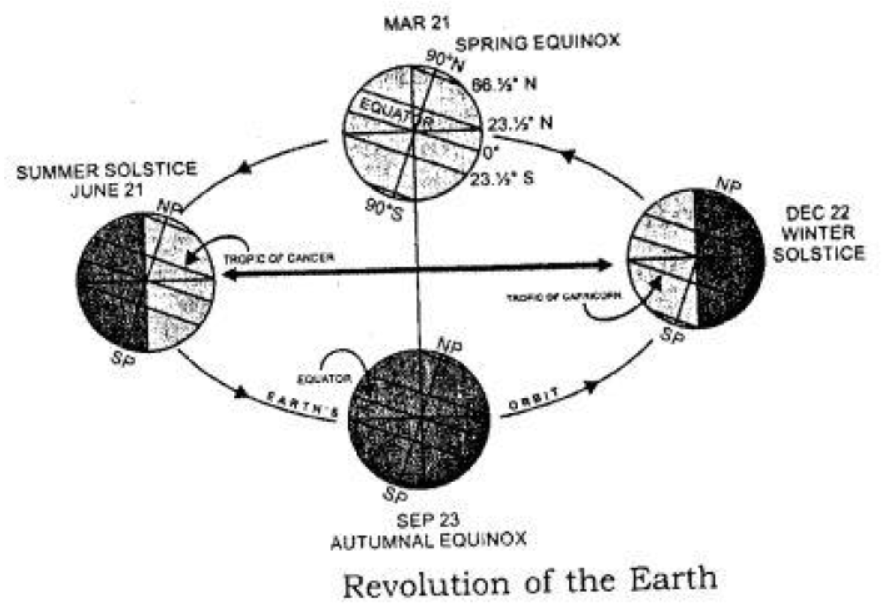
(d) **Effects:**
1. It causes the length of day and night to vary throughout the year.
2. It drives the cycle of changing seasons.
3. It defines the locations of the Tropic of Cancer and the Tropic of Capricorn, where the Sun's rays strike vertically.
4. It shifts the height (altitude) of the midday Sun in the sky.
5. It defines the length of a year, serving as a measure of time.
6. It creates six-month periods of daylight and darkness at the poles.
7. It controls how solar energy is distributed across different latitudes.
In simple words: Revolution is the Earth's yearly journey around the Sun. This motion creates seasons, varying day lengths, and six-month days at the poles.
Exam Tip: Be ready to define both 'aphelion' (furthest point) and 'perihelion' (closest point) with their respective distances and months.
Free study material for Geography
ICSE Voyage Solutions Class 9 Geography Chapter 3 Rotation And Revolution
Students can now access the detailed Voyage Solutions for Chapter 3 Rotation And Revolution on our portal. These solutions have been carefully prepared as per latest ICSE Class 9 syllabus. Each solution given above has been updated based on the current year pattern to ensure Class 9 students have the most updated Geography content.
Master Voyage Textbook Questions
Our subject experts have provided detailed explanations for all the questions found in the Voyage textbook for Class 9 Geography. We have focussed on making the concepts easy for you in Chapter 3 Rotation And Revolution so that students can understand the concepts behind every answer. For all numerical problems and theoretical concepts these solutions will help in strengthening your analytical skill required for the ICSE examinations.
Complete Geography Exam Preparation
By using these Voyage Class 9 solutions, you can enhance your learning and identify areas that need more attention. We recommend solving the Geography Questions from the textbook first and then use our teacher-verified answers. For a proper revision of Chapter 3 Rotation And Revolution, students should also also check our Revision Notes and Sample Papers available on studiestoday.com.
FAQs
You can download the verified Voyage solutions for Chapter 3 Rotation And Revolution on StudiesToday.com. Our teachers have prepared answers for Class 9 Geography as per 2026-27 ICSE academic session.
Yes, our solutions for Chapter 3 Rotation And Revolution are designed as per new 2026 ICSE standards. 40% competency-based questions required for Class 9, are included to help students understand application-based logic behind every Geography answer.
Yes, every exercise in Chapter 3 Rotation And Revolution from the Voyage textbook has been solved step-by-step. Class 9 students will learn Geography conceots before their ICSE exams.
Yes, follow structured format of these Voyage solutions for Chapter 3 Rotation And Revolution to get full 20% internal assessment marks and use Class 9 Geography projects and viva preparation as per ICSE 2026 guidelines.