

ICSE Solutions Voyage Class 9 Geography Chapter 4 Earth S Structure have been provided below and is also available in Pdf for free download. The Voyage ICSE solutions for Class 9 Geography have been prepared as per the latest syllabus and ICSE books and examination pattern suggested in Class 9. Questions given in ICSE Voyage book for Class 9 Geography are an important part of exams for Class 9 Geography and if answered properly can help you to get higher marks. Refer to more Chapter-wise answers for ICSE Class 9 Geography and also download more latest study material for all subjects. Chapter 4 Earth S Structure is an important topic in Class 9, please refer to answers provided below to help you score better in exams
Voyage Chapter 4 Earth S Structure Class 9 Geography ICSE Solutions
Class 9 Geography students should refer to the following ICSE questions with answers for Chapter 4 Earth S Structure in Class 9. These ICSE Solutions with answers for Class 9 Geography will come in exams and help you to score good marks
Chapter 4 Earth S Structure Voyage ICSE Solutions Class 9 Geography
Exercises
I. Short Answer Questions
Question 1. Name the sources of information about forces operating inside the earth.
Answer:
Geologists gather information regarding internal terrestrial forces through three main pathways: examining the behavior and velocity of seismic waves during earthquakes, analyzing materials ejected by volcanic eruptions, and reviewing astronomical evidence and scientific theories on the Earth's origin.
In simple words: Scientists learn about the Earth's interior by studying earthquake waves, volcanic lava, and scientific theories about how our planet was created.
Exam Tip: Make sure to list all three distinct sources (seismic waves, volcanic materials, and theories of origin) to get full credit.
Question 2. In which part of the earth is NIFE found ? What it is composed of ?
Answer:
NIFE is located in the innermost layer of the Earth, known as the core. The name NIFE is derived from its primary chemical components: Nickel (Ni) and Iron (Fe). Because these are highly dense, heavy metals, gravity pulled them deep into the Earth's interior during its early molten stage.
In simple words: NIFE is found in the Earth's core and is made of Nickel and Iron, which are heavy metals that sank deep underground because of their high density.
Exam Tip: Explain the abbreviation clearly - "Ni" for Nickel and "Fe" for Ferrum (Iron) - to write a complete, high-scoring answer.
Question 3. What are the consequences of the pressure and temperature in the interior of the earth ?
Answer:
The immense pressure and extreme temperatures deep underground profoundly shape the physical state and density of the Earth's layers:
1. **State of Matter**: In the crust, rocks remain solid, but as temperatures rise to 870°C - 2200°C in the mantle, materials exist in a semi-liquid, plastic state. In the core, where temperatures reach up to 2200°C (and up to 5000°C in the inner core), the material remains molten or is compressed into a solid-like state under extreme pressure.
2. **Density Gradient**: Due to compression, density increases progressively from the surface to the center: from \( 2.7\text{ to }3.0\text{ g/cm}^3 \) in the crust, to \( 3.0\text{ to }4.5\text{ g/cm}^3 \) in the mantle, and reaching \( 10.0\text{ to }13.0\text{ g/cm}^3 \) in the heavy metallic core.
In simple words: Intense heat and crushing pressure underground change the state of rocks from solid at the surface to semi-molten in the mantle. They also compress materials, causing density to increase dramatically closer to the center of the Earth.
Exam Tip: Discuss both physical state changes (solid to semi-liquid to liquid/solid core) and the density gradient to provide a complete answer.
Question 4. What is the lithosphere ?
Answer:
The lithosphere is the rigid, uppermost layer of the Earth, consisting primarily of the solid crust. Its thickness varies significantly across the globe: it extends up to 60 km deep beneath massive mountain ranges, but is much thinner beneath the ocean basins, ranging from 6 km to 12 km in thickness.
In simple words: The lithosphere is the Earth's solid outer crust. It is thick under high mountains (around 60 km) but very thin beneath the oceans (about 6 to 12 km).
Exam Tip: Make sure to contrast its continental thickness under mountain ranges with its oceanic thickness under ocean basins.
Question 5. Name the three layers of the earth’s interior.
Answer:
The three concentric layers that make up the Earth's interior, moving from the surface inward, are:
1. Crust (Lithosphere)
2. Mantle (Mesosphere)
3. Core (Barysphere)
In simple words: The three layers of the Earth's interior are the crust on the outside, the mantle in the middle, and the core at the center.
Exam Tip: While the standard terms are crust, mantle, and core, mentioning their scientific alternatives (lithosphere, mesosphere, barysphere) demonstrates advanced knowledge.
Question 6. State two chief characteristics of the earth’s crust.
Answer:
Two prominent characteristics of the Earth's crust are:
1. It is solid and rigid, composed entirely of crystalline and sedimentary rocks.
2. It is divided into two distinct geological parts: the lighter continental crust (Sial) and the denser oceanic crust (Sima) supporting ocean basins.
In simple words: The crust is a solid rock layer that is divided into two main parts: continents on land and ocean beds beneath the sea.
Exam Tip: Keep this answer brief and directly highlight its solid nature and division.
Question 7. Describe the mantle. State its two chief characteristics.
Answer:
The mantle is the massive intermediate layer of the Earth located directly beneath the crust, extending from a depth of about 60 km down to 2900 km.
Two of its chief characteristics are:
1. It is split into two major zones: the upper mantle (composed of solid rocks) and the lower mantle (where rocks exist in a semi-molten, plastic state).
2. The average density of this layer increases with depth, ranging from \( 3.0\text{ g/cm}^3 \text{ to } 4.5\text{ g/cm}^3 \).
In simple words: The mantle lies in the middle of the Earth, between 60 and 2900 km deep. It is split into a solid upper part and a semi-molten lower part, with its density increasing as you go deeper.
Exam Tip: Specify the depth boundary (60 km to 2900 km) and mention the solid upper and semi-molten lower zones.
Question 8. Where is asthenosphere found ? In which form does it exist ?
Answer:
The asthenosphere is located within the upper mantle at a depth ranging from approximately 100 km to 250 km below the surface. Because temperatures reach around 1100°C under immense pressure, it exists in a highly ductile, semi-molten, or plastic state.
In simple words: The asthenosphere is located in the upper mantle, between 100 and 250 km deep. It exists in a hot, semi-molten, gooey state with temperatures around 1100°C.
Exam Tip: Describe its state as "semi-molten" or "plastic" rather than completely liquid, as this is geologically accurate.
Question 9. Write one difference between Moho Discontinuity and Gutenberg Discontinuity.
Answer:
The primary difference between these two seismic boundaries is their location in the Earth's interior:
- **Moho Discontinuity**: This boundary separates the outer solid crust from the underlying dense mantle.
- **Gutenberg Discontinuity**: This deeper boundary marks the transition between the semi-molten mantle and the heavy metallic core.
In simple words: The Moho boundary separates the crust from the mantle, while the Gutenberg boundary separates the mantle from the deep core.
Exam Tip: Contrast their specific boundary interfaces (crust-mantle vs. mantle-core) to write a clear, full-mark comparative answer.
Question 10. Why is the earth’s interior in most part found in a solid state despite great heat and pressure ?
Answer:
Despite temperatures reaching up to 5000°C at the Earth's center, the inner core exists in a solid, rigid state due to the extreme gravitational pressure exerted by the overlying layers. This immense pressure raises the melting point of the metallic iron and nickel, keeping the compressed atoms locked firmly in a solid crystalline lattice.
In simple words: Even though the Earth's core is boiling hot, the crushing weight and pressure of the entire planet above compress the liquid metals so tightly that they are forced to remain solid.
Exam Tip: The key physical concept is that "extreme pressure raises the melting point," preventing the metallic core from liquefying despite the intense heat.
Question 11. Name two types of earth movements.
Answer:
The two primary types of movements operating within the Earth's crust are:
1. **Isostatic Adjustments**: The slow, vertical movements that maintain a state of gravitational balance between different crustal landforms of varying weights (like mountains and ocean basins).
2. **Tectonic Plate Movements**: The horizontal sliding and colliding movements of the rigid lithospheric plates over the ductile asthenosphere.
In simple words: The two main movements are isostasy (the vertical balancing of different landmasses) and plate tectonics (the horizontal sliding of crustal plates).
Exam Tip: Keep this answer brief and define both types of movements clearly.
Question 12. What is Geology ?
Answer:
Geology is the scientific study of the Earth, primarily focusing on its origin, structure, history, and the various rock formations and materials that compose its crust and interior.
In simple words: Geology is the science that studies the origin, layers, and types of rocks found inside and on the surface of the Earth.
Exam Tip: Keep this definition simple and focus on the origin and types of rocks.
II. Give reasons for each of the following
Question 1. The study of meteorites helps scientists to know about the interior of the earth.
Answer:
Meteorites and the planets of our solar system formed around the same time from the same primordial cloud of cosmic dust and gas. Because meteorites are solid fragments of other early planetary bodies that did not undergo geological recycling, studying their metallic and silicate composition allows scientists to calculate the exact elemental composition of the Earth's deep, inaccessible layers.
In simple words: Since meteorites and the Earth were formed at the same time from the exact same space materials, studying the rocks inside fallen meteorites helps scientists calculate what the Earth's deep interior looks like.
Exam Tip: Explain that meteorites are treated as proxy samples of early planetary material because they share the same origin.
Question 2. Temperature starts rising gradually towards the interior of the earth.
Answer:
The temperature increases progressively toward the Earth's interior due to two main factors: the decay of radioactive elements (like uranium and thorium) trapped in deep rocks, and the extreme compression generated by the crushing weight and density of overlying layers, which traps primordial heat inside.
In simple words: Temperatures rise underground because of heat released by radioactive decay in rocks and the intense compression and pressure caused by the heavy weight of the planet above.
Exam Tip: Cite "compaction/compression under pressure" and "decay of radioactive elements" as the dual causes of this thermal gradient.
Question 3. The asthenosphere is in a semi-molten state.
Answer:
Within the upper mantle at a depth of 100 km to 250 km, the temperature reaches a high of about 1100°C. Under this high heat and pressure, the rocks are close to their melting points, causing them to lose their rigidity and exist in a highly ductile, semi-molten, or plastic state.
In simple words: The asthenosphere is semi-molten because it is located at a depth where the temperature (around 1100°C) is hot enough to partially melt the rocks, turning them into a gooey, plastic-like layer.
Exam Tip: Clearly connect the 1100°C temperature with the partial melting of silicate minerals to explain the semi-molten state.
Question 4. The inner core is in a solid state.
Answer:
Despite temperatures soaring up to 5000°C at the Earth's center, the inner core is forced into a solid state by the immense, crushing gravitational pressure of the entire planet above. This intense compression raises the melting point of the metals, keeping them firmly solid.
In simple words: Even though the core is hot enough to melt any metal, the massive weight of the Earth above crushes the iron and nickel so tightly that they are forced to remain solid.
Exam Tip: Frame this around the concept of pressure counteracting high temperature by elevating the melting point of metals.
Question 5. The continents are placed above the oceans.
Answer:
The continents are composed of SIAL (Silica and Aluminium), which is a granitic rock layer with a lower density of about \( 2.7\text{ g/cm}^3 \). The ocean floor is composed of SIMA (Silica and Magnesium), which is a basaltic rock layer with a higher density of about \( 3.0\text{ g/cm}^3 \). During the early solidification of the Earth's crust, the lighter granitic SIAL layers floated upward to sit above the denser, heavier SIMA layers, causing the continents to rise above the ocean basins.
In simple words: Continents are made of a lighter rock layer called Sial, which floated to the top during the Earth's formation, while the ocean floors are made of a heavier, denser rock layer called Sima, causing continents to sit higher.
Exam Tip: Explain the density difference between SIAL (\( 2.7\text{ g/cm}^3 \)) and SIMA (\( 3.0\text{ g/cm}^3 \)) to provide a scientifically sound answer.
III. Long Answer Questions
Question 1. Look at the figure on the side and answer the questions: (a) Label the parts : (1), (2), (3), (4) and (5). (b) Name the state (solid, liquid or gas) in which each part exists.

Answer:
(a) The labeled layers of the Earth's structural diagram are:
1. **Atmosphere**
2. **Lithosphere** (Crust)
3. **Mantle**
4. **Core**
5. **Hydrosphere** (Oceans)
(b) The physical states of matter in which these layers exist are:
1. **Atmosphere** - Gaseous state.
2. **Lithosphere** - Solid state.
3. **Mantle** - Semi-solid (ductile/plastic) state.
4. **Core** - Molten/liquid state (outer core) and solid state (inner core).
5. **Hydrosphere** - Liquid state (water).
(c) The outer part of the Earth, consisting of the lithosphere (crust), is the most suitable zone for human habitation because it provides all the essential conditions for survival:
1. **Lithosphere**: Offers stable, solid ground and ideal temperatures for building settlements and conducting agriculture.
2. **Atmosphere**: Provides oxygen and vital gases needed for breathing.
3. **Hydrosphere**: Maintains the global water cycle, supplying fresh drinking water and navigation routes.
In simple words: (a) The layers shown are the gaseous atmosphere, the solid lithosphere, the semi-solid mantle, the core, and the liquid hydrosphere. (b) The state of matter ranges from gas for air to solid for crust, semi-solid for mantle, and liquid/solid for the core. (c) The Earth's outer surface is the only part fit for human life because it has solid land to build on, fresh water to drink, and oxygen-rich air to breathe.
Exam Tip: Break your answer down using labeled sub-parts to ensure you address every section of this multi-part question.
Question 2. Describe the layers of the interior of the earth and their chemical composition.
Answer:
The Earth's interior is divided into three major concentric layers, each with a distinct chemical composition:
1. **Crust (SIAL)**: The thin outermost layer, composed primarily of Silica (Si) and Aluminium (Al), giving it the name SIAL. It has a lower average density.
2. **Mantle (SIMA)**: The massive intermediate layer beneath the crust, composed primarily of Silica (Si) and Magnesium (Mg), giving it the name SIMA. It forms the basaltic ocean floor.
3. **Core (NIFE)**: The heavy, metallic innermost core, composed primarily of Nickel (Ni) and Iron (Fe), collectively known as NIFE.
In simple words: The Earth has three main layers: the outer crust made of Sial (silica and aluminium), the middle mantle made of Sima (silica and magnesium), and the metallic core made of Nife (nickel and iron).
Exam Tip: Structure your answer with clear headings for each of the three layers (Crust, Mantle, and Core) and their corresponding chemical compositions.
Question 3. There are two transitional zones between the two consecutive layers of the interior of the earth. Name them and state their chief characteristics.
Answer:
The two major transition zones in the Earth's interior are:
1. **Mohorovicic (Moho) Discontinuity**: Located between the crust and the upper mantle. This zone marks a sudden increase in seismic wave velocity, reflecting the change from lighter solid crustal rocks to denser solid mantle rocks.
2. **Gutenberg Discontinuity**: Located between the lower mantle and the outer core (at a depth of 2900 km). This boundary is characterized by a dramatic increase in density (exceeding 13.0 g/cm³) and temperature (above 2200°C), where S-waves are completely blocked and P-waves slow down, marking the transition to liquid metal.
In simple words: The Moho boundary lies between the crust and the mantle where wave speeds jump. The Gutenberg boundary lies between the mantle and the core, where temperatures exceed 2200°C and density rises dramatically.
Exam Tip: Clearly identify Moho as the crust-mantle transition and Gutenberg as the mantle-core boundary.
Question 4. Explain the layers of the interior of the earth with reference to the following : (a) Depth, (b) Temperature (c) Density.
Answer:
The Earth's concentric layers show distinct variations in depth, temperature, and density:
- **Crust**:
* *Depth*: Extends 35 km to 50 km beneath continents, and 6 km to 12 km beneath oceans.
* *Temperature*: Low, typically remaining less than 870°C.
* *Density*: Ranges from \( 2.7\text{ g/cm}^3 \text{ to } 5.5\text{ g/cm}^3 \).
- **Mantle**:
* *Depth*: Located between 50 km and 2900 km beneath the crust.
* *Temperature*: High, ranging from 1500°C to 2200°C.
* *Density*: Increases with depth from \( 3.0\text{ g/cm}^3 \text{ to } 4.5\text{ g/cm}^3 \).
- **Core**:
* *Depth*: Extends from 2900 km down to the Earth's center at about 3500 km radius.
* *Temperature*: Extremely high, ranging from 2200°C to 5000°C.
* *Density*: Exceptionally high, ranging from \( 10.0\text{ g/cm}^3 \text{ to } 13.6\text{ g/cm}^3 \).
In simple words: Moving from the surface inward, the layers get deeper, hotter, and denser. The crust is thin, cool, and light. The mantle is thicker, hotter, and heavier, and the core is extremely deep, boiling hot, and packed with heavy dense metals.
Exam Tip: Present this comparison clearly using bullet points for each of the three parameters to make your answer highly readable and easy to grade.
Question 5. Study the figure on the side and answer the questions: (a) What is known as Sial ? How deep is the area marked by Sial ? (b) What role does Sima play ? (c) Why is the expression ‘Nife’ so called ? (d) Which layer is responsible for earth’s magnetic field ? Why? (e) What happens to the continents if there is an earthquake?

Answer:
(a) **SIAL**: This is the outermost granitic layer of the Earth's crust, named after its primary mineral components, Silica (Si) and Aluminium (Al). Its average thickness is about 60 km under continental masses.
(b) **SIMA**: This is the denser, basaltic second layer of the crust, named after Silica (Si) and Magnesium (Mg). It forms the continuous floor of the ocean basins and supports the lighter continental blocks.
(c) **Nife**: This term refers to the Earth's innermost core. It is so called because it is primarily composed of heavy metallic Nickel (Ni) and Iron (Fe, from *Ferrum*).
(d) **Earth's Magnetic Field**: The **outer core** is responsible for the Earth's magnetic field. This is because the convection currents in the molten, flowing liquid iron and nickel act as a self-exciting dynamo, generating a strong magnetic field oriented toward the poles.
(e) **Impact of Earthquakes**: Intense earthquakes (with a magnitude of 8.0 or more) can cause massive shifts in the landscape: triggering devastating landslides, forming wide surface cracks and fault lines, and causing some coastal landmasses or small islands to submerge beneath the ocean.
In simple words: (a) Sial is the continental crust made of silica and aluminium, extending about 60 km deep. (b) Sima is the denser oceanic crust made of silica and magnesium that supports ocean beds. (c) Nife is called so because it is made of Nickel (Ni) and Iron (Fe). (d) The liquid outer core generates the Earth's magnetic field due to flowing molten iron. (e) Powerful earthquakes can cause buildings to collapse, create wide surface cracks, or cause coastal areas to sink into the sea.
Exam Tip: Break your answer down using labeled sub-parts to ensure you address every section of this multi-part question.
Practice Questions (Solved)
Question 1. Which are the two most abundant chemical elements in the Earth’s crust ?
Answer:
The two most abundant chemical elements in the Earth's crust are oxygen (nearly 46.6%) and silicon (nearly 27.7%).
In simple words: Oxygen and silicon are the two most common elements found in the Earth's crust.
Exam Tip: Keep this answer brief and directly list oxygen and silicon.
Question 2. Why does the Sun not rise at the same time everywhere in the world ?
Answer:
The sun does not rise simultaneously across the globe because the Earth is spherical and rotates on its axis from West to East. As a result, eastern longitudes rotate into the sun's light earlier than western longitudes, causing staggered sunrise times.
In simple words: Because the Earth is round and spins from West to East, places in the East face the sun and see the sunrise earlier than places in the West.
Exam Tip: Clearly identify both the "spherical shape" and the "West-to-East rotation" as the dual causes of staggered sunrise times.
Question 3. “The whole of the approaching ship is not visible at one time.” Why ?
Answer:
This occurs due to the spherical curvature of the Earth's surface. When a ship approaches a harbor from the horizon, its appearance is gradual: viewers on shore see the rising smoke first, then the mast, and finally the lower hull as it climbs over the Earth's curved surface.
In simple words: We don't see a whole ship at once because the Earth is curved. As a ship sails closer, its top mast appears first over the horizon, followed gradually by its body.
Exam Tip: Explain this phenomenon as a classic, simple proof of the Earth's spherical shape.
Question 4. “Even when the Earth is spherical, it appears to be flat.” Discuss.
Answer:
Although the Earth is a massive sphere, its curvature is extremely tiny relative to our limited field of view. To an observer standing on the ground, the curvature across a small area (such as 100 square miles) is negligible, which makes the horizon appear completely flat.
In simple words: The Earth is so incredibly large that its curve is too small for us to see. From the ground, our view is limited to a small area, making it look completely flat.
Exam Tip: Frame this around the concept of "relative scale," where our visual range is tiny compared to the Earth's vast radius.
Question 5. Why is the Earth slightly flattened at the poles ?
Answer:
The Earth is not a perfect sphere. It is slightly flattened at both the poles and bulges out at the equator due to the centrifugal forces generated by the rotation of the Earth on its axis.
In simple words: The Earth isn't a perfect round ball. Spinning on its axis generates rotational forces that cause the middle equator to bulge outward and the North and South Poles to flatten slightly.
Exam Tip: Attribute the oblate spheroid shape directly to the rotational forces generated by the Earth's spin.
Question 6. Explain briefly the structure of the earth. OR Discuss the structure of the earth giving details about each of its layers and arguments in support of your contention.
Answer:
The Earth's internal structure is composed of three primary concentric zones:
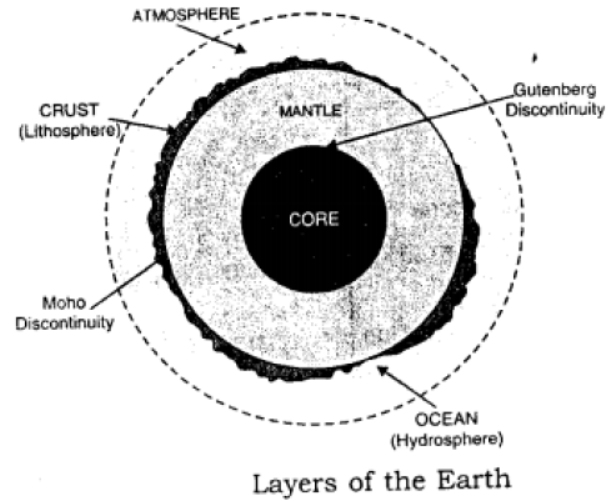
1. **Crust (Lithosphere)**: The solid, outermost rocky layer ranging from 8 km to 60 km in thickness. It consists of two sub-layers: the upper granitic **SIAL** (composed of Silica and Aluminium with an average density of 2.7) which forms the continents, and the lower continuous basaltic **SIMA** (composed of Silica and Magnesium with an average density of 3.0) supporting ocean basins.
2. **Mantle (Mesosphere)**: The intermediate layer extending down to 2900 km deep. It has a density ranging from 3.1 to 5.0 and is divided into the upper mantle (containing the semi-molten asthenosphere) and the denser lower mantle.
3. **Core (Barysphere)**: The metallic central nucleus composed primarily of Nickel and Iron (**NIFE**), spanning a radius of about 3471 km. It is divided into a liquid outer core and a solid, rigid inner core compressed under intense gravitational pressure (density ranges from 5.1 to 13.0).
In simple words: The Earth's interior has three main layers: the outer solid crust (divided into Sial for continents and Sima for ocean beds), the thick middle mantle (mesosphere), and the heavy metallic core (barysphere) made of Nickel and Iron (Nife).
Exam Tip: Use the standard concentric division (Lithosphere, Mesosphere, and Barysphere) to write a well-structured, comprehensive answer.
Question 7. Where is Mantle located in the Earth ?
Answer:
The mantle (or mesosphere) is located directly beneath the solid Earth crust, extending to a depth of approximately 2900 km where it meets the outer core.
In simple words: The mantle is the middle layer located directly under the crust, going down to a depth of about 2900 km.
Exam Tip: Keep this answer brief and specify its location directly beneath the crust.
Question 8. Describe any three experiments to prove the Spherical Shape of the Earth.
Answer:
Three simple scientific experiments that prove the Earth is spherical are:
1. **Ship on the Horizon**: When a ship approaches the shore, the top mast is visible first, followed gradually by the lower hull. On a flat Earth, the entire ship would appear at once, simply growing larger.

2. **Bedford Level Experiment**: Conducted by Mr. A.R. Wallace on the Bedford Canal. When three poles of equal length are fixed at equal intervals in a straight line, the top of the middle pole looks higher than the others, revealing the curved profile of the Earth's surface.

3. **Circular Horizon**: When observing the horizon from a high vantage point, it always appears circular. As elevation increases, the circular horizon widens, which is only possible on a spherical planet.

In simple words: We can prove the Earth is round through three proofs: seeing only the top mast of an approaching ship first, the Bedford Level experiment where a middle pole in a line looks higher, and seeing a circular horizon that expands as we go higher.
Exam Tip: Outline these three classic experiments clearly, noting Mr. This experiment was done by Mr A.R. Wallace on Bedford canal as a major scientific proof.
Free study material for Geography
ICSE Voyage Solutions Class 9 Geography Chapter 4 Earth S Structure
Students can now access the detailed Voyage Solutions for Chapter 4 Earth S Structure on our portal. These solutions have been carefully prepared as per latest ICSE Class 9 syllabus. Each solution given above has been updated based on the current year pattern to ensure Class 9 students have the most updated Geography content.
Master Voyage Textbook Questions
Our subject experts have provided detailed explanations for all the questions found in the Voyage textbook for Class 9 Geography. We have focussed on making the concepts easy for you in Chapter 4 Earth S Structure so that students can understand the concepts behind every answer. For all numerical problems and theoretical concepts these solutions will help in strengthening your analytical skill required for the ICSE examinations.
Complete Geography Exam Preparation
By using these Voyage Class 9 solutions, you can enhance your learning and identify areas that need more attention. We recommend solving the Geography Questions from the textbook first and then use our teacher-verified answers. For a proper revision of Chapter 4 Earth S Structure, students should also also check our Revision Notes and Sample Papers available on studiestoday.com.
FAQs
You can download the verified Voyage solutions for Chapter 4 Earth S Structure on StudiesToday.com. Our teachers have prepared answers for Class 9 Geography as per 2026-27 ICSE academic session.
Yes, our solutions for Chapter 4 Earth S Structure are designed as per new 2026 ICSE standards. 40% competency-based questions required for Class 9, are included to help students understand application-based logic behind every Geography answer.
Yes, every exercise in Chapter 4 Earth S Structure from the Voyage textbook has been solved step-by-step. Class 9 students will learn Geography conceots before their ICSE exams.
Yes, follow structured format of these Voyage solutions for Chapter 4 Earth S Structure to get full 20% internal assessment marks and use Class 9 Geography projects and viva preparation as per ICSE 2026 guidelines.