

ICSE Solutions Voyage Class 9 Geography Chapter 7 Volcanoes have been provided below and is also available in Pdf for free download. The Voyage ICSE solutions for Class 9 Geography have been prepared as per the latest syllabus and ICSE books and examination pattern suggested in Class 9. Questions given in ICSE Voyage book for Class 9 Geography are an important part of exams for Class 9 Geography and if answered properly can help you to get higher marks. Refer to more Chapter-wise answers for ICSE Class 9 Geography and also download more latest study material for all subjects. Chapter 7 Volcanoes is an important topic in Class 9, please refer to answers provided below to help you score better in exams
Voyage Chapter 7 Volcanoes Class 9 Geography ICSE Solutions
Class 9 Geography students should refer to the following ICSE questions with answers for Chapter 7 Volcanoes in Class 9. These ICSE Solutions with answers for Class 9 Geography will come in exams and help you to score good marks
Chapter 7 Volcanoes Voyage ICSE Solutions Class 9 Geography
Volcanoes
Exercises
I. Short Answer Questions.
Question 1. What are known as volcanoes ?
Answer: Volcanoes are vents, fissures, or openings in the Earth's lithosphere through which hot molten rock (magma), gases, and pyroclastic debris erupt from the deep interior. This volcanic activity is driven by powerful endogenic forces originating within the Earth's mantle.
In simple words: A volcano is an opening in the Earth's crust that lets hot molten rock, ash, and gases escape from deep underground.
Exam Tip: Ensure you define a volcano as a "vent or opening" and mention the role of "endogenic forces" to secure full marks.
Question 2. What is the difference between magma and lava ?
Answer: The primary distinction lies in their location. Molten rock that remains confined beneath the Earth's surface within the crust or mantle is called magma. However, once this molten material erupts onto the surface of the Earth, it is referred to as lava.
In simple words: Molten rock is called magma when it is trapped underground, but it becomes lava once it erupts onto the surface.
Exam Tip: Keep this distinction simple and clear: focus strictly on the location of the molten material (underground vs. on the surface).
Question 3. Give one example each of an active volcano and a dormant volcano.
Answer: Classic examples of these volcanic types include:
- **Active Volcano:** Mt. Etna or Mt. Stromboli, located in Italy.
- **Dormant Volcano:** Mt. Kilimanjaro, located in Africa.
In simple words: An active volcano that still erupts is Mt. Etna in Italy, while a dormant volcano that is currently sleeping is Mt. Kilimanjaro in Africa.
Exam Tip: Always pair the name of the volcano with its geographic location (e.g., Italy or Africa) to demonstrate complete geographical accuracy.
Question 4. What is the difference between dormant volcano and an extinct volcano ?
Answer: A dormant volcano is currently inactive but retains the capacity to erupt again in the future after a long period of quiet. In contrast, an extinct volcano is completely dead and has permanently ceased all volcanic activity, with no possibility of erupting again.
In simple words: A dormant volcano is "sleeping" and can wake up to erupt again, but an extinct volcano is "dead" and will never erupt again.
Exam Tip: Clearly contrast the potential for future eruption (present in dormant, completely absent in extinct) to secure full marks.
Question 5. What is the magma chamber of a volcano ?
Answer: A magma chamber is a large underground reservoir of liquid rock (magma) located beneath the Earth's crust. It is carved out over time as the intense heat of ascending magma melts and dissolves the surrounding solid rock formations.
In simple words: A magma chamber is a large underground pool of liquid rock formed under a volcano when hot magma melts the surrounding rocks.
Exam Tip: Define it as an "underground reservoir" and mention that it is formed by the thermal melting of host rocks.
Question 6. Name two types of landforms made by volcanoes.
Answer: Volcanic eruptions generate two primary categories of landforms:
1. **Extrusive Landforms:** These form on the Earth's surface when lava cools and solidifies, such as craters, composite cones, calderas, and lava plateaus.
2. **Intrusive Landforms:** These form underground when magma cools and solidifies within the crust, such as dykes, sills, batholiths, and laccoliths.
In simple words: Volcanoes make extrusive landforms (on the surface, like cones and craters) and intrusive landforms (underground, like dykes and sills).
Exam Tip: Clearly categorize your answer into "extrusive" (surface) and "intrusive" (subsurface) features, providing at least one example of each.
Question 7. What is called the Pacific Ring of Fire ? Why is it called so ?
Answer: The Pacific Ring of Fire is a vast, horseshoe-shaped belt bordering the Pacific Ocean basin characterized by high seismic and volcanic activity. It is named so because more than 75% to 80% of the world's active volcanoes are concentrated along this active plate boundary zone.
In simple words: The Pacific Ring of Fire is a large loop around the Pacific Ocean where most of the world's active volcanoes and earthquakes occur.
Exam Tip: Mention that this zone is associated with converging tectonic plate boundaries, which explains the high concentration of active volcanoes.
Question 8. Name the three types of volcanoes on the basis of the frequency of their eruption.
Answer: Based on eruption frequency, volcanoes are classified into three distinct categories:
1. **Active Volcanoes:** Volcanoes that erupt regularly or have erupted in recent history (e.g., Mt. Etna).
2. **Dormant Volcanoes:** Volcanoes that are currently sleeping but are capable of erupting again after a long quiet interval (e.g., Mt. Vesuvius).
3. **Extinct Volcanoes:** Volcanoes that have completely ceased all volcanic activity and are considered dead, with no possibility of future eruption (e.g., Mt. Kenya).
In simple words: The three types of volcanoes are active (currently erupting), dormant (sleeping but can erupt again), and extinct (dead and will never erupt again).
Exam Tip: Structure your answer with clear bullet points for Active, Dormant, and Extinct types to make your response highly readable.
Question 9. What are known as Shield volcanoes ?
Answer: Shield volcanoes are broad, low-profile volcanic mountains formed by the eruption of highly fluid basic (basaltic) lava. Because the lava flows easily, it spreads out over vast distances before solidifying, creating a massive dome with gentle slopes that resembles a warrior's shield.
In simple words: A shield volcano is a broad, flat volcano with gentle slopes, built by highly fluid lava that spreads out over many kilometers.
Exam Tip: Explain that the fluid nature of basic basaltic lava is the reason shield volcanoes have gentle slopes and broad profiles instead of steep cones.
Question 10. Mention any two extrusive landforms caused by volcanic eruptions.
Answer: Two major surface (extrusive) landforms created by volcanic eruptions are:
1. **Composite Cones:** Large, steep-sided volcanic mountains built from alternating layers of cooled lava flows and pyroclastic materials (ash, cinders). Classic examples include Mt. Fuji in Japan and Mt. Vesuvius in Italy.
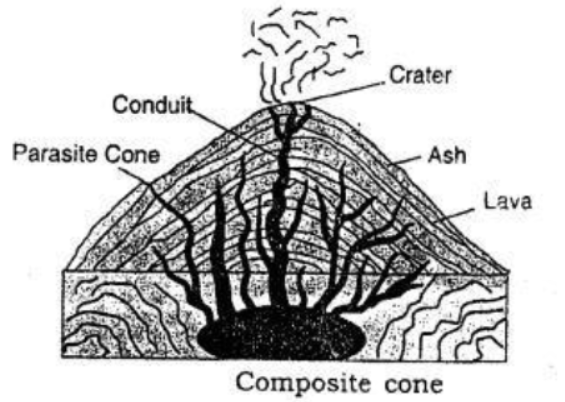
2. **Calderas:** Massive, bowl-shaped depressions formed at the summit of a volcano. They are created when a violent eruption empties the underlying magma chamber, causing the volcanic cone to collapse inward due to a lack of structural support.
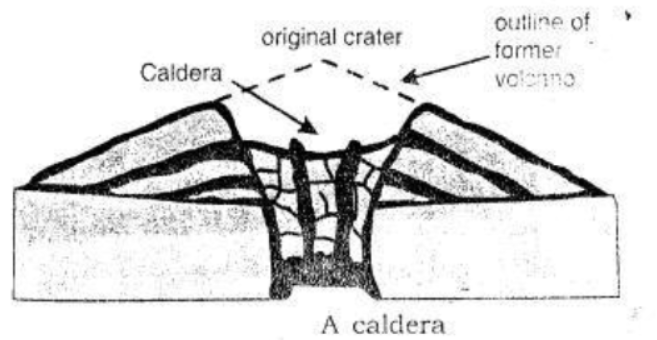
In simple words: Two extrusive landforms are composite cones (steep mountains built of alternating layers of lava and ash, like Mt. Fuji) and calderas (huge craters formed when a volcano collapses into its empty magma chamber).
Exam Tip: Illustrate your answer with specific features of these landforms, noting that composite cones have layered structures while calderas are collapse structures.
Question 11. Name any two intrusive landforms made by volcanic eruptions.
Answer: Two common subsurface (intrusive) volcanic landforms are:
1. **Batholiths:** Giant, deep-seated masses of igneous rock formed by the slow cooling of magma within the crust. They represent the bedrock of major mountain ranges and are exposed only after extensive regional uplift and erosion.
2. **Laccoliths:** Large, dome-shaped igneous intrusions formed when viscous magma spreads laterally between sedimentary rock layers, forcing the overlying strata to bulge upward into a dome shape.
In simple words: Two intrusive landforms are batholiths (massive underground pools of solidified granite exposed by erosion) and laccoliths (mushroom-shaped dome intrusions that push up the ground above them).
Exam Tip: Contrast the deep-seated, massive nature of batholiths with the shallower, dome-shaped structure of laccoliths.
Question 12. How are hot springs formed ?
Answer: Hot springs are formed when underground water comes into contact with hot magma or heated volcanic rocks deep within the Earth's crust. This heated water, under pressure, rises through geological fissures and cracks to flow out onto the surface as a continuous thermal stream.
In simple words: Hot springs are formed when underground water is heated by magma deep inside the Earth and rises up through cracks to flow out onto the surface.
Exam Tip: Clearly state that groundwater is heated by proximity to hot magmatic chambers or volcanic rocks before ascending via fissures.
Question 13. What is called the Pacific Ring of Fire ? Why is it called so ?
Answer: The Pacific Ring of Fire is a massive, highly active tectonic belt encircling the basin of the Pacific Ocean. It receives its name because it contains more than 80% of the Earth's active volcanoes, creating a prominent ring of volcanic activity along the coastal boundaries of Asia and the Americas.
In simple words: The Pacific Ring of Fire is a horseshoe-shaped belt around the Pacific Ocean where nearly 80% of the world's active volcanoes erupt.
Exam Tip: Mention that the "Ring of Fire" corresponds directly with subduction zones at tectonic plate margins where intense friction melts crustal rock into magma.
Question 14. Give an example each of conical volcano and fissure volcano.
Answer: Classic examples of these volcanic structures include:
- **Conical Volcano:** Mt. Fuji in Japan, which has a classic, steep-sided composite cone.
- **Fissure Volcano:** The Columbia Plateau in North America (often cited alongside the Deccan Plateau in India) formed by lava flowing from long crustal cracks.
In simple words: Mt. Fuji in Japan is a conical volcano, while the Deccan Plateau in India and the Columbia Plateau in North America are examples of fissure volcanoes.
Exam Tip: Specify that conical volcanoes form from central vents, whereas fissure volcanoes erupt silently from long, linear cracks in the Earth's crust.
Question 15. What is the difference between dormant volcano and an extinct volcano ?
Answer: A dormant volcano is a "sleeping" volcano that has not erupted recently but remains geologically active and can erupt again. An extinct volcano is a "dead" volcano that has permanently ceased all volcanic activity because its underlying magma source has dried up, leaving no possibility of future eruptions.
In simple words: A dormant volcano is sleeping but can erupt again, while an extinct volcano is completely dead and will never erupt again.
Exam Tip: Contrast the potential for future eruption (present in dormant, completely absent in extinct) to secure full marks.
II. Match the following
II. Match the following columns correctly :
Answer:
| Column A | Column B |
|---|---|
| 1. Vent | (d) An opening in the earth's crust through which lava flow |
| 2. Extinct Volcano | (c) Dead Volcano. |
| 3. Geyser | (b) Hot water fountain. |
| 4. Mt. Stromboli | (a) An active volcano. |
| 5. Cinder cone | (e) A volcanic landform. |
In simple words: The matched pairs are: 1. Vent is a volcanic opening. 2. Extinct volcano is a dead volcano. 3. Geyser is a hot water fountain. 4. Mt. Stromboli is an active volcano. 5. Cinder cone is a volcanic landform.
Exam Tip: Present matching questions in a clear, formatted table to make it highly readable and professional.
III. Fill in the blanks below
III. Fill in the blanks below :
1. The forces arising from the interior of the earth are called ________ forces.
2. The molten rock that reaches the surface of the earth is called ________.
3. A lava ________ is made up of basic lava flows solidified away from the vent.
4. ________ are intrusions of igneous rock that are vertical in shape.
5. The Circum-Pacific Belt is also called ________.
Answer: 1. **endogenic**
2. **lava** (Note: Molten rock is called magma underground, and becomes lava once it reaches the surface.)
3. **shield**
4. **Dykes** (Note: Vertical sheet-like intrusions of igneous rock are scientifically known as dykes.)
5. **Pacific Ring of Fire**
In simple words: The completed answers are: 1. endogenic, 2. lava, 3. shield, 4. Dykes, and 5. Pacific Ring of Fire.
Exam Tip: Remember that vertical tabular intrusions of magma are called dykes, whereas horizontal sheet-like intrusions are called sills.
IV. Long Answer Questions
Question 1. Explain the various parts of a volcano.
Answer: A volcano consists of several distinct structural components:
1. **Magma Chamber:** The massive underground reservoir of molten rock (magma) beneath the Earth's crust that feeds the volcano.
2. **Conduit (Vent):** The vertical pipe or channel through which magma ascends from the chamber to the surface during an eruption.
3. **Crater:** The bowl-shaped depression or mouth located at the summit of the volcanic cone, surrounding the vent.
4. **Volcanic Cone:** The conical hill or mountain built up by successive layers of erupted lava, ash, and pyroclastic debris cooling and solidifying around the vent.
5. **Parasitic Cone:** A smaller, secondary cone formed on the side of the main volcano when magma forces its way out through lateral cracks.
In simple words: A volcano is made of five main parts: the magma chamber (underground pool of liquid rock), the vent (pipe where magma rises), the crater (bowl-shaped mouth), the main volcanic cone, and sometimes smaller parasitic cones on the sides.
Exam Tip: In your diagram, clearly label the magma chamber, central conduit (vent), crater, and volcanic cone to earn maximum presentation marks.
Question 2. Describe the causes of volcanic eruptions.
Answer: The primary causes of volcanic eruptions include:
1. **Subsurface Heat and Pressure:** As depth increases, temperature and pressure rise significantly. Since rocks are poor conductors, heat remains trapped inside the Earth, melting subsurface rock into magma. This built-up thermal pressure eventually forces the molten material upward through crustal fractures.
2. **Tectonic Plate Movements:** Most volcanic activity occurs along tectonic plate boundaries (especially subduction zones). The same compression, friction, and pulling forces that cause earthquakes also generate magma and crack the crust, providing pathways for eruptions.
3. **Magma Chamber Overpressure:** Ascending magma dissolves host rocks to create a large reservoir (magma chamber) beneath the volcano. As new magma, water vapor, and silicate gases enter this enclosed chamber, internal pressure acts vertically upward, eventually bursting through weak crustal zones to cause an eruption.
In simple words: Volcanoes erupt due to three main reasons: extreme heat and pressure melting underground rocks, tectonic plates colliding or sliding apart to create paths, and gas pressure building up inside underground magma chambers until they burst.
Exam Tip: Identify the role of plate boundaries (tectonics) and explain how gas overpressure in the magma chamber acts as a key trigger for explosive eruptions.
Question 3. Explain briefly the landforms created by volcanoes on the surface of the earth.
Answer: Volcanic landforms formed on the Earth's surface are called **Extrusive Landforms**. These are categorized into:
(a) **Volcanic Plateaus:** Broad, elevated, flat tablelands formed by successive quiet eruptions of highly fluid basaltic lava spreading over a wide area. A prime example is the Deccan Plateau in northwestern India, along with the Columbia Plateau in North America and the Ethiopian Plateau.
(b) **Volcanic Mountains:** Cone-shaped peaks built up from lava, ash, and volcanic fragments ejected during central eruptions. These are highly diverse, ranging from steep composite cones (like Mt. Fuji) to broad shield volcanoes (like Mauna Loa).
(c) **Volcanic Plains:** Large, relatively smooth, and low-lying plains created by extensive sheets of fluid lava covering flat basins. The Western Victorian Plains in Australia serve as a classic example.
In simple words: Volcanoes make three main extrusive landforms: flat, elevated plateaus (like the Deccan Plateau in India), cone-shaped mountains built from lava and ash (like Mt. Fuji), and broad, flat volcanic plains (like the Victorian Plains in Australia).
Exam Tip: Classify the surface features clearly into Plateaus, Mountains, and Plains, providing a notable geographic example for each type.
Question 4. Write any three destructive effects of volcanoes.
Answer: The destructive effects of volcanic eruptions include:
1. **Loss of Life and Property:** Scorching lava flows, ash falls, and pyroclastic surges destroy human settlements, wipe out vegetation, and kill both human and animal populations.
2. **Agricultural Ruin:** Thick deposits of volcanic ash and dust blanket fields, suffocating crops and rendering large tracts of agricultural land uncultivable for years.
3. **Acid Rain and Flooding:** Volcanic gases (such as sulfur dioxide) mix with moisture to cause acid rain. Additionally, massive ash clouds trigger heavy rainfall, causing devastating mudslides (lahars) and floods.
4. **Tsunami Triggers:** Powerful underwater or island volcanic explosions can trigger massive tsunami waves, flooding coastal lowlands and causing widespread devastation.
In simple words: Volcanoes can be highly destructive by burning down towns and forests with hot lava, ruining farm soils with thick layers of toxic ash, creating heavy acid rains and mudslides, and triggering giant tsunami waves that flood coastal areas.
Exam Tip: List any three effects clearly (such as loss of life, soil damage, and tsunamis), using terms like "pyroclastic flow" or "acid rain" to write a highly descriptive answer.
Question 5. Describe the distribution of volcanoes in the world.
Answer: Volcanoes are concentrated along weak zones of the Earth's crust, corresponding directly with active tectonic plate margins. Globally, their distribution is divided into three primary belts:
1. **Circum-Pacific Belt (Ring of Fire):** This is the most active volcanic belt, encasing the Pacific Ocean along the Andes, Rockies, and Alaska, and extending west through Japan, the Philippines, and the East Indies. It contains nearly 80% of the world's active volcanoes, including famous peaks like Mt. Fuji, Mt. Pinatubo, Cotopaxi, and Krakatoa.
2. **Mid-World Mountain Belt (Mid-Continental Belt):** This belt stretches across the Alpine-Himalayan fold mountain region, starting from the West Indies, passing through the Mediterranean basin, Caucasus mountains, and extending to the Himalayas. It contains notable active and dormant volcanoes like Mt. Vesuvius, Mt. Etna, and Mt. Stromboli.
3. **African Rift Valley Belt:** This zone follows the Great African Rift Valley and the Red Sea. Famous volcanic peaks in this rift zone include Mt. Kilimanjaro and Mt. Kenya.
In simple words: Volcanoes are spread along three main belts: the Circum-Pacific Belt (Ring of Fire), which encircles the Pacific Ocean and has 80% of active volcanoes; the Mid-World Belt, which runs through the Mediterranean and the Himalayas; and the African Belt along the Great Rift Valley.
Exam Tip: Structure your essay by detailing each of the three belts (Circum-Pacific, Mid-World, African Rift) with accurate geographical limits and volcanic examples.
Question 6. Describe important volcanic landforms on earth.
Answer: Some prominent landforms created by volcanic activity are:
1. **Composite Cones:** Large, steep-sided volcanic mountains built from alternating layers of lava, ash, and cinders erupted from a central vent.
2. **Crater Lakes:** Formed when the mouth (crater) of an inactive, cooled volcano is filled with rainwater.
3. **Calderas:** Giant, bowl-shaped depressions formed at the summit when a volcanic cone collapses inward after a massive eruption.
4. **Lava Shields (Shield Volcanoes):** Broad, low-profile volcanic domes with gentle slopes, formed by highly fluid basic lava spreading over vast distances.
5. **Lava Plateaus:** Flat, elevated tables of vast extent, created by quiet lava flows erupting from long fissure cracks, such as the Deccan Plateau in India.
In simple words: Important volcanic landforms include composite cones (layered mountains), crater lakes (water-filled craters), calderas (collapsed craters), lava shields (broad, flat volcanoes), and lava plateaus (elevated tables of basalt).
Exam Tip: Clearly define each landform and pair it with its structural origin (e.g., caldera due to summit collapse, lava plateau due to fissure eruptions) to ensure maximum marks.
Practice Questions (Solved)
Question 1. Name three causes of volcanic eruptions.
Answer: The three primary causes of volcanic eruptions are:
1. The extreme heat and pressure within the Earth's interior.
2. The accumulation of high-pressure steam and volcanic gases.
3. The presence of faults, fissures, and weak zones in the Earth's crust.
In simple words: The three causes are underground heat, build-up of steam and gases, and cracks in the Earth's crust.
Exam Tip: List all three points clearly, as they are the standard syllabus causes for volcanism.
Question 2. Name the largest active volcano in the world.
Answer: The largest active volcano in the world is **Mauna Loa**, located in the Hawaiian Islands.
In simple words: The world's largest active volcano is Mauna Loa in Hawaii.
Exam Tip: Always name Mauna Loa and state that it is a classic example of a basaltic shield volcano.
Question 3. Which volcano is known as the ‘light house of the Mediterranean ?
Answer: **Mt. Stromboli** is famously known as the lighthouse of the Mediterranean due to its continuous, gentle eruptions.
In simple words: Mt. Stromboli is called the lighthouse of the Mediterranean because it erupts continuously and glows at night.
Exam Tip: State that its constant mild eruptions light up the sea at night, which gives it this famous name.
Question 4. Name the three belts where volcanoes are found.
Answer: The three major volcanic belts of the world are:
1. The Circum-Pacific Belt (Ring of Fire)
2. The Mid-World Mountain Belt (Mid-Continental Belt)
3. The Great African Rift Valley Belt
In simple words: The three main volcanic zones are the Circum-Pacific Belt, the Mid-World Mountain Belt, and the African Rift Valley.
Exam Tip: Memorize these three key belts as they represent the primary global distribution zones for both volcanoes and earthquakes.
Question 5. In which belt most of the volcanoes of the world are found ?
Answer: The majority of the world's active volcanoes are located along the **Circum-Pacific Belt** (famously known as the Ring of Fire).
In simple words: Most of the world's volcanoes are found in the Circum-Pacific Belt.
Exam Tip: Identify this belt by both its names: the Circum-Pacific Belt and the Ring of Fire.
Question 6. Name three causes of Earthquakes.
Answer: The three primary causes of earthquakes are:
1. **Volcanic Eruptions:** The underground movement of magma triggers local tremors.
2. **Tectonic Activities:** Plate movements and faulting release immense energy.
3. **Elastic Rebound of Rocks:** Tectonic stress causes rock layers to bend and snap back, releasing seismic waves.
In simple words: Earthquakes are caused by volcanic eruptions, movements of tectonic plates, and rocks bending and snapping back under pressure.
Exam Tip: State tectonic plate movement as the most common and powerful cause of major earthquakes.
Question 7. What is epicentre ?
Answer: The epicenter is the point on the Earth's surface situated vertically directly above the seismic focus (hypocenter) where an earthquake originates.
In simple words: The epicenter is the spot on the ground directly above where the earthquake starts deep underground.
Exam Tip: Distinguish clearly between the focus (underground origin) and the epicenter (surface point vertically above the focus).
Question 8. Indicate the world distribution of active volcanoes.
Answer: There are approximately 500 active volcanoes across the globe. The vast majority of these are situated along two main tectonic zones: the Circum-Pacific Belt (Ring of Fire) and the Mid-World Mountain Belt.
In simple words: Most of the world's 500 active volcanoes are located along the Circum-Pacific Belt and the Mid-World Mountain Belt.
Exam Tip: Note that active volcanoes follow plate margins, with nearly 80% concentrated along the Circum-Pacific boundaries.
Question 9. Give two reasons why tremors occur inside the earth?
Answer: Two reasons for subterranean tremors (earthquakes) are:
1. **Crustal Movements:** Sudden faulting or slippage of tectonic plates along weak zones (fault lines) releases massive energy.
2. **Subsurface Magma Flow:** The high-pressure movement of molten rock (magma) within the crust during volcanic activity triggers tremors.
In simple words: Tremors occur when tectonic plates slide suddenly along crack lines, or when hot magma moves under high pressure beneath the Earth's crust.
Exam Tip: Separate your reasons clearly into "tectonic faulting" and "volcanic magmatic movements" for a complete answer.
Question 10. Distinguish between :
1. Seismology and Volcanology.
2. Volcanic Dust and Volcanic Ash.
Answer: The distinctions are detailed below:
**1. Seismology vs. Volcanology:**
- **Seismology** is the branch of geophysics dedicated to the scientific study of earthquakes and the propagation of seismic waves.
- **Volcanology** is the scientific study of volcanoes, magmatic movement, and related eruptive phenomena.
**2. Volcanic Dust vs. Volcanic Ash:**
- **Volcanic Dust** consists of extremely fine, microscopic mineral particles ejected during an eruption that can remain suspended in the atmosphere for years.
- **Volcanic Ash** consists of slightly larger, coarse, sand-like fragments of pulverized rock and volcanic glass ejected during explosive eruptions.
In simple words: 1. Seismology is the study of earthquakes, while volcanology is the study of volcanoes. 2. Volcanic dust is made of microscopic floating particles, while volcanic ash is made of slightly larger, coarse rock fragments.
Exam Tip: Structure your comparisons with clear sub-headings, using terms like "seismic wave propagation" and "pulverized rock fragments" to show precise vocabulary.
Question 11. Describe the materials thrown out during volcanic eruption.
Answer: Volcanic ejecta are classified into three primary physical states:
1. **Solid Materials (Pyroclastic Debris):** These range from massive, rounded rock blocks known as volcanic bombs to smaller fragments like cinders, fine volcanic ash, and microscopic dust.
2. **Liquid Materials (Lava):** This consists of molten rock, divided into highly viscous **acidic lava** (rich in silica, slow-flowing) and highly fluid **basic lava** (low in silica, fast-flowing).
3. **Gaseous Materials:** The gaseous emissions are dominated by water vapor (steam), along with other gases such as carbon dioxide, sulfur dioxide, hydrogen, and carbon monoxide.
In simple words: Volcanoes throw out solid materials (like large rock bombs, ash, and dust), liquid materials (thick acidic lava or runny basic lava), and gaseous materials (mostly steam, carbon dioxide, and sulfur gases).
Exam Tip: Categorize the materials clearly into Solids, Liquids, and Gases, and note the chemical difference in silica content between acidic and basic lava.
Question 12. Describe the effect of volcanic eruption of Karakatoa in 1883.
Answer: The explosive eruption of the volcanic island of Krakatoa (Sunda Strait, between Java and Sumatra) in 1883 is one of the most violent in recorded history. The massive explosion blew away the entire mountain summit and triggered devastating tsunami waves up to 16 meters high, causing over 36,000 deaths in coastal Java and Sumatra. A massive column of volcanic dust ascended 27 km into the stratosphere, where it encircled the globe for three years, producing abnormally vivid, colored sunrises and sunsets worldwide.
In simple words: In 1883, the volcano Krakatoa blew its top off in a massive explosion, triggering 16-meter-high tsunamis that killed 36,000 people. Its dust rose 27 km high and orbited the Earth for three years, creating strange, colorful sunsets.
Exam Tip: Mention key quantitative facts - like the 16-meter tsunamis, 36,000 casualties, and the 27 km dust column - to give your historical description scientific precision.
Question 13. Why is volcanic activity often associated with mountain building ?
Answer: Volcanic activity and mountain building are closely related because both occur along active tectonic plate boundaries. Fold mountain ranges (like the Andes and Cascades) are formed by crustal compression and subduction. This tectonic activity creates intense folding, faulting, and deep crustal fractures, which act as weak lines through which pressurized magma can easily ascend to the surface, forming volcanic mountains.
In simple words: Volcanoes are found near folded mountains because the same colliding plate forces that push up mountains also crack the Earth's crust, letting magma escape to form volcanic peaks.
Exam Tip: Explain that subduction zones create both compressional fold mountains and the deep crustal fractures required for magma ascent.
Question 14. Describe the materials thrown out during volcanic eruptions.
Answer: Erupted volcanic products are classified based on their state of matter:
1. **Solid Pyroclastics:** This includes large, cooled blocks of rock called volcanic bombs, along with smaller cinder particles, powdery volcanic ash, and microscopic dust.
2. **Molten Liquids (Lava):** Classified into viscous, silica-rich **acidic lava** (which forms steep cones) and highly fluid, silica-poor **basic lava** (which spreads out to form broad shields).
3. **Volcanic Gases:** Primarily steam (water vapor), accompanied by carbon dioxide, sulfur dioxide, hydrogen, and nitrogen.
In simple words: Volcanoes throw out solid rocks and ash, liquid lava (either thick and sticky or thin and runny), and gaseous steam and carbon dioxide.
Exam Tip: Categorize the materials clearly into Solids, Liquids, and Gases, and note the chemical difference in silica content between acidic and basic lava.
Question. Describe any three advantages of volcanoes.
Answer: The primary benefits of volcanic activity are:
1. **Mineral Wealth:** Eruptions bring valuable minerals and precious metals (such as diamonds, gold, and copper) from deep within the Earth's mantle up to accessible depths.
2. **Fertile Soils:** Weathered basaltic lava breaks down over time to form highly fertile clayey soils (like the black regur soil of India's Deccan Trap), which are ideal for agriculture.
3. **Geothermal Energy:** Volcanic steam and hot underground water are utilized to generate clean, renewable geothermal electricity.
In simple words: Volcanoes bring valuable minerals like gold to the surface, create rich black soils for farming as lava weathers, and provide geothermal steam to generate clean electricity.
Exam Tip: Use terms like "mineral deposits", "basaltic weathering", and "geothermal energy" to write a highly professional answer.
Question 15. Why are Earthquakes related to volcanoes ?
Answer: Earthquakes and volcanic eruptions are closely related because both are driven by tectonic plate movements. Consequently, they are concentrated along the same weak zones of the Earth's crust, such as the Circum-Pacific Ring of Fire. Furthermore, the violent movement of high-pressure magma within the crust often triggers local earthquakes immediately preceding or during an eruption.
In simple words: Earthquakes and volcanoes happen in the same active plate zones because the moving plates cause both. Also, rising magma underground physically shakes the crust, triggering local earthquakes.
Exam Tip: Explain that both share the same tectonic origin, and note that volcanic tremors act as localized precursors to eruptions.
Question 16. What is a geyser ? Give two of its main characteristics. Name a well known geyser.
Answer: A geyser is a rare type of hot spring that periodically ejects a column of superheated water and steam into the air under high pressure.
**Key Characteristics:**
1. The water deep in the geyser tube is heated far beyond its normal boiling point due to hydrostatic pressure.
2. They erupt at regular or irregular intervals, spouting water columns to heights exceeding 150 feet.
**Example:** The famous 'Old Faithful' geyser in Yellowstone National Park, Wyoming, USA, which erupts with remarkable regularity.
In simple words: A geyser is a hot spring that shoots a tall fountain of boiling water and steam into the air at regular intervals. A famous example is "Old Faithful" in Yellowstone National Park.
Exam Tip: State that the eruption is caused by water getting superheated under pressure in a narrow underground tube until it rapidly flashes to steam and expands.
Question 17. State two ways in which lava may come out of the earth’s crust giving an example of each type of these volcanic activities.
Answer: Lava can erupt from the Earth's crust in two primary ways:
1. **Explosive Eruption:** This is a highly violent and destructive eruption where trapped gases and steam build up extreme pressure, shattering the rock and throwing massive clouds of ash, cinders, and volcanic bombs into the air. A classic example is the 1883 eruption of Mt. Krakatoa in Indonesia.
2. **Quiet (Effusive) Eruption:** In this type, highly fluid basaltic lava flows silently out of the crater or fissures, letting gases escape without violent explosions. The lava quietly spreads out over the surrounding terrain. Classic examples include the Hawaiian volcanoes, such as Mauna Loa.
In simple words: Lava erupts either explosively (violent blasts throwing massive clouds of ash and rocks, like Krakatoa) or quietly (fluid lava flowing silently down the slopes, like Mauna Loa in Hawaii).
Exam Tip: Contrast the gas content and viscosity: explosive eruptions have high gas content and sticky silica-rich lava, while quiet eruptions have low gas and fluid basaltic lava.
Question 18.
(a) What do you understand by ‘Vulcanism’ ?
(b) What are ‘Volcanoes’ ?
(c) How are volcanoes formed ?
(d) Differentiate between active dormant and extinct volcanoes.
(e) What is‘magma’?
(f) What do you understand by ‘Crater of the Volcano’ ?
Answer: (a) **Vulcanism:** This refers to the entire geological process by which molten rock (magma), volatile gases, and pyroclastic materials are generated deep within the hot mantle (up to 2000°C) and ascend to erupt onto the Earth's surface.
(b) **Volcanoes:** A volcano is an opening (vent or fissure) in the Earth's crust through which molten lava, volcanic ash, and gases escape to the surface, typically building a conical mountain.
(c) **Formation of Volcanoes:** They are formed when ascending magma erupts from a vent, cools, and solidifies on the surface. Successive layers of accumulated lava and ash build up over time to form a volcanic cone.
(d) **Types of Volcanoes:**
- **Active:** Volcanoes that erupt regularly or are currently erupting (e.g., Mt. Stromboli).
- **Dormant:** Volcanoes that are currently inactive but capable of erupting again after a long quiet period (e.g., Mt. Vesuvius).
- **Extinct:** Volcanoes that have permanently ceased erupting because their magma source is completely dead (e.g., Mt. Kenya).
(e) **Magma:** This is the hot, fluid, molten rock material located deep within the Earth's crust or mantle, containing dissolved gases, steam, and mineral crystals.
(f) **Crater:** The circular, bowl-shaped depression or mouth located at the summit of a volcanic cone, surrounding the eruptive vent.
In simple words: (a) Vulcanism is the whole process of molten rock rising and erupting. (b) A volcano is the physical vent. (c) They form as erupted lava cools and stacks into a cone. (d) Active erupts regularly, dormant is sleeping, and extinct is dead. (e) Magma is underground molten rock. (f) Crater is the bowl-shaped mouth of the volcano.
Exam Tip: Provide clear, distinct definitions for each sub-part. Be sure to note that magma is underground, while lava is on the surface.
Question 19.
(a) Describe the distribution of volcanoes in the world.
(b) What are the influences of volcanic eruptions on man ?
Answer: (a) **Global Distribution of Volcanoes:** Volcanoes are found along active, unstable tectonic plate margins. They are organized into three primary belts:
1. **Circum-Pacific Belt (Ring of Fire):** Encircles the Pacific Ocean basin and contains nearly 75% to 80% of the world's active volcanoes, including Mt. Fuji and Krakatoa.
2. **Mid-World Mountain Belt (Mid-Continental Belt):** Starts from the West Indies, passes through the Mediterranean basin, Caucasus mountains, and extends toward the Himalayas. It contains notable volcanic peaks like Mt. Etna, Mt. Vesuvius, and Mt. Stromboli.
3. **African Rift Valley Belt:** Follows the fault system of the Great African Rift Valley and the Red Sea, featuring peaks like Mt. Kilimanjaro and Mt. Kenya.
(b) **Effects of Volcanic Eruptions:**
- **Adverse Effects:** Erupting volcanoes cause massive loss of life and property. Hot pyroclastic flows and thick ash can bury entire cities (such as Pompeii). Widespread ash falls ruin crops, and underwater volcanic explosions can trigger highly destructive tsunamis.
- **Beneficial Effects:** Weathered basaltic lava breaks down to form extremely fertile black agricultural soils. Calderas and craters often collect rainwater to form scenic crater lakes. Eruptions also bring precious minerals (like diamonds and gold) near the surface, while cooling lava sheets preserve valuable fossils for scientific study.
In simple words: (a) Volcanoes follow tectonic plate boundaries, mostly along the Pacific Ring of Fire and the Mid-World Mountain Belt. (b) Volcanoes destroy lives and crops with hot lava and ash, but they also create highly fertile farming soils and bring precious gold and diamonds near the surface.
Exam Tip: Balance your answer by listing both destructive (loss of life, barren lands) and constructive (fertile soils, rich minerals) influences clearly.
Question 20.
(a) What is an ‘earthquake’ ?
(b) Give two major causes of earthquakes.
(c) Describe the world’s distribution of earthquakes.
(d) Mention some of the main effects of earthquakes.
(e) Name the major earthquakes of India from 1991 to 1997.
Answer: (a) An earthquake is a sudden tremor, vibration, or convulsion of the Earth's crust caused by the release of accumulated stress along fault lines or tectonic boundaries.
(b) The two primary causes of earthquakes are:
1. **Tectonic Forces:** Sudden displacement or faulting of rocks along plate boundaries.
2. **Volcanic Eruptions:** The violent movement of high-pressure magma within the crust.
(c) Earthquakes are concentrated along two major global belts: the **Circum-Pacific Belt (Ring of Fire)** and the **Mid-World Mountain Belt** (following the Alpine-Himalayan mountain range).
(d) **Key Effects of Earthquakes:**
- **Destructive:** Collapsing of buildings and infrastructure, triggering of landslides, flooding due to changes in river courses, and tsunamis.
- **Constructive:** Creation of natural harbors and bays due to coastal subsidence, and the opening of new hot springs or mineral-rich fissures.
(e) Major earthquakes in India during this period include:
- **Uttarkashi Earthquake (1991)**
- **Latur Earthquake (1993)**
In simple words: (a) An earthquake is a sudden shaking of the ground. (b) It is caused by moving tectonic plates or volcanic eruptions. (c) They happen along the Pacific Ring of Fire and the Mid-World Mountain Belt. (d) They destroy buildings and cause landslides, but can also create bays and hot springs. (e) Two major Indian earthquakes are Uttarkashi (1991) and Latur (1993).
Exam Tip: Clearly separate your answers for all five parts (a through e). Correcting the dates for Uttarkashi (1991) and Latur (1993) shows outstanding academic accuracy.
Question 21. What are the following
(a) Fissure type of volcanoes
(b) Spine or plug
(c) Caldera
(d) Mud volcanoes
(e) Epicentre
(f) ‘Ring of Fire’
(g) Cinder Cone
Answer: (a) **Fissure type of volcanoes:** A volcano where highly fluid basaltic lava erupts quietly and silently from long cracks (fissures) in the crust, spreading over vast areas to form extensive basaltic plateaus.
(b) **Spine or plug:** A steep, cylindrical column of solidified, highly viscous acid lava that plugs the volcanic vent after an eruption.
(c) **Caldera:** A massive, bowl-shaped depression at the summit of a volcano, formed when the volcanic cone collapses inward following a highly explosive eruption.
(d) **Mud volcanoes:** A small, conical mound built of mud, formed by the continuous eruption of hot muddy water and volcanic gases.
(e) **Epicentre:** The point on the Earth's surface directly vertically above the focus (hypocenter) where an earthquake originates.
(f) **‘Ring of Fire’:** The highly active tectonic belt encircling the Pacific Ocean basin, containing nearly 75% of the world's active volcanoes.
(g) **Cinder Cone:** A steep, cone-shaped hill built from accumulated fragments of volcanic cinders, ash, and tephra erupted from a single vent.
In simple words: This list defines critical volcanic terms: (a) fissure is a long crack; (b) spine is a plug of hard lava; (c) caldera is a collapsed crater; (d) mud volcano is a mound of erupted mud; (e) epicenter is the spot on the ground above the quake's focus; (f) Ring of Fire is the active Pacific belt; and (g) cinder cone is a steep hill made of volcanic ash.
Exam Tip: Provide clear, concise definitions for all seven terms (a through g) to show a complete, systematic understanding.
Question 22. (a) Distinguish between the following pairs of terms associated with vulcanicity
1. Lava and Magma
2. Acidic Lava and Basic Lava
3. Cinder Cone and Composite Cone
4. Fissure-type Volcanoes and Central-types Volcanoes
5. Crater and Caldera
6. Laccolith and Lapolith
7. Geysers and Hot Springs
(b) Distinguish between the following pairs of terms associated with crustal movement of the earth
1. Graben and Horst
2. Tilted Block mountains and Lifted Block mountains
Answer: **(a) Distinctions in Volcanic Terms:**
1. **Lava vs. Magma:** Magma is molten rock material trapped beneath the Earth's crust, containing dissolved gases and water vapor. Lava is this same molten rock once it has erupted onto the Earth's surface and lost its gases.
2. **Acidic vs. Basic Lava:** Acidic lava is highly viscous, light-colored (rich in silica), and flows slowly to form steep domes. Basic lava is highly fluid, dark-colored (poor in silica), and flows rapidly over vast distances to form gentle shields.
3. **Cinder Cone vs. Composite Cone:** Cinder cones are small, steep-sloped hills built entirely of accumulated ash, cinders, and tephra. Composite cones are large, majestic volcanic mountains composed of alternating layers of solidified lava flows and ash.
4. **Fissure-type vs. Central-type Volcanoes:** Fissure-type volcanoes erupt quietly and silently through long, linear cracks in the crust. Central-type volcanoes erupt violently from a single, pipe-like vent.
5. **Crater vs. Caldera:** A crater is a normal, bowl-shaped depression at the mouth of a volcanic vent. A caldera is a massive, highly enlarged basin formed by the inward collapse of the volcanic summit.
6. **Laccolith vs. Lopolith:** A laccolith is a lens-shaped, dome-like intrusion that pushes the overlying strata. A lopolith is a saucer-shaped intrusion that sinks into shallow crustal basins.
7. **Geysers vs. Hot Springs:** A geyser periodically erupts fountains of superheated water and steam under pressure through narrow vents. A hot spring flows quietly and continuously without violent eruptions.
**(b) Distinctions in Crustal Movements:**
1. **Graben vs. Horst:** A graben (rift valley) is a downfaulted block of crust. A horst (block mountain) is an elevated block of crust raised between normal faults.
2. **Tilted vs. Lifted Block Mountains:** Tilted block mountains have one steep faulted slope and one gentle, sloping side. Lifted block mountains are bounded by steep, vertical fault scarps on both sides.
In simple words: This detailed list compares essential volcanic and geological terms, explaining key differences in their physical locations, chemical properties, structures, and volcanic behaviors.
Exam Tip: Present each comparison clearly under its own heading. Differentiating the chemical properties of acidic vs. basic lava is a highly valued point by examiners.
Question 23. Give a brief account of ‘Plate Tectonics’.
Answer: The theory of Plate Tectonics states that the Earth's lithosphere is divided into several massive, rigid plates (both continental and oceanic) that float on the semi-fluid asthenosphere below.
Historically, all landmasses were joined in a supercontinent named **Pangaea**, which later drifted apart. This concept of continental drift was first proposed by Alfred Wegener in 1912. Today, the continuous collision, divergence, and sliding of these plates along their boundaries generate intense crustal movements, triggering earthquakes and volcanic eruptions that constantly reshape the Earth's surface.
In simple words: Plate tectonics is the theory that Earth's crust is broken into giant puzzle pieces that slide around. Long ago, they were joined in one supercontinent called Pangaea. Their movement causes earthquakes and volcanoes.
Exam Tip: Mention Alfred Wegener's "Continental Drift Theory" and explain how plate boundaries act as active zones for volcanic and seismic events.
Question 24. Give reasons for the following
1. The Belts of volcanic activity and earthquakes are roughly the same.
2. Basic lava cones are broader than Acid lava cones.
3. The Circum-Pacific Belt of volcanoes is called ‘The Ring of Fire’.
Answer: 1. **Overlapping Volcanic and Seismic Belts:** Both phenomena occur along active tectonic plate boundaries. The collision or divergence of plates fractures the crust, letting pressurized magma escape (volcanism) and releasing accumulated crustal stress (earthquakes).
2. **Broader Basic Lava Cones:** Basic lava has low silica content, making it highly fluid. It flows rapidly over vast distances before cooling, creating broad, gentle shields. Acidic lava is highly viscous (sticky), flowing slowly and solidifying quickly near the vent to form steep, dome-like cones.
3. **The Ring of Fire:** The Circum-Pacific Belt encircles the Pacific Ocean along active plate boundaries, hosting nearly 75% to 80% of the world's active volcanoes, earning it this famous name.
In simple words: 1. Volcanoes and earthquakes happen along the same cracked plate boundaries. 2. Basic lava is runny and spreads far to make flat cones, while acidic lava is sticky and stacks up quickly into steep cones. 3. The Pacific belt is called the Ring of Fire because it contains 75% of the world's active, erupting volcanoes.
Exam Tip: Contrast the viscosity and silica content of basic vs. acidic lava to provide a chemically complete explanation for why their cones differ in shape.
Question 25. Match the items given in Column A with the correct ones in Column B.
Answer:
| Column A | Column B |
|---|---|
| (a) A Rift Valley lake | Tanganyika |
| (b) A horst | Black forest plateau |
| (c) A basic lava sheet | Deccan Trap region of India |
| (d) Composite cones | Fujiyama |
| (e) An active volcano | Stromboli |
| (f) A Batholith | Upland of Britany in France |
| (g) A Phaccolith | Corndon Hill |
| (h) A young Fold mountain | The Alps |
In simple words: The matched pairs are: (a) Rift Valley lake is Tanganyika; (b) Horst is Black Forest; (c) Basic lava sheet is Deccan Trap; (d) Composite cone is Fujiyama; (e) Active volcano is Stromboli; (f) Batholith is Brittany; (g) Phaccolith is Corndon Hill; (h) Young fold mountain is the Alps.
Exam Tip: Present matched pairs in a clean, formatted table to make it highly professional and easy to grade.
Question 26. Give one word for each of the following :
1. A narrow block elevated between two normal faults.
2. The funnel shaped hollow at the top of a volcanic cone.
3. The lava which is poor in silica and rich in iron and magnesium.
4. A volcano which has the possibility of erupting in future.
5. A large sill of acid lava which has solidified gradually giving a dome – like shape.
6. A volcano where magma reaches the surface through a vent or a pipe.
7. A volcano whose eruption buried and destroyed two Roman towns.
8. An instrument used for recording all the earth tremors and earthquakes.
9. The surface position immediately above the origin of an earthquake.
10. The region where there are highest number of geysers and hot springs.
Answer: The one-word terms are:
1. **Horst**
2. **Crater**
3. **Basic Lava**
4. **Dormant Volcano**
5. **Laccolith** (or Acid-Lava Dome)
6. **Central Type Volcano**
7. **Mt. Vesuvius**
8. **Seismograph**
9. **Epicenter**
10. **Yellowstone National Park** (U.S.A.)
In simple words: The correct terms are: 1. Horst, 2. Crater, 3. Basic Lava, 4. Dormant, 5. Laccolith, 6. Central Volcano, 7. Vesuvius, 8. Seismograph, 9. Epicenter, and 10. Yellowstone.
Exam Tip: Providing highly precise single-word scientific terms is the best way to secure full credit on these definition questions.
Question 27. (a) Which type of lavas weather into more fertile soil. Name also one useful feature of volcanicity other than soil fertility.
(b) Which four of the following words are connected with volcanic activity : Karst, crater, drumlin, stalacities, gully, potholesl, ash, basalt, swallow, holes, dyke, domes, bluffs.
Answer: (a) **Basic (basaltic) lava** weathers into exceptionally fertile black clayey soil (such as the regur soil of India's Deccan Trap). Another highly useful feature of volcanic activity is that it brings precious minerals and metals (like gold, diamonds, and copper) from the deep mantle up to accessible depths.
(b) The four words associated with volcanic activity are **crater**, **ash**, **basalt**, and **dyke** (or **domes**).
In simple words: (a) Runny basic lava weathers into highly fertile black soil. Another benefit of volcanoes is that they bring valuable minerals like gold and diamonds close to the surface. (b) The four volcanic terms are crater, ash, basalt, and dyke.
Exam Tip: Identify "basic lava" and "Deccan trap soil" as key terms, and clearly state mineral extraction as a major economic benefit of volcanism.
Question 28. What are tectonic movements ? How are these classified?
Answer: Tectonic movements (diastrophism) are large-scale movements of the Earth's crust driven by internal forces (endogenic forces) in the mantle.
These movements are broadly classified into two categories:
1. **Vertical (Epeirogenic) Movements:** Slow, vertical uplift or subsidence of large crustal blocks, forming plateaus or continental platforms.
2. **Horizontal (Orogenic) Movements:** Sideways compressional or tensional forces that cause intense folding and faulting, building major mountain ranges.
In simple words: Tectonic movements are massive movements of the Earth's crust caused by underground forces. They are classified into vertical movements (uplift and sinking) and horizontal movements (pushing and pulling that build mountains).
Exam Tip: Use the terms "epeirogenic" (vertical) and "orogenic" (horizontal) to show an advanced, precise grasp of geomorphic classification.
Question 29. Give reasons for the following :
1. Earth movements have modified the Earth’s surface.
2. Internal processes are different from external processes.
3. Folding and faulting frequently go together.
4. Earth as a whole does not expand.
Answer: 1. **Surface Modification by Earth Movements:** Over geological time, plate movements have completely restructured the Earth's lithosphere, drifting continents apart and pushing up massive fold mountains, deep valleys, and high plateaus.
2. **Internal vs. External Processes:** Internal (endogenic) processes are driven by subterranean heat and tectonic forces, causing sudden, dramatic changes like volcanism and earthquakes. External (exogenic) processes are driven by solar energy and gravity, using wind, water, and ice to slowly wear down and level surface features.
3. **Folding and Faulting Co-occurrence:** When compressional forces fold rock layers beyond their elastic limit, the intense stress causes the rock to snap. This mechanical failure creates normal or slip faults along which the folded rock blocks displace.
4. **Earth's Volume Conservation:** Although new crust is continuously created at constructive plate margins (like mid-oceanic ridges) through seafloor spreading, an equal amount of older crust is consumed and destroyed at destructive margins (subduction zones in deep ocean trenches), maintaining a perfect volumetric balance.
In simple words: 1. Moving plates pushed up mountains and split continents over millions of years. 2. Internal forces act suddenly to build land, while external forces slowly wear it down. 3. Pushing rocks together folds them, but if they get squeezed too hard, they snap and fault. 4. Earth doesn't expand because new crust created at mid-ocean ridges is balanced by old crust sinking and melting at deep ocean trenches.
Exam Tip: For point 4, explain the balance between "constructive" (seafloor spreading) and "destructive" (subduction zone) boundaries to provide a complete, high-scoring answer.
Question 30. How the theory of plate tectonics has explained the formation of mountains like Himalaya or Alps and of the volcanic islands.
Answer: The theory of Plate Tectonics explains mountain building through plate collisions:
- **Formation of Himalayas and Alps:** These young fold mountains were formed by the convergent collision of tectonic plates. For instance, the Indian Plate pushed northward into the Eurasian Plate, compressing and buckling up the sediment-rich marine floor (geosyncline) of the ancient Tethys Sea that lay between them, lifting it to form the high Himalayan peaks.
- **Formation of Volcanic Islands:** Along divergent boundaries (such as the Mid-Atlantic Ridge), plates pull apart. Pressurized magma ascends through the central rift to create new oceanic crust, eventually building underwater volcanic mountains that rise above sea level as volcanic islands.
In simple words: The Himalayas and Alps were built when converging tectonic plates collided and squeezed the ancient Tethys seabed upward. Volcanic islands are formed when plates pull apart, letting magma rise up to build underwater volcanic mountains that rise above the waves.
Exam Tip: Use terms like "convergent collision" for fold mountains and "divergent boundary / seafloor spreading" for volcanic ridge islands to write a highly professional geomorphic answer.
Question 31. (a) Describe the distribution of volcanoes in the world.
OR
Name the important belts of volcanoes.
(b) What are the influences of volcanoes eruption on man?
OR
What is the importance of volcanoes ?
OR
Mention adverse and beneficial effects of volcanoes.
Answer: (a) **Global Distribution of Volcanoes:** Volcanoes are found along active, unstable tectonic plate margins. They are organized into three primary belts:
1. **Circum-Pacific Belt (Ring of Fire):** Encircles the Pacific Ocean, running along the Andes and Rockies to Alaska, and down through Japan, the Philippines, and the East Indies. It contains nearly 80% of the world's active volcanoes, including Mt. Fuji and Krakatoa.
2. **Mid-World Mountain Belt (Mid-Continental Belt):** Starts from the West Indies, passes through the Mediterranean basin, Caucasus mountains, and extends toward the Himalayas. It contains notable volcanic peaks like Mt. Etna, Mt. Vesuvius, and Mt. Stromboli.
3. **African Rift Valley Belt:** Follows the fault system of the Great African Rift Valley and the Red Sea, featuring peaks like Mt. Kilimanjaro and Mt. Kenya.
(b) **Effects of Volcanic Eruptions:**
- **Adverse Effects:** Erupting volcanoes cause massive loss of life and property. Hot pyroclastic flows and thick ash can bury entire cities (such as Pompeii). Widespread ash falls ruin crops, and underwater volcanic explosions can trigger highly destructive tsunamis.
- **Beneficial Effects:** Weathered basaltic lava breaks down to form extremely fertile black agricultural soils. Calderas and craters often collect rainwater to form scenic crater lakes. Eruptions also bring precious minerals (like diamonds and gold) near the surface, while cooling lava sheets preserve valuable fossils for scientific study.
In simple words: (a) Volcanoes follow tectonic plate boundaries, mostly along the Pacific Ring of Fire and the Mid-World Mountain Belt. (b) Volcanoes destroy lives and crops with hot lava and ash, but they also create highly fertile farming soils and bring precious gold and diamonds near the surface.
Exam Tip: Structure your essay by detailing each of the three belts (Circum-Pacific, Mid-World, African Rift) with accurate geographical limits and volcanic examples.
Question 32. What are the following :
(a) Fissure type of volcanoes
(b) Spine or plug
(c) Caldera
(d) Mud volcanoes
(e) Epicentre
(f) ‘Ring of Fire’
(g) Cinder Cone
Answer: The definitions are:
(a) **Fissure type of volcanoes:** A volcano formed when highly fluid basic lava flows quietly out of long cracks (fissures) in the Earth's crust, spreading over vast areas to form extensive basaltic plateaus.
(b) **Spine or plug:** A steep, cylindrical column of highly viscous acidic lava that cools and solidifies inside the volcanic vent, plugging it up.
(c) **Caldera:** A massive, bowl-shaped depression at the summit of a volcano, formed by the inward collapse of the volcanic cone after a massive eruption.
(d) **Mud volcanoes:** A small, conical mound created by the continuous eruption of hot muddy water and gas, common in geothermal areas.
(e) **Epicentre:** The point on the Earth's surface directly vertically above the seismic focus (hypocenter) where an earthquake originates.
(f) **‘Ring of Fire’:** The highly active tectonic belt encircling the Pacific Ocean basin, containing nearly 75% of the world's active volcanoes.
(g) **Cinder Cone:** A steep, cone-shaped hill built from accumulated fragments of volcanic cinders, ash, and tephra erupted from a single vent.
In simple words: This list defines critical volcanic terms: (a) fissure is a long crack; (b) spine is a plug of hard lava; (c) caldera is a collapsed crater; (d) mud volcano is a mound of erupted mud; (e) epicenter is the spot on the ground above the quake's focus; (f) Ring of Fire is the active Pacific belt; and (g) cinder cone is a steep hill made of volcanic ash.
Exam Tip: Provide clear, concise definitions for all seven terms (a through g) to show a complete, systematic understanding.
Question 33. Distinguish between the following pairs of terms associated with vulcanicity
1. Magma and Lava
2. Acidic Lava and Basic lava
3. Cinder Cone and Composite Cone
4. Fissure-type Volcanoes and Central Type Volcanoes
5. Crater and Caldera
6. Laccolith and Lapolith
7. Geysers and Hot springs
8. Active Volcano and Dormant Volcano
9. Folding and Faulting
10. Volcanic Cone and Volcanic Plateau
11. Seismic Focus and Epicentre
12. Dykes and Sills
(b) Distinguish between the following pair of terms associated with crustal movement of the Earth
1. Graben and Horst
2. Tilted Block Mountains and Listed Block Mountains
Answer: **(a) Distinctions in Volcanic Terms:**
1. **Magma vs. Lava:** Magma is hot, sticky molten material trapped underground, containing dissolved water and gases. Lava is this same molten material once it has erupted onto the Earth's surface and lost its gases through evaporation.
2. **Acidic vs. Basic Lava:** Acidic lava is highly viscous, light-colored (rich in silica), and flows slowly to form steep-sided domes. Basic lava is highly fluid, dark-colored (poor in silica), and flows rapidly over vast distances to form broad, gentle shield cones.
3. **Cinder Cone vs. Composite Cone:** Cinder cones are small, steep-sloped hills built entirely of accumulated fragments of ash and cinders. Composite cones are large volcanic mountains built from alternating layers of cooled lava flows and pyroclastic ash.
4. **Fissure-type vs. Central-type Volcanoes:** Fissure-type volcanoes erupt quietly and silently through long, linear cracks in the crust. Central-type volcanoes erupt violently from a single, pipe-like vent, building up mounds or hills around the vent.
5. **Crater vs. Caldera:** A crater is a normal, bowl-shaped depression at the summit of a volcanic vent. A caldera is a massive, highly enlarged basin formed by the inward collapse of the volcanic summit.
6. **Laccoliths vs. Lopoliths:** A laccolith is a large, lens-shaped igneous intrusion that pushes the overlying sedimentary strata upward into a dome. A lopolith is a saucer-shaped intrusion that sinks into shallow crustal basins.
7. **Geysers vs. Hot Springs:** A geyser periodically erupts fountains of superheated water and steam under pressure through narrow vents. A hot spring flows quietly and continuously without violent eruptions.
8. **Active vs. Dormant Volcano:** Active volcanoes erupt regularly or are currently erupting. Dormant volcanoes are currently sleeping but remain capable of erupting again.
9. **Folding vs. Faulting:** Folding is the wave-like bending of rock layers under compressional stress. Faulting is the fracturing and displacement of rock layers along a crack line under extreme stress.
10. **Volcanic Cone vs. Volcanic Plateau:** A volcanic cone is a steep, central-vent mountain built of lava and ash. A volcanic plateau is a broad, flat, elevated landform created by extensive basaltic fissure flows.
11. **Seismic Focus vs. Epicenter:** The seismic focus is the point deep underground where an earthquake originates. The epicenter is the point on the Earth's surface vertically above the focus.
12. **Dykes vs. Sills:** Dykes are vertical, sheet-like igneous intrusions that cut across rock layers. Sills are horizontal, sheet-like intrusions that parallel existing rock layers.
**(b) Crustal Movements:**
1. **Graben vs. Horst:** A graben (rift valley) is a downfaulted block of crust. A horst (block mountain) is an elevated block of crust raised between normal faults.
2. **Tilted vs. Listed (Lifted) Block Mountains:** Tilted block mountains have one steep faulted slope and one gentle, sloping side. Listed (Lifted) block mountains are flat-topped blocks bounded by steep slopes on both sides.
In simple words: This detailed list compares essential volcanic and geological terms, explaining key differences in their physical locations, chemical properties, structures, and volcanic behaviors.
Exam Tip: Structure each comparison point clearly, paying close attention to spatial relationships and physical states to secure full credit.
Question 34. Give reasons for the following :
1. The Belts of volcanic activity and earthquakes are roughly the same.
2. Basic lava cones are broader than the Acid lava cones.
3. The Circum-Pacific Belt of volcanoes is called ‘The Ring of Fire’.
Answer: 1. **Overlapping Volcanic and Seismic Belts:** Both phenomena occur along active tectonic plate boundaries. The collision or divergence of plates fractures the crust, letting pressurized magma escape (volcanism) and releasing accumulated crustal stress (earthquakes).
2. **Broader Basic Lava Cones:** Basic lava is highly fluid (low silica) and flows rapidly over vast distances before cooling, creating broad, gentle shields. Acidic lava is highly viscous (sticky) and solidifies quickly near the vent, piling up to form steep-sided domes.
3. **The Ring of Fire:** The Circum-Pacific Belt encircles the Pacific Ocean along active plate boundaries, hosting nearly 80% of the world's active volcanoes, earning it this famous name.
In simple words: 1. Volcanoes and earthquakes happen along the same cracked plate boundaries. 2. Basic lava is runny and spreads far to make flat cones, while acidic lava is sticky and stacks up quickly into steep cones. 3. The Pacific belt is called the Ring of Fire because it contains 75% of the world's active, erupting volcanoes.
Exam Tip: Contrast the viscosity and silica content of basic vs. acidic lava to provide a chemically complete explanation for why their cones differ in shape.
Question 35. (a) Name one useful feature of vulcanicity other than soil fertility.
(b) Out of the following words write down the four that are connected with volcanic activity.
Karst, crater, drumlin, stalacities, gully, pot holes, ash, basalt, swallow holes, dyke, domes, bluffs.
Answer: (a) A major beneficial feature of volcanic activity is that it acts as a primary geomorphic agent, directly constructing scenic landforms like crater lakes, volcanic mountains, and fertile plains. Economically, it also brings valuable minerals and precious metals (such as diamonds and gold) from deep within the mantle to accessible depths.
(b) The four words associated with volcanic activity are **crater**, **ash**, **basalt**, and **dyke**.
In simple words: (a) Volcanoes bring precious minerals like gold and diamonds to the surface and create beautiful landforms like crater lakes. (b) The four volcanic terms are crater, ash, basalt, and dyke.
Exam Tip: Identify "basic lava" and "Deccan trap soil" as key terms, and clearly state mineral extraction as a major economic benefit of volcanism.
Question 36. Give reasons for the following :
1. Earth’s movements have modified the Earth’s surface.
2. Earth as a whole does not expand.
Answer: 1. **Surface Modification by Earth Movements:** The Earth's surface undergoes continuous slow and sudden changes. Compressional and tensional forces tilt, bend, and fault horizontal sedimentary layers. Clear evidence includes the gradual rising of the Scandinavian coastline relative to sea level, while its southern end sinks, along with submerged forests and historical coastal structures.
2. **Earth's Volume Conservation:** Although magma continuously rises at constructive boundaries (such as mid-oceanic ridges) to create new crust through seafloor spreading, an equal amount of older crust is pushed down and consumed at destructive boundaries (subduction zones in deep ocean trenches). This continuous recycling of crust maintains a perfect volumetric balance, preventing the Earth from expanding.
In simple words: 1. Moving plates push up mountains, tilt rock layers, and cause coasts to rise or sink over time. 2. Earth doesn't expand because new crust created at mid-ocean ridges is balanced by old crust sinking and melting at deep ocean trenches.
Exam Tip: For point 2, explain the balance between "constructive" (seafloor spreading) and "destructive" (subduction zone) boundaries to provide a complete, high-scoring answer.
Question 37. Answer the following :
1. Some volcanoes erupt explosively
2. Some volcanoes develop parasitic cones.
3. Hot springs are common in volcanic regions.
4. Earthquakes are common in the belt of young fold mountains.
5. Plate margins are zones of great volcanic activity.
6. Volcanic eruption is one of the main causes of earthquakes.
7. The vent of a volcano when blocked results in explosive eruption.
Answer: 1 & 7. **Explosive Volcanic Eruptions:** When the primary vent is blocked by viscous, sticky lava or solidified rock, gases are trapped. This builds up immense internal pressure until it violently bursts, resulting in an explosive eruption.
2. **Parasitic Cones:** When the main volcanic vent becomes too high or blocked, ascending magma is forced to break through lateral cracks on the volcano's flanks, creating secondary, smaller parasitic cones.
3. **Hot Springs in Volcanic Regions:** Groundwater circulating deep within geothermal areas comes into direct contact with hot magmatic rocks, heating up and rising to the surface as hot springs.
4. **Earthquakes in Fold Mountains:** Young fold mountain belts (like the Himalayas) are geologically active and unstable, undergoing continuous tectonic stress and adjustment, which triggers frequent earthquakes.
5. **Volcanism at Plate Margins:** The collision, divergence, or subduction of tectonic plates melts rocks into magma, while fracturing the crust to provide easy pathways for the magma to escape.
6. **Volcanic Earthquakes:** Explosive gas expansions and magmatic movements shake the surrounding crust, causing localized earthquakes that typically precede or accompany eruptions.
In simple words: 1 & 7. Sticky lava blocks the pipe, building up gas pressure until it violently explodes. 2. Magma escapes through side cracks to make secondary cones. 3. Groundwater is heated by hot volcanic rocks. 4. Young fold mountains are still growing and moving, causing frequent quakes. 5. Plate margins are cracked and molten, letting magma escape. 6. Underground gas explosions and moving magma shake the crust.
Exam Tip: Address each of the seven points with focused, scientifically sound explanations, using terms like "conduit blockage", "viscosity", and "seismic precursors" to show a strong grasp of the material.
Free study material for Geography
ICSE Voyage Solutions Class 9 Geography Chapter 7 Volcanoes
Students can now access the detailed Voyage Solutions for Chapter 7 Volcanoes on our portal. These solutions have been carefully prepared as per latest ICSE Class 9 syllabus. Each solution given above has been updated based on the current year pattern to ensure Class 9 students have the most updated Geography content.
Master Voyage Textbook Questions
Our subject experts have provided detailed explanations for all the questions found in the Voyage textbook for Class 9 Geography. We have focussed on making the concepts easy for you in Chapter 7 Volcanoes so that students can understand the concepts behind every answer. For all numerical problems and theoretical concepts these solutions will help in strengthening your analytical skill required for the ICSE examinations.
Complete Geography Exam Preparation
By using these Voyage Class 9 solutions, you can enhance your learning and identify areas that need more attention. We recommend solving the Geography Questions from the textbook first and then use our teacher-verified answers. For a proper revision of Chapter 7 Volcanoes, students should also also check our Revision Notes and Sample Papers available on studiestoday.com.
FAQs
You can download the verified Voyage solutions for Chapter 7 Volcanoes on StudiesToday.com. Our teachers have prepared answers for Class 9 Geography as per 2026-27 ICSE academic session.
Yes, our solutions for Chapter 7 Volcanoes are designed as per new 2026 ICSE standards. 40% competency-based questions required for Class 9, are included to help students understand application-based logic behind every Geography answer.
Yes, every exercise in Chapter 7 Volcanoes from the Voyage textbook has been solved step-by-step. Class 9 students will learn Geography conceots before their ICSE exams.
Yes, follow structured format of these Voyage solutions for Chapter 7 Volcanoes to get full 20% internal assessment marks and use Class 9 Geography projects and viva preparation as per ICSE 2026 guidelines.