

ICSE Solutions Voyage Class 9 Geography Chapter 9 Weathering have been provided below and is also available in Pdf for free download. The Voyage ICSE solutions for Class 9 Geography have been prepared as per the latest syllabus and ICSE books and examination pattern suggested in Class 9. Questions given in ICSE Voyage book for Class 9 Geography are an important part of exams for Class 9 Geography and if answered properly can help you to get higher marks. Refer to more Chapter-wise answers for ICSE Class 9 Geography and also download more latest study material for all subjects. Chapter 9 Weathering is an important topic in Class 9, please refer to answers provided below to help you score better in exams
Voyage Chapter 9 Weathering Class 9 Geography ICSE Solutions
Class 9 Geography students should refer to the following ICSE questions with answers for Chapter 9 Weathering in Class 9. These ICSE Solutions with answers for Class 9 Geography will come in exams and help you to score good marks
Chapter 9 Weathering Voyage ICSE Solutions Class 9 Geography
Weathering
Exercises
I. Short Answer Questions.
Question 1. What is weathering ?
Answer: Weathering refers to the mechanical breakdown (disintegration) and chemical alteration (decay) of rocks in situ at or near the Earth's surface. This process is driven by exposure to temperature fluctuations, moisture, and atmospheric elements, which slowly compromise the structural and chemical composition of the rock.
In simple words: Weathering is the natural process where rocks are broken down into smaller pieces or dissolved by sun, rain, wind, and changing temperatures over time.
Exam Tip: Specify that weathering takes place "in situ" (in place, without transport) to distinguish it clearly from erosion and gain full marks.
Question 2. Give one point of difference between physical and chemical weathering.
Answer: Physical weathering involves the mechanical fragmentation and disintegration of rock into smaller fragments without altering its mineral makeup, whereas chemical weathering decomposes the rock by changing the actual chemical compounds and mineral compositions within it.
In simple words: Physical weathering breaks rocks apart mechanically without changing what they are made of, while chemical weathering alters the minerals inside the rock through chemical reactions.
Exam Tip: Contrasting the presence of "mineral alteration" (chemical) with "mere physical fracturing" (mechanical) is the key to a high-scoring answer.
Question 3. What is known as exfoliation ? Name the processes involved in it ?
Answer: Exfoliation is a physical weathering process where the outer layers of a rock scale off or peel away in curved sheets. This occurs because daily heating and nightly cooling cause alternating thermal expansion and contraction, which stresses the rock's outer layer. Additionally, water seeps into the resulting cracks, facilitating chemical weathering that helps loosen the surface.
In simple words: Exfoliation is when the outer layers of a rock peel away like an onion, caused by the rock constantly expanding in the hot sun and shrinking in the cold night.
Exam Tip: Describe this as onion-skin peeling and mention the primary cause: diurnal temperature changes causing differential thermal stress.
Question 4. Name the four processes involved in chemical weathering.
Answer: The four primary chemical processes that drive rock decomposition are solution, carbonation, oxidation, and hydration.
In simple words: The four chemical weathering processes are dissolving in water (solution), acid reactions (carbonation), rusting (oxidation), and absorbing water (hydration).
Exam Tip: Memorize this list of four key terms as they are frequently asked in short-answer and multiple-choice questions.
Question 5. What is known as oxidation ?
Answer: Oxidation is a chemical weathering process where minerals present in rocks react chemically with atmospheric oxygen, especially in the presence of moisture, commonly forming oxides such as rust in iron-rich rocks.
In simple words: Oxidation is when oxygen in the air reacts with minerals in a rock, causing it to rust, weaken, and crumble.
Exam Tip: Always give the example of iron-rich rocks turning into reddish-brown iron oxide (rust) to illustrate oxidation.
Question 6. Briefly describe biological weathering.
Answer: Biological weathering is the organic disintegration and decomposition of rocks caused by living organisms, including plants, burrowing animals, insects, and human activities. For instance, plant roots wedge into cracks, burrowing organisms dig subterranean tunnels, and human construction projects mechanically break apart bedrock.
In simple words: Biological weathering is when plants, animals, and humans break rocks apart through root growth, digging, or construction.
Exam Tip: Note that biological weathering combines both physical forces (like root pressure) and chemical forces (like organic acids released by decaying matter).
Question 7. What are exogenic forces ?
Answer: Exogenic forces are external geomorphic processes, such as weathering, erosion, and mass wasting, that originate outside the Earth's crust and continually wear down and sculpt landforms.
In simple words: Exogenic forces are natural external forces like wind, rain, and ice that shape and wear down the Earth's surface.
Exam Tip: Emphasize that these forces originate above or on the Earth's surface (driven by solar energy and gravity) to contrast them with internal endogenic forces.
Question 8. What is called denudation ? Name the processes involved in it.
Answer: Denudation is the comprehensive, long-term process of wearing down the Earth's surface and exposing underlying rock. It encompasses three main geologic phases: weathering (in-situ rock decay), mass wasting (downslope gravity movement), and erosion - transportation by wind, water, or glaciers.
In simple words: Denudation is the overall wearing away of the Earth's surface, which includes breaking down rocks, moving them downhill, and carrying them away.
Exam Tip: State clearly that Denudation = Weathering + Mass Wasting + Erosion + Transportation to show a complete, systematic grasp of the concept.
Question 9. Name the two processes of gradation.
Answer: Gradation involves two opposing geologic processes: degradation (the wearing down of highlands via denudation) and aggradation (the building up of lowlands through deposition).
In simple words: Gradation is the leveling of land through wearing down high areas (degradation) and filling in low areas (aggradation).
Exam Tip: Explain that gradation is a leveling process that continuously balances the surface by scraping away high points and filling in low basins.
Question 10. What is the chief characteristic of weathering in tropical climates ?
Answer: In tropical climates, weathering is heavily influenced by alternating wet and dry seasons combined with high evaporation rates. Heavy rains dissolve soluble silica, leaching it away, while insoluble iron and aluminum oxides concentrate in the remaining soil, ultimately forming nutrient-poor, reddish laterite soils.
In simple words: Tropical climates have hot, wet and dry seasons. Rain dissolves some minerals but leaves behind iron and aluminum oxides, which turn the soil into red laterite clay.
Exam Tip: Use the term "leaching" and mention the creation of "laterite soils" as they are key markers of tropical chemical weathering.
Question 11. What is known as mass wasting ?
Answer: Mass wasting is the gravity-driven, downslope movement of loose rock debris, soil, and weathered regolith without the direct aid of transporting agents like wind, running water, or glacial ice.
In simple words: Mass wasting is when gravity pulls loose soil, rocks, and mud downhill after they have been broken up by weathering.
Exam Tip: The defining feature of mass wasting is that gravity is the primary driving force behind the downslope movement of material.
Question 12. Name any two slow movements of mass wasting.
Answer: The two main slow-moving forms of downslope mass wasting are:
1. **Soil Creep:** The extremely slow, almost imperceptible downward migration of soil and rock debris under the influence of gravity.
2. **Solifluction:** The slow downslope flow of water-saturated soil or clay, acting as a viscous fluid, common in periglacial regions during seasonal thaws.
In simple words: Two slow movements are soil creep (a slow downward crawl of soil) and solifluction (where water-soaked soil flows downhill like a thick, muddy paste).
Exam Tip: State that soil creep is the slowest of all mass movements, while solifluction occurs predominantly in cold or sub-polar environments.
Question 13. Give one example of rapid mass movement.
Answer: A classic example of rapid mass movement is a **landslide**, which involves the sudden, fast-paced downslope sliding of a large mass of rock, soil, and debris. Other examples include mudflows and rockfalls, which quickly strip away the upper soil layer to expose the underlying bedrock.
In simple words: A landslide is a rapid mass movement where a huge pile of rocks, dirt, and mud suddenly crashes down a mountainside.
Exam Tip: Name landslides or mudflows as primary examples, highlighting that water often acts as a lubricant that triggers these sudden events.
Question 14. What is known as Sheet Wash ?
Answer: Sheet wash is the rapid downslope movement of a broad, continuous sheet of water-saturated soil, clay, and rock debris during heavy rains. This thick, muddy sheet flows across a wide area, stripping away vegetation, topsoil, and even human structures.
In simple words: Sheet wash is when a heavy sheet of mud and water sweeps down a slope, washing away topsoil, plants, and buildings.
Exam Tip: Explain that sheet wash is a non-channelized, broad-front erosion process, which sets it apart from channelized gully erosion.
II. Give a technical term for each of the following :
Question 1. Disintegration or decomposition of rock.
Answer: Weathering
In simple words: Weathering is the breaking down of rocks.
Exam Tip: Use the term "weathering" specifically when rocks break down in their original place without being carried away.
Question 2. Peeling off of the outer layer of rock through contraction and expansion.
Answer: Exfoliation
In simple words: Exfoliation is when rock layers peel away.
Exam Tip: Identify "exfoliation" as a form of physical weathering driven by daily temperature swings.
Question 3. Expansion of minerals in rocks on coming into contact with rainwater.
Answer: Hydration
In simple words: Hydration is when rock minerals absorb water and swell.
Exam Tip: Do not confuse hydration (absorbing water) with hydrolysis (chemical reaction with water ions).
Question 4. The leveling of land surface by erosion and deposition.
Answer: Gradation
In simple words: Gradation is the leveling of land.
Exam Tip: Write "gradation" as the overall process that balances high and low terrains.
Question 5. The process in which a landform of lower level is upgraded to a higher level.
Answer: Aggradation
In simple words: Aggradation is building up land levels by depositing sediment.
Exam Tip: Remember that aggradation is the depositional phase of gradation, which builds up low-lying basins.
III. Say whether the following are ‘True’ or ‘False’.
1. Temperature is not a factor in physical weathering.
Answer: False. Temperature fluctuations are a major cause of physical weathering, driving the thermal expansion and contraction that cracks rocks.
In simple words: This statement is false because temperature changes are actually one of the main causes of physical weathering.
Exam Tip: Temperature differences between day and night create stress that fractures rocks mechanically, proving temperature is a major factor.
2. In dry climates mechanical weathering is dominant.
Answer: True. Due to extreme daily temperature swings and a lack of moisture, mechanical (physical) weathering is the dominant process in arid climates.
In simple words: This statement is true because dry, desert climates have hot days and cold nights that break rocks physically.
Exam Tip: Arid climates lack the water required for chemical weathering, leaving thermal expansion to dominate.
3. In Polar regions there is no chemical weathering.
Answer: True. Because temperatures in polar regions remain below freezing, water stays frozen as ice, preventing any chemical reactions with minerals.
In simple words: This is true because chemical reactions need liquid water, which is frozen solid in polar regions.
Exam Tip: Chemical weathering requires liquid water and warmth, both of which are absent in freezing polar zones.
4. External forces are engaged only in erosion.
Answer: False. External (exogenic) forces drive multiple geological processes, including weathering, transportation, mass wasting, and deposition.
In simple words: This statement is false because external forces also cause weathering, deposition, and land-building.
Exam Tip: Exogenic forces drive the entire cycle of denudation and gradation, not just erosion.
5. Shear plane is the surface on which movement of a landslide takes place as a result of its breaking off.
Answer: True. The shear plane is the specific boundary surface along which a block of rock or soil breaks off and slides downhill during a landslide.
In simple words: This is true because the shear plane is the slick underground surface where a landslide breaks away and slides.
Exam Tip: Identify the shear plane as the zone of mechanical failure where gravitational force exceeds the shear strength of the slope.
IV. Long Answer Questions.
PQ. Describe the process of denudation and gradation.
Answer: **Denudation:** Denudation is the overall, continuous wearing down of the Earth's surface. It involves three linked stages: weathering (breaking down rock in place), mass wasting (gravity pulling debris downhill), and erosion - transportation (water, wind, and glaciers carrying sediment away). This process continuously sculpts highlands and exposes deeper rock strata.
**Gradation:** Gradation is the natural process of leveling the Earth's surface to a common base level. It is achieved through two opposing actions: degradation (wearing down elevated landforms through erosion) and aggradation (building up low basins and valleys by depositing sediment). The main agents driving gradation are running water (rivers), wind, and moving ice (glaciers).
In simple words: Denudation is the process of wearing down mountains and land. Gradation is the overall leveling of the land, done by scraping away high points and filling in low valleys with sediment.
Exam Tip: Differentiate denudation as a wearing-down process, while gradation is a leveling process that includes both wearing down and building up.
Question 1. Define weathering and describe the chief characteristics of weathering.
Answer: **Definition of Weathering:** Weathering is the mechanical breakdown (disintegration) and chemical decay (decomposition) of rocks in place (in-situ) at or near the Earth's surface, without any transport of the material by active agents.
**Chief Characteristics of Weathering:**
1. **In-situ Process:** Weathering occurs exactly where the rock is located, setting it apart from erosion.
2. **Rock Disintegration:** Physical weathering fractures solid rock into smaller pieces due to temperature changes and frost action.
3. **Chemical Decomposition:** Chemical reactions alter rock minerals, producing entirely new chemical compounds.
4. **Soil Formation:** Weathering breaks down parent rock into fine sediments, which mix with organic matter to form fertile soil.
5. **Landscape Changes:** By wearing down bedrock, weathering reshapes the land surface and prepares material for transport, leading to the creation of vast plains.
In simple words: Weathering is when rocks are broken down right where they stand by sun, water, and air. Its main features are fracturing rocks, altering minerals chemically, creating soil, and shaping the landscape.
Exam Tip: Be sure to emphasize that weathering is an "in-situ" process, meaning there is no movement of the broken rock fragments during the process itself.
Question 2. Distinguish between physical and chemical weathering.
Answer: The key differences between physical (mechanical) and chemical weathering are:
**Physical Weathering:**
1. It involves the mechanical fracturing of rocks without altering their chemical or mineral composition.
2. It is driven by physical stresses like temperature fluctuations, frost action, and pressure release.
3. It dominates in hot, arid deserts and freezing polar regions where rapid temperature changes occur.
4. It can fracture and crack rocks down to significant depths.
5. The primary physical agents are temperature changes, frost, and gravity.
**Chemical Weathering:**
1. It alters and decomposes the minerals within the rock, transforming them into new substances.
2. It is driven by chemical reactions such as acid action, oxidation, and hydration.
3. It dominates in warm, humid tropical regions where moisture accelerates chemical reactions.
4. It occurs mostly near the surface where rocks are exposed to air, rain, and soil acids.
5. The primary chemical processes are solution, oxidation, carbonation and hydration.
In simple words: Physical weathering breaks rocks apart mechanically without changing their minerals, dominating in hot deserts and cold poles. Chemical weathering decomposes rocks by chemically changing their minerals, dominating in hot, wet tropical areas.
Exam Tip: Set up a clear, structured comparison table or numbered points showing how physical weathering alters only form, while chemical weathering alters the substance.
Question 3. Describe chemical weathering mentioning the processes involved in it.
Answer: Chemical weathering is the decomposition of rocks driven by chemical changes in their constituent minerals. This process is facilitated by water, atmospheric gases, and organic acids, which alter the rock's chemical structure.
The four primary chemical weathering processes are:
1. **Solution:** Water dissolves soluble minerals (like rock salt and gypsum) as it seeps through cracks, washing them away.
2. **Carbonation:** Carbon dioxide dissolves in rainwater to form weak carbonic acid, which chemically dissolves carbonate rocks like limestone.
3. **Oxidation:** Oxygen in the air reacts with rock minerals (especially iron-rich ones), forming oxides and causing the rock to rust and crumble.
4. **Hydration:** Minerals in the rock chemically absorb rainwater, causing them to expand, weaken, and turn into a powdery mass.
In simple words: Chemical weathering decomposes rocks by changing their minerals. The four main ways this happens are: dissolving minerals (solution), acid eating away stone (carbonation), rusting (oxidation), and swelling up with water (hydration).
Exam Tip: Name the four processes clearly and provide brief chemical examples (like acid rain dissolving limestone) to give a thorough explanation.
Question 4. What is biological weathering ? State the main agents of biological weathering.
Answer: **Definition of Biological Weathering:** Biological (or organic) weathering is the breakdown of rocks driven by living organisms, including plants, animals, insects, and humans. It combines both physical fracturing and chemical decomposition.
**Main Agents and Their Roles:**
1. **Animals and Insects:** Burrowing animals (like rabbits, moles, and earthworms) dig tunnels that loosen the soil and fracture rock. When these organisms die, their decaying bodies release organic acids that chemically decompose the surrounding rock minerals.
2. **Vegetation (Plants):** As plant roots grow deep into rock crevices, they exert immense physical pressure that forces the cracks to widen, splitting the rock. Mosses and lichens also release organic acids that etch and weaken the stone. However, dense vegetation can also protect rocks by binding soil and shielding them from wind and rain.
3. **Human Activities:** Human actions like mining, road construction, quarrying, and agriculture physically break up massive bedrock formations at an accelerated rate.
In simple words: Biological weathering is when plants, animals, and humans break down rocks. Roots split stones apart, animals dig tunnels and release decaying acids, and humans crush bedrock through mining and construction.
Exam Tip: Explain that biological weathering is a combination of mechanical force (like root wedging) and chemical action (like humic acids from decay).
Question 5. Describe the chief characteristics of weathering in different climates.
Answer: The intensity and type of weathering vary significantly across different global climates:
1. **Equatorial Regions:** Characterized by high temperatures and abundant rainfall, these regions experience highly active chemical weathering. The hot, wet conditions rapidly dissolve and decompose rock minerals.
2. **Tropical Regions:** Marked by alternating wet and dry seasons with high evaporation, these areas are famous for the formation of laterite soils. Leaching removes soluble silica, leaving behind insoluble iron and aluminum oxides that turn the soil into red laterite clay.
3. **Arid (Desert) Regions:** Extreme daily temperature swings and a lack of moisture mean physical (mechanical) weathering dominates, fracturing rocks through thermal expansion and contraction.
4. **Polar Regions:** Freezing temperatures keep water frozen as ice, preventing chemical weathering and leaving frost action (freeze-thaw) as the main physical weathering agent.
In simple words: Weathering changes with climate: hot, wet equator areas have fast chemical weathering; dry deserts experience physical cracking from heat; polar regions have frost shattering; and tropical zones form red clay laterite soils.
Exam Tip: Contrast at least three climate zones (equatorial, tropical, desert, or polar) to give a well-rounded explanation of climatic weathering characteristics.
Question 6. State and explain the classification of mass movements.
Answer: Mass movements (mass wasting) are classified based on the speed of the downslope movement into slow and rapid movements:
**1. Slow Mass Movements:**
- **Soil Creep:** The extremely slow, gradual downhill crawl of soil and rock debris, visible only through tilted fence posts or curved tree trunks.
- **Solifluction:** The slow downslope flow of water-saturated clay and soil over a frozen subsurface layer, common in cold, periglacial climates.
**2. Rapid Mass Movements:**
- **Landslides:** The sudden, rapid sliding of large masses of rock and soil along a distinct slide plane, often triggered by heavy rains or earthquakes.
- **Earthflows and Mudflows:** The rapid flow of liquid mud and water-saturated soil down slopes, particularly in areas stripped of vegetation.
- **Sheet Wash:** A rapid, broad sheet flow of water and mud that sweeps away topsoil and vegetation across a wide slope.
These movements help shape prominent geological landforms, creating terraces, steep escarpments, and natural landslide-dammed lakes.
In simple words: Mass movements are classified by speed into slow (like soil creep and muddy solifluction) and rapid (like sudden landslides, mudflows, and broad sheet washes), which help shape mountain slopes, valleys, and lakes.
Exam Tip: Use a clear two-part structure (Slow vs. Rapid) and define specific examples like soil creep and landslides for each category.
Practice Questions (Solved)
Question 1. Name two processes involved in denudation.
Answer: Weathering and Erosion
In simple words: The two main processes of denudation are weathering and erosion.
Exam Tip: Weathering (breaking rock in place) and erosion (carrying rock away) work together to wear down the Earth's surface.
Question 2. What does the term denude mean ?
Answer: To lay the underlying rocks bare
In simple words: Denude means to strip away the soil and outer layers to expose the bare rock underneath.
Exam Tip: Keep this definition short: denude literally means to uncover or lay the bedrock bare.
Question 3. What is weathering ?
Answer: The physical breaking up and chemical decomposition of rocks in place by atmospheric elements like temperature and rain.
In simple words: Weathering is the breakdown of rocks by rain, wind, and temperature changes without moving them.
Exam Tip: Always define weathering as an "in-situ" (in-place) process of rock disintegration and decay.
Question 4. Name the gases involved in the process of chemical weathering.
Answer: Oxygen, carbon dioxide, and hydrogen (along with weak atmospheric acids)
In simple words: The main gases involved in chemical weathering are oxygen, carbon dioxide, and hydrogen.
Exam Tip: Carbon dioxide (for carbonation) and oxygen (for oxidation) are the two most important gases to list.
Question 5. In which region underground water is an effective agent of denudation.
Answer: Underground water is highly effective at eroding and shaping landscapes in **limestone regions** (Karst topography).
In simple words: Underground water is a powerful force for wearing away rock in areas made of limestone.
Exam Tip: Mention that limestone is soluble in weak carbonic acid, allowing groundwater to easily dissolve it and create caves.
Question 6. Name few well known physical features caused by chemical weathering.
Answer: Some well-known physical features formed by chemical weathering include:
1. The unique limestone caves, sinkholes, and sink valleys of the Karst region in former Yugoslavia.
2. Deeply weathered, rounded granite boulders and domes found in tropical Malaysia.
In simple words: Two famous examples are the limestone caves of the Karst region and the rounded, weathered granite rocks in tropical Malaysia.
Exam Tip: Using real-world examples like "Karst topography" and "granite weathering in Malaysia" makes your answer very strong.
Question 7. Why is mechanical weathering also known as physical weathering ?
Answer: It is called physical weathering because it involves the mechanical fracturing and disintegration of rock into smaller pieces without any change in its chemical composition. This mechanical breakdown is often accelerated once chemical weathering has already softened and weakened the rock structure.
In simple words: It is called physical weathering because it physically breaks rocks apart into pieces without changing their mineral makeup.
Exam Tip: State that physical/mechanical weathering only alters the size and shape of the rock, not its chemical identity.
Question 8. What is weathering ? Illustrate the process graphically.
Answer: Weathering is the in-situ physical disintegration and chemical decomposition of rocks at or near the Earth's surface due to exposure to atmospheric elements like temperature, rain, and frost, without any transport of the material.
**Graphical Illustration of Weathering:**
In simple words: Weathering is the breaking down of rock in its place by rain, heat, and frost. The diagram shows how weather splits rocks physically or decomposes them chemically.
Exam Tip: Focus on the key distinction that weathering breaks down rock *without* removing it, making it entirely an in-situ process.
Question 9. Distinguish between :
1. Weathering and Denudation
2. Loess and Alluvium.
Answer: The distinctions are as follows:
**1. Weathering vs. Denudation:**
- **Weathering** is the static, in-situ disintegration and decomposition of rocks by atmospheric elements without any transport.
- **Denudation** is a broader, dynamic geomorphic process that includes weathering, mass wasting, and erosion, working together to wear down the Earth's surface and expose underlying rock.
**2. Loess vs. Alluvium:**
- **Loess** is a fine, highly permeable, silt-like deposit transported and laid down over vast areas by wind.
- **Alluvium** is fertile sediment containing rich mineral and organic (humus) matter, deposited by running water (rivers) along floodplains.
In simple words: 1. Weathering is breaking rocks in place, while denudation is the whole process of wearing down the land. 2. Loess is fine dust deposited by wind, while alluvium is fertile mud deposited by rivers.
Exam Tip: Contrast the transport aspect: weathering is static (in-situ), while denudation and erosion always involve transport and movement.
Question 10. On what factors does the weathering depend ?
Answer: The rate and type of weathering depend on the following major factors:
1. **Rock Structure:** The mineral composition, hardness, jointing, and cracks in a rock determine how easily water and heat can break it apart.
2. **Climate:** Temperature and rainfall dictate whether weathering is predominantly physical (common in dry, cold areas) or chemical (dominant in hot, wet areas).
3. **Vegetation:** Plant roots physically crack stones, while decaying organic matter releases acids that decompose rock. Dense plants also shield soil from erosion.
4. **Topography and Slope:** Steep slopes encourage rapid mass wasting and exposure of fresh rock, while flat plains accumulate soil that can slow down physical weathering.
In simple words: Weathering depends on four main things: how hard and cracked the rocks are, the climate (temperature and rain), plant growth, and how steep the land is.
Exam Tip: List and briefly explain all four factors (structure, climate, vegetation, topography) to provide a complete, high-scoring essay response.
Question 11. What do you understand by Denudation ?
Answer: Denudation is a comprehensive geological term for the continuous wearing away of the Earth's surface by natural elements. It includes three linked phases: weathering (rock decay), mass wasting (downslope slide), and erosion/transportation, which collectively lower the terrain and eventually deposit the sediment in low-lying basins.
In simple words: Denudation is the natural process of wearing down the Earth's surface, moving the debris, and depositing it in low areas.
Exam Tip: Define denudation as a composite process consisting of weathering, mass wasting, erosion, and transport working together.
Question 12. Name any two agents of denudation.
Answer: The two main agents that drive denudation are:
1. **Atmospheric Weathering Agents:** Temperature swings (heat and cold) along with frost action that physically fracture rock.
2. **Running Water:** Rivers and streams that actively erode, carry, and deposit rock sediments.
In simple words: Two main agents are weather (like heat, cold, and frost) and running water (like rivers).
Exam Tip: Name running water and temperature/frost as the most active geomorphic agents shaping the Earth's surface.
Question 13. Name the gases which help in chemical weathering.
Answer: The primary atmospheric gases that drive chemical weathering are:
1. **Oxygen:** Drives oxidation, causing iron-rich minerals to rust.
2. **Carbon Dioxide:** Dissolves in water to form weak carbonic acid, driving carbonation.
3. **Hydrogen:** Participates in hydrolysis reactions that break down silicate minerals.
In simple words: The main gases that cause chemical weathering are oxygen, carbon dioxide, and hydrogen.
Exam Tip: Specify how each gas contributes chemically (e.g., carbon dioxide forms carbonic acid to dissolve limestone) to demonstrate depth of knowledge.
Question 14. What is humus ? How is it formed ? What is its significance in soil formation ?
Answer: Humus is a dark, organic substance found in soil, formed by the decay of dead plant and animal matter through the action of soil bacteria and fungi.
**Climatic Variation:** In hot, humid tropical climates, humus is rapidly broken down and consumed by abundant bacteria, leaving the soil poor in organic content. In colder climates, bacterial activity is slow, allowing rich layers of humus to accumulate in the soil.
**Significance in Soil Formation:**
1. It provides essential nutrients like nitrogen, phosphorus, and calcium, greatly increasing soil fertility.
2. It significantly improves the soil's water-holding capacity, preventing rapid drying.
3. It releases organic acids that accelerate the chemical weathering of soil minerals, releasing further nutrients.
In simple words: Humus is dark organic matter made of decayed plants and animals. It makes soil highly fertile by adding nutrients, holding water, and releasing acids that break down minerals.
Exam Tip: List at least three distinct benefits of humus (nutrients, water retention, mineral weathering) to provide a comprehensive answer.
Question 15. What is a badland topography ?
Answer: A badland topography is a highly eroded, dissected landscape carved by intense gully water erosion on steep slopes. Driven by heavy rains, deep gullies and ravines are cut into the soft clay and soil, leaving a rugged terrain of sharp ridges, earth pillars, deep ravines, and steep escarpments. A famous example is the Chambal Valley in Madhya Pradesh, India.
In simple words: A badland is a highly eroded, rugged landscape full of deep gullies, ravines, and steep ridges, like the famous Chambal Valley in India.
Exam Tip: Cite the Chambal Valley of India as a classic example of badland topography to show geographic accuracy.
Question 16. Explain the processes of physical weathering giving examples.
Answer: Physical (mechanical) weathering is the mechanical breakdown of bedrock into smaller fragments without any change in its chemical composition.
The two primary physical weathering processes are:
1. **Frost Shattering (Freeze-Thaw):** Water seeps into cracks in rocks. When temperatures drop below freezing, the water expands by nearly 10% as it turns to ice, exerting immense outward pressure that widens the crack. Repeated freeze-thaw cycles eventually shatter the rock into sharp fragments.
2. **Thermal Expansion and Contraction:** In hot deserts, rocks heat up and expand during the day, and contract as they cool down at night. Because different minerals expand at different rates, this continuous thermal stress causes the rock's outer layers to crack and peel away (exfoliate).
In simple words: Physical weathering breaks rocks apart mechanically. For example, water freezes and expands inside cracks, splitting the rock (frost shattering), or extreme day-night temperature changes cause rocks to expand, shrink, and crack.
Exam Tip: Describe freeze-thaw action (frost shattering) and thermal expansion clearly with relevant examples to provide a structured answer.
Question 17. Distinguish between the following
(a) ‘Weathering’ and denudation.
(b) ‘Mechanical Weathering’ and ‘Chemical Weathering’.
(c) Sheet erosion and gully erosion.
Answer: The distinctions are detailed below:
(a) **Weathering vs. Denudation:**
- **Weathering** is the static, in-situ disintegration and decomposition of rocks by atmospheric elements without any transport.
- **Denudation** is a broader geomorphic process that includes weathering, mass wasting, and erosion, working together to wear down the Earth's surface.
(b) **Mechanical vs. Chemical Weathering:**
- **Mechanical (Physical) Weathering** is the physical fracturing of rocks into smaller pieces due to temperature changes and frost action, without any mineral changes.
- **Chemical Weathering** is the decomposition of rocks through chemical processes like oxidation, hydration, and carbonation, altering the rock's minerals.
(c) **Sheet Erosion vs. Gully Erosion:**
- **Sheet Erosion** is the uniform removal of a thin, flat layer of topsoil over a wide area by surface runoff during heavy rain.
- **Gully Erosion** is the channelized cutting of deep, narrow trenches and ravines (gullies) into the soil by fast-moving storm runoff.
In simple words: (a) Weathering breaks rocks in place, while denudation is the whole process of wearing down the land. (b) Mechanical weathering physically cracks rocks, while chemical weathering decomposes their minerals. (c) Sheet erosion washes away a flat layer of topsoil, while gully erosion carves deep muddy trenches.
Exam Tip: Contrast the transport aspect: weathering is static (in-situ), while denudation and erosion always involve transport and movement.
Question 18. What do you understand by the following terms :
(a) Exfoliation
(b) Regolith
(c) Oxidation
(d) Carbonation
(e) Desilication
(f) Humus
Answer: The definitions are:
(a) **Exfoliation:** A physical weathering process where the curved outer layers of rock expand under heat and contract during the cold, eventually peeling away like onion skins.
(b) **Regolith:** The loose, unconsolidated layer of weathered rock fragments and soil covering solid bedrock.
(c) **Oxidation:** A chemical weathering process where atmospheric oxygen reacts with minerals (especially iron-rich ones) to form crumbly oxides (rust).
(d) **Carbonation:** A chemical weathering process where carbonic acid (from dissolved carbon dioxide in rain) reacts with minerals to form soluble carbonates.
(e) **Desilication:** The chemical removal or dissolution of silica from rock minerals by water.
(f) **Humus:** The dark, rich organic matter in soil formed by the decay of plant and animal remains.
In simple words: These explain key terms: (a) exfoliation is peeling rock layers; (b) regolith is loose rock debris; (c) oxidation is mineral rusting; (d) carbonation is acid dissolving stone; (e) weathering is static rock decay; (f) humus is rich soil organic matter; (g) soil profile is soil horizons; (h) landslide is a sudden slide; (i) texture is particle size; (j) gradation is land-leveling; (k) frost action is ice-wedging.
Exam Tip: Provide precise, single-sentence definitions for each of these eleven terms, highlighting the key physical or chemical mechanism to score full marks.
Question 19. (a) What are different types of soil according to their texture ?
(b) How are the different kinds of soils in Temperate zones formed ?
Answer: (a) Based on soil texture (the relative proportion of different particle sizes), soils are classified into three primary categories:
1. **Clayey Soil:** Dominated by extremely fine particles (diameter less than \( 0.002 \text{ mm} \)) that pack tightly and retain water.
2. **Loamy Soil (Silt):** A balanced mixture of sand, silt, and clay, ideal for plant growth.
3. **Sandy Soil (Sandy Loam):** Dominated by coarse sand and gravel particles (diameter up to \( 2 \text{ mm} \)) that are highly permeable.
(b) The different soils in temperate zones are formed under specific climatic and vegetational conditions:
1. **Podzol:** Formed in cool, moist climates under coniferous forests, where leaching makes the upper soil acidic and grayish-white.
2. **Chernozems (Black Earth):** Rich, dark soils formed in grassy steppes, where high organic matter from grasses creates extremely fertile soil.
3. **Brown and Grey Soils:** Formed under temperate deciduous forests of high and middle latitudes.
4. **Chestnut Soils:** Formed along the semi-arid, dry margins of grassy steppes.
In simple words: (a) Soils are grouped by particle size into clay (tiny particles), loam (medium silt), and sand (coarse particles). (b) In temperate zones, podzol forms under cold pine forests, chernozem black soil under grassy steppes, grey soil under deciduous forests, and chestnut soil in semi-arid plains.
Exam Tip: When describing temperate soils, pair each soil type with its corresponding vegetation zone (coniferous, steppe, deciduous, semi-arid) to show complete clarity.
Question 20. Rewrite the following sentences, choosing the right word from those given in brackets :
Answer: Below are the correct sentences with the right choice highlighted:
- **Humus** is produced by the decayed organic material, including dead leaves, stems, roots, living bacteria, fungi, worms, and other organisms.
- **Weathering** refers to the gradual disintegration and decomposition of rocks which lie exposed to the elements of weather.
- **Mature** soils are those which are undisturbed by erosion or deposition.
- **Hydration** occurs when the water itself combines chemically with some element or mineral.
- **Solution** is the chemical process in which some of the minerals are dissolved by the water.
In simple words: The correct choices are: 1. Humus is decayed organic matter. 2. Weathering breaks down rocks in place. 3. Mature soils are undisturbed. 4. Hydration is chemical water absorption. 5. Solution is dissolving minerals in water.
Exam Tip: Copy the complete sentence with your chosen word in bold to ensure your answers are presented clearly.
Question 21. Define the following terms briefly :
(a) Soil texture
(b) Soil structure
(c) Soil profile
(d) Soils
(e) Chernozems
Answer: The brief definitions are:
(a) **Soil texture:** The physical classification of soil based on the relative size distribution of its mineral particles (sand, silt, and clay).
(b) **Soil structure:** The physical arrangement or grouping of soil particles into distinct aggregates (such as granular, blocky, prismatic, or platy shapes), which regulates water movement.
(c) **Soil profile:** The vertical cross-section of soil layers (horizons) extending from the organic surface layer down to the underlying unweathered bedrock.
(d) **Soils:** The loose, unconsolidated outer layer of Earth's crust composed of weathered rock minerals, organic matter (humus), water, air, and living microorganisms.
(e) **Chernozems (Black Earth):** Exceptionally fertile, humus-rich black soils found in temperate grassy steppes, highly suited for wheat cultivation.
In simple words: These explain soil terms: (a) texture is particle size; (b) structure is how particles clump; (c) profile is the vertical layers from topsoil to bedrock; (d) soil is the mix of minerals and organic matter; and (e) chernozems are highly fertile black steppe soils.
Exam Tip: Provide clear, concise definitions, ensuring you mention "particle size" for texture and "particle clumping" for structure to show precise understanding.
Question 22. What are the various factors governing the formation of soil ? Which one is the most important and why ?
Answer: The primary factors governing soil formation (pedogenesis) are parent rock, topography, vegetation (organic activity), climate, and time.
Among these, **climate** is the most critical factor. This is because climate (primarily temperature and precipitation) directly regulates the rate and type of weathering - which is the fundamental first step of breaking down parent rock to create soil.
In simple words: Soil is formed by parent rock, topography, plants, climate, and time. Climate is the most important because temperature and rain decide how fast rocks break down to start making soil.
Exam Tip: List all five factors clearly, then identify climate as the active factor because it controls physical and chemical weathering rates.
Question 23. Match the following pairs correctly
Answer: Below is the correct matched pairs:
| Column A | Column B |
|---|---|
| (a) A soil formed at a place or a particular site. | Residual |
| (b) Over a long period of time this soil become mature. | Transported soil |
| (c) It is most fertile soil when renewed every year. | Alluvium |
| (d) This soil is found is cool or cold humid areas. | Podzol |
In simple words: The matched pairs are: (a) local soil is residual; (b) long-term soil is transported; (c) annually renewed soil is fertile alluvium; and (d) cold humid area soil is podzol.
Exam Tip: Present matching questions in a clear, formatted table to make it highly readable and professional.
Question 24. Explain the processes of physical weathering giving examples.
Answer: Physical (mechanical) weathering is the physical breakdown of solid rock into smaller pieces by mechanical forces, without altering its mineral or chemical composition. This process is highly active in dry, arid regions and high mountains, driven by:
1. **Thermal Stress (Temperature Changes):** In deserts, bare rocks expand under the hot sun during the day. At night, they lose heat rapidly via radiation and contract. Over time, this alternating expansion and contraction causes cracks to form. Since different minerals in the rock expand and contract at different rates, the mineral grains lose cohesion and crumble (granular disintegration).
2. **Frost Shattering:** Water seeps into rock cracks. When temperatures drop below freezing, the water expands by about 10% as it freezes, acting as a wedge that splits the rock apart (block disintegration).
In simple words: Physical weathering breaks rocks apart mechanically without changing their minerals. This happens when extreme day-night temperature changes cause minerals in rock to expand and shrink at different rates, eventually cracking and crumbling the stone.
Exam Tip: Clearly define both "granular disintegration" (due to different mineral expansion rates) and "block disintegration" (due to freeze-thaw) as physical weathering examples.
Question 25. Distinguish between the following :
(a) Weathering and Denudation
(b) Physical Weathering and Chemical Weathering.
(c) Sheet erosion and Gully erosion.
(d) Granular Disintegration and Block Disintegration.
(e) Solution and Hydration
(f) Erosion and Weathering.
Answer: The geological distinctions are outlined below:
(a) **Weathering vs. Denudation:**
- **Weathering** is the static, in-situ physical disintegration and chemical decay of rock surface layers without any transport.
- **Denudation** is a broader geomorphic process that includes weathering, mass wasting, and erosion, working together to wear down the Earth's surface.
(b) **Physical vs. Chemical Weathering:**
- **Physical weathering** mechanically fractures bedrock without changing its mineral composition, dominating in dry, cold regions.
- **Chemical weathering** decomposes rock minerals through chemical processes (like oxidation or carbonation), altering its substance, dominating in hot, humid areas.
(c) **Sheet Erosion vs. Gully Erosion:**
- **Sheet Erosion** is the uniform removal of a thin, flat layer of topsoil across a wide slope by broad rainwater runoff.
- **Gully Erosion** is the channelized cutting of deep, narrow trenches (gullies) into soil beds by fast-moving storm runoff.
(d) **Granular vs. Block Disintegration:**
- **Granular Disintegration** occurs when different minerals in a rock expand and contract at different rates under thermal stress, causing the rock to crumble into individual grains.
- **Block Disintegration** occurs when water freezes and expands inside joints and fissures, wedge-splitting the rock along its joints into large rectangular blocks.
(e) **Solution vs. Hydration:**
- **Solution** is a chemical process where water dissolves and carries away soluble minerals (like gypsum or rock salt).
- **Hydration** is a chemical process where minerals absorb water into their crystalline structure, causing them to expand, weaken, and turn to powder.
(f) **Erosion vs. Weathering:**
- **Erosion** is the active wearing away and removal of rock material, involving motion by agents like rivers, wind, and glaciers.
- **Weathering** is the static breakdown of rocks by atmospheric elements, involving no movement.
In simple words: This lists major differences: (a) weathering is static rock decay, denudation is overall land wearing; (b) physical breaks rocks mechanically, chemical decomposes minerals; (c) sheet washes away flat topsoil, gully cuts deep trenches; (d) granular crumbles rock to grains, block splits rock into rectangular chunks; (e) solution dissolves minerals, hydration swells crystals with water; (f) erosion involves motion, weathering is static.
Exam Tip: Contrast the transport aspect: weathering is static (in-situ), while denudation and erosion always involve transport and movement.
Question 26. What do you understand by the following terms :
(a) Exfoliation
(b) Regolith
(c) Oxidation
(d) Carbonation
(e) Weathering
(f) Humus
(g) Soil profile
(h) Landslide
(i) Soil texture
(j) Gradation
(k) Frost action
Answer: The definitions are:
(a) **Exfoliation:** A physical weathering process where the curved outer layers of rock expand under heat and contract during the cold, eventually peeling away like onion skins.
(b) **Regolith:** The loose, unconsolidated layer of weathered rock fragments and soil covering solid bedrock.
(c) **Oxidation:** A chemical weathering process where atmospheric oxygen reacts with minerals (especially iron-rich ones) to form crumbly oxides (rust).
(d) **Carbonation:** A chemical weathering process where carbonic acid (from dissolved carbon dioxide in rain) reacts with minerals to form soluble carbonates.
(e) **Weathering:** The static, in-situ disintegration and decomposition of rocks at or near the surface due to atmospheric elements.
(f) **Humus:** The rich, dark organic matter in soil formed by the decay of plant and animal remains.
(g) **Soil profile:** The vertical cross-section of soil showing its distinct layered structure (horizons) from topsoil down to bedrock.
(h) **Landslide:** The sudden, rapid downslope sliding of a large mass of rock, soil, and weathered debris.
(i) **Soil texture:** The classification of soil based on the size distribution of its mineral particles (clay, silt, and sand).
(j) **Gradation:** The geological process of leveling the Earth's surface through erosion, transportation, and deposition.
(k) **Frost action:** A physical weathering process where water freezes and expands inside cracks, wedging and splitting the rock apart.
In simple words: This list defines critical terms: (a) exfoliation is peeling rock layers; (b) regolith is loose rock debris; (c) oxidation is mineral rusting; (d) carbonation is acid dissolving stone; (e) weathering is static rock decay; (f) humus is rich soil organic matter; (g) soil profile is soil horizons; (h) landslide is a sudden slide; (i) texture is particle size; (j) gradation is land-leveling; (k) frost action is ice-wedging.
Exam Tip: Provide precise, single-sentence definitions for each of these eleven terms, highlighting the key physical or chemical mechanism to score full marks.
Question 27. Account for the two types of weathering.
Answer: Weathering is broadly classified into two primary types based on the mechanism of breakdown:
1. **Mechanical (Physical) Weathering:** This involves the physical fracturing and disintegration of rock into smaller pieces by mechanical forces (like temperature changes, frost, or root growth) without altering the rock's chemical composition.
2. **Chemical Weathering:** This involves the gradual decomposition and decay of rock minerals through chemical reactions (like oxidation, carbonation, hydration, or solution) with atmospheric gases. The presence of liquid water is absolutely essential for chemical weathering to occur.
In simple words: Weathering has two types: physical weathering, which cracks rocks mechanically without changing their minerals, and chemical weathering, which decomposes the minerals inside the rock using rain and air.
Exam Tip: State that physical weathering changes only the size and shape of rock, while chemical weathering completely alters its mineral identity and requires liquid water.
Question 28. Describe how changes of temperature lead to weathering.
OR
How do changing temperature lead to weathering ?
Answer: Alternate heating and cooling play a major role in physical weathering. During the day, rocks absorb solar heat and expand; during the night, they lose heat and contract. Because rocks are composed of multiple minerals, each with its own rate of thermal expansion and contraction, this continuous diurnal cycle exerts uneven mechanical stress within the rock. Eventually, the mineral grains lose cohesion, crack, and break apart (granular disintegration).
In simple words: Alternate hot days and cold nights cause rocks to expand and shrink. Since different minerals in rock swell and shrink at different rates, this stress makes the grains crumble and crack.
Exam Tip: Explain how the presence of "different minerals with different expansion rates" causes stress and leads to granular disintegration.
Question 29. How does frost action cause weathering ?
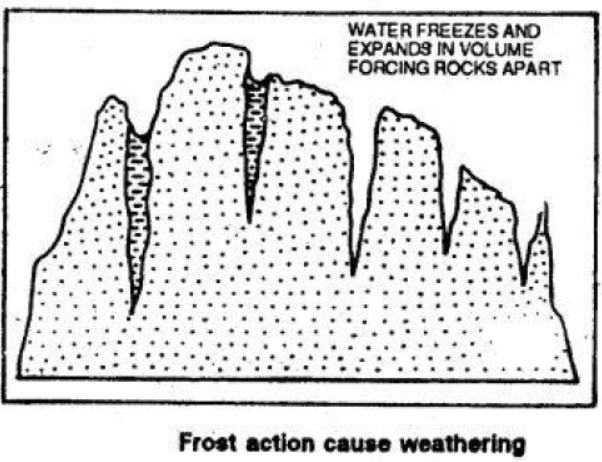
Answer: Frost action (freeze-thaw weathering) is highly active in high mountains and sub-polar climates. During the day, water seeps into rock cracks. At night, temperatures drop below freezing, and the water freezes into ice. Because water expands by about 10% in volume when freezing, it exerts immense outward pressure on the surrounding rock, widening the crack. Repeated freeze-thaw cycles eventually split the rock along its joints into large rectangular blocks (block disintegration).
In simple words: During the day, water enters rock cracks, and at night it freezes and expands. This ice acts like a wedge, widening the cracks until the rock splits into blocks.
Exam Tip: State that water expands by about one-tenth of its volume when freezing, which exerts the outward pressure that drives block disintegration.
Question 30. Name the different processes of chemical weathering.
Answer: The primary processes that drive chemical weathering are:
1. **Solution:** Water dissolves and carries away soluble minerals.
2. **Hydration:** Minerals chemically absorb water, expanding and turning to powder.
3. **Oxidation:** Oxygen reacts with minerals (especially iron) to form crumbly rust.
4. **Carbonation:** Carbonic acid reacts with minerals (like limestone) to form carbonates.
In simple words: The four chemical weathering processes are dissolving in water (solution), swelling with water (hydration), rusting (oxidation), and acid dissolving stone (carbonation).
Exam Tip: Be ready to list these four terms and provide a brief definition or chemical example for each to secure full marks.
Question 31. Describe the work of plants as agents of weathering.
Answer: Plants drive both physical and chemical weathering:
1. **Physical Wedging:** Plant roots grow into small joints and cracks in rocks. As the roots expand, they exert immense mechanical pressure that forces the cracks to widen, eventually splitting the rock.
2. **Water Seepage:** Widened cracks allow rainwater to penetrate deeper, accelerating chemical weathering and frost action.
3. **Organic Acid Decay:** Decaying plant matter (leaves, flowers, roots) releases organic humic acids into the soil. These acids react with rock minerals, breaking them down chemically.
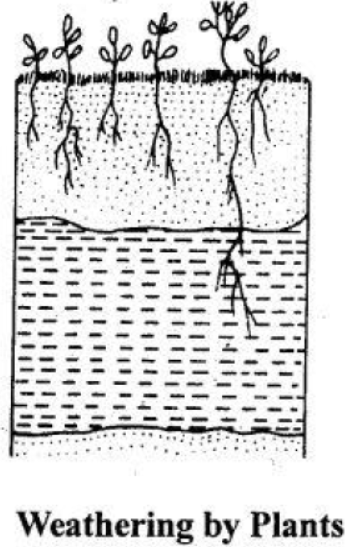
In simple words: Plant roots grow into rock cracks and split them apart mechanically. Decaying plant leaves and roots also release organic acids that dissolve rock minerals chemically.
Exam Tip: State that plants cause both physical weathering (via root pressure) and chemical weathering (via decaying organic acids).
Question 32. Which human activities lead to weathering of rocks ?
Answer: The primary human activities driving rock weathering are:
1. **Mining and Quarrying:** These industrial operations physically blast and expose massive bedrock formations, exposing fresh rock surfaces to rapid weathering.
2. **Deforestation:** Cutting down forests removes the protective soil-binding cover of plant roots. The exposed soil is easily eroded, and the bare bedrock beneath is directly exposed to sun, rain, and rapid temperature weathering.
In simple words: Human activities like mining, quarrying, and cutting down forests expose bare bedrock to rain and sun, causing it to weather much faster.
Exam Tip: Explain how exposing fresh bedrock surfaces to atmospheric elements accelerates weathering rates in industrial and cleared zones.
Question 33. State the effects of weathering.
Answer: The primary effects of weathering are:
1. **Landslides:** It weakens rocks and soil on steep slopes, triggering sudden landslides.
2. **Mudflows:** Weathered clay and debris mixed with rainwater flow rapidly downslope as mudflows.
3. **Erosion and Transport:** Breaking down hard rock into fine sediment makes it easy for rivers, wind, and glaciers to carry them away, exposing fresh rock to further weathering.
4. **Soil Creation:** Weathering is the essential first step of soil formation, grinding down bedrock into fine mineral sediments.
In simple words: Weathering causes landslides and mudflows on steep slopes, breaks down solid rock into fine particles that rivers can easily carry away, and helps create soil.
Exam Tip: List the key geomorphic and ecological effects of weathering - such as landslide triggers, erosion preparation, and soil pedogenesis - to ensure a complete answer.
Question 34. Give reasons for the following :
1. Change of temperature leads to physical weathering.
2. Presence of water aids chemical weathering.
3. Human activities encourage weathering.
4. Climate is the most important factor of soil formation.
5. Farmers are encouraged to adopt soil conservation methods.
6. A soil dominated by clay makes tilling difficult.
7. Grassland soils are less acidic than forest soils.
Answer: 1. **Temperature and Physical Weathering:** Daily heating expands the outer layers of rock, while nightly cooling contracts them, creating mechanical stress that cracks the rock.
2. **Water and Chemical Weathering:** Liquid water acts as a universal solvent, dissolving soluble minerals and facilitating chemical reactions like oxidation and carbonation.
3. **Human Activities:** Deforestation, mining, and quarrying strip away protective soil cover, directly exposing fresh bedrock surfaces to rapid weathering.
4. **Climate and Soil:** Climate determines the rate of weathering and the availability of soil moisture required for plant growth and microbial decomposers.
5. **Soil Conservation:** Conserving soil protects the nutrient-rich upper topsoil horizon from being washed away by water or blown away by wind.
6. **Clayey Soil Tilling:** High clay content makes soil sticky when wet and extremely tough when dry, making plowing and tilling difficult.
7. **Less Acidic Grassland Soil:** Grasses absorb large amounts of basic minerals, recycling them back to the surface and preventing acidic leaching common under forests.
In simple words: These explain key facts: 1. Heat expands rocks and cold contracts them, cracking the stone. 2. Water dissolves minerals and drives chemical reactions. 3. Human mining and logging expose bare rock to the elements. 4. Climate controls weathering rates and soil moisture. 5. Soil conservation protects the valuable, fertile topsoil. 6. Clayey soil is sticky and tough to plow. 7. Grassland soil is less acidic because grasses keep basic minerals near the surface.
Exam Tip: Answer each sub-part with a focused, scientifically sound explanation, referencing terms like "leaching" and "diurnal temperature range".
Question 35. Explain the following terms.
1. Colloids
2. Bases
Answer: 1. **Colloids:** These are extremely small, sub-microscopic soil particles that remain suspended indefinitely in water. They carry electrical charges, allowing them to attract and hold basic mineral ions (like calcium and magnesium). While they help the soil retain water, an excessive amount of clay colloids can make the soil sticky, dense, and difficult to till.
2. **Bases:** These are positively charged mineral ions, such as calcium, magnesium, and potassium, which are essential nutrients required by plants for their growth and development.
In simple words: 1. Colloids are tiny, charged particles that float in soil water and hold onto nutrients. 2. Bases are essential plant nutrients like calcium and potassium.
Exam Tip: Define soil colloids as charged particles that act as nutrient reservoirs, holding onto basic ions needed by crops.
Free study material for Geography
ICSE Voyage Solutions Class 9 Geography Chapter 9 Weathering
Students can now access the detailed Voyage Solutions for Chapter 9 Weathering on our portal. These solutions have been carefully prepared as per latest ICSE Class 9 syllabus. Each solution given above has been updated based on the current year pattern to ensure Class 9 students have the most updated Geography content.
Master Voyage Textbook Questions
Our subject experts have provided detailed explanations for all the questions found in the Voyage textbook for Class 9 Geography. We have focussed on making the concepts easy for you in Chapter 9 Weathering so that students can understand the concepts behind every answer. For all numerical problems and theoretical concepts these solutions will help in strengthening your analytical skill required for the ICSE examinations.
Complete Geography Exam Preparation
By using these Voyage Class 9 solutions, you can enhance your learning and identify areas that need more attention. We recommend solving the Geography Questions from the textbook first and then use our teacher-verified answers. For a proper revision of Chapter 9 Weathering, students should also also check our Revision Notes and Sample Papers available on studiestoday.com.
FAQs
You can download the verified Voyage solutions for Chapter 9 Weathering on StudiesToday.com. Our teachers have prepared answers for Class 9 Geography as per 2026-27 ICSE academic session.
Yes, our solutions for Chapter 9 Weathering are designed as per new 2026 ICSE standards. 40% competency-based questions required for Class 9, are included to help students understand application-based logic behind every Geography answer.
Yes, every exercise in Chapter 9 Weathering from the Voyage textbook has been solved step-by-step. Class 9 students will learn Geography conceots before their ICSE exams.
Yes, follow structured format of these Voyage solutions for Chapter 9 Weathering to get full 20% internal assessment marks and use Class 9 Geography projects and viva preparation as per ICSE 2026 guidelines.