

Access the latest CBSE Class 10 Mathematics Quadratic Equations Worksheet Set 03. We have provided free printable Class 10 Mathematics worksheets in PDF format, specifically designed for Chapter 4 Quadratic Equation. These practice sets are prepared by expert teachers following the 2025-26 syllabus and exam patterns issued by CBSE, NCERT, and KVS.
Chapter 4 Quadratic Equation Mathematics Practice Worksheet for Class 10
Students should use these Class 10 Mathematics chapter-wise worksheets for daily practice to improve their conceptual understanding. This detailed test papers include important questions and solutions for Chapter 4 Quadratic Equation, to help you prepare for school tests and final examination. Regular practice of these Class 10 Mathematics questions will help improve your problem-solving speed and exam accuracy for the 2026 session.
Download Class 10 Mathematics Chapter 4 Quadratic Equation Worksheet PDF
Question. Rohan’s mother is 26 years older than him. The product of their ages 3 years from now will be 360, then Rohan’s present age is
(a) 6 years
(b) 7 years
(c) 10 years
(d) 8 years
Answer: (b) 7 years
Explanation: Let Rohan’s present age be \( x \) years.
Then Rohan’s mother age will be \( (x + 26) \) years.
And after 3 years their ages will be \( (x + 3) \) and \( (x + 26 + 3) = (x + 29) \) years. According to question,
\( (x + 3) (x + 29) = 360 \)
\( \Rightarrow x^2 + 29x + 3x + 87 = 360 \)
\( \Rightarrow x^2 + 32x - 273 = 0 \)
\( \Rightarrow x^2 + 39x - 7x - 273 = 0 \)
\( \Rightarrow x(x + 39) - 7(x + 39) = 0 \)
\( \Rightarrow (x - 7) (x + 39) = 0 \)
\( \Rightarrow x - 7 = 0 \) and \( x + 39 = 0 \)
\( \Rightarrow x = 7 \) and \( x = -39 \) [\( x = -39 \) is not possible]
Therefore, Rohan’s present age is 7 years.
Question. If \( ax^2 + bx + c = 0 \) has equal roots, then c is equal to
(a) \( \frac{b^2}{2a} \)
(b) \( \frac{b^2}{4a} \)
(c) \( \frac{-b^2}{4a} \)
(d) \( -\frac{b^2}{2a} \)
Answer: (b) \( \frac{b^2}{4a} \)
Explanation: If \( ax^2 + bx + c = 0 \) has equal roots, then
\( b^2 - 4ac = 0 \)
\( \Rightarrow 4ac = b^2 \)
\( \Rightarrow c = \frac{b^2}{4a} \)
Question. Which of the following is a quadratic equation?
(a) \( x^3 - x^2 = (x - 1)^3 \)
(b) \( x^2 + 2x + 1 = (4 - x)^2 + 3 \)
(c) \( -2x^2 = (5 - x) (2x - \frac{2}{5}) \)
(d) \( (k + 1)x^2 + \frac{3}{2}x - 5 = 0 \), where k = – 1
Answer: (a) \( x^3 - x^2 = (x - 1)^3 \)
Explanation: In equation \( x^3 - x^2 = (x - 1)^3 \)
\( \Rightarrow x^3 - x^2 = x^3 - 1 - 3x^2 + 3x \)
\( \Rightarrow -x^2 + 3x^2 - 3x + 1 = 0 \)
\( \Rightarrow 2x^2 - 3x + 1 = 0 \)
It is a quadratic equation as its degree is 2.
Question. If ‘sin α’ and ‘cos α’ are the roots of the equation \( ax^2 + bx + c = 0 \), then \( b^2 = \)
(a) \( a^2 + 2ac \)
(b) \( a^2 + ac \)
(c) \( a^2 - ac \)
(d) \( a^2 - 2ac \)
Answer: (a) \( a^2 + 2ac \)
Explanation: Given: \( \alpha = \sin \alpha \) and \( \beta = \cos \alpha \)
\( \because \alpha + \beta = \frac{-b}{a} \)
\( \therefore \sin \alpha + \cos \alpha = \frac{-b}{a} \)
\( \Rightarrow (\sin \alpha + \cos \alpha)^2 = \frac{b^2}{a^2} \)
\( \Rightarrow 1 + 2 \sin \alpha \cos \alpha = \frac{b^2}{a^2} \) .....(i)
And \( \alpha\beta = \frac{c}{a} \)
\( \Rightarrow \sin \alpha \cos \alpha = \frac{c}{a} \)
\( \Rightarrow 2 \sin \alpha \cos \alpha = \frac{2c}{a} \) .....(ii)
Subtracting eq. (ii) from eq. (i), we get
\( 1 = \frac{b^2}{a^2} - \frac{2c}{a} \)
\( \Rightarrow 1 = \frac{b^2 - 2ac}{a^2} \)
\( \Rightarrow a^2 = b^2 - 2ac \)
\( \Rightarrow b^2 = a^2 + 2ac \)
Question. The quadratic equation, sum of whose roots is \( 3\sqrt{2} \) and their product is 5, is
(a) \( x^2 + 3\sqrt{2}x - 5 = 0 \)
(b) \( x^2 + 3\sqrt{2}x + 5 = 0 \)
(c) \( x^2 - 3\sqrt{2}x - 5 = 0 \)
(d) \( x^2 - 3\sqrt{2}x + 5 = 0 \)
Answer: (d) \( x^2 - 3\sqrt{2}x + 5 = 0 \)
Explanation: Given: Sum of roots \( (\alpha + \beta) = 3\sqrt{2} \) and Product of roots \( (\alpha\beta) = 5 \)
\( \therefore x^2 - (\alpha + \beta)x + \alpha\beta = 0 \)
\( \Rightarrow x^2 - 3\sqrt{2}x + 5 = 0 \)
Question. State whether the following equation is quadratic equation in x? \( 2x^2 + \frac{5}{2}x - \sqrt{3} = 0 \)
Answer: We have, \( 2x^2 + \frac{5}{2}x - \sqrt{3} = 0 \)
\( \Rightarrow 4x^2 + 5x - 2\sqrt{3} = 0 \)
Clearly, it is in the form of \( ax^2 + bx + c = 0 \)
\( \therefore 2x^2 + \frac{5}{2}x - \sqrt{3} = 0 \) is a quadratic equation.
Question. If -2 is a root of the equation \( 3x^2 + 5x + 2k = 0 \), then find the value of k.
Answer: put \( x = -2 \) in \( 3x^2 + 5x + 2k = 0 \)
\( 3(-2)^2 + 5(-2) + 2k = 0 \)
\( 3(4) + 5(-2) + 2k = 0 \)
\( 12 - 10 + 2k = 0 \)
\( 2 = -2k \)
\( \Rightarrow k = \frac{2}{-2} \)
\( \therefore k = -1 \)
Question. Find two consecutive numbers whose squares have the sum 85.
Answer: Let the two consecutive numbers be \( x \) and \( x + 1 \).
According to question,
\( x^2 + (x + 1)^2 = 85 \)
\( x^2 + x^2 + 1 + 2x = 85 \)
\( 2x^2 + 2x = 85 - 1 \)
\( 2x^2 + 2x = 84 \)
\( 2(x^2 + x) = 84 \)
\( x^2 + x = 42 \)
\( x^2 + x - 42 = 0 \)
\( x^2 + 7x - 6x - 42 = 0 \)
\( x(x + 7) - 6(x + 7) = 0 \)
\( (x + 7)(x - 6) = 0 \)
Hence, numbers are 6 and 7 or -7 and -6
Question. Check whether the given equation is quadratic equation: \( (x + 1)^2 = 2(x - 3) \)
Answer: The given equation is \( (x + 1)^2 = 2(x - 3) \)
\( \Rightarrow x^2 + 2x + 1 = 2x - 6 \)
\( \Rightarrow x^2 + 2x + 1 - 2x + 6 = 0 \)
\( \Rightarrow x^2 + 7 = 0 \)
\( \Rightarrow x^2 + 0.x + 7 = 0 \)
Which is of the form \( ax^2 + bx + c = 0 \)
Hence, the given equation is a quadratic equation.
Question. Find discriminant of the quadratic equation: \( 5x^2 + 5x + 6 = 0 \).
Answer: Given equation is \( 5x^2 + 5x + 6 = 0 \)
Here \( a = 5, b = 5, c = 6 \)
\( D = b^2 - 4ac = (5)^2 - 4 \times 5 \times 6 = 25 - 120 = -95 \)
Question. The sum of the squares of two positive integers is 208. If the square of the larger number is 18 times the smaller number, find the numbers.
Answer: Let the smaller number be \( x \) and the larger number be \( y \).
Also, Square of the larger number \( (y^2) = 18x \)
According to question,
\( x^2 + y^2 = 208 \)
\( \Rightarrow x^2 + 18x = 208 \)
\( \Rightarrow x^2 + 18x - 208 = 0 \)
\( \Rightarrow x^2 + 26x - 8x - 208 = 0 \)
\( \Rightarrow (x + 26) (x - 8) = 0 \Rightarrow x = 8, x = -26 \)
But, the numbers are positive. Therefore, \( x = 8 \)
Square of the larger number \( = 18x = 18 \times 8 = 144 \)
Therefore, larger number \( = \sqrt{144} = 12 \)
Hence, the numbers are 8 and 12.
Question. Solve the quadratic equation by factorization: \( 3x^2 - 2\sqrt{6}x + 2 = 0 \)
Answer: \( 3x^2 - 2\sqrt{6}x + 2 = 0 \)
\( 3x^2 - \sqrt{6}x - \sqrt{6}x + 2 = 0 \)
\( \Rightarrow \sqrt{3}x (\sqrt{3}x - \sqrt{2}) - \sqrt{2} (\sqrt{3}x - \sqrt{2}) = 0 \)
\( \Rightarrow (\sqrt{3}x - \sqrt{2}) (\sqrt{3}x - \sqrt{2}) = 0 \)
\( (\sqrt{3}x - \sqrt{2}) (\sqrt{3}x - \sqrt{2}) = 0 \)
\( \Rightarrow \sqrt{3}x - \sqrt{2} = 0 \) or \( x = \sqrt{\frac{2}{3}} \).
\( \therefore \) the roots are \( \sqrt{\frac{2}{3}}, \sqrt{\frac{2}{3}} \)
Question. A fast train takes 3 hours less than a slow train for a journey of 600 km. If the speed of the slow train is 10 km/h less than that of the fast train, find the speeds of the two trains.
Answer: Let the speed of the slow train be \( x \) km/hr
Then, the speed of the fast train \( = (x + 10) \) km/hr
As we know that Time \( = \frac{Distance}{Speed} \)
Time taken by the fast train to cover 600 km \( = \frac{600}{x+10} \) hrs
Time taken by the slow train to cover 600 km \( = \frac{600}{x} \) hrs
\( \therefore \frac{600}{x} - \frac{600}{x+10} = 3 \)
\( \Rightarrow \frac{600(x+10) - 600x}{x(x+10)} = 3 \)
\( \Rightarrow \frac{6000}{x^2+10x} = 3 \)
\( \Rightarrow 3x^2 + 30x - 6000 = 0 \)
\( \Rightarrow 3(x^2 + 10x - 2000) = 0 \) or \( x^2 + 10x - 2000 = 0 \)
\( \Rightarrow x^2 + 50x - 40x - 2000 = 0 \)
\( \Rightarrow x(x + 50) - 40(x + 50) = 0 \)
\( \Rightarrow (x + 50) (x - 40) = 0 \)
Either \( x = -50 \) or \( x = 40 \)
But the speed of the train cannot be negative. So, \( x = 40 \)
Hence, the speed of the two trains are 40 km/hr and 50 km/hr respectively.
Question. The difference of two numbers is 4. If the difference of their reciprocals is \( \frac{4}{21} \), then find the two numbers.
Answer: Let first number be \( x \).
Then, second number \( = x + 4 \)
According to the question,
\( \frac{1}{x} - \frac{1}{x+4} = \frac{4}{21} \)
\( \frac{x + 4 - x}{x(x+4)} = \frac{4}{21} \)
\( \frac{4}{x^2 + 4x} = \frac{4}{21} \)
\( 4x^2 + 4x = 84 \)
\( \Rightarrow 4x^2 + 16x - 84 = 0 \)
\( \Rightarrow 4(x^2 + 4x - 21) = 0 \)
\( \Rightarrow (x^2 + 4x - 21) = 0 \)
\( \Rightarrow (x + 7) (x - 3) = 0 \)
\( \Rightarrow x + 7 = 0 \) or \( x - 3 = 0 \)
\( \Rightarrow x = -7 \) or \( x = 3 \)
Therefore, the two numbers are 3 and 7 or -7 and -3
Question. A swimming pool is filled with three pipes with uniform flow. The first two pipes operating simultaneously, fill the pool in the same time during which the pool is filled by the third pipe alone. The second pipe fills the pool five hours faster than the first pipe and four hours slower than the third pipe. Find the time required by each pipe to fill the pool separately.
Answer: Let the number of hours required by the second pipe alone to fill the pool be \( x \) hrs.
Then, the first and third pipe takes \( (x + 5) \) hrs, \( (x - 4) \) hrs respectively to fill the pool.
So, the parts of the pool filled by the first, second and third pipes in one hour are respectively \( \frac{1}{x+5}, \frac{1}{x} \) and \( \frac{1}{x-4} \).
Let the time taken by first and second pipes to fill the pool simultaneously be \( t \) hrs. Then the third pipe also takes the same time to fill the pool.
\( \frac{1}{x+5} + \frac{1}{x} = \frac{1}{x-4} \)
\( \frac{x+x+5}{x(x+5)} = \frac{1}{x-4} \)
\( (2x+5) (x-4) = x^2 + 5x \)
\( 2x^2 - 3x - 20 - x^2 - 5x = 0 \)
\( x^2 - 8x - 20 = 0 \)
\( x^2 - 10x + 2x - 20 = 0 \)
\( x(x-10) + 2(x-10) = 0 \)
\( (x-10) (x+2) = 0 \)
Either \( x - 10 = 0 \) or \( x + 2 = 0 \)
\( x = 10, -2 \)
Since time taken cannot be negative. So \( x = 10 \)
Hence, the time required by the first, second and the third pipes to fill the pool individually are 15 hrs, 10 hrs and 6 hrs respectively.
Question. Two numbers differ by 3 and their product is 504. Find the numbers.
Answer: Let the required number be \( x \) and \( x + 3 \).
Then, according to given question we have,
\( x \times (x + 3) = 504 \)
\( \Rightarrow x^2 + 3x = 504 \)
\( \Rightarrow x^2 + 3x - 504 = 0 \)
\( \Rightarrow x^2 + 24x - 21x - 504 = 0 \)
\( \Rightarrow x(x + 24) - 21(x + 24) = 0 \)
\( \Rightarrow (x + 24)(x - 21) = 0 \)
\( \Rightarrow x + 24 = 0 \) or \( x - 21 = 0 \)
\( \Rightarrow x = -24 \) or \( x = 21 \)
Case I: When \( x = -24 \)
\( \therefore x + 3 = -24 + 3 = -21 \)
Case II: When \( x = 21 \)
\( \therefore x + 3 = 21 + 3 = 24 \)
Hence, the numbers are -21, -24 or 21, 24.
Question. The sum of first n even natural numbers is given by the relation \( x = n (n + 1) \). Find n, if the sum is 420.
Answer: \( n(n + 1) = 420 \) ...Given
\( \Rightarrow n^2 + n = 420 \)
\( \Rightarrow n^2 + n - 420 = 0 \)
Comparing with \( An^2 + Bn + C = 0 \), we get
A = 1, B = 1, C = -420
Using the quadratic formula, \( n = \frac{-B \pm \sqrt{B^2 - 4AC}}{2A} \)
we get \( \Rightarrow \frac{-1 \pm \sqrt{1 + 1680}}{2} = \frac{-1 \pm \sqrt{1681}}{2} \)
\( = \frac{-1 \pm 41}{2} \)
\( \frac{-1 + 41}{2}, \frac{-1 - 41}{2} = 20, -21 \)
\( n = -21 \) is inadmissible as n is the number of terms.
\( \therefore n = 20 \)
Hence, the required value of n is 20.
Question. The length of the hypotenuse of a right-angled triangle exceeds the length of the base by 2 cm and exceeds twice the length of the altitude by 1 cm. Find the length of each side of the triangle.
Answer: Let base \( = x \)
Altitude \( = y \)
Hypotenuse \( = h \)
According to question,
\( h = x + 2 \)
\( h = 2y + 1 \)
\( \Rightarrow x + 2 = 2y + 1 \)
\( \Rightarrow x + 2 - 1 = 2y \)
\( \Rightarrow x + 1 = 2y \)
\( \Rightarrow \frac{x+1}{2} = y \)
And \( x^2 + y^2 = h^2 \)
\( \Rightarrow x^2 + \left( \frac{x+1}{2} \right)^2 = (x + 2)^2 \)
\( \Rightarrow x^2 - 15x + x - 15 = 0 \)
\( \Rightarrow x^2 - 15x + x - 15 = 0 \)
\( \Rightarrow (x - 15)(x + 1) = 0 \)
\( \Rightarrow x = 15 \) or \( x = -1 \)
Base = 15 cm
Altitude = \( \frac{x+1}{2} = 8 \text{ cm} \)
Hypotenuse = 17 cm.
Question. In the centre of a rectangular lawn of dimensions 50 m × 40 m, a rectangular pond has to be constructed so that the area of the grass surrounding the pond would be 1184 \( m^2 \). Find the length and breadth of the pond
Answer: Let width of the pond border be \( x \) m. Then,
The length of pond \( = (50 - 2x) \) m and the breadth of pond \( = (40 - 2x) \) m
Area of grass around the pond \( = 1184 \text{ m}^2 \)
\( \Rightarrow \) Area of Lawn - Area of Pond \( = 1184 \)
\( \Rightarrow 50 \times 40 - (50 - 2x)(40 - 2x) = 1184 \)
\( \Rightarrow 2000 - (2000 - 100x - 80x + 4x^2) - 1184 = 0 \)
\( \Rightarrow 2000 - (2000 - 180x + 4x^2) - 1184 = 0 \)
\( \Rightarrow 2000 - 2000 + 180x - 4x^2 - 1184 = 0 \)
\( \Rightarrow 4x^2 - 180x + 1184 = 0 \)
\( \Rightarrow 4(x^2 - 45x + 296) = 0 \)
\( \Rightarrow x^2 - 45x + 296 = 0 \)
Factorise now,
\( \Rightarrow x^2 - 37x - 8x + 296 = 0 \)
\( \Rightarrow x(x - 37) - 8(x - 37) = 0 \)
\( \Rightarrow (x - 37) (x - 8) = 0 \)
\( \Rightarrow x - 37 = 0 \) or \( x - 8 = 0 \)
\( \Rightarrow x = 37 \) or \( x = 8 \)
When \( x = 37 \), then
The length of pond \( = 50 - 2 \times 37 = 50 - 74 = -24 \) m (Length cannot be negative)
When \( x = 8 \), then
The length of pond \( = 50 - 2(8) = 50 - 16 = 34 \) m
And the breadth of the pond \( = 40 - 2(8) = 40 - 16 = 24 \) m
Therefore, the length and breadth of the pond are 34 m and 24 m respectively.
Question. A man travels a distance of 300 km at a uniform speed. If the speed of the train is increased by 5 km an hour, the journey would have taken two hours less. Find the original speed of the train.
Answer: Let the original speed of the train be \( x \) km an hour
Then, the total speed taken by the train to travel a distance of 300 km at a uniform speed of \( x \) km an hour \( = \frac{300}{x} \) hours
Increased speed of the train \( = (x + 5) \) km an hour
Time taken by the train to travel a distance of 300 km at the increased speed \( = \frac{300}{x+5} \) hours
According to the equation,
\( \frac{300}{x} - 2 = \frac{300}{x+5} \)
\( \Rightarrow \frac{300}{x} - \frac{300}{x+5} = 2 \Rightarrow 300 \left( \frac{1}{x} - \frac{1}{x+5} \right) = 2 \)
\( \Rightarrow \frac{1}{x} - \frac{1}{x+5} = \frac{2}{300} \Rightarrow \frac{1}{x} - \frac{1}{x+5} = \frac{1}{150} \)
\( \Rightarrow \frac{x+5-x}{x(x+5)} = \frac{1}{150} \Rightarrow \frac{5}{x^2+5x} = \frac{1}{150} \)
\( \Rightarrow x^2 + 5x = 750 \)
\( \Rightarrow x^2 + 5x - 750 = 0 \)
Comparing with \( ax^2 + bx + c = 0 \)
a = 1, b = 5, c = -750
Using the quadratic formula, \( x = \frac{-b \pm \sqrt{b^2 - 4ac}}{2a} \)
we get \( = \frac{-5 \pm \sqrt{(5)^2 - 4(1)(-750)}}{2(1)} \)
\( = \frac{-5 \pm \sqrt{25 + 3000}}{2} = \frac{-5 \pm \sqrt{3025}}{2} = \frac{-5 \pm 55}{2} \)
\( = \frac{-5+55}{2}, \frac{-5-55}{2} = 25, -30 \)
\( x = -30 \) is inadmissible as \( x \) is the speed of the train and speed cannot be negative.
\( \therefore x = 25 \)
Hence, the original speed of the train is 25 km an hour.
Question. \( (x + 1)^2 - x^2 = 0 \) has
(a) no real roots
(b) 1 real root
(c) 2 real roots
(d) 4 real roots
Answer: (b) 1 real root
Question. \( 9x^2 + 12x + 4 = 0 \) have
(a) Real and Distinct roots
(b) No real roots
(c) Distinct roots
(d) Real and Equal roots
Answer: (d) Real and Equal roots
Question. If the equation \( (a^2 + b^2)x^2 - 2(ac + bd)x + c^2 + d^2 = 0 \) has equal roots, then
(a) \( ad = bc \)
(b) \( ab = cd \)
(c) \( ad = \sqrt{bc} \)
(d) \( ab = \sqrt{cd} \)
Answer: (a) \( ad = bc \)
Question. The ratio of sum and the product of the roots of \( 7x^2 - 12x + 18 = 0 \) is
(a) 2 : 3
(b) 3 : 2
(c) 7 : 18
(d) 7 : 12
Answer: (a) 2 : 3
Question. If \( y = 1 \) is the common root of \( ly^2 + ly + 3 = 0 \) and \( y^2 + y + m = 0 \), then the value of ‘\( lm \)’ is
(a) 3
(b) – 4
(c) 4
(d) None of the options
Answer: (a) 3
Question. Solve the quadratic equations by factorization method: \( x^2 - 9 = 0 \)
Answer: We have,
\( x^2 - 9 = 0 \)
\( \Rightarrow (x - 3)(x + 3) = 0 \)
\( \Rightarrow x - 3 = 0 \) or \( x + 3 = 0 \)
\( \Rightarrow x = 3 \) or, \( x = -3 \)
\( \Rightarrow x = \pm 3 \)
Thus, \( x = 3 \) and \( x = -3 \) are roots of the given equation.
Question. Find the values of \( p \) for which the quadratic equation \( 4x^2 + px + 3 = 0 \) has equal roots.
Answer: \( 4x^2 + px + 3 = 0 \)
\( a = 4, b = p \) and \( c = 3 \)
As the equation has equal roots
\( \therefore D = 0 \)
\( D = b^2 - 4ac = 0 \)
or, \( p^2 - 4 \times 4 \times 3 = 0 \)
or, \( p^2 - 48 = 0 \)
or, \( p^2 = 48 \)
or, \( p = \pm 4\sqrt{3} \)
Question. Form a quadratic equation whose roots are -3 and 4.
Answer: We have, \( x = 4 \) and \( x = -3 \).
Then,
\( x - 4 = 0 \) and \( x + 3 = 0 \)
\( \Rightarrow (x - 4)(x + 3) = 0 \)
\( \Rightarrow x^2 + 3x - 4x - 12 = 0 \)
\( \Rightarrow x^2 - x - 12 = 0 \)
This is the required quadratic equation
Question. If \( x = -\frac{1}{2} \) is a solution of the quadratic equation \( 3x^2 + 2kx + 3 = 0 \), find the value of \( k \).
Answer: we have, \( 3x^2 + 2kx + 3 = 0 \)
put, \( x = -\frac{1}{2} \) (given)
\( \Rightarrow 3(-\frac{1}{2})^2 + 2k(-\frac{1}{2}) + 3 = 0 \)
\( \Rightarrow 3(\frac{1}{4}) - k + 3 = 0 \)
\( \Rightarrow \frac{3}{4} - k + 3 = 0 \)
\( \Rightarrow k = 3 + \frac{3}{4} \)
\( \therefore k = \frac{15}{4} \)
Question. Write the discriminant of the given quadratic equation \( x^2 + x - 12 = 0 \)
Answer: The given quadratic equation is \( x^2 + x - 12 = 0 \),
here \( a=1, b=1, c=-12 \)
\( \therefore D = b^2 - 4ac = (1)^2 - 4(1)(-12) = 1 + 48 = 49 \)
Hence, the discriminant is 49.
Question. Find the values of \( k \) for which the given equation has real and equal roots: \( (k + 1)x^2 - 2(k - 1)x + 1 = 0 \)
Answer: We have, \( (k + 1)x^2 - 2(k - 1)x + 1 = 0 \).
\( a = k + 1, b = -2(k - 1), c = 1 \).
\( D = b^2 - 4ac = 4(k - 1)^2 - 4(k + 1) = 4(k^2 - 3k) \)
The given equation will have real and equal roots, if
\( D = 0 \Rightarrow 4(k^2 - 3k) = 0 \Rightarrow k^2 - 3k = 0 \Rightarrow k(k - 3) = 0 \Rightarrow k = 0, 3 \)
Question. Check, whether the quadratic equation have real roots and if so, then find the roots of equation. \( 6x^2 + x - 2 = 0 \)
Answer: The given equation is \( 6x^2 + x - 2 = 0 \)
Here, \( a = 6, b = 1 \) and, \( c = -2 \)
\( D = b^2 - 4ac = 1 - 4 \times 6 \times -2 = 49 > 0 \)
So, the given equation has real roots, given by
\( \alpha = \frac{-b + \sqrt{D}}{2a} = \frac{-1 + \sqrt{49}}{2 \times 6} = \frac{-1 + 7}{12} = \frac{6}{12} = \frac{1}{2} \)
and, \( \beta = \frac{-b - \sqrt{D}}{2a} = \frac{-1 - \sqrt{49}}{2 \times 6} = \frac{-1 - 7}{12} = \frac{-8}{12} = \frac{-2}{3} \)
Question. Check whether the given equation is quadratic equation: \( (x - 3)(2x + 1) = x(x + 5) \)
Answer: The given equation is \( (x - 3)(2x + 1) = x(x + 5) \)
\( \Rightarrow 2x^2 + x - 6x - 3 = x^2 + 5x \)
\( \Rightarrow 2x^2 - 5x - 3 = x^2 + 5x \)
\( \Rightarrow x^2 - 10x - 3 = 0 \)
It is in the form of \( ax^2 + bx + c = 0, a \neq 0 \)
\( \therefore \) the given equation is a quadratic equation.
Question. In a class test, the sum of Shefali's marks in Mathematics and English is 30. Had she got 2 marks more in Mathematics and 3 marks less in English, the product of their marks would have been 210. Find her marks in the two subjects.
Answer: Let Shefali's marks in Mathematics \( = x \)
Let Shefali's marks in English \( = 30 - x \)
If, she had got 2 marks more in Mathematics, her marks would be \( = x + 2 \)
If, she had got 3 marks less in English, her marks in English would be \( = 30 - x - 3 = 27 - x \)
According to given condition:
\( \Rightarrow (x + 2)(27 - x) = 210 \)
\( \Rightarrow 27x - x^2 + 54 - 2x = 210 \)
\( \Rightarrow x^2 - 25x + 156 = 0 \)
Comparing quadratic equation \( x^2 - 25x + 156 = 0 \) with general form \( ax^2 + bx + c = 0 \),
We get \( a = 1, b = -25 \) and \( c = 156 \)
Applying Quadratic Formula \( x = \frac{-b \pm \sqrt{b^2 - 4ac}}{2a} \)
\( x = \frac{25 \pm \sqrt{(-25)^2 - 4(1)(156)}}{2 \times 1} \)
\( \Rightarrow \frac{25 \pm \sqrt{625 - 624}}{2} \)
\( \Rightarrow x = \frac{25 \pm \sqrt{1}}{2} \)
\( \Rightarrow x = \frac{25 + 1}{2}, \frac{25 - 1}{2} \)
\( \Rightarrow x = 13, 12 \)
Therefore, Shefali's marks in Mathematics \( = 13 \) or \( 12 \)
Shefali's marks in English \( = 30 - x = 30 - 13 = 17 \)
Or Shefali's marks in English \( = 30 - x = 30 - 12 = 18 \)
Therefore, her marks in Mathematics and English are (13, 17) or (12, 18).
Question. If 2 is a root of the quadratic equation \( 3x^2 + px - 8 = 0 \) and the quadratic equation \( 4x^2 - 2px + k = 0 \) has equal roots, find \( k \).
Answer: Given, 2 is a root of the equation, \( 3x^2 + px - 8 = 0 \)
Putting \( x = 2 \) in \( 3x^2 + px - 8 = 0 \)
\( 3(2)^2 + 2p - 8 = 0 \)
\( 12 + 2p - 8 = 0 \)
or, \( p = -2 \)
Given, \( 4x^2 - 2px + k = 0 \) has equal roots
\( 4x^2 + 4x + k = 0 \) has equal roots
\( D = b^2 - 4ac = 0 \)
or, \( (4)^2 - 4(4)(k) = 0 \)
or, \( 16 - 16k = 0 \)
or, \( 16k = 16 \)
\( \therefore k = 1 \)
Question. If \( p, q, r \) and \( s \) are real numbers such that \( pr = 2(q + s) \), then show that at least one of the equations \( x^2 + px + q = 0 \) and \( x^2 + rx + s = 0 \) has real roots.
Answer: Given quadratic equations are;
\( x^2 + px + q = 0 \) —(i)
and, \( x^2 + rx + s = 0 \) ......(ii)
Also given; \( pr = 2(q + s) \) ........(iii)
Let \( D_1 \) and \( D_2 \) be the discriminant of quadratic equations (i) and (ii) respectively.
Then,
\( D_1 = p^2 - 4q \) and \( D_2 = r^2 - 4s \)
\( \Rightarrow D_1 + D_2 = p^2 - 4q + r^2 - 4s = (p^2 + r^2) - 4(q + s) \)
\( \Rightarrow D_1 + D_2 = p^2 + r^2 - 4(\frac{pr}{2}) \) ([from equation (iii)]
\( \Rightarrow D_1 + D_2 = p^2 + r^2 - 2pr = (p - r)^2 \ge 0 \) [\( \because (p - r)^2 \ge 0 \) for all real \( p, r \)]
Now, Since sum of both \( D_2 \) & \( D_1 \) is greater than or equal to 0. Hence, both can't be negative.
\( \Rightarrow \) At least one of \( D_1 \) and \( D_2 \) is greater than or equal to zero
Case 1. If \( D_1 \ge 0 \), equation (i) has real roots.
Case 2. If \( D_2 \ge 0 \), equation (ii) has real roots.
Case 3. If \( D_1 \) & \( D_2 \) both \( \ge 0 \), then equation (i) & (ii) both have equal roots.
Clearly, from case 1, 2 & 3 at least one given quadratic equations has equal roots.
Question. The speed of a boat in still water is 8 km/hr. It can go 15 km upstream and 22 km downstream in 5 hours. Find the speed of the stream.
Answer: Given, speed of boat in still water = 8 Km/hr. Let the speed of the stream be \( x \) km/hr.
Then,
Speed of boat in downstream = \( (8 + x) \) km/hr
Speed of boat in upstream = \( (8 - x) \) km/hr
We know that time taken to cover 'd' km with speed 's' km/hr is \( \frac{d}{s} \)
So, Time taken by the boat to go 15 km upstream \( = \frac{15}{8-x} \) hours.
&, Time taken by the boat to 22 km downstream \( = \frac{22}{8+x} \) hours.
It is given that the total time taken by boat to go 15 km upstream & 22 km downstream is 5 hours.
\( \therefore \frac{15}{8-x} + \frac{22}{8+x} = 5 \)
\( \Rightarrow \frac{15(8+x) + 22(8-x)}{(8-x)(8+x)} = 5 \)
\( \Rightarrow \frac{120 + 15x + 176 - 22x}{8^2 - x^2} = 5 \)
\( \Rightarrow \frac{-7x + 296}{64 - x^2} = 5 \)
\( \Rightarrow -7x + 296 = 5(64 - x^2) \)
\( \Rightarrow -7x + 296 = 320 - 5x^2 \)
\( \Rightarrow 5x^2 - 7x + 296 - 320 = 0 \)
\( \Rightarrow 5x^2 - 7x - 24 = 0 \)
\( \Rightarrow 5x^2 - 15x + 8x - 24 = 0 \)
\( \Rightarrow 5x(x - 3) + 8(x - 3) = 0 \)
\( \Rightarrow (5x + 8)(x - 3) = 0 \)
\( \Rightarrow x - 3 = 0 \) [\( \because \) Speed cannot be negative \( \therefore 5x + 8 \neq 0 \)]
\( \Rightarrow x = 3 \)
Hence, the speed of the stream is 3 km/hr.
Question. A train travelling at a uniform speed for 360 km, would have taken 48 minutes less to travel the same distance if its speed were 5 km/hour more. Find the original speed of the train.
Answer: Given that a train travelling at a uniform speed for 360 km
Let the original speed of the train be \( x \) km/hr
Time taken \( = \frac{Distance}{Speed} = \frac{360}{x} \)
Time taken at increased speed \( = \frac{360}{x + 5} \) hours.
According to the question
\( \frac{360}{x} - \frac{360}{x+5} = \frac{48}{60} \)
\( 360 \left[ \frac{1}{x} - \frac{1}{x+5} \right] = \frac{4}{5} \)
or, \( \frac{360(x + 5 - x)}{x^2 + 5x} = \frac{4}{5} \)
or, \( \frac{1800}{x^2 + 5x} = \frac{4}{5} \)
\( \Rightarrow x^2 + 5x - 2250 = 0 \)
\( \Rightarrow x^2 + (50 - 45)x - 2250 = 0 \)
\( \Rightarrow x^2 + 50x - 45x - 2250 = 0 \)
\( \Rightarrow (x + 50)(x - 45) = 0 \)
Either \( x = -50 \) or \( x = 45 \)
As speed cannot be negative
\( \therefore \) Original speed of train = 45 km/hr.
Question. Solve for \( x \): \( \sqrt{3}x^2 + 10x + 7\sqrt{3} = 0 \)
Answer: We have the following equation,
\( \sqrt{3}x^2 + 10x + 7\sqrt{3} = 0 \)
Now factorise the equation,
\( \sqrt{3}x^2 + 3x + 7x + 7\sqrt{3} = 0 \)
\( \Rightarrow \sqrt{3}x(x + \sqrt{3}) + 7(x + \sqrt{3}) = 0 \)
\( \Rightarrow (x + \sqrt{3})(\sqrt{3}x + 7) = 0 \)
\( \Rightarrow x = -\sqrt{3} \) or \( x = \frac{-7}{\sqrt{3}} \)
If \( x = \frac{-7}{\sqrt{3}} \) we need to rationalise it.
\( \Rightarrow x = \frac{-7 \times \sqrt{3}}{\sqrt{3} \times \sqrt{3}} = -\frac{7\sqrt{3}}{3} \)
Therefore, Roots are \( -\sqrt{3}, -\frac{7\sqrt{3}}{3} \)
Question. Solve for \( x \): \( 2\left(\frac{x+2}{2x-3}\right) - 9\left(\frac{2x-3}{x+2}\right) = 3 \); given that \( x \neq -2, x \neq \frac{3}{2} \)
Answer: Let \( \frac{x+2}{2x-3} = y \) ...(i)
\( \therefore \) Given equation becomes,
\( 2y - 9 \times \frac{1}{y} = 3 \)
\( \Rightarrow 2y^2 - 3y - 9 = 0 \)
\( \Rightarrow 2y^2 - 6y + 3y - 9 = 0 \)
\( \Rightarrow 2y(y - 3) + 3(y - 3) = 0 \)
\( \Rightarrow (2y + 3)(y - 3) = 0 \)
\( \Rightarrow y = -\frac{3}{2} \) or \( y = 3 \)
Putting the value of \( y \) in equation (i), we get
\( \frac{x+2}{2x-3} = -\frac{3}{2} \) or \( \frac{x+2}{2x-3} = 3 \)
\( \Rightarrow 2x + 4 = -6x + 9 \) or \( x + 2 = 6x - 9 \)
\( \Rightarrow 8x = 5 \) or \( -5x = -11 \)
\( \Rightarrow x = \frac{5}{8} \) or \( x = \frac{11}{5} \)

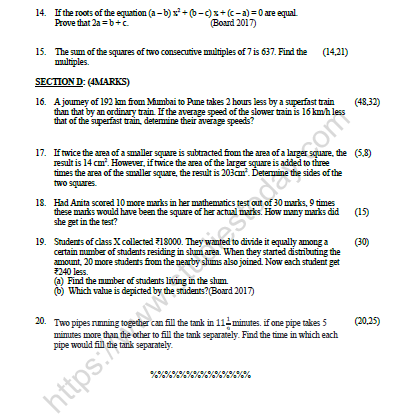
Please click on below link to download CBSE Class 10 Mathematics Quadratic Equations Worksheet Set C
Free study material for Mathematics
Chapter 4 Quadratic Equation CBSE Class 10 Mathematics Worksheet
Students can use the Chapter 4 Quadratic Equation practice sheet provided above to prepare for their upcoming school tests. This solved questions and answers follow the latest CBSE syllabus for Class 10 Mathematics. You can easily download the PDF format and solve these questions every day to improve your marks. Our expert teachers have made these from the most important topics that are always asked in your exams to help you get more marks in exams.
NCERT Based Questions and Solutions for Chapter 4 Quadratic Equation
Our expert team has used the official NCERT book for Class 10 Mathematics to create this practice material for students. After solving the questions our teachers have also suggested to study the NCERT solutions which will help you to understand the best way to solve problems in Mathematics. You can get all this study material for free on studiestoday.com.
Extra Practice for Mathematics
To get the best results in Class 10, students should try the Mathematics MCQ Test for this chapter. We have also provided printable assignments for Class 10 Mathematics on our website. Regular practice will help you feel more confident and get higher marks in CBSE examinations.
FAQs
You can download the teacher-verified PDF for CBSE Class 10 Mathematics Quadratic Equations Worksheet Set 03 from StudiesToday.com. These practice sheets for Class 10 Mathematics are designed as per the latest CBSE academic session.
Yes, our CBSE Class 10 Mathematics Quadratic Equations Worksheet Set 03 includes a variety of questions like Case-based studies, Assertion-Reasoning, and MCQs as per the 50% competency-based weightage in the latest curriculum for Class 10.
Yes, we have provided detailed solutions for CBSE Class 10 Mathematics Quadratic Equations Worksheet Set 03 to help Class 10 and follow the official CBSE marking scheme.
Daily practice with these Mathematics worksheets helps in identifying understanding gaps. It also improves question solving speed and ensures that Class 10 students get more marks in CBSE exams.
All our Class 10 Mathematics practice test papers and worksheets are available for free download in mobile-friendly PDF format. You can access CBSE Class 10 Mathematics Quadratic Equations Worksheet Set 03 without any registration.