

Access the latest CBSE Class 10 Mathematics Statistics Worksheet Set 02. We have provided free printable Class 10 Mathematics worksheets in PDF format, specifically designed for Chapter 13 Statistics. These practice sets are prepared by expert teachers following the 2025-26 syllabus and exam patterns issued by CBSE, NCERT, and KVS.
Chapter 13 Statistics Mathematics Practice Worksheet for Class 10
Students should use these Class 10 Mathematics chapter-wise worksheets for daily practice to improve their conceptual understanding. This detailed test papers include important questions and solutions for Chapter 13 Statistics, to help you prepare for school tests and final examination. Regular practice of these Class 10 Mathematics questions will help improve your problem-solving speed and exam accuracy for the 2026 session.
Download Class 10 Mathematics Chapter 13 Statistics Worksheet PDF
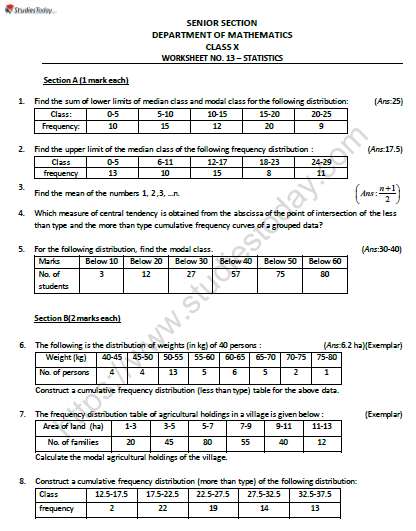
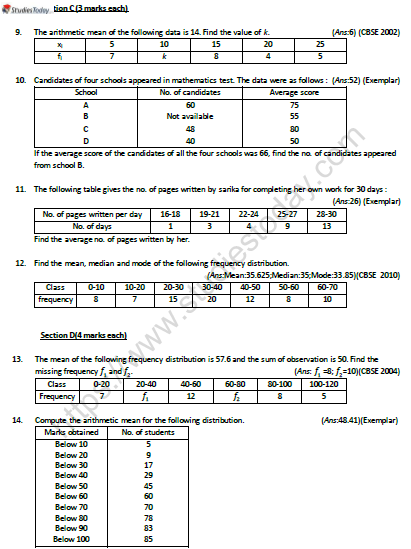
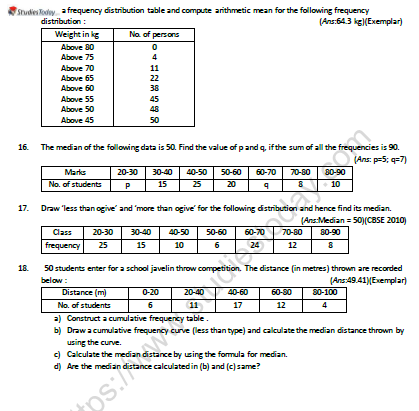
Evaluation and Analysis Based Questions
Question. The mean of \( x_1, x_2, x_3, \dots, x_n \) is \( \bar{x} \). If \( (a - 2b) \) is added to each of the observations, show that the mean of the new observations \( = \bar{x} + (a - 2b) \)
Answer:
Sol. Given, \( \frac{x_1 + x_2 + x_3 + \dots + x_n}{n} = \bar{x} \)
\( \Rightarrow x_1 + x_2 + x_3 + \dots + x_n = n\bar{x} \) ...(i)
Now, the sum of the new 'n' observations
\( = x_1 + (a - 2b) + x_2 + (a - 2b) + \dots + x_n + (a - 2b) \)
\( = x_1 + x_2 + \dots + x_n + n(a - 2b) \)
\( = n\bar{x} + n(a - 2b) \)
\( = n\{\bar{x} + (a - 2b)\} \) [From (i)]
New mean \( = \frac{n\{\bar{x} + (a - 2b)\}}{n} = \bar{x} + (a - 2b) \).
Hence Proved.
Question. Given \( \sum_{i=1}^{n}(x_i - 3) = 84 \) and \( \sum_{i=1}^{n}(x_i + 2) = 144 \), find n and the mean.
Answer:
Sol. \( \sum_{i=1}^{n}(x_i - 3) = x_1 + x_2 + \dots + x_n - 3n = 84 \)
\( \therefore S - 3n = 84 \) [Let \( S = x_1 + x_2 + \dots + x_n \)] ...(i)
and \( \sum_{i=1}^{n}(x_i + 2) = x_1 + x_2 + x_3 + \dots + x_n + 2n = 144 \)
\( = 144 \)
\( \Rightarrow S + 2n = 144 \) ...(ii)
Multiplying equation (i) by 2 and equation (ii) by 3 and then adding, we get
\( 5S = 2 \times 84 + 3 \times 144 \)
\( \Rightarrow 5S = 168 + 432 \)
\( \Rightarrow 5S = 600 \)
\( \Rightarrow S = 120 \)
Putting the value of \( S \) in equation (i), we get
\( 120 - 3n = 84 \)
\( \Rightarrow 3n = 120 - 84 = 36 \)
\( \Rightarrow n = \frac{36}{3} = 12 \)
\( \text{Mean} = \frac{S}{n} = \frac{120}{12} = 10 \).
Question. The A.M. of n observations is M. If the sum of n – 4 observations is a, then find the mean of remaining 4 observations.
Answer:
Sol. Let the mean of the remaining 4 observations be \( \bar{x} \).
Given, mean of n observations \( = M \)
\( \therefore M = \frac{a + 4\bar{x}}{(n - 4) + 4} \)
where \( a = \) sum of \( n - 4 \) observations
\( \Rightarrow \bar{x} = \frac{nM - a}{4} \)
Hence, mean of remaining 4 observations \( = \frac{nM - a}{4} \)
Question. Prove that \( \sum_{i=1}^{n}(x_i - \bar{x}) = 0 \).
Answer:
Sol. Let \( x_1, x_2, x_3, \dots, x_n \) be the set of n observations.
Then, \( \bar{x} = \frac{x_1 + x_2 + x_3 + \dots + x_n}{n} \)
or \( n\bar{x} = x_1 + x_2 + x_3 + \dots + x_n \) ...(i)
The sum of the deviations of all the observations from their mean is given by
\( \sum_{i=1}^{n}(x_i - \bar{x}) \)
\( = (x_1 - \bar{x}) + (x_2 - \bar{x}) + \dots + (x_n - \bar{x}) \)
\( = (x_1 + x_2 + x_3 + \dots + x_n) - (\bar{x} + \bar{x} + \dots \text{ n times}) \)
\( = n\bar{x} - n\bar{x} = 0 \) [From (i)]
Hence Proved.
Question. The mean of marks scored by 100 students was found to be 40. Later on, it was discovered that a score of 53 was misread as 83. Find the correct mean.
Answer:
Sol. Here, \( n = 100, \bar{x} = 40 \)
We know, \( \bar{x} = \frac{1}{n}(\sum x_i) \Rightarrow 40 = \frac{1}{100}(\sum x_i) \)
\( \therefore \) Incorrect value of \( \sum x_i = 4000 \)
Now, correct value of \( \sum x_i = 4000 - 83 + 53 = 3970 \)
\( \therefore \text{Correct mean} = \frac{\text{Correct value of } \sum x_i}{n} \)
\( = \frac{3970}{100} = 39.7 \)
So, the correct mean is 39.7.
Question. If the median of the following frequency distribution is 32.5. Find the values of \( f_1 \) and \( f_2 \).
Class | Frequency
0 – 10 | \( f_1 \)
10 – 20 | 5
20 – 30 | 9
30 – 40 | 12
40 – 50 | \( f_2 \)
50 – 60 | 3
60 – 70 | 2
Total | 40
Answer:
Sol. Given, Median \( = 32.5 \)
Class | Frequency | Cumulative Frequency
0 – 10 | \( f_1 \) | \( f_1 \)
10 – 20 | 5 | \( f_1 + 5 \)
20 – 30 | 9 | \( f_1 + 14 \)
30 – 40 | 12 | \( f_1 + 26 \)
40 – 50 | \( f_2 \) | \( f_1 + f_2 + 26 \)
50 – 60 | 3 | \( f_1 + f_2 + 29 \)
60 – 70 | 2 | \( f_1 + f_2 + 31 \)
Total frequency \( = 40 \)
\( \therefore f_1 + f_2 + 31 = 40 \)
or \( f_1 + f_2 = 9 \) ...(i)
Also, \( \frac{n}{2} = \frac{40}{2} = 20 \)
Median \( = 32.5 \) (Given) which lies in the class interval (30 – 40)
\( \therefore \text{Median class} = 30 – 40 \)
\( l = 30 \)
\( f = 12, c.f = f_1 + 14 \)
\( h = 10 \)
So, \( \text{Median} = l + \left[ \frac{\frac{n}{2} - c.f.}{f} \right] \times h \)
\( \Rightarrow 32.5 = 30 + \left[ \frac{20 - (f_1 + 14)}{12} \right] \times 10 \)
\( \Rightarrow 32.5 = 30 + \left( \frac{6 - f_1}{12} \right) \times 10 \)
\( \Rightarrow 2.5 = \frac{5}{6}(6 - f_1) \)
\( \Rightarrow \frac{2.5 \times 6}{5} = 6 - f_1 \)
\( \Rightarrow 6 - f_1 = 3 \Rightarrow f_1 = 3 \)
From equation (i), we get \( f_2 = 6 \)
\( \therefore f_1 = 3, f_2 = 6 \)
Question. In a retail market, fruit vendors were selling mangoes kept in packing boxes. These boxes contained varying number of mangoes. The following was the distribution of mangoes according to the number of boxes.
Number of mangoes | Number of boxes
50 – 52 | 15
53 – 55 | 110
56 – 58 | 135
59 – 61 | 115
62 – 65 | 25
Find the mean number of mangoes kept in a packing box. Which method of finding the mean did you choose?
Answer:
Sol.
C.I. | \( f_i \) | (\( x_i \)) | \( d_i = x_i - 75 \) | \( f_id_i \)
50 – 52 | 15 | 51 | – 6 | – 90
53 – 55 | 110 | 54 | – 3 | – 330
56 – 58 | 135 | \( 57 = A \) | 0 | 0
59 – 61 | 115 | 60 | 3 | 345
62 – 64 | 25 | 63 | 6 | 150
Total | \( \sum f_i = 400 \) | | | \( \sum f_id_i = 75 \)
Here, we have \( \sum f_id_i = 75, A = 57 \)
Now, \( \bar{x} = A + \frac{\sum f_id_i}{\sum f_i} \)
\( = 57 + \frac{75}{400} \)
\( = 57 + 0.1875 = 69.43 \)
Question. The following tables gives the literacy rate (in percentage) of 35 cities. Find the mean literacy rate.
Literacy rate (in %) | Number of cities
45 – 55 | 3
55 – 65 | 10
65 – 75 | 11
75 – 85 | 8
85 – 95 | 3
Answer:
Sol.
Literacy rate (in %) | Number of cities (\( f_i \)) | Class mark (\( x_i \)) | \( d_i = x_i - 70 \) | \( f_id_i \)
45 – 55 | 3 | 50 | – 20 | – 60
55 – 65 | 10 | 60 | – 10 | – 100
65 – 75 | 11 | \( 70 = A \) | 0 | 0
75 – 85 | 8 | 80 | 10 | 80
85 – 95 | 3 | 90 | 20 | 60
Total | | | | \( \sum f_id_i = -20 \)
Here, we have \( \bar{x} = A + \frac{\sum f_id_i}{\sum f_i} = 70 - \frac{20}{35} \)
\( = 70 - 0.57 = 64.93 \)
Hence, the mean literacy rate is 69.43%.
Question. 100 surnames were randomly picked up from a local telephone directory and the frequency distribution of the number of letters in the English alphabets in the surnames was obtained as follows :
Number of letters | Number of surnames
1 – 4 | 6
4 – 7 | 30
7 – 10 | 40
10 – 13 | 16
13 – 16 | 4
16 – 19 | 4
Determine the median number of letters in the surnames. Find the mean number of letters in the surnames? Also find the modal size of the surnames.
Answer:
Sol.
Number of letters | Number of surnames | Cumulative frequency
1 – 4 | 6 | 6
4 – 7 | 30 | \( 6 + 30 = 36 \)
7 – 10 | 40 | \( 36 + 40 = 76 \)
10 – 13 | 16 | \( 76 + 16 = 92 \)
13 – 16 | 4 | \( 92 + 4 = 96 \)
16 – 19 | 4 | \( 96 + 4 = 100 \)
Total | 100 |
Now, \( n = 100, \frac{n}{2} = 50 \). Here the observations lies in the class 7 – 10.
\( l, \) lower limit of the class \( = 7 \)
\( f, \) frequency of the median class \( (7 – 10) = 40 \)
\( c.f., \) cumulative frequency of the class preceding \( (7 – 10) = 36 \)
\( h, \) class size \( = 3 \)
\( \text{Median} = l + \left( \frac{\frac{N}{2} - c.f.}{f} \right) \times h \)
\( = 7 + \frac{(50-36)}{40} \times 3 = 7 + \frac{14 \times 3}{40} = 7 + 1.05 = 8.05 \)
\( \text{Median} = 8.05 \). Median number of letters in the surnames \( = 8.05 \)
Number of letters | Number of surnames (\( f_i \)) | Class size (\( x_i \)) | \( d_i = x_i - A \) | \( f_id_i \)
1 – 4 | 6 | 2.5 | – 9 | – 54
4 – 7 | 30 | 5.5 | – 6 | – 180
7 – 10 | 40 | 8.5 | – 3 | – 120
10 – 13 | 16 | \( 11.5 = A \) | 0 | 0
13 – 16 | 4 | 14.5 | 3 | 12
16 – 19 | 4 | 17.5 | 6 | 24
Total | | | | – 318
This mean number of letters in the surnames, \( \bar{x} = 11.5 + \left( \frac{-3.18}{100} \right) = 11.5 - 3.18 = 8.32 \)
Now, we have to find the modal size of the surnames
Number of letters | Number of surnames (f)
1 – 4 | 6
4 – 7 | 30
7 – 10 | 40
10 – 13 | 16
13 – 16 | 4
16 – 19 | 4
Here the maximum frequency is 40. The class corresponding to this frequency is 7 – 10.
\( l = \text{lower limit of the modal class} = 7 \)
frequency \( (f_1) \) of the modal class \( = 40 \)
frequency \( (f_0) \) of the class proceeding the modal class \( = 30 \)
frequency \( (f_2) \) of the class succeeding the modal class \( = 16 \)
Mode of the class \( (h) = 3 \)
\( \text{Mode} = l + \left( \frac{f_1 - f_0}{2f_1 - f_0 - f_2} \right) \times h \)
\( = 7 + \left( \frac{40 - 30}{2 \times 40 - 30 - 16} \right) \times 3 = 7 + \frac{10}{34} \times 3 = 7 + \frac{30}{34} = 7 + 0.88 = 7.88 \)
The modal size of the surname \( = 7.88 \).
Question. The following distribution shows the daily pocket allowance of children of a locality. If the mean pocket allowance is Rs. 18, find the missing frequency f.
Daily pocket allowance (in Rs.) | Number of children
11 – 13 | 7
13 – 15 | 6
15 – 17 | 9
17 – 19 | 13
19 – 21 | f
21 – 23 | 5
23 – 25 | 4
Answer:
Sol. We have,
Daily pocket allowance (in Rs.) | Number of children \( f_i \) | Mid-value of \( x_i \) | \( f_i \times x_i \)
11 – 13 | 7 | 12 | 84
13 – 15 | 6 | 14 | 84
15 – 17 | 9 | 16 | 144
17 – 19 | 13 | 18 | 234
19 – 21 | f | 20 | \( 20f \)
21 – 23 | 5 | 22 | 110
23 – 25 | 4 | 24 | 96
Total | \( \sum f_i = 44 + f \) | | \( \sum f_ix_i = 752 + 20f \)
Now, \( \text{mean} = \frac{\sum f_ix_i}{\sum f_i} \)
\( \Rightarrow 18 = \frac{752 + 20f}{44 + f} \)
\( \Rightarrow 18(44 + f) = 752 + 20f \)
\( \Rightarrow 792 + 18f = 752 + 20f \)
\( \Rightarrow 2f = 40 \)
\( \Rightarrow f = 20 \)
Question. To find out the concentration of \( SO_2 \) in the air (in parts per million i.e., ppm), the data was collected for 30 localities in a certain city and is presented below :
Concentration of \( SO_2 \) (in ppm) | Frequency
0.00 – 0.04 | 4
0.04 – 0.08 | 9
0.08 – 0.12 | 9
0.12 – 0.16 | 2
0.16 – 0.20 | 4
0.20 – 0.24 | 2
Find the mean concentration of \( SO_2 \) in the air.
Answer:
Sol.
Concentration of \( SO_2 \) (in ppm) | Frequency (f) | Class mark | \( d_i = x_i - 0.14 \) | \( u_i = \frac{d_i}{0.04} \) | \( f_iu_i \)
0.00 – 0.04 | 4 | 0.02 | – 0.12 | – 3 | – 12
0.04 – 0.08 | 9 | 0.06 | – 0.08 | – 2 | – 18
0.08 – 0.12 | 9 | 0.10 | – 0.04 | – 1 | – 9
0.12 – 0.16 | 2 | \( 0.14 = A \) | 0 | 0 | 0
0.16 – 0.20 | 4 | 0.18 | 0.04 | 1 | 4
0.20 – 0.24 | 2 | 0.22 | 0.08 | 2 | 4
Here, we have \( \sum f_i = 30, \sum f_iu_i = – 31 \), \( h = 0.04 \) and \( A = 0.14 \)
\( \bar{x} = A + \frac{\sum f_iu_i}{\sum f_i} \times h = 0.14 + \frac{-31}{30} \times 0.04 = 0.14 - 0.041 = 0.99 \)
Assertion and Reasoning Based Questions
Question. Assertion : The median of an ungrouped data and the median calculated when the same data grouped are always the same.
Reason : The formula we used is based on the assumption that the observations in the classes are uniformly distributed.
(a) Both the Assertion and the Reason are correct and Reason is the correct explanation of the Assertion.
(b) Both the Assertion and the Reason are correct but Reason is not the correct explanation of the Assertion.
(c) Assertion is true but Reason is false.
(d) Both Assertion and Reason are false.
Answer: (c) Assertion is true but Reason is false.
Explanation : When we calculate the median of a grouped data, the formula we used is based on the assumption that the observations in the classes are uniformly distributed. \( \{(n + 1) \div 2\}^{\text{th}} \) value, where n is the number of values in a set of data. In order to calculate the median, the data must first be ranked (sorted in ascending order). The median is the number in the middle. Median = the middle value of a set of ordered data. Thus, the assertion is false.
Question. Assertion : The mean, mode and median of grouped data will always be different.
Reason : Mean = sum of all observations/ number of observations.
(a) Both the Assertion and the Reason are correct and the Reason is the correct explanation of the Assertion.
(b) Both the Assertion and the Reason are correct but the Reason is not the correct explanation of the Assertion.
(c) Assertion is true but Reason is false.
(d) Both Assertion and Reason are false.
Answer: (b) Both the Assertion and the Reason are correct but the Reason is not the correct explanation of the Assertion.
Explanation : Though the reason is partially correct; however it is not the correct explanation as the calculations for all three terminologies are different.
Question. Each question consists of two statements, namely, Assertion (A) and Reason (R). For selecting the correct answer : use the following code :
Assertion (A)
Consider the following distribution :
Class interval | Frequency
3 – 6 | 2
6 – 9 | 5
9 – 12 | 21
12 – 15 | 23
15 – 18 | 10
18 – 21 | 12
The mode of the above is 12.4.
Reason (R)
The value of the variable which occurs most often is the mode.
(a) Both the Assertion and the Reason are correct and Reason is the correct explanation of the Assertion.
(b) Both the Assertion and the Reason are correct but Reason is not the correct explanation of the Assertion.
(c) Assertion is true but Reason is false.
(d) Both Assertion and Reason are false.
Answer: (a) Both the Assertion and the Reason are correct and Reason is the correct explanation of the Assertion.
Explanation : Reason (R) is true. Maximum frequency = 23. Hence, modal class is 12 – 15. Now, mode = \( x + \frac{(f_k - f_{k-1})}{2f_k - f_{k-1} - f_{k+1}} = 12 + \left( \frac{23-21}{46-21-10} \right) \times 3 = 12 + \frac{6}{46-31} = 12 + \frac{6}{15} = 12.4 \)
Case Based Questions
In a school class X B and C students appeared for Sunday sample paper test 05 and marks obtained out of 80 are formulated in a table as follows :
Marks | Number of Students
Less than 10 | 8
Less than 20 | 20
Less than 30 | 30
Less than 40 | 50
Less than 50 | 60
Less than 60 | 70
Less than 70 | 75
Less than 80 | 80
Question. How many students secured less than 40 marks ?
(a) 50
(b) 40
(c) 60
(d) 30
Answer: (a) 50
Question. The upper limit of modal class is :
(a) 20
(b) 30
(c) 40
(d) 50
Answer: (c) 40
Explanation :
Marks | Number of Students
00 – 10 | 8
10 – 20 | 12
20 – 30 | 10
30 – 40 | 20
40 – 50 | 10
50 – 60 | 10
60 – 70 | 5
70 – 80 | 5
Since highest frequency = 20
So Modal class = 30 – 40
\( \therefore \) Upper limit = 40.
Question. The median class is :
(a) 10 – 20
(b) 20 – 30
(c) 30 – 40
(d) 40 – 50
Answer: (c) 30 – 40
Explanation :
\( \frac{N}{2} = \frac{80}{2} = 40 \)
So median class = 30 – 40
Question. The mean marks of the students is :
(a) 35.8
(b) 35.9
(c) 36
(d) 36.5
Answer: (b) 35.9
Explanation :
Marks | \( x \) | \( f \) | \( fx \)
0 – 10 | 5 | 8 | 40
10 – 20 | 15 | 12 | 180
20 – 30 | 25 | 10 | 250
30 – 40 | 35 | 20 | 700
40 – 50 | 45 | 10 | 450
50 – 60 | 55 | 10 | 550
60 – 70 | 65 | 5 | 325
70 – 80 | 75 | 5 | 375
\( \bar{x} = \frac{\sum fx}{N} = \frac{2870}{80} = 35.9 \)
Question. Class mark of the class preceding the modal class in :
(a) 35
(b) 30
(c) 25
(d) 45
Answer: (a) 35
Explanation :
Model class is 30 – 40
\( \therefore \) Class limit = \( \frac{30 + 40}{2} = 35 \)
Mr. Madhu Sudhan is a Maths teacher who is working in Pearl Public School in Banglore. In class X, total 80 students are there. He decided to teach them as per their capabilities. So, he conducted one revision test on the basis of class IX result. The maximum marks were 50. There were 12 students who scored less than 10 marks. Shruthi who got 3 marks was handed over a red card as an intimation to work hard for 1 month and show improvement, as she scored the least in the class. Rishank was presented a badge of honour for scoring the highest in the class. He scored 48 marks and best performer badge was given to Rishank. Mr. Madhu Sudhan prepared a frequency distribution table for the data of the marks obtained by the students in the revision test as follows :
Marks | Number of Students | \( c.f. \)
0 – 10 | 12 | 12
10 – 20 | 16 | 28
20 – 30 | 21 | 49
30 – 40 | 13 | 62
40 – 50 | 18 | 80
Question. The lower limit of modal class of the frequency distribution obtained by Mr. Madhu Sudhan is :
(a) 10
(b) 20
(c) 30
(d) 40
Answer: (b) 20
Explanation :
Highest frequency as 21.
\( \therefore \) Model class is 20 – 30.
Question. The median class of the ditribution is :
(a) 10 – 20
(b) 20 – 30
(c) 30 – 40
(d) 40 – 50
Answer: (b) 20 – 30
Explanation :
\( N = 80 \)
\( \frac{N}{2} = 40 \)
The class having cumulative frequency just above 40 is 20 – 30.
So, 20 – 30 is the median class.
Question. The mean marks obtained by the students is :
(a) 23.25
(b) 24.25
(c) 26.125
(d) 31.375
Answer: (c) 26.125
Explanation :
Marks | Numbers of Students (\( f \)) | \( x \) | \( f \times x \)
0 – 10 | 12 | 5 | 60
10 – 20 | 16 | 15 | 240
20 – 30 | 21 | 25 | 525
30 – 40 | 13 | 35 | 455
40 – 50 | 18 | 45 | 810
\( \sum fx = 2090 \)
Mean \( = \frac{\sum f_i x_i}{\sum f_i} = \frac{2090}{80} = 26.125. \)
Question. The range of the marks obtained by the students is :
(a) 31
(b) 37.25
(c) 41.25
(d) 45
Answer: (d) 37.25
Explanation :
Range of Marks obtained by the students
= Highest Marks – Lowest marks.
= 48 – 3 = 45
Question. Mr. Madhu Shudhan formed Section A for those who scored above 40, Section B for those who scored between 30 and 40, Section C between 20 and 30 and Section D for those who scored below 20. How many students were there in Section D ?
(a) 12
(b) 16
(c) 28
(d) 49
Answer: (c) 28
Explanation :
Number of students in section D
= Number of students who scored less than 20 marks
= cumulative frequency of the class 10 – 20
= 28.
The COVID-19 pandemic, also known as the corona virus pandemic, is an going pandemic of corona disease 2019 (COVID-19) caused by severe acute respiratory syndrome corona virus 2 [SARS - COV-2]. It was first identified in Dec 2019 in Wuhan, China. During survey, the ages of 80 patients infected by COVID and admitted in the one of the city hospital were recorded and the collected data is represented in the less than cumulative frequency distribution table.
Age (in years) | No. of Patients
Below 15 | 6
Below 25 | 17
Below 35 | 38
Below 45 | 61
Below 55 | 75
Below 65 | 80
Question. Based on the above information, answer these question :
Question. The modal class interval is :
(a) 45 – 55
(b) 35 – 45
(c) 25 – 35
(d) 15 – 25
Answer: (b) 35 – 45
Explanation :
Age (in years) | No. of Patients | \( c.f. \)
5 – 15 | 6 | 6
15 – 25 | 11 | 17
25 – 35 | 21 | 38
35 – 45 | 23 | 61
45 – 55 | 14 | 75
55 – 65 | 5 | 80
Since the highest frequency is 23 which belongs to 35 – 45.
\( \therefore \) Modal class is 35 – 45.
Question. The median class interval is :
(a) 45 – 55
(b) 35 – 45
(c) 25 – 35
(d) 15 – 25
Answer: (b) 35 – 45
Explanation :
Here \( n = 80, \frac{n}{2} = 40 \)
Which is in 35 – 45
\( \therefore \) Median class in 35 – 45.
Question. The modal age of the patients admitted in the hospital is :
(a) 38.6 years
(b) 35.8 years
(c) 36.8 years
(d) 38.5 years
Answer: (c) 36.8 years
Explanation :
Here \( l = 35, f_0 = 21, f_1 = 23, f_2 = 14, h = 10 \)
Mode \( = l + \frac{f_1 - f_0}{2f_1 - f_0 - f_2} \times h \)
\( = 35 + \frac{23 - 21}{46 - 21 - 14} \times 10 \)
\( = 35 + \frac{2}{11} \times 10 = 36.8 \) years.
Question. Which age group was affected the most ?
(a) 35 – 45
(b) 25 – 35
(c) 15 – 25
(d) 45 – 55
Answer: (a) 35 – 45
Explanation :
Modal class is 35 – 45.
Therefore, they are affected the most.
Question. How many patients of the age 45 years and above were admitted ?
(a) 61
(b) 19
(c) 14
(d) 23
Answer: (b) 19
Explanation :
14 + 5 = 19.
A stopwatch was used to find the time that it took a group of students to run 100 m.
Time (in sec) | No. of Student
0 – 20 | 8
20 – 40 | 10
40 – 60 | 13
60 – 80 | 6
80 – 100 | 3
Question. The mean time taken by a student to finish the race is :
(a) 54
(b) 63
(c) 43
(d) 50
Answer: (c) 63
Explanation :
Time (in sec) | No. of students (\( f \)) | (\( x \)) | \( c.f. \) | \( fx \)
0 – 20 | 8 | 10 | 8 | 80
20 – 40 | 10 | 30 | 18 | 300
40 – 60 | 13 | 50 | 31 | 650
60 – 80 | 6 | 70 | 37 | 420
80 – 100 | 3 | 90 | 40 | 270
\( f = 40 \) | | | | \( \sum fx = 1720 \)
Mean \( = \frac{1720}{40} = 43. \)
Question. The upper limit of the modal class is :
(a) 20
(b) 40
(c) 60
(d) 80
Answer: (c) 36.8 years
Question. The construction of cumulative frequency table is useful in determining the :
(a) Mean
(b) Median
(c) Mode
(d) All of the options
Answer: (b) Median.
Question. The sum of lower limits of median class and modal class is :
(a) 60
(b) 100
(c) 80
(d) 140
Answer: (c) 80
Explanation :
Median class = 40 – 60
Modal class = 40 – 60
Sum of limits of median class and modal class
= 40 + 40 = 80.
Question. How many students finished the race within 1 minute ?
(a) 18
(b) 37
(c) 31
(d) 8
Answer: (c) 31
Explanation :
Students finished the race within 1 minute
= Students between 0 – 20 + Student between 20 – 40 + Students between 40 – 60
= 8 + 10 + 13
= 31.
A bread manufacturer wants to know the lifetime of the product. For this, he tested the life time of 400 packets of bread. The following tables gives the distribution of the life time of 400 packets.
Lifetime (in hours) | Number of packets (Cumulative frequency)
150 – 200 | 14
200 – 250 | 70
250 – 300 | 130
300 – 350 | 216
350 – 400 | 290
400 – 450 | 352
450 – 500 | 400
Based on the above information, answer the following questions :
Question. If \( m \) be the class mark and \( b \) the upper limit of a class in a continuous frequency distribution, then lower limit of the class is :
(a) 2m + b
(b) \( \sqrt{2m+b} \)
(c) m – b
(d) 2m –b
Answer: (d) 2m –b
Explanation :
We know that,
Class mark \( = \frac{\text{Lower limit} + \text{Upper limit}}{2} \)
\( \Rightarrow m = \frac{\text{Lower limit} + b}{2} \)
\( \Rightarrow \) Lower limit = 2m – b
Question. The average lifetime of a packet is :
(a) 341 hrs
(b) 300 hrs
(c) 340 hrs
(d) 301 hrs
Answer: (a) 341 hrs
Explanation :
Lifetime (in hours) | Class mark \( x_i \) | \( f_i \) | \( d_i = x_i - A \) | \( f_i d_i \)
150 – 200 | 175 | 14 | –150 | –2100
200 – 250 | 225 | 56 | –100 | –5600
250 – 300 | 275 | 60 | –50 | –3000
300 – 350 | 325 = A | 86 | 0 | 0
350 – 400 | 375 | 74 | 50 | 3700
400 – 450 | 425 | 62 | 100 | 6200
450 – 500 | 475 | 48 | 150 | 7200
Total | | 400 | | 6400
\( \therefore \) Average lifetime of a packet
\( \bar{x} = A + \frac{\sum f_i d_i}{\sum f_i} \)
\( = 325 + \frac{6400}{400} = 341 \) hrs
Question. The median lifetime of a packet is :
(a) 347 hrs
(b) 340 hrs
(c) 346 hrs
(d) 342 hrs
Answer: (b) 340 hrs
Explanation :
Here, N = 400
\( \Rightarrow \frac{N}{2} = 200 \)
Also, cumulative frequency for the given distribution are 14, 70, 130, 216, 290, 352, 400.
\( \therefore c.f. \) just greater than 200 is 216, which is corresponding to the interval 300–350.
\( l = 300, f = 86, c.f. = 130, h = 50 \)
Median \( = l + \left( \frac{\frac{N}{2} - c.f.}{f} \right) \times h \)
\( = 300 + \left( \frac{200 - 130}{86} \right) \times 50 \)
\( = 300 + 40.697 = 340.697 \)
= 340 hrs (approx.)
Question. If empirical formula is used, then modal lifetime of a packet is :
(a) 340 hrs
(b) 341 hrs
(c) 348 hrs
(d) 349 hrs
Answer: (c) 31
Explanation :
We know that Mode = 3 Median – 2 Mean
= 3(340.697) – 2(341)
= 1022.091 – 682 = 340.091
= 340 hrs.
Question. Manufacturer should claim that the lifetime of a packet is :
(a) 346 hrs
(b) 341 hrs
(c) 340 hrs
(d) 347 hrs
Answer: (c) 340 hrs
Explanation :
Since, minimum of mean, median and mode is approximately 340 hrs. So, manufacturer should claim that lifetime of a packet is 340 hrs.
As the demand for the products grew, a manufacturing company decided to hire more employees. For which they want to know the mean time required to complete the work for a worker. The following table shows the frequency distribution of the time required for each worker to complete a work.
Time (in hours) | Number of workers
15 – 19 | 10
20 – 24 | 15
25 – 29 | 12
30 – 34 | 8
35 – 39 | 5
Based on the above information, answer the following questions.
Question. The class mark of the class 25 – 29 is :
(a) 17
(b) 22
(c) 27
(d) 32
Answer: (c) 27
Explanation :
Class mark of class 25 – 29
\( = \frac{25+29}{2} = \frac{54}{2} = 27 \)
Question. If \( x_i \)‘s denotes the class marks and \( h \)‘s denotes the corresponding frequencies for the given data, then the value of \( \sum x_i f_i \) equals to :
(a) 1200
(b) 1205
(c) 1260
(d) 1265
Answer: (d) 1265
Explanation :
Class | Class mark (\( x_i \)) | Frequency (\( f_i \)) | \( x_i f_i \)
15 – 19 | 17 | 10 | 170
20 – 24 | 22 | 15 | 330
25 – 29 | 27 | 12 | 324
30 – 34 | 32 | 8 | 256
35 – 39 | 37 | 5 | 185
Total | | \( \sum f_i = 50 \) | \( \sum x_i f_i = 1265 \)
Question. The mean time required to complete the work for a worker is :
(a) 22 hrs
(b) 23 hrs
(c) 24 hrs
(d) None of the options
Answer: (d) None of the options
Explanation :
Mean \( \bar{x} = \frac{\sum f_i x_i}{\sum f_i} = \frac{1265}{50} = 25.3 \)
Question. If a worker works for 8 hrs in a day, then approximate time required to complete the work for a worker is :
(a) 3 days
(b) 4 days
(c) 5 days
(d) 6 days
Answer: (a) 3 days
Explanation :
If worker works four 8 hours in a days
\( \therefore \) No. of days = \( \frac{25.3}{8} = 3.16 \)
Therefore, it is 3 days approx.
Question. The measure of central tendency is :
(a) Mean
(b) Median
(c) Mode
(d) All of the options
Answer: (d) All of the options
Explanation :
We know the measure of central tendency are mean, median and mode.
Please click on below link to download CBSE Class 10 Mathematics Statistics Worksheet Set B
Free study material for Mathematics
Chapter 13 Statistics CBSE Class 10 Mathematics Worksheet
Students can use the Chapter 13 Statistics practice sheet provided above to prepare for their upcoming school tests. This solved questions and answers follow the latest CBSE syllabus for Class 10 Mathematics. You can easily download the PDF format and solve these questions every day to improve your marks. Our expert teachers have made these from the most important topics that are always asked in your exams to help you get more marks in exams.
NCERT Based Questions and Solutions for Chapter 13 Statistics
Our expert team has used the official NCERT book for Class 10 Mathematics to create this practice material for students. After solving the questions our teachers have also suggested to study the NCERT solutions which will help you to understand the best way to solve problems in Mathematics. You can get all this study material for free on studiestoday.com.
Extra Practice for Mathematics
To get the best results in Class 10, students should try the Mathematics MCQ Test for this chapter. We have also provided printable assignments for Class 10 Mathematics on our website. Regular practice will help you feel more confident and get higher marks in CBSE examinations.
FAQs
You can download the teacher-verified PDF for CBSE Class 10 Mathematics Statistics Worksheet Set 02 from StudiesToday.com. These practice sheets for Class 10 Mathematics are designed as per the latest CBSE academic session.
Yes, our CBSE Class 10 Mathematics Statistics Worksheet Set 02 includes a variety of questions like Case-based studies, Assertion-Reasoning, and MCQs as per the 50% competency-based weightage in the latest curriculum for Class 10.
Yes, we have provided detailed solutions for CBSE Class 10 Mathematics Statistics Worksheet Set 02 to help Class 10 and follow the official CBSE marking scheme.
Daily practice with these Mathematics worksheets helps in identifying understanding gaps. It also improves question solving speed and ensures that Class 10 students get more marks in CBSE exams.
All our Class 10 Mathematics practice test papers and worksheets are available for free download in mobile-friendly PDF format. You can access CBSE Class 10 Mathematics Statistics Worksheet Set 02 without any registration.