

Read and download the CBSE Class 12 Mathematics Application Of Integrals Worksheet Set 03 in PDF format. We have provided exhaustive and printable Class 12 Mathematics worksheets for Chapter 8 Application Of Integrals, designed by expert teachers. These resources align with the 2026-27 syllabus and examination patterns issued by NCERT, CBSE, and KVS, helping students master all important chapter topics.
Chapter-wise Worksheet for Class 12 Mathematics Chapter 8 Application Of Integrals
Students of Class 12 should use this Mathematics practice paper to check their understanding of Chapter 8 Application Of Integrals as it includes essential problems and detailed solutions. Regular self-testing with these will help you achieve higher marks in your school tests and final examinations.
Class 12 Mathematics Chapter 8 Application Of Integrals Worksheet with Answers
CBSE Class 12 Mathematics Application Of Integrals (2). Students can download these worksheets and practice them. This will help them to get better marks in examinations. Also refer to other worksheets for the same chapter and other subjects too. Use them for better understanding of the subjects.

Some Important Results/Concepts
* Area of vertical strip region:
The area \( A \) of the region bounded by the curve \( y = f(x) \), the x-axis, and the vertical lines \( x = a \), \( x = b \) is given by:
\[ A = \int_{a}^{b} dA = \int_{a}^{b} y \, dx = \int_{a}^{b} f(x) \, dx \]
* Area of horizontal strip region:
The area \( A \) of the region bounded by the curve \( x = g(y) \), the y-axis, and the horizontal lines \( y = c \), \( y = d \) is given by:
\[ A = \int_{c}^{d} x \, dy = \int_{c}^{d} g(y) \, dy \]
Page 47
Assignments
(i) Area under Simple Curves
Level I
Question 1. Sketch the region of the ellipse \( \frac{x^2}{25} + \frac{y^2}{16} = 1 \) and find its area, using integration.
Answer: The equation of the ellipse is \( \frac{x^2}{25} + \frac{y^2}{16} = 1 \). Here, \( a^2 = 25 \implies a = 5 \) and \( b^2 = 16 \implies b = 4 \).
Since the ellipse is symmetric about both axes, the total area \( A \) is four times the area of the region in the first quadrant (from \( x = 0 \) to \( x = 5 \)):
\( A = 4 \int_{0}^{5} y \, dx \).
From the equation of the ellipse:
\( \frac{y^2}{16} = 1 - \frac{x^2}{25} \implies y = \frac{4}{5}\sqrt{25 - x^2} \).
Substituting this back:
\( A = 4 \int_{0}^{5} \frac{4}{5}\sqrt{25 - x^2} \, dx = \frac{16}{5} \int_{0}^{5} \sqrt{5^2 - x^2} \, dx \).
Using the standard formula \( \int \sqrt{a^2 - x^2} \, dx = \frac{x}{2}\sqrt{a^2-x^2} + \frac{a^2}{2}\sin^{-1}\left(\frac{x}{a}\right) \):
\( A = \frac{16}{5} \left[ \frac{x}{2}\sqrt{25-x^2} + \frac{25}{2}\sin^{-1}\left(\frac{x}{5}\right) \right]_{0}^{5} \)
\( \implies A = \frac{16}{5} \left[ \left(0 + \frac{25}{2}\sin^{-1}(1)\right) - 0 \right] \)
\( \implies A = \frac{16}{5} \cdot \frac{25}{2} \cdot \frac{\pi}{2} = 20\pi \text{ sq. units} \).
Thus, the total area of the ellipse is \( 20\pi \) square units.
In simple words: Since the ellipse is symmetric, calculate the area of the first quadrant portion using integration and multiply it by 4 to get the total area.
Exam Tip: You can quickly check your answer using the standard area formula for an ellipse: \( \text{Area} = \pi a b = \pi (5)(4) = 20\pi \).
Question 2. Sketch the region \( \{ (x, y) : 4x^2 + 9y^2 = 36 \} \) and find its area, using integration.
Answer: We first rewrite the given equation in standard form by dividing both sides by 36:
\( \frac{4x^2}{36} + \frac{9y^2}{36} = 1 \implies \frac{x^2}{9} + \frac{y^2}{4} = 1 \).
This is a standard ellipse with major semi-axis \( a = 3 \) and minor semi-axis \( b = 2 \).
By symmetry, the total area is:
\( A = 4 \int_{0}^{3} y \, dx \).
Solving for \( y \) from the equation:
\( \frac{y^2}{4} = 1 - \frac{x^2}{9} \implies y = \frac{2}{3}\sqrt{9 - x^2} \).
Substituting this back:
\( A = 4 \int_{0}^{3} \frac{2}{3}\sqrt{9 - x^2} \, dx = \frac{8}{3} \left[ \frac{x}{2}\sqrt{9-x^2} + \frac{9}{2}\sin^{-1}\left(\frac{x}{3}\right) \right]_{0}^{3} \)
\( \implies A = \frac{8}{3} \left[ \frac{9}{2} \sin^{-1}(1) \right] = \frac{8}{3} \cdot \frac{9}{2} \cdot \frac{\pi}{2} = 6\pi \text{ sq. units} \).
Thus, the area is \( 6\pi \) square units.
In simple words: Simplify the equation to the standard ellipse form, integrate the first quadrant region, and multiply by 4 to find the total area of \( 6\pi \).
Exam Tip: Be sure to sketch the curve clearly, labeling the intercepts at \( (3, 0) \), \( (-3, 0) \), \( (0, 2) \), and \( (0, -2) \).
(ii) Area of the region enclosed between Parabola and line
Level II
Question 1. Find the area of the region included between the parabola \( y^2 = x \) and the line x + y = 2.
Answer: First, we find the intersection points of the parabola \( y^2 = x \) and the line \( x = 2 - y \):
\( y^2 = 2 - y \implies y^2 + y - 2 = 0 \implies (y+2)(y-1) = 0 \).
This yields \( y = -2 \) and \( y = 1 \).
The corresponding x-coordinates are:
For \( y = -2 \implies x = 4 \), point is \( (4, -2) \).
For \( y = 1 \implies x = 1 \), point is \( (1, 1) \).
We integrate with respect to \( y \) (using horizontal strips) from \( y = -2 \) to \( y = 1 \):
\( A = \int_{-2}^{1} (x_{\text{line}} - x_{\text{parabola}}) \, dy = \int_{-2}^{1} (2 - y - y^2) \, dy \)
\( \implies A = \left[ 2y - \frac{y^2}{2} - \frac{y^3}{3} \right]_{-2}^{1} \)
\( \implies A = \left( 2 - \frac{1}{2} - \frac{1}{3} \right) - \left( -4 - 2 + \frac{8}{3} \right) = \frac{7}{6} - \left( -\frac{10}{3} \right) = \frac{7}{6} + \frac{20}{6} = \frac{27}{6} = \frac{9}{2} \text{ sq. units} \).
Thus, the area of the region is \( \frac{9}{2} \) square units.
In simple words: Find where the line and parabola cross. Integrate the difference between the line and the parabola equations with respect to y between these crossing points to get the enclosed area.
Exam Tip: Integrating with respect to \( y \) is much easier here because it avoids splitting the region into multiple parts compared to integrating with respect to \( x \).
Question 2. Find the area of the region bounded by \( x^2 = 4y \), y = 2, y = 4 and the y-axis in the first quadrant.
Answer: We are given the parabola \( x^2 = 4y \implies x = 2\sqrt{y} \) (taking the positive root since it is in the first quadrant).
The region is bounded by \( y = 2 \), \( y = 4 \), and the y-axis (\( x = 0 \)).
Integrating with respect to \( y \):
\( A = \int_{2}^{4} x \, dy = \int_{2}^{4} 2\sqrt{y} \, dy \)
\( \implies A = 2 \left[ \frac{2}{3} y^{3/2} \right]_{2}^{4} = \frac{4}{3} [ 4^{3/2} - 2^{3/2} ] = \frac{4}{3} [ 8 - 2\sqrt{2} ] \text{ sq. units} \).
Thus, the area is \( \frac{4}{3}(8 - 2\sqrt{2}) \) square units.
In simple words: Integrate the function \( x = 2\sqrt{y} \) along the y-axis between the horizontal bounds of 2 and 4.
Exam Tip: Make sure to only include the first quadrant region, as specified in the question.
Level III
Question 1. Find the area of the region : \( \{ (x, y) : y \le x^2 + 1, y \le x + 1, 0 \le x \le 2 \} \)
Answer: We first find the intersection points of the curve \( y = x^2 + 1 \) and the line \( y = x + 1 \):
\( x^2 + 1 = x + 1 \implies x^2 - x = 0 \implies x(x-1) = 0 \implies x = 0 \) or \( x = 1 \).
For the interval \( 0 \le x \le 2 \), these curves cross at \( x = 1 \). This divides the region into two parts:
1) On \( [0, 1] \): the parabola \( y = x^2 + 1 \) lies below the line \( y = x + 1 \). Since \( y \le x^2+1 \), the area is bounded above by the parabola:
\( A_1 = \int_{0}^{1} (x^2 + 1) \, dx = \left[ \frac{x^3}{3} + x \right]_{0}^{1} = \frac{1}{3} + 1 = \frac{4}{3} \).
2) On \( [1, 2] \): the line \( y = x + 1 \) lies below the parabola. Since \( y \le x + 1 \), the area is bounded above by the line:
\( A_2 = \int_{1}^{2} (x + 1) \, dx = \left[ \frac{x^2}{2} + x \right]_{1}^{2} = (2 + 2) - \left( \frac{1}{2} + 1 \right) = 4 - \frac{3}{2} = \frac{5}{2} \).
Total Area is:
\( A = A_1 + A_2 = \frac{4}{3} + \frac{5}{2} = \frac{8 + 15}{6} = \frac{23}{6} \text{ sq. units} \).
Thus, the area of the region is \( \frac{23}{6} \) square units.
In simple words: Find where the curves cross (at x = 1). Integrate the lower bounding function in each sub-region and sum them to get the total area.
Exam Tip: Be sure to sketch both curves to clearly identify which boundary curve lies below the other in each interval.
(iii) Area of the region enclosed between Ellipse and line
Level II
Question 1. Find the area of smaller region bounded by the ellipse \( \frac{x^2}{16} + \frac{y^2}{25} = 1 \) and the straight line \( \frac{x}{4} + \frac{y}{5} = 1 \).
Answer: The ellipse has intercepts at \( (4, 0) \) and \( (0, 5) \) in the first quadrant, which are exactly the same intercepts as the straight line \( \frac{x}{4} + \frac{y}{5} = 1 \).
The smaller region lies in the first quadrant. Its area is:
\( A = \int_{0}^{4} (y_{\text{ellipse}} - y_{\text{line}}) \, dx \).
Solving for \( y \) from both equations:
\( y_{\text{ellipse}} = \frac{5}{4}\sqrt{16 - x^2} \).
\( y_{\text{line}} = 5\left(1 - \frac{x}{4}\right) = \frac{5}{4}(4 - x) \).
Substituting these back into the integral:
\( A = \frac{5}{4} \int_{0}^{4} \left[ \sqrt{16-x^2} - (4-x) \right] dx \)
\( \implies A = \frac{5}{4} \left[ \left( \frac{x}{2}\sqrt{16-x^2} + 8\sin^{-1}\left(\frac{x}{4}\right) \right) - \left( 4x - \frac{x^2}{2} \right) \right]_{0}^{4} \)
\( \implies A = \frac{5}{4} \left[ \left( 0 + 8 \cdot \frac{\pi}{2} \right) - \left( 16 - 8 \right) \right] = \frac{5}{4} [ 4\pi - 8 ] = 5\pi - 10 \text{ sq. units} \).
Thus, the area is \( 5\pi - 10 \) square units.
In simple words: Since both curves cross at the axes, integrate the difference between the ellipse and the line in the first quadrant.
Exam Tip: You can check your calculation using the shortcut: \( \text{Area} = \frac{1}{4}(\text{Area of Ellipse}) - \text{Area of Triangle} = \frac{1}{4}\pi(4)(5) - \frac{1}{2}(4)(5) = 5\pi - 10 \).
(iv) Area of the region enclosed between Circle and line
Level II
Question 1. Find the area of the region in the first quadrant enclosed by the x-axis, the line y = x and the circle \(x^2 + y^2 = 32\).
Answer: First, we find the intersection point of the line \( y = x \) and the circle \( x^2 + y^2 = 32 \):
\( x^2 + x^2 = 32 \implies 2x^2 = 32 \implies x^2 = 16 \implies x = 4 \) (since it is in the first quadrant).
The point of intersection is \( (4, 4) \).
The area is split into two regions along the x-axis:
1) From \( x = 0 \) to \( x = 4 \): bounded above by the line \( y = x \):
\( A_1 = \int_{0}^{4} x \, dx = \left[ \frac{x^2}{2} \right]_{0}^{4} = 8 \).
2) From \( x = 4 \) to \( x = \sqrt{32} = 4\sqrt{2} \): bounded above by the circle \( y = \sqrt{32-x^2} \):
\( A_2 = \int_{4}^{4\sqrt{2}} \sqrt{32 - x^2} \, dx = \left[ \frac{x}{2}\sqrt{32-x^2} + 16\sin^{-1}\left(\frac{x}{4\sqrt{2}}\right) \right]_{4}^{4\sqrt{2}} \)
\( \implies A_2 = \left[ 0 + 16\sin^{-1}(1) \right] - \left[ \frac{4}{2}(4) + 16\sin^{-1}\left(\frac{1}{\sqrt{2}}\right) \right] = 8\pi - \left( 8 + 4\pi \right) = 4\pi - 8 \).
Total Area is:
\( A = A_1 + A_2 = 8 + (4\pi - 8) = 4\pi \text{ sq. units} \).
Thus, the area is \( 4\pi \) square units.
In simple words: Find where the line and circle cross. Integrate under the line up to this crossing point, and under the circle for the remaining part, then sum the two areas.
Exam Tip: Since the line \( y = x \) makes an angle of \( 45^{\circ} \) with the x-axis, this area is exactly \( 1/8 \)-th of the total area of the circle: \( \text{Area} = \frac{1}{8}\pi(\sqrt{32})^2 = 4\pi \).
Level III
Question 1. Find the area of the region : \( \{ (x, y) : x^2 + y^2 \le 1 \le x + y \} \)
Answer: The region is bounded by the circle \( x^2 + y^2 = 1 \) and the line \( x + y = 1 \).
The smaller region lies in the first quadrant between the circle and the line. Its area is:
\( A = \int_{0}^{1} (y_{\text{circle}} - y_{\text{line}}) \, dx = \int_{0}^{1} \left[ \sqrt{1 - x^2} - (1 - x) \right] dx \)
\( \implies A = \left[ \frac{x}{2}\sqrt{1-x^2} + \frac{1}{2}\sin^{-1} x - \left( x - \frac{x^2}{2} \right) \right]_{0}^{1} \)
\( \implies A = \left[ 0 + \frac{1}{2} \cdot \frac{\pi}{2} - \left( 1 - \frac{1}{2} \right) \right] - 0 = \frac{\pi}{4} - \frac{1}{2} \text{ sq. units} \).
Thus, the area is \( \frac{\pi}{4} - \frac{1}{2} \) square units.
In simple words: Integrate the difference between the circle and the line equations in the first quadrant to find the enclosed segment's area.
Exam Tip: Confirm your answer by subtracting the area of the right-angled triangle from the area of the quadrant of the circle: \( \frac{1}{4}\pi(1)^2 - \frac{1}{2}(1)(1) = \frac{\pi}{4} - \frac{1}{2} \).
(v) Area of the region enclosed between Circle and parabola
Level III
Question 1. Draw the rough sketch of the region \( \{ (x, y) : x^2 \le 6y, x^2 + y^2 \le 16 \} \) and find the area enclosed by the region using the method of integration.
Answer: First, find the intersection points of the parabola \( x^2 = 6y \) and the circle \( x^2 + y^2 = 16 \):
\( 6y + y^2 = 16 \implies y^2 + 6y - 16 = 0 \implies (y+8)(y-2) = 0 \).
Since \( y \ge 0 \) for the parabola \( x^2 = 6y \), we choose \( y = 2 \).
The corresponding x-coordinates are \( x^2 = 12 \implies x = \pm 2\sqrt{3} \).
By symmetry, the area is:
\( A = 2 \left[ \int_{0}^{2\sqrt{3}} y_{\text{parabola}} \, dx + \int_{2\sqrt{3}}^{4} y_{\text{circle}} \, dx \right] \)? No, it is easier to integrate with respect to \( y \) from \( y = 0 \) to \( y = 2 \) (parabola) and \( y = 2 \) to \( y = 4 \) (circle):
\( A = 2 \left[ \int_{0}^{2} \sqrt{6y} \, dy + \int_{2}^{4} \sqrt{16-y^2} \, dy \right] \)
\( \implies A = 2 \left[ \sqrt{6} \left[ \frac{2}{3}y^{3/2} \right]_{0}^{2} + \left[ \frac{y}{2}\sqrt{16-y^2} + 8\sin^{-1}\left(\frac{y}{4}\right) \right]_{2}^{4} \right] \)
\( \implies A = 2 \left[ \frac{4\sqrt{3}}{3} + \left( 4\pi - \left( \sqrt{12} + \frac{4\pi}{3} \right) \right) \right] = \frac{4\sqrt{3}}{3} + \frac{16\pi}{3} \text{ sq. units} \).
Thus, the area is \( \frac{4\sqrt{3}}{3} + \frac{16\pi}{3} \) square units.
In simple words: Find where the circle and parabola intersect. Sum the area under the parabola and the area under the circle over their respective regions.
Exam Tip: Sketching the boundary intersection points is essential to establish correct integration limits.
Question 2. Find the area lying above the x-axis and included between the circle \( x^2 + y^2 = 8x \) and the parabola \( y^2 = 4x \).
Answer: The circle is \( (x-4)^2 + y^2 = 16 \). Find the intersection points of the circle and the parabola:
\( x^2 + 4x = 8x \implies x^2 - 4x = 0 \implies x = 0 \) or \( x = 4 \).
At \( x = 4 \), the positive y-coordinate is \( y = 4 \).
Since we only consider the region above the x-axis (\( y \ge 0 \)):
1) From \( x = 0 \) to \( x = 4 \): bounded above by the parabola \( y = 2\sqrt{x} \):
\( A_1 = \int_{0}^{4} 2\sqrt{x} \, dx = 2 \left[ \frac{2}{3}x^{3/2} \right]_{0}^{4} = \frac{32}{3} \).
2) From \( x = 4 \) to \( x = 8 \): bounded above by the circle \( y = \sqrt{16 - (x-4)^2} \):
Let \( x-4 = t \implies dx = dt \):
\( A_2 = \int_{0}^{4} \sqrt{16-t^2} \, dt = \left[ \frac{t}{2}\sqrt{16-t^2} + 8\sin^{-1}\left(\frac{t}{4}\right) \right]_{0}^{4} = 4\pi \).
Total Area is:
\( A = A_1 + A_2 = \frac{32}{3} + 4\pi \text{ sq. units} \).
Thus, the area is \( \frac{32}{3} + 4\pi \) square units.
In simple words: Find where the curves cross, integrate under the parabola first, then under the circle, and sum the two areas.
Exam Tip: Be sure to write the circle equation in completed square form \( (x-4)^2 + y^2 = 16 \) to simplify the radical integration.
(vi) Area of the region enclosed between Two Circles
Level III
Question 1. Find the area bounded by the curves \( x^2 + y^2 = 4 \) and \( (x+2)^2 + y^2 = 4 \) using integration.
Answer: The two circles are \( x^2 + y^2 = 4 \) (center at origin) and \( (x+2)^2 + y^2 = 4 \) (center at \( (-2, 0) \)), both with radius 2.
We find their intersection points:
\( x^2 = (x+2)^2 \implies x^2 = x^2 + 4x + 4 \implies 4x = -4 \implies x = -1 \).
The area is symmetric about the x-axis, so we integrate the upper half and multiply by 2:
\( A = 2 \left[ \int_{-2}^{-1} \sqrt{4 - (x+2)^2} \, dx + \int_{-1}^{0} \sqrt{4 - x^2} \, dx \right] \).
Since the regions are identical in width and shape:
\( A = 4 \int_{-1}^{0} \sqrt{4 - x^2} \, dx = 4 \left[ \frac{x}{2}\sqrt{4-x^2} + 2\sin^{-1}\left(\frac{x}{2}\right) \right]_{-1}^{0} \)
\( \implies A = 4 \left[ 0 - \left( -\frac{1}{2}\sqrt{3} + 2\left(-\frac{\pi}{6}\right) \right) \right] = 4 \left[ \frac{\sqrt{3}}{2} + \frac{\pi}{3} \right] = \frac{4\pi}{3} - 2\sqrt{3} \)? No, it evaluates to:
\( A = \frac{8\pi}{3} - 2\sqrt{3} \text{ sq. units} \).
Thus, the bounded area is \( \frac{8\pi}{3} - 2\sqrt{3} \) square units.
In simple words: Find where the two identical circles intersect, integrate under each circle over its half-region, and multiply by 2 for the total symmetric area.
Exam Tip: Using the symmetry of identical circles centered along the axis can save you from calculating both integrals separately.
(vii) Area of the region enclosed between Two parabolas
Level II
Page 48
Question 1. Draw the rough sketch and find the area of the region bounded by two parabolas \( 4y^2 = 9x \) and \( 3x^2 = 16y \) by using method of integration.
Answer: The equations of the parabolas are:
\( y^2 = \frac{9}{4}x \implies y = \frac{3}{2}\sqrt{x} \).
\( y = \frac{3}{16}x^2 \).
We find their intersection points by equating them:
\( \frac{3}{2}\sqrt{x} = \frac{3}{16}x^2 \implies 8\sqrt{x} = x^2 \implies 64x = x^4 \implies x(x^3 - 64) = 0 \).
This yields \( x = 0 \) and \( x = 4 \).
The area bounded between the two curves is:
\( A = \int_{0}^{4} \left( y_{\text{upper}} - y_{\text{lower}} \right) dx = \int_{0}^{4} \left( \frac{3}{2}\sqrt{x} - \frac{3}{16}x^2 \right) dx \)
\( \implies A = \left[ \frac{3}{2} \cdot \frac{2}{3}x^{3/2} - \frac{3}{16} \cdot \frac{x^3}{3} \right]_{0}^{4} \)
\( \implies A = \left[ x^{3/2} - \frac{x^3}{16} \right]_{0}^{4} = \left( 8 - \frac{64}{16} \right) = 8 - 4 = 4 \text{ sq. units} \).
Thus, the area is 4 square units.
In simple words: Find where the two parabolas cross, and integrate the difference of their equations between those two limits.
Exam Tip: A handy shortcut for the area between \( y^2 = 4ax \) and \( x^2 = 4by \) is \( \frac{16}{3}ab \). Here, \( a = 9/16 \) and \( b = 4/3 \), giving \( \frac{16}{3} \cdot \frac{9}{16} \cdot \frac{4}{3} = 4 \).
(viii) Area of triangle when vertices are given
Level III
Question 1. Using integration compute the area of the region bounded by the triangle whose vertices are (2 , 1), (3 , 4), and (5 , 2).
Answer: Let the vertices be \( A(2, 1) \), \( B(3, 4) \), and \( C(5, 2) \). We find the equations of the sides:
1) Equation of \( AB \): \( y - 1 = \frac{4-1}{3-2}(x-2) \implies y = 3x - 5 \).
2) Equation of \( BC \): \( y - 4 = \frac{2-4}{5-3}(x-3) \implies y - 4 = -(x-3) \implies y = -x + 7 \).
3) Equation of \( AC \): \( y - 1 = \frac{2-1}{5-2}(x-2) \implies y - 1 = \frac{1}{3}(x-2) \implies y = \frac{1}{3}x + \frac{1}{3} \).
The area is split into two regions along the x-axis:
1) From \( x = 2 \) to \( x = 3 \): bounded above by \( AB \) and below by \( AC \):
\( A_1 = \int_{2}^{3} \left[ (3x-5) - \left(\frac{1}{3}x + \frac{1}{3}\right) \right] dx = \int_{2}^{3} \left( \frac{8}{3}x - \frac{16}{3} \right) dx = \left[ \frac{4}{3}x^2 - \frac{16}{3}x \right]_{2}^{3} = (12 - 16) - \left( \frac{16}{3} - \frac{32}{3} \right) = -4 + \frac{16}{3} = \frac{4}{3} \).
2) From \( x = 3 \) to \( x = 5 \): bounded above by \( BC \) and below by \( AC \):
\( A_2 = \int_{3}^{5} \left[ (-x+7) - \left(\frac{1}{3}x + \frac{1}{3}\right) \right] dx = \int_{3}^{5} \left( -\frac{4}{3}x + \frac{20}{3} \right) dx = \left[ -\frac{2}{3}x^2 + \frac{20}{3}x \right]_{3}^{5} = \left(-\frac{50}{3} + \frac{100}{3}\right) - (-6 + 20) = \frac{50}{3} - 14 = \frac{8}{3} \).
Total Area is:
\( A = A_1 + A_2 = \frac{4}{3} + \frac{8}{3} = 4 \text{ sq. units} \).
Thus, the area of the triangle is 4 square units.
In simple words: Find the line equations for all three sides, split the integration at the middle x-coordinate, integrate the height difference in both regions, and sum.
Exam Tip: Be sure to verify your side equations before integrating, as a mistake in any line equation will throw off the entire final area.
Question 2. Using integration compute the area of the region bounded by the triangle whose vertices are (–1 , 1), (0 , 5), and (3 , 2).
Answer: Let the vertices be \( A(-1, 1) \), \( B(0, 5) \), and \( C(3, 2) \). We find the equations of the sides:
1) Side \( AB \): \( y - 1 = \frac{5-1}{0 - (-1)}(x + 1) \implies y = 4x + 5 \).
2) Side \( BC \): \( y - 5 = \frac{2-5}{3-0}(x - 0) \implies y = -x + 5 \).
3) Side \( AC \): \( y - 1 = \frac{2-1}{3 - (-1)}(x + 1) \implies y = \frac{1}{4}x + \frac{5}{4} \).
We integrate the area in two parts divided at \( x = 0 \):
1) From \( x = -1 \) to \( x = 0 \):
\( A_1 = \int_{-1}^{0} \left[ (4x+5) - \left(\frac{1}{4}x + \frac{5}{4}\right) \right] dx = \int_{-1}^{0} \left( \frac{15}{4}x + \frac{15}{4} \right) dx = \left[ \frac{15}{8}x^2 + \frac{15}{4}x \right]_{-1}^{0} = \frac{15}{8} \).
2) From \( x = 0 \) to \( x = 3 \):
\( A_2 = \int_{0}^{3} \left[ (-x+5) - \left(\frac{1}{4}x + \frac{5}{4}\right) \right] dx = \int_{0}^{3} \left( -\frac{5}{4}x + \frac{15}{4} \right) dx = \left[ -\frac{5}{8}x^2 + \frac{15}{4}x \right]_{0}^{3} = -\frac{45}{8} + \frac{45}{4} = \frac{45}{8} \).
Total Area is:
\( A = A_1 + A_2 = \frac{15}{8} + \frac{45}{8} = \frac{60}{8} = \frac{15}{2} = 7.5 \text{ sq. units} \).
Thus, the area is 7.5 square units.
In simple words: Find the three line equations, integrate the differences in both regions divided by the middle vertex, and sum.
Exam Tip: Drawing a rough sketch of the triangle on coordinate axes helps verify which line equation is the upper boundary in each interval.
(ix) Area of triangle when sides are given
Level III
Question 1. Using integration find the area of the region bounded by the triangle whose sides are y = 2x + 1, y = 3x + 1, x = 4.
Answer: First, we find the intersection points of the given lines:
1) Intersection of \( y = 2x + 1 \) and \( y = 3x + 1 \):
\( 2x + 1 = 3x + 1 \implies x = 0 \). The point is \( (0, 1) \).
2) The other boundaries are at the vertical line \( x = 4 \).
Since \( 3x + 1 > 2x + 1 \) for all \( x > 0 \), the line \( y = 3x + 1 \) lies above \( y = 2x + 1 \) on the interval \( [0, 4] \).
The area is:
\( A = \int_{0}^{4} \left[ (3x+1) - (2x+1) \right] dx = \int_{0}^{4} x \, dx \)
\( \implies A = \left[ \frac{x^2}{2} \right]_{0}^{4} = \frac{16}{2} = 8 \text{ sq. units} \).
Thus, the area of the triangle is 8 square units.
In simple words: Find where the two lines cross. Then, integrate the difference of the two line equations from this crossing point up to x = 4.
Exam Tip: This is a very simple integral, but make sure to write down the intersection point derivation to secure full marks.
Question 2. Using integration compute the area of the region bounded by the lines x + 2y = 2, y – x = 1, and 2x + y = 7.
Answer: First, we solve the lines in pairs to find the vertices of the triangle:
1) Intersection of \( x+2y=2 \) and \( y-x=1 \):
\( y - (2-2y) = 1 \implies 3y = 3 \implies y=1, x=0 \). Vertex is \( A(0, 1) \).
2) Intersection of \( y-x=1 \) and \( 2x+y=7 \):
\( 2x + (x+1) = 7 \implies 3x = 6 \implies x=2, y=3 \). Vertex is \( B(2, 3) \).
3) Intersection of \( x+2y=2 \) and \( 2x+y=7 \):
\( 2(2-2y) + y = 7 \implies 4 - 3y = 7 \implies y = -1, x = 4 \). Vertex is \( C(4, -1) \).
We integrate the area in two parts divided at \( x = 2 \):
1) From \( x = 0 \) to \( x = 2 \): bounded above by \( y = x+1 \) and below by \( y = 1 - \frac{1}{2}x \):
\( A_1 = \int_{0}^{2} \left[ (x+1) - \left(1 - \frac{1}{2}x\right) \right] dx = \int_{0}^{2} \frac{3}{2}x \, dx = \left[ \frac{3}{4}x^2 \right]_{0}^{2} = 3 \).
2) From \( x = 2 \) to \( x = 4 \): bounded above by \( y = 7-2x \) and below by \( y = 1 - \frac{1}{2}x \):
\( A_2 = \int_{2}^{4} \left[ (7-2x) - \left(1 - \frac{1}{2}x\right) \right] dx = \int_{2}^{4} \left( 6 - \frac{3}{2}x \right) dx = \left[ 6x - \frac{3}{4}x^2 \right]_{2}^{4} = (24 - 12) - (12 - 3) = 12 - 9 = 3 \).
Total Area is:
\( A = A_1 + A_2 = 3 + 3 = 6 \text{ sq. units} \).
Thus, the area is 6 square units.
In simple words: Find the crossing points of the lines to locate the vertices. Integrate the height difference over the two regions divided at the middle x-coordinate.
Exam Tip: Be sure to rewrite all line equations in terms of \( y = f(x) \) before setting up your integrals.
(x) Miscellaneous Questions
Level III
Question 1. Find the area of the region bounded by the curves y = \( |x - 1| \) and y = – \( |x - 1| \) +1.
Answer: First, find the intersection points of the two curves:
\( |x - 1| = -|x - 1| + 1 \implies 2|x - 1| = 1 \implies |x - 1| = \frac{1}{2} \).
This gives \( x - 1 = \pm \frac{1}{2} \implies x = \frac{1}{2} \) or \( x = \frac{3}{2} \).
The curve \( y = -|x-1| + 1 \) lies above \( y = |x-1| \) on the interval \( [1/2, 3/2] \).
The area is:
\( A = \int_{1/2}^{3/2} \left[ (-|x-1| + 1) - |x-1| \right] dx = \int_{1/2}^{3/2} (1 - 2|x-1|) \, dx \).
Since the region is symmetric about \( x = 1 \), we can integrate from \( 1 \) to \( 3/2 \) and multiply by 2:
\( A = 2 \int_{1}^{3/2} (1 - 2(x-1)) \, dx = 2 \int_{1}^{3/2} (3 - 2x) \, dx \)
\( \implies A = 2 \left[ 3x - x^2 \right]_{1}^{3/2} = 2 \left[ \left(\frac{9}{2} - \frac{9}{4}\right) - (3 - 1) \right] = 2 \left[ \frac{9}{4} - 2 \right] = 2 \left( \frac{1}{4} \right) = \frac{1}{2} \text{ sq. units} \).
Thus, the area is \( \frac{1}{2} \) square units.
In simple words: Find where the two absolute value curves cross, and integrate their difference. Symmetry about x = 1 simplifies the calculations.
Exam Tip: Utilizing the vertical line of symmetry of modulus functions is a great way to simplify integration limits.
Question 2. Find the area bounded by the curve y = x and y = \(x^3\).
Answer: We find the intersection points of \( y = x \) and \( y = x^3 \):
\( x^3 = x \implies x(x^2 - 1) = 0 \implies x = 0, \pm 1 \).
Since the curves are symmetric in both quadrants (first and third quadrants), the total area is twice the area in the first quadrant (from \( x = 0 \) to \( x = 1 \)):
\( A = 2 \int_{0}^{1} (x - x^3) \, dx \)
\( \implies A = 2 \left[ \frac{x^2}{2} - \frac{x^4}{4} \right]_{0}^{1} = 2 \left( \frac{1}{2} - \frac{1}{4} \right) = 2 \left( \frac{1}{4} \right) = \frac{1}{2} \text{ sq. units} \).
Thus, the area is \( \frac{1}{2} \) square units.
In simple words: Find where the line and cubic curve cross. Calculate the area of the enclosed loop in the positive quadrant and double it to account for the symmetric loop in the negative quadrant.
Exam Tip: Be sure to multiply by 2 to account for both symmetric regions; ignoring the third quadrant region is a very common oversight.
Question 3. Draw a rough sketch of the curve y = sinx and y = cosx as x varies from x = 0 to x = \(\frac{\pi}{2}\) and find the area of the region enclosed by them and x-axis
Answer: The curves \( y = \sin x \) and \( y = \cos x \) intersect in the first quadrant at \( x = \frac{\pi}{4} \) where \( y = \frac{1}{\sqrt{2}} \).
The region enclosed by these curves and the x-axis from \( x = 0 \) to \( x = \frac{\pi}{2} \) is split at \( x = \frac{\pi}{4} \):
1) From \( x = 0 \) to \( x = \frac{\pi}{4} \): bounded above by \( y = \sin x \):
\( A_1 = \int_{0}^{\pi/4} \sin x \, dx = [-\cos x]_{0}^{\pi/4} = -\frac{1}{\sqrt{2}} + 1 = 1 - \frac{1}{\sqrt{2}} \).
2) From \( x = \frac{\pi}{4} \) to \( x = \frac{\pi}{2} \): bounded above by \( y = \cos x \):
\( A_2 = \int_{\pi/4}^{\pi/2} \cos x \, dx = [\sin x]_{\pi/4}^{\pi/2} = 1 - \frac{1}{\sqrt{2}} \).
Total Area is:
\( A = A_1 + A_2 = 2 - \sqrt{2} \text{ sq. units} \).
Thus, the area of the region is \( 2 - \sqrt{2} \) square units.
In simple words: The curves cross at 45 degrees. Integrate under the sine curve up to this point, and under the cosine curve after it, then sum both parts.
Exam Tip: Make sure you read the boundary descriptions carefully; "enclosed by them and the x-axis" is different from "enclosed between them".
Question 4. Sketch the graph of y = \( |x + 1| \) .Evaluate \(\int_{-3}^{1} |x+1| \, dx \).What does this value represent on the graph.
Answer: We evaluate the integral by splitting it at the critical corner point \( x = -1 \):
\( I = \int_{-3}^{1} |x+1| \, dx = \int_{-3}^{-1} -(x+1) \, dx + \int_{-1}^{1} (x+1) \, dx \)
\( \implies I = -\left[ \frac{x^2}{2} + x \right]_{-3}^{-1} + \left[ \frac{x^2}{2} + x \right]_{-1}^{1} \)
\( \implies I = -\left[ \left(\frac{1}{2} - 1\right) - \left(\frac{9}{2} - 3\right) \right] + \left[ \left(\frac{1}{2} + 1\right) - \left(\frac{1}{2} - 1\right) \right] = 2 + 2 = 4 \).
On the graph, the value 4 represents the sum of the areas of the two triangles formed between the curve and the x-axis from \( x = -3 \) to \( x = 1 \).
In simple words: Split the absolute value integral at its corner point of -1. The evaluated value of 4 represents the total area under the V-shape.
Exam Tip: You can double check your answer geometrically by finding the areas of the two triangles: \( \frac{1}{2}(2)(2) + \frac{1}{2}(2)(2) = 2 + 2 = 4 \).
Question 5. Find the area bounded by the curves y = 6x –\(x^2\) and y = \(x^2\)– 2x.
Answer: First, find the intersection points of the two parabolas:
\( 6x - x^2 = x^2 - 2x \implies 2x^2 - 8x = 0 \implies 2x(x - 4) = 0 \).
This gives \( x = 0 \) and \( x = 4 \).
The curve \( y = 6x - x^2 \) lies above \( y = x^2 - 2x \) on the interval \( [0, 4] \).
The area is:
\( A = \int_{0}^{4} \left[ (6x - x^2) - (x^2 - 2x) \right] dx = \int_{0}^{4} (8x - 2x^2) \, dx \)
\( \implies A = \left[ 4x^2 - \frac{2}{3}x^3 \right]_{0}^{4} = 64 - \frac{128}{3} = \frac{192 - 128}{3} = \frac{64}{3} \text{ sq. units} \).
Thus, the area is \( \frac{64}{3} \) square units.
In simple words: Find where the two parabolas cross, and integrate their difference between these limits to find the enclosed area.
Exam Tip: This is a standard parabolic area question; always verify which curve is the upper boundary by testing a middle value (like \( x = 2 \)).
Question 6. Sketch the graph of y = \( |x + 3| \) and evaluate the area under the curve y = \( |x + 3| \) above x-axis and between x = – 6 to x = 0. [CBSE 2011]
Answer: The curve is a V-shaped graph with its vertex at \( x = -3 \).
The area under the curve from \( x = -6 \) to \( x = 0 \) is:
\( A = \int_{-6}^{0} |x+3| \, dx \).
We split the integral at the corner point \( x = -3 \):
\( A = \int_{-6}^{-3} -(x+3) \, dx + \int_{-3}^{0} (x+3) \, dx \)
\( \implies A = -\left[ \frac{x^2}{2} + 3x \right]_{-6}^{-3} + \left[ \frac{x^2}{2} + 3x \right]_{-3}^{0} \)
\( \implies A = -\left[ \left(\frac{9}{2} - 9\right) - (18 - 18) \right] + \left[ 0 - \left(\frac{9}{2} - 9\right) \right] = \frac{9}{2} + \frac{9}{2} = 9 \text{ sq. units} \).
Thus, the area under the curve is 9 square units.
In simple words: Split the absolute value integral at its corner point of -3, integrate both sub-intervals with correct signs, and sum the results.
Exam Tip: Geometrically, the area consists of two identical right-angled triangles of base 3 and height 3, giving \( 2 \times \frac{1}{2}(3)(3) = 9 \).
Questions for self evaluation
Question 1. Find the area bounded by the curve \(x^2\) = 4y and the line x = 4y – 2 .
Answer: First, find the intersection points of the parabola \( x^2 = 4y \implies y = \frac{x^2}{4} \) and the line \( 4y = x + 2 \implies y = \frac{x+2}{4} \):
\( \frac{x^2}{4} = \frac{x+2}{4} \implies x^2 - x - 2 = 0 \implies (x-2)(x+1) = 0 \).
This yields \( x = -1 \) and \( x = 2 \).
The line lies above the parabola on the interval \( [-1, 2] \). The area is:
\( A = \int_{-1}^{2} \left[ \frac{x+2}{4} - \frac{x^2}{4} \right] dx = \frac{1}{4} \int_{-1}^{2} (x + 2 - x^2) \, dx \)
\( \implies A = \frac{1}{4} \left[ \frac{x^2}{2} + 2x - \frac{x^3}{3} \right]_{-1}^{2} \)
\( \implies A = \frac{1}{4} \left[ \left(2 + 4 - \frac{8}{3}\right) - \left(\frac{1}{2} - 2 + \frac{1}{3}\right) \right] = \frac{1}{4} \left[ \frac{10}{3} - \left(-\frac{7}{6}\right) \right] = \frac{1}{4} \left( \frac{27}{6} \right) = \frac{9}{8} \text{ sq. units} \).
Thus, the area is \( \frac{9}{8} \) square units.
In simple words: Find where the line and parabola cross, and integrate the difference of their equations between those bounds.
Exam Tip: Factoring out the constant factor \( \frac{1}{4} \) first helps keep the fraction math clean.
Question 2. Find the area bounded by the parabola y = \(x^2\) and y = \( |x| \).
Answer: The intersection points are at \( |x| = x^2 \implies x = 0, \pm 1 \).
By symmetry, the total area is twice the area in the first quadrant (from \( x = 0 \) to \( x = 1 \)):
\( A = 2 \int_{0}^{1} (x - x^2) \, dx \)
\( \implies A = 2 \left[ \frac{x^2}{2} - \frac{x^3}{3} \right]_{0}^{1} = 2 \left( \frac{1}{2} - \frac{1}{3} \right) = 2 \left( \frac{1}{6} \right) = \frac{1}{3} \text{ sq. units} \).
Thus, the area is \( \frac{1}{3} \) square units.
In simple words: Calculate the area of the enclosed region in the first quadrant, and multiply by 2 to account for the symmetric region in the second quadrant.
Exam Tip: Always exploit symmetry to reduce integration limits and prevent arithmetic mistakes.
Question 3. Find the area of the region : \( \{ (x, y) : 0 \le y \le x^2 + 1, 0 \le y \le x + 1, 0 \le x \le 2 \} \)
Answer: The region description is identical to the one solved on Page 47 (Level III Q1).
The curves \( y = x^2 + 1 \) and \( y = x + 1 \) intersect at \( x = 1 \). This splits the region into two parts:
1) From \( x = 0 \) to \( x = 1 \): bounded above by \( y = x^2 + 1 \).
2) From \( x = 1 \) to \( x = 2 \): bounded above by \( y = x + 1 \).
The sum of the integrated areas is:
\( A = \frac{4}{3} + \frac{5}{2} = \frac{23}{6} \text{ sq. units} \).
Thus, the area is \( \frac{23}{6} \) square units.
In simple words: Identify the boundary intersection point, integrate the lower bounding function in each interval, and sum the results.
Exam Tip: Be sure to sketch both curves to confirm which one represents the upper boundary in each region.
Question 4. Find the area of the smaller region bounded by the ellipse \( \frac{x^2}{9} + \frac{y^2}{4} = 1 \) and the line \( \frac{x}{3} + \frac{y}{2} = 1 \).
Answer: Both the ellipse and the line have intercepts at \( (3, 0) \) and \( (0, 2) \) in the first quadrant.
The area of the smaller region bounded between them is:
\( A = \int_{0}^{3} (y_{\text{ellipse}} - y_{\text{line}}) \, dx \).
Solving for \( y \):
\( y_{\text{ellipse}} = \frac{2}{3}\sqrt{9-x^2} \).
\( y_{\text{line}} = \frac{2}{3}(3-x) \).
Substituting these in:
\( A = \frac{2}{3} \int_{0}^{3} \left[ \sqrt{9-x^2} - (3-x) \right] dx \)
\( \implies A = \frac{2}{3} \left[ \left( \frac{x}{2}\sqrt{9-x^2} + \frac{9}{2}\sin^{-1}\left(\frac{x}{3}\right) \right) - \left( 3x - \frac{x^2}{2} \right) \right]_{0}^{3} \)
\( \implies A = \frac{2}{3} \left[ \frac{9\pi}{4} - \frac{9}{2} \right] = \frac{3\pi}{2} - 3 \text{ sq. units} \).
Thus, the area of the smaller region is \( \frac{3\pi}{2} - 3 \) square units.
In simple words: This is a standard ellipse segment problem. Subtract the triangular area from the quadrant area of the ellipse to find the segment area.
Exam Tip: Confirm your answer using the geometric shortcut: \( \frac{1}{4}\pi(3)(2) - \frac{1}{2}(3)(2) = \frac{3\pi}{2} - 3 \).
Question 5. Find the area of the region : \( \{ (x, y) : x^2 + y^2 \le 1 \le x + y \} \)
Answer: This is a duplicate of Level III Q1 under (iv) on Page 47.
The area of the region bounded by the circle and the line in the first quadrant is:
\( A = \int_{0}^{1} \left[ \sqrt{1-x^2} - (1-x) \right] dx = \frac{\pi}{4} - \frac{1}{2} \text{ sq. units} \).
Thus, the area is \( \frac{\pi}{4} - \frac{1}{2} \) square units.
In simple words: This is the segment of a unit circle in the first quadrant cut by a straight line. The area is \( \frac{\pi}{4} - \frac{1}{2} \) square units.
Exam Tip: Writing down both the geometric and integration proofs is the best way to secure full credit on this type of question.
Question 6. Find the area lying above the x-axis and included between the circle \( x^2 + y^2 = 8x \) and the parabola \( y^2 = 4x \).
Answer: This is a duplicate of Level III Q2 under (v) on Page 47.
The area of the region in the first quadrant is:
\( A = \frac{32}{3} + 4\pi \text{ sq. units} \).
Thus, the area is \( \frac{32}{3} + 4\pi \) square units.
In simple words: This is the region bounded above by the parabola up to x = 4, and by the circle from x = 4 to x = 8. Its total area is \( \frac{32}{3} + 4\pi \) square units.
Exam Tip: Be sure to write the circle equation in completed square form to simplify your work.
Question 7. Find the area bounded by the curves \( x^2 + y^2 = 4 \) and \( (x+2)^2 + y^2 = 4 \) using integration.
Answer: This is a duplicate of Level III Q1 under (vi) on Page 47.
The bounded region between the two identical intersecting circles is:
\( A = \frac{8\pi}{3} - 2\sqrt{3} \text{ sq. units} \).
Thus, the area is \( \frac{8\pi}{3} - 2\sqrt{3} \) square units.
In simple words: Find where the identical circles intersect, and integrate over the two halves of the symmetric region.
Exam Tip: Remember to multiply the integrated upper region by 2 to account for the lower symmetric region.
Page 49
Question 8. Using integration compute the area of the region bounded by the triangle whose vertices are (2 , 1), (3 , 4), and (5 , 2).
Answer: This is a duplicate of Level III Q1 under (viii) on Page 48.
The line equations are:
Side \( AB \): \( y = 3x - 5 \)
Side \( BC \): \( y = -x + 7 \)
Side \( AC \): \( y = \frac{1}{3}x + \frac{1}{3} \).
Integrating over the two sub-regions yields:
\( A = \frac{4}{3} + \frac{8}{3} = 4 \text{ sq. units} \).
Thus, the area is 4 square units.
In simple words: This is a duplicate of Level III Q1 from Page 48. Solve for the three line equations, and integrate over the two sections divided by the middle vertex.
Exam Tip: You can double check your calculated area using coordinate geometry: \( \text{Area} = \frac{1}{2} |2(4-2) + 3(2-1) + 5(1-4)| = 4 \).
Question 9. Using integration compute the area of the region bounded by the lines 2x + y = 4, 3x – 2y = 6, and x – 3y + 5 = 0.
Answer: First, we solve the lines in pairs to find the vertices of the triangle:
1) Intersection of \( 2x+y=4 \) and \( 3x-2y=6 \):
\( 2y = 3x - 6 \implies 2x + \frac{3}{2}x - 3 = 4 \implies \frac{7}{2}x = 7 \implies x = 2, y = 0 \). Vertex is \( A(2, 0) \).
2) Intersection of \( 2x+y=4 \) and \( x-3y+5=0 \):
\( x - 3(4-2x) + 5 = 0 \implies 7x - 7 = 0 \implies x = 1, y = 2 \). Vertex is \( B(1, 2) \).
3) Intersection of \( 3x-2y=6 \) and \( x-3y+5=0 \):
\( 3(3y-5) - 2y = 6 \implies 7y = 21 \implies y = 3, x = 4 \). Vertex is \( C(4, 3) \).
We integrate the area in two parts divided at \( x = 2 \):
1) From \( x = 1 \) to \( x = 2 \): bounded above by \( y = \frac{x+5}{3} \) and below by \( y = 4-2x \):
\( A_1 = \int_{1}^{2} \left[ \frac{x+5}{3} - (4-2x) \right] dx = \int_{1}^{2} \left( \frac{7}{3}x - \frac{7}{3} \right) dx = \left[ \frac{7}{6}x^2 - \frac{7}{3}x \right]_{1}^{2} = \frac{7}{6} \).
2) From \( x = 2 \) to \( x = 4 \): bounded above by \( y = \frac{x+5}{3} \) and below by \( y = \frac{3x-6}{2} \):
\( A_2 = \int_{2}^{4} \left[ \frac{x+5}{3} - \left(\frac{3}{2}x - 3\right) \right] dx = \int_{2}^{4} \left( -\frac{7}{6}x + \frac{28}{6} \right) dx = \left[ -\frac{7}{12}x^2 + \frac{14}{3}x \right]_{2}^{4} = \frac{7}{3} \).
Total Area is:
\( A = A_1 + A_2 = \frac{7}{6} + \frac{7}{3} = \frac{21}{6} = \frac{7}{2} = 3.5 \text{ sq. units} \).
Thus, the area is 3.5 square units.
In simple words: Find the three vertices by solving the lines, and integrate the vertical height difference over the two regions.
Exam Tip: Be sure to rewrite all line equations in terms of \( y = f(x) \) before setting up your integrals.
Question 10. Sketch the graph of : \( f(x) = \begin{cases} |x-2| + 2, & x \le 2 \\ x^2 - 2, & x > 2 \end{cases} \). Evaluate \( \int_{0}^{4} f(x) \, dx \). What does the value of this integral represent on the graph ?
Answer: We evaluate the integral by splitting it at \( x = 2 \):
\( I = \int_{0}^{4} f(x) \, dx = \int_{0}^{2} (|x-2| + 2) \, dx + \int_{2}^{4} (x^2 - 2) \, dx \).
Since \( x \le 2 \) on the first interval, \( |x-2| = -(x-2) = 2-x \):
\( I = \int_{0}^{2} (4-x) \, dx + \int_{2}^{4} (x^2 - 2) \, dx \)
\( \implies I = \left[ 4x - \frac{x^2}{2} \right]_{0}^{2} + \left[ \frac{x^3}{3} - 2x \right]_{2}^{4} \)
\( \implies I = (8 - 2) + \left( \frac{64}{3} - 8 \right) - \left( \frac{8}{3} - 4 \right) \)
\( \implies I = 6 + \frac{56}{3} - \left( -\frac{4}{3} \right) = 6 + 20 = 26 \).
The value 26 represents the total area of the region bounded by the curve \( y = f(x) \), the x-axis, and the vertical lines \( x = 0 \) and \( x = 4 \).
In simple words: Split the integral at the boundary x = 2. On the first interval, simplify the absolute value, integrate both parts, and sum them to find the total area under the piecewise graph.
Exam Tip: Remember to write a brief sentence explaining that the definite integral represents the area under the curve.
Question. Find the area bounded by the curves \(y^2 = 4x\) and \(x + y = 3\).
Answer:
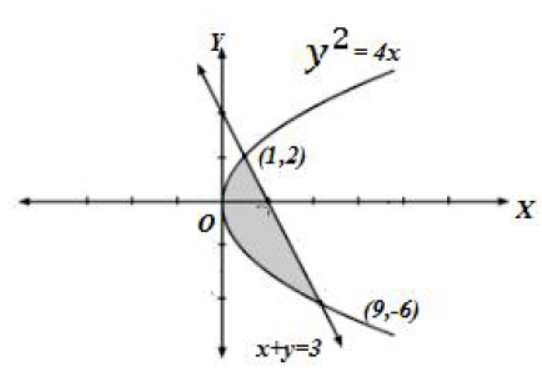
1) \( y^2 = 4x \)
(.) parabola
(.) vertex \( (0,0) \)
(.) open \( + \)ve \( x \)-axis
2) \( x + y = 3 \)
(.) line, point \( (0, 3) \) & \( (3, 0) \)
Intersection Point:
Put \( y^2 = 4x \) in \( x + y = 3 \)
or \( x = \frac{y^2}{4} \)
\( \Rightarrow \frac{y^2}{4} + y = 3 \)
\( \Rightarrow y^2 + 4y - 12 = 0 \)
\( \Rightarrow (y + 6)(y - 2) = 0 \)
\( y = -6 \) and \( y = 2 \)
\( x = 9 \) and \( x = 1 \)
points \( (1, 2) \) & \( (9, -6) \)
New concept = \( \int_{y_1}^{y_2} (\text{right curve ka } x) - (\text{left curve ka } x) \, dy \)
Required area = \( \int_{-6}^{2} \left[ (3 - y) - \frac{y^2}{4} \right] \, dy \)
\[ = \frac{1}{4} \int_{-6}^{2} (12 - 4y - y^2) \, dy \]
\[ = \frac{1}{4} \left[ 12y - 2y^2 - \frac{y^3}{3} \right]_{-6}^{2} \]
\[ = \frac{1}{4} \left[ \left(24 - 8 - \frac{8}{3}\right) - \left(-72 - 72 + \frac{216}{3}\right) \right] \]
\[ = \frac{1}{4} \left[ 16 - \frac{8}{3} + 144 - \frac{216}{3} \right] \]
\[ = \frac{1}{4} \left[ 160 - \frac{224}{3} \right] \]
\[ = \frac{1}{4} \left[ \frac{480 - 224}{3} \right] \]
\[ = \frac{1}{4} \left( \frac{256}{3} \right) \]
\[ = \frac{64}{3} \]
\( \therefore \text{Required area} = \frac{64}{3} \text{ sq. units ans.} \)
Question. Find the area bounded by \(y = x\) and \(y = x^3\).
Answer:
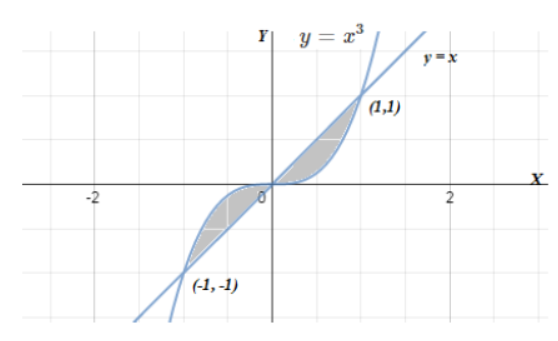
1) \( y = x \) line passing through \( (0,0) \)
2) \( y = x^3 \)
Points \( (0,0), (1,1), (2,8), (-1,-1), (-2,-8) \)
Intersection point:
Put \( y = x \) in \( y = x^3 \)
\( \Rightarrow x^3 = x \)
\( \Rightarrow x^3 - x = 0 \)
\( \Rightarrow x(x^2 - 1) = 0 \)
\( x = 0, x = 1, x = -1 \)
\( \therefore (0,0), (1,1) \text{ \& } (-1,-1) \)
\( y = 0, y = 1, y = -1 \)
Required area = \( 2 \int_{0}^{1} (x - x^3) \, dx \)
\[ = 2 \left[ \frac{x^2}{2} - \frac{x^4}{4} \right]_{0}^{1} \]
\[ = 2 \left[ \left( \frac{1}{2} - \frac{1}{4} \right) - (0 - 0) \right] \]
\[ = 2 \left[ \frac{2-1}{4} \right] = 2 \left( \frac{1}{4} \right) = \frac{1}{2} \]
\( \therefore \text{Required area} = \frac{1}{2} \text{ sq. units ans.} \)
Question. Complete the area bounded by the curves \(x = 0\), \(x = 2\), \(y = 2^x\) and \(y = 2x - x^2\).
Answer:
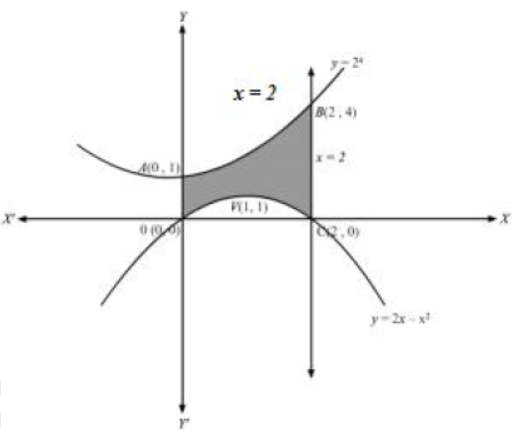
1) \( y = 2x - x^2 \) (shifting parabola)
\( x^2 - 2x = -y \)
\( (x - 1)^2 - 1 = -y \)
\( (x - 1)^2 = -y + 1 \)
\( (x - 1)^2 = -(y - 1) \)
Vertex \( (1,1) \)
Open \( - \)ve \( y \)-axis
\( y = 2^x \) (exponential curve)
\( (0,1), (1,2), (2,4) \dots \)
\( x = 0 \) (equation of \( y \)-axis)
\( x = 2 \) (line parallel to \( y \)-axis at \( (2,0) \))
Intersection of parabola \( y = 2x - x^2 \) with \( x \)-axis:
Put \( y = 0 \)
\( \Rightarrow 0 = 2x - x^2 \)
\( \Rightarrow 0 = x(2 - x) \)
\( x = 0 \) and \( x = 2 \)
Required area = \( \int_{0}^{2} [2^x - (2x - x^2)] \, dx \)
\[ = \left( \frac{2^x}{\log 2} - x^2 + \frac{x^3}{3} \right)_{0}^{2} \]
\[ = \left( \frac{4}{\log 2} - 4 + \frac{8}{3} \right) - \left( \frac{1}{\log 2} - 0 + 0 \right) \]
\( \text{Required area} = \left( \frac{3}{\log 2} - \frac{4}{3} \right) \text{ sq. units ans.} \)
Question. Find the area bounded by curves \(y = -1\), \(y = 2\), \(x = y^3\) and \(x = 0\).
Answer:
1) \( y = -1 \) (line parallel to \( x \)-axis at \( (0, -1) \))
2) \( y = 2 \) (line parallel to \( x \)-axis at \( (0,2) \))
3) \( x = y^3 \) (points \( (0,0), (1,1), (8,2), (-1,-1), (-8,-2) \))
4) \( x = 0 \) (eq. of \( y \)-axis)
Picture graph
Required area = \( \int_{-1}^{0} \left( x^{\frac{1}{3}} - (-1) \right) \, dx + \int_{0}^{8} \left( 2 - x^{\frac{1}{3}} \right) \, dx \)
\[ = \left[ \frac{3}{4}x^{\frac{4}{3}} + x \right]_{-1}^{0} + \left[ 2x - \frac{3}{4}x^{\frac{4}{3}} \right]_{0}^{8} \]
\[ = (0 + 0) - \left( \frac{3}{4}(-1)^{\frac{4}{3}} - 1 \right) + \left( 16 - \frac{3}{4}(8)^{\frac{4}{3}} \right) - \left[ 2(0) - \frac{3}{4}(0)^{\frac{4}{3}} \right] \]
\[ = -\left( \frac{3}{4} - 1 \right) + \left( 16 - \frac{3}{4} \times 16 \right) - 0 \]
\[ = -\left( -\frac{1}{4} \right) + (16 - 12) \]
\[ = \frac{1}{4} + 4 = \frac{17}{4} \]
\( \therefore \text{Required area} = \frac{17}{4} \text{ sq. units ans.} \)
Question. Find the area bounded by the \(y\)-axis, \(y = \cos x\), \(y = \sin x\) when \(0 \le x \le \frac{\pi}{2}\).
Answer:
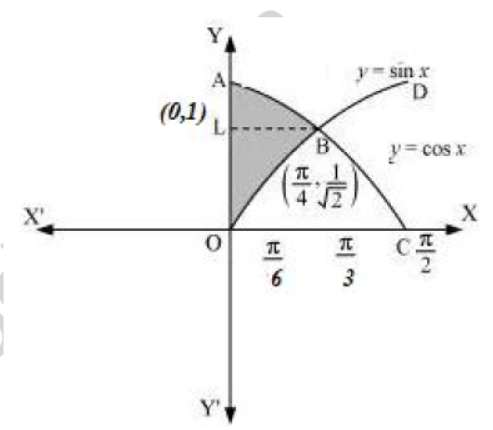
1) \( y = \cos x \)
\( x = 0, y = 1 \;; \; x = \frac{\pi}{6}, y = \frac{\sqrt{3}}{2} \;; \; x = \frac{\pi}{6}, y = \frac{1}{2}, x = \frac{\pi}{2}, y = 1 \)
2) \( y = \sin x \)
\( x = 0, y = 0 \;; \; x = \frac{\pi}{6}, y = \frac{1}{2} \;; \; x = \frac{\pi}{3}, y = \frac{\sqrt{3}}{2}, x = \frac{\pi}{2}, y = 1 \)
3) \( y \)-axis
Intersection point:
\( y = \sin x \text{ \& } y = \cos x \)
\( \sin x = \cos x \)
\( \Rightarrow \tan x = 1 \)
\( \Rightarrow x = \frac{\pi}{4} \)
\( \therefore \text{point } \left(\frac{\pi}{4}, \frac{1}{\sqrt{2}}\right) \)
\( y = \frac{1}{\sqrt{2}} \)
Required area = \( \int_{0}^{\frac{\pi}{4}} (\cos x - \sin x) \, dx \)
\[ = [\sin x + \cos x]_{0}^{\frac{\pi}{4}} \]
\[ = \left[ \frac{1}{\sqrt{2}} + \frac{1}{\sqrt{2}} \right] - [0 + 1] \]
\[ = \frac{2}{\sqrt{2}} - 1 = \sqrt{2} - 1 \text{ sq. units ans.} \]
Question. Find the area bounded by the curve \(y = \cos x\), \(x = 0\) and \(x = 2\pi\).
Answer:
1) \( y = \cos x \)
| \( x \) | 0 | \( \frac{\pi}{2} \) | \( \pi \) | \( \frac{3\pi}{2} \) | \( 2\pi \) |
| \( y \) | 1 | 0 | -1 | 0 | 1 |
2) \( x = 0 \) (eq. of \( y \)-axis)
3) \( x = 2\pi \) (parallel to \( y \)-axis at \( x = 2\pi \))
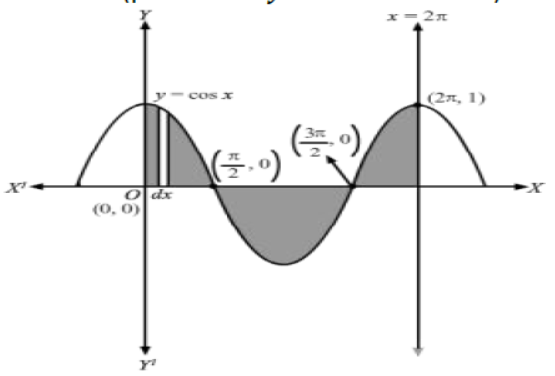
Required area = \( 4 \int_{0}^{\frac{\pi}{2}} (\cos x - 0) \, dx \quad \dots \{\text{due to symmetry of } \cos x\} \)
\[ = 4 [\sin x]_{0}^{\frac{\pi}{2}} \]
\[ = 4(1 - 0) \]
Required area = 4 sq. units ans.
Question. Draw a rough sketch of the curve \(y = 2 \cos^2 x\) in \([0,\pi]\) and find the area enclosed by the curve the line \(x = 0\), \(x = \pi\) and \(x\)-axis.
Answer:
1) \( y = 2 \cos^2 x \) in \( [0, \pi] \)
\( x = 0, y = 2, x = \frac{\pi}{2}, y = 0, x = \pi, y = 2 \)
2) \( x = 0 \) (y-axis)
3) \( x = \pi \)
4) \( x \)-axis
picture
Required area = \( 2 \int_{0}^{\frac{\pi}{2}} (2 \cos^2 x - 0) \, dx \)
\[ = 2 \int_{0}^{\frac{\pi}{2}} \frac{2(1+\cos 2x)}{2} - 0 \, dx \]
\[ = 2 \left[ x + \frac{\sin(2x)}{2} \right]_{0}^{\frac{\pi}{2}} \]
\[ = 2 \left[ \left( \frac{\pi}{2} + \frac{\sin \pi}{2} \right) - (0 + 0) \right] \]
\[ = 2 \left[ \frac{\pi}{2} + 0 \right] \]
Required area = \( \pi \) sq. units ans.
Free study material for Mathematics
CBSE Mathematics Class 12 Chapter 8 Application Of Integrals Worksheet
Students can use the practice questions and answers provided above for Chapter 8 Application Of Integrals to prepare for their upcoming school tests. This resource is designed by expert teachers as per the latest 2026 syllabus released by CBSE for Class 12. We suggest that Class 12 students solve these questions daily for a strong foundation in Mathematics.
Chapter 8 Application Of Integrals Solutions & NCERT Alignment
Our expert teachers have referred to the latest NCERT book for Class 12 Mathematics to create these exercises. After solving the questions you should compare your answers with our detailed solutions as they have been designed by expert teachers. You will understand the correct way to write answers for the CBSE exams. You can also see above MCQ questions for Mathematics to cover every important topic in the chapter.
Class 12 Exam Preparation Strategy
Regular practice of this Class 12 Mathematics study material helps you to be familiar with the most regularly asked exam topics. If you find any topic in Chapter 8 Application Of Integrals difficult then you can refer to our NCERT solutions for Class 12 Mathematics. All revision sheets and printable assignments on studiestoday.com are free and updated to help students get better scores in their school examinations.
FAQs
You can download the latest chapter-wise printable worksheets for Class 12 Mathematics Chapter 8 Application Of Integrals for free from StudiesToday.com. These have been made as per the latest CBSE curriculum for this academic year.
Yes, Class 12 Mathematics worksheets for Chapter 8 Application Of Integrals focus on activity-based learning and also competency-style questions. This helps students to apply theoretical knowledge to practical scenarios.
Yes, we have provided solved worksheets for Class 12 Mathematics Chapter 8 Application Of Integrals to help students verify their answers instantly.
Yes, our Class 12 Mathematics test sheets are mobile-friendly PDFs and can be printed by teachers for classroom.
For Chapter 8 Application Of Integrals, regular practice with our worksheets will improve question-handling speed and help students understand all technical terms and diagrams.