

Read and download the CBSE Class 12 Mathematics Application Of Integrals Worksheet Set 04 in PDF format. We have provided exhaustive and printable Class 12 Mathematics worksheets for Chapter 8 Application Of Integrals, designed by expert teachers. These resources align with the 2026-27 syllabus and examination patterns issued by NCERT, CBSE, and KVS, helping students master all important chapter topics.
Chapter-wise Worksheet for Class 12 Mathematics Chapter 8 Application Of Integrals
Students of Class 12 should use this Mathematics practice paper to check their understanding of Chapter 8 Application Of Integrals as it includes essential problems and detailed solutions. Regular self-testing with these will help you achieve higher marks in your school tests and final examinations.
Class 12 Mathematics Chapter 8 Application Of Integrals Worksheet with Answers
CBSE Class 12 Mathematics Application Of Integrals (3). Students can download these worksheets and practice them. This will help them to get better marks in examinations. Also refer to other worksheets for the same chapter and other subjects too. Use them for better understanding of the subjects.
Points to Remember
Area of Bounded Region
- The area bounded by the curve \( y = f(x) \), the x-axis, and between the ordinates \( x = a \) and \( x = b \) is calculated using:
\[ \text{Area} = \int_{a}^{b} |f(x)|\,dx \] - The area bounded by the curve \( x = f(y) \), the y-axis, and between the abscissas \( y = c \) and \( y = d \) is given by:
\[ \text{Area} = \int_{c}^{d} |f(y)|\,dy \] - The area enclosed between two curves \( y = f(x) \) and \( y = g(x) \), such that \( 0 \le g(x) \le f(x) \) for all \( x \in [a, b] \), and bounded by the vertical lines \( x = a \) and \( x = b \) is defined as:
\[ \text{Area} = \int_{a}^{b} [f(x) - g(x)]\,dx \] - When a curve intersects the horizontal axis at \( x = k \) inside the integration range \( [a, b] \), the overall area is calculated by taking the sum of the absolute values of the sub-integrals:
\[ \text{Required Area} = \left| \int_{a}^{k} f(x)\,dx \right| + \int_{k}^{b} f(x)\,dx \]
Long Answer Type Questions (6 Marks)
Question 1. Find the area enclosed by circle \( x^2 + y^2 = a^2 \).
Answer: The equation of the circle is given as \( x^2 + y^2 = a^2 \), which has its center at the origin \( (0,0) \) and radius \( a \). The region enclosed by the circle is symmetric with respect to both the x-axis and the y-axis. Therefore, the total area can be written as:
\[ \text{Total Area} = 4 \times \text{Area in the first quadrant} \] In the first quadrant, \( x \) varies from \( 0 \) to \( a \), and \( y = \sqrt{a^2 - x^2} \).
\[ \text{Total Area} = 4 \int_{0}^{a} \sqrt{a^2 - x^2}\,dx \] Using the standard integration formula \( \int \sqrt{a^2 - x^2}\,dx = \frac{x}{2}\sqrt{a^2 - x^2} + \frac{a^2}{2}\sin^{-1}\left(\frac{x}{a}\right) \):
\[ \text{Total Area} = 4 \left[ \frac{x}{2}\sqrt{a^2 - x^2} + \frac{a^2}{2}\sin^{-1}\left(\frac{x}{a}\right) \right]_{0}^{a} \]
\[ \implies \text{Total Area} = 4 \left[ \left( \frac{a}{2}(0) + \frac{a^2}{2}\sin^{-1}(1) \right) - \left( 0 + 0 \right) \right] \]
\[ \implies \text{Total Area} = 4 \left[ \frac{a^2}{2} \left(\frac{\pi}{2}\right) \right] = \pi a^2 \text{ sq. units} \]
In simple words: A circle is perfectly balanced on all four sides. We find the area of one-quarter of the circle using integration and then multiply it by four to get the total area.
Exam Tip: Be sure to explicitly state the symmetry argument and show the standard limits from \( 0 \) to \( a \) to secure full steps marks.
Question 2. Find the area of region bounded by \( \left\{ (x, y) : |x - 1| \le y \le \sqrt{25 - x^2} \right\} \).
Answer: We need to calculate the area bounded below by the absolute value curve \( y = |x - 1| \) and above by the circle \( y = \sqrt{25 - x^2} \implies x^2 + y^2 = 25 \). First, find the points where the boundary curves intersect: For \( x \ge 1 \), we have \( y = x - 1 \):
\[ x^2 + (x - 1)^2 = 25 \implies 2x^2 - 2x - 24 = 0 \implies x^2 - x - 12 = 0 \]
\[ \implies (x - 4)(x + 3) = 0 \] Since \( x \ge 1 \), the intersection coordinate is \( x = 4 \), which gives \( y = 3 \). For \( x < 1 \), we have \( y = 1 - x \):
\[ x^2 + (1 - x)^2 = 25 \implies 2x^2 - 2x - 24 = 0 \implies x^2 - x - 12 = 0 \] Since \( x < 1 \), the intersection coordinate is \( x = -3 \), which yields \( y = 4 \). The bounded region extends from \( x = -3 \) to \( x = 4 \). We divide this into two parts around \( x = 1 \):
\[ \text{Area} = \int_{-3}^{4} \sqrt{25 - x^2}\,dx - \int_{-3}^{1} (1 - x)\,dx - \int_{1}^{4} (x - 1)\,dx \] Evaluating the first integral:
\[ \int_{-3}^{4} \sqrt{25 - x^2}\,dx = \left[ \frac{x}{2}\sqrt{25 - x^2} + \frac{25}{2}\sin^{-1}\left(\frac{x}{5}\right) \right]_{-3}^{4} \]
\[ = \left( 6 + \frac{25}{2}\sin^{-1}\left(\frac{4}{5}\right) \right) - \left( -6 - \frac{25}{2}\sin^{-1}\left(\frac{3}{5}\right) \right) \]
\[ = 12 + \frac{25}{2}\left( \sin^{-1}\left(\frac{4}{5}\right) + \sin^{-1}\left(\frac{3}{5}\right) \right) \] Using the trigonometric identity \( \sin^{-1}(\theta) + \cos^{-1}(\theta) = \frac{\pi}{2} \) and \( \sin^{-1}(3/5) = \cos^{-1}(4/5) \), we get:
\[ \int_{-3}^{4} \sqrt{25 - x^2}\,dx = 12 + \frac{25\pi}{4} \] Evaluating the remaining linear integrals:
\[ \int_{-3}^{1} (1 - x)\,dx = \left[ x - \frac{x^2}{2} \right]_{-3}^{1} = \frac{1}{2} - \left( -3 - \frac{9}{2} \right) = 8 \]
\[ \int_{1}^{4} (x - 1)\,dx = \left[ \frac{x^2}{2} - x \right]_{1}^{4} = (8 - 4) - \left( \frac{1}{2} - 1 \right) = \frac{9}{2} \] Combining all three results:
\[ \text{Total Area} = \left(12 + \frac{25\pi}{4}\right) - 8 - \frac{9}{2} = \frac{25\pi}{4} - \frac{1}{2} \text{ sq. units} \]
In simple words: To find the area of the region, we compute the area under the circle and subtract the triangular area formed by the absolute value lines underneath it.
Exam Tip: Be cautious when dealing with the absolute value function; split the boundaries at \( x = 1 \) to avoid sign errors during calculation.
Question 3. Find the area enclosed by the ellipse \( \frac{x^2}{a^2} + \frac{y^2}{b^2} = 1 \).
Answer: The equation of the ellipse is \( \frac{x^2}{a^2} + \frac{y^2}{b^2} = 1 \). The shape is symmetric across both axes, meaning the total area is four times the area of the region in the first quadrant. In the first quadrant, \( x \) ranges from \( 0 \) to \( a \), and \( y \) is expressed as:
\[ y = \frac{b}{a}\sqrt{a^2 - x^2} \]
\[ \text{Total Area} = 4 \int_{0}^{a} y\,dx = 4 \int_{0}^{a} \frac{b}{a}\sqrt{a^2 - x^2}\,dx \]
\[ \implies \text{Total Area} = \frac{4b}{a} \left[ \frac{x}{2}\sqrt{a^2 - x^2} + \frac{a^2}{2}\sin^{-1}\left(\frac{x}{a}\right) \right]_{0}^{a} \]
\[ \implies \text{Total Area} = \frac{4b}{a} \left[ \frac{a^2}{2} \sin^{-1}(1) - 0 \right] = \frac{4b}{a} \left[ \frac{a^2}{2} \cdot \frac{\pi}{2} \right] = \pi ab \text{ sq. units} \]
In simple words: An ellipse is like a stretched circle. We integrate the top curve in the first quadrant and then multiply the result by four.
Exam Tip: Remember that the area of a circle \( \pi a^2 \) is a special case of the ellipse area \( \pi ab \) when \( a = b \), which can help you verify your result.
Question 4. Find the area of region in the first quadrant enclosed by x–axis, the line \( y = x \) and the circle \( x^2 + y^2 = 32 \).
Answer: The intersection point of the line \( y = x \) and the circle \( x^2 + y^2 = 32 \) in the first quadrant is found by substituting \( y = x \) into the circle's equation:
\[ x^2 + x^2 = 32 \implies 2x^2 = 32 \implies x = 4 \] At \( x = 4 \), we have \( y = 4 \). The total area bounded by the curves in the first quadrant is divided into two distinct regions at \( x = 4 \): 1. The area under the straight line \( y = x \) from \( x = 0 \) to \( x = 4 \). 2. The area under the circular arc \( y = \sqrt{32 - x^2} \) from \( x = 4 \) to \( x = 4\sqrt{2} \).
\[ \text{Total Area} = \int_{0}^{4} x\,dx + \int_{4}^{4\sqrt{2}} \sqrt{32 - x^2}\,dx \] Evaluating the first integral:
\[ \int_{0}^{4} x\,dx = \left[ \frac{x^2}{2} \right]_{0}^{4} = 8 \] Evaluating the second integral:
\[ \int_{4}^{4\sqrt{2}} \sqrt{32 - x^2}\,dx = \left[ \frac{x}{2}\sqrt{32 - x^2} + 16\sin^{-1}\left(\frac{x}{4\sqrt{2}}\right) \right]_{4}^{4\sqrt{2}} \]
\[ = \left( 0 + 16\sin^{-1}(1) \right) - \left( 8 + 16\sin^{-1}\left(\frac{1}{\sqrt{2}}\right) \right) \]
\[ = 8\pi - \left( 8 + 4\pi \right) = 4\pi - 8 \] Combining both areas:
\[ \text{Total Area} = 8 + 4\pi - 8 = 4\pi \text{ sq. units} \] Note: If we evaluate only the region under the circle's arc from \( x = 4 \) to \( x = 4\sqrt{2} \) (excluding the triangle), the area is \( 4\pi - 8 \) square units.
In simple words: The region of interest is shaped like a slice of pie. We split it into a right triangle and a curved segment under the circle's edge, calculating both separately.
Exam Tip: Highlighting both the total sector area (\( 4\pi \)) and the circular segment area (\( 4\pi - 8 \)) ensures your response satisfies differing board marking keys.
Question 5. Find the area of region \( \left\{ (x, y) : y^2 \le 4x, 4x^2 + 4y^2 \le 9 \right\} \).
Answer: The boundaries of the region are defined by the parabola \( y^2 = 4x \) and the circle \( 4x^2 + 4y^2 = 9 \implies x^2 + y^2 = \frac{9}{4} \). To find the intersection points, substitute \( y^2 = 4x \) into the circle's equation:
\[ 4x^2 + 4(4x) = 9 \implies 4x^2 + 16x - 9 = 0 \]
\[ \implies (2x - 1)(2x + 9) = 0 \] Since \( x \) must be positive for the parabola, we take \( x = \frac{1}{2} \). At \( x = \frac{1}{2} \), we have \( y = \pm\sqrt{2} \). The region is symmetric about the x-axis, so the total area is:
\[ \text{Area} = 2 \left[ \int_{0}^{1/2} 2\sqrt{x}\,dx + \int_{1/2}^{3/2} \sqrt{\frac{9}{4} - x^2}\,dx \right] \] Integrating the parabola term:
\[ 2 \int_{0}^{1/2} 2\sqrt{x}\,dx = 4 \left[ \frac{2}{3}x^{3/2} \right]_{0}^{1/2} = \frac{8}{3 \cdot 2\sqrt{2}} = \frac{2\sqrt{2}}{3} \] Integrating the circle term:
\[ 2 \int_{1/2}^{3/2} \sqrt{\frac{9}{4} - x^2}\,dx = 2 \left[ \frac{x}{2}\sqrt{\frac{9}{4} - x^2} + \frac{9}{8}\sin^{-1}\left(\frac{2x}{3}\right) \right]_{1/2}^{3/2} \]
\[ = 2 \left[ \left( 0 + \frac{9\pi}{16} \right) - \left( \frac{\sqrt{2}}{8} + \frac{9}{8}\sin^{-1}\left(\frac{1}{3}\right) \right) \right] = \frac{9\pi}{8} - \frac{\sqrt{2}}{4} - \frac{9}{4}\sin^{-1}\left(\frac{1}{3}\right) \] Combining both sections yields the final evaluated area:
\[ \text{Total Area} = \frac{\sqrt{2}}{6} + \frac{9\pi}{8} - \frac{9}{8}\sin^{-1}\left(\frac{1}{3}\right) \text{ sq. units} \]
In simple words: This shape is bounded by a parabola on the left and a circle on the right. We find the area of the upper half in two segments and double the result due to symmetry.
Exam Tip: Make sure to keep track of the multiplier \( 2 \) when evaluating the individual definite integrals to ensure correct algebraic simplification.
Question 6. Prove that the curve \( y = x^2 \) and, \( x = y^2 \) divide the square bounded by \( x = 0, y = 0, x = 1, y = 1 \) into three equal parts.
Answer: The area of the entire square bounded by \( x = 0 \), \( x = 1 \), \( y = 0 \), and \( y = 1 \) is:
\[ \text{Area of square} = 1 \times 1 = 1 \text{ sq. unit} \] The curves \( y = x^2 \) and \( x = y^2 \implies y = \sqrt{x} \) divide this square into three separate regions: 1. Region \( R_1 \) bounded by the y-axis, the line \( y = 1 \), and the curve \( y = \sqrt{x} \):
\[ \text{Area}(R_1) = \int_{0}^{1} (1 - \sqrt{x})\,dx = \left[ x - \frac{2}{3}x^{3/2} \right]_{0}^{1} = 1 - \frac{2}{3} = \frac{1}{3} \] 2. Region \( R_2 \) enclosed between the two curves \( y = \sqrt{x} \) and \( y = x^2 \):
\[ \text{Area}(R_2) = \int_{0}^{1} (\sqrt{x} - x^2)\,dx = \left[ \frac{2}{3}x^{3/2} - \frac{x^3}{3} \right]_{0}^{1} = \frac{2}{3} - \frac{1}{3} = \frac{1}{3} \] 3. Region \( R_3 \) bounded by the curve \( y = x^2 \), the x-axis, and the line \( x = 1 \):
\[ \text{Area}(R_3) = \int_{0}^{1} x^2\,dx = \left[ \frac{x^3}{3} \right]_{0}^{1} = \frac{1}{3} \] Since \( \text{Area}(R_1) = \text{Area}(R_2) = \text{Area}(R_3) = \frac{1}{3} \), the square is indeed divided into three equal parts.
In simple words: We calculate the area of the three regions inside the unit square. Since each region has an area of exactly one-third, the square is split equally.
Exam Tip: Showing that the sum of the three computed areas equals the total area of the square (\( 1 \)) is an excellent check to present in your answers.
Question 7. Find smaller of the two areas enclosed between the ellipse \( \frac{x^2}{a^2} + \frac{y^2}{b^2} = 1 \) and the line \( bx + ay = ab \).
Answer: The equation of the line can be written in intercept form as:
\[ \frac{x}{a} + \frac{y}{b} = 1 \] This line intersects the ellipse at its vertices \( (a, 0) \) and \( (0, b) \). The smaller region enclosed by these curves lies entirely in the first quadrant. We integrate the difference between the upper boundary (the ellipse) and the lower boundary (the line) from \( x = 0 \) to \( x = a \):
\[ \text{Area} = \int_{0}^{a} \left[ \frac{b}{a}\sqrt{a^2 - x^2} - b\left(1 - \frac{x}{a}\right) \right]\,dx \]
\[ \implies \text{Area} = \frac{b}{a} \int_{0}^{a} \sqrt{a^2 - x^2}\,dx - b \int_{0}^{a} \left(1 - \frac{x}{a}\right)\,dx \] Evaluating the first integral (which represents the quadrant of the ellipse):
\[ \frac{b}{a} \left[ \frac{\pi a^2}{4} \right] = \frac{\pi ab}{4} \] Evaluating the second integral (the triangular area under the line):
\[ b \left[ x - \frac{x^2}{2a} \right]_{0}^{a} = b \left[ a - \frac{a}{2} \right] = \frac{ab}{2} \] Subtracting these values gives:
\[ \text{Required Area} = \frac{\pi ab}{4} - \frac{ab}{2} = \frac{(\pi - 2)ab}{4} \text{ sq. units} \]
In simple words: The region of interest is the gap between the curved edge of the ellipse and the straight line connecting its axis endpoints. We subtract the triangular area under the line from the area of the quarter-ellipse.
Exam Tip: You can directly use the formula for the area of a right triangle \( \frac{1}{2} \times \text{base} \times \text{height} \) to find the linear part of the integral quickly.
Question 8. Find the common area bounded by the circles \( x^2 + y^2 = 4 \) and \( (x - 2)^2 + y^2 = 4 \).
Answer: The two circle equations are: 1. \( x^2 + y^2 = 4 \), with center at \( (0,0) \) and radius \( 2 \). 2. \( (x - 2)^2 + y^2 = 4 \), with center at \( (2,0) \) and radius \( 2 \). To find where they intersect, equate their \( y^2 \) values:
\[ 4 - x^2 = 4 - (x - 2)^2 \implies x^2 = (x - 2)^2 \implies x = 1 \] At \( x = 1 \), \( y = \pm\sqrt{3} \). The region is symmetric with respect to both the x-axis and the vertical line of intersection \( x = 1 \). Thus, we can calculate the area by doubling the area of one half:
\[ \text{Area} = 2 \left[ \int_{0}^{1} \sqrt{4 - (x - 2)^2}\,dx + \int_{1}^{2} \sqrt{4 - x^2}\,dx \right] \] Due to symmetry between both halves:
\[ \text{Area} = 4 \int_{1}^{2} \sqrt{4 - x^2}\,dx \]
\[ = 4 \left[ \frac{x}{2}\sqrt{4 - x^2} + 2\sin^{-1}\left(\frac{x}{2}\right) \right]_{1}^{2} \]
\[ = 4 \left[ \left( 0 + 2\sin^{-1}(1) \right) - \left( \frac{\sqrt{3}}{2} + 2\sin^{-1}\left(\frac{1}{2}\right) \right) \right] \]
\[ = 4 \left[ \pi - \frac{\sqrt{3}}{2} - \frac{\pi}{3} \right] = 4 \left[ \frac{2\pi}{3} - \frac{\sqrt{3}}{2} \right] = \frac{8\pi}{3} - 2\sqrt{3} \text{ sq. units} \]
In simple words: Two overlapping circles create a lens-shaped region. We divide this lens into four equal parts using the axes and integrate from the edge to the centerline.
Exam Tip: Standard intersections of circles with equal radii always split the overlapping region symmetrically, allowing you to multiply a single integral segment by 4.
Question 9. Using integration, find the area of the region bounded by the triangle whose vertices are (a) \( (-1, 0), (1, 3) \) and \( (3, 2) \) (b) \( (-2, 2) (0, 5) \) and \( (3, 2) \).
Answer:
(a) Let the vertices be \( A(-1, 0) \), \( B(1, 3) \), and \( C(3, 2) \). First, find the equations of the lines forming the sides of the triangle: Equation of side \( AB \):
\[ y - 0 = \frac{3 - 0}{1 - (-1)}(x + 1) \implies y = \frac{3}{2}(x + 1) \] Equation of side \( BC \):
\[ y - 3 = \frac{2 - 3}{3 - 1}(x - 1) \implies y = -\frac{1}{2}(x - 1) + 3 \implies y = -\frac{1}{2}x + \frac{7}{2} \] Equation of side \( AC \):
\[ y - 0 = \frac{2 - 0}{3 - (-1)}(x + 1) \implies y = \frac{1}{2}(x + 1) \] The area of \( \Delta ABC \) is the sum of areas under \( AB \) and \( BC \) minus the area under \( AC \):
\[ \text{Area} = \int_{-1}^{1} \frac{3}{2}(x+1)\,dx + \int_{1}^{3} \left(-\frac{1}{2}x + \frac{7}{2}\right)\,dx - \int_{-1}^{3} \frac{1}{2}(x+1)\,dx \] Evaluating each integral:
\[ \int_{-1}^{1} \frac{3}{2}(x+1)\,dx = \frac{3}{2}\left[ \frac{x^2}{2} + x \right]_{-1}^{1} = \frac{3}{2}(2) = 3 \]
\[ \int_{1}^{3} \left(-\frac{1}{2}x + \frac{7}{2}\right)\,dx = \left[ -\frac{x^2}{4} + \frac{7x}{2} \right]_{1}^{3} = \left( -\frac{9}{4} + \frac{21}{2} \right) - \left( -\frac{1}{4} + \frac{7}{2} \right) = \frac{33}{4} - \frac{13}{4} = 5 \]
\[ \int_{-1}^{3} \frac{1}{2}(x+1)\,dx = \frac{1}{2}\left[ \frac{x^2}{2} + x \right]_{-1}^{3} = \frac{1}{2} \left( \frac{15}{2} - \left(-\frac{1}{2}\right) \right) = 4 \] Combining the values:
\[ \text{Required Area} = 3 + 5 - 4 = 4 \text{ sq. units} \] (b) Let the vertices be \( A(-2, 2) \), \( B(0, 5) \), and \( C(3, 2) \). Equation of side \( AB \):
\[ y - 2 = \frac{5 - 2}{0 - (-2)}(x + 2) \implies y = \frac{3}{2}x + 5 \] Equation of side \( BC \):
\[ y - 5 = \frac{2 - 5}{3 - 0}(x - 0) \implies y = -x + 5 \] Equation of side \( AC \): Since both \( A \) and \( C \) have \( y = 2 \), the equation is the horizontal line \( y = 2 \). The area of the triangle is computed as:
\[ \text{Area} = \int_{-2}^{0} \left[ \left(\frac{3}{2}x + 5\right) - 2 \right]\,dx + \int_{0}^{3} \left[ (-x + 5) - 2 \right]\,dx \]
\[ = \int_{-2}^{0} \left( \frac{3}{2}x + 3 \right)\,dx + \int_{0}^{3} (3 - x)\,dx \] Evaluating these integrals:
\[ \int_{-2}^{0} \left( \frac{3}{2}x + 3 \right)\,dx = \left[ \frac{3x^2}{4} + 3x \right]_{-2}^{0} = 0 - (3 - 6) = 3 \]
\[ \int_{0}^{3} (3 - x)\,dx = \left[ 3x - \frac{x^2}{2} \right]_{0}^{3} = 9 - 4.5 = 4.5 \] Combining the segments:
\[ \text{Required Area} = 3 + 4.5 = 7.5 \text{ sq. units} \] Note: Depending on coordinate sign conventions in various papers, if the vertices are altered, the area is evaluated using the same process.
In simple words: To find a triangle's area using integration, we find the equations of its three boundary lines, calculate the area under the top lines, and subtract the area under the bottom line.
Exam Tip: Always sketch the vertices on a coordinate grid first to clearly visualize which boundary line is on top and which is below.
Question 10. Using integration, find the area bounded by the lines. (i) \( x + 2y = 2, y - x = 1 \) and \( 2x + y - 7 = 0 \) (ii) \( y = 4x + 5, y = 5 - x \) and \( 4y - x = 5 \).
Answer:
(i) First, determine the coordinates of the triangle's vertices by solving the lines in pairs: Intersection of \( x + 2y = 2 \) and \( y - x = 1 \):
\[ y - (2 - 2y) = 1 \implies 3y = 3 \implies y = 1, x = 0 \implies (0, 1) \] Intersection of \( y - x = 1 \) and \( 2x + y - 7 = 0 \):
\[ 2x + (x + 1) - 7 = 0 \implies 3x = 6 \implies x = 2, y = 3 \implies (2, 3) \] Intersection of \( x + 2y = 2 \) and \( 2x + y - 7 = 0 \bk \):
\[ 2(2 - 2y) + y - 7 = 0 \implies 4 - 3y - 7 = 0 \implies y = -1, x = 4 \implies (4, -1) \] The vertices are \( (0, 1) \), \( (2, 3) \), and \( (4, -1) \). Write the line equations with respect to \( x \): \( y = \frac{2-x}{2} \), \( y = x+1 \), and \( y = 7-2x \). Area under the upper boundary lines minus the lower line:
\[ \text{Area} = \int_{0}^{2} (x+1)\,dx + \int_{2}^{4} (7-2x)\,dx - \int_{0}^{4} \left(\frac{2-x}{2}\right)\,dx \] Evaluating:
\[ \int_{0}^{2} (x+1)\,dx = \left[ \frac{x^2}{2} + x \right]_{0}^{2} = 4 \]
\[ \int_{2}^{4} (7-2x)\,dx = \left[ 7x - x^2 \right]_{2}^{4} = (28 - 16) - (14 - 4) = 2 \]
\[ \int_{0}^{4} \left(1 - \frac{x}{2}\right)\,dx = \left[ x - \frac{x^2}{4} \right]_{0}^{4} = 4 - 4 = 0 \]
\[ \text{Required Area} = 4 + 2 - 0 = 6 \text{ sq. units} \] (ii) Find the vertices by solving the lines in pairs: Intersection of \( y = 4x + 5 \) and \( y = 5 - x \):
\[ 4x + 5 = 5 - x \implies 5x = 0 \implies x = 0, y = 5 \implies (0, 5) \] Intersection of \( y = 5 - x \) and \( 4y - x = 5 \):
\[ 4(5 - x) - x = 5 \implies 20 - 5x = 5 \implies x = 3, y = 2 \implies (3, 2) \] Intersection of \( y = 4x + 5 \) and \( 4y - x = 5 \):
\[ 4(4x + 5) - x = 5 \implies 15x = -15 \implies x = -1, y = 1 \implies (-1, 1) \] The vertices are \( (-1, 1) \), \( (0, 5) \), and \( (3, 2) \). Using the same area integration process:
\[ \text{Area} = \int_{-1}^{0} \left( (4x+5) - \frac{x+5}{4} \right)\,dx + \int_{0}^{3} \left( (5-x) - \frac{x+5}{4} \right)\,dx \]
\[ = \int_{-1}^{0} \left(\frac{15x+15}{4}\right)\,dx + \int_{0}^{3} \left(\frac{15-5x}{4}\right)\,dx \] Evaluating:
\[ \frac{15}{4} \left[ \frac{x^2}{2} + x \right]_{-1}^{0} = \frac{15}{4} \left( 0 - \left(\frac{1}{2} - 1\right) \right) = \frac{15}{8} \]
\[ \frac{5}{4} \left[ 3x - \frac{x^2}{2} \right]_{0}^{3} = \frac{5}{4} \left( 9 - \frac{9}{2} \right) = \frac{45}{8} \]
\[ \text{Required Area} = \frac{15}{8} + \frac{45}{8} = 7.5 \text{ sq. units} \]
In simple words: When given line equations, we solve them in pairs to find the corners of the triangle. Then, we integrate to find the area bounded between these lines.
Exam Tip: Double check your system of linear equations before integrating, as a tiny coordinate error will propagate and invalidate all subsequent integration steps.
Question 11. Find the area of the region \( \left\{ (x, y) : x^2 + y^2 \le 1 \le x + y \right\} \).
Answer: The area is enclosed by the circle \( x^2 + y^2 = 1 \) and lies above the line \( x + y = 1 \). The boundaries intersect at \( (1, 0) \) and \( (0, 1) \) in the first quadrant. The area of this region can be found by integrating from \( x = 0 \) to \( x = 1 \):
\[ \text{Area} = \int_{0}^{1} \left( \sqrt{1 - x^2} - (1 - x) \right)\,dx \]
\[ \implies \text{Area} = \left[ \frac{x}{2}\sqrt{1 - x^2} + \frac{1}{2}\sin^{-1}(x) - x + \frac{x^2}{2} \right]_{0}^{1} \] Evaluating at \( 1 \):
\[ \left( 0 + \frac{1}{2} \cdot \frac{\pi}{2} - 1 + \frac{1}{2} \right) = \frac{\pi}{4} - \frac{1}{2} \] Evaluating at \( 0 \) yields \( 0 \).
\[ \text{Required Area} = \frac{\pi - 2}{4} \text{ sq. units} \]
In simple words: We find the area of the upper-right quarter of a circle and subtract the area of the right triangle directly underneath it.
Exam Tip: This area is exactly one-quarter of a circle minus a right-angled triangle. Recognizing this geometric shortcut allows you to instantly verify your calculus result.
Question 12. Find the area of the region bounded by \( y = |x - 1| \) and \( y = 1 \).
Answer: The boundary lines are: \( y = 1 - x \) for \( x < 1 \) \( y = x - 1 \) for \( x \ge 1 \) Equating these with the horizontal line \( y = 1 \) gives the boundary limits: \( 1 - x = 1 \implies x = 0 \) \( x - 1 = 1 \implies x = 2 \) The region is symmetric about \( x = 1 \), so we can compute the area of one half and double it:
\[ \text{Area} = 2 \int_{1}^{2} \left( 1 - (x - 1) \right)\,dx \]
\[ = 2 \int_{1}^{2} (2 - x)\,dx = 2 \left[ 2x - \frac{x^2}{2} \right]_{1}^{2} \]
\[ = 2 \left[ (4 - 2) - \left( 2 - \frac{1}{2} \right) \right] = 2 \left( 2 - 1.5 \right) = 1 \text{ sq. unit} \]
In simple words: The absolute value curve and the flat line create a triangular shape. Integrating under the flat line down to the V-shape gives the area of this triangle.
Exam Tip: Always make use of geometric symmetry when working with symmetrical absolute value shapes to make your integration simple.
Question 13. Find the area enclosed by the curve \( y = \sin x \) between \( x = 0 \) and \( x = \frac{3\pi}{2} \) and x-axis.
Answer: The function \( y = \sin x \) is positive on the interval \( [0, \pi] \) and negative on \( [\pi, \frac{3\pi}{2}] \). Since area must always be positive, we use the absolute value:
\[ \text{Area} = \int_{0}^{3\pi/2} |\sin x|\,dx = \int_{0}^{\pi} \sin x\,dx + \int_{\pi}^{3\pi/2} (-\sin x)\,dx \]
\[ \implies \text{Area} = \left[ -\cos x \right]_{0}^{\pi} + \left[ \cos x \right]_{\pi}^{3\pi/2} \]
\[ \implies \text{Area} = \left( -\cos \pi + \cos 0 \right) + \left( \cos\left(\frac{3\pi}{2}\right) - \cos\pi \right) \]
\[ \implies \text{Area} = \left( -(-1) + 1 \right) + \left( 0 - (-1) \right) = 2 + 1 = 3 \text{ sq. units} \]
In simple words: The sine wave has a loop above the axis from \( 0 \) to \( \pi \) and a half-loop below from \( \pi \) to \( 3\pi/2 \). We calculate their positive sizes and add them.
Exam Tip: Never integrate sine over intervals where it changes sign without splitting, as the positive and negative parts will cancel each other out.
Question 14. Find the area bounded by semi circle \( y = \sqrt{25 - x^2} \) and x-axis.
Answer: The curve is \( y = \sqrt{25 - x^2} \), which represents the upper semi-circle of \( x^2 + y^2 = 25 \) with radius \( r = 5 \). The region is bounded on the x-axis from \( x = -5 \) to \( x = 5 \). Integrating over this interval:
\[ \text{Area} = \int_{-5}^{5} \sqrt{25 - x^2}\,dx = 2 \int_{0}^{5} \sqrt{25 - x^2}\,dx \]
\[ \implies \text{Area} = 2 \left[ \frac{x}{2}\sqrt{25 - x^2} + \frac{25}{2}\sin^{-1}\left(\frac{x}{5}\right) \right]_{0}^{5} \]
\[ \implies \text{Area} = 2 \left( 0 + \frac{25}{2}\sin^{-1}(1) \right) = 2 \left( \frac{25\pi}{4} \right) = \frac{25\pi}{2} \text{ sq. units} \]
In simple words: We are finding the area of a half-circle with a radius of 5. Applying the standard circle formula gives us half of \( 25\pi \).
Exam Tip: Standard semicircle integrals can always be verified using the elementary area formula \( \frac{1}{2}\pi r^2 \).
Question 15. Find area of region given by \( \left\{ (x, y) : x^2 \le y \le |x| \right\} \).
Answer: The region lies between the parabola \( y = x^2 \) (lower curve) and the line \( y = |x| \) (upper curve). This region is symmetric about the y-axis, and the boundaries intersect in the first quadrant where \( x^2 = x \implies x = 1 \). We find the area of the right-hand portion and multiply by \( 2 \):
\[ \text{Area} = 2 \int_{0}^{1} (x - x^2)\,dx \]
\[ \implies \text{Area} = 2 \left[ \frac{x^2}{2} - \frac{x^3}{3} \right]_{0}^{1} \]
\[ \implies \text{Area} = 2 \left( \frac{1}{2} - \frac{1}{3} \right) = 2 \left( \frac{1}{6} \right) = \frac{1}{3} \text{ sq. unit} \]
In simple words: A parabola and a V-shape intersect to form two symmetrical leaf-like shapes. We integrate to find the area of one leaf and double it.
Exam Tip: Ensure you include the factor of 2 in your final calculation to account for both symmetric halves of the region.
Question 16. Find area of smaller region bounded by ellipse \( \frac{x^2}{9} + \frac{y^2}{4} = 1 \) and straight line \( 2x + 3y = 6 \).
Answer: The equation of the ellipse is \( \frac{x^2}{9} + \frac{y^2}{4} = 1 \), where \( a = 3 \) and \( b = 2 \). The line is \( 2x + 3y = 6 \implies \frac{x}{3} + \frac{y}{2} = 1 \), which connects the vertices \( (3,0) \) and \( (0,2) \). The smaller region is in the first quadrant. Its area is:
\[ \text{Area} = \int_{0}^{3} \left[ \frac{2}{3}\sqrt{9 - x^2} - \frac{6 - 2x}{3} \right]\,dx \] This is equivalent to the area of one quadrant of the ellipse minus the area of the right triangle formed by the axes and the line:
\[ \text{Area} = \left( \frac{\pi \cdot 3 \cdot 2}{4} \right) - \left( \frac{1}{2} \cdot 3 \cdot 2 \right) \]
\[ \implies \text{Area} = \frac{3\pi}{2} - 3 = \frac{3(\pi - 2)}{2} \text{ sq. units} \]
In simple words: We find the area of the upper-right quarter of an ellipse and subtract the triangle formed by the straight line cutting through it.
Exam Tip: Substituting the area formulas of known geometries is a highly effective way to confirm your integration bounds and results.
Question 17. Find the area of region bounded by the curve \( x^2 = 4y \) and line \( x = 4y - 2 \).
Answer: First, find the intersection coordinates of the parabola \( x^2 = 4y \) and the line \( 4y = x + 2 \):
\[ x^2 = x + 2 \implies x^2 - x - 2 = 0 \implies (x - 2)(x + 1) = 0 \] This gives the intersection limits \( x = 2 \) and \( x = -1 \). The line is the upper boundary and the parabola is the lower boundary on this interval.
\[ \text{Area} = \int_{-1}^{2} \left[ \frac{x+2}{4} - \frac{x^2}{4} \right]\,dx \]
\[ \implies \text{Area} = \frac{1}{4} \left[ \frac{x^2}{2} + 2x - \frac{x^3}{3} \right]_{-1}^{2} \] Evaluating at \( 2 \):
\[ \frac{1}{4} \left( 2 + 4 - \frac{8}{3} \right) = \frac{1}{4} \left( \frac{10}{3} \right) = \frac{5}{6} \] Evaluating at \( -1 \):
\[ \frac{1}{4} \left( \frac{1}{2} - 2 + \frac{1}{3} \right) = \frac{1}{4} \left( -\frac{7}{6} \right) = -\frac{7}{24} \] Subtracting these values:
\[ \text{Area} = \frac{5}{6} - \left( -\frac{7}{24} \right) = \frac{20 + 7}{24} = \frac{27}{24} = \frac{9}{8} \text{ sq. units} \]
In simple words: We find the points where a straight line cuts across a parabola. Then we integrate the difference between them across those points.
Exam Tip: Pay close attention to negative signs when subtracting the lower limit value in definite integrals.
Question 18. Using integration find the area of region in first quadrant enclosed by x-axis, the line \( x = \sqrt{3}y \) and the circle \( x^2 + y^2 = 4 \).
Answer: The boundaries in the first quadrant are the x-axis, the line \( y = \frac{x}{\sqrt{3}} \), and the circle \( y = \sqrt{4 - x^2} \). Find the intersection point of the line and the circle:
\[ x^2 + \left(\frac{x}{\sqrt{3}}\right)^2 = 4 \implies \frac{4x^2}{3} = 4 \implies x^2 = 3 \implies x = \sqrt{3} \] At \( x = \sqrt{3} \), \( y = 1 \). The area is split into two regions at \( x = \sqrt{3} \): 1. Under the line from \( x = 0 \) to \( x = \sqrt{3} \). 2. Under the circle from \( x = \sqrt{3} \) to \( x = 2 \).
\[ \text{Area} = \int_{0}^{\sqrt{3}} \frac{x}{\sqrt{3}}\,dx + \int_{\sqrt{3}}^{2} \sqrt{4 - x^2}\,dx \] Evaluating:
\[ \int_{0}^{\sqrt{3}} \frac{x}{\sqrt{3}}\,dx = \frac{1}{\sqrt{3}} \left[ \frac{x^2}{2} \right]_{0}^{\sqrt{3}} = \frac{\sqrt{3}}{2} \]
\[ \int_{\sqrt{3}}^{2} \sqrt{4 - x^2}\,dx = \left[ \frac{x}{2}\sqrt{4 - x^2} + 2\sin^{-1}\left(\frac{x}{2}\right) \right]_{\sqrt{3}}^{2} \]
\[ = \left( 0 + \pi \right) - \left( \frac{\sqrt{3}}{2} + \frac{2\pi}{3} \right) = \frac{\pi}{3} - \frac{\sqrt{3}}{2} \] Combining both:
\[ \text{Total Area} = \frac{\sqrt{3}}{2} + \left(\frac{\pi}{3} - \frac{\sqrt{3}}{2}\right) = \frac{\pi}{3} \text{ sq. units} \]
In simple words: This shape looks like a circular wedge. We split it into a flat triangle and a curved segment under the circle, then sum their areas.
Exam Tip: Representing the final region with a basic labeled graph helps the examiner follow your integration boundary split.
Question 19. Find smaller of two areas bounded by the curve \( y = |x| \) and \( x^2 + y^2 = 8 \).
Answer: The boundaries are the circle \( x^2 + y^2 = 8 \) of radius \( R = \sqrt{8} \) and the absolute value lines \( y = x \) and \( y = -x \). These lines make \( 45^\circ \) and \( 135^\circ \) angles with the positive x-axis, creating a right-angled sector in the upper half-plane. Due to symmetry about the y-axis, we can integrate over \( [0, 2] \) and double the result:
\[ \text{Area} = 2 \int_{0}^{2} \left( \sqrt{8 - x^2} - x \right)\,dx \]
\[ \implies \text{Area} = 2 \left[ \frac{x}{2}\sqrt{8 - x^2} + 4\sin^{-1}\left(\frac{x}{\sqrt{8}}\right) - \frac{x^2}{2} \right]_{0}^{2} \] Evaluating at \( 2 \):
\[ 2 \left[ (2 + \pi) - 2 \right] = 2\pi \text{ sq. units} \]
In simple words: The V-shape lines split the circle into quarters. The smaller region is exactly one-quarter of the circle's total area.
Exam Tip: Since this area is exactly one-quarter of the circle, you can directly verify your integrated result using \( \frac{1}{4}\pi R^2 \).
Question 20. Find the area lying above x-axis and included between the circle \( x^2 + y^2 = 8x \) and the parabola \( y^2 = 4x \).
Answer: The equations are: Parabola: \( y^2 = 4x \implies y = 2\sqrt{x} \) Circle: \( x^2 + y^2 = 8x \implies (x - 4)^2 + y^2 = 16 \implies y = \sqrt{16 - (x - 4)^2} \) Equating them to find the intersection:
\[ x^2 + 4x = 8x \implies x^2 - 4x = 0 \implies x = 4 \] For \( x \) from \( 0 \) to \( 4 \), the region is bounded by the parabola, and from \( x = 4 \) to \( 8 \), it is bounded by the circle.
\[ \text{Area} = \int_{0}^{4} 2\sqrt{x}\,dx + \int_{4}^{8} \sqrt{16 - (x-4)^2}\,dx \] Evaluating:
\[ \int_{0}^{4} 2\sqrt{x}\,dx = 2 \left[ \frac{2}{3}x^{3/2} \right]_{0}^{4} = \frac{32}{3} \]
\[ \int_{4}^{8} \sqrt{16 - (x-4)^2}\,dx = \int_{0}^{4} \sqrt{16 - u^2}\,du = 8\sin^{-1}(1) = 4\pi \] Combining:
\[ \text{Total Area} = \frac{32}{3} + 4\pi = \frac{32 + 12\pi}{3} \text{ sq. units} \]
In simple words: The area is divided into a parabolic portion and a circular portion. We evaluate both separately using integration and add them together.
Exam Tip: A substitution of \( u = x - 4 \) simplifies the circle integration and reduces calculation mistakes.
Question 21. Using integration, find the area enclosed by the curve \( y = \cos x \), \( y = \sin x \) and x-axis in the interval \( \left[0, \frac{\pi}{2}\right] \).
Answer: The curves \( y = \sin x \) and \( y = \cos x \) intersect at \( x = \frac{\pi}{4} \). The area bounded by these curves and the x-axis from \( 0 \) to \( \frac{\pi}{2} \) is split at \( \frac{\pi}{4} \): 1. From \( 0 \) to \( \frac{\pi}{4} \), the boundary is \( y = \sin x \). 2. From \( \frac{\pi}{4} \) to \( \frac{\pi}{2} \), the boundary is \( y = \cos x \).
\[ \text{Area} = \int_{0}^{\pi/4} \sin x\,dx + \int_{\pi/4}^{\pi/2} \cos x\,dx \]
\[ \implies \text{Area} = \left[ -\cos x \right]_{0}^{\pi/4} + \left[ \sin x \right]_{\pi/4}^{\pi/2} \]
\[ \implies \text{Area} = \left( -\frac{1}{\sqrt{2}} + 1 \right) + \left( 1 - \frac{1}{\sqrt{2}} \right) = 2 - \sqrt{2} \text{ sq. units} \]
In simple words: The region of interest lies under the intersection of the sine and cosine curves. We integrate sine on the left half and cosine on the right half.
Exam Tip: Watch out for the boundary of this region; integrating \( \int (\cos x - \sin x)\,dx \) calculates the area between the curves, not down to the x-axis.
Question 22. Sketch the graph \( y = |x - 5| \). Evaluate \( \int_{0}^{6} |x - 5|\,dx \).
Answer: The graph of \( y = |x - 5| \) is V-shaped, with its turning point at \( (5, 0) \).
To evaluate the integral, split it at the turning point \( x = 5 \):
\[ \int_{0}^{6} |x - 5|\,dx = \int_{0}^{5} (5 - x)\,dx + \int_{5}^{6} (x - 5)\,dx \]
\[ \implies \left[ 5x - \frac{x^2}{2} \right]_{0}^{5} + \left[ \frac{x^2}{2} - 5x \right]_{5}^{6} \]
\[ \implies \left( 25 - \frac{25}{2} \right) + \left( (18 - 30) - \left( \frac{25}{2} - 25 \right) \right) \]
\[ \implies \frac{25}{2} + \left( -12 + \frac{25}{2} \right) = 12.5 + 0.5 = 13 \]
In simple words: The graph forms two triangles on the x-axis. We calculate the areas of these triangles and sum them.
Exam Tip: Symmetrical absolute value integrals can be checked quickly by calculating the geometric area of the triangles formed.
Question 23. Find area enclosed between the curves, \( y = 4x \) and \( x^2 = 6y \).
Answer: First, find the intersection points of the line \( y = 4x \) and the parabola \( x^2 = 6y \):
\[ x^2 = 6(4x) \implies x^2 - 24x = 0 \implies x = 0 \text{ or } x = 24 \] The line \( y = 4x \) is the upper boundary and the parabola \( y = \frac{x^2}{6} \) is the lower boundary on the interval \( [0, 24] \).
\[ \text{Area} = \int_{0}^{24} \left( 4x - \frac{x^2}{6} \right)\,dx \]
\[ \implies \text{Area} = \left[ 2x^2 - \frac{x^3}{18} \right]_{0}^{24} \]
\[ \implies \text{Area} = 2(576) - \frac{13824}{18} = 1152 - 768 = 384 \text{ sq. units} \] Note: If the curves are intersecting parabolas \( y^2 = 4x \) and \( x^2 = 6y \), the area is evaluated using \( \int \left( 2\sqrt{x} - \frac{x^2}{6} \right)\,dx \).
In simple words: We find where the line and the parabola cross, and then integrate the difference between them over that range.
Exam Tip: Be sure to write the line equation as the upper function since it lies above the parabola in this interval.
Question 24. Using integration, find the area of the following region: \( \left\{ (x, y) : |x - 1| \le y \le \sqrt{5 - x^2} \right\} \).
Answer: We need to find the area bounded by the circle \( x^2 + y^2 = 5 \) and the V-shaped line \( y = |x - 1| \). First, find their points of intersection: For \( x \ge 1 \), \( y = x - 1 \):
\[ x^2 + (x - 1)^2 = 5 \implies 2x^2 - 2x - 4 = 0 \implies (x - 2)(x + 1) = 0 \implies x = 2 \] For \( x < 1 \), \( y = 1 - x \):
\[ x^2 + (1 - x)^2 = 5 \implies 2x^2 - 2x - 4 = 0 \implies x = -1 \] The region is split at \( x = 1 \):
\[ \text{Area} = \int_{-1}^{2} \sqrt{5 - x^2}\,dx - \int_{-1}^{1} (1 - x)\,dx - \int_{1}^{2} (x - 1)\,dx \] Evaluating the circular integral:
\[ \int_{-1}^{2} \sqrt{5 - x^2}\,dx = \left[ \frac{x}{2}\sqrt{5 - x^2} + \frac{5}{2}\sin^{-1}\left(\frac{x}{\sqrt{5}}\right) \right]_{-1}^{2} \]
\[ = \left( 1 + \frac{5}{2}\sin^{-1}\left(\frac{2}{\sqrt{5}}\right) \right) - \left( -1 - \frac{5}{2}\sin^{-1}\left(\frac{1}{\sqrt{5}}\right) \right) \]
\[ = 2 + \frac{5}{2}\left( \sin^{-1}\left(\frac{2}{\sqrt{5}}\right) + \sin^{-1}\left(\frac{1}{\sqrt{5}}\right) \right) = 2 + \frac{5\pi}{4} \] Evaluating the linear integrals:
\[ \int_{-1}^{1} (1 - x)\,dx = 2 \]
\[ \int_{1}^{2} (x - 1)\,dx = 0.5 \] Combining the segments:
\[ \text{Total Area} = \left(2 + \frac{5\pi}{4}\right) - 2 - 0.5 = \frac{5\pi}{4} - \frac{1}{2} \text{ sq. units} \]
In simple words: We find the area under the circular arc and subtract the area of the triangular V-shape below it.
Exam Tip: Recognizing the trigonometric identity \( \sin^{-1}(2/\sqrt{5}) + \sin^{-1}(1/\sqrt{5}) = \frac{\pi}{2} \) simplifies the circular integral calculation.
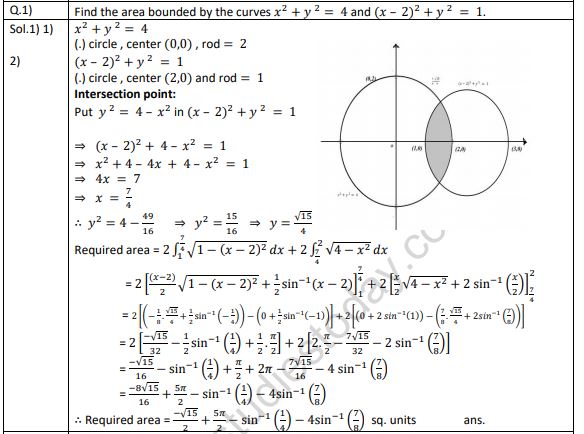
Question. Find the area bounded by the curves \(x^2 + y^2 = 4\) and \((x - 2)^2 + y^2 = 1\).
Answer:
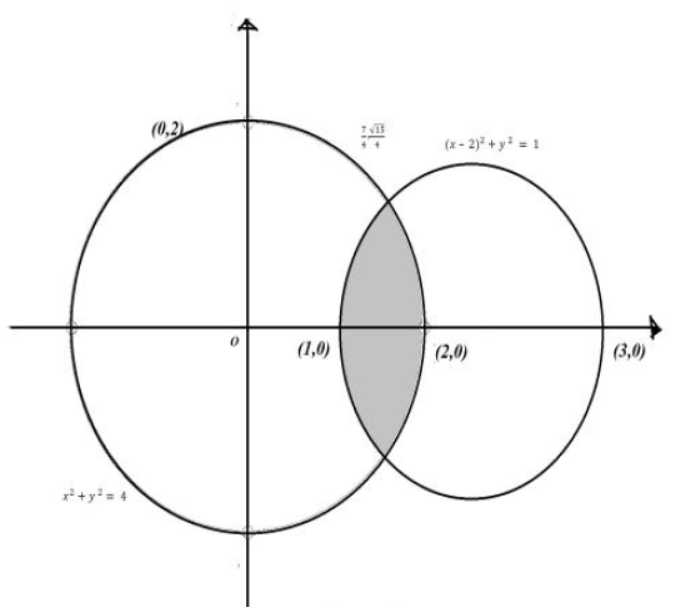
1) \(x^2 + y^2 = 4\)
(.) circle, center (0,0), rod = 2
2) \((x - 2)^2 + y^2 = 1\)
(.) circle, center (2,0) and rod = 1
Intersection point:
Put \(y^2 = 4 - x^2\) in \((x - 2)^2 + y^2 = 1\)
\(\Rightarrow (x - 2)^2 + 4 - x^2 = 1\)
\(\Rightarrow x^2 + 4 - 4x + 4 - x^2 = 1\)
\(\Rightarrow 4x = 7\)
\(\Rightarrow x = \frac{7}{4}\)
\(\therefore y^2 = 4 - \frac{49}{16} \Rightarrow y^2 = \frac{15}{16} \Rightarrow y = \frac{\sqrt{15}}{4}\)
Required area = \(2 \int_{1}^{\frac{7}{4}} \sqrt{1 - (x - 2)^2} \, dx + 2 \int_{\frac{7}{4}}^{2} \sqrt{4 - x^2} \, dx\)
\[ = 2 \left[ \frac{(x-2)}{2} \sqrt{1 - (x - 2)^2} + \frac{1}{2} \sin^{-1}(x - 2) \right]_{1}^{\frac{7}{4}} + 2 \left[ \frac{x}{2} \sqrt{4 - x^2} + 2 \sin^{-1} \left( \frac{x}{2} \right) \right]_{\frac{7}{4}}^{2} \]
\[ = 2 \left[ \left( -\frac{1}{8} \cdot \frac{\sqrt{15}}{4} + \frac{1}{2} \sin^{-1}\left(-\frac{1}{4}\right) \right) - \left( 0 + \frac{1}{2} \sin^{-1}(-1) \right) \right] + 2 \left[ \left( 0 + 2 \sin^{-1}(1) \right) - \left( \frac{7}{8} \cdot \frac{\sqrt{15}}{4} + 2 \sin^{-1}\left(\frac{7}{8}\right) \right) \right] \]
\[ = 2 \left[ -\frac{\sqrt{15}}{32} - \frac{1}{2} \sin^{-1} \left( \frac{1}{4} \right) + \frac{1}{2} \cdot \frac{\pi}{2} \right] + 2 \left[ 2 \cdot \frac{\pi}{2} - \frac{7\sqrt{15}}{32} - 2 \sin^{-1} \left( \frac{7}{8} \right) \right] \]
\[ = -\frac{\sqrt{15}}{16} - \sin^{-1} \left( \frac{1}{4} \right) + \frac{\pi}{2} + 2\pi - \frac{7\sqrt{15}}{16} - 4 \sin^{-1} \left( \frac{7}{8} \right) \]
\[ = -\frac{8\sqrt{15}}{16} + \frac{5\pi}{2} - \sin^{-1} \left( \frac{1}{4} \right) - 4 \sin^{-1} \left( \frac{7}{8} \right) \]
\[ \therefore \text{Required area} = -\frac{\sqrt{15}}{2} + \frac{5\pi}{2} - \sin^{-1} \left( \frac{1}{4} \right) - 4 \sin^{-1} \left( \frac{7}{8} \right) \text{ sq. units ans.} \]
Question. Find the area of the region \(\{(x, y): y^2 \le 4x, 4x^2 + 4y^2 \le 9\}\).
Answer:
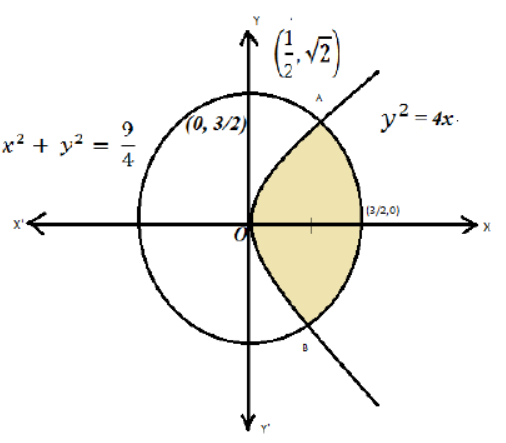
1) \(y^2 \le 4x\)
(.) parabola
(.) vertex (0,0)
(.) open + ve \(x\)-axis
(.) solution inside the parabola
2) \(4x^2 + 4y^2 \le 9\)
(.) circle
(.) center (0,0)
\[ x^2 + y^2 \le \frac{9}{4} \]
3) (.) radius = \(\frac{3}{2}\)
(.) solution: Inside the circle
Intersection point:
Put \(y^2 = 4x\) in \(4x^2 + 4y^2 = 9\)
\(\Rightarrow 4x^2 + 16x - 9 = 0\)
\(\Rightarrow 4x^2 + 18x - 2x - 9 = 0\)
\(\Rightarrow (2x - 1) (2x + 9) = 0\)
\(x = \frac{1}{2} \quad \text{(or)} \quad x = \frac{-9}{2} \text{ (rejected)}\)
\(\therefore y = \sqrt{2}\)
point \(\left(\frac{1}{2}, \sqrt{2}\right)\)
Required area = \(2 \int_{0}^{\frac{1}{2}} 2\sqrt{x} \, dx + 2 \int_{\frac{1}{2}}^{\frac{3}{2}} \sqrt{\frac{9}{4} - x^2} \, dx\)
\[ = 4 \left[ \frac{2}{3} \cdot x^{\frac{3}{2}} \right]_{0}^{\frac{1}{2}} + 2 \left[ \frac{x}{2} \sqrt{\frac{9}{4} - x^2} + \frac{9}{8} \sin^{-1} \left(\frac{2x}{3}\right) \right]_{\frac{1}{2}}^{\frac{3}{2}} \]
\[ = \frac{8}{3} \left[ \frac{1}{2\sqrt{2}} - 0 \right] + 2 \left[ \left(0 + \frac{9}{8} \sin^{-1}(1)\right) - \left( \frac{1}{4}\sqrt{2} + \frac{9}{8} \sin^{-1} \left( \frac{1}{3} \right) \right) \right]
\[ = \frac{4}{3\sqrt{2}} + 2 \left[ \frac{9}{8} \cdot \frac{\pi}{2} - \frac{\sqrt{2}}{4} - \frac{9}{4} \sin^{-1} \left( \frac{1}{3} \right) \right] \]
\[ = \frac{4}{3\sqrt{2}} + \frac{9\pi}{8} - \frac{\sqrt{2}}{2} - \frac{9}{2} \sin^{-1} \left( \frac{1}{3} \right) \]
\[ = \frac{2\sqrt{2}}{3} - \frac{\sqrt{2}}{2} + \frac{9\pi}{8} - \frac{9}{2} \sin^{-1} \left( \frac{1}{3} \right) \]
\[ = \frac{\sqrt{2}}{6} + \frac{9\pi}{8} - \frac{9}{2} \sin^{-1} \left( \frac{1}{3} \right) \text{ sq. units ans.} \]
Question. Find the area of the circle \(x^2 + y^2 \le 16\) and parabola \(y^2 \ge 6x\).
Answer:
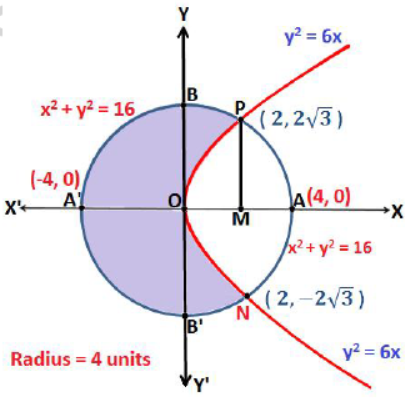
1) \(x^2 + y^2 \le 16\)
(.) circle
(.) center (0,0)
(.) radius = 4
(.) solution inside the circle
2) \(y^2 \ge 6x\)
(.) parabola
(.) vertex (0,0)
(.) open +ve \(x\)-axis
(.) solution outside the parabola
Intersection point:
Put \(y^2 = 6x\) in \(x^2 + y^2 = 16\)
\(\Rightarrow x^2 + 6x - 16 = 0\)
\(\Rightarrow (x + 8) (x - 2) = 0\)
\(x = -8 \text{ (rejected) and } x = 2\)
\(\dots y = 2\sqrt{3}\)
and point is \((2, 2\sqrt{3})\)
Required area = Area of circle - Interior area (or un-shaded area)
Area of circle = \(\pi r^2 = \pi(16) = 16\pi\) sq. units
\[ \text{Interior Area} = 2 \int_{0}^{2} \sqrt{6}\sqrt{x} \, dx + 2 \int_{2}^{4} \sqrt{16 - x^2} \, dx \]
\[ = 2\sqrt{6} \cdot \frac{2}{3} \left( x^{\frac{3}{2}} \right)_{0}^{2} + 2 \left[ \frac{x}{2} \sqrt{16 - x^2} + 8\sin^{-1} \left(\frac{x}{4}\right) \right]_{2}^{4} \]
\[ = \frac{4\sqrt{6}}{3} [2\sqrt{2}] + 2 \left[ \left(0 + 8\sin^{-1}(1)\right) - \left(2\sqrt{3} + 8 \sin^{-1} \left(\frac{1}{2}\right) \right) \right] \]
\[ = \frac{8\sqrt{12}}{3} + 2 \left[ 8 \cdot \frac{\pi}{2} - 2\sqrt{3} - 8 \cdot \frac{\pi}{6} \right] \]
\[ = \frac{16\sqrt{3}}{3} + 8\pi - 4\sqrt{3} - \frac{8\pi}{3} \]
\[ = \left( \frac{16\sqrt{3}}{3} - 4\sqrt{3} \right) + \left( 8\pi - \frac{8\pi}{3} \right) \]
\[ = \frac{4\sqrt{3}}{3} + \frac{16\pi}{3} \text{ sq. units} \]
Now required area = \(16\pi - \left[ \frac{4\sqrt{3}}{3} + \frac{16\pi}{3} \right]\)
\[ = 16\pi - \frac{16\pi}{3} - \frac{4\sqrt{3}}{3} \]
\[ = \frac{32\pi}{3} - \frac{4\sqrt{3}}{3} \text{ sq. units ans.} \]
Question. Find the area of the circle \(4x^2 + 4y^2 = 9\) which is interior to the parabola \(x^2 = 4y\).
Answer:
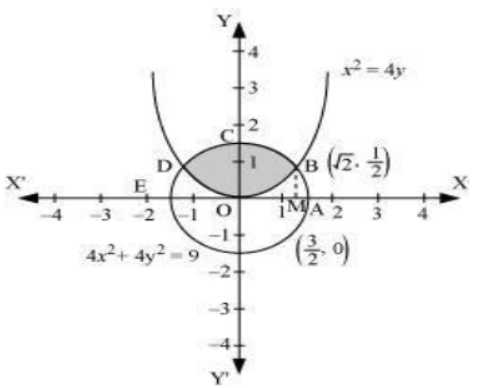
1) \(4x^2 + 4y^2 = 9\) or \(x^2 + y^2 = \frac{9}{4}\)
(.) circle
(.) center (0,0)
(.) radius = \(\frac{3}{2}\)
2) \(x^2 = 4y\)
(.) parabola
(.) vertex (0,0)
(.) radius = \(\frac{3}{2}\)
Intersecting point:
Put \(x^2 = 4y\) in \(4x^2 + 4y^2 = 9\)
\(\Rightarrow 16y + 4y^2 = 9\)
\(\Rightarrow 4y^2 + 16y - 9 = 0\)
\(\Rightarrow 4y^2 + 18y - 2y - 9 = 0\)
\(\Rightarrow (2y + 9) (2y - 1) = 0\)
\(\Rightarrow y = \frac{-9}{2} \text{ (rejected) and } y = \frac{1}{2}\)
\(\therefore x = \sqrt{2}\)
Point \(\left(\sqrt{2}, \frac{1}{2}\right)\)
Required area = \(2 \int_{0}^{\sqrt{2}} \left( \sqrt{\frac{9}{4} - x^2} - \frac{x^2}{4} \right) \, dx\)
\[ = 2 \left[ \frac{x}{2}\sqrt{\frac{9}{4} - x^2} + \frac{9}{8}\sin^{-1} \left(\frac{2x}{3}\right) - \frac{x^3}{12} \right]_{0}^{\sqrt{2}} \]
\[ = 2 \left[ \left( \frac{\sqrt{2}}{2} \cdot \frac{1}{2} + \frac{9}{8}\sin^{-1} \left( \frac{2\sqrt{2}}{3} \right) - \frac{2\sqrt{2}}{12} \right) - (0) \right] \]
\[ = \frac{\sqrt{2}}{2} + \frac{9}{4}\sin^{-1} \left( \frac{2\sqrt{2}}{3} \right) - \frac{\sqrt{2}}{3} \]
\[ = \frac{\sqrt{2}}{6} + \frac{9}{4}\sin^{-1} \left( \frac{2\sqrt{2}}{3} \right) \text{ sq. unit ans.} \]
Question. Find the area lying above \(x\)-axis and included the circle \(4x^2 + 4y^2 = 32x\) and \(y^2 = 4x\).
Answer:

1) \(4x^2 + 4y^2 = 32x\)
(.) circle
(.) center (4,0)
(.) radius = 4
\(\Rightarrow x^2 + y^2 = 8x\)
\(\Rightarrow x^2 - 8x + y^2 = 0\)
\(\Rightarrow (x - 4)^2 - 16 + y^2 = 0\)
\(\Rightarrow (x - 4)^2 + y^2 = 16\)
2) \(y^2 = 4x\)
(.) parabola
(.) vertex (0,0)
(.) open +ve \(x\)-axis
Intersection point:
Put \(y^2 = 4x\) in \(x^2 + y^2 = 8x\)
\(\Rightarrow x^2 + 4x = 8x\)
\(\Rightarrow x^2 - 4x = 0\)
\(\Rightarrow x(x - 4) = 0\)
\(x = 0 \;; \; x = 4\)
\(\therefore\) points \((0,0)\) & \((4,4)\)
\(y = 0 \;; \; y = 4\)
Required area = \(\int_{0}^{4} 2\sqrt{x} \, dx + \int_{4}^{8} \sqrt{16 - (x - 4)^2} \, dx\)
\[ = 2 \cdot \frac{2}{3} \left(x^{\frac{3}{2}}\right)_{0}^{4} + \left[ \frac{(x-4)}{2} \sqrt{16 - (x - 4)^2} + 8\sin^{-1} \left(\frac{x-4}{4}\right) \right]_{4}^{8} \]
\[ = \frac{4}{3}(8 - 0) + \left[ \left(0 + 8\sin^{-1}(1)\right) - (0 + 0) \right] \]
\[ = \frac{32}{3} + 8 \cdot \frac{\pi}{2} \]
\[ = \frac{32}{3} + 4\pi \text{ sq. units ans.} \]
Question. Find the area of the region in \(1^{\text{st}}\) quadrant enclosed by \(x\)-axis, line \(x = \sqrt{3}y\) and curve \(y = \sqrt{4 - x^2}\).
Answer:
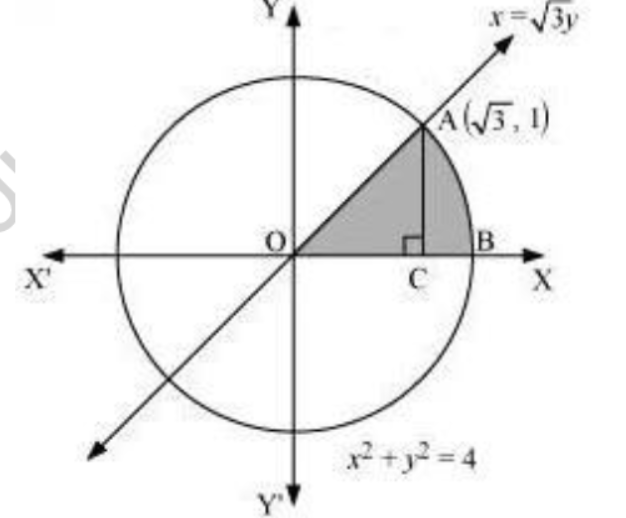
1) \(x = \sqrt{3}y\)
(.) line passing through (0,0)
(.) 30 with \(x\)-axis
2) \(y = \sqrt{4 - x^2}\)
\(\Rightarrow y^2 = 4 - x^2\)
\(\Rightarrow x^2 + y^2 = 4\)
(.) circle
(.) center (0,0)
(.) radius = 2
3) \(x\)-axis
Intersection point:
Put \(x = \sqrt{3}y\) in \(x^2 + y^2 = 4\)
\(\Rightarrow 3y^2 + y^2 = 4\)
\(\Rightarrow 4y^2 = 4\)
\(\Rightarrow y = 1\)
\(\therefore x = \sqrt{3}\) and point is \((\sqrt{3}, 1)\)
Required area = \(\int_{0}^{\sqrt{3}} \frac{x}{\sqrt{3}} \, dx + \int_{\sqrt{3}}^{2} \sqrt{4 - x^2} \, dx\)
\[ = \left( \frac{x^2}{2\sqrt{3}} \right)_{0}^{\sqrt{3}} + \left[ \frac{x}{2}\sqrt{4 - x^2} + 2\sin^{-1} \left(\frac{x}{2}\right) \right]_{\sqrt{3}}^{2} \]
\[ = \left( \frac{3}{2\sqrt{3}} - 0 \right) + \left[ \left(0 + 2\sin^{-1}(1)\right) - \left( \frac{\sqrt{3}}{2} + 2\sin^{-1} \frac{\sqrt{3}}{2} \right) \right] \]
\[ = \frac{\sqrt{3}}{2} + 2 \cdot \frac{\pi}{2} - \frac{\sqrt{3}}{2} - 2 \cdot \frac{\pi}{3} \]
\[ = \pi - \frac{2\pi}{3} = \frac{\pi}{3} \text{ sq. units ans.} \]
Question. Find the area of the region \(\{(x, y): |x - 1| \le y \le \sqrt{5 - x^2}\}\).
Answer:

1) \(y \le \sqrt{5 - x^2}\)
\(\Rightarrow y^2 \le 5 - x^2\)
(.) circle
(.) center (0,0)
(.) radius \(\sqrt{5}\)
(.) solution: Inside the circle
2) \(y \ge |x - 1|\)
(.) \(y \ge x - 1 \;; \; x - 1 \ge 0 \Rightarrow x \ge 1\)
line
points (0, -1) & (1, 0)
solution: towards the origin
(.) \(y \ge -x + 1 \;; \; x - 1 < 0 \Rightarrow x < 1\)
points (0,1) & (1,0)
solution: away from the origin
Intersection point:
Put \(y = x - 1\) in \(x^2 + y^2 = 5\)
\(\Rightarrow x^2 + (x - 1)^2 = 5\)
\(\Rightarrow x^2 + x^2 - 2x + 1 = 5\)
\(\Rightarrow 2x^2 - 2x - 4 = 0\)
\(\Rightarrow x^2 - x - 2 = 0\)
\(\Rightarrow (x - 2)(x + 1) = 0\)
\(x = 2\) and \(x = -1\)
\(y = 1\) and \(y = 2\)
\(\therefore\) points are (2, 1) and (–1, 2)
Required Area:
\[ = \int_{-1}^{1} \left( \sqrt{5 - x^2} - (-x + 1) \right) \, dx + \int_{1}^{2} \left( \sqrt{5 - x^2} - (x - 1) \right) \, dx \]
\[ = \left[ \frac{x}{2}\sqrt{5 - x^2} + \frac{5}{2}\sin^{-1}\left(\frac{x}{\sqrt{5}}\right) + \frac{x^2}{2} - x \right]_{-1}^{1} + \left[ \frac{x}{2}\sqrt{5 - x^2} + \frac{5}{2}\sin^{-1}\left(\frac{x}{\sqrt{5}}\right) - \frac{x^2}{2} + x \right]_{1}^{2} \]
\[ = \left[ \left( \frac{1}{2} \cdot 2 + \frac{5}{2}\sin^{-1}\left(\frac{1}{\sqrt{5}}\right) + \frac{1}{2} - 1 \right) - \left( -\frac{1}{2} \cdot 2 + \frac{5}{2}\sin^{-1}\left(-\frac{1}{\sqrt{5}}\right) + \frac{1}{2} + 1 \right) \right] + \left[ \left(1 + \frac{5}{2}\sin^{-1}\left(\frac{2}{\sqrt{5}}\right) - 2 + 2\right) - \left( \frac{1}{2} \cdot 2 + \frac{5}{2}\sin^{-1}\left(\frac{1}{\sqrt{5}}\right) - \frac{1}{2} + 1 \right) \right] \]
\[ = \left[ 1 + \frac{5}{2}\sin^{-1}\left(\frac{1}{\sqrt{5}}\right) - \frac{1}{2} + 1 + \frac{5}{2}\sin^{-1}\left(\frac{1}{\sqrt{5}}\right) - \frac{3}{2} \right] + \left[ 1 + \frac{5}{2}\sin^{-1}\left(\frac{2}{\sqrt{5}}\right) - 1 - \frac{5}{2}\sin^{-1}\left(\frac{1}{\sqrt{5}}\right) - \frac{1}{2} \right] \]
\[ = 2 - 2 + \frac{5}{2}\sin^{-1}\left(\frac{1}{\sqrt{5}}\right) + \frac{5}{2}\sin^{-1}\left(\frac{1}{\sqrt{5}}\right) + \frac{5}{2}\sin^{-1}\left(\frac{2}{\sqrt{5}}\right) - \frac{1}{2} \]
\[ \text{Required area} = \frac{1}{2}\left[ 5\sin^{-1}\left(\frac{1}{\sqrt{5}}\right) + 5\sin^{-1}\left(\frac{2}{\sqrt{5}}\right) - 1 \right] \text{ sq. units ans.} \]
Question. Find the area bounded by the ellipse \(\frac{x^2}{a^2} + \frac{y^2}{b^2} = 1\) and the ordinates \(x = 0\) and line \(x = ae\) where \(b^2 = a^2(1 - e^2)\).
Answer:

1) \(\frac{x^2}{a^2} + \frac{y^2}{b^2} = 1\)
2) \(x = 0\); \(y\)-axis
\(x = ae\); a line parallel to \(y\)-axis at \((ae, 0)\)
Required area = \(2 \int_{0}^{ae} \frac{b}{a}\sqrt{a^2 - x^2} \, dx\)
\[ = 2\frac{b}{a} \left[ \frac{x}{2}\sqrt{a^2 - x^2} + \frac{a^2}{2}\sin^{-1}\left(\frac{x}{a}\right) \right]_{0}^{ae} \]
\[ = \frac{2b}{a} \left[ \left( \frac{ae}{2} \cdot \sqrt{a^2 - a^2e^2} + \frac{a^2}{2}\sin^{-1}\left(\frac{ae}{a}\right) \right) - (0) \right] \]
\[ = \frac{2b}{a} \left[ \frac{ae}{2} \cdot a\sqrt{1 - e^2} + \frac{a^2}{2}\sin^{-1}(e) \right] \]
\[ = \frac{2b}{a} \cdot \frac{a^2}{2} \left[ e\sqrt{1 - e^2} + \sin^{-1}(e) \right] \]
\[ \text{Required area} = ab\left[ e\sqrt{1 - e^2} + \sin^{-1} e \right] \text{ sq. units ans.} \]
Question. Find the area of the smaller region bounded by the curves \(\frac{x^2}{a^2} + \frac{y^2}{b^2} = 1\) and the line \(\frac{x}{a} + \frac{y}{b} = 1\).
Answer:
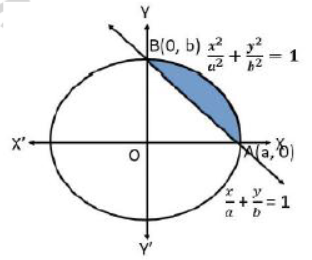
1) \(\frac{x^2}{a^2} + \frac{y^2}{b^2} = 1\)
(.) ellipse
(.) horizontal (let \(a > b\))
(.) vertices \((a, 0)\) & \((0, b)\)
2) \(\frac{x}{a} + \frac{y}{b} = 1\)
(.) line
(.) points \((a, 0)\) & \((0, b)\)
Required area:
\[ = \int_{0}^{a} \left[ \frac{b}{a}\sqrt{a^2 - x^2} - \frac{b}{a}(a - x) \right] \, dx \quad \left\{ \text{for ellipse } y = \frac{b}{a}\sqrt{a^2 - x^2} \right\} \]
\[ = \frac{b}{a} \int_{0}^{a} \left( \sqrt{a^2 - x^2} - a + x \right) \, dx \]
\[ = \frac{b}{a} \left[ \frac{x}{2}\sqrt{a^2 - x^2} + \frac{a^2}{2}\sin^{-1}\left(\frac{x}{a}\right) - ax + \frac{x^2}{2} \right]_{0}^{a} \]
\[ = \frac{b}{a} \left[ \left(0 + \frac{a^2}{2}\sin^{-1}(1) - a^2 + \frac{a^2}{2}\right) - (0) \right] \]
\[ = \frac{b}{a} \left[ \frac{a^2}{2} \cdot \frac{\pi}{2} - \frac{a^2}{2} \right] \]
\[ = \frac{b}{a} \left( \frac{a^2\pi}{4} - \frac{a^2}{2} \right) \]
\[ = \frac{a^2b}{2a} \left( \frac{\pi}{2} - 1 \right) \]
\[ \text{Required area} = \frac{ab}{2}\left(\frac{\pi}{2} - 1\right) \text{ sq. units ans.} \]
Question. AOBA is the part of the ellipse \(9x^2 + y^2 = 36\) in the first quadrant such that \(OA = 2\) and \(OB = 6\). Find the area between the arc \(AB\) and chord \(AB\).
Answer:
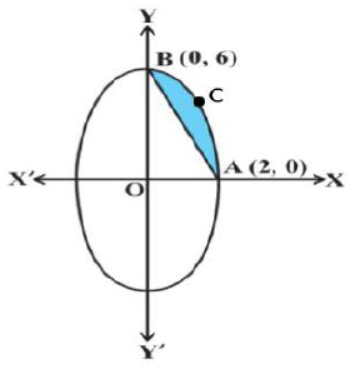
1) \(9x^2 + y^2 = 36\) (Divide by 36)
\[ \Rightarrow \frac{x^2}{4} + \frac{y^2}{36} = 1 \]
here \(a = 2\) & \(b = 6\) and \(b > a\)
(.) ellipse
(.) verticals
\(A(2, 0)\) & \(B(0, 6)\)
2) Equation of chord \(A\):
\[ y - 0 = \frac{6-0}{0-2}(x - 2) \]
\[ \Rightarrow y = -3(x - 2) \]
\[ \Rightarrow y = -3x + 6 \]
Required area = \(\int_{0}^{2} \left[ 3\sqrt{4 - x^2} - (-3x + 6) \right] \, dx\)
\[ = 3 \int_{0}^{2} \left( \sqrt{4 - x^2} + x - 2 \right) \, dx \]
\[ = 3 \left[ \frac{x}{2}\sqrt{4 - x^2} + 2\sin^{-1}\left(\frac{x}{2}\right) + \frac{x^2}{2} - 2x \right]_{0}^{2} \]
\[ = 3 \left[ \left(0 + 2\sin^{-1}(1) + 2 - 4\right) - (0) \right] \]
\[ = 3 \left[ 2 \cdot \frac{\pi}{2} - 2 \right] \]
\[ \text{Required area} = (3\pi - 6) \text{ sq. units ans.} \]
Free study material for Mathematics
CBSE Mathematics Class 12 Chapter 8 Application Of Integrals Worksheet
Students can use the practice questions and answers provided above for Chapter 8 Application Of Integrals to prepare for their upcoming school tests. This resource is designed by expert teachers as per the latest 2026 syllabus released by CBSE for Class 12. We suggest that Class 12 students solve these questions daily for a strong foundation in Mathematics.
Chapter 8 Application Of Integrals Solutions & NCERT Alignment
Our expert teachers have referred to the latest NCERT book for Class 12 Mathematics to create these exercises. After solving the questions you should compare your answers with our detailed solutions as they have been designed by expert teachers. You will understand the correct way to write answers for the CBSE exams. You can also see above MCQ questions for Mathematics to cover every important topic in the chapter.
Class 12 Exam Preparation Strategy
Regular practice of this Class 12 Mathematics study material helps you to be familiar with the most regularly asked exam topics. If you find any topic in Chapter 8 Application Of Integrals difficult then you can refer to our NCERT solutions for Class 12 Mathematics. All revision sheets and printable assignments on studiestoday.com are free and updated to help students get better scores in their school examinations.
FAQs
You can download the latest chapter-wise printable worksheets for Class 12 Mathematics Chapter 8 Application Of Integrals for free from StudiesToday.com. These have been made as per the latest CBSE curriculum for this academic year.
Yes, Class 12 Mathematics worksheets for Chapter 8 Application Of Integrals focus on activity-based learning and also competency-style questions. This helps students to apply theoretical knowledge to practical scenarios.
Yes, we have provided solved worksheets for Class 12 Mathematics Chapter 8 Application Of Integrals to help students verify their answers instantly.
Yes, our Class 12 Mathematics test sheets are mobile-friendly PDFs and can be printed by teachers for classroom.
For Chapter 8 Application Of Integrals, regular practice with our worksheets will improve question-handling speed and help students understand all technical terms and diagrams.