

Read and download the CBSE Class 12 Mathematics Relations And Functions Worksheet Set 04 in PDF format. We have provided exhaustive and printable Class 12 Mathematics worksheets for Chapter 1 Relations and Functions, designed by expert teachers. These resources align with the 2026-27 syllabus and examination patterns issued by NCERT, CBSE, and KVS, helping students master all important chapter topics.
Chapter-wise Worksheet for Class 12 Mathematics Chapter 1 Relations and Functions
Students of Class 12 should use this Mathematics practice paper to check their understanding of Chapter 1 Relations and Functions as it includes essential problems and detailed solutions. Regular self-testing with these will help you achieve higher marks in your school tests and final examinations.
Class 12 Mathematics Chapter 1 Relations and Functions Worksheet with Answers
CBSE Class 12 Mathematics Relations And Functions (4). The Relations And Functions questions in the worksheets have been specifically designed by best mathematics teachers so that the students can practise them to clear their Relations And Functions concepts and get better marks in class 12 mathematics tests and examinations. Students can free download these Relations And Functions worksheets in pdf and practice them. This will help them to get better marks in examinations. Also refer to other worksheets for the Relations And Functions chapter and other subjects too. Use them for better understanding of the subjects.

Page 9
| Topic | Concepts | Degree of Importance | References (NCERT Text Book XII Ed. 2007) |
|---|---|---|---|
| Relations & Functions | (i) Domain, Co domain & Range of a relation | * | (Previous Knowledge) |
| (ii) Types of relations | *** | Ex 1.1 Q.No- 5,9,12 | |
| (iii) One-one, onto & inverse of a function | *** | Ex 1.2 Q.No- 7,9 | |
| (iv) Composition of function | * | Ex 1.3 QNo- 7,9,13 | |
| (v) Binary Operations | *** | Example 45, Ex 1.4 QNo- 5,11 |
Some Important Results/Concepts
A relation \( R \) in a set \( A \) is called:
- Reflexive: if \( (a, a) \in R \) for every \( a \in A \).
- Symmetric: if \( (a_1, a_2) \in R \) implies that \( (a_2, a_1) \in R \), for all \( a_1, a_2 \in A \).
- Transitive: if \( (a_1, a_2) \in R \) and \( (a_2, a_3) \in R \) implies that \( (a_1, a_3) \in R \), for all \( a_1, a_2, a_3 \in A \).
Equivalence Relation: A relation \( R \) is an equivalence relation if it is reflexive, symmetric, and transitive.
Function: A relation \( f : A \to B \) is a function if every element of set \( A \) is associated with a unique element in set \( B \).
- \( A \) is the domain of the function.
- \( B \) is the codomain of the function.
- For any element \( x \in A \), the function \( f \) maps it to an element in \( B \), which is denoted by \( f(x) \) and is called the image of \( x \) under \( f \). In this case, \( x \) is referred to as the pre-image of \( y = f(x) \).
- Range = \( \{ f(x) \mid x \in A \} \). The range is always a subset of the codomain, i.e., Range \( \subseteq \) Codomain.
- The largest possible domain of a function is called its domain of definition.
Composite Function:
Let two functions be defined as \( f : A \to B \) and \( g : B \to C \). Then we can define a function \( \phi : A \to C \) by setting \( \phi(x) = g(f(x)) \) where \( x \in A \), \( f(x) \in B \), and \( g(f(x)) \in C \). This function \( \phi : A \to C \) is called the composite function of \( f \) and \( g \) in that order, and we write \( \phi = g \circ f \).
Page 10
Different Types of Functions
Let \( f : A \to B \) be a function.
- \( f \) is a one-to-one (injective) mapping if any two distinct elements in \( A \) are mapped to distinct elements in \( B \), i.e., \( x_1 \neq x_2 \implies f(x_1) \neq f(x_2) \), or equivalently, \( f(x_1) = f(x_2) \implies x_1 = x_2 \).
- \( f \) is a many-to-one mapping if there exist at least two distinct elements in \( A \) that share the same image in \( B \).
- \( f \) is an onto mapping (surjective) if every element in the codomain \( B \) has at least one pre-image in the domain \( A \).
- \( f \) is an into mapping if the range of the function is a proper subset of its codomain.
- \( f \) is a bijective mapping if it is both one-to-one (injective) and onto (surjective).
Binary Operations
A binary operation \( * \) on a set \( A \) is a function defined as \( * : A \times A \to A \). We denote \( *(a, b) \) as \( a * b \).
- A binary operation \( * \) on \( A \) is a rule that associates every ordered pair \( (a, b) \) of \( A \times A \) with a unique element \( a * b \) in \( A \).
- An operation \( * \) on \( A \) is commutative if and only if \( a * b = b * a \) for all \( a, b \in A \).
- An operation \( * \) on \( A \) is associative if and only if \( (a * b) * c = a * (b * c) \) for all \( a, b, c \in A \).
- Given a binary operation \( * : A \times A \to A \), an element \( e \in A \), if it exists, is called the identity for the operation if \( a * e = a = e * a \) for all \( a \in A \).
- Given a binary operation \( * : A \times A \to A \) with an identity element \( e \in A \), an element \( a \in A \) is invertible with respect to the operation if there exists an element \( b \in A \) such that \( a * b = e = b * a \). Here, \( b \) is the inverse of \( a \), denoted as \( a^{-1} \)
Assignments
(i) Domain, Co domain & Range of a relation
Level I
Question 1. If A = {1, 2, 3, 4, 5}, write the relation a R b such that a + b = 8, a ,b ∈ A. Write the domain, range & co-domain.
Answer: Given set \( A = \{1, 2, 3, 4, 5\} \). We seek ordered pairs \( (a, b) \in A \times A \) satisfying \( a + b = 8 \).
Testing combinations from set \( A \):
If \( a = 3 \), then \( b = 5 \) (since \( 3 + 5 = 8 \))
If \( a = 4 \), then \( b = 4 \) (since \( 4 + 4 = 8 \))
If \( a = 5 \), then \( b = 3 \) (since \( 5 + 3 = 8 \))
No other pairs from \( A \times A \) satisfy this condition.
Thus, the relation is: \( R = \{(3, 5), (4, 4), (5, 3)\} \).
The domain of \( R \) is the set of first elements: \( \{3, 4, 5\} \).
The range of \( R \) is the set of second elements: \( \{3, 4, 5\} \).
The co-domain is the entire target set \( A = \{1, 2, 3, 4, 5\} \).
In simple words: Look for pairs of numbers in set A that add up to 8. The first numbers of these pairs make the domain, the second numbers make the range, and the whole set A is the codomain.
Exam Tip: Be sure to only select elements that belong to set A. For instance, do not include (6, 2) since 6 is not in set A.
Question 2. Define a relation R on the set N of natural numbers by R={(x , y) : y = x +7, x is a natural number less than 4 ; x, y ∈ N}. Write down the domain and the range.
Answer: The natural numbers \( x \) less than 4 are \( \{1, 2, 3\} \).
We calculate \( y = x + 7 \) for each value:
For \( x = 1 \): \( y = 1 + 7 = 8 \)
For \( x = 2 \): \( y = 2 + 7 = 9 \)
For \( x = 3 \): \( y = 3 + 7 = 10 \)
So, the relation is \( R = \{(1, 8), (2, 9), (3, 10)\} \).
The domain is the set of inputs: \( \{1, 2, 3\} \).
The range is the set of outputs: \( \{8, 9, 10\} \).
In simple words: Substitute x values of 1, 2, and 3 into the equation to get y values. The x values form the domain, and the y values form the range.
Exam Tip: Pay close attention to the constraint on x. Since x must be less than 4, only use 1, 2, and 3 as inputs.
2. Types of relations
Level II
Question 1. Let R be the relation in the set N given by R = {(a , b)| a = b - 2 , b > 6} Whether the relation is reflexive or not ?justify your answer.
Answer: For a relation \( R \) on \( \mathbb{N} \) to be reflexive, every element \( a \in \mathbb{N} \) must be related to itself, meaning \( (a, a) \in R \) for all \( a \in \mathbb{N} \).
If \( (a, a) \in R \), then from the relation definition:
\( a = a - 2 \)
\( \implies 0 = -2 \)
This statement is a contradiction and is mathematically impossible. Therefore, \( (a, a) \notin R \) for any element in \( \mathbb{N} \). Consequently, the relation is not reflexive.
In simple words: A relation is reflexive if every number is paired with itself. Here, that would require a number to equal itself minus two, which can never be true.
Exam Tip: To disprove reflexivity, simply provide a single counterexample, such as showing that (7, 7) does not belong to the relation.
Question 2. Show that the relation R in the set N given by R = {(a , b)| a is divisible by b , a , b ∈ N} is reflexive and transitive but not symmetric.
Answer: We analyze the relation step-by-step:
Reflexivity: For any \( a \in \mathbb{N} \), \( a \) is always divisible by itself, since \( \frac{a}{a} = 1 \). Therefore, \( (a, a) \in R \) for all \( a \in \mathbb{N} \). This proves \( R \) is reflexive.
Symmetry: Consider \( a = 6 \) and \( b = 2 \). Here, \( 6 \) is divisible by \( 2 \), which means \( (6, 2) \in R \). However, \( 2 \) is not divisible by \( 6 \), so \( (2, 6) \notin R \). Because \( (a, b) \in R \) does not imply \( (b, a) \in R \), the relation is not symmetric.
Transitivity: Let \( (a, b) \in R \) and \( (b, c) \in R \). This means \( a \) is divisible by \( b \), and \( b \) is divisible by \( c \). Thus, we can write \( a = k_1 b \) and \( b = k_2 c \) for some integers \( k_1, k_2 \). Substituting \( b \) into the first equation yields:
\( a = k_1 (k_2 c) = (k_1 k_2) c \)
Since \( k_1 k_2 \) is an integer, \( a \) is divisible by \( c \). This means \( (a, c) \in R \), showing the relation is transitive.
In simple words: Any number divides itself (reflexive), and if a first number divides a second, which divides a third, the first divides the third (transitive). But just because 6 divides 3, it does not mean 3 divides 6 (not symmetric).
Exam Tip: When proving transitivity, write down the division relationships as algebraic equations to show the logic clearly.
Question 3. Let R be the relation in the set N given by R = {(a ,b)| a > b} Show that the relation is neither reflexive nor symmetric but transitive.
Answer: Let us check the three properties of relations:
Reflexivity: For any \( a \in \mathbb{N} \), the inequality \( a > a \) is false. Thus, \( (a, a) \notin R \) for any element, meaning the relation is not reflexive.
Symmetry: If \( a > b \), then \( b > a \) cannot be true. For example, \( (5, 3) \in R \) because \( 5 > 3 \), but \( 3 > 5 \) is false, meaning \( (3, 5) \notin R \). Thus, it is not symmetric.
Transitivity: Let \( (a, b) \in R \) and \( (b, c) \in R \), which means \( a > b \) and \( b > c \). By the transitive property of inequalities, \( a > c \), which implies \( (a, c) \in R \). This confirms the relation is transitive.
In simple words: A number is never strictly greater than itself, so the relation is not reflexive. If x is bigger than y, then y cannot be bigger than x. But if x is bigger than y, and y is bigger than z, then x is definitely bigger than z.
Exam Tip: Clearly state a counterexample for reflexivity and symmetry, but use general variables for the proof of transitivity.
Question 4. Let R be the relation on R defined as (a , b) ∈ R iff 1+ ab > 0 ∀ a,b ∈ R. (a) Show that R is symmetric. (b) Show that R is reflexive. (c) Show that R is not transitive.
Answer: We test each property on the set of real numbers \( \mathbb{R} \):
(a) Symmetry: Let \( (a, b) \in R \). This means \( 1 + ab > 0 \). Because multiplication of real numbers is commutative, \( ab = ba \). Thus, \( 1 + ba > 0 \), which implies \( (b, a) \in R \). This proves the relation is symmetric.
(b) Reflexivity: For any \( a \in \mathbb{R} \), we have \( 1 + a \cdot a = 1 + a^2 \). Since the square of any real number is non-negative (\( a^2 \ge 0 \)), we know that \( 1 + a^2 \ge 1 > 0 \). Thus, \( 1 + a^2 > 0 \) is always true, meaning \( (a, a) \in R \) for all \( a \in \mathbb{R} \). This proves reflexivity.
(c) Transitivity: To show the relation is not transitive, we find a counterexample. Let \( a = 1 \), \( b = -0.5 \), and \( c = -4 \).
Check \( (a, b) \): \( 1 + ab = 1 + 1(-0.5) = 0.5 > 0 \), so \( (1, -0.5) \in R \).
Check \( (b, c) \): \( 1 + bc = 1 + (-0.5)(-4) = 1 + 2 = 3 > 0 \), so \( (-0.5, -4) \in R \).
Check \( (a, c) \): \( 1 + ac = 1 + 1(-4) = -3 \), which is not greater than 0. Thus, \( (1, -4) \notin R \).
Since \( (a, b) \in R \) and \( (b, c) \in R \) does not lead to \( (a, c) \in R \), the relation is not transitive.
In simple words: The order of multiplication does not matter, making it symmetric. Any squared number plus one is positive, making it reflexive. However, two positive pairs can connect through a negative number to make an invalid third pair, so it is not transitive.
Exam Tip: Fractional and negative values are excellent candidates for building counterexamples to disprove transitivity in algebraic relations.
Question 5. Check whether the relation R is reflexive, symmetric and transitive. R = { (x , y)| x - 3y = 0} on A ={1, 2, 3, ..., 13, 14}.
Answer: The relation is defined as \( x = 3y \) for \( x, y \in A \). Writing down the elements of this relation yields:
\( R = \{(3, 1), (6, 2), (9, 3), (12, 4)\} \).
Let us evaluate its properties:
Reflexivity: For \( R \) to be reflexive, we must have \( (a, a) \in R \) for all \( a \in A \). However, \( (1, 1) \notin R \) because \( 1 - 3(1) = -2 \neq 0 \). Hence, \( R \) is not reflexive.
Symmetry: Since \( (3, 1) \in R \), symmetry would require \( (1, 3) \in R \). But \( 1 - 3(3) = -8 \neq 0 \), so \( (1, 3) \notin R \). Thus, \( R \) is not symmetric.
Transitivity: Observe that \( (9, 3) \in R \) and \( (3, 1) \in R \). For transitivity to hold, \( (9, 1) \) must be in \( R \). But \( 9 - 3(1) = 6 \neq 0 \), so \( (9, 1) \notin R \). Thus, \( R \) is not transitive.
The relation is neither reflexive, symmetric, nor transitive.
In simple words: This relation only links a number to three times its value. A number is never three times itself (not reflexive). If 3 is linked to 1, then 1 is not linked to 3 (not symmetric). And even though 9 links to 3 and 3 links to 1, 9 does not link to 1 (not transitive).
Exam Tip: Writing the relation in roster form first makes checking reflexivity, symmetry, and transitivity with specific elements much easier.
Page 11
Level III
Question 1. Show that the relation R on A ,A = { x| x ∈ Z , 0 ≤ x ≤ 12 } , R = {(a ,b): |a - b| is multiple of 3.} is an equivalence relation.
Answer: To establish that \( R \) is an equivalence relation, we must verify three properties:
Reflexivity: Let \( a \in A \). The difference \( |a - a| = 0 \), which is divisible by 3 (since \( 0 = 3 \times 0 \)). Thus, \( (a, a) \in R \) for all \( a \in A \), proving reflexivity.
Symmetry: Let \( (a, b) \in R \). This means \( |a - b| \) is a multiple of 3, so \( |a - b| = 3k \) for some non-negative integer \( k \). Because \( |a - b| = |b - a| \), it follows that \( |b - a| = 3k \). This implies \( (b, a) \in R \), establishing symmetry.
Transitivity: Let \( (a, b) \in R \) and \( (b, c) \in R \). Thus, \( |a - b| \) and \( |b - c| \) are multiples of 3. We can write:
\( a - b = \pm 3k_1 \) and \( b - c = \pm 3k_2 \) for some integers \( k_1, k_2 \). Adding these equations gives:
\( (a - b) + (b - c) = \pm 3k_1 \pm 3k_2 \)
\( \implies a - c = 3(\pm k_1 \pm k_2) \)
Since the sum of integers is an integer, \( a - c \) is a multiple of 3, which means \( |a - c| \) is a multiple of 3. Thus, \( (a, c) \in R \). This proves transitivity.
Since \( R \) is reflexive, symmetric, and transitive, it is an equivalence relation.
In simple words: The distance between a number and itself is 0, which is always a multiple of 3. Switching the order of two numbers does not change their distance. Finally, if two steps are both multiples of 3, their combined total step is also a multiple of 3.
Exam Tip: Use the algebraic property \( a - c = (a - b) + (b - c) \) to cleanly prove transitivity for difference-based relations.
Question 2. Let N be the set of all natural numbers & R be the relation on N × N defined by { (a , b) R (c , d) iff a + d = b + c}. Show that R is an equivalence relation.
Answer: We verify the three criteria for an equivalence relation on \( \mathbb{N} \times \mathbb{N} \):
Reflexivity: For any \( (a, b) \in \mathbb{N} \times \mathbb{N} \), we have \( a + b = b + a \). According to the definition, this means \( (a, b) R (a, b) \). Hence, \( R \) is reflexive.
Symmetry: Let \( (a, b) R (c, d) \). This implies \( a + d = b + c \). Rearranging the terms, we get \( c + b = d + a \), which is exactly the condition for \( (c, d) R (a, b) \). Thus, \( R \) is symmetric.
Transitivity: Let \( (a, b) R (c, d) \) and \( (c, d) R (e, f) \). This gives:
\( a + d = b + c \) and \( c + f = d + e \).
Adding these equations together:
\( (a + d) + (c + f) = (b + c) + (d + e) \)
\( \implies a + f + c + d = b + e + c + d \)
Subtracting \( c + d \) from both sides yields:
\( a + f = b + e \).
This matches the definition for \( (a, b) R (e, f) \), verifying transitivity.
Because \( R \) is reflexive, symmetric, and transitive, it constitutes an equivalence relation.
In simple words: Each pair matches itself because adding their opposite parts yields the same sum. Swapping the pairs maintains the balance. Adding the equations for two connected relationships shows that the outer pair is also balanced.
Exam Tip: When dealing with relations on ordered pairs, keep track of which coordinates represent the "outer" and "inner" terms of the equality.
Question 3. Show that the relation R in the set A of all polygons as: R ={(P1,P2), P1& P2 have the same number of sides} is an equivalence relation. What is the set of all elements in A related to the right triangle T with sides 3,4 & 5 ?
Answer: We analyze the relation step-by-step:
Reflexivity: Every polygon \( P_1 \) has the same number of sides as itself, meaning \( (P_1, P_1) \in R \) for all \( P_1 \in A \). Hence, \( R \) is reflexive.
Symmetry: If \( (P_1, P_2) \in R \), then \( P_1 \) and \( P_2 \) have the same number of sides. This means \( P_2 \) and \( P_1 \) have the same number of sides, so \( (P_2, P_1) \in R \). Hence, \( R \) is symmetric.
Transitivity: If \( (P_1, P_2) \in R \) and \( (P_2, P_3) \in R \), then \( P_1 \) and \( P_2 \) have the same number of sides, and \( P_2 \) and \( P_3 \) have the same number of sides. It follows that \( P_1 \) and \( P_3 \) have the same number of sides, meaning \( (P_1, P_3) \in R \). Thus, \( R \) is transitive.
Therefore, \( R \) is an equivalence relation.
The right triangle \( T \) with sides 3, 4, and 5 is a polygon with 3 sides. The set of all elements in \( A \) related to \( T \) consists of all polygons in \( A \) that have exactly 3 sides. This is the set of all triangles in \( A \).
In simple words: Polygons are related if they have the same number of sides. Since a triangle has three sides, any other triangle in the set has the same number of sides and is therefore related to it.
Exam Tip: Don't get distracted by the specific side lengths 3, 4, 5 of the triangle. The only property that matters for this relation is that it is a triangle (has 3 sides).
Question 4. Show that the relation R on A ,A = { x| x ∈ Z , 0 ≤ x ≤ 12 } , R = {(a ,b): |a - b| is multiple of 3.} is an equivalence relation.
Answer: We confirm the relation properties:
Reflexivity: For any \( a \in A \), \( |a - a| = 0 = 3 \times 0 \), which is a multiple of 3. So \( (a, a) \in R \).
Symmetry: If \( (a, b) \in R \), then \( |a - b| = 3k \) for some integer \( k \). Since \( |a - b| = |b - a| \), \( |b - a| \) is also a multiple of 3, meaning \( (b, a) \in R \).
Transitivity: Let \( (a, b) \in R \) and \( (b, c) \in R \). Then \( a - b = \pm 3k_1 \) and \( b - c = \pm 3k_2 \) for integers \( k_1, k_2 \). Adding these gives:
\( a - c = 3(\pm k_1 \pm k_2) \).
Thus, \( |a - c| \) is a multiple of 3, showing \( (a, c) \in R \).
Hence, \( R \) is an equivalence relation.
In simple words: The difference between a number and itself is 0, which is always divisible by 3. Reversing the order of two numbers does not change the difference. Finally, combining two changes that are multiples of 3 results in a total change that is also a multiple of 3.
Exam Tip: Be sure to write out each proof stage clearly, defining the integers used for the multiples of 3.
Question 5. Let N be the set of all natural numbers & R be the relation on N × N defined by { (a , b) R (c , d) iff a + d = b + c}. Show that R is an equivalence relation. [CBSE 2010]
Answer: We demonstrate that this relation is reflexive, symmetric, and transitive:
Reflexivity: For any \( (a, b) \in \mathbb{N} \times \mathbb{N} \), the equation \( a + b = b + a \) holds true because addition is commutative. This means \( (a, b) R (a, b) \).
Symmetry: Let \( (a, b) R (c, d) \), which means \( a + d = b + c \). This equation can be rewritten as \( c + b = d + a \), which is the definition for \( (c, d) R (a, b) \).
Transitivity: Let \( (a, b) R (c, d) \) and \( (c, d) R (e, f) \). This implies:
\( a + d = b + c \) and \( c + f = d + e \).
Summing these equations yields:
\( a + d + c + f = b + c + d + e \)
\( \implies a + f = b + e \), which means \( (a, b) R (e, f) \).
Thus, the relation is an equivalence relation.
In simple words: Each pair is related to itself because cross-adding coordinates yields identical sums. Swapping pairs keeps this balance. Adding equations shows that if pair 1 matches pair 2, and pair 2 matches pair 3, then pair 1 matches pair 3.
Exam Tip: Adding equations is a neat algebraic method to quickly eliminate intermediate terms in transitivity proofs.
Question 6. Let A = Set of all triangles in a plane and R is defined by R={(T1,T2) : T1,T2 ∈ A & T1~T2 } Show that R is equivalence relation. Consider the right angled ∆s, T1 with size 3,4,5; T2 with size 5,12,13; T3 with side 6,8,10; Which of the pairs are related?
Answer: First, let us prove that similarity (\( \sim \)) of triangles is an equivalence relation:
Reflexivity: Every triangle is similar to itself (\( T_1 \sim T_1 \)), so \( (T_1, T_1) \in R \).
Symmetry: If \( T_1 \sim T_2 \), then \( T_2 \sim T_1 \), meaning \( (T_1, T_2) \in R \implies (T_2, T_1) \in R \).
Transitivity: If \( T_1 \sim T_2 \) and \( T_2 \sim T_3 \), then \( T_1 \sim T_3 \), meaning \( (T_1, T_2) \in R \) and \( (T_2, T_3) \in R \implies (T_1, T_3) \in R \).
Thus, \( R \) is an equivalence relation.
Now we compare the three given right-angled triangles:
\( T_1 \) has sides: 3, 4, 5.
\( T_2 \) has sides: 5, 12, 13.
\( T_3 \) has sides: 6, 8, 10.
Two triangles are similar if their corresponding sides are in the same ratio. Let's compare \( T_1 \) and \( T_3 \):
\( \frac{3}{6} = \frac{4}{8} = \frac{5}{10} = \frac{1}{2} \).
Since the sides are proportional, \( T_1 \sim T_3 \). Thus, \( T_1 \) and \( T_3 \) are related.
In simple words: Any triangle is similar to itself. If one is similar to a second, the second is similar to the first. And if similarity connects a chain of three, the first and third are similar. For the given triangles, T1 and T3 have sides that are in the exact same proportion (1 to 2), so they are related.
Exam Tip: Remember that similarity requires the ratio of all corresponding sides to be equal. Write out the fractions explicitly to demonstrate similarity.
(iii) One-one , onto & inverse of a function
Level I
Question 1. If f(x) = \( x^2 - x^{-2} \), then find f(1/x).
Answer: Given \( f(x) = x^2 - \frac{1}{x^2} \). We substitute \( \frac{1}{x} \) in place of \( x \):
\( f\left(\frac{1}{x}\right) = \left(\frac{1}{x}\right)^2 - \left(\frac{1}{x}\right)^{-2} \)
\( \implies f\left(\frac{1}{x}\right) = \frac{1}{x^2} - x^2 \)
\( \implies f\left(\frac{1}{x}\right) = -\left(x^2 - \frac{1}{x^2}\right) \)
\( \implies f\left(\frac{1}{x}\right) = -f(x) \).
In simple words: Putting 1/x into the formula flips the terms around. This makes the resulting expression the negative version of the original function.
Exam Tip: Negative exponents flip the fraction, so \( (1/x)^{-2} \) simplifies directly to \( x^2 \).
Question 2. Show that the function f: R→R defined by f(x)=\(x^2\) is neither one-one nor onto.
Answer: We test both conditions on the real numbers:
One-one Check: Let \( x_1 = 1 \) and \( x_2 = -1 \). These are distinct inputs since \( 1 \neq -1 \). Calculating their outputs:
\( f(1) = 1^2 = 1 \) and \( f(-1) = (-1)^2 = 1 \).
Since distinct inputs yield identical outputs, the function is not one-one.
Onto Check: The codomain of the function is all real numbers \( \mathbb{R} \). However, the square of any real number is non-negative, meaning the range of \( f(x) = x^2 \) is \( [0, \infty) \). Negative numbers in the codomain (such as -3) have no real pre-image because \( x^2 = -3 \) has no real solution. Thus, the function is not onto.
In simple words: It is not one-one because different inputs like 1 and -1 give the same output of 1. It is not onto because you can never get a negative output from squaring a real number.
Exam Tip: A simple counterexample with numbers (like 1 and -1) is the quickest way to show a function is not one-one.
Question 3. Show that the function f: N→N given by f(x)=2x is one-one but not onto.
Answer: We test both properties on the set of natural numbers \( \mathbb{N} \):
One-one Check: Let \( f(x_1) = f(x_2) \). This gives:
\( 2x_1 = 2x_2 \)
\( \implies x_1 = x_2 \). Since equal outputs require equal inputs, the function is one-one.
Onto Check: The codomain is the set of all natural numbers \( \mathbb{N} \). Let \( y = 3 \) (an odd natural number in the codomain). For a pre-image \( x \) to exist, we must have:
\( 2x = 3 \implies x = 1.5 \).
Since \( 1.5 \) is not a natural number (\( 1.5 \notin \mathbb{N} \)), there is no pre-image for 3. Thus, the function is not onto.
In simple words: Every natural number has its own unique doubled value, making it one-one. However, odd numbers cannot be outputs since doubling always gives an even number, so it is not onto.
Exam Tip: Always check the defined set. A function that is not onto on \( \mathbb{N} \) might be onto if the domain/codomain were changed to \( \mathbb{R} \).
Question 4. Show that the signum function f: R→R given by: f(x) = { 1, if x > 0; 0, if x = 0; -1, if x < 0 is neither one-one nor onto.
Answer: We analyze the properties of the signum function:
One-one Check: Consider \( x_1 = 2 \) and \( x_2 = 5 \). Since both are greater than 0, we have \( f(2) = 1 \) and \( f(5) = 1 \). Since different inputs give the same output, the function is not one-one.
Onto Check: The codomain is \( \mathbb{R} \). However, the range of this function is restricted to just three values: \( \{-1, 0, 1\} \). Any other real number, such as 4, has no pre-image. Hence, the function is not onto.
In simple words: This function only outputs -1, 0, or 1. Any positive numbers like 2 and 5 both output 1, so it is not one-one. Since it cannot output other numbers like 4, it is not onto.
Exam Tip: For piecewise functions, show that different inputs in the same interval produce duplicate output values to disprove the one-one property.
Question 5. Let A = {-1,0,1} and B = {0,1}. State whether the function f : A → B defined by f(x) = \(x^2\) is bijective.
Answer: A function is bijective if it is both one-one and onto.
Let's test the one-one property first:
Observe that \( -1 \) and \( 1 \) are distinct elements in domain \( A \). Calculating their outputs:
\( f(-1) = (-1)^2 = 1 \)
\( f(1) = 1^2 = 1 \).
Since \( f(-1) = f(1) \) for distinct inputs, the function is not one-one. Consequently, it cannot be bijective.
In simple words: To be bijective, each input must map to a unique output. Because both -1 and 1 map to the output 1, this function is not bijective.
Exam Tip: If a function fails to be one-one, you can immediately conclude it is not bijective without wasting time checking the onto property.
Question 6. Let f(x) = \( \frac{x-1}{x+1} \) , x ≠ -1, then find \(f^{-1}(x)\).
Answer: Let \( y = f(x) \). We write:
\( y = \frac{x-1}{x+1} \)
Now, we solve for \( x \) in terms of \( y \):
\( y(x + 1) = x - 1 \)
\( \implies yx + y = x - 1 \)
\( \implies yx - x = -y - 1 \)
\( \implies x(y - 1) = -(y + 1) \)
\( \implies x = \frac{y+1}{1-y} \).
Replacing \( y \) with \( x \), we get the inverse function:
\( f^{-1}(x) = \frac{x+1}{1-x} \) where \( x \neq 1 \).
In simple words: Set the function equal to y, rearrange the equation to isolate x on one side, and then swap the x and y variables to find the inverse.
Exam Tip: Always state the restriction on the domain of the inverse function (here, \( x \neq 1 \)) as part of your final answer.
Level II
Question 1. Let A = {1,2,3}, B = {4,5,6,7} and let f = {(1,4),(2,5), (3,6)} be a function from A to B. State whether f is one-one or not. [CBSE2011]
Answer: We examine the mapping of each element from domain \( A \) to codomain \( B \):
\( f(1) = 4 \)
\( f(2) = 5 \)
\( f(3) = 6 \)
We see that every distinct input in set \( A \) maps to a unique, distinct output in set \( B \). No two different domain elements share an image. Therefore, the function \( f \) is one-one.
In simple words: Each number in set A connects to a different number in set B. Because there are no duplicate outputs, the function is one-one.
Exam Tip: In relation format, simply check that no two ordered pairs have the same second coordinate to prove the function is one-one.
Question 2. If f : R→R defined as f(x) = \( \frac{2x-7}{4} \) is an invertible function . Find \( f^{-1}(x) \).
Answer: Let \( y = \frac{2x-7}{4} \). We rearrange this equation to solve for \( x \):
\( 4y = 2x - 7 \)
\( \implies 2x = 4y + 7 \)
\( \implies x = \frac{4y+7}{2} \).
Replacing \( y \) with \( x \) gives the inverse function:
\( f^{-1}(x) = \frac{4x+7}{2} \).
In simple words: To find the inverse, write the equation as y equals the function, solve for x, and then switch the roles of x and y.
Exam Tip: You can verify your inverse by checking if \( f(f^{-1}(x)) = x \). This is a great way to avoid algebraic errors during exams.
Question 3. Write the number of all one-one functions on the set A={a, b, c} to itself.
Answer: The number of elements in set \( A \) is \( n = 3 \).
A one-one function from a finite set \( A \) to itself must also be onto, which makes it a permutation of the \( n \) elements. The total number of such functions is given by \( n! \):
Total one-one functions = \( 3! = 3 \times 2 \times 1 = 6 \).
In simple words: Since we are matching three letters to themselves without duplicates, we have 3 choices for the first, 2 for the second, and 1 for the last. Multiplying these gives 6 possible ways.
Exam Tip: For any finite set of size n, the number of one-one functions to itself is always \( n! \).
Question 4. Show that function f :R→R defined by f(x)=\(7-2x^3\) for all x ∈R is bijective.
Answer: To show \( f \) is bijective, we prove it is both one-one and onto:
One-one Check: Let \( f(x_1) = f(x_2) \). Then:
\( 7 - 2x_1^3 = 7 - 2x_2^3 \)
\( \implies -2x_1^3 = -2x_2^3 \)
\( \implies x_1^3 = x_2^3 \)
Since the cube root of any real number is unique, we get:
\( x_1 = x_2 \). This proves \( f \) is one-one.
Onto Check: Let \( y \in \mathbb{R} \). We set \( y = 7 - 2x^3 \) and solve for \( x \):
\( 2x^3 = 7 - y \)
\( \implies x^3 = \frac{7-y}{2} \)
\( \implies x = \left(\frac{7-y}{2}\right)^{1/3} \).
For any real number \( y \), \( \left(\frac{7-y}{2}\right)^{1/3} \) is a well-defined real number. Thus, every element in the codomain has a pre-image in the domain, proving \( f \) is onto.
Since \( f \) is one-one and onto, it is bijective.
In simple words: Working backward from any output y, we can always find exactly one real input x. Because every output has a single matching input, the function is bijective.
Exam Tip: Odd powers like \( x^3 \) are generally bijective over \( \mathbb{R} \), whereas even powers like \( x^2 \) are not.
Question 5. If f: R→R is defined by f(x)=\( \frac{3x+5}{2} \) . Find \(f^{-1}\).
Answer: Let \( y = \frac{3x+5}{2} \). We isolate \( x \):
\( 2y = 3x + 5 \)
\( \implies 3x = 2y - 5 \)
\( \implies x = \frac{2y-5}{3} \).
Replacing \( y \) with \( x \) gives the inverse function:
\( f^{-1}(x) = \frac{2x-5}{3} \).
In simple words: Double y, subtract 5, and divide by 3 to find the formula that reverses the function's action.
Exam Tip: Be precise when moving terms across the equals sign to avoid simple sign errors.
Page 12
Level III
Question 1. Show that the function f: R→R defined by f(x) = \( \frac{2x-1}{3} \) , x ∈ R is one-one & onto function. Also find the \(f^{-1}\).
Answer: We analyze the function to prove both properties:
One-one Check: Let \( f(x_1) = f(x_2) \). Then:
\( \frac{2x_1-1}{3} = \frac{2x_2-1}{3} \)
\( \implies 2x_1 - 1 = 2x_2 - 1 \)
\( \implies 2x_1 = 2x_2 \)
\( \implies x_1 = x_2 \). This shows the function is one-one.
Onto Check: Let \( y \in \mathbb{R} \). We set \( y = \frac{2x-1}{3} \) and solve for \( x \):
\( 3y = 2x - 1 \)
\( \implies 2x = 3y + 1 \)
\( \implies x = \frac{3y+1}{2} \).
Since \( \frac{3y+1}{2} \) is always a real number for any real \( y \), a pre-image always exists. Thus, the function is onto.
Inverse: The inverse function is found by swapping variables:
\( f^{-1}(x) = \frac{3x+1}{2} \).
In simple words: This function is a straight line, which means it covers all values uniquely. Solving the equation for x gives the inverse formula.
Exam Tip: Linear functions of the form \( f(x) = ax + b \) (where \( a \neq 0 \)) are always bijective over \( \mathbb{R} \).
Question 2. Consider a function f :\(R_+\)→[-5, ∞) defined f(x) = \(9x^2 +6x - 5\). Show that f is invertible & \(f^{-1}(y) = \frac{\sqrt{y+6} - 1}{3}\) , where \(R_+\) = (0,∞).
Answer: Let \( y = 9x^2 + 6x - 5 \). We can solve for \( x \) by completing the square:
\( y = (3x)^2 + 2(3x)(1) + 1^2 - 1 - 5 \)
\( \implies y = (3x + 1)^2 - 6 \)
\( \implies y + 6 = (3x + 1)^2 \)
Taking the square root on both sides:
\( \sqrt{y + 6} = 3x + 1 \)
(Since \( x > 0 \), we take the positive square root)
\( 3x = \sqrt{y+6} - 1 \)
\( \implies x = \frac{\sqrt{y+6} - 1}{3} \).
This unique solution shows that \( f \) is bijective (hence invertible) with inverse:
\( f^{-1}(y) = \frac{\sqrt{y+6}-1}{3} \).
In simple words: By rewriting the quadratic formula using a perfect square, we can isolate x. Taking the positive square root gives us the inverse function.
Exam Tip: Completing the square is often much easier and cleaner than using the general quadratic formula when solving for \( x \) in quadratic functions.
Question 3. Consider a function f: R→R given by f(x) = 4x + 3. Show that f is invertible & \(f^{-1}\): R→R with \(f^{-1}(y) = \frac{y-3}{4}\).
Answer: To establish invertibility, we show \( f \) is one-one and onto:
One-one Check: Let \( f(x_1) = f(x_2) \implies 4x_1 + 3 = 4x_2 + 3 \implies 4x_1 = 4x_2 \implies x_1 = x_2 \). Hence, \( f \) is one-one.
Onto Check: Let \( y \in \mathbb{R} \). Setting \( y = 4x + 3 \), we find \( x = \frac{y-3}{4} \). Since this is a real number for all \( y \), \( f \) is onto.
Thus, the function is invertible, and its inverse is:
\( f^{-1}(y) = \frac{y-3}{4} \).
In simple words: Every output has a single, unique input. Reversing the steps of multiplying by 4 and adding 3 gives the inverse formula.
Exam Tip: For standard linear functions, quickly prove both injective and surjective properties to secure full marks for invertibility.
Question 4. Show that f: R→R defined by f(x)= \(x^3\)+4 is one-one, onto. Show that \(f^{-1}(x)=(x- 4)^{1/3}\).
Answer: We prove both properties:
One-one Check: Let \( f(x_1) = f(x_2) \implies x_1^3 + 4 = x_2^3 + 4 \implies x_1^3 = x_2^3 \implies x_1 = x_2 \). This proves it is one-one.
Onto Check: Let \( y \in \mathbb{R} \). Setting \( y = x^3 + 4 \), we solve for \( x \):
\( x^3 = y - 4 \implies x = (y - 4)^{1/3} \). Since every real number has a real cube root, a pre-image always exists. Hence, \( f \) is onto.
Thus, the inverse function is:
\( f^{-1}(x) = (x - 4)^{1/3} \).
In simple words: Subtract 4 from the output and take the cube root to find the unique input that produced it.
Exam Tip: When taking odd roots (like cube roots), you do not need to worry about positive/negative cases, unlike even roots.
Question 5. Let A = R - {3} and B = R - {1}. Consider the function f : A → B defined by f(x) = \( \frac{x-2}{x-3} \). Show that f is one one onto and hence find \(f^{-1}\). [CBSE2012]
Answer: We analyze the rational function:
One-one Check: Let \( f(x_1) = f(x_2) \). Then:
\( \frac{x_1-2}{x_1-3} = \frac{x_2-2}{x_2-3} \)
Cross-multiplying gives:
\( (x_1 - 2)(x_2 - 3) = (x_2 - 2)(x_1 - 3) \)
\( \implies x_1 x_2 - 3x_1 - 2x_2 + 6 = x_1 x_2 - 3x_2 - 2x_1 + 6 \)
Subtracting \( x_1 x_2 + 6 \) from both sides:
\( -3x_1 - 2x_2 = -3x_2 - 2x_1 \)
\( \implies -x_1 = -x_2 \)
\( \implies x_1 = x_2 \). Thus, \( f \) is one-one.
Onto Check: Let \( y \in B \). Set \( y = \frac{x-2}{x-3} \) and solve for \( x \):
\( y(x-3) = x - 2 \)
\( \implies yx - 3y = x - 2 \)
\( \implies yx - x = 3y - 2 \)
\( \implies x(y-1) = 3y - 2 \)
\( \implies x = \frac{3y-2}{y-1} \).
Since \( y \in B \), we know \( y \neq 1 \), so the denominator is non-zero. Also, \( x \) can never equal 3 (since \( 3y-2 = 3(y-1) \implies -2 = -3 \), which is impossible). Thus, \( x \in A \). This proves \( f \) is onto.
Inverse: Swap the variables to get the inverse function:
\( f^{-1}(x) = \frac{3x-2}{x-1} \).
In simple words: Cross-multiply and simplify to prove it is one-one. Solving for x shows that every output except 1 has a valid input, making it onto.
Exam Tip: Always show that the calculated pre-image \( x \) actually belongs to the domain set \( A \) (i.e., \( x \neq 3 \)) to complete your proof.
Question 6. Show that f : N → N defined by f(x) = { x+1, if x is odd; x-1, if x is even is both one one onto. [CBSE2012]
Answer: Let's check both properties:
One-one Check: Let \( f(x_1) = f(x_2) \). We consider three cases:
1. If both \( x_1, x_2 \) are odd: \( x_1 + 1 = x_2 + 1 \implies x_1 = x_2 \).
2. If both \( x_1, x_2 \) are even: \( x_1 - 1 = x_2 - 1 \implies x_1 = x_2 \).
3. If \( x_1 \) is odd and \( x_2 \) is even: \( f(x_1) \) is even and \( f(x_2) \) is odd. Since an even number cannot equal an odd number, \( f(x_1) \neq f(x_2) \). This case is impossible.
Thus, the function is one-one.
Onto Check: Let \( y \in \mathbb{N} \).
If \( y \) is odd, then \( y + 1 \) is even. Its pre-image under the even case is \( f(y+1) = (y+1) - 1 = y \).
If \( y \) is even, then \( y - 1 \) is odd. Its pre-image under the odd case is \( f(y-1) = (y-1) + 1 = y \).
Thus, every natural number has a pre-image. The function is onto.
In simple words: This function pairs up odd and even numbers (1 with 2, 3 with 4, etc.). Since every number has a unique partner, it is both one-one and onto.
Exam Tip: Be sure to analyze all parity cases (odd-odd, even-even, and odd-even) when proving injectivity for piecewise parity functions.
(iv) Composition of functions
Level I
Question 1. If f(x) = \(e^{2x}\) and g(x) = log √x , x > 0, find (a) (f + g)(x) (b) (f .g)(x) (c) f o g ( x ) (d) g o f (x ).
Answer: Given \( f(x) = e^{2x} \) and \( g(x) = \log \sqrt{x} = \frac{1}{2} \log x \). We compute each operation:
(a) \( (f + g)(x) = f(x) + g(x) = e^{2x} + \log \sqrt{x} \)
(b) \( (f \cdot g)(x) = f(x) \cdot g(x) = e^{2x} \log \sqrt{x} \)
(c) \( (f \circ g)(x) = f(g(x)) = e^{2 \log \sqrt{x}} = e^{\log (\sqrt{x})^2} = e^{\log x} = x \)
(d) \( (g \circ f)(x) = g(f(x)) = \log \sqrt{e^{2x}} = \log e^x = x \).
In simple words: Adding and multiplying are done term-by-term. For composition, plug one function into the variable of the other; log and exponential terms cancel each other out.
Exam Tip: Remember the logarithm power rule: \( 2 \log \sqrt{x} = \log (\sqrt{x})^2 = \log x \). This is essential for simplifying the composition step.
Question 2. If f(x) = \( \frac{x-1}{x+1} \) , then show that (a) f(1/x) = - f(x) (b) f(-1/x) = \( \frac{-1}{f(x)} \)
Answer: We substitute into the given function \( f(x) = \frac{x-1}{x+1} \):
(a) Proof:
\( f\left(\frac{1}{x}\right) = \frac{\frac{1}{x} - 1}{\frac{1}{x} + 1} = \frac{\frac{1-x}{x}}{\frac{1+x}{x}} = \frac{1-x}{1+x} = -\frac{x-1}{x+1} = -f(x) \).
This proves part (a).
(b) Proof:
\( f\left(-\frac{1}{x}\right) = \frac{-\frac{1}{x} - 1}{-\frac{1}{x} + 1} = \frac{\frac{-1-x}{x}}{\frac{-1+x}{x}} = \frac{-(x+1)}{x-1} = -\frac{x+1}{x-1} = -\frac{1}{\frac{x-1}{x+1}} = -\frac{1}{f(x)} \).
This proves part (b).
In simple words: Replacing x with 1/x flips the numerator and yields the negative of the function. Using -1/x instead flips the whole fraction and adds a negative sign.
Exam Tip: Find a common denominator for the numerator and denominator fractions first before trying to simplify complex fractions.
Level II
Question 1. Let f, g : R→R be defined by f(x)=|x| & g(x) = [x] where [x] denotes the greatest integer function. Find f o g ( 5/2 ) & g o f (-\sqrt{2}).
Answer: We evaluate the compositions step-by-step:
First Part:
\( (f \circ g)(5/2) = f(g(2.5)) \).
Since \( g(x) = [x] \), we have \( g(2.5) = [2.5] = 2 \).
Now, \( f(2) = |2| = 2 \).
Thus, \( (f \circ g)(5/2) = 2 \).
Second Part:
\( (g \circ f)(-\sqrt{2}) = g(f(-\sqrt{2})) \).
Since \( f(x) = |x| \), we have \( f(-\sqrt{2}) = |-\sqrt{2}| = \sqrt{2} \approx 1.414 \).
Now, \( g(\sqrt{2}) = [1.414] = 1 \).
Thus, \( (g \circ f)(-\sqrt{2}) = 1 \).
In simple words: For the first, find the greatest integer of 2.5 (which is 2) and take its absolute value. For the second, take the absolute value of -\(\sqrt{2}\) (which is \(\sqrt{2} \approx 1.414\)) and round down to the nearest integer.
Exam Tip: Remember that the greatest integer function always rounds down to the nearest integer, so \( [1.414] = 1 \).
Question 2. Let f(x) = \( \frac{x-1}{x+1} \) . Then find f(f(x))
Answer: We substitute \( f(x) \) into itself:
\( f(f(x)) = \frac{f(x) - 1}{f(x) + 1} = \frac{\frac{x-1}{x+1} - 1}{\frac{x-1}{x+1} + 1} \)
Multiplying numerator and denominator by \( (x+1) \):
\( f(f(x)) = \frac{(x-1) - (x+1)}{(x-1) + (x+1)} = \frac{-2}{2x} = -\frac{1}{x} \).
Thus, \( f(f(x)) = -\frac{1}{x} \).
In simple words: Plug the fraction into its own variable, simplify the nested fraction, and the result reduces down to -1/x.
Exam Tip: Multiplying the entire numerator and denominator by the common denominator is a quick way to simplify compound fractions.
Question 3. If y = f(x) = \( \frac{3x+4}{5x-3} \) , then find (fof)(x) i.e. f(y)
Answer: We substitute \( f(x) \) into itself:
\( f(f(x)) = \frac{3f(x) + 4}{5f(x) - 3} = \frac{3\left(\frac{3x+4}{5x-3}\right) + 4}{5\left(\frac{3x+4}{5x-3}\right) - 3} \)
Multiplying numerator and denominator by \( (5x-3) \):
\( f(f(x)) = \frac{3(3x+4) + 4(5x-3)}{5(3x+4) - 3(5x-3)} \)
\( \implies f(f(x)) = \frac{9x + 12 + 20x - 12}{15x + 20 - 15x + 9} \)
\( \implies f(f(x)) = \frac{29x}{29} = x \).
Thus, \( (f \circ f)(x) = x \).
In simple words: When you plug the function back into itself, all the terms simplify perfectly, leaving you with just x.
Exam Tip: If \( f(f(x)) = x \), it means the function is its own inverse.
Question 4. Let f : R → R be defined as f(x) = 10x + 7.Find the function g : R → R such that g o f (x)= f o g(x) = \(I_R\) [CBSE2011]
Answer: The condition \( g \circ f = f \circ g = I_{\mathbb{R}} \) means that \( g \) is the inverse function of \( f \).
Let \( y = 10x + 7 \). We solve for \( x \):
\( y - 7 = 10x \)
\( \implies x = \frac{y-7}{10} \).
Thus, the function \( g(x) \) is:
\( g(x) = \frac{x-7}{10} \).
In simple words: The function g must reverse everything f does. Since f multiplies by 10 and adds 7, g must subtract 7 and divide by 10.
Exam Tip: The identity function \( I_{\mathbb{R}} \) simply means \( I_{\mathbb{R}}(x) = x \). Writing this out helps clarify the goal of finding the inverse.
Question 5. If f : R → R be defined as f(x) = \( (3 - x^3)^{1/3} \) , then find f o f(x).
Answer: We substitute \( f(x) \) into itself:
\( (f \circ f)(x) = f(f(x)) = \left(3 - (f(x))^3\right)^{1/3} \)
\( \implies (f \circ f)(x) = \left(3 - \left((3 - x^3)^{1/3}\right)^3\right)^{1/3} \)
\( \implies (f \circ f)(x) = \left(3 - (3 - x^3)\right)^{1/3} \)
\( \implies (f \circ f)(x) = \left(3 - 3 + x^3\right)^{1/3} \)
\( \implies (f \circ f)(x) = \left(x^3\right)^{1/3} = x \).
Thus, \( (f \circ f)(x) = x \).
In simple words: The outer cube root cancels out the inner cubing, which simplifies the whole expression step-by-step down to just x.
Exam Tip: Keep your brackets organized when working with nested powers to make sure the cancellations are applied in the right order.
Question 6. Let f :R→R& g : R→R be defined as f(x) = \(x^2\) , g(x) = 2x - 3 . Find fog(x).
Answer: We substitute \( g(x) \) into the function \( f(x) \):
\( (f \circ g)(x) = f(g(x)) = (g(x))^2 \)
\( \implies (f \circ g)(x) = (2x - 3)^2 \)
\( \implies (f \circ g)(x) = 4x^2 - 12x + 9 \).
In simple words: Put the formula for g inside the x of function f, and then expand the squared bracket.
Exam Tip: Do not forget the middle term when expanding a binomial square: \( (a-b)^2 = a^2 - 2ab + b^2 \).
Page 13
(v) Binary Operations
Level I
Question 1. Let * be the binary operation on N given by a*b = LCM of a & b . Find 3*5.
Answer: The binary operation is defined as \( a * b = \text{LCM}(a, b) \).
For \( a = 3 \) and \( b = 5 \):
\( 3 * 5 = \text{LCM}(3, 5) \).
Since 3 and 5 are prime numbers, their least common multiple is their product:
\( \text{LCM}(3, 5) = 15 \).
Thus, \( 3 * 5 = 15 \).
In simple words: The operation tells us to find the lowest common multiple of the two numbers. The lowest multiple shared by 3 and 5 is 15
Exam Tip: For coprime numbers, the LCM is always equal to their product.
Question 2. Let * be the binary on N given by a*b =HCF of {a ,b} , a,b∈N. Find 20*16.
Answer: The binary operation is defined as \( a * b = \text{HCF}(a, b) \).
For \( a = 20 \) and \( b = 16 \):
\( 20 * 16 = \text{HCF}(20, 16) \).
The factors of 20 are 1, 2, 4, 5, 10, 20, and the factors of 16 are 1, 2, 4, 8, 16. The highest common factor is 4.
Thus, \( 20 * 16 = 4 \).
In simple words: This operation asks for the highest common factor of 20 and 16. The largest number that divides both evenly is 4.
Exam Tip: You can quickly find the HCF of two numbers by using prime factorization.
Question 3. Let * be a binary operation on the set Q of rational numbers defined as a * b = \( \frac{ab}{5} \) . Write the identity of *, if any.
Answer: Let \( e \in \mathbb{Q} \) be the identity element for \( * \). By definition, \( a * e = a \) for all \( a \in \mathbb{Q} \).
\( \frac{a \cdot e}{5} = a \)
\( \implies a \cdot e = 5a \)
\( \implies a(e - 5) = 0 \).
Since this must hold for all rational numbers \( a \), we have:
\( e = 5 \).
We verify with left-identity: \( 5 * a = \frac{5a}{5} = a \).
Since \( 5 \in \mathbb{Q} \), the identity element exists and is 5.
In simple words: We are looking for a number e that leaves any number unchanged when operated on. Solving the equation shows that 5 is the identity element.
Exam Tip: Always verify that your calculated identity element actually belongs to the given set (in this case, \( 5 \in \mathbb{Q} \)).
Question 4. If a binary operation '*' on the set of integer Z , is defined by a * b = a + \(3b^2\) Then find the value of 2 * 4.
Answer: The binary operation is defined as \( a * b = a + 3b^2 \). We substitute \( a = 2 \) and \( b = 4 \):
\( 2 * 4 = 2 + 3(4)^2 \)
\( \implies 2 * 4 = 2 + 3(16) \)
\( \implies 2 * 4 = 2 + 48 = 50 \).
Thus, the value of \( 2 * 4 \) is 50.
In simple words: Plug 2 in for the first variable and 4 in for the second variable, then calculate the arithmetic.
Exam Tip: Always follow the order of operations (BODMAS). Square the second number before multiplying it by 3.
Level 2
Question 1. Let A= N×N & * be the binary operation on A defined by (a ,b) * (c ,d) = (a+c, b+d ) Show that * is (a) Commutative (b) Associative (c) Find identity for * on A, if any.
Answer: We examine each property of the operation on \( \mathbb{N} \times \mathbb{N} \):
(a) Commutativity:
\( (a, b) * (c, d) = (a + c, b + d) \).
\( (c, d) * (a, b) = (c + a, d + b) \).
Since addition is commutative in \( \mathbb{N} \), \( a + c = c + a \) and \( b + d = d + b \).
Thus, \( (a, b) * (c, d) = (c, d) * (a, b) \). The operation is commutative.
(b) Associativity:
\( \left((a, b) * (c, d)\right) * (e, f) = (a + c, b + d) * (e, f) = (a + c + e, b + d + f) \).
\( (a, b) * \left((c, d) * (e, f)\right) = (a, b) * (c + e, d + f) = (a + c + e, b + d + f) \).
Since both groupings yield the same result, the operation is associative.
(c) Identity Element:
Let \( (e_1, e_2) \) be the identity element. Then:
\( (a, b) * (e_1, e_2) = (a, b) \implies (a + e_1, b + e_2) = (a, b) \).
This requires \( a + e_1 = a \implies e_1 = 0 \) and \( b + e_2 = b \implies e_2 = 0 \).
However, \( 0 \notin \mathbb{N} \) (since \( \mathbb{N} \) is the set of natural numbers starting from 1). Therefore, there is no identity element for this operation on \( A \).
In simple words: Changing the order or grouping of elements does not affect the sums, making it commutative and associative. But since an identity would require zeros, and zero is not a natural number, no identity element exists.
Exam Tip: Pay close attention to the set definition. If the set were whole numbers \( \mathbb{W} \) instead of natural numbers \( \mathbb{N} \), the identity would exist and be (0, 0).
Question 2. Let A = Q×Q. Let * be a binary operation on A defined by (a,b)*(c,d)= (ac , ad+b). Find: (i) the identity element of A (ii) the invertible element of A.
Answer: We solve both parts systematically:
(i) Identity Element:
Let \( (e_1, e_2) \in A \) be the identity. Then:
\( (a, b) * (e_1, e_2) = (a, b) \implies (a e_1, a e_2 + b) = (a, b) \).
This gives two equations:
1) \( a e_1 = a \implies e_1 = 1 \).
2) \( a e_2 + b = b \implies a e_2 = 0 \implies e_2 = 0 \).
Thus, candidate identity is \( (1, 0) \). We check left-identity:
\( (1, 0) * (a, b) = (1 \cdot a, 1 \cdot b + 0) = (a, b) \).
Thus, \( (1, 0) \) is the identity element of \( A \).
(ii) Invertible Elements:
Let \( (x, y) \) be the inverse of \( (a, b) \). Then:
\( (a, b) * (x, y) = (1, 0) \implies (ax, ay + b) = (1, 0) \).
This gives:
1) \( ax = 1 \implies x = \frac{1}{a} \) (requires \( a \neq 0 \)).
2) \( ay + b = 0 \implies y = -\frac{b}{a} \).
Thus, any element \( (a, b) \) with \( a \neq 0 \) is invertible, and its inverse is \( \left(\frac{1}{a}, -\frac{b}{a}\right) \).
In simple words: The pair (1, 0) acts as the identity because it leaves other pairs unchanged. Any pair where the first number is not zero can be inverted using the formula.
Exam Tip: When finding inverses, always identify any conditions (like \( a \neq 0 \)) that prevent an inverse from existing.
Question 3. Examine which of the following is a binary operation (i) a * b = \( \frac{a+b}{2} \) ; a, b∈ N (ii) a*b = \( \frac{a+b}{2} \) a, b∈ Q For binary operation check commutative & associative law.
Answer: We examine both cases:
(i) Case 1: \( a * b = \frac{a+b}{2} \) over \( \mathbb{N} \).
Let \( a = 1, b = 2 \in \mathbb{N} \). Then \( 1 * 2 = \frac{1+2}{2} = 1.5 \). Since \( 1.5 \notin \mathbb{N} \), the operation is not closed on \( \mathbb{N} \). Thus, it is not a binary operation.
(ii) Case 2: \( a * b = \frac{a+b}{2} \) over \( \mathbb{Q} \).
The average of two rational numbers is always rational, so this is a valid binary operation.
Let's check properties for Case 2:
Commutativity:
\( a * b = \frac{a+b}{2} = \frac{b+a}{2} = b * a \). Thus, it is commutative.
Associativity:
\( (a * b) * c = \left(\frac{a+b}{2}\right) * c = \frac{\frac{a+b}{2} + c}{2} = \frac{a+b+2c}{4} \).
\( a * (b * c) = a * \left(\frac{b+c}{2}\right) = \frac{a + \frac{b+c}{2}}{2} = \frac{2a+b+c}{4} \).
Since \( \frac{a+b+2c}{4} \neq \frac{2a+b+c}{4} \) in general, the operation is not associative.
In simple words: The average of two integers isn't always a whole number, so it's not a binary operation on natural numbers. For fractions, it is a binary operation and is commutative, but changing the order of grouping changes the average.
Exam Tip: To prove an operation is not associative, pick simple numbers (like \( a=1, b=2, c=3 \)) to show a clear numerical inequality.
Level 3
Question 1. Let A= N×N & * be a binary operation on A defined by (a , b) * (c , d) = (ac , bd) ∀ (a, b),(c , d) ∈N×N (i) Find (2,3) * (4,1) (ii) Find [(2,3)*(4,1)]*(3,5) and (2,3)*[(4,1)* (3,5)] & show they are equal (iii) Show that * is commutative & associative on A.
Answer: We solve each part of the problem:
(i) calculation:
\( (2, 3) * (4, 1) = (2 \times 4, 3 \times 1) = (8, 3) \).
(ii) calculation:
First part: \( \left[(2,3)*(4,1)\right]*(3,5) = (8,3)*(3,5) = (8 \times 3, 3 \times 5) = (24, 15) \).
Second part: \( (2,3)*\left[(4,1)*(3,5)\right] = (2,3)*(4 \times 3, 1 \times 5) = (2,3)*(12,5) = (2 \times 12, 3 \times 5) = (24, 15) \).
Since both calculations result in \( (24, 15) \), they are equal.
(iii) Proof:
Commutativity: \( (a, b) * (c, d) = (ac, bd) \). Since natural number multiplication is commutative, \( ac = ca \) and \( bd = db \). Thus, \( (ac, bd) = (ca, db) = (c, d) * (a, b) \). This proves commutativity.
Associativity:
\( \left((a, b) * (c, d)\right) * (e, f) = (ac, bd) * (e, f) = ((ac)e, (bd)f) \).
\( (a, b) * \left((c, d) * (e, f)\right) = (a, b) * (ce, df) = (a(ce), b(df)) \).
Since multiplication in \( \mathbb{N} \) is associative, the coordinates are equal, proving associativity.
In simple words: This operation multiplies the corresponding numbers of the pairs. It is commutative and associative because normal multiplication of numbers is commutative and associative.
Exam Tip: When showing commutativity and associativity for coordinate-wise operations, rely on the properties of normal arithmetic multiplication.
Question 2. Define a binary operation * on the set {0,1,2,3,4,5} as a * b = { a+b, if a+b < 6; a+b-6, a+b ≥ 6 Show that zero in the identity for this operation & each element of the set is invertible with 6 - a being the inverse of a.
Answer: Let the set be \( S = \{0, 1, 2, 3, 4, 5\} \).
Identity: Let \( e = 0 \). For any \( a \in S \), \( a + 0 = a < 6 \). Thus, we use the first case:
\( a * 0 = a + 0 = a \).
Similarly, \( 0 * a = 0 + a = a \).
Therefore, 0 is the identity element.
Inverses: Let \( a \in S \).
For \( a = 0 \): \( 0 * 0 = 0 \), so 0 is its own inverse.
For \( a \neq 0 \), let us test \( 6 - a \). Since \( 1 \le a \le 5 \), we have \( 1 \le 6 - a \le 5 \), which means \( 6-a \in S \).
We calculate the sum of the elements: \( a + (6 - a) = 6 \). Since \( 6 \ge 6 \), we use the second case:
\( a * (6 - a) = a + (6 - a) - 6 = 0 \).
Similarly, \( (6 - a) * a = 0 \).
Thus, the inverse of any non-zero element \( a \) is \( 6 - a \).
In simple words: Adding 0 doesn't change a number, so 0 is the identity. To get back to 0, any non-zero number a must be paired with 6 - a, because their sum is 6, which wraps back to 0
Exam Tip: Be sure to treat the \( a = 0 \) case separately, as \( 6 - 0 = 6 \) is not inside the defined set \( S \).
Question 3. Consider the binary operations ∗ :R × R → R and o : R × R → R defined as a ∗b = |a - b| and a o b = a, ∀a, b ∈R. Show that ∗is commutative but not associative, o is associative but not commutative.
Answer: We analyze both operations on \( \mathbb{R} \):
Operation \( * \):
\( a * b = |a - b| \).
Commutativity: Since \( |a - b| = |b - a| \), we have \( a * b = b * a \). Thus, \( * \) is commutative.
Associativity: Consider \( a = 1, b = 2, c = 3 \):
\( (1 * 2) * 3 = |1 - 2| * 3 = 1 * 3 = |1 - 3| = 2 \).
\( 1 * (2 * 3) = 1 * |2 - 3| = 1 * 1 = |1 - 1| = 0 \).
Since \( 2 \neq 0 \), \( * \) is not associative.
Operation \( \circ \):
\( a \circ b = a \).
Commutativity: \( a \circ b = a \), but \( b \circ a = b \). Since \( a \neq b \) in general, \( \circ \) is not commutative.
Associativity:
\( (a \circ b) \circ c = a \circ c = a \).
\( a \circ (b \circ c) = a \circ b = a \).
Since both groupings equal \( a \), \( \circ \) is associative.
In simple words: Taking absolute differences is commutative because distance doesn't care about direction, but it fails associativity. The second operation always returns the first number, which makes grouping order irrelevant (associative) but swapping order changes the result (not commutative).
Exam Tip: When evaluating multiple operations, keep your notation distinct to avoid mixing up the rules for \( * \) and \( \circ \).
Questions for self evaluation
Question 1. Show that the relation R in the set A = {1, 2, 3, 4, 5} given by R = {(a, b) : |a - b| is even}, is an equivalence relation. Show that all the elements of {1, 3, 5} are related to each other and all the elements of {2, 4} are related to each other. But no element of {1, 3, 5} is related to any element of {2, 4}.
Answer: We divide our proof into two main sections:
Part 1: Proving Equivalence Relation
Reflexivity: For any \( a \in A \), \( |a - a| = 0 \), which is an even number. Thus, \( (a, a) \in R \).
Symmetry: If \( (a, b) \in R \), then \( |a - b| \) is even. Since \( |a - b| = |b - a| \), \( |b - a| \) is also even, so \( (b, a) \in R \).
Transitivity: Let \( (a, b) \in R \) and \( (b, c) \in R \). This means \( a - b \) and \( b - c \) are both even integers. We can express them as \( a - b = 2k_1 \) and \( b - c = 2k_2 \) for integers \( k_1, k_2 \). Adding these:
\( (a - b) + (b - c) = 2k_1 + 2k_2 \)
\( \implies a - c = 2(k_1 + k_2) \).
Since the sum is a multiple of 2, \( |a - c| \) is even, so \( (a, c) \in R \). Thus, \( R \) is an equivalence relation.
Part 2: Relationship Between Subsets
1) Elements of \( \{1, 3, 5\} \): The difference between any two odd numbers is always even. Thus, for any \( a, b \in \{1, 3, 5\} \), \( |a - b| \) is even, so they are all related to each other.
2) Elements of \( \{2, 4\} \): The difference between any two even numbers is always even. Thus, for any \( a, b \in \{2, 4\} \), \( |a - b| \) is even, so they are all related to each other.
3) Elements from different subsets: Let \( a \in \{1, 3, 5\} \) (odd) and \( b \in \{2, 4\} \) (even). The difference between an odd and an even number is always odd. Thus, \( |a - b| \) is odd, meaning they cannot be related.
In simple words: Numbers are related if their difference is even. Since odd-odd and even-even differences are even, those groups relate internally. But an odd minus an even is always odd, so those groups never mix.
Exam Tip: This question demonstrates the partition of a set into equivalence classes (odd and even classes), which are disjoint subsets.
Question 2. Show that each of the relation R in the set A = {x ∈ Z : 0 ≤ x ≤ 12}, given by R = {(a, b) : |a - b| is a multiple of 4} is an equivalence relation. Find the set of all elements related to 1.
Answer: We verify the equivalence properties:
Reflexivity: For any \( a \in A \), \( |a - a| = 0 \), which is a multiple of 4. Thus, \( (a, a) \in R \).
Symmetry: If \( (a, b) \in R \), then \( |a - b| = 4k \) for an integer \( k \). Because \( |a - b| = |b - a| \), \( |b - a| = 4k \), so \( (b, a) \in R \).
Transitivity: Let \( (a, b) \in R \) and \( (b, c) \in R \). Then \( a - b = \pm 4k_1 \) and \( b - c = \pm 4k_2 \). Adding these gives:
\( a - c = 4(\pm k_1 \pm k_2) \).
Thus, \( |a - c| \) is a multiple of 4, so \( (a, c) \in R \). This proves \( R \) is an equivalence relation.
Elements Related to 1:
We seek all \( x \in A \) such that \( |x - 1| \) is a multiple of 4. Given \( 0 \le x \le 12 \):
\( |x - 1| = 0 \implies x = 1 \)
\( |x - 1| = 4 \implies x - 1 = 4 \implies x = 5 \) (or \( x - 1 = -4 \implies x = -3 \notin A \))
\( |x - 1| = 8 \implies x - 1 = 8 \implies x = 9 \) (or \( x - 1 = -8 \implies x = -7 \notin A \))
\( |x - 1| = 12 \implies x - 1 = 12 \implies x = 13 \notin A \).
Thus, the set of elements related to 1 is \( \{1, 5, 9\} \).
In simple words: The difference must be divisible by 4. Starting at 1 and moving in steps of 4 within the range of 0 to 12 gives the related numbers: 1, 5, and 9.
Exam Tip: Don't forget to check values that lie outside the domain boundary and explicitly state why they are excluded from the final se
Page 14
Question 3. Show that the relation R defined in the set A of all triangles as R = {(T1, T2) : T1 is similar to T2}, is equivalence relation. Consider three right angle triangles T1 with sides 3, 4, 5, T2 with sides 5, 12, 13 and T3 with sides 6, 8, 10. Which triangles among T1, T2 and T3 are related?
Answer: We analyze the similarity relation on triangles:
Reflexivity: Every triangle \( T_1 \) is similar to itself (\( T_1 \sim T_1 \)). Thus, \( (T_1, T_1) \in R \) for all \( T_1 \in A \).
Symmetry: If \( (T_1, T_2) \in R \implies T_1 \sim T_2 \). Then \( T_2 \sim T_1 \), meaning \( (T_2, T_1) \in R \).
Transitivity: If \( (T_1, T_2) \in R \) and \( (T_2, T_3) \in R \implies T_1 \sim T_2 \) and \( T_2 \sim T_3 \). Thus, \( T_1 \sim T_3 \), which means \( (T_1, T_3) \in R \).
This confirms \( R \) is an equivalence relation.
Now we compare the three given right-angled triangles:
\( T_1 \) has sides: 3, 4, 5.
\( T_2 \) has sides: 5, 12, 13.
\( T_3 \) has sides: 6, 8, 10.
We check if corresponding sides are proportional:
Ratio of sides of \( T_1 \) and \( T_3 \):
\( \frac{3}{6} = \frac{4}{8} = \frac{5}{10} = \frac{1}{2} \).
Since all three side ratios are equal, \( T_1 \) is similar to \( T_3 \). Thus, \( T_1 \) and \( T_3 \) are related.
In simple words: Triangles are related if they share the same shape. Triangle T1 and T3 are related because the sides of T3 are exactly twice as long as the sides of T1, keeping their shapes identical.
Exam Tip: Clearly show the side-length ratios as fractions to prove similarity mathematically.
Question 4. If R1 and R2 are equivalence relations in a set A, show that R1 ∩ R2 is also an equivalence relation.
Answer: Let \( R = R_1 \cap R_2 \). We prove the three required properties:
Reflexivity: Let \( a \in A \). Since \( R_1 \) and \( R_2 \) are equivalence relations, they are both reflexive. Thus, \( (a, a) \in R_1 \) and \( (a, a) \in R_2 \). This implies \( (a, a) \in R_1 \cap R_2 = R \). Thus, \( R \) is reflexive.
Symmetry: Let \( (a, b) \in R \). This means \( (a, b) \in R_1 \) and \( (a, b) \in R_2 \). Since \( R_1, R_2 \) are symmetric:
\( (b, a) \in R_1 \) and \( (b, a) \in R_2 \).
This implies \( (b, a) \in R_1 \cap R_2 = R \). Thus, \( R \) is symmetric.
Transitivity: Let \( (a, b) \in R \) and \( (b, c) \in R \). This means:
1) \( (a, b) \in R_1 \) and \( (b, c) \in R_1 \implies (a, c) \in R_1 \) (since \( R_1 \) is transitive).
2) \( (a, b) \in R_2 \) and \( (b, c) \in R_2 \implies (a, c) \in R_2 \) (since \( R_2 \) is transitive).
Thus, \( (a, c) \in R_1 \cap R_2 = R \). Hence, \( R \) is transitive.
Since \( R \) satisfies all three conditions, \( R_1 \cap R_2 \) is an equivalence relation.
In simple words: Since both relations contain reflexivity, symmetry, and transitivity, their shared intersection must also preserve these same properties.
Exam Tip: Intersection proofs require you to show that the property holds in both sets individually before concluding it holds in their intersection.
Question 5. Let A = R - {3} and B = R - {1}. Consider the function f : A → B defined by f(x) = \( \frac{x-2}{x-3} \). Is f one-one and onto? Justify your answer.
Answer: We evaluate both characteristics of the function:
One-one Check: Let \( f(x_1) = f(x_2) \). Then:
\( \frac{x_1-2}{x_1-3} = \frac{x_2-2}{x_2-3} \)
\( (x_1 - 2)(x_2 - 3) = (x_2 - 2)(x_1 - 3) \)
\( \implies x_1 x_2 - 3x_1 - 2x_2 + 6 = x_1 x_2 - 3x_2 - 2x_1 + 6 \)
Simplifying this equation yields:
\( -x_1 = -x_2 \implies x_1 = x_2 \). This proves \( f \) is one-one.
Onto Check: Let \( y \in B = \mathbb{R} \setminus \{1\} \). We set \( y = \frac{x-2}{x-3} \) and solve for \( x \):
\( y(x-3) = x - 2 \)
\( \implies yx - 3y = x - 2 \)
\( \implies x(y - 1) = 3y - 2 \)
\( \implies x = \frac{3y-2}{y-1} \).
Since \( y \neq 1 \), this expression is defined for all \( y \in B \). Additionally, \( x \) can never be 3 because that would require \( -2 = -3 \). Thus, \( x \in A \). This proves \( f \) is onto.
In simple words: Yes, it is both. Every different input gives a different output, and every output except 1 can be reached by a valid real input.
Exam Tip: When justifying the onto property, make sure to explain why the calculated x value never equals the excluded domain value (3).
Question 6. Consider f : R+ → [– 5, ∞) given by f(x) = \(9x^2 + 6x - 5\). Show that f is invertible and find \(f^{-1}\).
Answer: We solve by completing the square to establish a clean algebraic route:
\( y = 9x^2 + 6x - 5 \)
\( \implies y = (3x + 1)^2 - 6 \)
\( \implies y + 6 = (3x + 1)^2 \).
Since \( x \in \mathbb{R}_+ \), we take the positive square root:
\( \sqrt{y+6} = 3x + 1 \)
\( \implies 3x = \sqrt{y+6} - 1 \)
\( \implies x = \frac{\sqrt{y+6}-1}{3} \).
This demonstrates that for every \( y \in [-5, \infty) \), there is a unique positive pre-image \( x \in \mathbb{R}_+ \). Thus, \( f \) is invertible, and the inverse is:
\( f^{-1}(x) = \frac{\sqrt{x+6}-1}{3} \).
In simple words: By rewriting the quadratic terms as a single squared term, we can find a unique formula for x. This proves the function is invertible.
Exam Tip: Be sure to explicitly state why the negative square root is ignored, citing the positive domain constraint \( x > 0 \
Question 7. On R - {1} a binary operation '*' is defined as a * b = a + b - ab. Prove that '*' is commutative and associative. Find the identity element for '*'.Also prove that every element of R - {1} is invertible.
Answer: We systematically prove each property:
Commutativity:
\( a * b = a + b - ab \).
\( b * a = b + a - ba \).
Since normal addition and multiplication are commutative, \( a * b = b * a \). This proves commutativity.
Associativity:
\( (a * b) * c = (a + b - ab) * c = (a + b - ab) + c - (a + b - ab)c = a + b + c - ab - ac - bc + abc \).
\( a * (b * c) = a * (b + c - bc) = a + (b + c - bc) - a(b + c - bc) = a + b + c - bc - ab - ac + abc \).
Both groupings yield identical terms. Hence, \( * \) is associative.
Identity Element:
Let \( e \) be the identity. Then:
\( a * e = a \implies a + e - ae = a \implies e(1 - a) = 0 \).
Since \( a \neq 1 \), we must have \( e = 0 \). The identity element is 0.
Invertibility:
Let \( b \) be the inverse of \( a \). Then:
\( a * b = 0 \implies a + b - ab = 0 \implies b(1 - a) = -a \implies b = \frac{a}{a-1} \).
Since \( a \neq 1 \), this inverse is always defined and belongs to \( \mathbb{R} \setminus \{1\} \) (as \( \frac{a}{a-1} = 1 \implies a = a-1 \), which is impossible). Hence, every element is invertible.
In simple words: The operation is commutative and associative because normal arithmetic is. The identity is 0 because operating with 0 changes nothing, and any number a has a valid inverse equal to a/(a - 1).
Exam Tip: Make sure to verify that the calculated inverse \( b = \frac{a}{a-1} \) can never equal 1, to satisfy the set constraint \( \mathbb{R} \setminus \{1\} \).
Question 8. If A = Q× Q and '*' be a binary operation defined by (a, b) * (c, d) = (ac, b + ad), for (a, b), (c, d) ∈ A .Then with respect to '*' on A: (i) examine whether '*' is commutative & associative (i) find the identity element in A, (ii) find the invertible elements of A.
Answer: We test each property on the set \( \mathbb{Q} \times \mathbb{Q} \):
(i) Commutativity & Associativity:
Commutativity Check:
\( (a, b) * (c, d) = (ac, b + ad) \).
\( (c, d) * (a, b) = (ca, d + cb) \).
In general, \( b + ad \neq d + cb \) (for example, \( (1, 2) * (3, 4) = (3, 6) \), but \( (3, 4) * (1, 2) = (3, 10) \)). Thus, it is not commutative.
Associativity Check:
\( \left((a, b) * (c, d)\right) * (e, f) = (ac, b + ad) * (e, f) = (ace, b + ad + acf) \).
\( (a, b) * \left((c, d) * (e, f)\right) = (a, b) * (ce, d + cf) = (ace, b + a(d + cf)) = (ace, b + ad + acf) \).
Both match, so the operation is associative.
(i) Identity Element:
Let \( (e_1, e_2) \) be the identity element. Then:
\( (a, b) * (e_1, e_2) = (a, b) \implies (a e_1, b + a e_2) = (a, b) \).
This requires \( a e_1 = a \implies e_1 = 1 \) and \( b + a e_2 = b \implies e_2 = 0 \).
Checking left-identity: \( (1, 0) * (a, b) = (a, b) \). Hence, \( (1, 0) \) is the identity.
(ii) Invertible Elements:
Let \( (x, y) \) be the inverse of \( (a, b) \). Then:
\( (a, b) * (x, y) = (1, 0) \implies (ax, b + ay) = (1, 0) \).
This gives \( ax = 1 \implies x = \frac{1}{a} \) (requires \( a \neq 0 \)), and \( b + ay = 0 \implies y = -\frac{b}{a} \).
Thus, elements where \( a \neq 0 \) are invertible, with inverse \( \left(\frac{1}{a}, -\frac{b}{a}\right) \).
In simple words: The operation is associative but not commutative because changing the order of pairs alters the second coordinate. The identity is (1, 0), and any pair whose first term is non-zero has a valid inverse.
Exam Tip: Be careful with non-commutative operations; you must verify that the identity and inverse work from both the left and right sides.
Page 1
Question 1. * : \( P(X) \times P(X) \rightarrow P(X) \) defined by \( A * B = (A - B) \cup (B - A) \) for all \( A, B \in P(X) \). Show that \( \phi \) is the identity element and all the elements of \( P(X) \) are invertible with \( A^{-1} = A \).
Answer:
We are given the binary operation \( A * B = (A - B) \cup (B - A) \).
(1) To prove that the empty set \( \phi \) is the identity element for this operation, we must establish that:
\( A * \phi = A \) and \( \phi * A = A \) for all \( A \in P(X) \).
Let us evaluate \( A * \phi \):
\( A * \phi = (A - \phi) \cup (\phi - A) \)
Since subtracting an empty set leaves a set unchanged, and subtracting anything from an empty set yields the empty set:
\( = A \cup \phi \)
\( = A \)
Now, let us evaluate \( \phi * A \):
\( \phi * A = (\phi - A) \cup (A - \phi) \)
\( = \phi \cup A \)
\( = A \)
Therefore, \( \phi \) is indeed the identity element for the given operation.
(2) Next, to find the invertible elements, let \( B \) be the inverse of \( A \) such that:
\( A * B = \phi \)
\( \implies (A - B) \cup (B - A) = \phi \)
The union of two sets is empty if and only if both individual sets are empty:
\( \implies A - B = \phi \) and \( B - A = \phi \)
\( \implies A \subseteq B \) and \( B \subseteq A \)
This condition is satisfied if and only if:
\( B = A \)
Let us check this by substituting \( B = A \):
\( A * A = (A - A) \cup (A - A) = \phi \cup \phi = \phi \).
Thus, every element \( A \in P(X) \) is invertible, and each element is its own inverse, meaning \( A^{-1} = A \).
In simple words: This operation calculates the symmetric difference, which finds elements in one set but not both. Combining a set with an empty set leaves it unchanged, making the empty set the identity. Combining a set with itself leaves nothing behind, meaning every set is its own inverse.
Exam Tip: Remember that in set operations, \( A - B = \phi \implies A \subseteq B \). If both \( A \subseteq B \) and \( B \subseteq A \), then \( A = B \). This is a standard proof method in set theory.
Question 2. Consider the binary operation \( * : R \times R \rightarrow R \) and \( \circ : R \times R \rightarrow R \) defined by \( a * b = |a - b| \) and \( a \circ b = a \).
(i) Show that \( * \) is commutative but not associative.
(ii) Show that \( \circ \) is associative but not commutative.
(iii) Show that \( a * (b \circ c) = (a * b) \circ (a * c) \).
(iv) Does \( \circ \) distribute over \( * \)?
Answer:
(i) Commutativity and Associativity of \( * \):
First, let us examine the commutativity of the operation \( * \):
For any \( a, b \in R \):
\( a * b = |a - b| \)
\( b * a = |b - a| = |-(a - b)| = |a - b| = a * b \)
Since \( a * b = b * a \), the operation \( * \) is commutative on \( R \).
Next, we check the associativity of \( * \):
For any \( a, b, c \in R \):
\( (a * b) * c = |a - b| * c = \big| |a - b| - c \big| \)
\( a * (b * c) = a * |b - c| = \big| a - |b - c| \big| \)
These two expressions are generally unequal: \( (a * b) * c \neq a * (b * c) \).
Let us prove this with a counterexample using \( a = 1, b = 2, c = 3 \):
\( (1 * 2) * 3 = |1 - 2| * 3 = 1 * 3 = |1 - 3| = 2 \)
\( 1 * (2 * 3) = 1 * |2 - 3| = 1 * 1 = |1 - 1| = 0 \)
Since \( 2 \neq 0 \), the operation \( * \) is not associative on \( R \).
(ii) Associativity and Commutativity of \( \circ \):
Now consider the operation \( \circ \):
For any \( a, b \in R \):
\( a \circ b = a \)
\( b \circ a = b \)
Since \( a \neq b \) in general, \( a \circ b \neq b \circ a \).
For example, \( 1 \circ 2 = 1 \) and \( 2 \circ 1 = 2 \). Since \( 1 \neq 2 \), the operation \( \circ \) is not commutative on \( R \).
Let us check if \( \circ \) is associative:
\( (a \circ b) \circ c = a \circ c = a \)
\( a \circ (b \circ c) = a \circ b = a \)
Since \( (a \circ b) \circ c = a \circ (b \circ c) \), the operation \( \circ \) is associative on \( R \).
(iii) Distributivity Verification:
We want to verify the identity \( a * (b \circ c) = (a * b) \circ (a * c) \).
Evaluating the Left-Hand Side (LHS):
\( \text{LHS} = a * (b \circ c) = a * b = |a - b| \)
Evaluating the Right-Hand Side (RHS):
\( \text{RHS} = (a * b) \circ (a * c) = |a - b| \circ |a - c| \)
Since \( x \circ y = x \), we have:
\( = |a - b| \)
Since \( \text{LHS} = \text{RHS} \), the given equation is verified.
(iv) Distribution of \( \circ \) over \( * \):
For \( \circ \) to distribute over \( * \), we must have \( a \circ (b * c) = (a \circ b) * (a \circ c) \) for all \( a, b, c \in R \).
Let us check the Left-Hand Side (LHS):
\( \text{LHS} = a \circ (b * c) = a \circ |b - c| = a \)
Now, let us evaluate the Right-Hand Side (RHS):
\( \text{RHS} = (a \circ b) * (a \circ c) = a * a = |a - a| = 0 \)
Since \( a \neq 0 \) in general, \( \text{LHS} \neq \text{RHS} \).
Thus, the operation \( \circ \) does not distribute over \( * \).
In simple words: This problem explores properties of two different binary operations. Commutativity means order doesn't matter (like addition), while associativity means grouping doesn't matter. We also show how one operation can distribute over another, similar to how multiplication distributes over addition.
Exam Tip: To show a property does not hold (like associativity or commutativity), always provide a specific numerical counterexample to secure full marks.
Page 2
Question 3. Let * be a binary operation on set z (integers) defined by \( a * b = 2a + b - 3 \). Find
(i) \( (3 * 4) * 2 \)
(ii) \( (2 * 3) * 4 \)
Answer:
We are given the operation defined on the set of integers \( Z \) by \( a * b = 2a + b - 3 \).
(i) Let us find the value of \( (3 * 4) * 2 \):
First, evaluate the term inside the parenthesis, \( 3 * 4 \):
\( 3 * 4 = 2(3) + 4 - 3 = 6 + 4 - 3 = 7 \)
Now, substitute this result back into the main expression:
\( (3 * 4) * 2 = 7 * 2 \)
\( = 2(7) + 2 - 3 = 14 + 2 - 3 = 13 \).
(ii) Let us find the value of \( (2 * 3) * 4 \):
First, calculate the inside term \( 2 * 3 \):
\( 2 * 3 = 2(2) + 3 - 3 = 4 + 3 - 3 = 4 \)
Now, complete the calculation with the remaining term:
\( (2 * 3) * 4 = 4 * 4 \)
\( = 2(4) + 4 - 3 = 8 + 4 - 3 = 9 \).
In simple words: To solve these expressions, we evaluate the brackets first by replacing a and b with the given numbers in the formula. Once we have that result, we use the formula one more time with the third number.
Exam Tip: Be careful with the order of operations in non-associative binary relations. Always evaluate the terms inside the parentheses first.
Question 4. Let * be a binary operation on set A where A = {1,2,3,4}
(i) write the total number of binary operations
(ii) If a * b = HCF of a & b construct the operation table.
Answer:
(i) The total number of binary operations on a set with \( n \) elements is given by the formula \( n^{(n^2)} \).
Since our set \( A \) contains \( 4 \) elements, we have \( n = 4 \).
Substituting \( n = 4 \) into the formula, we find:
\( \text{Total binary operations} = 4^{(4^2)} = 4^{16} \).
(ii) We are given \( a * b = \text{HCF of } a \text{ & } b \). Let us construct the operation table based on this formula:
| * | 1 | 2 | 3 | 4 |
|---|---|---|---|---|
| 1 | 1 | 1 | 1 | 1 |
| 2 | 1 | 2 | 1 | 2 |
| 3 | 1 | 1 | 3 | 1 |
| 4 | 1 | 2 | 1 | 4 |
In simple words: The first part tells us how many different binary operations can be made on a 4-element set. The second part is a multiplication-like table where each entry shows the Highest Common Factor (HCF) of its row and column numbers.
Exam Tip: When constructing an operation table, ensure the rows and columns are clearly labeled. Check your calculations twice, especially for HCFs of larger pairs of numbers.
Page 3
Question 5. Show that the number of binary operations on {1 , 2} having 1 as identity element and having 2 as inverse of 2 is exactly one
Answer:
We know that a binary operation on a set \( S \) is a function mapping from \( S \times S \) to \( S \).
For the set \( S = \{1, 2\} \), the domain \( S \times S \) consists of the four ordered pairs: \( \{(1, 1), (1, 2), (2, 1), (2, 2)\} \). The codomain is \( S = \{1, 2\} \).
Let \( * \) represent the required binary operation.
Since \( 1 \) is the identity element, we must have \( a * 1 = a \) and \( 1 * a = a \) for all \( a \in S \). This gives:
\( 1 * 1 = 1 \)
\( 1 * 2 = 2 \)
\( 2 * 1 = 2 \)
Next, we are given that \( 2 \) is the inverse of \( 2 \). Since \( 1 \) is the identity element, the inverse condition \( a * b = e \) requires:
\( 2 * 2 = 1 \).
Thus, every possible ordered pair in \( S \times S \) has its image uniquely and completely determined:
- \( (1, 1) \rightarrow 1 \)
- \( (1, 2) \rightarrow 2 \)
- \( (2, 1) \rightarrow 2 \)
- \( (2, 2) \rightarrow 1 \)
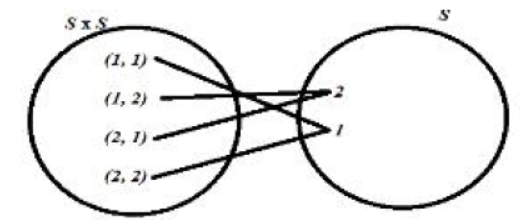
Since each of the four inputs is mapped to exactly one unique output, the binary operation can be defined in only one possible way. Therefore, the number of such binary operations is exactly \( 1 \).
In simple words: A binary operation on a two-element set must assign an output to four different pairs of inputs. Because of the identity and inverse rules, every single output is forced to be a specific number. Since we have no choices left, there is only one possible operation.
Exam Tip: Representing binary operations as mappings from \( S \times S \rightarrow S \) helps you easily count the number of free choices you have for the outputs.
Question 6. Define a binary operation * on the set {0,1,2,3,4,5} as \( a * b = \begin{cases} a + b & \text{if } a + b < 6 \\ a + b - 6 & \text{if } a + b \geq 6 \end{cases} \). Show that zero is the identity for this operation and each element \( a \neq 0 \) of the set is invertible with \( 6 - a \) being the inverse of \( a \).
Answer:
Let us denote the set as \( A = \{0, 1, 2, 3, 4, 5\} \).
Proof for Identity Element:
Let \( e \in A \) be the identity element. Then we must have \( a * e = e * a = a \) for all \( a \in A \).
- If \( a + e < 6 \), the operation is defined as \( a * e = a + e \).
\( \implies a + e = a \implies e = 0 \in A \).
- If \( a + e \geq 6 \), the operation is defined as \( a * e = a + e - 6 \).
\( \implies a + e - 6 = a \implies e = 6 \notin A \).
Therefore, the unique identity element is \( e = 0 \).
Proof for Inverse:
Let \( b \in A \) be the inverse of a non-zero element \( a \in A \). Since the identity is \( 0 \), we must have \( a * b = 0 \).
- Case 1: If \( a + b < 6 \):
\( a * b = a + b = 0 \implies b = -a \). Since \( a \neq 0 \) and \( a \in A \), \( -a \) is negative and therefore \( -a \notin A \). Thus, no inverse exists in this case.
- Case 2: If \( a + b \geq 6 \):
\( a * b = a + b - 6 = 0 \implies b = 6 - a \).
Since \( a \in \{1, 2, 3, 4, 5\} \), the value \( 6 - a \) lies in \( \{1, 2, 3, 4, 5\} \), which is fully contained in \( A \).
Also, \( a + (6 - a) = 6 \geq 6 \), which satisfies the condition for this case.
Thus, every non-zero element \( a \in A \) is invertible, and its unique inverse is \( 6 - a \).
In simple words: This operation is addition modulo 6. Adding 0 to any number doesn't change it, so 0 is the identity. For any other number, its partner (inverse) is whatever we must add to it to reach exactly 6, which is why the inverse is 6 - a.
Exam Tip: Be sure to write out both cases for both identity and inverse, explaining why one case is rejected (because the result falls outside the set) and the other is accepted.
Page 4
Question 7. Show that zero is the identity element for addition on R (real no's) and 1 is the identity element for multiplication on R but there is no identity element for subtraction on R and division on R - {0}.
Answer:
Let us examine each operation individually:
(i) Addition on \( R \):
Define \( a * b = a + b \). Let \( e \) be the identity element:
\( a + e = a \implies e = 0 \in R \)
\( e + a = a \implies e = 0 \in R \)
Since both left and right identity checks give the same constant, \( 0 \) is the identity element for addition on \( R \).
(ii) Multiplication on \( R \):
Define \( a * b = a \cdot b \). Let \( e \) be the identity element:
\( a \cdot e = a \implies e = 1 \in R \)
\( e \cdot a = a \implies e = 1 \in R \)
Since both checks yield \( 1 \), \( 1 \) is the identity element for multiplication on \( R \).
(iii) Subtraction on \( R \):
Define \( a * b = a - b \). Let \( e \) be the identity element:
- Left check: \( a - e = a \implies e = 0 \in R \).
- Right check: \( e - a = a \implies e = 2a \).
Since \( e \) depends on the variable \( a \) rather than being a unique constant, no identity element exists for subtraction on \( R \).
(iv) Division on \( R - \{0\} \):
Define \( a * b = \frac{a}{b} \). Let \( e \) be the identity element:
- Left check: \( \frac{a}{e} = a \implies e = 1 \in R - \{0\} \).
- Right check: \( \frac{e}{a} = a \implies e = a^2 \).
Since the value of \( e \) is not a constant and varies with \( a \), there is no identity element for division on \( R - \{0\} \).
In simple words: An identity element must work the same way from both sides and be a single fixed number for everyone. Adding 0 and multiplying by 1 always work. However, subtraction and division don't work the same way when we swap the order, so they don't have an identity.
Exam Tip: For an identity element to exist, the left identity (\( a * e = a \)) and right identity (\( e * a = a \)) must yield the exact same constant value. If \( e \) depends on \( a \), no identity element exists.
Topic: Functions
Question 8. Let \( f : R - \left\{-\frac{4}{3}\right\} \rightarrow R \) defined as \( f(x) = \frac{4x}{3x + 4} \). Show that f is invertible and find its inverse.
Answer:
Proof of Injectivity (One-One):
Let \( x_1, x_2 \in R - \left\{-\frac{4}{3}\right\} \) such that \( f(x_1) = f(x_2) \):
\( \frac{4x_1}{3x_1 + 4} = \frac{4x_2}{3x_2 + 4} \)
Cross-multiplying the denominators:
\( 4x_1(3x_2 + 4) = 4x_2(3x_1 + 4) \)
\( 12x_1x_2 + 16x_1 = 12x_1x_2 + 16x_2 \)
Subtracting \( 12x_1x_2 \) from both sides:
\( 16x_1 = 16x_2 \)
\( \implies x_1 = x_2 \).
Therefore, \( f \) is a one-one function.
Proof of Surjectivity (Onto):
Let \( y = f(x) \) where \( y \) belongs to the range of the function. We express \( x \) in terms of \( y \):
\( y = \frac{4x}{3x + 4} \)
\( y(3x + 4) = 4x \)
\( 3xy + 4y = 4x \)
\( 4y = 4x - 3xy \)
\( 4y = x(4 - 3y) \)
\( x = \frac{4y}{4 - 3y} \)
For every \( y \neq \frac{4}{3} \) in the codomain, there exists an element \( x = \frac{4y}{4 - 3y} \) in the domain such that:
\( f(x) = f\left(\frac{4y}{4 - 3y}\right) = \frac{4\left(\frac{4y}{4 - 3y}\right)}{3\left(\frac{4y}{4 - 3y}\right) + 4} \)
\( = \frac{16y}{12y + 4(4 - 3y)} = \frac{16y}{12y + 16 - 12y} = \frac{16y}{16} = y \).
Thus, the range equals the codomain, and \( f \) is an onto function.
Since \( f \) is both one-one and onto, it is a bijective function and is therefore invertible.
The inverse function is:
\( f^{-1}(y) = \frac{4y}{4 - 3y} \)
Or in terms of \( x \circ \):
\( f^{-1}(x) = \frac{4x}{4 - 3x} \).
In simple words: To show the function is invertible, we first prove that different inputs always have different outputs (one-one). Then we show we can reverse the equation to find x for any output y (onto). Reversing the equation gives us the inverse formula.
Exam Tip: Be sure to write the final inverse function in terms of both \( y \) and \( x \) as shown in textbook solutions to ensure maximum grading points.
Page 5
Question 9. Consider \( f: R_+ \rightarrow [4, \infty) \) given by \( f(x) = x^2 + 4 \). Show that f is bijective. Also find the inverse.
Answer:
Proof of One-One:
Let \( x_1, x_2 \in R_+ \) (where \( R_+ \) is the set of positive real numbers) such that \( f(x_1) = f(x_2) \):
\( x_1^2 + 4 = x_2^2 + 4 \)
\( \implies x_1^2 = x_2^2 \)
\( \implies x_1 = \pm x_2 \)
Since \( x_1, x_2 \in R_+ \), we must have \( x_1 = x_2 \).
Therefore, the function \( f \) is one-one.
Proof of Onto:
Let \( y = f(x) \), where \( y \in [4, \infty) \).
\( y = x^2 + 4 \)
\( \implies x^2 = y - 4 \)
\( \implies x = \sqrt{y - 4} \) \( \quad (\because x \in R_+) \)
For every \( y \in [4, \infty) \), there exists a corresponding \( x = \sqrt{y - 4} \in R_+ \) such that:
\( f(x) = f(\sqrt{y - 4}) = (\sqrt{y - 4})^2 + 4 = y - 4 + 4 = y \).
Thus, \( f \) is onto.
Since the function \( f \) is both one-one and onto, it is bijective and therefore invertible.
The inverse function is:
\( f^{-1}(y) = \sqrt{y - 4} \)
Replacing \( y \) with \( x \), we get:
\( f^{-1}(x) = \sqrt{x - 4} \).
In simple words: This function takes a positive number, squares it, and adds 4. Since squaring positive numbers is unique, it is one-one. To find the inverse, we undo the steps: we subtract 4 and then take the square root.
Exam Tip: Always mention that \( x = +\sqrt{y-4} \) and reject the negative root because the domain of \( f \) is restricted to positive real numbers \( R_+ \).
Page 6
Question 10. Let \( f : N \rightarrow S \), where \( S \) is the range of \( f \). \( f(x) = 4x^2 + 12x + 15 \). Show f is invertible and find its inverse.
Answer:
Proof of One-One:
Let \( x_1, x_2 \in N \) such that \( f(x_1) = f(x_2) \):
\( 4x_1^2 + 12x_1 + 15 = 4x_2^2 + 12x_2 + 15 \)
\( 4(x_1^2 - x_2^2) + 12(x_1 - x_2) = 0 \)
Using the algebraic identity \( a^2 - b^2 = (a - b)(a + b) \):
\( 4(x_1 - x_2)(x_1 + x_2) + 12(x_1 - x_2) = 0 \)
Factoring out \( (x_1 - x_2) \):
\( (x_1 - x_2)[4(x_1 + x_2) + 12] = 0 \)
Since \( x_1, x_2 \in N \) are natural numbers, they are positive, which means that \( 4(x_1 + x_2) + 12 > 0 \). Therefore, the second factor cannot be zero.
This leaves us with:
\( x_1 - x_2 = 0 \implies x_1 = x_2 \).
Thus, \( f \) is a one-one function.
Proof of Onto:
Let \( y = f(x) \), where \( y \in S \). Since the codomain is defined as the range \( S \), every element \( y \in S \) is guaranteed to have a pre-image in the domain.
\( y = 4x^2 + 12x + 15 \)
Rearranging this into a quadratic equation in terms of \( x \):
\( 4x^2 + 12x + (15 - y) = 0 \)
Applying the quadratic formula with \( a = 4, b = 12, \) and \( c = 15 - y \):
\( x = \frac{-12 \pm \sqrt{12^2 - 4(4)(15 - y)}}{2(4)} \)
\( = \frac{-12 \pm \sqrt{144 - 16(15 - y)}}{8} \)
\( = \frac{-12 \pm \sqrt{16y - 96}}{8} \)
\( = \frac{-12 \pm 4\sqrt{y - 6}}{8} \)
\( = \frac{-3 \pm \sqrt{y - 6}}{2} \)
Since \( x \in N \), it must be positive. Therefore, we reject the negative root:
\( x = \frac{-3 + \sqrt{y - 6}}{2} \).
Since every element in the range \( S \) corresponds to a unique natural number \( x \), \( f \) is onto.
Because \( f \) is both one-one and onto, it is bijective and invertible. The inverse function is:
\( f^{-1}(y) = \frac{-3 + \sqrt{y - 6}}{2} \)
Or in terms of \( x \):
\( f^{-1}(x) = \frac{-3 + \sqrt{x - 6}}{2} \).
In simple words: To find the inverse of this quadratic function, we rewrite it as a quadratic equation and solve for x using the quadratic formula. Since x must be a positive natural number, we keep only the positive root to get our final inverse formula.
Exam Tip: Be very careful when simplifying the discriminant under the square root. Factoring out \( 16 \) from \( 16y - 96 \) allows you to bring \( 4 \) outside the root and simplify the entire fraction.
Please click the link below to download CBSE Class 12 Mathematics Relations And Functions (4).
Free study material for Mathematics
CBSE Mathematics Class 12 Chapter 1 Relations and Functions Worksheet
Students can use the practice questions and answers provided above for Chapter 1 Relations and Functions to prepare for their upcoming school tests. This resource is designed by expert teachers as per the latest 2026 syllabus released by CBSE for Class 12. We suggest that Class 12 students solve these questions daily for a strong foundation in Mathematics.
Chapter 1 Relations and Functions Solutions & NCERT Alignment
Our expert teachers have referred to the latest NCERT book for Class 12 Mathematics to create these exercises. After solving the questions you should compare your answers with our detailed solutions as they have been designed by expert teachers. You will understand the correct way to write answers for the CBSE exams. You can also see above MCQ questions for Mathematics to cover every important topic in the chapter.
Class 12 Exam Preparation Strategy
Regular practice of this Class 12 Mathematics study material helps you to be familiar with the most regularly asked exam topics. If you find any topic in Chapter 1 Relations and Functions difficult then you can refer to our NCERT solutions for Class 12 Mathematics. All revision sheets and printable assignments on studiestoday.com are free and updated to help students get better scores in their school examinations.
FAQs
You can download the latest chapter-wise printable worksheets for Class 12 Mathematics Chapter 1 Relations and Functions for free from StudiesToday.com. These have been made as per the latest CBSE curriculum for this academic year.
Yes, Class 12 Mathematics worksheets for Chapter 1 Relations and Functions focus on activity-based learning and also competency-style questions. This helps students to apply theoretical knowledge to practical scenarios.
Yes, we have provided solved worksheets for Class 12 Mathematics Chapter 1 Relations and Functions to help students verify their answers instantly.
Yes, our Class 12 Mathematics test sheets are mobile-friendly PDFs and can be printed by teachers for classroom.
For Chapter 1 Relations and Functions, regular practice with our worksheets will improve question-handling speed and help students understand all technical terms and diagrams.