

Read and download the CBSE Class 12 Mathematics Relations And Functions Worksheet Set 05 in PDF format. We have provided exhaustive and printable Class 12 Mathematics worksheets for Chapter 1 Relations and Functions, designed by expert teachers. These resources align with the 2026-27 syllabus and examination patterns issued by NCERT, CBSE, and KVS, helping students master all important chapter topics.
Chapter-wise Worksheet for Class 12 Mathematics Chapter 1 Relations and Functions
Students of Class 12 should use this Mathematics practice paper to check their understanding of Chapter 1 Relations and Functions as it includes essential problems and detailed solutions. Regular self-testing with these will help you achieve higher marks in your school tests and final examinations.
Class 12 Mathematics Chapter 1 Relations and Functions Worksheet with Answers

Question 1. Let A and B are any two-empty sets. Show that \( f: A \times B \rightarrow B \times A \) such that \( f(a, b) = (b, a) \) is a bijective function.
Answer:
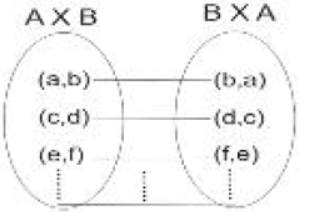
First, let us show that the function is injective (one-one):
Assume elements \( (a, b) \) and \( (c, d) \) lie in the domain \( A \times B \).
Suppose their images under \( f \) are equal:
\( f(a, b) = f(c, d) \)
\( \implies (b, a) = (d, c) \)
By equating the corresponding components of these ordered pairs, we obtain:
\( b = d \) and \( a = c \)
\( \implies (a, b) = (c, d) \)
Thus, \( f \) is confirmed to be a one-to-one mapping.
Next, we establish that the function is surjective (onto):
The cardinalities of the domain and codomain are equal, as \( n(A \times B) = n(B \times A) \).
Since we have demonstrated that \( f \) is injective and the sets are of equivalent size, the range of the function is equal to its codomain.
\( \implies \text{Range} = \text{Codomain} \)
Consequently, \( f \) must be an onto function.
Since \( f \) is both injective and surjective, it is a bijective function.
In simple words: This function is bijective because every pair in the starting set maps to a unique, reversed pair in the destination set, and no pairs are left unmatched.
Exam Tip: To prove bijectivity, always break your answer into two clear sections: first prove injectivity (one-one), then prove surjectivity (onto).
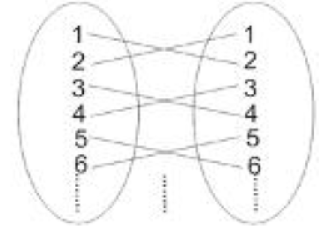
Question 2. Show that \( f: N \rightarrow N \) given by \( f(x) = \begin{cases} x + 1 & \text{; if } x \text{ is odd} \\ x - 1 & \text{; if } x \text{ is even} \end{cases} \) is a bijective function.
Answer:
One-One function :-
Case 1: let \( x_1 \) and \( x_2 \) are both odd integers in the domain \( N \). Setting their function values equal gives:
\( f(x_1) = f(x_2) \)
\( \implies x_1 + 1 = x_2 + 1 \)
\( \implies x_1 = x_2 \)
Case 2: let \( x_1 \) and \( x_2 \) are both even. Setting their images equal:
\( f(x_1) = f(x_2) \)
\( \implies x_1 - 1 = x_2 - 1 \)
\( \implies x_1 = x_2 \)
Case 3: let \( x_1 \) is odd and \( x_2 \) is even. If we assume their images are identical:
\( f(x_1) = f(x_2) \)
\( \implies x_1 + 1 = x_2 - 1 \)
\( \implies x_2 - x_1 = 2 \)
This scenario is impossible because subtracting an odd number from an even number cannot equal an even number like 2. Hence, this case is not valid.
Case 4: let \( x_1 \) is even and \( x_2 \) is odd. Assuming \( f(x_1) = f(x_2) \):
\( \implies x_1 - 1 = x_2 + 1 \)
\( \implies x_1 - x_2 = 2 \)
This is also impossible as the difference between an even and an odd number can never be an even number. Consequently, this case is also ruled out.
Therefore, the overall function is injective (one-one).
On-To :
For every odd number \( (2n - 1) \in N \) (co-domain), there exists an even number \( (2n) \) in the domain \( (N) \).
For every even number \( (2p) \in N \) (co-domain), there exists an odd number \( (2p - 1) \in N \) (domain).
\( \implies \text{co-domain} = \text{Range} \)
Thus, the function \( f \) is onto.
Since \( f \) is both injective and surjective, it is a bijective function.
In simple words: This function shifts odd numbers up by 1 and even numbers down by 1. Since this perfectly pairs every natural number with a different one, it is a bijective function.
Exam Tip: For piecewise functions, when proving injectivity, do not forget to test cross-cases (e.g., one element even and the other odd) to show that their images can never be equal.
Page 2
Question 2. Given examples of two functions \( f : N \rightarrow Z \) and \( g : Z \rightarrow Z \) such that gof is injective but g is not injective.
Answer:
Given: \( f : N \rightarrow Z \) and \( g : Z \rightarrow Z \).
The domain of the composite function 'gof' is identical to the domain of 'f', which is \( N \).
The codomain of 'gof' corresponds to the codomain of 'g', which is \( Z \).
Thus, we have \( gof : N \rightarrow Z \).
Let us define the functions as: \( f(x) = x \) and \( g(x) = |x| \).
Then, \( gof = g(f(x)) = g(x) = |x| \).
one-one (for gof)
Let \( x_1, x_2 \in N \) (domain of gof), and assume:
\( (gof)(x_1) = (gof)(x_2) \)
\( \implies g(f(x_1)) = g(f(x_2)) \)
\( \implies |x_1| = |x_2| \)
\( \implies x_1 = \pm x_2 \)
Since \( x_1, x_2 \in N \), they must be positive. Thus, \( x_1 \neq -x_2 \).
Therefore, we obtain \( x_1 = x_2 \).
This shows that gof is indeed a one-one function.
Now, let us examine if g is injective:
Take two distinct values from the domain \( (Z) \) of g, for instance, \( -1 \) and \( 1 \).
\( g(-1) = |-1| = 1 \)
\( g(1) = |1| = 1 \)
Since the two different inputs \( -1 \) and \( 1 \) produce the same output \( 1 \), the function g is not one-one.
Thus, the chosen example satisfies the given conditions.
In simple words: Even though the outer function alone can map negative and positive numbers to the same output, when it is combined with a first function that only allows positive numbers, the combination remains one-one.
Exam Tip: Absolute value (modulus) functions are a great tool for constructing counterexamples of functions that are not injective on \( Z \) or \( R \), but become injective when restricted to \( N \).
Page 3
Question 3(i). \( f(x) = (3 - x^3)^{\frac{1}{3}} \). Find f0f(x)
Answer:
The composition \( fof(x) \) is defined as \( f(f(x)) \). We substitute the expression for \( f(x) \) into itself:
\( fof(x) = f\left[ (3 - x^3)^{\frac{1}{3}} \right] \)
\( = \left[ 3 - \left( (3 - x^3)^{\frac{1}{3}} \right)^3 \right]^{\frac{1}{3}} \)
Simplifying the cube of the cube root:
\( = \left[ 3 - (3 - x^3) \right]^{\frac{1}{3}} \)
\( = \left[ 3 - 3 + x^3 \right]^{\frac{1}{3}} \)
\( = \left( x^3 \right)^{\frac{1}{3}} \)
\( = x \).
Thus, \( fof(x) = x \).
In simple words: Applying this function twice brings us right back to the starting value of x, meaning the function is its own inverse.
Exam Tip: Be very neat with your exponents and brackets when simplifying compositions of algebraic powers to avoid sign errors.
Question 3(ii). \( f(x) = |x| \), \( g(x) = |5x - 2| \). Is fog = gof for all \( x \in R \) ?
Answer:
Let's find both compositions \( fog \) and \( gof \):
\( fog = f(g(x)) = f(|5x - 2|) \)
Applying the absolute value function \( f \):
\( = \big| |5x - 2| \big| = |5x - 2| \)
Now, \( gof = g(f(x)) = g(|x|) \)
Applying the function \( g \):
\( = |5|x| - 2| \)
By comparing these two results, we see that \( fog \neq gof \).
For example, let \( x = -1 \):
\( fog = |5(-1) - 2| = |-5 - 2| = |-7| = 7 \)
\( gof = |5|-1| - 2| = |5(1) - 2| = |3| = 3 \)
Since \( 7 \neq 3 \), the composite functions are not equal.
In simple words: The order of combining functions matters. Doing f first and then g gives a different result than doing g first and then f.
Exam Tip: When showing that two functions are not equal, providing a single numerical counterexample is a mathematically rigorous and complete proof.
Question 3(iii). If \( f(x) = 2x \); \( g(y) = 3y + 4 \) and \( h(z) = \sin z \). Show that ho(gof) = (hog)of
Answer:
Let us evaluate the Left-Hand Side (LHS) first:
\( \text{LHS} = ho(gof) \)
\( = ho[g(f(x))] \)
\( = ho[g(2x)] \)
\( = ho[3(2x) + 4] \)
\( = ho(6x + 4) \)
\( = \sin(6x + 4) \)
Now, let's calculate the Right-Hand Side (RHS):
\( \text{RHS} = (hog)of \)
\( = [hog](f(x)) \)
\( = [h(g(y))](2x) \)
\( = [h(3y + 4)](2x) \)
\( = [\sin(3y + 4)](2x) \)
Substituting \( f(x) = 2x \) into this composition:
\( = \sin(3(2x) + 4) = \sin(6x + 4) \)
Since both sides yield the exact same expression, \( \text{LHS} = \text{RHS} \).
In simple words: This shows that function composition is associative. Grouping them differently does not change the final formula.
Exam Tip: Clearly write down intermediate steps for LHS and RHS separately to show the examiner how both expressions arrive at the same result.
Page 4
Question 4. Let f : R → R be defined as \( f(x) = 10x + 7 \). Find function g(x) such that fog = gof = IR
Answer:
We are given the function \( f(x) = 10x + 7 \).
We want to find \( g(x) \) such that \( fog = gof = I_R \).
This means that \( (fog)(x) = x \) and \( (gof)(x) = x \) for all real numbers \( x \).
Let us solve the relation \( f(g(x)) = x \):
\( 10 g(x) + 7 = x \)
\( \implies 10 g(x) = x - 7 \)
\( \implies g(x) = \frac{x - 7}{10} \)
Now, let us verify this with the composition \( gof \):
\( gof = g(f(x)) \)
\( = g(10x + 7) \)
\( = \frac{(10x + 7) - 7}{10} \)
\( = \frac{10x}{10} = x = I_R \) (verified)
Since both compositions yield the identity function, the solution is correct.
Thus, \( g(x) = \frac{x - 7}{10} \).
In simple words: To find the inverse function g, we undo the operations of f. We subtract 7 and then divide by 10.
Exam Tip: Showing the verification step for both directions (\( fog \) and \( gof \)) is highly recommended to earn full marks for inverse questions.
Question 5. Let f = R → R be the sign um function defined as \( f(x) = \begin{cases} -1, & x < 0 \\ 0, & x = 0 \\ 1, & x > 0 \end{cases} \) and \( g(x) = [x] \) be the greatest integer function. Then does fog and gof coincide (equal) in (0 , 1) ?
Answer:
Let \( x \) lie in the open interval \( (0, 1) \).
For any \( x \) in this interval, the greatest integer function gives: \( g(x) = [x] = 0 \).
Also, since \( x > 0 \), the signum function gives: \( f(x) = 1 \).
Let us evaluate the composition \( fog \) for \( x \in (0, 1) \):
\( (fog)(x) = f(g(x)) = f(0) = 0 \)
Next, let us evaluate the composition \( gof \) for \( x \in (0, 1) \):
\( (gof)(x) = g(f(x)) = g(1) = [1] = 1 \)
Since \( (fog)(x) = 0 \) and \( (gof)(x) = 1 \) for all \( x \in (0, 1) \), we find that \( 0 \neq 1 \).
Therefore, \( fog \) and \( gof \) do not coincide on the interval \( (0, 1) \).
In simple words: In this open interval, fog always outputs 0 because the greatest integer function rounds the input down to 0 first. However, gof always outputs 1 because the signum function makes it positive first.
Exam Tip: Be careful with intervals. For \( x \in (0,1) \), \( [x] \) is strictly \( 0 \), whereas for the closed interval \( [0,1] \), \( [x] \) can be \( 0 \) or \( 1 \).
Question 6. Let f : {1 ,3,4} → {1,2,5} and g : {1,2,5} → {1,3} be given by f = {(1,2), (3,5), (4,1)} and g = {(1,3), (2,3), (5,1)} write down gof.
Answer:
The domain of \( gof \) corresponds to the domain of \( f \), which is \( \{1, 3, 4\} \).
The codomain of \( gof \) is the codomain of \( g \), which is \( \{1, 3\} \).
Let us evaluate the composition for each element in the domain:
For \( x = 1 \): \( (gof)(1) = g(f(1)) = g(2) = 3 \)
For \( x = 3 \): \( (gof)(3) = g(f(3)) = g(5) = 1 \)
For \( x = 4 \): \( (gof)(4) = g(f(4)) = g(1) = 3 \)
Combining these results into set notation, we obtain:
\( gof = \{(1, 3), (3, 1), (4, 3)\} \).
In simple words: We find the composite mapping by passing each input through f first, and then taking that output and putting it through g.
Exam Tip: When writing a composite function represented as ordered pairs, write down the final set of ordered pairs clearly inside curly brackets.
Page 5
Question 7. Let A = {1,2,3} and B = {4,5,6,7} and f = {(1 , 4), (2 , 5), (3 , 6)} be a function from A to B. State whether f is one-one or on-to.
Answer:
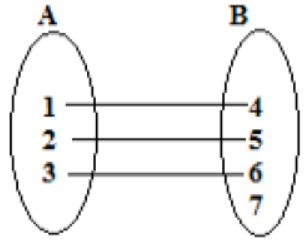
From the given function definition, we have the following mappings:
\( f(1) = 4 \), \( f(2) = 5 \), and \( f(3) = 6 \)
Since every distinct element in the domain \( A \) has a unique image in the codomain \( B \), the function \( f \) is injective (one-one).
Now, let us check for surjectivity (onto):
The element \( 7 \) belongs to the codomain \( B \), but there is no element in the domain \( A \) that maps to it.
Because the range \( \{4, 5, 6\} \) does not equal the codomain \( \{4, 5, 6, 7\} \), \( f \) is not surjective (onto).
In simple words: This function is one-one because different inputs have different outputs. It is not onto because the number 7 in the target set is left out with no input pointing to it.
Exam Tip: To show a function is not onto, you only need to identify a single element in the codomain that has no pre-image in the domain.
Question 8. Consider the function \( f : \left[0, \frac{\pi}{2}\right] \rightarrow R \) given by \( f(x) = \sin x \) and \( g : \left[0, \frac{\pi}{2}\right] \rightarrow R \) given by g(x) = cos x. Show that f and g are one-one but f + g is not one-one.
Answer:
In the interval \( \left[0, \frac{\pi}{2}\right] \), both sine and cosine are strictly monotonic functions (sine is strictly increasing and cosine is strictly decreasing).
Thus, for any two distinct elements \( x_1, x_2 \in \left[0, \frac{\pi}{2}\right] \), we have:
\( \sin(x_1) \neq \sin(x_2) \)
\( \implies f(x_1) \neq f(x_2) \)
and
\( \cos(x_1) \neq \cos(x_2) \)
\( \implies g(x_1) \neq g(x_2) \)
Therefore, both \( f \) and \( g \) are individually one-one.
Now, let us examine their sum, \( f + g \):
\( (f + g)(x) = \sin x + \cos x \)
Evaluating this sum at the boundary points \( 0 \) and \( \frac{\pi}{2} \):
\( (f + g)(0) = \sin(0) + \cos(0) = 0 + 1 = 1 \)
\( (f + g)\left(\frac{\pi}{2}\right) = \sin\left(\frac{\pi}{2}\right) + \cos\left(\frac{\pi}{2}\right) = 1 + 0 = 1 \)
Here, we see that \( (f + g)(0) = (f + g)\left(\frac{\pi}{2}\right) = 1 \), even though \( 0 \neq \frac{\pi}{2} \).
Since two different inputs produce the identical output, the sum function \( f + g \) is not one-one.
In simple words: Although sine and cosine never repeat their values on this interval, their sum does repeat. Both 0 and 90 degrees add up to 1, so the sum function is not one-one.
Exam Tip: Trigonometric boundaries like \( 0 \) and \( \frac{\pi}{2} \) are perfect test values to quickly disprove injectivity for combinations of sine and cosine.
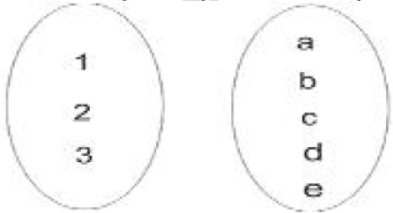
Question 9(i). If \( A = \{1, 2, 3\} \) and \( B = \{a, c, d, e\} \). Find number of one-one functions
Answer:
To construct a one-to-one function from \( A \) to \( B \), we map each element of \( A \) to a unique element in \( B \):
The first element \( 1 \in A \) can be mapped to any of the 4 elements in \( B \) (which are \( a, c, d, e \)).
Since the function must be one-one, the second element \( 2 \in A \) can only be mapped to any of the remaining 3 elements in \( B \).
Finally, the third element \( 3 \in A \) can be mapped to any of the remaining 2 elements in \( B \).
By the fundamental counting principle, the total number of unique one-one functions is:
\( 4 \times 3 \times 2 = 24 \).
In simple words: We have 4 choices for the first number, 3 remaining choices for the second, and 2 remaining choices for the third. Multiplying these gives 24 possible one-one arrangements.
Exam Tip: For any sets with cardinality \( m \) and \( n \), the number of one-one functions from \( A \) to \( B \) is given by \( ^n P_m \) (where \( n \geq m \)).
Question 9(ii). Find the number of on-to function from A to A if A = {1,2,3......n}
Answer:
For a mapping from a finite set \( A \) to itself to be onto (surjective), it must also be one-one (injective).
We can calculate the possible assignments for elements in the codomain:
The first element can be associated with any of the \( n \) domain elements.
The second element can be associated with any of the remaining \( n - 1 \) elements.
The third element can be associated with any of the remaining \( n - 2 \) elements.
This continues down to the last element, which has only \( 1 \) choice left.
Therefore, the total number of onto functions is:
\( n \times (n - 1) \times (n - 2) \times \dots \times 1 = n! \).
In simple words: An onto function from a finite set to itself is a permutation of its elements. The total number of ways to arrange n items is n-factorial.
Exam Tip: Always remember that any onto function from a finite set to itself is automatically one-one as well, making it a bijection.
Page 6
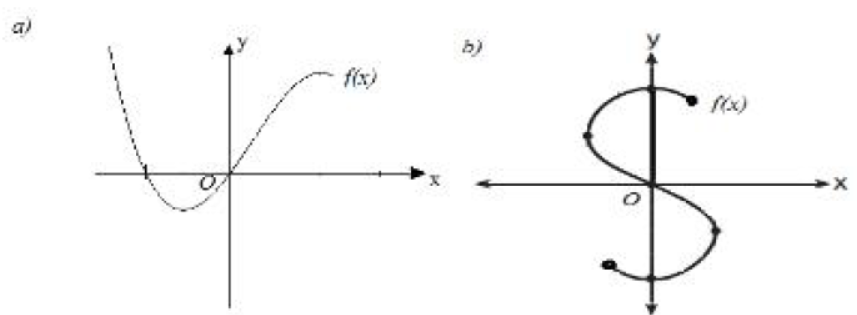
Question 10. Which of the following graphs represent a function ?
Answer:
Let's analyze each graph using the vertical line test:
Graph (a) represents a function. For every value of \( x \) on the horizontal axis, a vertical line intersects the graph at exactly one unique point, meaning \( f(x) \) has a single defined value for each \( x \).
Graph (b) does not represent a function. A vertical line drawn through certain values of \( x \) intersects the curve at more than one point, showing that a single input \( x \) corresponds to multiple output values.
In simple words: Graph a is a function because every x-value has only one y-value. Graph b is not a function because some x-values have more than one y-value.
Exam Tip: Use the "vertical line test" on graph problems. If any vertical line can cross a graph more than once, it cannot represent a function.
Please click the link below to download full pdf file for CBSE Class 12 Mathematics Relations And Functions (5).
Free study material for Mathematics
CBSE Mathematics Class 12 Chapter 1 Relations and Functions Worksheet
Students can use the practice questions and answers provided above for Chapter 1 Relations and Functions to prepare for their upcoming school tests. This resource is designed by expert teachers as per the latest 2026 syllabus released by CBSE for Class 12. We suggest that Class 12 students solve these questions daily for a strong foundation in Mathematics.
Chapter 1 Relations and Functions Solutions & NCERT Alignment
Our expert teachers have referred to the latest NCERT book for Class 12 Mathematics to create these exercises. After solving the questions you should compare your answers with our detailed solutions as they have been designed by expert teachers. You will understand the correct way to write answers for the CBSE exams. You can also see above MCQ questions for Mathematics to cover every important topic in the chapter.
Class 12 Exam Preparation Strategy
Regular practice of this Class 12 Mathematics study material helps you to be familiar with the most regularly asked exam topics. If you find any topic in Chapter 1 Relations and Functions difficult then you can refer to our NCERT solutions for Class 12 Mathematics. All revision sheets and printable assignments on studiestoday.com are free and updated to help students get better scores in their school examinations.
FAQs
You can download the latest chapter-wise printable worksheets for Class 12 Mathematics Chapter 1 Relations and Functions for free from StudiesToday.com. These have been made as per the latest CBSE curriculum for this academic year.
Yes, Class 12 Mathematics worksheets for Chapter 1 Relations and Functions focus on activity-based learning and also competency-style questions. This helps students to apply theoretical knowledge to practical scenarios.
Yes, we have provided solved worksheets for Class 12 Mathematics Chapter 1 Relations and Functions to help students verify their answers instantly.
Yes, our Class 12 Mathematics test sheets are mobile-friendly PDFs and can be printed by teachers for classroom.
For Chapter 1 Relations and Functions, regular practice with our worksheets will improve question-handling speed and help students understand all technical terms and diagrams.