

ICSE Solutions Selina Concise Class 6 Mathematics Chapter 28 Polygons have been provided below and is also available in Pdf for free download. The Selina Concise ICSE solutions for Class 6 Mathematics have been prepared as per the latest syllabus and ICSE books and examination pattern suggested in Class 6. Questions given in ICSE Selina Concise book for Class 6 Mathematics are an important part of exams for Class 6 Mathematics and if answered properly can help you to get higher marks. Refer to more Chapter-wise answers for ICSE Class 6 Mathematics and also download more latest study material for all subjects. Chapter 28 Polygons is an important topic in Class 6, please refer to answers provided below to help you score better in exams
Selina Concise Chapter 28 Polygons Class 6 Mathematics ICSE Solutions
Class 6 Mathematics students should refer to the following ICSE questions with answers for Chapter 28 Polygons in Class 6. These ICSE Solutions with answers for Class 6 Mathematics will come in exams and help you to score good marks
Chapter 28 Polygons Selina Concise ICSE Solutions Class 6 Mathematics
Polygons
Important Points
A polygon is a flat, closed shape made of three or more straight lines. Each line segment is called a side, and the points where they meet are called vertices.
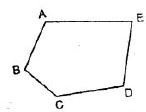
Properties of a polygon include:
- It is completely closed.
- Its straight sides only intersect at their endpoints.
- No two adjacent sides form a straight line, meaning no vertex angle can be 180 degrees.
| Number of Sides | Name of Polygon |
|---|---|
| 3 | Triangle |
| 4 | Quadrilateral |
| 5 | Pentagon |
| 6 | Hexagon |
Sum of Interior Angles of a Polygon
We can find the sum of all inside angles of any polygon by dividing it into triangles. For example:
- A triangle has a sum of 180 degrees.
- A quadrilateral can be split into two triangles, so its angle sum is 360 degrees.
- A pentagon can be split into three triangles, giving an angle sum of 540 degrees.
- A hexagon can be split into four triangles, giving an angle sum of 720 degrees.
From this pattern, we find that the sum of interior angles of an n-sided polygon is given by the formula:
Sum of interior angles = \( (n - 2) \times 180^\circ \) or \( (2n - 4) \times 90^\circ \)
Exercise 28(A)
Question 1. State, which of the following are polygons :
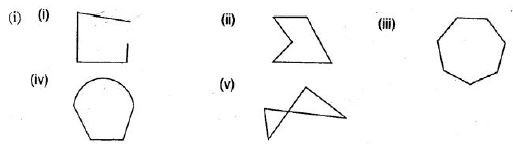
Answer: Only figure (ii) and (iii) are polygons.
In simple words: A polygon must be closed and made of only straight lines. Only shapes (ii) and (iii) fit this rule.
Exam Tip: Remember, a polygon cannot have any curved lines and cannot be open at any point.
Question 2. Find the sum of interior angles of a polygon with :
(i) 9 sides
(ii) 13 sides
(iii) 16 sides
Answer:
To find the sum of all inside angles, we use the formula:
Sum of interior angles = \( (2n - 4) \times 90^\circ \), where \( n \) is the number of sides.
(i) For 9 sides (\( n = 9 \)):
Sum = \( (2 \times 9 - 4) \times 90^\circ \)
\( \implies \) Sum = \( (18 - 4) \times 90^\circ \)
\( \implies \) Sum = \( 14 \times 90^\circ = 1260^\circ \)
(ii) For 13 sides (\( n = 13 \)):
Sum = \( (2 \times 13 - 4) \times 90^\circ \)
\( \implies \) Sum = \( (26 - 4) \times 90^\circ \)
\( \implies \) Sum = \( 22 \times 90^\circ = 1980^\circ \)
(iii) For 16 sides (\( n = 16 \)):
Sum = \( (2 \times 16 - 4) \times 90^\circ \)
\( \implies \) Sum = \( (32 - 4) \times 90^\circ \)
\( \implies \) Sum = \( 28 \times 90^\circ = 2520^\circ \)
In simple words: Multiply the number of sides by 2, subtract 4, and then multiply the result by 90 to get the total degrees of all inside angles.
Exam Tip: Be careful with basic multiplication and subtraction steps inside the parentheses before multiplying by 90.
Question 3. Find the number of sides of a polygon, if the sum of its interior angles is :
(i) 1440°
(ii) 1620°
Answer:
Let the number of sides of the polygon be \( n \).
We know that the sum of interior angles is \( (2n - 4) \times 90^\circ \).
(i) For a sum of 1440°:
\( (2n - 4) \times 90^\circ = 1440^\circ \)
\( \implies 2n - 4 = \frac{1440^\circ}{90^\circ} \)
\( \implies 2n - 4 = 16 \)
\( \implies 2n = 16 + 4 \)
\( \implies 2n = 20 \)
\( \implies n = 10 \)
So, the polygon has 10 sides.
(ii) For a sum of 1620°:
\( (2n - 4) \times 90^\circ = 1620^\circ \)
\( \implies 2n - 4 = \frac{1620^\circ}{90^\circ} \)
\( \implies 2n - 4 = 18 \)
\( \implies 2n = 18 + 4 \)
\( \implies 2n = 22 \)
\( \implies n = 11 \)
So, the polygon has 11 sides.
In simple words: To find the sides, divide the total degrees by 90. Then add 4 to that number and divide by 2.
Exam Tip: You can quickly check your answer by plugging \( n \) back into the formula and verifying if it gives the given sum.
Question 4. Is it possible to have a polygon, whose sum of interior angles is 1030°.
Answer:
Let the number of sides be \( n \).
The formula for the sum of angles is \( (2n - 4) \times 90^\circ = 1030^\circ \).
\( \implies 2(n - 2) = \frac{1030^\circ}{90^\circ} \)
\( \implies n - 2 = \frac{1030^\circ}{2 \times 90^\circ} \)
\( \implies n - 2 = \frac{103}{18} \)
\( \implies n = \frac{103}{18} + 2 \)
\( \implies n = \frac{139}{18} \)
Since the value of \( n \) is not a whole number (an integer), it is impossible to have a polygon with this angle sum. A polygon must always have a whole number of sides.
In simple words: The number of sides of a shape cannot be a fraction. Since our calculation does not give a whole number, such a shape cannot exist.
Exam Tip: Whenever the calculated number of sides \( n \) is not a natural number (greater than or equal to 3), state clearly that the polygon is not possible.
Question 5. (i) If all the angles of a hexagon are equal, find the measure of each angle.
(ii) If all the angles of an octagon are equal, find the measure of each angle,
Answer:
(i) For a hexagon, the number of sides \( n = 6 \).
Let each equal angle be \( x^\circ \).
Total sum of angles = \( 6x^\circ \).
Using the formula:
\( (2n - 4) \times 90^\circ = 6x^\circ \)
\( \implies (2 \times 6 - 4) \times 90^\circ = 6x^\circ \)
\( \implies (12 - 4) \times 90^\circ = 6x^\circ \)
\( \implies 8 \times 90^\circ = 6x^\circ \)
\( \implies 720^\circ = 6x^\circ \)
\( \implies x = \frac{720^\circ}{6} = 120^\circ \)
Therefore, each angle of the hexagon is 120°.
(ii) For an octagon, the number of sides \( n = 8 \).
Let each equal angle be \( x^\circ \).
Total sum of angles = \( 8x^\circ \).
Using the formula:
\( (2n - 4) \times 90^\circ = 8x^\circ \)
\( \implies (2 \times 8 - 4) \times 90^\circ = 8x^\circ \)
\( \implies 12 \times 90^\circ = 8x^\circ \)
\( \implies 1080^\circ = 8x^\circ \)
\( \implies x = \frac{1080^\circ}{8} = 135^\circ \)
Therefore, each angle of the octagon is 135°.
In simple words: First find the sum of all interior angles for the shape, then divide that sum by the number of angles to find the value of each one.
Exam Tip: A polygon with all equal sides and angles is called a "regular" polygon. You can directly divide the total sum of angles by \( n \) to find each interior angle.
Question 6. One angle of a quadrilateral is 90° and all other angles are equal ; find each equal angle.
Answer:
Let the three remaining equal angles each measure \( x^\circ \).
The total sum of all interior angles in any quadrilateral is 360°.
Therefore:
\( x^\circ + x^\circ + x^\circ + 90^\circ = 360^\circ \)
\( \implies 3x^\circ + 90^\circ = 360^\circ \)
\( \implies 3x^\circ = 360^\circ - 90^\circ \)
\( \implies 3x^\circ = 270^\circ \)
\( \implies x = \frac{270^\circ}{3} = 90^\circ \)
So, each of the equal angles is 90°.
In simple words: Since all four angles add up to 360 degrees, subtracting the known 90 degrees leaves 270 degrees. Dividing this remaining amount equally among the three other angles gives 90 degrees each.
Exam Tip: Be sure to write down the sum of the angles of a quadrilateral (360°) as the starting point to earn full step-marks.
Question 7. If angles of quadrilateral are in the ratio 4 : 5 : 3 : 6 ; find each angle of the quadrilateral.
Answer:
Let the four angles of the quadrilateral be \( 4x \), \( 5x \), \( 3x \), and \( 6x \).
The total sum of these angles must be 360°.
Therefore:
\( 4x + 5x + 3x + 6x = 360^\circ \)
\( \implies 18x = 360^\circ \)
\( \implies x = \frac{360^\circ}{18} = 20^\circ \)
Now, we calculate the size of each individual angle:
First angle = \( 4 \times 20^\circ = 80^\circ \)
Second angle = \( 5 \times 20^\circ = 100^\circ \)
Third angle = \( 3 \times 20^\circ = 60^\circ \)
Fourth angle = \( 6 \times 20^\circ = 120^\circ \)
In simple words: Add up the ratio parts to get 18. Divide the total 360 degrees by 18 to find that one part is equal to 20 degrees, then multiply each ratio number by 20.
Exam Tip: You can quickly check your final answers by adding the four values together: \( 80^\circ + 100^\circ + 60^\circ + 120^\circ = 360^\circ \).
Question 8. If one angle of a pentagon is 120° and each of the remaining four angles is x°, find the magnitude of x.
Answer:
One angle of the pentagon is 120°.
Let the other four angles be \( x^\circ \), \( x^\circ \), \( x^\circ \), and \( x^\circ \).
The sum of these five angles is \( 4x + 120^\circ \).
We know the sum of all interior angles of a pentagon is:
\( (2n - 4) \times 90^\circ = (2 \times 5 - 4) \times 90^\circ = 6 \times 90^\circ = 540^\circ \).
Equating the two expressions:
\( 4x + 120^\circ = 540^\circ \)
\( \implies 4x = 540^\circ - 120^\circ \)
\( \implies 4x = 420^\circ \)
\( \implies x = \frac{420^\circ}{4} = 105^\circ \)
Thus, the value of \( x \) is 105°.
In simple words: Subtract the one known angle of 120 degrees from the pentagon's total of 540 degrees. This leaves 420 degrees, which we divide by 4 to get 105 degrees for each remaining angle.
Exam Tip: Always make sure to write down the formula to calculate the total sum of angles for any given polygon before solving for the unknown variable.
Question 9. The angles of a pentagon are in the ratio 5 : 4 : 5 : 7 : 6 ; find each angle of the pentagon.
Answer:
Let the five angles of the pentagon be \( 5x \), \( 4x \), \( 5x \), \( 7x \), and \( 6x \).
The sum of the angles is:
\( 5x + 4x + 5x + 7x + 6x = 27x \).
We know the total sum of interior angles in a pentagon is 540°.
Therefore:
\( 27x = 540^\circ \)
\( \implies x = \frac{540^\circ}{27} = 20^\circ \)
Now, we find each angle:
First angle = \( 5 \times 20^\circ = 100^\circ \)
Second angle = \( 4 \times 20^\circ = 80^\circ \)
Third angle = \( 5 \times 20^\circ = 100^\circ \)
Fourth angle = \( 7 \times 20^\circ = 140^\circ \)
Fifth angle = \( 6 \times 20^\circ = 120^\circ \)
In simple words: Add all parts of the ratio together to get 27 parts. Since the whole shape has 540 degrees inside, each part is 20 degrees. Multiply each number in the ratio by 20 to find the angles.
Exam Tip: Be careful with the sum of the ratio parts. Double check that you added \( 5+4+5+7+6 \) correctly to get 27.
Question 10. Two angles of a hexagon are 90° and 110°. If the remaining four angles are equal, find each equal angle.
Answer:
Two given angles of the hexagon are 90° and 110°.
Let the remaining four equal angles each be \( x^\circ \).
The sum of these four angles is \( 4x \).
So, the total sum of all angles is \( 4x + 90^\circ + 110^\circ = 4x + 200^\circ \).
The total interior angle sum of a hexagon is:
\( (2n - 4) \times 90^\circ = (2 \times 6 - 4) \times 90^\circ = 8 \times 90^\circ = 720^\circ \).
Equating the two expressions:
\( 4x + 200^\circ = 720^\circ \)
\( \implies 4x = 720^\circ - 200^\circ \)
\( \implies 4x = 520^\circ \)
\( \implies x = \frac{520^\circ}{4} = 130^\circ \)
Each of the remaining equal angles is 130°.
In simple words: Subtract the two known angles (90 and 110 degrees) from the hexagon's total of 720 degrees. Divide the remaining 520 degrees by 4 to get 130 degrees for each of the other angles.
Exam Tip: Write down each step clearly, especially the subtraction of the sum of the known angles from the total angle sum.
Exercise 28(B)
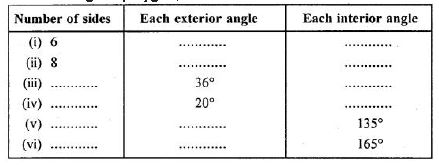
Question 1. Fill in the blanks :
In case of regular polygon, with
Answer:
Using the relationship that the sum of an interior angle and an exterior angle is always \( 180^\circ \) (i.e., \( \text{Interior Angle} + \text{Exterior Angle} = 180^\circ \)) and the formula \( \text{Exterior Angle} = \frac{360^\circ}{n} \) (where \( n \) is the number of sides), we can complete the table as follows:
| S.No. | Number of sides (\( n \)) | Each exterior angle | Each interior angle |
|---|---|---|---|
| (i) | 6 | 60° | 120° |
| (ii) | 8 | 45° | 135° |
| (iii) | 10 | 36° | 144° |
| (iv) | 18 | 20° | 160° |
| (v) | 8 | 45° | 135° |
| (vi) | 24 | 15° | 165° |
In simple words: The outer and inner angles of a regular shape always add up to 180 degrees. Also, dividing 360 degrees by the number of sides gives the measure of each outer angle.
Exam Tip: Remember the two key relationships: \( \text{Interior} + \text{Exterior} = 180^\circ \) and \( \text{Sides} = 360^\circ / \text{Exterior Angle} \). These will help you fill any missing values instantly.
Question 2. Find the number of sides in a regular polygon, if its each interior angle is :
(i) 160°
(ii) 150°
Answer:
Let the number of sides of the regular polygon be \( n \).
The formula for each interior angle is \( \frac{(2n - 4) \times 90^\circ}{n} \).
(i) For each interior angle = 160°:
\( \frac{(2n - 4) \times 90^\circ}{n} = 160^\circ \)
\( \implies 180n - 360 = 160n \)
\( \implies 180n - 160n = 360 \)
\( \implies 20n = 360 \)
\( \implies n = \frac{360}{20} = 18 \)
So, the polygon has 18 sides.
(ii) For each interior angle = 150°:
\( \frac{(2n - 4) \times 90^\circ}{n} = 150^\circ \)
\( \implies 180n - 360 = 150n \)
\( \implies 180n - 150n = 360 \)
\( \implies 30n = 360 \)
\( \implies n = \frac{360}{30} = 12 \)
So, the polygon has 12 sides.
In simple words: Set up the formula for one angle and solve for \( n \). Another easy way is to subtract the interior angle from 180 to find the exterior angle, then divide 360 by that exterior angle.
Exam Tip: Finding the exterior angle first (\( 180^\circ - \text{interior angle} \)) and dividing \( 360^\circ \) by it is a faster, error-free alternative method for this type of problem.
Question 3. Find number of sides in a regular polygon, if its each exterior angle is :
(i) 30°
(ii) 36°
Answer:
For any regular polygon, we know that the sum of all exterior angles is always 360°.
The number of sides \( n \) is given by the formula:
\( n = \frac{360^\circ}{\text{Each exterior angle}} \)
(i) When each exterior angle is 30°:
\( n = \frac{360^\circ}{30^\circ} = 12 \) sides.
(ii) When each exterior angle is 36°:
\( n = \frac{360^\circ}{36^\circ} = 10 \) sides.
In simple words: Since all the outer angles of any shape always add up to 360 degrees, dividing 360 by the size of one outer angle tells you how many sides the shape has.
Exam Tip: This formula only works for "regular" polygons where all exterior angles are equal.
Question 4. Is it possible to have a regular polygon whose each interior angle is :
(i) 135°
(ii) 155°
Answer:
A regular polygon is only possible if the calculated number of sides \( n \) is a whole number greater than or equal to 3.
(i) For an interior angle of 135°:
The exterior angle is \( 180^\circ - 135^\circ = 45^\circ \).
Number of sides \( n = \frac{360^\circ}{45^\circ} = 8 \).
Since 8 is a whole number, a regular polygon with each interior angle equal to 135° is possible (it is a regular octagon).
(ii) For an interior angle of 155°:
The exterior angle is \( 180^\circ - 155^\circ = 25^\circ \).
Number of sides \( n = \frac{360^\circ}{25^\circ} = 14.4 \).
Since 14.4 is not a whole number, it is not possible to have a regular polygon with each interior angle measuring 155°.
In simple words: Find the outer angle first by subtracting the inner angle from 180. Then divide 360 by that outer angle. If the result is a whole number, the shape can exist.
Exam Tip: Always show that the number of sides \( n \) must be a positive integer (whole number) for the polygon to exist.
Question 5. Is it possible to have a regular polygon whose each exterior angle is :
(i) 100°
(ii) 36°
Answer:
A regular polygon is possible only when the number of sides \( n = \frac{360^\circ}{\text{exterior angle}} \) is a whole number.
(i) When the exterior angle is 100°:
\( n = \frac{360^\circ}{100^\circ} = 3.6 \).
Since 3.6 is not a whole number, it is impossible to have such a regular polygon.
(ii) When the exterior angle is 36°:
\( n = \frac{360^\circ}{36^\circ} = 10 \).
Since 10 is a whole number, it is possible to have a regular polygon with each exterior angle measuring 36° (it has 10 sides).
In simple words: Divide 360 by the outer angle. If the answer is a whole number, the shape can exist. If it has a decimal point, the shape is impossible.
Exam Tip: A polygon cannot have a fractional number of sides. Always state this fact clearly when justifying your final answer.
Question 6. The ratio between the interior angle and the exterior angle of a regular polygon is 2 : 1. Find :
(i) each exterior angle of this polygon.
(ii) number of sides in the polygon.
Answer:
Let the interior angle be \( 2x^\circ \) and the exterior angle be \( x^\circ \).
Since an interior angle and an exterior angle on a straight line add up to 180°:
\( 2x^\circ + x^\circ = 180^\circ \)
\( \implies 3x^\circ = 180^\circ \)
\( \implies x = \frac{180^\circ}{3} = 60^\circ \)
(i) Each exterior angle is \( x^\circ = 60^\circ \).
(ii) The number of sides \( n \) is given by:
\( n = \frac{360^\circ}{\text{exterior angle}} \)
\( \implies n = \frac{360^\circ}{60^\circ} = 6 \) sides.
In simple words: The inner angle and the outer angle make a straight line, so they add up to 180 degrees. Since the inner angle is twice as big as the outer one, the outer angle must be 60 degrees. Dividing 360 by 60 tells us the shape has 6 sides.
Exam Tip: Remember that the ratio method is highly reliable for finding angle measures, and always check that your final number of sides is an integer.
Free study material for Mathematics
ICSE Selina Concise Solutions Class 6 Mathematics Chapter 28 Polygons
Students can now access the detailed Selina Concise Solutions for Chapter 28 Polygons on our portal. These solutions have been carefully prepared as per latest ICSE Class 6 syllabus. Each solution given above has been updated based on the current year pattern to ensure Class 6 students have the most updated Mathematics content.
Master Selina Concise Textbook Questions
Our subject experts have provided detailed explanations for all the questions found in the Selina Concise textbook for Class 6 Mathematics. We have focussed on making the concepts easy for you in Chapter 28 Polygons so that students can understand the concepts behind every answer. For all numerical problems and theoretical concepts these solutions will help in strengthening your analytical skill required for the ICSE examinations.
Complete Mathematics Exam Preparation
By using these Selina Concise Class 6 solutions, you can enhance your learning and identify areas that need more attention. We recommend solving the Mathematics Questions from the textbook first and then use our teacher-verified answers. For a proper revision of Chapter 28 Polygons, students should also also check our Revision Notes and Sample Papers available on studiestoday.com.
FAQs
You can download the verified Selina Concise solutions for Chapter 28 Polygons on StudiesToday.com. Our teachers have prepared answers for Class 6 Mathematics as per 2026-27 ICSE academic session.
Yes, our solutions for Chapter 28 Polygons are designed as per new 2026 ICSE standards. 40% competency-based questions required for Class 6, are included to help students understand application-based logic behind every Mathematics answer.
Yes, every exercise in Chapter 28 Polygons from the Selina Concise textbook has been solved step-by-step. Class 6 students will learn Mathematics conceots before their ICSE exams.
Yes, follow structured format of these Selina Concise solutions for Chapter 28 Polygons to get full 20% internal assessment marks and use Class 6 Mathematics projects and viva preparation as per ICSE 2026 guidelines.