

ICSE Solutions Selina Concise Class 6 Mathematics Chapter 29 The Circle have been provided below and is also available in Pdf for free download. The Selina Concise ICSE solutions for Class 6 Mathematics have been prepared as per the latest syllabus and ICSE books and examination pattern suggested in Class 6. Questions given in ICSE Selina Concise book for Class 6 Mathematics are an important part of exams for Class 6 Mathematics and if answered properly can help you to get higher marks. Refer to more Chapter-wise answers for ICSE Class 6 Mathematics and also download more latest study material for all subjects. Chapter 29 The Circle is an important topic in Class 6, please refer to answers provided below to help you score better in exams
Selina Concise Chapter 29 The Circle Class 6 Mathematics ICSE Solutions
Class 6 Mathematics students should refer to the following ICSE questions with answers for Chapter 29 The Circle in Class 6. These ICSE Solutions with answers for Class 6 Mathematics will come in exams and help you to score good marks
Chapter 29 The Circle Selina Concise ICSE Solutions Class 6 Mathematics
The Circle
Important Points
1. A circle represents a circular closed shape, and its middle spot is referred to as the center.
2. The straight line segment connecting the center to any location on the boundary is known as a radius. An infinite number of radii can be drawn from the center, and every radius in a circle has the same length.
3. Any line segment that passes directly through the circle's center and has both of its ends resting on the boundary is called a diameter. All diameters belonging to a single circle are equal in length.
4. Regions of a Circle: A circle is composed of three distinct areas: (i) the inside region (interior), (ii) the outside region (exterior), and (iii) the boundary line (circle itself).
5. Concentric Circles: Two or more circular figures sharing an identical central point but having different radial distances are known as concentric circles.
6. Chord of a Circle: Any segment that splits a circle into two regions is referred to as a chord. The longest chord you can draw inside a circle is its diameter.
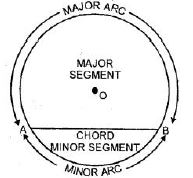
7. Segment of a Circle: When a chord partitions the circle into two unequal sections, the larger portion is termed the major segment, while the smaller portion is termed the minor segment.
8. Arc of a Circle: Any section of a circle's perimeter is known as an arc. An arc that spans more than half of the boundary is called a major arc, whereas an arc spanning less than half of the boundary is called a minor arc.
9. Sector of a Circle: A diameter splits a circle into two identical halves, with each half defined as a semicircle. A sector that is larger than a semicircle is called a major sector, while a sector smaller than a semicircle is called a minor sector of the circle.
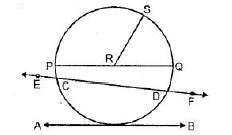
Question 1. Use the figure given below to fill in the blanks :
(i) R is the ...... of the circle.
(ii) Diameter of a circle is ...... .
(iii) Tangent to a circle is … .
(iv) EF is a …… of the circle.
(v) …… is a chord of the circle.
(vi) Diameter = 2 x …..
(vii) ……. is a radius of the circle.
(viii) If the length of RS is 5 cm, the length of PQ = ……
(ix) If PQ is 8 cm long, the length of RS =…..
(x) AB is a ….. of the circle
Answer:
(i) centre
(ii) PQ
(iii) AB
(iv) secant
(v) CD
(vi) radius
(vii) RS
(viii) 10 cm
(ix) 4 cm
(x) tangent
In simple words: This question helps us identify the core terminology of a circle, including its center, radius, diameter, chord, secant, and tangent line, along with their basic relationships.
Exam Tip: Keep in mind that a secant cuts through a circle at two distinct points, whereas a tangent touches the circle at exactly one single point on its boundary.
Question 2. Draw a circle of radius 4.2 cm. Mark its centre as O. Take a point A on the circumference of the circle. Join AO and extend it till it meets point B on the circumference of the circle,
(i) Measure the length of AB.
(ii) Assign a special name to AB.
Answer:
(i) Measuring the segment, we find that AB has a length of 8.4 cm.
(ii) Since this line segment passes through the centre O and has its endpoints on the boundary, AB is identified as the diameter.
In simple words: The diameter is always double the radius of the circle. When we extend the radius OA through the center to the opposite side, we form the full diameter AB, which measures 8.4 cm.
Exam Tip: Remember that any line segment passing through the center with both ends touching the circle is the diameter, and its length is calculated as \(2 \times \text{radius}\).
Question 3. Draw circle with diameter :
(i) 6 cm
(ii) 8.4 cm.
In each case, measure the length of the radius of the circle drawn.
Answer:
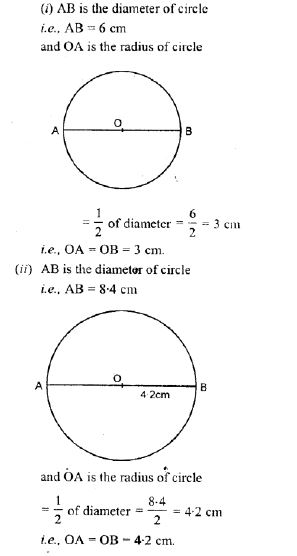
In simple words: To draw these circles, divide the given diameter by 2 to find the radius. Set your compass to this radius value to draw the circle.
Exam Tip: Always show the calculation step dividing the diameter by 2 to demonstrate how you determined the compass radius setting.
Question 4. Draw a circle of radius 6 cm. In the circle, draw a chord AB = 6 cm.
(i) If O is the centre of the circle, join OA and OB.
(ii) Assign a special name to \(\Delta AOB\)
(iii) Write the measure of angle AOB.
Answer:
(i) Point O is the circle's centre. By connecting OA and OB, we form two radii that measure 6 cm each.
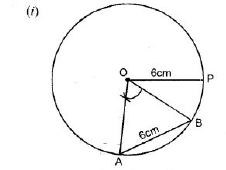
(ii) Since the chord AB is also 6 cm, all three sides of the triangle AOB are equal (OA = OB = AB = 6 cm). Therefore, \(\Delta AOB\) is an equilateral triangle.
(iii) Measuring the angle with a protractor, we find that \(\angle AOB\) measures 60 degrees, which is expected since all angles in an equilateral triangle are equal.
In simple words: Since the radius and the chord are both 6 cm, they create a triangle where all three sides are equal. This is an equilateral triangle, and all its angles are exactly 60 degrees.
Exam Tip: When a chord length equals the circle's radius, it always forms an equilateral triangle with the center, subtending a 60-degree angle.
Question 5. Draw a circle of radius 4.8 cm and mark its centre as P.
(i) Draw radii PA and PB such that \(\angle APB = 45^\circ\).
(ii) Shade the major sector of the circle
Answer:
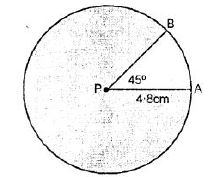
First, set the radius PA = 4.8 cm.
(i) Draw the circle with P as the central point. Draw the two radii PA and PB so that the angle between them, \(\angle APB\), measures 45 degrees.
(ii) The larger section of the circle is the major sector, which has been shaded in the accompanying diagram.
In simple words: A sector is a wedge of a circle. The smaller slice is the minor sector, and the rest of the circle is the major sector, which we shade here.
Exam Tip: Be careful to shade the major (larger) sector, leaving the minor (smaller) 45-degree sector unshaded, as specified in the question.
Question 6. Draw a circle of radius 3.6 cm. In the circle, draw a chord AB = 5 cm. Now shade the minor segment of the circle.
Answer:
First, construct a circle with a radius of 3.6 cm and draw a 5 cm chord labeled AB. The smaller region cut off by this chord is the minor segment, which has been highlighted with shading in the diagram.
In simple words: When you draw a chord across a circle, it splits the area into two segments. The smaller of the two parts is the minor segment.
Exam Tip: A segment is bounded by a chord and an arc, while a sector is bounded by two radii and an arc. Do not confuse the two during your exam.
Question 7. Mark two points A and B ,4cm a part, Draw a circle passing through B and with A as a center
Answer:
Mark two points A and B at a distance of 4 cm. Using A as the center and a radius equal to AB (4 cm), construct a circle. Point B will lie directly on the circumference, as shown in the diagram.
In simple words: Since point B is 4 cm away from center A, setting the radius to 4 cm ensures the circle's boundary passes perfectly through point B.
Exam Tip: In this setup, AB acts as the radius of the circle, meaning the boundary is exactly 4 cm away from the center A at all points.
Question 8. Draw a line AB = 8.4 cm. Now draw a circle with AB as diameter. Mark a point C on the circumference of the circle. Measure angle ACB.
Answer:
Draw the line segment AB = 8.4 cm and construct a circle using this segment as the diameter. Place any point C on the circle's boundary. Measuring the resulting angle, we find that \(\angle ACB\) is exactly 90 degrees.
In simple words: Any angle drawn from the ends of a diameter to any point on the circle's edge is always a right angle (\(90^\circ\)).
Exam Tip: This illustrates the classic theorem: "The angle subtended by a diameter in a semicircle is a right angle." Always write down this theorem name in your steps.
Exercise 29(B)
Question 1. Construct a triangle ABC with AB = 4.2 cm, BC = 6 cm and AC = 5cm. Construct the circumcircle of the triangle drawn.
Answer:
Steps of Construction:
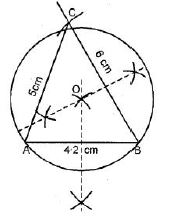
(i) Set up triangle ABC with the given dimensions: AB = 4.2 cm, BC = 6 cm, and AC = 5 cm.
(ii) Construct the perpendicular bisectors of two chosen sides of the triangle, marking their intersection as O.
(iii) With O as the center and a radius equal to OA, OB, or OC, draw the circle. This circumcircle will pass through all three corners A, B, and C.
In simple words: First draw the triangle. Then draw lines cutting two sides in half at 90 degrees. Where these lines cross is the center. Use it to draw a circle around the triangle.
Exam Tip: Keep your construction arcs visible! Perpendicular bisectors are key to finding the circumcenter of a triangle.
Question 2. Construct a triangle PQR with QR = 5.5 cm, ∠Q = 60° and angle R = 45°. Construct the circumcircle of the triangle PQR.
Answer:
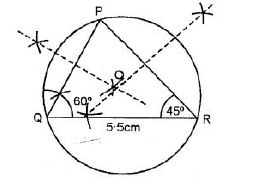
Steps of Construction:
(i) Draw the baseline QR = 5.5 cm. Construct a 60-degree angle at Q and a 45-degree angle at R, extending the arms to intersect at point P.
(ii) Draw perpendicular bisectors for sides PQ and PR, letting them cross at point O.
(iii) Set the compass at O and use the distance OP, OQ, or OR as the radius to draw the circle. The resulting circumcircle passes through the three vertices P, Q, and R.
In simple words: Draw the triangle base and use angles to locate point P. Find the middle crossing point of two sides, and draw a circle around all three corners.
Exam Tip: Construct angles of \(60^\circ\) and \(45^\circ\) using a ruler and compass to obtain full marks for precise construction.
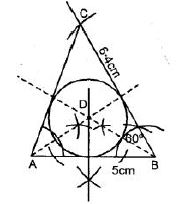
Question 3. Construct a triangle ABC with AB = 5 cm, ∠B = 60° and BC = 6.4 cm. Draw the incircle of the triangle ABC.
Answer:
Steps of Construction:
(i) Draw a horizontal line segment AB of length 5 cm.
(ii) Using a compass with B as the center, construct a 60-degree angle. Draw an arc on this ray at a distance of 6.4 cm to mark point C.
(iii) Connect points A and C to finish drawing triangle ABC.
(iv) Construct the angle bisectors of both \(\angle A\) and \(\angle B\). These two bisectors intersect at point D.
(v) Using D as the center, draw the incircle so that it just touches the three sides of the triangle.
In simple words: To draw an incircle, we split two angles of the triangle in half. The intersection point D gives the center for drawing a circle that fits perfectly inside.
Exam Tip: Remember: angle bisectors find the *incenter* (for an incircle), while perpendicular side bisectors find the *circumcenter* (for a circumcircle).
Question 4. Construct a triangle XYZ in which XY = YZ= 4.5 cm and ZX = 5.4 cm. Draw the circumcircle of the triangle and measure its circumradius.
Answer:
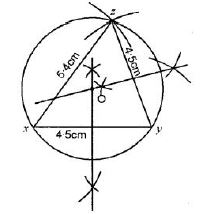
Steps of Construction:
(i) Create triangle XYZ with XY = 4.5 cm, YZ = 4.5 cm, and ZX = 5.4 cm.
(ii) Draw the perpendicular bisectors of sides XZ and YZ, marking their point of intersection as O.
(iii) With O as the center and a radius of OX, OY, or OZ, draw the circumcircle. This circle will pass through all three vertices X, Y, and Z. Measuring the circumradius, we find it is approximately 2.7 cm.
In simple words: Draw the triangle base and sides using a compass. Cross the perpendicular lines of two sides to find the center O, then draw the circle passing through the three points.
Exam Tip: Since XY = YZ, triangle XYZ is an isosceles triangle, meaning the circumcenter O will lie directly on the perpendicular bisector of the base ZX.
Question 5. Construct a triangle PQR in which, PQ = QR = RP = 5.7 cm. Draw the incircle of the triangle and measure its radius.
Answer:
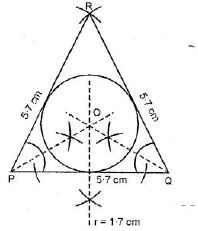
Steps of Construction:
(i) Construct an equilateral triangle RPQ where each side is 5.7 cm long.
(ii) Draw the bisectors for \(\angle P\) and \(\angle Q\), letting them meet at the intersection point O.
(iii) Using O as the center, draw the incircle that perfectly touches the three sides of triangle RPQ. By measurement, the radius is approximately 1.7 cm.
In simple words: Since all sides are equal, we construct an equilateral triangle. Bisecting the angles gives the center O of the circle that fits perfectly inside.
Exam Tip: For any equilateral triangle, the incenter and circumcenter lie at the exact same point. Measuring the perpendicular distance from this point to any side gives the exact inradius.
Revision Exercise
Question 1. The centre of a circle is at point O and its radius is 8 cm. State the position of a point P (point P may lie inside the circle, on the circumference of the circle, or outside the circle), when:
(a) OP = 10.6 cm
(b) OP = 6.8 cm
(c) OP = 8 cm
Answer:
For each scenario, consider a circle centered at O with a radius of 8 cm:
(a) Since the distance OP = 10.6 cm is larger than the circle's radius of 8 cm, point P lies outside the circle.
(b) Since the distance OP = 6.8 cm is smaller than the circle's radius of 8 cm, point P lies inside the circle.
(c) Since the distance OP = 8 cm is exactly equal to the circle's radius, point P lies on the circumference of the circle.
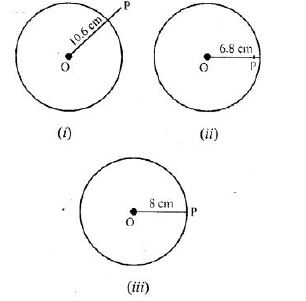
In simple words: Compare the point's distance from the center to the radius. If it is longer, the point is outside. If it is shorter, it is inside. If it is equal, it is right on the boundary.
Exam Tip: Use the basic mathematical rules: \(OP > \text{radius} \implies \text{Outside}\), \(OP < \text{radius} \implies \text{Inside}\), and \(OP = \text{radius} \implies \text{On the circle}\).
Question 2. The diameter of a circle is 12.6 cm. State, the length of its radius.
Answer:
The diameter of this circle is 12.6 cm. To find the radius, divide the diameter by 2:
\[ \text{Radius} = \frac{\text{Diameter}}{2} = \frac{12.6}{2} = 6.3\text{ cm} \]
In simple words: The radius is always exactly half the length of the diameter. So, dividing 12.6 cm by 2 gives 6.3 cm.
Exam Tip: Be precise with decimal division. Writing down the relation \(\text{Radius} = \frac{1}{2} \times \text{Diameter}\) ensures full formula marks.
Question 3. Can the length of a chord of a circle be greater than its diameter ? Explain.
Answer:
No, a chord's length cannot exceed the circle's diameter. The diameter is always the longest chord that can be drawn within any circle.
In simple words: No. Since the diameter goes straight through the center, it represents the widest span across the circle. No other line segment across the circle can be longer.
Exam Tip: State clearly that "the diameter is the longest chord of a circle" as the mathematical explanation for your answer.
Question 4. Draw a circle of diameter 7 cm. Draw two radii of this circle such that the angle between these radii is 90°. Shade the minor sector obtained. Write a special name for this sector.
Answer:
Draw a circle whose diameter is 7 cm (meaning the radius is 3.5 cm). Draw two radii, OA and OB, with a 90-degree angle between them. Shading this region gives the minor sector AOB, which is also known as a quadrant of the circle.
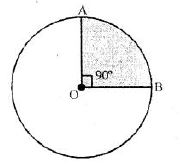
In simple words: A sector with a 90-degree central angle is exactly one-quarter of a circle, which we call a quadrant.
Exam Tip: Mention both terms, "minor sector" and "quadrant", as examiners specifically look for the term "quadrant" for a \(90^\circ\) sector.
Question 5. State, which of following statements are true and which are false :
(i) If the end points A and B of the line segment lie on the circumference of a circle, AB is a diameter.
(ii) The longest chord of a circle is its diameter.
(iii) Every diameter bisects a circle and each part of the circle so obtained is a semi-circle.
(iv) The diameters of a circle always pass through the same point in the circle.
Answer:
(i) False. While A and B lie on the boundary, AB is only a diameter if it passes through the center; otherwise, it is simply a chord.
(ii) True. The longest chord in any circle is its diameter.
(iii) True. A diameter divides the circle into two identical halves, which are semicircles.
(iv) True. Every diameter must cross through the center of the circle.
In simple words: A diameter is a special chord because it must pass through the center. This center is the point where all diameters intersect, cutting the circle into two equal semicircles.
Exam Tip: Clarify the difference between a chord and a diameter: every diameter is a chord, but not all chords qualify as diameters.
Free study material for Mathematics
ICSE Selina Concise Solutions Class 6 Mathematics Chapter 29 The Circle
Students can now access the detailed Selina Concise Solutions for Chapter 29 The Circle on our portal. These solutions have been carefully prepared as per latest ICSE Class 6 syllabus. Each solution given above has been updated based on the current year pattern to ensure Class 6 students have the most updated Mathematics content.
Master Selina Concise Textbook Questions
Our subject experts have provided detailed explanations for all the questions found in the Selina Concise textbook for Class 6 Mathematics. We have focussed on making the concepts easy for you in Chapter 29 The Circle so that students can understand the concepts behind every answer. For all numerical problems and theoretical concepts these solutions will help in strengthening your analytical skill required for the ICSE examinations.
Complete Mathematics Exam Preparation
By using these Selina Concise Class 6 solutions, you can enhance your learning and identify areas that need more attention. We recommend solving the Mathematics Questions from the textbook first and then use our teacher-verified answers. For a proper revision of Chapter 29 The Circle, students should also also check our Revision Notes and Sample Papers available on studiestoday.com.
FAQs
You can download the verified Selina Concise solutions for Chapter 29 The Circle on StudiesToday.com. Our teachers have prepared answers for Class 6 Mathematics as per 2026-27 ICSE academic session.
Yes, our solutions for Chapter 29 The Circle are designed as per new 2026 ICSE standards. 40% competency-based questions required for Class 6, are included to help students understand application-based logic behind every Mathematics answer.
Yes, every exercise in Chapter 29 The Circle from the Selina Concise textbook has been solved step-by-step. Class 6 students will learn Mathematics conceots before their ICSE exams.
Yes, follow structured format of these Selina Concise solutions for Chapter 29 The Circle to get full 20% internal assessment marks and use Class 6 Mathematics projects and viva preparation as per ICSE 2026 guidelines.