

ICSE Solutions Selina Concise Class 6 Mathematics Chapter 30 Revision Exercise Symmetry have been provided below and is also available in Pdf for free download. The Selina Concise ICSE solutions for Class 6 Mathematics have been prepared as per the latest syllabus and ICSE books and examination pattern suggested in Class 6. Questions given in ICSE Selina Concise book for Class 6 Mathematics are an important part of exams for Class 6 Mathematics and if answered properly can help you to get higher marks. Refer to more Chapter-wise answers for ICSE Class 6 Mathematics and also download more latest study material for all subjects. Chapter 30 Revision Exercise Symmetry is an important topic in Class 6, please refer to answers provided below to help you score better in exams
Selina Concise Chapter 30 Revision Exercise Symmetry Class 6 Mathematics ICSE Solutions
Class 6 Mathematics students should refer to the following ICSE questions with answers for Chapter 30 Revision Exercise Symmetry in Class 6. These ICSE Solutions with answers for Class 6 Mathematics will come in exams and help you to score good marks
Chapter 30 Revision Exercise Symmetry Selina Concise ICSE Solutions Class 6 Mathematics
Important Points on Symmetry
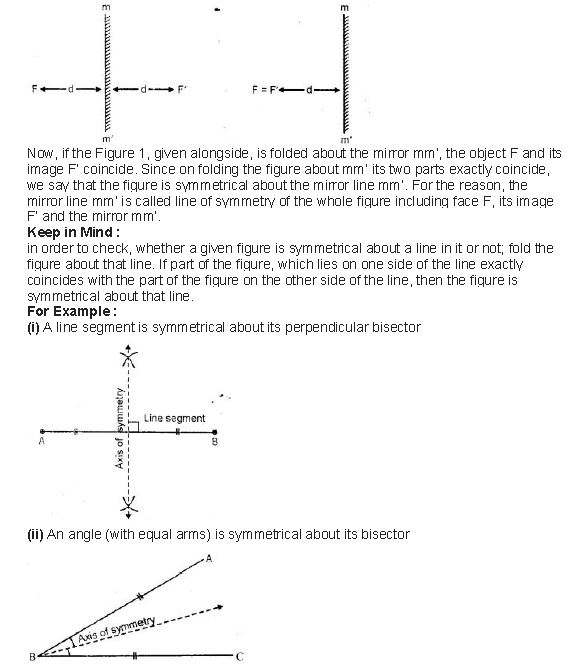
1. Understanding Linear Symmetry: Imagine placing a flat mirror named \( mm' \). If your face \( F \) stands at a distance \( d \) in front of the glass, its reflection \( F' \) appears at the exact same distance \( d \) behind it.
When you fold a drawing along the mirror line \( mm' \), the real object \( F \) and its reflection \( F' \) will land perfectly on top of each other. Because these two sections match exactly when folded, we say the shape is symmetrical across that line. This dividing line \( mm' \) is called the line of symmetry.
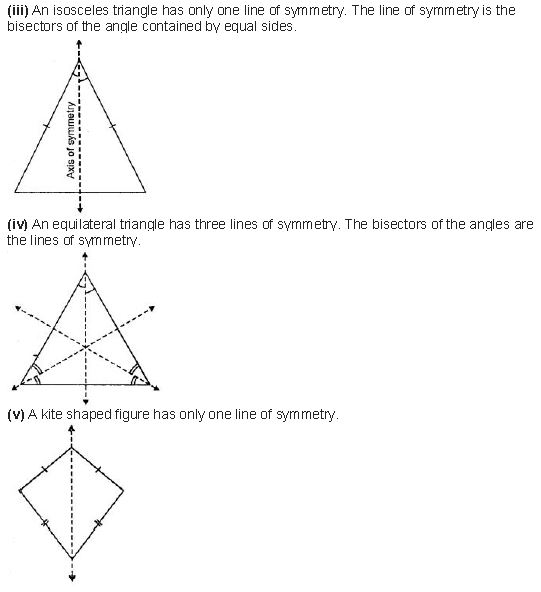
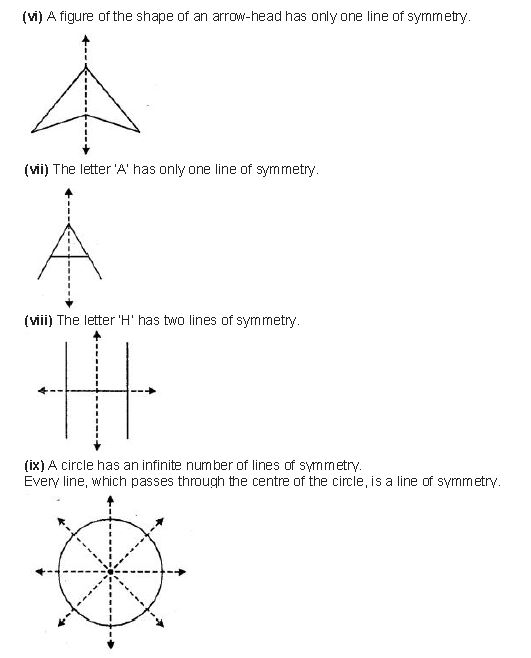
Question 1. State, whether true or false :
(i) The letter B has one line of symmetry.
(ii) The letter F has no line of symmetry.
(iii) The letter O has only two lines of symmetry.
(iv) The figure [rounded rectangle] has no line of symmetry.
(v) The letter N has one line of symmetry.
(vi) The figure [rounded rectangle] has one line of symmetry.
(vii) The letter D has only one line of symmetry.
(viii) A scalene triangle has three lines of symmetry.
Answer:
(i) True. If both curves of the letter B are identical, a horizontal line of symmetry exists.
(ii) True. There is no way to fold the letter F so its parts match.
(iii) False. The letter O typically has more than two lines of symmetry if circular, or exactly two if oval.
(iv) False. A rounded rectangle has two lines of symmetry, not zero.
(v) False. The letter N has rotational symmetry but no lines of symmetry.
(vi) True. Since the shape has lines of symmetry, it does possess at least one line of symmetry.
(vii) True. A horizontal line splits the letter D into equal upper and lower parts.
(viii) False. A scalene triangle has no sides equal, meaning it has zero lines of symmetry.
In simple words: Symmetrical shapes can be folded perfectly in half. Some letters like B and D have one fold line, while N and F have none.
Exam Tip: Remember that letters like N and S do not have linear symmetry because folding them does not make the halves overlap, even though they look balanced.
Question 2. Construct a triangle ABC, in which AB = AC = 5 cm and BC 6 cm. Draw all its lines of Symmetry.
Answer:
Steps of Construction:
(i) Draw a horizontal line segment BC of length 6 cm.
(ii) Set your compass to 5 cm, place its needle on point B, and draw an arc above the line BC.
(iii) Keep the same compass width of 5 cm, place its needle on point C, and draw another arc that crosses the first one at point A.
(iv) Join points AB and AC to finish drawing the triangle ABC.
(v) Since AB = AC, this is an isosceles triangle. Draw a vertical line from the top point A down to the middle of BC. This is the single line of symmetry for this triangle.
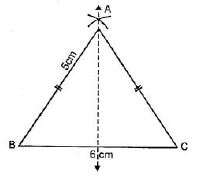
In simple words: First, we draw the bottom side of 6 cm. Then, we use a compass set to 5 cm to find the top point A from both ends. Since two sides are the same length, we only have one line that splits the triangle right down the middle.
Exam Tip: In an isosceles triangle, the line of symmetry is always the perpendicular bisector of the base, which also bisects the vertex angle.
Question 3. Examine each of the following figures carefully, draw line(s) of symmetry in which ever figure possible :
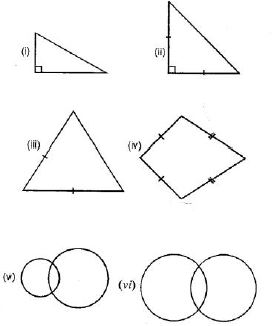
Answer:
(i) This figure is a scalene right-angled triangle, so no line of symmetry can be drawn.
(ii) For this right-angled isosceles triangle, one line of symmetry exists. It bisects the right angle and goes through the hypotenuse.
(iii) This isosceles triangle has one line of symmetry running vertically from the top vertex down to the base.
(iv) Since this is a kite shape, it has a single line of symmetry along its vertical diagonal.
(v) For these two unequal intersecting circles, only one line of symmetry is possible, which runs horizontally through both centers.
(vi) For these two identical intersecting circles, there are two lines of symmetry: one horizontal line through their centers and one vertical line passing through their points of intersection.
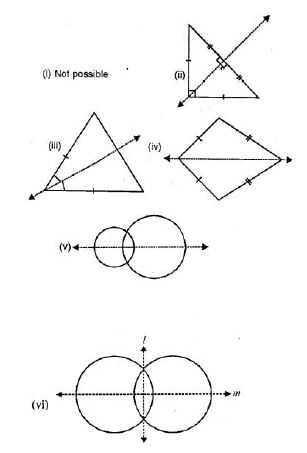
In simple words: We look for lines where we can fold each shape exactly in half. For asymmetrical or scalene shapes, no fold works. For intersecting equal circles, we can fold them either down the middle or along the line connecting their centers.
Exam Tip: Always look closely at tick marks indicating equal sides or identical shapes. They tell you which lines can act as mirrors.
Question 4. Construct a triangle XYZ, in which XY = YZ = ZX = 4.5 cm. Draw all its lines of symmetry.
Answer:
Steps of Construction:
(i) Start by drawing the base line segment XY of length 4.5 cm.
(ii) Set your compass to a width of 4.5 cm, place its needle on point X, and draw an arc above the line.
(iii) Place the compass needle on point Y with the same 4.5 cm width, and draw another arc intersecting the first one at point Z.
(iv) Join points XZ and YZ to complete the equilateral triangle XYZ.
(v) Draw the perpendicular bisectors from each corner (vertex) to its opposite side. These three lines represent the lines of symmetry.
In simple words: Since an equilateral triangle has three equal sides and three equal angles, it can be folded in three different ways. Each line goes from one corner straight through the middle of the opposite side.
Exam Tip: Always remember that an equilateral triangle has exactly three lines of symmetry, whereas an isosceles triangle has only one, and a scalene triangle has none.
Question 5. Construct a triangle ABC, in which AB = BC = 4 cm and ∠ABC = 60°. Draw all its lines of symmetry.
Answer:
Steps of Construction:
(i) Draw a horizontal line segment AB of length 4 cm.
(ii) Use a protractor or compass to construct a 60° angle at point B.
(iii) Set your compass to 4 cm, place the needle on B, and draw an arc along the new ray to mark point C such that BC = 4 cm.
(iv) Connect points A and C to form the triangle ABC.
(v) Since all three sides are equal (each is 4 cm) and all angles are 60°, this is an equilateral triangle. Draw the three perpendicular bisectors of the sides to show its three lines of symmetry.
In simple words: Even though we started with two equal sides and a 60-degree angle, this naturally creates a perfect equilateral triangle. Because of this, it has three lines of symmetry just like any other equilateral triangle.
Exam Tip: If an isosceles triangle has one angle of 60° at the vertex or base, it automatically becomes an equilateral triangle, meaning it will have 3 lines of symmetry instead of 1.
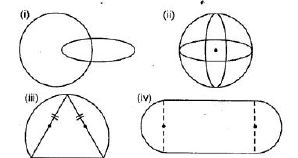
Question 6. Draw the line(s) of symmetry for each figure drawn below :
Answer:
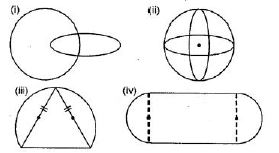
(i) This figure has a single horizontal line of symmetry running through the middle of both shapes.
(ii) This shape has two lines of symmetry: one horizontal and one vertical, splitting it into four equal quarters.
(iii) This figure has one vertical line of symmetry passing straight down through the center of the triangle and the semicircle.
(iv) This rounded capsule shape has two lines of symmetry: one running horizontally and one running vertically.
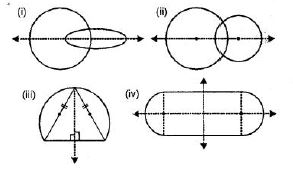
In simple words: We find the lines where we can fold each shape exactly in half. Shapes that are balanced in both directions, like the circle and the capsule, have two fold lines.
Exam Tip: Ensure that lines of symmetry pass through the geometric center of any overlapping or symmetric parts of the figure.
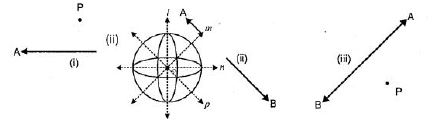
Question 7. In each of the following case, construct a point that is symmetric to the given point P with respect to the given line AB.
Answer:
(i) Drop a perpendicular line from point P down to the line AB, meeting it at point O. Extend this line further below AB to a point Q such that the distance OQ is exactly equal to OP. Point Q is the symmetric point of P.
(ii) Draw a perpendicular line PO from point P to the line AB. Extend this line to point Q on the other side so that OQ matches PO. This point Q is symmetrical to P.
(iii) Draw a line from point P perpendicular to the angled line AB, intersecting it at O. Extend this line to point Q so that OQ is equal in length to OP. Point Q is the symmetrical image of point P across line AB.
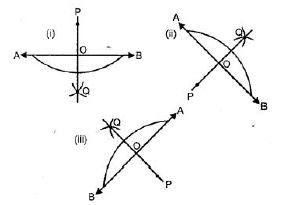
In simple words: To find the mirror image of a point across a line, we draw a straight line to the mirror at a 90-degree angle, then measure the exact same distance on the other side.
Exam Tip: Always use a set square or protractor to draw the 90° line first, then use your compass or ruler to make sure the distance on both sides is identical.
Question 8. Mark two points A and B 5.5 cm apart. Draw a line PQ so that A and B are symmetric with respect to the line PQ. Give a special name to line PQ.
Answer:
Steps of Construction:
(i) Draw a horizontal line segment AB of length 5.5 cm.
(ii) Place the needle of your compass on point A, open it to a width greater than half of AB, and draw arcs above and below AB.
(iii) Place the needle on point B, keeping the same compass width, and draw arcs that cross the first ones. Name these intersection points P and Q.
(iv) Draw a straight line through P and Q. This line PQ is the perpendicular bisector of the line segment AB.
In simple words: When you draw a line that cuts a segment right in the middle at a 90-degree angle, both endpoints become mirror images of each other. This special dividing line is called the perpendicular bisector.
Exam Tip: For any two symmetric points, the mirror line is always their perpendicular bisector. Make sure to clearly state its name in your answer.
Question 9. For each letter of the English alphabet, draw the maximum possible number of lines of symmetry.
Answer:
Here is the classification of all 26 uppercase letters of the English alphabet based on their lines of symmetry:
1. Letters with one vertical line of symmetry: A, M, T, U, V, W, Y
2. Letters with one horizontal line of symmetry: B, C, D, E, K
3. Letters with two lines of symmetry (both vertical and horizontal): H, I, X
4. Letters with infinite lines of symmetry: O (if drawn as a perfect circle)
5. Letters with zero lines of symmetry: F, G, J, L, N, P, Q, R, S, Z
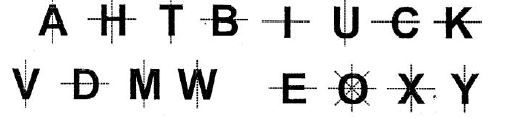
In simple words: Some letters can be folded in half up-and-down, some left-to-right, and some in both ways. A perfect letter O has endless lines of symmetry, while letters like F or S cannot be folded symmetrically at all.
Exam Tip: In examinations, remember that letters like 'O' have infinite axes of symmetry ONLY when drawn as a perfect circle. Standard printed 'O' is often an oval, which has exactly two lines.
Question 10. Draw all the possible lines of symmetry for each figure given below :
(i) Parallelogram
(ii) Rectangle
(iii) Square
(iv) A semi-circle
(v) A quadrant

Answer:
(i) A parallelogram does not have any lines of symmetry because its opposite sides are angled, preventing halves from overlapping when folded.
(ii) A rectangle has exactly two lines of symmetry, which connect the midpoints of its opposite sides (horizontal and vertical).
(iii) A square has exactly four lines of symmetry: two connecting the opposite midpoints and two along its diagonals.
(iv) A semicircle has exactly one line of symmetry, which is the vertical bisector of its diameter.

(v) A quadrant (quarter circle) has exactly one line of symmetry, which bisects the 90-degree angle at its center.
In simple words: A parallelogram cannot be folded to match perfectly, but a square can be folded in four different ways: across its sides and down its diagonals.
Exam Tip: A parallelogram has rotational symmetry of order 2 but 0 lines of symmetry. This is a common trap in MCQ or true/false questions.
Question 11. For each shaded portion given below, draw all the possible lines of symmetry :
Answer:
(i) A minor segment is bounded by a chord and an arc. The perpendicular bisector of the chord acts as its single line of symmetry.
(ii) For a major segment, the single line of symmetry is the perpendicular bisector of the chord, splitting the remaining large region into two equal halves.
(iii) A quadrant (shaded quarter-circle) has exactly one line of symmetry, which is the bisector of its 90-degree angle.
(iv) This shaded sector/arrowhead region has a single line of symmetry dividing it right down its center.
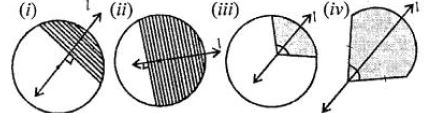
In simple words: No matter how we shade a circle or its parts, if the shaded region is balanced on both sides of a line, we can fold it perfectly. Each of these shapes has exactly one fold line.
Exam Tip: For any circular region or portion, the line of symmetry always passes through the center of the circle.
Free study material for Mathematics
ICSE Selina Concise Solutions Class 6 Mathematics Chapter 30 Revision Exercise Symmetry
Students can now access the detailed Selina Concise Solutions for Chapter 30 Revision Exercise Symmetry on our portal. These solutions have been carefully prepared as per latest ICSE Class 6 syllabus. Each solution given above has been updated based on the current year pattern to ensure Class 6 students have the most updated Mathematics content.
Master Selina Concise Textbook Questions
Our subject experts have provided detailed explanations for all the questions found in the Selina Concise textbook for Class 6 Mathematics. We have focussed on making the concepts easy for you in Chapter 30 Revision Exercise Symmetry so that students can understand the concepts behind every answer. For all numerical problems and theoretical concepts these solutions will help in strengthening your analytical skill required for the ICSE examinations.
Complete Mathematics Exam Preparation
By using these Selina Concise Class 6 solutions, you can enhance your learning and identify areas that need more attention. We recommend solving the Mathematics Questions from the textbook first and then use our teacher-verified answers. For a proper revision of Chapter 30 Revision Exercise Symmetry, students should also also check our Revision Notes and Sample Papers available on studiestoday.com.
FAQs
You can download the verified Selina Concise solutions for Chapter 30 Revision Exercise Symmetry on StudiesToday.com. Our teachers have prepared answers for Class 6 Mathematics as per 2026-27 ICSE academic session.
Yes, our solutions for Chapter 30 Revision Exercise Symmetry are designed as per new 2026 ICSE standards. 40% competency-based questions required for Class 6, are included to help students understand application-based logic behind every Mathematics answer.
Yes, every exercise in Chapter 30 Revision Exercise Symmetry from the Selina Concise textbook has been solved step-by-step. Class 6 students will learn Mathematics conceots before their ICSE exams.
Yes, follow structured format of these Selina Concise solutions for Chapter 30 Revision Exercise Symmetry to get full 20% internal assessment marks and use Class 6 Mathematics projects and viva preparation as per ICSE 2026 guidelines.