

Access the latest CBSE Class 10 Mathematics Some Applications of Trigonometry Worksheet Set 03. We have provided free printable Class 10 Mathematics worksheets in PDF format, specifically designed for Chapter 9 Some Applications of Trigonometry. These practice sets are prepared by expert teachers following the 2025-26 syllabus and exam patterns issued by CBSE, NCERT, and KVS.
Chapter 9 Some Applications of Trigonometry Mathematics Practice Worksheet for Class 10
Students should use these Class 10 Mathematics chapter-wise worksheets for daily practice to improve their conceptual understanding. This detailed test papers include important questions and solutions for Chapter 9 Some Applications of Trigonometry, to help you prepare for school tests and final examination. Regular practice of these Class 10 Mathematics questions will help improve your problem-solving speed and exam accuracy for the 2026 session.
Download Class 10 Mathematics Chapter 9 Some Applications of Trigonometry Worksheet PDF
Question. If the angle of depression of a car from a 100 m high tower is \( 45^\circ \), then the distance of the car from the tower is
(a) 100 m
(b) 200 m
(c) \( 100\sqrt{3} \) m
(d) \( 200\sqrt{3} \) m
Answer: (a) 100 m
Explanation:
Let the distance of the car from the tower be \( x \) meters.
\( \therefore \tan 45^\circ = \frac{AC}{BC} \)
\( \implies 1 = \frac{100}{x} \) m
\( \implies x = 100 \) m
Therefore, the distance of the car from the tower is 100 m.
Question. A kite is flying at a height of 200 m above the ground. The string attached to the kite is temporarily tied to a point on the ground. The inclination of the string with the ground is \( 45^\circ \). The length of the string, assuming that there is no slack in the string is
(a) 100 m
(b) 200 m
(c) \( 200\sqrt{2} \) m
(d) \( 100\sqrt{2} \) m
Answer: (c) \( 200\sqrt{2} \) m
Explanation:
Here, in triangle ABC, Height of the slide = AB = 200 m
Angle of elevation = \( \theta = 45^\circ \)
To find: Length of the string = AC
\( \therefore \sin 45^\circ = \frac{AB}{AC} \)
\( \implies \frac{1}{\sqrt{2}} = \frac{200}{AC} \)
\( \implies AC = 200\sqrt{2} \) m
Question. The angles of elevation of the top of a tower from two points on the ground at distances 8 m and 18 m from the base of the tower and in the same straight line with it are complementary. The height of the tower is
(a) 12 m
(b) 18 m
(c) 8 m
(d) 16 m
Answer: (a) 12 m
Explanation:
In triangle ABC, \( \tan \theta = \frac{h}{18} \) ….(i)
And in triangle ADC, \( \tan(90^\circ - \theta) = \frac{h}{8} \)
\( \implies \cot \theta = \frac{h}{8} \) ….(ii)
Multiplying eq. (i) and (ii), we get
\( \tan \theta \cdot \cot \theta = \frac{h}{18} \times \frac{h}{8} \)
\( \implies 1 = \frac{h^2}{144} \)
\( \implies h^2 = 144 \)
\( \implies h = 12 \) m
Question. The _____________ is the line drawn from the eye of an observer to the point in the object viewed by the observer.
(a) Horizontal line
(b) line of sight
(c) None of the options
(d) Vertical line
Answer: (b) line of sight
Explanation:
The line of sight is the imaginary line drawn from the eye of an observer to the point in the object viewed by the observer. The angle between the line of sight and the ground is called angle of elevation
Question. A pole 10 m high cast a shadow 10 m long on the ground, then the sun’s elevation is
(a) \( 60^\circ \)
(b) \( 15^\circ \)
(c) \( 45^\circ \)
(d) \( 30^\circ \)
Answer: (c) \( 45^\circ \)
Explanation:
Let the length of the shadow BC be 10 meters.
Then the height of the pole AB is 10meter.
\( \therefore \tan \theta = \frac{AB}{BC} \)
\( \implies \tan \theta = \frac{10}{10} \)
\( \implies \tan \theta = 1 \)
\( \implies \tan \theta = \tan 45^\circ \)
\( \implies \theta = 45^\circ \)
Question. A ladder 15 m long just reaches the top of a vertical wall. If the ladder makes an angle of \( 60^\circ \) with the wall, then find the height of the wall.
Answer: Let AC be the ladder and BC be the wall. Then, we have
AC = 15 m and \( \angle ACB = 60^\circ \)
Now, let BC = h m
Clearly, In \( \triangle ABC \), we have
\( \cos 60^\circ = \frac{B}{H} = \frac{BC}{AC} \)
\( \cos 60^\circ = \frac{h}{15} \)
\( \implies \frac{1}{2} = \frac{h}{15} \) [ \( \because \cos 60^\circ = \frac{1}{2} \) ]
\( \implies h = \frac{15}{2} \) m
\( \implies h = 7.5 \) m
Therefore, height of wall = 7.5 m
Question. If the angles of elevation of the top of a tower from two points distant a and b (a > b) from its foot and in the same straight line from it are respectively \( 30^\circ \) and \( 60^\circ \), then find the height of the tower.
Answer: Let the height of tower be h.
From \( \triangle ABD, \frac{h}{a} = \tan 30^\circ \)
\( \therefore h = a \times \frac{1}{\sqrt{3}} = \frac{a}{\sqrt{3}} \) … (i)
From \( \triangle ACD, \frac{h}{b} = \tan 60^\circ \)
\( h = b \times \sqrt{3} = b\sqrt{3} \) … (ii)
From (i) \( a = \sqrt{3}h \)
From (ii) \( b = \frac{h}{\sqrt{3}} \)
\( \therefore a \times b = \sqrt{3}h \times \frac{h}{\sqrt{3}} \)
\( \implies h^2 = ab \)
\( \implies h = \sqrt{ab} \)
Hence, the height of the tower = \( \sqrt{ab} \)
Question. If the height and length of shadow of a man are the same, then find the angle of elevation of the Sun.
Answer: Let BC be the height of man and AB be the shadow of the man.
According to the question, AB = BC
Again, let the angle of elevation of the Sun be \( \theta \).
In right-angled triangle,
\( \tan \theta = \frac{P}{B} = \frac{BC}{AB} \)
\( \implies \tan \theta = \frac{BC}{BC} \) [ height of pole = length of shadow or AB = BC ]
\( \implies \tan \theta = 1 \)
\( \implies \tan \theta = \tan 45^\circ \) (\( \because \tan 45^\circ = 1 \))
\( \implies \theta = 45^\circ \)
\( \therefore \) Angle of elevation of Sun is \( 45^\circ \).
Question. An observer 1.5 m tall is 28.5 m away from a tower. The angle of elevation of the top of the tower from her eyes is 45°. What is the height of the tower?
Answer: Let AB be the tower of height h and CD be the observer of height 1.5 m at a distance of 28.5 m from the tower AB.
In \( \triangle AED \), we have
\( \tan 45^\circ = \frac{AE}{DE} \)
\( \implies 1 = \frac{AE}{28.5} \)
\( \implies AE = 28.5 \) m
\( \therefore h = AE + BE \)
= AE + DC
= (28.5 + 1.5) m = 30m
Hence, the height of the tower is 30 m.
Question. A vertical tower of height 90 m stands on the ground. The angle of elevation of the top of the tower as observed from a point on the ground is \( 60^\circ \). Find the distance of the point from the foot of the tower.
Answer: AB = 90m
In right \( \triangle ABC \),
\( \frac{AB}{BC} = \tan 60^\circ \)
\( \implies \frac{90}{BC} = \sqrt{3} \)
\( BC = \frac{90}{\sqrt{3}} = 30\sqrt{3} \) m
Question. A pole 5 m high is fixed on the top of a tower. The angle of elevation of the top of pole observed from a point A on the ground is \( 60^\circ \) and the angle of depression of the point A from the top of the tower is \( 45^\circ \). Find the height of the tower. (Take \( \sqrt{3} = 1.732 \))
Answer: given: the height of the pole (CB) = 5m
let 'h' be the height of the tower, then;
In \( \triangle ABD \),
\( \frac{AD}{h} = \cot 45^\circ \)
\( \implies \frac{AD}{h} = 1 \)
\( \implies AD = h \)
In \( \triangle ADC \),
\( \frac{AD}{h+5} = \cot 60^\circ = \frac{1}{\sqrt{3}} \)
\( \implies \frac{h}{h+5} = \frac{1}{\sqrt{3}} \) [\( \because AD = h \)]
\( \implies h + 5 = \sqrt{3}h \)
\( \implies 5 = (\sqrt{3} - 1)h \)
\( \implies h = \left( \frac{5}{\sqrt{3}-1} \right) \left( \frac{\sqrt{3}+1}{\sqrt{3}+1} \right) = \frac{5(1.732+1)}{3-1} = 6.83 \) m
Question. A pole casts a shadow of length \( 2\sqrt{3} \) m on the ground, When the Sun's elevation is \( 60^\circ \). Find the height of the pole.
Answer: AB = \( 2\sqrt{3} \) m. BC is the height of pole.
In right-angle \( \triangle ABC, \angle B = 90^\circ \)
\( \tan 60^\circ = \frac{P}{B} = \frac{BC}{AB} \)
\( \implies \sqrt{3} = \frac{BC}{AB} \)
\( \implies \sqrt{3} = \frac{BC}{2\sqrt{3}} \)
\( \implies BC = \sqrt{3} \times 2\sqrt{3} \)
\( \implies BC = 6 \)
Therefore, height of the pole = 6 m.
Question. The pilot of an aircraft flying horizontally at a speed of 1200 km/hr. observes that the angle of depression of a point on the ground changes from 30° to 45° in 15 seconds. Find the height at which the aircraft is flying.
Answer: Distance covered in 15 seconds = AB
Speed = 1200 km/hr.
\( \therefore AB = 1200 \times \frac{15}{3600} = 5 \) km
AB = DC = 5km
Let height = x km
In rt. \( \triangle BDE \),
\( \frac{BD}{ED} = \tan 45^\circ \implies \frac{x}{y} = 1 \implies x = y \)
In rt. \( \triangle ACE \),
\( \frac{AC}{EC} = \tan 30^\circ \implies \frac{x}{y+5} = \frac{1}{\sqrt{3}} \)
\( \implies \frac{x}{x+5} = \frac{1}{\sqrt{3}} \)
\( \implies \sqrt{3}x = x + 5 \)
\( \implies (\sqrt{3} - 1)x = 5 \)
\( \therefore x = \frac{5}{\sqrt{3}-1} = \frac{5(\sqrt{3}+1)}{2} = 6.83 \) km
Question. A tree standing on a horizontal plane is leaning towards east. At two points situated at distances a and b exactly due west on it, the angles of elevation of the top are respectively \( \alpha \) and \( \beta \). Prove that the height of the top from the ground is \( \frac{(b-a) \tan \alpha \tan \beta}{\tan \alpha - \tan \beta} \).
Answer: Let OP be the tree and A, B be two points such that OA = a and OB = b.
In \( \triangle \)'s ALP and BLP, we have
\( \tan \alpha = \frac{h}{OL+a} \) and \( \tan \beta = \frac{h}{OL+b} \)
\( \implies OL + a = h \cot \alpha \) and \( OL + b = h \cot \beta \)
\( \implies b - a = h \cot \beta - h \cot \alpha \)
\( \implies h = \frac{(b-a)}{\cot \beta - \cot \alpha} = \frac{(b-a) \tan \alpha \tan \beta}{\tan \alpha - \tan \beta} \)
Question. At the foot of a mountain the elevation of its summit is \( 45^\circ \). After ascending 1000 m towards the mountain up a slope of \( 30^\circ \) inclination, the elevation is found to be \( 60^\circ \). Find the height of the mountain.
Answer: Let AB be the mountain of height h m and C be its foot.
CE = 1000 m , \( \angle ACB = 45^\circ \), \( \angle ECB = 30^\circ \) and \( \angle AEF = 60^\circ \)
If \( \triangle ACB \), we have
\( \tan 45^\circ = \frac{h}{CB} \implies 1 = \frac{h}{CB} \)
\( \implies h = CB \)...........(i)
In \( \triangle CGE \), we have \( \sin 30^\circ = \frac{EG}{1000} \)
\( \frac{1}{2} = \frac{EG}{1000} \implies EG = 500 \)...........(ii)
In \( \triangle CGE \), we have \( \cos 30^\circ = \frac{CG}{1000} \)
\( \implies \frac{\sqrt{3}}{2} = \frac{CG}{1000} \implies CG = 500\sqrt{3} \)...........(iii)
Now, BG = BC - GC
\( \implies BG = h - 500\sqrt{3} \) [ from (i) ]
In \( \triangle AEF \), we have, \( \tan 60^\circ = \frac{AF}{EF} \)
\( \implies \sqrt{3} = \frac{h-BF}{BG} \) [ \( \because BG = EF \) and BF = EG = 500]
\( \implies \sqrt{3} = \frac{h-500}{h-500\sqrt{3}} \)
\( \implies h - 500 = \sqrt{3}h - 500 \times 3 \)
\( \implies \sqrt{3}h - h = 1500 - 500 \)
\( \implies h(\sqrt{3} - 1) = 1000 \)
\( \implies 1000 = h \times 0.73 \)
\( \implies h = \frac{1000}{0.73} = 1369.86 \) m
\( \therefore \) the height of the mountain is 1369.86 m.
Question. As observed from the top of a 150 m tall light house, the angles of depression of two ships approaching it are 30° and 45°. If one ship is directly behind the other, find the distance between the two ships.
Answer: Height of light house AB = 150m
In \( \triangle ABQ \)
\( \tan 45^\circ = \frac{AB}{BQ} \)
\( \implies 1 = \frac{150}{BQ} \)
BQ = 150m
In \( \triangle ABP \)
\( \tan 30^\circ = \frac{AB}{PB} \)
\( \implies \frac{1}{\sqrt{3}} = \frac{150}{PB} \)
\( \implies PB = 150\sqrt{3} = 150 \times 1.73 = 259.5 \) m
\( \therefore \) Distance between two ships PQ = PB - BQ
= 259.5 - 150
= 109.5m
Question. On the same side of a tower, two objects are located. When observed from the top of the tower, their angles of depression are 45° and 60°. If the height of the tower is 150 m, find the distance between the objects.
Answer: Let AB be the tower of height 150 m and two objects are located when top of tower are observed, makes an angle of depression from the top and bottom of tower are 45° and 60°
In \( \triangle ABD \)
\( \tan 45^\circ = \frac{AB}{BD} \)
\( \implies 1 = \frac{150}{BD} \)
\( \implies BD = 150 \) m
In \( \triangle ABC \)
\( \tan 60^\circ = \frac{AB}{BC} \)
\( \implies \sqrt{3} = \frac{150}{BC} \)
\( \implies BC = \frac{150}{\sqrt{3}} \times \frac{\sqrt{3}}{\sqrt{3}} \)
\( \implies BC = \frac{150\sqrt{3}}{3} \)
\( \implies BC = 50\sqrt{3} = 50 \times 1.732 = 86.6 \) m
\( \therefore \) Distance between two objects = DC
= BD - BC
= 150 - 86.6
= 63.4 m
Question. On a horizontal plane there is a vertical tower with a flag pole on the top of the tower. At a point 9 metres away from the foot of the tower the angle of elevation of the top and bottom of the flag pole are 60° and 30° respectively. Find the height of the tower and the flag pole mounted on it.
Answer: Let us suppose that AB be the tower and BC be flagpole
Let us suppose that O be the point of observation. Then, OA = 9m
According to question it is given that
\( \angle AOB = 30^\circ \) and \( \angle AOC = 60^\circ \)
From right angled \( \triangle BOA \)
\( \frac{AB}{OA} = \tan 30^\circ \)
\( \implies \frac{AB}{9} = \frac{1}{\sqrt{3}} \implies AB = 3\sqrt{3} \)
From right angled \( \triangle OAC \)
\( \frac{AC}{OA} = \tan 60^\circ \)
\( \frac{AC}{9} = \sqrt{3} \implies AC = 9\sqrt{3} \)
\( \therefore BC = (AC - AB) = 6\sqrt{3} \text{ m} \)
Thus \( AB = 3\sqrt{3}\text{ m} = 5.196\text{ m} \) and \( BC = 6\sqrt{3}\text{ m} = 10.392\text{ m} \)
Hence, height of the tower is 5.196m and the height of the flagpole is 10.392 m
Question. A man standing on the deck of a ship, which is 10 m above water level. He observes the angle of elevation of the top of a hill as 60° and the angle of depression of the base of the hill as 30°. Calculate the distance of the hill from the ship and the height of the hill.
Answer: Suppose the man is standing on the deck of a ship at point A and let CD be the hill. It is given that the angle of depression of the base C of the hill CD observed from A is 30° and the angle of elevation of the top D of the hill CD observed from A is 60°
Then, \( \angle EAD = 60^\circ, \angle BCA = 30^\circ \).
Also, AB = 10m
In \( \triangle AED \), we have
\( \tan 60^\circ = \frac{DE}{EA} \)
\( \implies \sqrt{3} = \frac{h}{x} \implies h = \sqrt{3}x \) .. …(i)
In \( \triangle ABC \), we have
\( \tan 30^\circ = \frac{AB}{BC} \)
\( \implies \frac{1}{\sqrt{3}} = \frac{10}{x} \implies x = 10\sqrt{3} \) .....(ii)
Putting \( x = 10\sqrt{3} \) in equation (i), we get
\( h = \sqrt{3} \times 10\sqrt{3} = 30 \)
\( \implies DE = 30 \) m
\( \therefore CD = CE + ED = 10 + 30 = 40 \) metres
Hence, the distance of the hill from the ship is \( 10\sqrt{3} \) metres and the height of the hill is 40 metres.
Question. A river is 60 m wide. A tree of unknown height is on one bank. The angle of elevation of the top of the tree from the point exactly opposite to the foot of the tree, on the other bank, is \( 30^{\circ} \). The height of the tree is
(a) \( 30\sqrt{3} \text{ m} \)
(b) \( 10\sqrt{3} \text{ m} \)
(c) \( 20\sqrt{3} \text{ m} \)
(d) \( 60\sqrt{3} \text{ m} \)
Answer: (c) \( 20\sqrt{3} \text{ m} \)
Explanation: Let BC = 60 m be the width of the river and angle of elevation = \( 30^{\circ} \)
To find: Height of the tree AC
\( \therefore \tan 30^{\circ} = \frac{AC}{BC} \)
\( \implies \frac{1}{\sqrt{3}} = \frac{AC}{60} \)
\( \implies AC = \frac{60}{\sqrt{3}} \)
\( = \frac{60}{\sqrt{3}} \times \frac{\sqrt{3}}{\sqrt{3}} = 20\sqrt{3}\text{m} \)
Therefore, the height of the tree is \( 20\sqrt{3}\text{m} \).
Question. If the altitude of the sun is \( 60^{\circ} \), the height of a tower which casts a shadow of length 90 m is
(a) 60 m
(b) \( 90\sqrt{3} \text{ m} \)
(c) 90 m
(d) \( 60\sqrt{3} \text{ m} \)
Answer: (b) \( 90\sqrt{3} \text{ m} \)
Explanation: Let Height of the tower = AB = \( h \) meters,
Length of the shadow = BC = 90 m
And angle of elevation \( \theta = 60^{\circ} \)
\( \therefore \tan 60^{\circ} = \frac{AB}{BC} \)
\( \implies \sqrt{3} = \frac{h}{90} \)
\( \implies h = 90\sqrt{3} \text{ meters} \)
Question. If the shadow of a tower is 30 m long when the sun’s elevation is \( 30^{\circ} \). The length of the shadow, when the sun’s elevation is \( 60^{\circ} \) is
(a) 10 m
(b) 30 m
(c) \( 10\sqrt{3} \text{ m} \)
(d) 20 m
Answer: (a) 10 m
Explanation: Let the height of the tower be \( h \)
\( \therefore \tan 30^{\circ} = \frac{h}{30} \)
\( \implies \frac{1}{\sqrt{3}} = \frac{h}{30} \)
\( \implies h = \frac{30}{\sqrt{3}} \)
Again \( \tan 60^{\circ} = \frac{h}{x} \)
\( \implies \sqrt{3} = \frac{30}{\sqrt{3} \times x} \)
\( \implies x = 10 \text{ m} \)
Therefore, the length of the shadow is 10 m long.
Question. Two men are on opposite sides of a tower. They observe the angles of elevation of the top of the tower as \( 60^{\circ} \) and \( 45^{\circ} \) respectively. If the height of the tower is 60m, then the distance between them is
(a) \( 20(3 - \sqrt{3})m \)
(b) \( 20(\sqrt{3} - 3)m \)
(c) None of the options
(d) \( 20(\sqrt{3} + 3)m \)
Answer: (d) \( 20(\sqrt{3} + 3)m \)
Explanation: Let the height of the tower = AD = 60 m and angles of elevation of the top of the tower of two men are \( 60^{\circ} \) and \( 45^{\circ} \) respectively.
To find: Distance between two men = BC
In triangle ABD,
\( \tan 60^{\circ} = \frac{60}{BD} \)
\( \implies \sqrt{3} = \frac{60}{BD} \)
\( \implies BD = \frac{60}{\sqrt{3}} \times \frac{\sqrt{3}}{\sqrt{3}} = 20\sqrt{3} \text{ m} \)
In triangle ADC,
\( \tan 45^{\circ} = \frac{60}{DC} \)
\( \implies 1 = \frac{60}{DC} \)
\( \implies DC = 60 \text{ m} \)
\( \therefore BC = BD + DC = 20\sqrt{3} + 60 \)
\( = 20(\sqrt{3} + 3) \text{ m} \)
Question. A plane is observed to be approaching the airport. It is at a distance of 12 km from the point of observation and makes an angle of elevation of 30° there at. Its height above the ground is
(a) 10 km
(b) 12 km
(c) 6 km
(d) None of the options
Answer: (c) 6 km
Explanation: Let the height of the flying plane be AB = h meters, distance from the point of observation AC = 12 km and angle of elevation \( \theta = 30^{\circ} \)
\( \therefore \sin 30^{\circ} = \frac{AB}{AC} \)
\( \implies \frac{1}{2} = \frac{h}{12} \)
\( \implies h = 6 \text{ kilometers} \)
Question. A ladder, leaning against a wall, makes an angle of \( 60^{\circ} \) with the horizontal.If the foot of the ladder is 2.5 m away from the wall, then find the length of the ladder.
Answer: Let AC be the ladder of length \( h \text{ m} \) and BC be the wall.
Then, AB = 2.5 m and \( \angle CAB = 60^{\circ} \)
In right-angled \( \triangle ABC \),
\( \sec 60^{\circ} = \frac{H}{B} = \frac{AC}{AB} \)
\( \sec 60^{\circ} = \frac{h}{2.5} \)
\( \implies 2 = \frac{h}{2.5} \) [ \( \because \sec 60^{\circ} = 2 \) ]
\( \implies h = 5 \text{ m} \)
Therefore, find the length of the ladder = 5 m
Question. A kite is flying at a height of 60 m above the ground. The string attached to the kite is temporarily tied to a point on the ground. The inclination of the string with the ground is 60°. Find the length of the string assuming that there is no slack in the string.
Answer: Let A be the kite and CA be the string attached to the kite such that its one end is tied to a point C on the ground. The inclination of the string CA with the ground is 60°.
In \( \triangle ABC \), we are given that \( \angle C = 60^{\circ} \) and perpendicular AB = 60 m and we have to find hypotenuse AC. So, we use the trigonometric ratio involving perpendicular and hypotenuse.
In \( \triangle ABC \), we have
\( \sin C = \frac{AB}{AC} \)
\( \implies \sin 60^{\circ} = \frac{60}{AC} \)
\( \implies \frac{\sqrt{3}}{2} = \frac{60}{AC} \)
\( \implies AC = \frac{120}{\sqrt{3}} = 40\sqrt{3}\text{m} \).
Hence, the length of the string is \( 40\sqrt{3}\text{m} \).
Question. A kite is flying at a height of 30 m from the ground. The length of the string from kite to the ground is 60 m. Assuming that there is no slack in the string, find the angle of elevation of the kite at the ground.
Answer: Let kite is at point K,then AK = length of string
\( \therefore \) In right \( \triangle ABK \),
\( \frac{BK}{AK} = \sin \theta \)
\( = \sin \theta = \frac{30}{60} \)
\( \implies \sin \theta = \frac{1}{2} \)
\( \implies \theta = 30^{\circ}\text{ m} \)
Question. If a pole 6m high throws shadow of \( 2\sqrt{3} \) m, then find the angle of elevation of the sun.
Answer: given,
height of the pole = 6m
Let AB is pole and BC is its shadow
\( \therefore AB = 6m, BC = 2\sqrt{3} \text{ m} \)
In right ABC,
\( \frac{AB}{BC} = \tan \theta \)
\( \implies \tan \theta = \frac{6}{2\sqrt{3}} \)
\( \implies \tan \theta = \sqrt{3} \)
\( \implies \theta = 60^{\circ} \)
Question. The length of shadow of a tower on the plane ground is \( \sqrt{3} \) times the height of the tower. Find the angle of elevation of the sun.
Answer: According to the question, the length of shadow of the tower on the plane ground is \( \sqrt{3} \) times the height of the tower.
Let \( \theta \) be the angle of elevation.
BC = \( \sqrt{3} \times AB \)
\( \implies \frac{BC}{AB} = \sqrt{3} \)
\( \implies \frac{AB}{BC} = \cot \theta \)
\( \implies \cot \theta = \frac{BC}{h} = \sqrt{3} \)
\( \implies \cot \theta = \cot 30^{\circ} \)
\( \implies \theta = 30^{\circ} \)
Question. The angle of elevation of the top of a building from the foot of the tower is 30° and the angle of elevation of the top of the tower from the foot of the building is 45°. If the tower is 30 m high, find the height of the building.
Answer: Let the height of the building be CD = h m. and distance between tower and building be, BD = x m.
and height of the tower be AB = 30m
In \( \triangle ABD, \tan 45^{\circ} = \frac{AB}{BD} \)
\( \implies 1 = \frac{30}{x} \)
\( \implies x = 30 \text{ .....(i)} \)
Now in \( \triangle BDC, \tan 30^{\circ} = \frac{CD}{BD} \)
\( \implies \frac{1}{\sqrt{3}} = \frac{h}{x} \)
\( \implies \sqrt{3}h = x \)
\( \implies h = \frac{x}{\sqrt{3}} \text{ ....(ii)} \)
From (i) and (ii), \( h = \frac{30}{\sqrt{3}} = \frac{30\sqrt{3}}{\sqrt{3} \times \sqrt{3}} = 10\sqrt{3}\text{m} \)
Rationalising Numerator and Denominator above we get
= \( 10\sqrt{3}\text{m} \)
\( \therefore \) Height of the building, \( h = 10\sqrt{3}\text{m} \)
Question. A person standing on the bank of a river, observes that the angle of elevation of the top of the tree standing on the opposite bank is 60°. When he retreats 20 m from the bank, he finds the angle of elevation to be 30°. Find the height of the tree and the breadth of the river.
Answer: Let the height be 'h' m and breadth of river be 'b' m.
In \( \triangle ABC \),
\( \frac{h}{b} = \tan 60^{\circ} = \sqrt{3} \)
\( \implies h = \sqrt{3}b \)
In \( \triangle ABD \),
\( \frac{h}{b+20} = \tan 30^{\circ} = \frac{1}{\sqrt{3}} \)
\( h = \frac{b+20}{\sqrt{3}} \)
\( b + 20 = h\sqrt{3} = 3b \)
b = 10 m
And \( h = 10 \times \sqrt{3} = 17.3\text{m} \)
Question. A person observed the angle of elevation of the top of a tower is 30°. He walked 50 m towards the foot of the tower along level ground and found the angle of elevation of the top of the tower as 60°. Find the height of the tower.
Answer: Let height of the tower be DC = h m and BC = x m AC = (50 + x) m
In \( \triangle DBC \), \( \frac{h}{x} = \tan 60^{\circ} = \sqrt{3} \)
\( \implies h = \sqrt{3}x \text{ ..(i)} \)
In \( \triangle DAC \), \( \frac{h}{x+50} = \tan 30^{\circ} = \frac{1}{\sqrt{3}} \),
\( \implies \sqrt{3}h = x + 50 \text{ ...(ii)} \)
Substituting the value of h from (i) in (ii), we get
3x = x + 50
or, 3x - x = 50
\( \implies 2x = 50 \)
\( \implies x = 25 \text{ m} \)
\( h = 25\sqrt{3} = 25 \times 1.732\text{m} = 43.3 \text{ m} \)
Hence, Height of tower = 43.3 m.
Question. The horizontal distance between two poles is 15 m. The angle of depression of the top of first pole as seen from the top of second pole is 30°. If the height of the first pole is 24 m, find the height of the second pole.[Use \( \sqrt{3} = 1.732 \)]
Answer: In \( \triangle PTR \),
\( \tan 30^{\circ} = \frac{PT}{TR} \)
\( \frac{1}{\sqrt{3}} = \frac{h}{15} \)
\( h = \frac{15}{\sqrt{3}} = 5\sqrt{3} \)
= \( 5 \times 1.732 = 8.66 \)
PQ = PT + TQ
= 8.66 + 24
= 32.66 m
Height of the second pole is 32.66 m.
Question. A man standing on the deck of a ship, which is 10 m above water level, observes the angle of elevation of the top of a hill as 60° and angle of depression of the base of the hill as 30°. Find the distance of the hill from the ship and height of the hill.
Answer: Let CD is deck of ship and AB is hill. \( CD = BE = 10\text{m} \)
In \( \triangle BEC \), \( \frac{CE}{BE} = \cot 30^{\circ} \)
\( \implies CE = BE \cdot \cot 30^{\circ} \implies CE = 10 \times \sqrt{3}\text{m} = 17.3\text{m} \)
In \( \triangle AEC \), \( \frac{AE}{CE} = \tan 60^{\circ} \)
\( \implies AE = CE \cdot \sqrt{3} \text{ m} \implies AE = 10 \times \sqrt{3} \times \sqrt{3}\text{m} = 30\text{m} \)
\( \therefore \) Height of hill \( AB = AE + EB = (30 + 10)m = 40\text{m} \)
Distance of hill \( CE = 17.3\text{m} \)
Question. The horizontal distance between two trees of different heights is 60 m. The angle of depression of the top of the first tree, when seen from the top of the second tree is 45°. If the height of the second tree is 80 m, find the height of the first tree. (3)
Answer: Let height of first tree = h m
Height of second tree = 80 m
\( \therefore AB = (80 - h)m \)
Distance between both trees = 60 m
In \( \triangle ABE \)
\( \tan 45^{\circ} = \frac{AB}{BE} \)
\( \implies 1 = \frac{80-h}{60} \)
\( \implies 60 = 80 - h \)
\( \implies h = 80 - 60 = 20\text{m} \)
Question. The elevation of a tower at a station A due north of is \( \alpha \) and at a station B due west of A is \( \beta \). prove that the height of the tower is \( \frac{AB \sin \alpha \sin \beta}{\sqrt{\sin^{2} \alpha - \sin^{2} \beta}} \).
Answer: Let OP be the tower and let A be a point due north of the tower OP and let B be the point due west of A. Such that \( \angle OAP = \alpha \) and \( \angle OBP = \beta \). Let h be the height of the tower.
In right-angled triangle OAP and OBP, we have
\( \tan \alpha = \frac{h}{OA} \) and \( \tan \beta = \frac{h}{OB} \)
\( \implies OA = h \cot \alpha \) and \( OB = h \cot \beta \)
In \( \triangle OAB \), we have
\( OB^{2} = OA^{2} + AB^{2} \)
\( \implies AB^{2} = OB^{2} - OA^{2} \)
\( \implies AB^{2} = h^{2} \left[ \cot^{2} \beta - \cot^{2} \alpha \right] \)
\( \implies AB^{2} = h^{2} \left[ (\text{cosec}^{2} \beta - 1) - (\text{cosec}^{2} \alpha - 1) \right] \)
\( \implies AB^{2} = h^{2} \left( \text{cosec}^{2} \beta - \text{cosec}^{2} \alpha \right) \)
\( \implies AB^{2} = h^{2} \left( \frac{\sin^{2} \alpha - \sin^{2} \beta}{\sin^{2} \alpha \sin^{2} \beta} \right) \)
\( \implies h = \frac{AB \sin \alpha \sin \beta}{\sqrt{\sin^{2} \alpha - \sin^{2} \beta}} \)
Question. The angle of elevation of the top of a tower at a distance of 120 m from a point A on the ground is 45°. If the angle of elevation of the top of a flagstaff fixed at the top of the tower, at A is 60°, then find the height of the flagstaff. [Use \( \sqrt{3} = 1.73 \)].
Answer: Height of flagstaff = CD = h m
Height of tower = BD = x m
\( \angle DAB = 45^{\circ}, \angle CAB = 60^{\circ} \)
AB = 120 m
\( \triangle ABD \) is right angled triangle
\( \tan 45^{\circ} = 1 \)
\( \frac{x}{AB} = 1 \)
x = AB = 120 m
\( \triangle ACB \) is right angled triangle
\( \frac{h+x}{120} = \tan 60^{\circ} = \sqrt{3} \)
h + 120 = \( 120\sqrt{3} \)
h = \( 120\sqrt{3} - 120 \)
h = \( 120(\sqrt{3} - 1) \)
h = 120(1.73 – 1)
h = 120 \( \times \) 0.73
h = 87.6 m
Hence, height of the flagstaff = 87.6 m.
Question. From an aeroplane vertically above a straight horizontal plane, the angles of depression of two consecutive kilometer stones on the opposite sides of the aeroplane are found to be \( \alpha \) and \( \beta \). Show that the height of the aeroplane is \( \frac{\tan \alpha \tan \beta}{\tan \alpha + \tan \beta} \).
Answer: Let us suppose that aeroplane is at A
Suppose B and C are two consecutive kilometre stones such that
\( \angle XAB = \alpha \) and \( \angle YAC = \beta \)
\( \therefore \angle ABD = \alpha \) and \( \angle ACD = \beta \)
Let us suppose that BD = x km.
AD is height of aeroplane.
In \( \triangle ADB, \frac{AD}{BD} = \tan \alpha \)
\( \implies \frac{AD}{x} = \tan \alpha \)
\( \implies x = \frac{AD}{\tan \alpha} \)
In \( \triangle ADC, \frac{AD}{DC} = \tan \beta \)
\( \implies \frac{AD}{1-x} = \tan \beta \)
\( \implies \frac{AD}{1-\frac{AD}{\tan \alpha}} = \tan \beta \)
\( \implies \frac{AD \tan \alpha}{\tan \alpha - AD} = \tan \beta \)
\( \implies AD \tan \alpha = \tan \alpha \cdot \tan \beta - AD \tan \beta \)
\( \implies AD \tan \alpha + AD \tan \beta = \tan \alpha \cdot \tan \beta \)
\( \implies AD = \frac{\tan \alpha \cdot \tan \beta}{\tan \alpha + \tan \beta} \)
Hence proved.
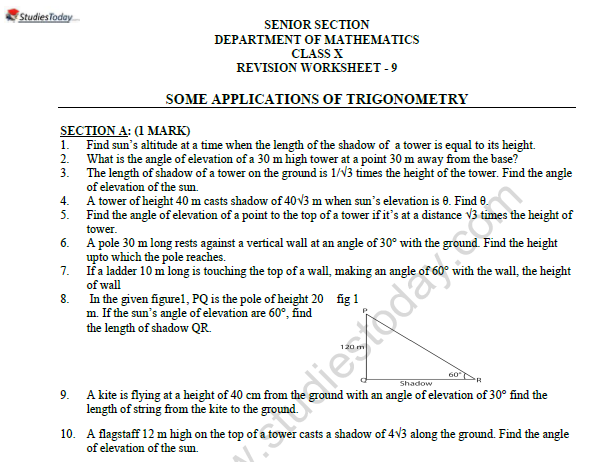
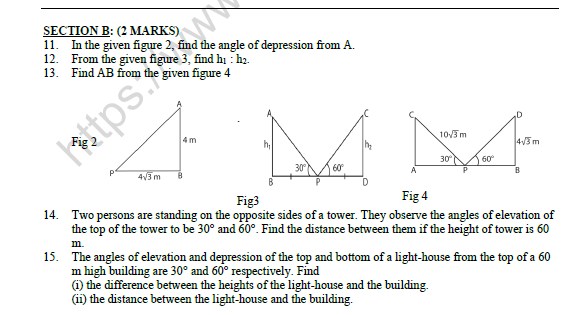
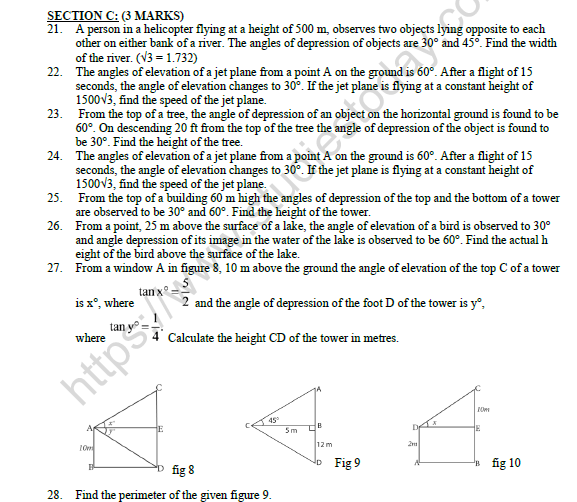
Please click on below link to download CBSE Class 10 Mathematics Application of Trignometry Worksheet Set C
Free study material for Mathematics
Chapter 9 Some Applications of Trigonometry CBSE Class 10 Mathematics Worksheet
Students can use the Chapter 9 Some Applications of Trigonometry practice sheet provided above to prepare for their upcoming school tests. This solved questions and answers follow the latest CBSE syllabus for Class 10 Mathematics. You can easily download the PDF format and solve these questions every day to improve your marks. Our expert teachers have made these from the most important topics that are always asked in your exams to help you get more marks in exams.
NCERT Based Questions and Solutions for Chapter 9 Some Applications of Trigonometry
Our expert team has used the official NCERT book for Class 10 Mathematics to create this practice material for students. After solving the questions our teachers have also suggested to study the NCERT solutions which will help you to understand the best way to solve problems in Mathematics. You can get all this study material for free on studiestoday.com.
Extra Practice for Mathematics
To get the best results in Class 10, students should try the Mathematics MCQ Test for this chapter. We have also provided printable assignments for Class 10 Mathematics on our website. Regular practice will help you feel more confident and get higher marks in CBSE examinations.
FAQs
You can download the teacher-verified PDF for CBSE Class 10 Mathematics Some Applications of Trigonometry Worksheet Set 03 from StudiesToday.com. These practice sheets for Class 10 Mathematics are designed as per the latest CBSE academic session.
Yes, our CBSE Class 10 Mathematics Some Applications of Trigonometry Worksheet Set 03 includes a variety of questions like Case-based studies, Assertion-Reasoning, and MCQs as per the 50% competency-based weightage in the latest curriculum for Class 10.
Yes, we have provided detailed solutions for CBSE Class 10 Mathematics Some Applications of Trigonometry Worksheet Set 03 to help Class 10 and follow the official CBSE marking scheme.
Daily practice with these Mathematics worksheets helps in identifying understanding gaps. It also improves question solving speed and ensures that Class 10 students get more marks in CBSE exams.
All our Class 10 Mathematics practice test papers and worksheets are available for free download in mobile-friendly PDF format. You can access CBSE Class 10 Mathematics Some Applications of Trigonometry Worksheet Set 03 without any registration.