

Read and download the CBSE Class 10 Arithmetic Progressions Sure Shot Questions Set 01. Designed for 2026-27, this advanced study material provides Class 10 Mathematics students with detailed revision notes, sure-shot questions, and detailed answers. Prepared by expert teachers and they follow the latest CBSE, NCERT, and KVS guidelines to ensure you get best scores.
Advanced Study Material for Class 10 Mathematics Chapter 5 Arithmetic Progression
To achieve a high score in Mathematics, students must go beyond standard textbooks. This Class 10 Chapter 5 Arithmetic Progression study material includes conceptual summaries and solved practice questions to improve you understanding.
Class 10 Mathematics Chapter 5 Arithmetic Progression Notes and Questions
CBSE Class 10 Arithmetic Progressions Sure Shot Questions Set A. There are many more useful educational material which the students can download in pdf format and use them for studies. Study material like concept maps, important and sure shot question banks, quick to learn flash cards, flow charts, mind maps, teacher notes, important formulas, past examinations question bank, important concepts taught by teachers. Students can download these useful educational material free and use them to get better marks in examinations. Also refer to other worksheets for the same chapter and other subjects too. Use them for better understanding of the subjects.
Q1. Determine the AP whose 3rd term is 5 and the 7th term is 9.
Q2. The 8th term of an AP is 37 and its 12th term is 57. Find the AP.
Q3. The 7th term of an AP is – 4 and its 13th term is – 16. Find the AP.
Q4. If the 10th term of an AP is 52 and the 17th term is 20 more than the 13th term, find the AP.
Q5. If the 8th term of an AP is 31 and its 15th term is 16 more than the 11th term, find the AP.
Q6. Check whether 51 is a term of the AP 5, 8, 11, 14, ……?
Q7. The 6th term of an AP is – 10 and its 10th term is – 26. Determine the 15th term of the AP.
Q8. The sum of 4th term and 8th term of an AP is 24 and the sum of 6th and 10th terms is 44. Find the AP.
Q9. The sum of 5th term and 9th term of an AP is 72 and the sum of 7th and 12th terms is 97. Find the AP.
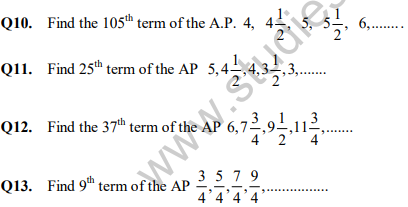
Q14. An AP consists of 50 terms of which 3rd term is 12 and the last term is 106. Find the 29th term.
Q15. Determine the AP whose third term is 16 and the 7th term exceeds the 5th term by 12.
Q16. The 17th term of an AP exceeds its 10th term by 7. Find the common difference.
Q17. If the nth term of an AP is (5n – 2), find its first term and common difference. Also find its 19th term.
Q18. If the nth term of an AP is (4n – 10), find its first term and common difference. Also find its 16th term.
Q19. If 2x, x + 10, 3x + 2 are in A.P., find the value of x.
Recap Notes
SEQUENCE
- Sequence is a list of numbers that follows a certain rule. Each of the numbers in the list is called a term. For example, 1, 9, 13, 18, 27, ... , it is a sequence where numbers are arranged in ascending order.
PROGRESSION
- The sequence, whose terms always follow a certain pattern is called progression.
ARITHMETIC PROGRESSION (A.P.)
- A progression is called an arithmetic progression if the difference between its any two consecutive terms is a fixed constant called common difference denoted by \(d\).
- i.e., Let \(a_1, a_2, a_3, a_4, ......., a_n\) be an arithmetic progression. Then, \(a_2 – a_1= a_3 – a_2 = a_4 – a_3 = .......... = a_n – a_{n – 1} = d\)
- Common difference can be negative, zero or positive.
- \(a, a + d, a + 2d, a + 3d, ...\) represents an arithmetic progression where \(a\) is the first term and \(d\) is the common difference. This is known as general form of an A.P.
- In general, for an A.P. \(a_1, a_2, a_3, ..., a_n\); \(d = a_{r + 1} – a_r\), where \(a_r\) and \(a_{r + 1}\) are the \(r^{th}\) and \((r + 1)^{th}\) term of the A.P. respectively. To find common difference (\(d\)) in a given A.P., we need not find all of \(a_2 – a_1, a_3 – a_2, ...\) we can find only one of them.
Note : (i) Any three numbers in A.P. can be taken as \(a – d, a, a + d\).
(ii) Any four numbers in A.P. can be taken as \(a – 3d, a – d, a + d, a + 3d\).
Types of A.P.
There are two types of A.P. as given below :
- (i) Finite A.P. : An arithmetic progression whose number of terms is finite is called finite A.P. For example, 900, 800, 700, ...., 100, it is a finite A.P.
- (ii) Infinite A.P. : An arithmetic progression whose number of terms is infinite (not countable) is called an infinite A.P. For example, 7, 10, 13, 16, ...., it is an infinite A.P.
GENERAL TERM OR \(n^{th}\) TERM OF AN A.P.
- Let \(a, a + d, a + 2d, .........\) represents an A.P. with first term \(a\) and common difference \(d\). The general term is denoted by \(a_n = a + (n – 1) d\), where \(n\) is a natural number.
- If the A.P. is finite i.e., if there are \(n\) terms in an A.P., then \(n^{th}\) term is known as last term of the A.P. and it is denoted by \(l\), so \(l = a + (n – 1)d\), where \(a\) is the first term and \(d\) is the common difference.
For example, \(15^{th}\) term of the A.P. 13, 9, 5, 1, –3, .... is \(a_{15} = 13 + (15 – 1)(–4)\), where \(a = 13\) and \(d = –4\) so, \(a_{15} = 13 – 4 \times 14 = –43\)
Note :
(i) \(n^{th}\) term from the end of the A. P. is \(a + (m – n) d\), where \(m\) is the total number of terms in the A.P.
(ii) \(n^{th}\) term from the end of A.P. is \(l – (n – 1)d\), where \(l\) is last term, \(d\) is common difference and \(n\) is number of terms.
SUM OF FIRST \(n\) TERMS OF AN A.P.
- For an A. P., \(a, a + d, a + 2d, ......\) sum of first \(n\) terms is denoted by \(S_n\) and defined by \(S_n = \frac{n}{2}[2a + (n – 1)d]\), where \(a\) is the first term and \(d\) is the common difference.
- It can also be written as \(S_n = \frac{n}{2}[a + l]\), where \(l\) is the last term given by \(l = a + (n – 1) d\).
For example, sum of first 20 terms of the A.P. : 3, 7, 11, 15, … is \(S_{20} = \frac{20}{2}(6 + (20 – 1) 4)\), where first term is 3 and common difference is 4.
\(\therefore S_{20} = 10(6 + 19 \times 4) = 10(82) = 820\)
Note : If \(S_n\) is the sum of first \(n\) terms of an A.P., then its \(n^{th}\) term, \(a_n\) is defined as \(a_n = S_n – S_{n – 1}\).
Multiple Choice Questions
Question. The common difference of the A.P. \(\frac{1}{3q}, \frac{1 - 6q}{3q}, \frac{1 - 12q}{3q}, ...... \) is
(a) \(q\)
(b) \(-q\)
(c) \(-2\)
(d) 2
Answer: (c)
Question. If \(k, 2k – 1\) and \(2k + 1\) are three consecutive terms of an A.P., then the value of \(k\) is
(a) 2
(b) 3
(c) –3
(d) 5
Answer: (b)
Question. The next term of the A.P. \(\sqrt{18}, \sqrt{50}, \sqrt{98} ...\) is
(a) \(\sqrt{146}\)
(b) \(\sqrt{128}\)
(c) \(\sqrt{162}\)
(d) \(\sqrt{200}\)
Answer: (c)
Question. The value of \(a_{30} – a_{20}\) for the A.P. 2, 7, 12, 17, ... is
(a) 100
(b) 10
(c) 50
(d) 20
Answer: (c)
Question. In an A.P., if \(a = -10, n = 6\) and \(a_n = 10\), then the value of \(d\) is
(a) 0
(b) 4
(c) \(-4\)
(d) 10/3
Answer: (b)
Question. If the sum of first \(m\) terms of an A.P. is \(2m^2 + 3m\), then what is its second term?
(a) 9
(b) 10
(c) 11
(d) 12
Answer: (a)
Question. If the sum of \(n\) terms of two A.P.s are in the ratio \((3n + 5) : (5n + 7)\), then their \(n^{th}\) terms are in the ratio
(a) \((3n – 1) : (5n – 1)\)
(b) \((3n + 1) : (5n – 1)\)
(c) \((3n + 1) : (5n + 1)\)
(d) \((5n + 1) : (3n + 1)\)
Answer: (a)
Question. If the \(10^{th}\) term of an A.P. is 52 and \(17^{th}\) term is 20 more than the \(13^{th}\) term, then find the A.P.
(a) 40, 45, 50,.....
(b) 45, 50, 55,.....
(c) 17, 22, 27,.....
(d) 7, 12, 17,.....
Answer: (d)
Question. Two persons Anil and Happy joined D.W. Associates. Anil and Happy started with an initial salary of ₹ 50000 and ₹ 64000 respectively with annual increment of ₹ 2500 and ₹ 2000 each respectively. In which year will Anil start earning more salary than Happy?
(a) \(28^{th}\)
(b) \(29^{th}\)
(c) \(30^{th}\)
(d) \(27^{th}\)
Answer: (b)
Question. The production of TV in a factory increases uniformly by a fixed number every year. It produced 8000 TV’s in \(6^{th}\) year & 11300 in \(9^{th}\) year, find the production in \(8^{th}\) year.
(a) 10500
(b) 9800
(c) 9700
(d) 10200
Answer: (d)
Question. The number of terms in the A.P. 3, 6, 9, 12,...., 111 is
(a) 25
(b) 40
(c) 37
(d) 30
Answer: (c)
Question. A man starts repaying a loan with first monthly installment of ₹ 1000. If he increases the installment by ₹ 50 every month, what amount will he pay in the \(30^{th}\) installment?
(a) ₹ 1450
(b) ₹ 2450
(c) ₹ 2050
(d) ₹ 2040
Answer: (b)
Question. The value of \(x\) for which \((8x + 4), (6x – 2)\) and \((2x + 7)\) are in A.P., is
(a) 15/2
(b) 2/15
(c) –15/2
(d) –2/15
Answer: (a)
Question. The numbers –11, – 7, – 3, 1, 5, ...... are
(a) in A.P. with \(d = -18\)
(b) in A.P. with \(d = -4\)
(c) in A.P. with \(d = 4\)
(d) not in A.P.
Answer: (c)
Question. Which term of the A.P. 3, 15, 27, 39, ...... will be 252 more than its \(44^{th}\) term?
(a) \(66^{th}\)
(b) \(64^{th}\)
(c) \(65^{th}\)
(d) \(67^{th}\)
Answer: (c)
Question. If \(p^{th}\) term of an A.P. is \(\frac{3p - 1}{6}\), then sum of first \(n\) terms of the A.P. is
(a) \(\frac{n}{12} [3n + 1]\)
(b) \(\frac{n}{12} [3n - 1]\)
(c) \(\frac{n}{6} [3n + 1]\)
(d) \(\frac{n}{6} [3n - 1]\)
Answer: (a)
Question. The common difference of the A.P. \(\frac{1}{p}, \frac{1 - p}{p}, \frac{1 - 2p}{p}, ..... \) is
(a) \(p\)
(b) \(-p\)
(c) –1
(d) 1
Answer: (c)
Question. For what value of \(n\), are the \(n^{th}\) terms of two A.P.’s 52, 54, 56, ..... and 4, 12, 20, ..... equal ?
(a) 11
(b) 12
(c) 10
(d) 9
Answer: (d)
Question. Find the sum of all two digit natural numbers which when divided by 3 yield 1 as remainder.
(a) 1605
(b) 1780
(c) 1080
(d) 1960
Answer: (a)
Question. The famous mathematician associated with finding the sum of the first 100 natural numbers is
(a) Pythagoras
(b) Newton
(c) Gauss
(d) Euclid
Answer: (c)
Question. If the common difference of an A.P. is 5, then what is \(a_{18} – a_{13}\) ?
(a) 5
(b) 20
(c) 25
(d) 30
Answer: (c)
Question. What is the common difference of four terms in an A.P. such that the ratio of the product of the first and fourth terms to that of the second and third is 2 : 3 and the sum of all four terms is 20?
(a) 3
(b) 1
(c) 4
(d) 2
Answer: (d)
Question. If the seventh term of an A.P. is 1/9 and its ninth term is 1/7, find common difference.
(a) 1
(b) 2/63
(c) 3/64
(d) 1/63
Answer: (d)
Question. The sum \((– 6) + (0) + (6) + ..... \) upto \(13^{th}\) term =
(a) 390
(b) 1380
(c) 378
(d) 1830
Answer: (a)
Question. If \(a, (a – 2)\) and \(3a\) are in A.P., then the value of \(a\) is
(a) – 3
(b) – 2
(c) 3
(d) 2
Answer: (a)
Question. If \(m^{th}\) term of an A.P. is \(1/n\) and \(n^{th}\) term is \(1/m\), then the sum of first \(mn\) terms is
(a) \(mn + 1\)
(b) \(\frac{mn + 1}{2}\)
(c) \(\frac{mn - 1}{2}\)
(d) \(\frac{mn - 1}{3}\)
Answer: (b)
Question. If 9 times the \(9^{th}\) term in an arithmetic progression is equal to 15 times of its \(15^{th}\) term, then what is the \(24^{th}\) term?
(a) 0
(b) 9
(c) 15
(d) 23
Answer: (a)
Question. If \(x \neq y\) and the sequences \(x, a_1, a_2, y\) and \(x, b_1, b_2, y\) each are in A.P., then \(\frac{a_2 - a_1}{b_2 - b_1}\) is
(a) 2/3
(b) 3/2
(c) 1
(d) 3/4
Answer: (c)
Question. If the sum of 7 terms of an A.P. is 49 and that of 17 terms is 289, then, its first term is
(a) 1
(b) – 1
(c) 2
(d) –2
Answer: (a)
Question. Find how many terms are there in the A.P. 16, 24, 32, ......, 96.
(a) 10
(b) 11
(c) 12
(d) 14
Answer: (b)
Question. If the first, second and last terms of an A.P. are \(a, b\) and \(2a\) respectively, its sum is
(a) \(\frac{ab}{2(b - a)}\)
(b) \(\frac{ab}{b - a}\)
(c) \(\frac{3ab}{2(b - a)}\)
(d) None of these
Answer: (c)
Question. Find the sum of first 15 multiples of 8.
(a) 840
(b) 1020
(c) 960
(d) 920
Answer: (c)
Question. Find the sum of first 10 terms of the A.P. \(x – 8, x – 2, x + 4, …\)
(a) \(10x + 210\)
(b) \(10x + 190\)
(c) \(5x + 190\)
(d) \(5x + 210\)
Answer: (b)
Question. In an A.P., the sum of first \(n\) terms is \(\frac{3}{2}n^2 + \frac{13}{2}n\). Find its \(15^{th}\) term.
(a) 45
(b) 50
(c) 60
(d) 75
Answer: (b)
Question. Three numbers in an A.P. have sum 18. Its middle term is
(a) 6
(b) 8
(c) 3
(d) 2
Answer: (a)
Question. Find the sixteenth term of the A.P. –10, –6, –2, 2,...
(a) 10
(b) 20
(c) 40
(d) 50
Answer: (d)
Question. \(\frac{3}{\sqrt{5}} + \sqrt{5} + \frac{7}{\sqrt{5}} + ...\) to 15 terms is equal to
(a) \(51\sqrt{5}\)
(b) \(17\sqrt{5}\)
(c) \(81\sqrt{5}\)
(d) \(9\sqrt{5}\)
Answer: (a)
Question. Which of the following is not an A.P. ?
(a) \(-3, \frac{-5}{2}, -2, \frac{-3}{2},......\)
(b) 0.3, 0.33, 0.333, ......
(c) \(\sqrt{3}, \sqrt{12}, \sqrt{27}, \sqrt{48}, .....\)
(d) \(p, 2p + 1, 3p + 2, 4p + 3, .....\)
Answer: (b)
Free study material for Mathematics
CBSE Class 10 Mathematics Chapter 5 Arithmetic Progression Study Material
Students can find all the important study material for Chapter 5 Arithmetic Progression on this page. This collection includes detailed notes, Mind Maps for quick revision, and Sure Shot Questions that will come in your CBSE exams. This material has been strictly prepared on the latest 2026 syllabus for Class 10 Mathematics. Our expert teachers always suggest you to use these tools daily to make your learning easier and faster.
Chapter 5 Arithmetic Progression Expert Notes & Solved Exam Questions
Our teachers have used the latest official NCERT book for Class 10 Mathematics to prepare these study material. We have included previous year examination questions and also step-by-step solutions to help you understand the marking scheme too. After reading the above chapter notes and solved questions also solve the practice problems and then compare your work with our NCERT solutions for Class 10 Mathematics.
Complete Revision for Mathematics
To get the best marks in your Class 10 exams you should use Mathematics Sample Papers along with these chapter notes. Daily practicing with our online MCQ Tests for Chapter 5 Arithmetic Progression will also help you improve your speed and accuracy. All the study material provided on studiestoday.com is free and updated regularly to help Class 10 students stay ahead in their studies and feel confident during their school tests.
FAQs
Our advanced study package for Chapter 5 Arithmetic Progression includes detailed concepts, diagrams, Mind Maps, and explanation of complex topics to ensure Class 10 students learn as per syllabus for 2026 exams.
The Mind Maps provided for Chapter 5 Arithmetic Progression act as visual anchors which will help faster recall during high-pressure exams.
Yes, teachers use our Class 10 Mathematics resources for lesson planning as they are in simple language and have lot of solved examples.
Yes, You can download the complete, mobile-friendly PDF of the Mathematics Chapter 5 Arithmetic Progression advanced resources for free.
Yes, our subject matter experts have updated the Chapter 5 Arithmetic Progression material to align with the rationalized NCERT textbooks and have removed deleted topics and added new competency-based questions.