

Access the latest CBSE Class 10 Mathematics Real Numbers Worksheet Set 04. We have provided free printable Class 10 Mathematics worksheets in PDF format, specifically designed for Chapter 1 Real Numbers. These practice sets are prepared by expert teachers following the 2025-26 syllabus and exam patterns issued by CBSE, NCERT, and KVS.
Chapter 1 Real Numbers Mathematics Practice Worksheet for Class 10
Students should use these Class 10 Mathematics chapter-wise worksheets for daily practice to improve their conceptual understanding. This detailed test papers include important questions and solutions for Chapter 1 Real Numbers, to help you prepare for school tests and final examination. Regular practice of these Class 10 Mathematics questions will help improve your problem-solving speed and exam accuracy for the 2026 session.
Download Class 10 Mathematics Chapter 1 Real Numbers Worksheet PDF
Basic Concepts
- Fundamental theorem of Arithmetic: Every composite number can be expressed (factorised) as a product of primes, and this factorisation is unique apart from the order in which the prime factors occur.
- If \( x \) is a positive prime, then \( \sqrt{x} \) is an irrational number.
For example, 7 is a positive prime
\( \implies \) \( \sqrt{7} \) is an irrational number.
Some Important Facts/Tips:
(i) If ‘p’ is a prime and \( p \) divides \( a^2 \), then \( p \) divides ‘a’ also, where \( a \) is positive integer.
For example: 3 divides 36 i.e., \( 6^2 \)
\( \implies \) 3 divides 6.
(ii) For any two positive integers \( a \) and \( b \); \( HCF (a, b) \times LCM (a, b) = a \times b \)
For example: \( a = 6, b = 4 \)
\( LCM of (6, 4) = 12 \)
\( HCF of (6, 4) = 2 \)
\( LCM (6, 4) \times HCF (6, 4) = 6 \times 4 \)
\( 12 \times 2 = 6 \times 4 = 24 \)
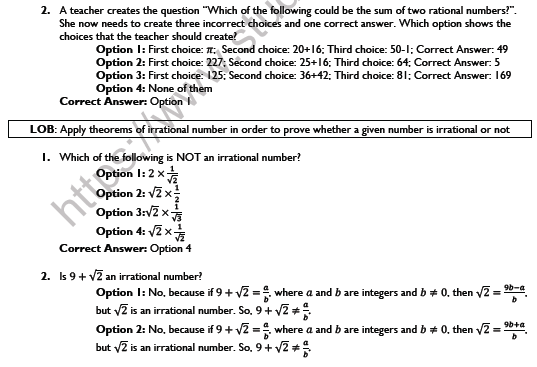
(iii) The sum or difference of a rational and an irrational number is irrational.
(iv) The product and quotient of a non-zero rational number and an irrational number is irrational.
Question. An army contingent of 616 members is to march behind an army band of 32 members in a parade. The two groups are to march in the same number of columns. What is the maximum number of columns in which they can march?
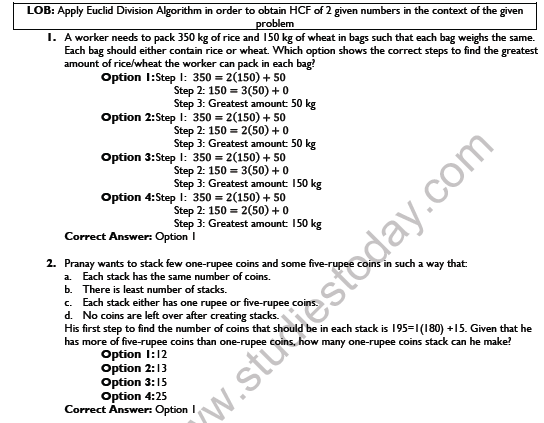
Answer: For the maximum number of columns, we have to find the HCF of 616 and 32.
\( 616 = 2 \times 2 \times 2 \times 7 \times 11 \)
\( = 2^3 \times 7 \times 11 \)
\( 32 = 2 \times 2 \times 2 \times 2 \times 2 \)
\( = 2^3 \times 2^2 \)
HCF of 616, 32 \( = 2^3 = 8 \)
Hence, maximum number of columns is 8.
Question. Check whether \( 6^n \) can end with the digit 0 for any natural number \( n \).
Answer: If the number \( 6^n \), for any \( n \), were to end with the digit zero, then it would be divisible by 5. That is, the prime factorisation of \( 6^n \) would contain the prime 5. But \( 6^n = (2 \times 3)^n = 2^n \times 3^n \) so the primes in factorisation of \( 6^n \) are 2 and 3. So the uniqueness of the Fundamental Theorem of Arithmetic guarantees that there are no other primes except 2 and 3 in the factorisation of \( 6^n \). So there is no natural number \( n \) for which \( 6^n \) ends with digit zero.
Question. Explain why \( 7 \times 11 \times 13 + 13 \) and \( 7 \times 6 \times 5 \times 4 \times 3 \times 2 \times 1 + 5 \) are composite numbers?
Answer: We have, \( 7 \times 11 \times 13 + 13 = 1001 + 13 = 1014 \)
\( 1014 = 2 \times 3 \times 13 \times 13 \)
So, it is the product of more than two prime numbers. 2, 3 and 13.
Hence, it is a composite number.
\( 7 \times 6 \times 5 \times 4 \times 3 \times 2 \times 1 + 5 = 5040 + 5 = 5045 \)
\( \implies \) \( 5045 = 5 \times 1009 \)
It is the product of prime factor 5 and 1009.
Hence, it is a composite number.
Question. There is a circular path around a sports field. Sonia takes 18 minutes to drive one round of the field, while Ravi takes 12 minutes for the same. Suppose they both start from the same point and at the same time, and go in the same direction. After how many minutes will they meet again at the starting point?
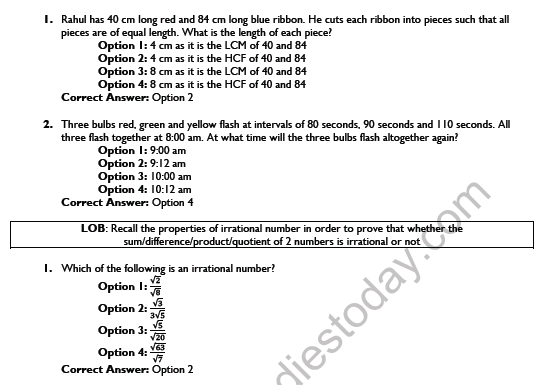
Answer: To find the time after which they meet again at the starting point, we have to find LCM of 18 and 12 minutes. We have
\( 18 = 2 \times 3^2 \)
and \( 12 = 2^2 \times 3 \)
Therefore, LCM of 18 and 12 \( = 2^2 \times 3^2 = 36 \)
So, they will meet again at the starting point after 36 minutes.
Question. Show that \( 5 - \sqrt{3} \) is irrational.
Answer: Let us assume, to the contrary, that \( 5 - \sqrt{3} \) is rational.
That is, we can find coprime \( a \) and \( b \) (\( b \neq 0 \)) such that \( 5 - \sqrt{3} = \frac{a}{b} \).
Therefore, \( 5 - \frac{a}{b} = \sqrt{3} \).
Rearranging this equation, we get \( \sqrt{3} = 5 - \frac{a}{b} = \frac{5b - a}{b} \).
Since \( a \) and \( b \) are integers, we get \( \frac{5b - a}{b} \) is rational, and so \( \sqrt{3} \) is rational.
But this contradicts the fact that \( \sqrt{3} \) is irrational.
This contradiction has arisen because of our incorrect assumption that \( 5 - \sqrt{3} \) is rational.
So, we conclude that \( 5 - \sqrt{3} \) is irrational.
Question. Prove that \( 3 + 2\sqrt{5} \) is an irrational number.
Answer: Let \( 3 + 2\sqrt{5} \) is a rational number.
\( \implies \) \( 3 + 2\sqrt{5} = \frac{p}{q} \), where \( p, q \) are integers and \( q \neq 0 \)
\( \implies \) \( 2\sqrt{5} = \frac{p}{q} - 3 \)
\( \implies \) \( 2\sqrt{5} = \frac{p - 3q}{q} \)
\( \implies \) \( \sqrt{5} = \frac{p - 3q}{2q} \) ...(i)
Since, \( p, q, 2 \) and \( -3 \) are integers, \( p, -3q, 2q \) are also integers.
Also, \( 2 \neq 0, q \neq 0 \implies 2q \neq 0 \)
[\(\because\) Product of two non-zero numbers can never be zero]
Therefore, RHS of (i) is rational number and LHS \( = \sqrt{5} \) is an irrational number.
But this is not possible.
So, our assumption is wrong.
Hence, \( 3 + 2\sqrt{5} \) is irrational number.
Question. Prove that \( 7\sqrt{5} \) is an irrational number.
Answer: Let \( 7\sqrt{5} \) be a rational number.
\( \implies \) \( 7\sqrt{5} = \frac{p}{q} \), where \( p, q \) are integers and \( q \neq 0 \)
\( \implies \) \( \sqrt{5} = \frac{p}{7q} \) ...(i)
\(\because\) \( p, 7, q \) are integers \( \implies \) \( p, 7q \) are integers
Also \( 7 \neq 0, q \neq 0, \implies 7q \neq 0 \)
Therefore RHS of (i) is rational number but LHS \( = \sqrt{5} \) is irrational, which is contradiction.
Hence, \( 7\sqrt{5} \) is an irrational number.
Question. Prove that \( 6 + \sqrt{2} \) is an irrational number.
Answer: Let \( 6 + \sqrt{2} \) be a rational number.
\( \implies \) \( 6 + \sqrt{2} = \frac{p}{q} \), where \( p, q \) are integers and \( q \neq 0 \).
\( \implies \) \( \sqrt{2} = \frac{p}{q} - 6 \)
\( \implies \) \( \sqrt{2} = \frac{p - 6q}{q} \) ...(i)
\(\because\) \( p, q, -6 \) are integers \( \implies \) \( p - 6q, q \) are integers.
Also, \( q \neq 0 \)
Therefore, RHS of (i) is rational number but LHS \( = \sqrt{2} \) is irrational, which is contradiction.
Hence, \( 6 + \sqrt{2} \) is irrational.
Multiple Choice Questions
Question. \( n^2 - 1 \) is divisible by 8 if \( n \) is
(a) an integer
(b) a natural number
(c) an odd integer
(d) an even integer
Answer: (c) an odd integer
Question. The product of three consecutive integers is divisible by
(a) 5
(b) 6
(c) 7
(d) None of the options
Answer: (b) 6
Question. The largest number which divides 615 and 963 leaving remainder 6 in each case is
(a) 82
(b) 95
(c) 87
(d) 93
Answer: (c) 87
Question. The largest number which divides 70 and 125 leaving remainders 5 and 8 respectively is
(a) 13
(b) 65
(c) 875
(d) 1750
Answer: (a) 13
Question. If two positive integers \( a \) and \( b \) are written as \( a = x^3 y^2 \) and \( b = x y^3 \); \( x, y \) are prime numbers, then LCM (\( a, b \)) is
(a) \( xy \)
(b) \( xy^2 \)
(c) \( x^3 y^3 \)
(d) \( x^2 y^2 \)
Answer: (c) \( x^3 y^3 \)
Question. If HCF (26, 169) = 13 then LCM (26, 169) is
(a) 26
(b) 52
(c) 338
(d) 13
Answer: (c) 338
Question. The HCF and the LCM of 12, 21, 15 respectively are
(a) 3, 140
(b) 12, 420
(c) 3, 420
(d) 420, 3
Answer: (c) 3, 420
Question. The product of two irrational numbers is
(a) always irrational
(b) always rational
(c) rational or irrational
(d) one
Answer: (c) rational or irrational
Question. \( 3.\overline{27} \) is
(a) an integer
(b) a rational number
(c) a natural number
(d) an irrational number
Answer: (b) a rational number
Question. If 3 is the least prime factor of number \( a \) and 7 is the least prime factor of number \( b \), then the least prime factor of (\( a + b \)) is
(a) 2
(b) 3
(c) 5
(d) 10
Answer: (a) 2
Question. Which of these is a RATIONAL number?
(a) \( 3\pi \)
(b) \( 5\sqrt{5} \)
(c) 0.346666...
(d) 0.345210651372849...
Answer: (c) 0.346666...
Question. Which of these numbers can be expressed as a product of two or more prime numbers?
(i) 15
(ii) 34568
(iii) (\( 15 \times 13 \))
(a) only (ii)
(b) only (iii)
(c) only (i) and (ii)
(d) all-(i), (ii) and (iii)
Answer: (d) all-(i), (ii) and (iii)
Question. A number of the form \( 8^n \), where \( n \) is a natural number greater than 1, cannot be divisible by
(a) 1
(b) 40
(c) 64
(d) \( 2^{2n} \)
Answer: (b) 40
Question. 1245 is a factor of the numbers \( p \) and \( q \). Which of the following will always have 1245 as a factor?
(i) \( p + q \)
(ii) \( p \times q \)
(iii) \( p \div q \)
[Competency Based Question]
(a) only (ii)
(b) only (i) and (ii)
(c) only (ii) and (iii)
(d) all-(i), (ii) and (iii)
Answer: (b) only (i) and (ii)
Very Short Answer Questions
Question. What is the HCF of the smallest composite number and the smallest prime number?
Answer: Smallest prime \( = 2 \)
Smallest composite \( = 4 \)
HCF (2, 4) \( = 2 \)
The HCF of the smallest prime and smallest composite is 2.
Question. If HCF (336, 54) = 6. Find LCM (336, 54).
Answer: \( \text{LCM } (336, 54) = \frac{336 \times 54}{6} \)
\( = 336 \times 9 = 3024 \)
Question. If a is an odd number, b is not divisible by 3 and LCM of a and b is P, what is the LCM of 3a and 2b?
Answer: \(\because\) \( a \) is odd
\( \implies \) factors of \( a \) can be : \( 1, 3, 5, 7 \) ...(i)
\( b \) is not divisible by 3
\( \implies \) factors of \( b \) can be : \( 1, 2, 4, 5, 7 \) ...(ii)
\( \text{LCM } (a, b) = P \) [Given]
Factors of \( 3a = 3(1, 3, 5, 7, ...) \) [From (i)]
Factors of \( 2b = 2(1, 2, 4, 5, 7, ...) \) [From (ii)]
\( \text{LCM } (3a \text{ and } 2b) = 3 \times 2 \times \text{LCM } (a, b) = 6P \)
Question. Two positive integers \( p \) and \( q \) can be expressed as \( p = a^2b^3 \) and \( q = a^3b \), \( a \) and \( b \) are prime numbers. What is the LCM of \( p \) and \( q \)?
Answer: \( \text{LCM } (p, q) = a^3b^3 \) [Highest power of the variables]
Short Answer Questions-I
Each of the following questions are of 2 marks.
Question. Explain whether \( 3 \times 12 \times 101 + 4 \) is prime number or a composite number.
Answer: We have,
\( 3 \times 12 \times 101 + 4 = 4(3 \times 3 \times 101 + 1) \)
\( = 4(909 + 1) \)
\( = 4(910) \)
\( = 2 \times 2 \times 2 \times 5 \times 7 \times 13 \) is a composite number (\(\because\) Product of more than two prime factors)
Question. Check whether \( 12^n \) can end with the digit 0 for any natural number n.
Answer: Prime factors of 12 are \( 2 \times 2 \times 3 \).
Since 5 is not a factor, so \( 12^n \) can not end with 0.
Question. Find the HCF of 612 and 1314 using prime factorisation.
Answer: \( 612 = 2 \times 2 \times 3 \times 3 \times 17 \)
\( 1314 = 2 \times 3 \times 3 \times 73 \)
\( \text{HCF } = 2 \times 3 \times 3 = 18 \)
Question. Given that \( \sqrt{2} \) is irrational, prove that \( (5 + 3\sqrt{2}) \) is an irrational number.
Answer: Given: \( \sqrt{2} \) is irrational
To prove: \( 5 + 3\sqrt{2} \) is irrational.
Proof: Let us assume \( 5 + 3\sqrt{2} \) is rational. So it is in form \( a/b \). \( [a, b \in \mathbb{Z}, b \neq 0, \text{HCF}(a, b)=1] \)
\( \implies 5 + 3\sqrt{2} = \frac{a}{b} \)
\( 3\sqrt{2} = \frac{a}{b} - 5 \)
\( 3\sqrt{2} = \frac{a - 5b}{b} \)
\( \sqrt{2} = \frac{a - 5b}{3b} \)
This shows that \( \sqrt{2} \) is rational (\(\because a - 5b\) and \( 3b \) are integers).
But we know that \( \sqrt{2} \) is irrational.
This contradicts our assumption that \( 5 + 3\sqrt{2} \) is rational.
\( \implies 5 + 3\sqrt{2} \) is irrational, hence proved.
Question. Find the smallest natural number by which 1200 should be multiplied so that the square root of the product is a rational number.
Answer: We have, \( 1200 = 4 \times 3 \times 10 \times 10 \)
\( = 4 \times 3 \times 2 \times 5 \times 2 \times 5 = 4 \times 3 \times (2 \times 5)^2 \)
\( = 2^2 \times 3 \times 2^2 \times 5^2 = 2^4 \times 3 \times 5^2 \)
Hence, the required smallest natural number is 3.
Question. Find the value of x, y and z in the given factor tree. Can the value of 'x' be found without finding the value of 'y' and 'z'? If yes, explain.
Answer: \( z = 2 \times 17 = 34 \); \( y = 34 \times 2 = 68 \)
and \( x = 2 \times 68 = 136 \)
Yes, value of x can be found without finding value of y or z as
\( x = 2 \times 2 \times 2 \times 17 \) which are prime factors of x.
Short Answer Questions-II
Each of the following questions are of 3 marks.
Question. Write the smallest number which is divisible by both 306 and 657.
Answer: Here, to find the required smallest number we will find LCM of 306 and 657.
\( 306 = 2 \times 3^2 \times 17 \)
\( 657 = 3^2 \times 73 \)
\( \text{LCM } = 2 \times 3^2 \times 17 \times 73 = 22338 \)
Question. Express the number \( 0.31\overline{78} \) in the form of rational number \( \frac{a}{b} \).
Answer: Let \( x = 0.31\overline{78} \)
Then \( x = 0.31787878... \) ...(i)
\( 100x = 31.787878... \) ...(ii)
\( 10000x = 3178.7878... \) ...(iii)
On subtracting (ii) from (iii), we get
\( 9900x = 3147 \)
\( \implies x = \frac{3147}{9900} = \frac{1049}{3300} \)
Note: The source image solution shows \( 9990x = 3175 \implies x = \frac{3175}{9990} = \frac{635}{1998} \). Verbatim transcription of the Topper's logic:
Let \( x = 0.31\overline{78} \)
Then \( x = 0.3178178178... \) ...(i)
\( 10x = 3.178178178... \) ...(ii)
\( 10000x = 3178.178178... \) ...(iii)
On subtracting (ii) from (iii), we get
\( 9990x = 3175 \)
\( \implies x = \frac{3175}{9990} = \frac{635}{1998} \)
\( \therefore 0.31\overline{78} = \frac{635}{1998} \)
Question. Find HCF and LCM of 404 and 96 and verify that HCF \(\times\) LCM = Product of the two given numbers.
Answer: Numbers: 404, 96. To find: HCF and LCM.
\( 404 = 2^2 \times 101 \)
\( 96 = 2^5 \times 3 \)
\( \text{HCF } = \text{greatest common factor} = 2^2 = 4. \)
\( \text{LCM } = 2^5 \times 3 \times 101 = 9696. \)
Product of two numbers \( = 96 \times 404 = 38784 \)
Product of \( \text{HCF } \times \text{LCM } = 9696 \times 4 = 38784. \)
Hence, \( \text{HCF } \times \text{LCM } = \text{product of two numbers} \).
Question. Find the largest number which on dividing 1251, 9377 and 15628 leaves remainders 1, 2 and 3 respectively.
Answer: \( 1251 - 1 = 1250, 9377 - 2 = 9375, 15628 - 3 = 15625 \)
Required largest number \( = \text{HCF } (1250, 9375, 15625) \)
\( 1250 = 2 \times 5^4 \)
\( 9375 = 3 \times 5^5 \)
\( 15625 = 5^6 \)
\( \therefore \text{HCF } (1250, 9375, 15625) = 5^4 = 625 \)
Long Answer Questions
Each of the following questions are of 5 marks.
Question. Prove that \( (\sqrt{2} + \sqrt{5}) \) is irrational.
Answer: On the contrary, let \( \sqrt{2} + \sqrt{5} \) is rational, i.e., \( \sqrt{2} + \sqrt{5} = \frac{a}{b} \), where \( a \) and \( b \) are co-prime and \( b \neq 0 \).
\( \implies \sqrt{5} = \frac{a}{b} - \sqrt{2} \)
Squaring both sides, we have
\( 5 = \left(\frac{a}{b} - \sqrt{2}\right)^2 \)
\( \implies 5 = \frac{a^2}{b^2} - 2\sqrt{2}\frac{a}{b} + 2 \)
\( \implies 2\sqrt{2}\frac{a}{b} = \frac{a^2}{b^2} - 3 \)
\( \implies \sqrt{2} = \left(\frac{a^2 - 3b^2}{b^2}\right) \times \frac{b}{2a} = \frac{a^2 - 3b^2}{2ab} \)
\( \implies \sqrt{2} = \frac{-3b}{2a} + \frac{a}{2b} \)
Irrational = Rational, which is not possible as Irrational \(\neq\) Rational.
This contradicts our assumption.
Thus, \( \sqrt{2} + \sqrt{5} \) is an irrational number. Proved
Question. Prove that \( \sqrt{3} \) is an irrational number.
Answer: Let us assume, if possible, that \( \sqrt{3} \) is rational.
Then, \( \sqrt{3} \) can be expressed as \( \frac{p}{q} \) where \( q \neq 0 \) and \( p, q \) are co-primes [\( \text{HCF}(p, q) = 1 \)]
\( \therefore \sqrt{3} = \frac{p}{q} \) [\( p, q \in \mathbb{Z} ; \text{HCF}(p, q) = 1 \)]
on squaring both sides,
\( 3 = \frac{p^2}{q^2} \)
\( \implies p^2 = 3q^2 \) ---(1)
\( 3 \text{ divides } p^2 \)
\( \therefore 3 \text{ divides } p. \)
Then, \( p \) can be written as;
\( p = 3a \) for some integer 'a'
on squaring,
\( p^2 = 9a^2 \)
Put \( p^2 = 3q^2 \) from (1)
\( \implies 3q^2 = 9a^2 \)
\( \implies q^2 = 3a^2. \)
\( 3 \text{ divides } q^2 \)
\( \therefore 3 \text{ divides } q. \)
\( \because 3 \text{ divides both } p \text{ and } q, 3 \text{ is a common factor of } p \text{ and } q. \)
But, \( p \) and \( q \) are co-primes.
Therefore, our assumption is wrong.
\( \therefore \sqrt{3} \text{ is irrational.} \)
Question. Show that there is no positive integer n for which \( \sqrt{n-1} + \sqrt{n+1} \) is rational.
Answer: Let there be a positive integer \( n \) for which \( \sqrt{n-1} + \sqrt{n+1} \) be a rational number.
\( \sqrt{n-1} + \sqrt{n+1} = \frac{p}{q} \); where \( p, q \) are integers and \( q \neq 0 \) ...(i)
\( \implies \frac{1}{\sqrt{n-1} + \sqrt{n+1}} = \frac{q}{p} \)
\( \implies \frac{\sqrt{n-1} - \sqrt{n+1}}{(\sqrt{n-1} + \sqrt{n+1})(\sqrt{n-1} - \sqrt{n+1})} = \frac{q}{p} \)
\( \implies \frac{\sqrt{n-1} - \sqrt{n+1}}{(n-1) - (n+1)} = \frac{q}{p} \)
\( \implies \frac{\sqrt{n-1} - \sqrt{n+1}}{n - 1 - n - 1} = \frac{q}{p} \)
\( \implies \frac{\sqrt{n-1} - \sqrt{n+1}}{-2} = \frac{q}{p} \)
\( \implies \sqrt{n+1} - \sqrt{n-1} = \frac{2q}{p} \) ...(ii)
Adding (i) and (ii), we get
\( \sqrt{n+1} + \sqrt{n-1} + \sqrt{n+1} - \sqrt{n-1} = \frac{p}{q} + \frac{2q}{p} \)
\( \implies 2\sqrt{n+1} = \frac{p^2 + 2q^2}{pq} \)
\( \implies \sqrt{n+1} = \frac{p^2 + 2q^2}{2pq} \)
\( \implies \sqrt{n+1} \) is rational number as \( \frac{p^2 + 2q^2}{2pq} \) is rational.
\( \implies n+1 \) is perfect square of positive integer. ...(A)
Again subtracting (ii) from (i), we get
\( \sqrt{n-1} + \sqrt{n+1} - \sqrt{n+1} + \sqrt{n-1} = \frac{p}{q} - \frac{2q}{p} \)
\( \implies 2\sqrt{n-1} = \frac{p^2 - 2q^2}{pq} \)
\( \implies \sqrt{n-1} \) is rational number as \( \frac{p^2 - 2q^2}{2pq} \) is rational.
\( \implies n-1 \) is also perfect square of positive integer. ...(B)
From (A) and (B)
\( \sqrt{n+1} \) and \( \sqrt{n-1} \) are perfect squares of positive integer. It contradict the fact that two perfect squares differ at least by 3.
Hence, there is no positive integer \( n \) for which \( \sqrt{n-1} + \sqrt{n+1} \) is rational.
Question. Let \( a, b, c, k \) be rational numbers such that k is not a perfect cube. If \( a + bk^{1/3} + ck^{2/3} = 0 \) then prove that \( a = b = c = 0 \).
Answer: Given, \( a + bk^{1/3} + ck^{2/3} = 0 \) ...(i)
Multiplying both sides by \( k^{1/3} \), we have
\( ak^{1/3} + bk^{2/3} + ck = 0 \) ...(ii)
Multiplying (i) by \( b \) and (ii) by \( c \) and then subtracting, we have
\( (ab + b^2k^{1/3} + bck^{2/3}) - (ack^{1/3} + bck^{2/3} + c^2k) = 0 \)
\( \implies (b^2 - ac)k^{1/3} + ab - c^2k = 0 \)
\( \implies b^2 - ac = 0 \) and \( ab - c^2k = 0 \) [Since \( k^{1/3} \) is irrational]
\( \implies b^2 = ac \) and \( ab = c^2k \)
\( \implies b^2 = ac \) and \( a^2b^2 = c^4k^2 \) [By putting \( b^2 = ac \) in \( a^2b^2 = c^4k^2 \)]
\( \implies a^2(ac) = c^4k^2 \)
\( \implies a^3c - k^2c^4 = 0 \)
\( \implies (a^3 - k^2c^3)c = 0 \)
\( \implies a^3 - k^2c^3 = 0 \) or \( c = 0 \)
Now, if \( a^3 - k^2c^3 = 0 \)
\( \implies k^2 = \frac{a^3}{c^3} \implies (k^2)^{1/3} = \left(\frac{a^3}{c^3}\right)^{1/3} \)
\( \implies k^{2/3} = \frac{a}{c} \)
This is impossible as \( k^{2/3} \) is irrational and \( \frac{a}{c} \) is rational.
\( \therefore a^3 - k^2c^3 \neq 0 \)
From other condition \( c = 0 \).
Substituting \( c = 0 \) in \( b^2 - ac = 0 \), we get \( b = 0 \)
Substituting \( b = 0 \) and \( c = 0 \) in \( a + bk^{1/3} + ck^{2/3} = 0 \), we get \( a = 0 \)
Hence, \( a = b = c = 0 \)
Please click on below link to download CBSE Class 10 Mathematics Real Numbers Worksheet Set D
Free study material for Mathematics
Chapter 1 Real Numbers CBSE Class 10 Mathematics Worksheet
Students can use the Chapter 1 Real Numbers practice sheet provided above to prepare for their upcoming school tests. This solved questions and answers follow the latest CBSE syllabus for Class 10 Mathematics. You can easily download the PDF format and solve these questions every day to improve your marks. Our expert teachers have made these from the most important topics that are always asked in your exams to help you get more marks in exams.
NCERT Based Questions and Solutions for Chapter 1 Real Numbers
Our expert team has used the official NCERT book for Class 10 Mathematics to create this practice material for students. After solving the questions our teachers have also suggested to study the NCERT solutions which will help you to understand the best way to solve problems in Mathematics. You can get all this study material for free on studiestoday.com.
Extra Practice for Mathematics
To get the best results in Class 10, students should try the Mathematics MCQ Test for this chapter. We have also provided printable assignments for Class 10 Mathematics on our website. Regular practice will help you feel more confident and get higher marks in CBSE examinations.
FAQs
You can download the teacher-verified PDF for CBSE Class 10 Mathematics Real Numbers Worksheet Set 04 from StudiesToday.com. These practice sheets for Class 10 Mathematics are designed as per the latest CBSE academic session.
Yes, our CBSE Class 10 Mathematics Real Numbers Worksheet Set 04 includes a variety of questions like Case-based studies, Assertion-Reasoning, and MCQs as per the 50% competency-based weightage in the latest curriculum for Class 10.
Yes, we have provided detailed solutions for CBSE Class 10 Mathematics Real Numbers Worksheet Set 04 to help Class 10 and follow the official CBSE marking scheme.
Daily practice with these Mathematics worksheets helps in identifying understanding gaps. It also improves question solving speed and ensures that Class 10 students get more marks in CBSE exams.
All our Class 10 Mathematics practice test papers and worksheets are available for free download in mobile-friendly PDF format. You can access CBSE Class 10 Mathematics Real Numbers Worksheet Set 04 without any registration.