

Access the latest CBSE Class 10 Mathematics Real Numbers Worksheet Set 06. We have provided free printable Class 10 Mathematics worksheets in PDF format, specifically designed for Chapter 1 Real Numbers. These practice sets are prepared by expert teachers following the 2025-26 syllabus and exam patterns issued by CBSE, NCERT, and KVS.
Chapter 1 Real Numbers Mathematics Practice Worksheet for Class 10
Students should use these Class 10 Mathematics chapter-wise worksheets for daily practice to improve their conceptual understanding. This detailed test papers include important questions and solutions for Chapter 1 Real Numbers, to help you prepare for school tests and final examination. Regular practice of these Class 10 Mathematics questions will help improve your problem-solving speed and exam accuracy for the 2026 session.
Download Class 10 Mathematics Chapter 1 Real Numbers Worksheet PDF
Question. Find HCF of 321 and 396 using Euclid’s division algorithm.
Answer: We know that for finding the HCF of two distinct positive integers \( a \) and \( b \) \( (a > b) \) by using Euclid’s division algorithm we take larger number as '\( a \)' and smaller number as '\( b \)' and we obtain two integers \( q \) and \( r \) such that \( a = b \times q + r, 0 \le r < b \).
This process remains continue till we get remainder as zero. [i.e. type of long division method]
In this process when we get remainder as zero the last divisor is known as HCF. Now, for this particular question we take 396 as '\( a \)' and 231 as '\( b \)' and 396 will express as under.
Step (1):
\( 396 = 231 \times 1 + 165 \)
Step (2): As remainder is 165 which is not zero so now we will take 165 as divisor and 231 (previous divisor) as dividend.
Hence 231 will be expressed as \( 231 = 165 \times 1 + 66 \).
Step (3): Remainder obtained in step number (2) is 66 which is not zero hence now 66 will be taken as divisor and previous divisor i.e. 165 as dividend.
So, 165 will be expressed as: \( 165 = 66 \times 2 + 33 \)
Step (4): Remainder obtained in the step number (3) is 33 which is not zero so we will take 33 as divisor and divisor of previous step i.e. 66 as dividend for this step.
So 66 can be expressed \( 66 = 33 \times 2 + 0 \)
Finally we get remainder as zero hence HCF of 396 and 231 is 33 because last divisor in solving this problem is 33. Ans. 33.
Question. Use Euclid’s division algorithm to find the H.C.F. of:
(i) 135 and 225
(ii) 196 and 38220
(iii) 867 and 225
Answer: (i) We start with the larger number 225.
By Euclid’s Division Algorithm, we have
\( 225 = 135 \times 1 + 90 \)
We apply Euclid’s Division Algorithm on Divisor 135 as dividend and the remainder 90 as divisor
\( 135 = 90 \times 1 + 45 \)
Again we apply Euclid’s Division Algorithm on Divisor 90 and remainder 45
\( 90 = 45 \times 2 + 0 \)
H.C.F. (225, 90) = 45
So, H.C.F of 225 and 135 is 45.
(ii) We have:
Dividend = 38220 and Divisor = 196
So \( \implies \) \( 38220 = 196 \times 195 + 0 \)
Hence, H.C.F. (196, 38220) = 196. Ans. 196.
(iii) By Euclid’s Division Algorithm, we have
\( 867 = 255 \times 3 + 102 \)
We apply Euclid’s Division Algorithm on the Divisor 255 and the remainder 102.
\( 255 = 102 \times 2 + 51 \)
Again we apply Euclid’s Division Algorithm on the Divisor 102 and the remainder 51.
\( 102 = 51 \times 2 + 0 \)
H.C.F. (867, 255) = H.C.F. (255, 102) = H.C.F. (102, 51) = 51. Ans. 51.
Question. Using Euclid’s Division Lemma, find the H.C.F. of 92690, 7378 and 7161.
Answer: By using Euclid’s Division Lemma, we have
\( 92690 = 7378 \times 12 + 4154 \)
Again we apply Euclid’s Division Lemma on divisor 7378 and remainder 4154.
\( 7378 = 4154 \times 1 + 3224 \)
Again applying Euclid’s Division Lemma on divisor 4154 and remainder 3224.
\( 4154 = 3224 \times 1 + 930 \)
Again applying Euclid’s Division Lemma on divisor 3224 and remainder 930.
\( 3224 = 930 \times 3 + 434 \)
Again applying Euclid’s Division Lemma on divisor 930 and remainder 434.
\( 930 = 434 \times 2 + 62 \)
Again applying Euclid’s Division Lemma on divisor 434 and remainder 62.
\( 434 = 62 \times 7 + 0 \)
H.C.F. (92690, 7378) = H.C.F. (7378, 4154) = H.C.F (4154, 3224) = H.C.F. (3224, 930) = H.C.F. (930, 434) = H.C.F. (434, 62) = 62
Now using Euclid’s Division Lemma on third number 7161 and HCF of first two number i.e., 62 we have
\( 7161 = 62 \times 115 + 31 \)
Again applying Euclid’s Division Lemma on divisor 62 and remainder 31.
We get:
\( 62 = 31 \times 2 + 0 \)
Now, H.C.F. (7161, 62) = H.C.F. (62, 31) = 31
Hence, H.C.F. of 92690, 7378 and 7161 is 31. Ans. 31.
Question. Using Euclid’s division algorithm prove that: 847, 2160 are co-primes/ relatively prime.
Answer: Definition of co-primes or relatively primes: Two numbers are said to be co-prime or relatively prime. If their HCF is 1. Hence to prove 847 and 2160 as co-prime numbers we will find their HCF and which should be 1.
Now steps to find HCF will be as under
\( 2160 = 847 \times 2 + 466 \)
\( 847 = 466 \times 1 + 381 \)
\( 466 = 381 \times 1 + 85 \)
\( 381 = 85 \times 4 + 41 \)
\( 85 = 41 \times 2 + 3 \)
\( 41 = 3 \times 13 + 2 \)
\( 3 = 2 \times 1 + 1 \)
\( 2 = 1 \times 2 + 0 \)
Therefore, the HCF = 1. Hence, the numbers are co-prime relatively prime.
Question. If H is the HCF of 4052 and 12576 and H = 4052 × A + 12576 × B then find the value of [H + A + B].
Answer: Step 1: Since \( 12576 > 4052 \), we apply the division lemma to 12576 and 4052, we get
\( 12576 = 4052 \times 3 + 420 \) ...(1)
Step 2: Since the remainder \( 420 \neq 0 \), we apply the division lemma to 4052 and 420, to get
\( 4052 = 420 \times 9 + 272 \) ...(2)
Step 3: We consider the new divisor 420 and the new remainder 272, and apply the division lemma to get
\( 420 = 272 \times 1 + 148 \) ...(3)
Step 4: We consider the new divisor 272 and the new remainder 148, and apply the division lemma to get
\( 272 = 148 \times 1 + 124 \) ...(4)
Step 5: We consider the new divisor 148 and the new remainder 124, and apply the division lemma to get
\( 148 = 124 \times 1 + 24 \) ...(5)
Step 6: We consider the new divisor 124 and the new remainder 24, and apply the division lemma to get
\( 124 = 24 \times 5 + 4 \) ...(6)
Step 7: We consider the new divisor 24 and the new remainder 4, and apply the division lemma to get
\( 24 = 4 \times 6 + 0 \) ...(7)
The remainder has now become zero, so our procedure stops. Since the divisor at this stage is 4, the HCF of 12576 and 4052 is 4.
Question. Express each number as a product of its prime factors:
(i) 140
(ii) 156
(iii) 3825
(iv) 5005
(v) 7429
Answer: (i) We use the division method:
\( 140 = 2 \times 2 \times 5 \times 7 = 2^2 \times 5 \times 7 \)
(ii) We use the division method:
\( 156 = 2 \times 2 \times 3 \times 13 = 2^2 \times 3 \times 13 \)
(iii) We use the division method:
\( 3825 = 3 \times 3 \times 5 \times 5 \times 17 = 3^2 \times 5^2 \times 17 \)
(iv) We use the division method:
\( 5005 = 5 \times 7 \times 11 \times 13 \)
(v) We use the division method:
\( 7429 = 17 \times 19 \times 23 \)
Question. Find the LCM and HCF of 6 and 20 by the prime factorisation method.
Answer: We have:
\( 6 = 2^1 \times 3^1 \) and \( 20 = 2 \times 2 \times 5 = 2^2 \times 5^1 \).
HCF (6, 20) = \( 2^1 = 2 \) = Product of the smallest power of each common prime factor in the numbers.
LCM (6, 20) = \( 2^2 \times 3^1 \times 5^1 = 60 \) = Product of the greatest power of each prime factor, involved in the numbers.
From this example we have noticed that HCF (6, 20) \( \times \) LCM (6, 20) = \( 6 \times 20 \). We can verify that for any two positive integers \( a \) and \( b \), HCF \( (a, b) \times \text{LCM } (a, b) = a \times b \). We can use this result to find the LCM of two positive integers, if we already know the two positive integers and their HCF.
Question. Find the missing numbers in the following prime factorisation.
(A factor tree with 136 at the top, splitting into 2 and 68; 68 splitting into 2 and 34; 34 splitting into 2 and 17).
Answer: The product of primes starts at the bottom of the factor tree and this product goes up to the top.
The upper box, on 2 and 17 is filled by the product of 2 and 17, i.e., 34.
The next upper box, on 2 and 34 is filled by the product of 2 and 34, i.e., 68.
The top most box, on 2 and 68 is filled by the product of 2 and 68, i.e., 136.
Question. Find the HCF of 96 and 404 by the prime factorisation method. Hence, find their LCM.
Answer: The prime factorisation of 96 and 404 are:
\( 96 = 2^5 \times 3, \quad 404 = 2^2 \times 101 \)
Therefore, the HCF of these two integers is \( 2^2 = 4 \).
Also, LCM (96, 404) \( = \frac{96 \times 404}{\text{HCF } (96, 404)} = \frac{96 \times 404}{4} = 9696 \)
Question. Find the HCF and LCM of 6, 72 and 120, using the prime factorisation method.
Answer: We have
\( 6 = 2 \times 3, \quad 72 = 2^3 \times 3^2, \quad 120 = 2^3 \times 3 \times 5 \)
Here, \( 2^1 \) and \( 3^1 \) are the smallest powers of the common factors 2 and 3 respectively.
So, HCF (6, 72, 120) = \( 2^1 \times 3^1 = 2 \times 3 = 6 \)
\( 2^3, 3^2 \) and \( 5^1 \) are the greatest powers of the prime factors 2, 3 and 5 respectively involved in the three numbers.
So, LCM (6, 72, 120) = \( 2^3 \times 3^2 \times 5^1 = 360 \)
Remark: Notice, \( 6 \times 72 \times 120 \neq \text{HCF } (6, 72, 120) \times \text{LCM } (6, 72, 120) \). So, the product of three numbers is not equal to the product of their HCF and LCM.
Examples based on Unit’s Place Digit of Numbers
Question. Find the unit’s place digit in the expansion of followings:
(i) \( (405)^{361} \)
(ii) \( (191)^{1009} \)
(iii) \( (67)^{761} \)
(iv) \( (84)^{561} \)
(v) \( (896)^{896} \)
(vi) \( (38)^{820} \)
Answer: (i) Units place digit in the expansion of \( (405)^{361} \) will be 5 because we know that the unit’s place digit in the expansion of a number of type : \( (x)^n, n \in N \) is always 5 if unit’s place digit of the base \( (x) \) is 5. Here base is 405 its unit’s place digit is 5 so unit’s place digit in the expansion of \( (405)^{361} \) is 5.
(ii) Unit’s place digit in the expansion of \( (191)^{1009} \) will be 1 because we know that unit’s place digit in the expansion of \( (x)^n, n \in N \) is always 1 if unit’s place digit in the base '\( x \)' is 1. Here unit’s place digit of base of \( (191)^{1009} \) is 1 so unit’s place digit of expansion \( (191)^{1009} \) will be 1.
(iii) Unit’s place digit in the expansion \( (67)^{761} \) will be 7 because, we know that if \( n = 1 \) then units digit will be 7.
If \( n = 2 \) then units digit will be 9.
If \( n = 3 \) then units digit will be 3.
If \( n = 4 \) then units digit will be 1.
and for \( n = 761 \) we can say \( 761 = 4 \times 190 + 1 \) i.e. remainder when power 761 is divided by 4 is 1 hence unit's place digit in the expansion of \( (67)^{761} \) will be same as when \( n = 1 \) i.e. 7.
(iv) Unit’s place digit in the expansion of \( (84)^{561} \) will be 4, because
Unit's place digit in the given expansion will be 4 if \( n = 1 \)
Unit's place digit in the given expansion will be 6 if \( n = 2 \)
Unit's place digit in the given expansion will be 4 if \( n = 3 \)
Unit's place digit in the given expansion will be 6 if \( n = 4 \)
and so on i.e. for each odd '\( n \)' unit’s place digit will be 4.
Hence unit’s place digit in the expansion of \( (84)^{561} \) will be 4 as value of \( n = 561 \) is odd.
(vi) Unit’s place digit in the expansion of \( (38)^{820} \) will be 6, because
Unit's place digit in the given expansion will be 8 if \( n = 1 \)
Unit's place digit in the given expansion will be 4 if \( n = 2 \)
Unit's place digit in the given expansion will be 2 if \( n = 3 \)
Unit's place digit in the given expansion will be 6 if \( n = 4 \)
Now powers of (38) is 820 when divided by 4 remainder is zero.
Hence unit’s digit of given expansion will be same as in case when \( n = 4 \) i.e. 6.
Question. Check whether expansion of \( (252)^n, n \in N \) can end with zero for any \( n \) as natural number.
Answer: We know that the expansion of \( (x)^n, n \in N \) can end with zero only if prime factorisation of base number i.e. \( x \) has at least one 2 and one 5 otherwise the expansion \( (x)^n \) can never end with zero.
Now to check whether \( (252)^n \) can end with zero or not we will find the prime factors of base i.e. 252 which are as under
\( 252 = 2 \times 2 \times 3 \times 3 \times 7 = 2^2 \times 3^2 \times 7 \)
The digit 5 does not appears in the prime factors of 252.
Hence \( (252)^n \) can never end with zero for any \( n \in N \).
Question. Check whether \( (75)^n \) can end with zero for any \( n \in N \).
Answer: No, because prime factors of base i.e. 75 are \( 3 \times 5 \times 5 \). There is no 2 in the prime factors of 75 hence for any \( n \in N \), \( (75)^n \) cannot end with zero.
Question. Prove that there is no natural number for which \( 4^n \) ends with the digit zero.
Answer: We know that any positive integer ending with the digit zero is divisible by 5 and so its prime factorisation must contain the prime 5.
We have, \( 4^n = (2^2)^n = 2^{2n} \)
\( \implies \) The only prime in the factorisation of \( 4^n \) is 2.
\( \implies \) There is no other primes in the factorisation of \( 4^n = 2^{2n} \) [By uniqueness of the Fundamental Theorem of Arithmetic]
\( \implies \) 5 does not occur in the prime factorisation of \( 4^n \) for any \( n \).
\( \implies \) \( 4^n \) does not end with the digit zero for any natural number \( n \).
Question. Check whether \( 6^n \) can end with the digit 0 for any \( n \in N \). [NCERT Textbook]
Answer: If the number \( 6^n \) ends with the digit zero, then it is divisible by 5. Therefore the prime factorisation of \( 6^n \) contains the prime 5. This is not possible because the only primes in the factorisation of \( 6^n \) are 2 and 3 and the uniqueness of the fundamental theorem of arithmetic guarantees that there are no other prime in the factorisation of \( 6^n \).
So, there is no value of \( n \) in natural numbers for which \( 6^n \) ends with the digit zero.
Examples based on Application of Fundamental Theorem of Arithmetic
Question. Explain why \( 7 \times 11 \times 13 + 13 \) and \( 7 \times 6 \times 5 \times 4 \times 3 \times 2 \times 1 + 5 \) are composite numbers. [NCERT Textbook]
Answer: We have, \( 7 \times 11 \times 13 + 13 = 1001 + 13 = 1014 \)
\( 1014 = 2 \times 3 \times 13 \times 13 \)
So, it is the product of more than two prime numbers: 2, 3 and 13.
Hence, it is a composite number.
\( 7 \times 6 \times 5 \times 4 \times 3 \times 2 \times 1 + 5 = 5040 + 5 = 5045 \)
\( 5045 = 5 \times 1009 \)
It is the product of prime factors 5 and 1009.
Hence, it is a composite number.
Question. There is a circular path around a sports field. Sonia takes 18 minutes to drive one round of the field, while Ravi takes 12 minutes for the same. Suppose they both start at the same point and at the same time, and go in the same direction. After how many minutes will they meet again at the starting point? [NCERT Textbook]
Answer: They will be again at the starting point at least common multiples of 18 and 12 minutes. To find the LCM of 18 and 12, we have:
\( 18 = 2 \times 3 \times 3 \) and \( 12 = 2 \times 2 \times 3 \)
L.C.M. of 18 and 12 = \( 2 \times 2 \times 3 \times 3 = 36 \)
So, Sonia and Ravi will meet again at the starting point after 36 minutes.
Question. A circular field has a circumference of 360 km. Two cyclists Aayush and Anuj start together and can cycle at speeds of 12 km/hr and 15 km/hr, respectively, round the circular field. After how many hours will they meet again at starting point?
Answer: Speed of Aayush = 12 km/hr.
Number of hours taken by Aayush to complete one round = \( \frac{360}{12} = 30 \)
Speed of Anuj = 15 km/hr
Number of hours taken by Anuj to complete one round = \( \frac{360}{15} = 24 \)
So, Aayush and Anuj complete one round in 30 hrs and 24 hrs, respectively. Now, let us find the LCM of 30 and 24.
\( 30 = 2 \times 3 \times 5 \)
\( 24 = 2^3 \times 3 \)
Then, LCM (30, 24) = \( 2^3 \times 3 \times 5 = 120 \).
Hence, Aayush and Anuj will meet each other again after 120 hours.
Question. Four bells toll at an interval of 8, 12, 15 and 18 seconds respectively. All the four begin to toll together. How many times will they toll together in one hour excluding the one at the start?
Answer: LCM of 8, 12, 15 and 18 = 360
So, after each 360 seconds i.e. after each 6 minutes four bells will toll together so in 1 hour that in 60 minutes these four bell will toll together \( = \frac{60}{6} = 10 \) times.
Question. In a school there are two sections of class X and the sections are A and B. There are 96 students in section A and 120 students in section B. Determine the least number of books required for the library of the school so that the books can be distributed equally among students of the section A or that of the section B?
Answer: Least number of books required = LCM of 96 and 120
\( 96 = 2 \times 2 \times 2 \times 2 \times 2 \times 3 = 2^5 \times 3 \)
\( 120 = 2 \times 2 \times 2 \times 3 \times 5 = 2^3 \times 3^1 \times 5^1 \)
Hence LCM = \( 2^5 \times 3^1 \times 5^1 = 480 \).
So required number of books = 480.
Questions based on Prime Factorisation
Question. Find the prime factors of the following numbers:
(i) 176 (ii) 256 (iii) 4825 (iv) 12673
Answer: (i) \( 176 = 2 \times 2 \times 2 \times 2 \times 11 \) (ii) \( 256 = 2^8 \) (iii) \( 4825 = 5 \times 5 \times 193 \) (iv) \( 12673 = 19 \times 23 \times 29 \)
Question. Find the missing numbers in the following factor trees.
(Two trees (i) and (ii) provided in image).
Answer: (i) From top to bottom 15015, 5005, 7, 13 (ii) From top to bottom 3, 5, 1729, 247
Question. Find the L.C.M. and H.C.F. of the following pairs of integers by applying the Fundamental Theorem of Arithmetic method.
(i) 455, 78 (ii) 408, 170 (iii) 13, 11
Answer: (i) HCF = 13, LCM = 2730 (ii) HCF = 34, LCM = 2040 (iii) HCF = 1, LCM = 143.
Question. Find the L.C.M. and H.C.F. of the following integers by applying the prime factorisation method.
(i) 275, 225, 175 (ii) 765, 510, 408 (iii) 19, 13, 7
Answer: (i) HCF = 25, LCM = 17325, (ii) HCF = 51, LCM = 6120, (iii) HCF = 1, LCM = 1729
Question. Given that H.C.F. (1261, 1067) = 97, find L.C.M. (1261, 1067).
Answer: LCM = 13871
Question. Find the L.C.M. and H.C.F. of the following pairs of integers and verify : L.C.M. x H.C.F. = Product of the two numbers.
(i) 26 and 91 (ii) 510 and 92 (iii) 336 and 54
Answer: (i) LCM = 182, HCF = 13, (ii) LCM = 23460, HCF = 2, (iii) LCM = 3024, HCF = 6
Questions based on Unit’s Place Digit
Question. Check whether \( (15)^n \) can end with the digit 0 for any \( n \in N \).
Answer: No
Question. Check whether \( (28)^n \) can end with the digit 0 for any \( n \in N \).
Answer: No
Question. Check whether \( (26)^n \) can end with the digit 5 for any \( n \in N \).
Answer: No
Question. Check whether \( 2^n \) can end with the digit 6 for any \( n \in N \).
Answer: Yes for \( n = 4 \)
Question. Check whether \( 3^n \) can end with the digit 1 for any \( n \in N \).
Answer: Yes for \( n = 4 \)
Questions based on Application of Fundamental Theorem of Arithmetic
Question. Explain why: \( 3 \times 5 \times 7 + 7 \times 11 \) is a composite number.
Answer: Composite
Question. Explain why: \( 5 \times 7 \times 11 + 13 \times 17 \) is a composite number. Also find smallest divisor.
Answer: Composite
Question. Check whether following numbers are prime or composite
(i) \( 2 \times 3 + 5 \) (ii) \( 7 \times 11 \times 13 + 13 \) (iii) \( 3 \times 7 + 2 \) (iv) \( 13 \times 17 \times 19 + 23 \times 38 \)
Answer: (i) Prime (ii) Composite (iii) Prime (iv) Composite
Question. A rectangular field is 150 m x 60 m. Two cyclists Karan and Vijay start together and can cycle at speed of 21 m/min and 28 m/min, respectively. They cycle along the rectangular track, around the field from the same point and at the same moment. After how many minutes will they meet again at the starting point?
Answer: 60 minutes
Question. Radius of a circular track is 63 m. Two cyclists Amit and Ajit start together from the same position, at the same time and. in the same direction with speeds 33 m/min and 44 m/min. After how many minutes they meet again at the starting point?
Answer: 36 minutes
Value based Questions
Question. On a morning walk, three persons step off together and their steps measure 40 cm, 42 cm and 45 cm, respectively. What is the minimum distance each should walk so that each can cover the same distance in complete steps?
Answer: (2520 cm) Values: unity and caring for health
Question. An army contingent of 455 members is to march behind an army band of 42 members in a parade. The two groups are to march in the same number of columns. What is the maximum number of columns in which they can march?
Answer: 7 members [Patronise, Togetherness]
Question. Three sets of English, Hindi and Mathematics books have to be stacked in such a way that all the books are stored topic wise and the height of each stack is the same. The number of English books is 96, the number of Hindi books is 240 and the number of Mathematics books is 336. Assuming that the books are of the same thickness, determine the number of stacks of English, Hindi and Mathematics books.
Answer: English - 2, Hindi - 5, Mathematics - 7. Values: Management, use of books.
Question. In a delegation of students there are 60 Indian, 84 Chinese and 108 British. They all want to stay in the same hotel. The number of students stay in each room is same and will also stay with their own country students. Find the minimum number of rooms required for stay of these students.
Answer: No. of rooms = 21. [Love, peace and togetherness in world]
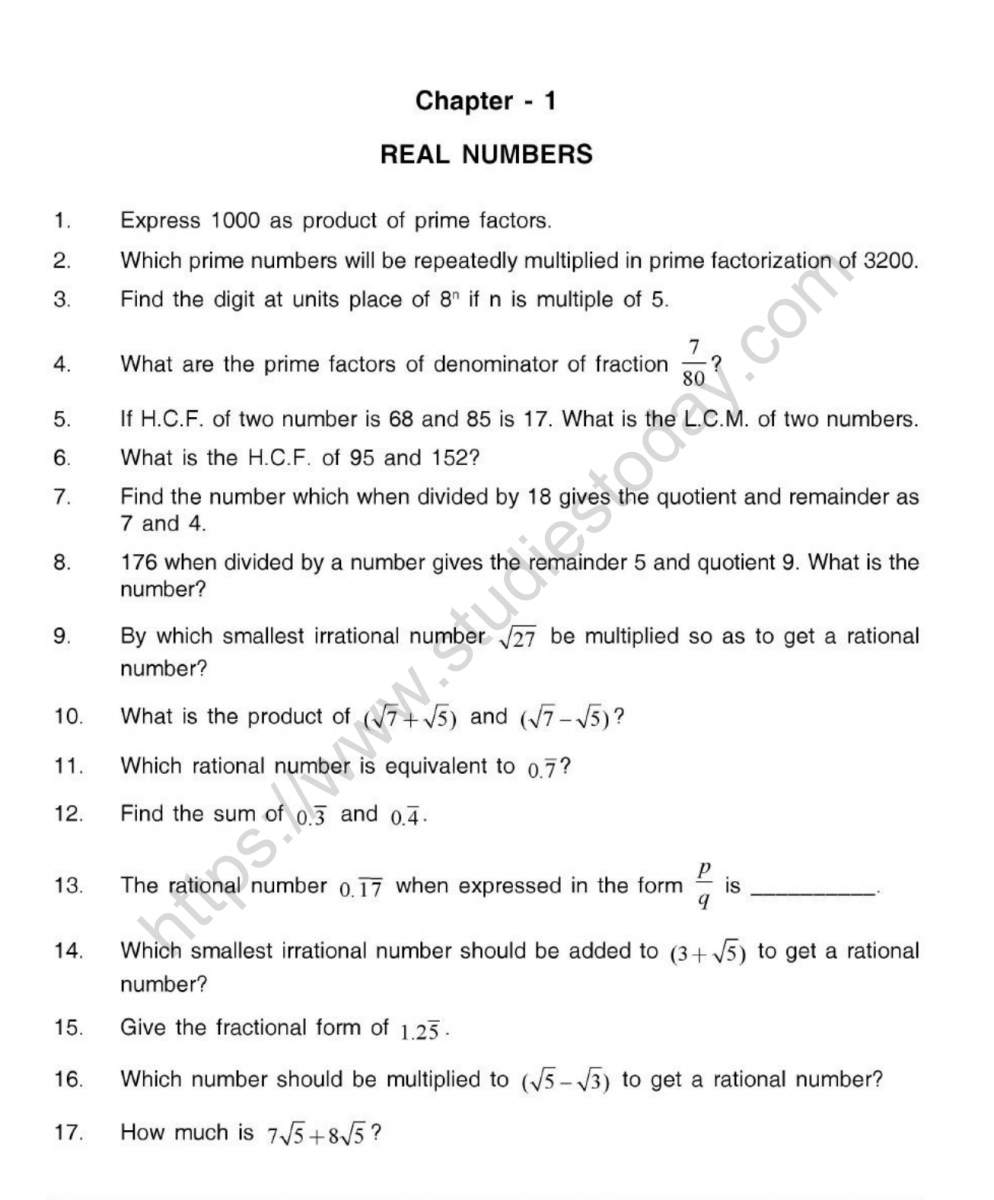
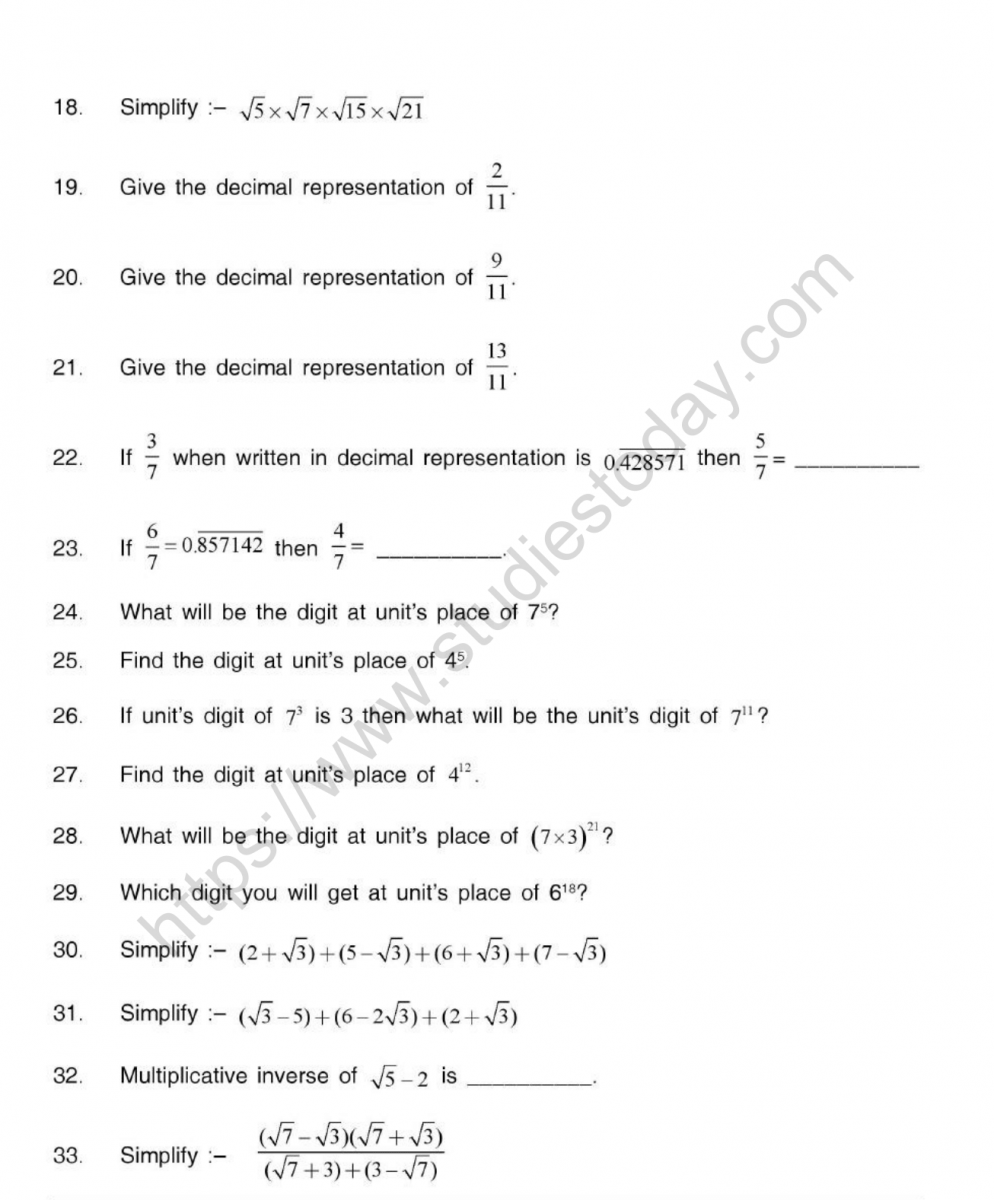
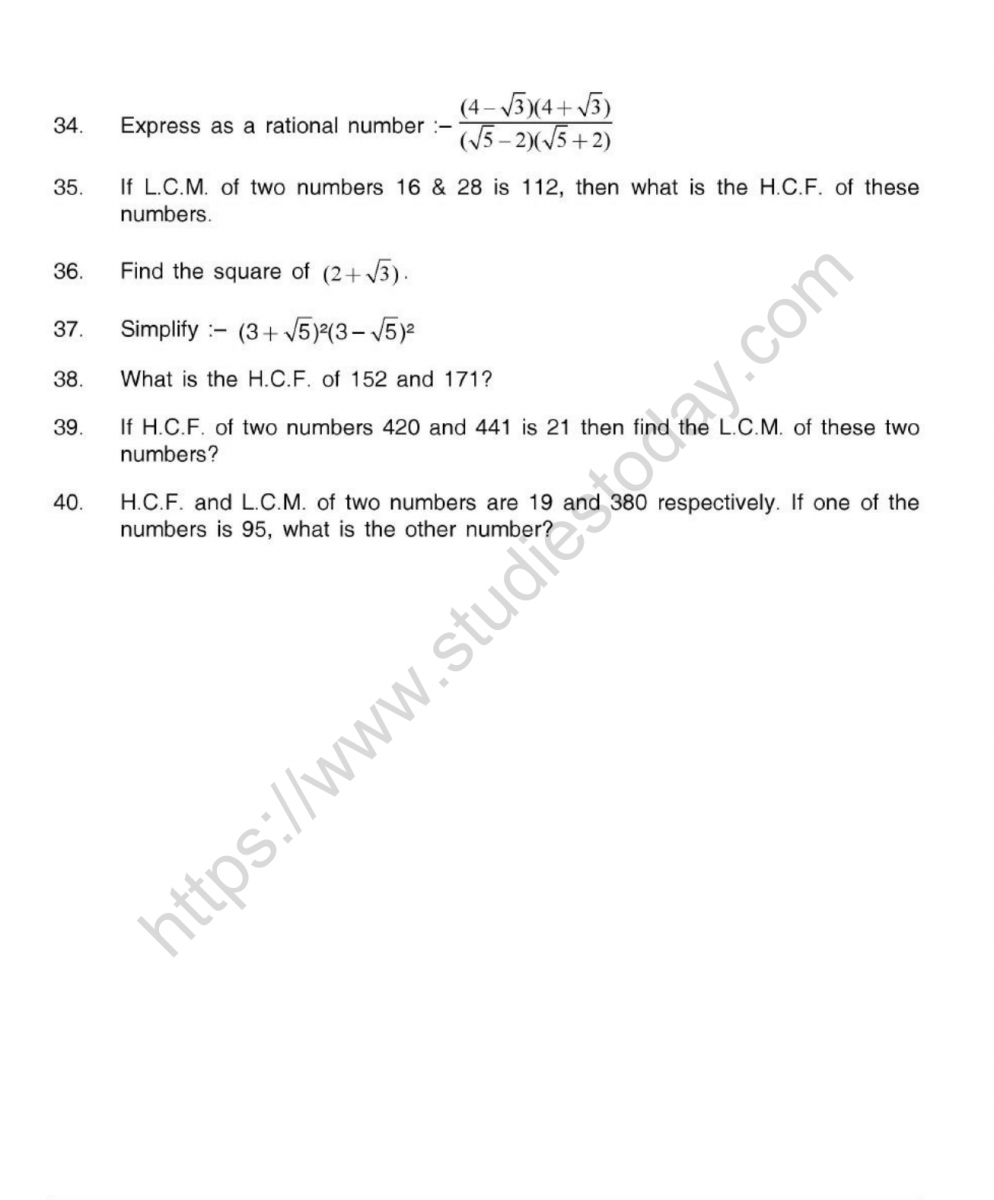

Free study material for Mathematics
Chapter 1 Real Numbers CBSE Class 10 Mathematics Worksheet
Students can use the Chapter 1 Real Numbers practice sheet provided above to prepare for their upcoming school tests. This solved questions and answers follow the latest CBSE syllabus for Class 10 Mathematics. You can easily download the PDF format and solve these questions every day to improve your marks. Our expert teachers have made these from the most important topics that are always asked in your exams to help you get more marks in exams.
NCERT Based Questions and Solutions for Chapter 1 Real Numbers
Our expert team has used the official NCERT book for Class 10 Mathematics to create this practice material for students. After solving the questions our teachers have also suggested to study the NCERT solutions which will help you to understand the best way to solve problems in Mathematics. You can get all this study material for free on studiestoday.com.
Extra Practice for Mathematics
To get the best results in Class 10, students should try the Mathematics MCQ Test for this chapter. We have also provided printable assignments for Class 10 Mathematics on our website. Regular practice will help you feel more confident and get higher marks in CBSE examinations.
FAQs
You can download the teacher-verified PDF for CBSE Class 10 Mathematics Real Numbers Worksheet Set 06 from StudiesToday.com. These practice sheets for Class 10 Mathematics are designed as per the latest CBSE academic session.
Yes, our CBSE Class 10 Mathematics Real Numbers Worksheet Set 06 includes a variety of questions like Case-based studies, Assertion-Reasoning, and MCQs as per the 50% competency-based weightage in the latest curriculum for Class 10.
Yes, we have provided detailed solutions for CBSE Class 10 Mathematics Real Numbers Worksheet Set 06 to help Class 10 and follow the official CBSE marking scheme.
Daily practice with these Mathematics worksheets helps in identifying understanding gaps. It also improves question solving speed and ensures that Class 10 students get more marks in CBSE exams.
All our Class 10 Mathematics practice test papers and worksheets are available for free download in mobile-friendly PDF format. You can access CBSE Class 10 Mathematics Real Numbers Worksheet Set 06 without any registration.